The May Fourth Movement and Modern China
If you stand on the campus of Peking University in early May, when the willow trees around Weiming Lake are heavy and green and students gather in noisy discussion groups that seem to never end, you may notice a modest stone marker that does not commemorate an emperor or a victorious general. It marks a student protest. That fact alone tells you something essential about modern China. In the official and popular imagination of China, May 4th 1919 is a date that carries the same symbolic weight that 1776 carries in America or 1789 carries in France. It was a day when a relatively small number of students decided that their country could no longer continue on its existing path, and in doing so they set in motion a chain of cultural, political and social transformations that continues to shape China more than a century later.[1]
The lake in that opening was not yet this university’s. In 1919 Peking University stood at Shatan, in the city. The willows and the tower came to it in 1952. Where the institution began is told in The Only Reform Left Standing.
1. China on the eve of 1919
To understand why a student demonstration could have such lasting power, you need to understand the China that existed on the eve of that demonstration. By 1919 China had been a republic for only seven years. The Qing dynasty, which had ruled for nearly three centuries, collapsed in 1912 amid revolution, foreign pressure and internal decay. What replaced it was not a strong central government but a fragmented republic. The early president Yuan Shikai tried to make himself emperor and failed, and after his death in 1916 power devolved to regional military leaders usually called warlords. In Beijing there was a government that issued stamps and received foreign diplomats, but its control over the provinces was often nominal. At the same time, Chinese society was experiencing an extraordinary intellectual ferment. A generation of writers, teachers and students who had witnessed the defeat of China by Japan in 1895, the humiliation of the Boxer settlement in 1901 and the slow erosion of sovereignty to foreign concessions had come to a painful conclusion. The problem was not simply that China lacked modern weapons or factories. The problem, they argued, was deeper, located in the culture itself and in the way that traditional ideas organized family, politics, education and gender.
This critique became institutionalized around 1915 in what became known as the New Culture Movement. Its center was Peking University and its chief platform was the magazine New Youth, founded and edited by Chen Duxiu, a brilliant and combative former Qing degree holder who had turned against the old order. Around Chen gathered a remarkable constellation of thinkers who would define twentieth century Chinese thought. Hu Shih had just returned from Columbia University where he had studied with the American philosopher John Dewey. Li Dazhao was a librarian and political theorist who would later become one of the founders of Chinese communism. Cai Yuanpei was the chancellor of Peking University, a reformer who believed that a university should be a sanctuary for all ideas. And Lu Xun, then a quiet medical student turned writer, would become China’s most famous modern author. Together they asked a question that was considered almost sacrilegious at the time. What if the very core of traditional Chinese ethics, the Confucian emphasis on hierarchy, filial obedience and ritual propriety, was not a source of strength but a source of weakness in the modern world. They called for the invitation of two new figures into Chinese life, Mr Democracy and Mr Science, using the English terms transliterated as De and Sai. By democracy they did not simply mean elections. They meant a whole worldview centered on individual dignity, legal equality, freedom of thought and the right to question authority. By science they did not simply mean chemistry and physics. They meant a method, the willingness to test ideas against evidence, to accept doubt and to reject superstition. For four years this debate raged in journals and classrooms, passionate but largely confined to educated elites. What dragged it into the streets was international politics.[2][3]
When the First World War began in 1914, Japan used the opportunity to seize the German concession in Shandong province. Germany had taken that territory, including the port of Qingdao and extensive railway and mining rights, in 1898 after two German missionaries were killed. For many Chinese this was one more in a long series of territorial losses. In 1917, after long debate, the Beijing government entered the war on the Allied side, primarily because Britain and France hinted that as a victorious ally China would recover Shandong. China sent some one hundred and forty thousand laborers to work behind the front lines in France and Belgium, men who dug trenches and whose graves still lie in European cemeteries. In addition, Chinese intellectuals placed enormous hope in the rhetoric of American president Woodrow Wilson, whose Fourteen Points promised a new diplomacy based on open agreements and self determination for peoples. Wilson’s words were translated, discussed and celebrated on Chinese campuses as proof that the old age of imperialism was ending and that right would finally triumph over might.[4]
2. The Paris Peace Conference and Shandong
That hope collapsed in Paris in the spring of 1919. At the Paris Peace Conference, the Chinese delegation led by the brilliant diplomat Wellington Koo presented a powerful legal and moral case for the return of Shandong. They argued that the German rights had been obtained by force and that China, as a loyal ally, should recover them. What they did not know was that in 1917 Britain, France and Italy had signed secret agreements promising to support Japan’s claim to Shandong in exchange for Japanese naval support. When the matter was decided by the Council of Three, the claims of China were set aside and the German rights in Shandong were transferred to Japan. News of this decision reached Beijing on the night of April thirtieth, and it produced a reaction of shock, disbelief and then fury that is hard to overstate. The Treaty of Versailles, which was supposed to enshrine a just peace, was seen in China as simply ratifying another theft. For students who had believed Wilson, it felt like a personal betrayal and proof that China would never be treated as an equal unless it became strong enough to force equality.
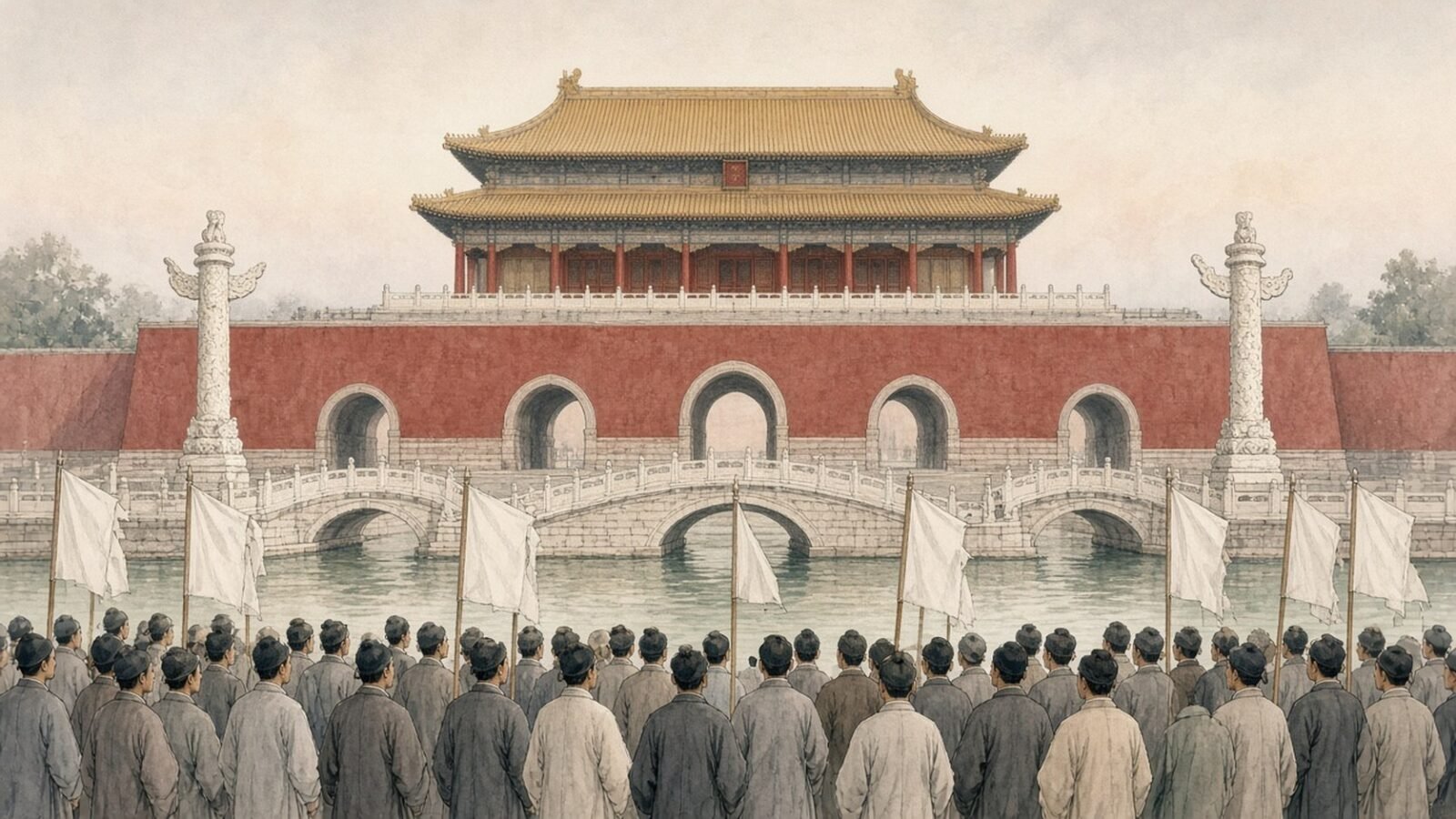
What happened on May fourth itself is well documented because the participants wrote about it extensively afterwards. On the afternoon of May fourth 1919, about three thousand students from thirteen universities and colleges in Beijing assembled at Tiananmen, then still a gate to the imperial palace, not the vast square it is today. They wore traditional long gowns, carried hastily painted banners that read Return Qingdao to Us and Punish the National Traitors, and planned to march to the foreign legation quarter to present a petition. They were blocked by police, and their frustration turned toward the private residence of Cao Rulin, the vice minister of foreign affairs who was widely seen as pro Japanese because he had negotiated a series of loans from Japan that granted it expanded influence in Shandong. The students entered the house, found Zhang Zongxiang, the Chinese minister to Japan, who was meeting there, beat him severely, and set fire to the building. Thirty two students were arrested that afternoon. That evening the government expected the matter to end. Instead it exploded.
3. The spread of the protests
The following morning Peking University and other schools declared a student strike. Within days similar demonstrations broke out in Tianjin, Shanghai, Wuhan, Nanjing, Changsha, Guangzhou and many other cities. New permanent organizations appeared almost overnight, including the Beijing Student Union and the Shanghai Student Union. Merchants, who were crucial to urban life and who had their own grievances against Japanese economic dominance, closed their shops in sympathy. In early June workers in Shanghai shipyards and textile mills went on strike, marking the first time in modern Chinese history that the industrial working class entered national politics as an organized force. The movement had transformed from a student protest into a nationwide alliance of students, merchants and workers, a social coalition that would become a model for later political mobilization. Two specific demands unified this coalition. First, that the Chinese delegation in Paris refuse to sign the Treaty of Versailles. Second, that the three officials associated with the pro Japanese policy, Cao Rulin, Zhang Zongxiang and Lu Zongyu, be dismissed from office.
It is important to understand that May Fourth was never only about Shandong or about the Versailles Treaty. Those were the sparks, but the fuel had been accumulating for years. The New Culture Movement provided the language and the target. One of the most powerful features of May Fourth was its attack on the Confucian family system. Chen Duxiu famously wrote that Confucian morality was a system that devoured people. Lu Xun in his short story Diary of a Madman, published in 1918 in vernacular Chinese, described a man who looks through a Confucian history book and sees between the lines only two characters repeated over and over, eat people. This was not simply literary exaggeration. For the May Fourth generation, Confucianism as a state orthodoxy had been used to justify arranged marriage, the subordination of women, the absolute authority of elders and officials, and the suppression of individual thought. They wanted to rescue what they saw as the valuable ethical insights of the past from the political system that had turned those insights into instruments of control.
The second cultural earthquake was linguistic, and its effects are still with us. For more than two thousand years, all serious writing in China had been done in classical Chinese, a concise, allusive and highly learned written language that was completely different from the spoken language of daily life. Mastery of classical Chinese required years of memorization and was therefore a barrier to literacy. In 1917 Hu Shih published an essay arguing that the living vernacular language, baihua, should become the standard language for literature and education. Lu Xun proved that great literature could be written in baihua. After May Fourth, the momentum for this change became unstoppable. Schools, newspapers, government documents and novels switched to vernacular Chinese. This was arguably the most successful literacy revolution of the twentieth century. It made it possible for millions of ordinary people to read and write and to participate in national political life. If you read a modern Chinese newspaper or novel today, you are reading in the language that May Fourth made normal.
4. The flood of new ideas
The third cultural shift was the sudden flood of new ideas, often called the isms. Between 1919 and 1921 Chinese intellectual life was inundated with translations and debates about anarchism, liberalism, pragmatism, nationalism, social Darwinism, feminism and socialism. John Dewey arrived in China in May 1919 and stayed for more than two years, lecturing to packed halls about education and democracy. Bertrand Russell arrived in 1920 and lectured about logic and social reconstruction. Li Dazhao published an influential essay in 1918 called The Victory of Bolshevism, introducing many Chinese students to Marxism not yet as a rigid state doctrine but as a new way of analyzing imperialism and economic power. The atmosphere was one of almost unlimited intellectual possibility and also of intense urgency, as if China had to choose its future right now.
In immediate political terms, the May Fourth Movement achieved something rare for popular protests in China at that time. It won. Cai Yuanpei resigned as chancellor of Peking University to protest the arrest of students, lending enormous moral prestige to the cause. Under combined pressure from students, merchants and public opinion, the Beijing government released the arrested students. More importantly, it dismissed Cao Rulin, Zhang Zongxiang and Lu Zongyu from office. The greatest symbolic victory came in Paris. Faced with domestic unrest and intense pressure from its own students and from public opinion at home, the Chinese delegation refused to sign the Treaty of Versailles. On June twenty eighth 1919, when the treaty was signed in the Hall of Mirrors at Versailles, the two seats for China remained empty. China was the only allied power that did not sign. For a country that had endured a century of unequal treaties, this refusal to sign an unjust treaty was seen as a restoration of dignity.
The longer term effects of May Fourth were organizational and laid the groundwork for the structure of Chinese politics for the rest of the century. Before 1919 political activity in China had been largely the affair of educated elites, secret societies or military cliques. After May Fourth, politics became mass politics. The techniques that would dominate later decades, the street demonstration, the public manifesto, the organization of a boycott of Japanese goods, the student union, the labor union, the mass meeting and the political study society, all entered Chinese life in May and June 1919. The Shanghai general strike in particular demonstrated that urban workers could be organized and that their economic power could be used for political ends.
Two political parties in particular trace their modern form directly to May Fourth. The first was the Kuomintang, the Nationalist Party founded by Sun Yat sen. In 1919 Sun was in the south of China at a low point, with little national support. He watched May Fourth with great excitement and quickly adopted its language of anti imperialism and nationalism. He reorganized the Kuomintang in the early nineteen twenties along more disciplined lines, with Soviet advice, precisely to capture the energy of this new mass nationalism.
5. The founding of the Chinese Communist Party
The second was the Chinese Communist Party. The Party was founded in Shanghai in July 1921 by thirteen delegates, almost all of whom had been active in New Culture and May Fourth study societies. Chen Duxiu and Li Dazhao were its two main intellectual founders. Mao Zedong, then a twenty seven year old former student and assistant librarian at Peking University, had been in Beijing during May Fourth distributing leaflets. Mao himself later said that May Fourth was the point from which the Chinese revolution really began and that many of its leaders were the predecessors of the Communist Party. Without the network of study societies, journals and personal friendships created by May Fourth, the early Communist Party would have had no base from which to grow.
The social and cultural legacy was equally profound and in some ways more lasting than the political one. In education, Cai Yuanpei’s ideal of the university as a place of free inquiry and inclusion of diverse viewpoints became the model for Chinese higher education. The tradition of student autonomy and student activism at Peking University, which persists to this day, dates from this moment. Thousands of students went abroad in the nineteen twenties to study in Japan, Europe and America, bringing back modern medicine, engineering, sociology and economics. In literature, the May Fourth period produced a complete break with the past. The new vernacular literature dealt with themes that would have been unthinkable in classical writing, including romantic love, the conflict between the individual and the family, and the suffering of ordinary people. Ba Jin’s novel The Family, which portrays the suffocating power of a traditional Confucian household, Lu Xun’s stories about the cruelty of village life, and Xu Zhimo’s romantic poetry are all direct products of May Fourth’s call for individual liberation.
Nowhere was the impact more dramatic than in the status of women. Before May Fourth, women were largely excluded from higher education and public life. Foot binding was still common. Arranged marriage was the norm. The May Fourth attack on the Confucian family system as patriarchal and oppressive opened intellectual and social space for a generation of women writers, teachers and activists. Writers like Bing Xin and Ding Ling began to write in their own voices about female experience. In 1920 Peking University admitted its first female students. New women’s magazines proliferated, advocating economic independence, free choice in marriage and access to education. The ideal of the new woman, educated, independent and socially engaged, became a powerful cultural image. While full legal equality would take decades, the ideological justification for gender hierarchy was shattered in May Fourth.
The legacy of May Fourth is contested precisely because it contained such different possibilities. In mainland China today, May Fourth is officially commemorated as a patriotic and anti imperialist youth movement, the moment when the Chinese people stood up against foreign aggression and when the working class entered history. In Taiwan during the martial law period, May Fourth was commemorated as a cultural renaissance, a liberal movement for democracy and science. Among liberal intellectuals both inside and outside China, May Fourth is often remembered as China’s unfinished enlightenment, a call for individual rights, academic freedom and democratic governance that has yet to be fully realized.
6. Competing readings of May Fourth
All three readings have historical support because May Fourth itself was a coalition. There was a liberal May Fourth that followed Hu Shih’s advice to talk less about isms and study more concrete problems, that believed in gradual reform, experimentalism and the slow building of democratic habits. Hu Shih himself remained a lifelong liberal who distrusted violent revolution and believed that China needed more John Dewey and less Vladimir Lenin. There was a radical May Fourth that concluded from the betrayal in Paris that Western liberalism would never allow China to be equal, that cultural change was impossible without political revolution and that imperialism and capitalism had to be smashed together. This is the May Fourth that leads logically to the founding of the Communist Party and to 1949. And there was a nationalist May Fourth whose overriding passion was to make China strong, sovereign and respected in the world, a passion that could align with either liberalism or revolution.
That unresolved tension is why May Fourth still matters. The central dilemma identified by its leaders, how to build a strong state capable of saving the nation without crushing the individual freedoms that make the nation worth saving, has never been fully resolved. The tension between Mr Democracy and Mr Science, between the desire for an independent critical spirit and the desire for national wealth and power, runs through every major debate in modern China, from education policy to the role of traditional culture to the limits of free speech.
When students gathered in Tiananmen Square in 1989, they deliberately invoked May Fourth, marching to the square on its seventieth anniversary and carrying portraits of Hu Shih and Cai Yuanpei. When the government today speaks of the great rejuvenation of the Chinese nation, it frames May Fourth as the starting point of that rejuvenation. When young Chinese feminists use social media to challenge sexual harassment, or when young writers experiment with new forms of vernacular expression, they are walking on a road that was paved in 1919.
The three thousand students who gathered on that hot afternoon in Beijing did not achieve all their goals. They did not restore Shandong immediately, that would take until 1922, and they did not create a democratic China overnight. What they did was more fundamental. They changed the definition of what it meant to be Chinese in the modern world. They insisted that patriotism was not loyalty to a government but responsibility for the fate of the people. They insisted that China could be both fully itself and fully modern, that it could learn from the world without losing its soul. More than a century later, China is still answering the questions they asked, and the world is still watching how it answers.
7. Timeline
A generation of writers, teachers and students who had witnessed the defeat of China by Japan in 1895, the humiliation of the Boxer settlement in 1901 and the slow erosion of sovereignty to foreign concessions had come to a painful conclusion.
Germany had taken that territory, including the port of Qingdao and extensive railway and mining rights, in 1898 after two German missionaries were killed.
The Qing dynasty, which had ruled for nearly three centuries, collapsed in 1912 amid revolution, foreign pressure and internal decay.
What they did not know was that in 1917 Britain, France and Italy had signed secret agreements promising to support Japan’s claim to Shandong in exchange for Japanese naval support.
Lu Xun in his short story Diary of a Madman, published in 1918 in vernacular Chinese, described a man who looks through a Confucian history book and sees between the lines only two characters repeated over and over, eat people.
On June twenty eighth 1919, when the treaty was signed in the Hall of Mirrors at Versailles, the two seats for China remained empty.
In 1920 Peking University admitted its first female students.
They did not restore Shandong immediately, that would take until 1922, and they did not create a democratic China overnight.
This is the May Fourth that leads logically to the founding of the Communist Party and to 1949.
When students gathered in Tiananmen Square in 1989, they deliberately invoked May Fourth, marching to the square on its seventieth anniversary and carrying portraits of Hu Shih and Cai Yuanpei.