The Road to Tiananmen
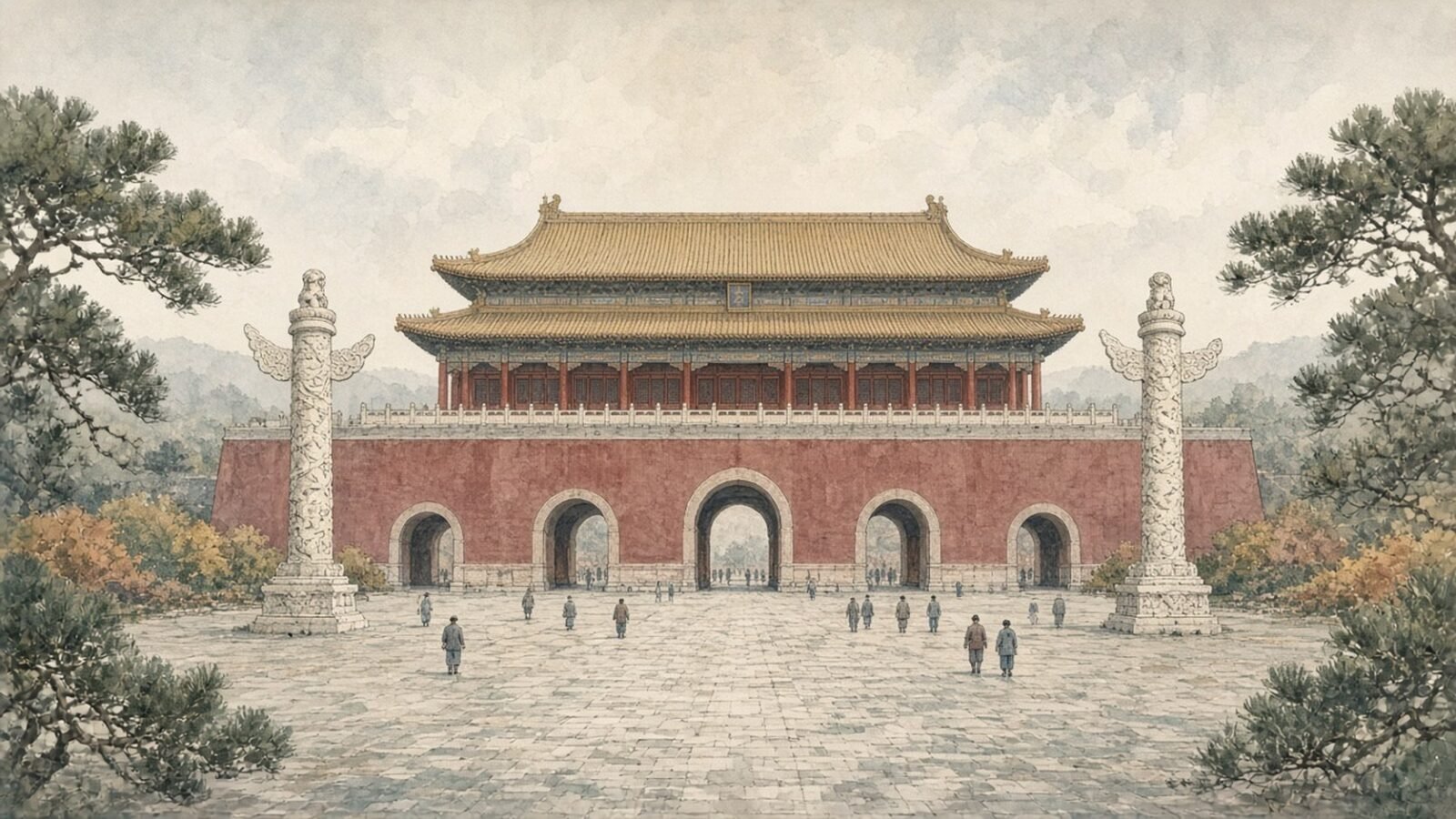
At three in the afternoon on 1 October 1949, on the rostrum of the Tiananmen gate tower in Beijing, above the walls where emperors had proclaimed their edicts for five hundred years, a tall Hunanese in a plain grey tunic leaned to the microphone and announced that the Central People’s Government of the People’s Republic of China was hereby established. Below him the square held a crowd estimated at three hundred thousand: soldiers of the People’s Liberation Army in their cloth shoes, students, workers, shopkeepers, all under a sea of red flags and hand-lettered banners. Mao Zedong’s announcement itself was a bureaucratic sentence. It was the speech he had given ten days earlier, opening the political conference that prepared the new state, that supplied the phrase the country remembers: the Chinese people, he said, have now stood up. The cannons fired twenty-eight salutes, one for each year of the Communist Party’s existence. The ceremony lasted an afternoon; the war that produced it had lasted, depending on how you count, three years or twenty-two; and the story of how that war was lost and won, between 1946 and 1949, is one of the great reversals in military and political history.
This is the ninth and final essay in a series that began with the Macartney embassy of 1793 and has followed China through the kowtow crisis, the opium trade, the treaty ports, the Taiping, the fall of the dynasty, the warlord wilderness and the eight-year war against Japan. Here the century of collision closes, and the China that the whole story had been approaching finally appears.
The race for the ruins
In August 1945 victory found the two Chinese parties in sharply unequal positions. The Nationalists had four million troops, the cities, the treasury, international recognition and the American alliance; the Communists had perhaps a million, the villages of the north, and momentum that did not show on any map. The prize both raced for was Manchuria, Japan’s industrial colony, which the Soviet army had overrun in a week and would hold until the spring of 1946, stripping its factories and, when it withdrew, leaving the Communists to move in while the Americans airlifted Nationalist divisions into the great cities of the coast. Through the first half of 1946 General George Marshall shuttled between the parties trying to build a coalition neither side wanted, and the truces he arranged were used by both to position for the war both expected. Full civil war began in the summer of 1946, and its first year went to the Nationalists: they took city after city, and in March 1947 captured Yan’an itself, the Communist capital, which Mao abandoned without a battle, remarking that the enemy had taken a burden, not a victory. It was the last unmistakably good news Chiang Kai-shek’s government would have.
The Nationalist collapse is usually told as a military story, but its foundations were economic and moral. The government had won the world war and lost its own currency: war finance by printing press had set off an inflation that by 1948 was consuming the fabi banknote entirely, prices doubling in days, savings and salaries annihilated, the urban middle class, the regime’s natural constituency, pauperized while speculators and connected families profited. In August 1948 the government tried a currency reform, the gold yuan, enforced in Shanghai by Chiang’s son Chiang Ching-kuo, whose tiger-hunting campaign against hoarders briefly terrorized the speculators before being forced to spare the biggest, who had the right surnames. The reform collapsed within months, taking with it the last economic credibility of the state. The army was rotten in proportion: conscription by press-gang, peasants roped together on the march, soldiers unpaid and unfed while their generals traded on their rations. Against this the Communists deployed the two instruments the Nationalists had never managed to build: a disciplined party that reached into every village, and land reform, the redistribution of the landlords’ acres to the families who worked them, which gave the peasantry of north China a reason to fight that no conscription could imitate. By the autumn of 1948 the numerical balance had reversed. Then came the three campaigns that decided everything.
Three campaigns
The first, Liaoshen, fought in Manchuria from September to November 1948, destroyed the Nationalists’ best armies in the northeast. Lin Biao’s forces took the rail junction at Jinzhou and sealed the region, and the Nationalist garrisons, cut off and undersupplied, disintegrated; at Changchun, besieged for five months, the civilian population starved between the lines in one of the worst atrocities of the war, with the dead estimated in the tens or hundreds of thousands. When Manchuria fell, the Nationalists had lost nearly half a million men and the strategic reserve, and the military initiative passed permanently to the Communists. The second campaign, Huaihai, fought across the Huai River plain between November 1948 and January 1949, was the decisive battle of the century in Asia: well over a million soldiers engaged across a front of hundreds of miles, sixty-five days of encirclements and trench warfare in the freezing mud, and at the end of it the Nationalist armies north of the Yangzi had ceased to exist. What made Huaihai different from every battle before it was the logistics: the Communist supply train was five and a half million peasant porters, pushing handcarts and carrying shoulder poles through the winter to feed the front. Chen Yi, one of the Communist commanders, said afterward that the victory at Huaihai had been pushed out by the common people’s handcarts. It was the literal truth, and it was the political story of the whole war in one image: the side that had organized the countryside could feed a million-man battle; the side that had not could not. The third campaign, Pingjin, closing over the new year, surrounded the north, and on 31 January 1949 General Fu Zuoyi surrendered Beijing without a fight, preserving the ancient capital intact, its palaces, temples and walls handed over to the revolution unharmed, one of the great mercies of the century.
The last gunboat
In April 1949 the last pretence of negotiation collapsed, and on the night of 20-21 April the People’s Liberation Army crossed the Yangzi on a front of three hundred miles, in junks, on rafts, by swimming, against a river line the Nationalists could no longer man. That same week, almost as an epilogue composed for this series, the river produced its final scene of the old era: HMS Amethyst, a British frigate steaming up the Yangzi to relieve the guard ship at Nanjing, was fired on by Communist batteries, holed, and trapped aground in the river for a hundred and one days before slipping away by night. For a hundred years, since the Nemesis had steamed up these same waters in 1840, the right of foreign gunboats to move on China’s rivers had been the working definition of the treaty system. Now a Chinese army fired on a British warship, and the world adjusted. Nanjing, the Nationalist capital, fell on 23 April, its presidential palace occupied and photographed. Hangzhou and Wuhan followed; Shanghai, the great prize, was taken on 27 May in a battle kept deliberately away from the city’s heart; and through the autumn the advance rolled south and west, Guangzhou, Chongqing, Chengdu, province after province folding. On 10 December 1949 Chiang Kai-shek flew from Chengdu to Taipei. He never set foot on the mainland again. With him went the remnants of his government, two million soldiers and refugees, the gold reserves of the central bank, and, crated in the holds of ships, the greatest treasures of the imperial Palace Museum, which remain in Taipei to this day, the portable patrimony of the China that had lost the mainland.
Standing up
What the victors built in 1949 was, before anything else, a state. The first years of the People’s Republic delivered, to a degree no Chinese government had managed since the 1920s, the elementary public goods the century had destroyed: the currency was stabilized within a year, ending the inflation that had eaten the middle class; the railways were reopened; the armies of soldiers, bandits and beggars were demobilized or absorbed; opium, the poison that had opened the country a century before, was eradicated as a mass trade within a few years; land reform reached the villages of the whole country, at a cost in landlords’ lives that numbered in the millions and that the new state counted as justice. China leaned to one side, in Mao’s phrase: in December 1949 he travelled to Moscow, his first journey abroad, and returned with the Sino-Soviet Treaty of February 1950 and a fraternal ally who would soon prove conditional. The United States, meanwhile, convulsed itself over the so-called loss of China, as if China had been America’s to lose, a framing that said more about the century’s habits than about the revolution. And within a year of the proclamation the new state did the thing no Chinese government had done since 1839: in October 1950, as American-led forces drove toward the Yalu River, China entered the Korean War and fought the strongest military power on earth, with its jets and its artillery and its atomic monopoly, to a three-year standstill. It was a ferociously costly war, and its meaning was registered around the world and never forgotten in Beijing: the empire that the Nemesis had chastised with a paddle-steamer now traded blows with the United States and did not yield. Napoleon’s ledger, at last, closed in full.
The long view
Standing at the rostrum in 1949, looking back along the road this series has travelled, the whole shape of the century becomes visible, and it is not the shape either side expected. The Qing had assumed the world would come to them on their terms; the West had assumed China could be opened like a market and tutored like a child; the reformers had assumed institutions could be decreed; the self-strengtheners that hardware was enough; the Nationalists that the cities were the country. Each assumption failed in turn, and each failure was paid for by the same people, in the villages, in the millions. What succeeded in the end was the one thing none of the earlier attempts had managed: the organization of the countryside itself, the mobilization of the four-fifths of China that every previous state, imperial, republican, treaty-port, had simply taxed and ignored. The revolution of 1949 was many things, and its future, the campaigns, the famine of the Great Leap, the Cultural Revolution, would test the proposition that liberation had arrived, at costs the century had not finished paying. But on the first day of October the crowd in the square was celebrating something real and enormous: the end of the hundred years that had begun with the Nemesis in the Pearl River. China was unified, independent, uninvadable by the methods that had worked since 1840, and governed, for better and for worse, from Beijing. Macartney had come asking for an island and been refused; Amherst had been turned away at dawn; the treaties had taken the islands and the ports by force; and now the country that had signed those treaties under guns had, by its own prolonged and terrible effort, resumed the management of its own affairs. The lion, as the apocrypha Napoleon never quite said, was awake. What it would do awake, the next century would have to learn.