How the Forbidden City Encoded the Cosmos
1. The emperor and his City
In the spring of 1406, the Yongle emperor of Ming China issued an order that would consume the labour of perhaps a hundred thousand workers for fifteen years. Zhu Di 朱棣, the fourth son of the dynasty’s founder and the most powerful of the early Ming princes, commanded that a new imperial palace be built in his patrimonial base at Beijing 北京 — a vast walled complex of halls, gates, gardens and pavilions that would serve as the residence of the Son of Heaven and the ceremonial heart of the Chinese empire. By the time the first emperor moved into the completed palace in 1420, the project had consumed an estimated thirty million taels of silver, employed master craftsmen drawn from across the empire, and moved more stone than any construction project in the world would attempt for centuries.
The Yongle emperor had a particular need for such a palace. He had not inherited the throne. In 1402 he had marched his army south, taken Nanjing 南京 by siege, and displaced his nephew — the Jianwen 建文 emperor, second of the Ming — in a coup that the official histories describe, with characteristic restraint, as the change of the jingtai 靖難 era. To cement his legitimacy Yongle needed a new capital and a new palace that would embody the cosmic order his dynasty claimed to restore.
He chose Beijing carefully. His power base was in the north, in the fief of Yan that he had governed since 1370; the steppe frontier, with its Mongol threat, lay just beyond the mountains; and the geographic symbolism — a capital closer to the source of dynastic legitimacy in the steppe and to the agricultural heartland to the south — was compelling. In 1421 the court moved north, and Beijing took its definitive shape: an outer city wall, an inner city wall, the Imperial City 皇城 containing the palace complex and the administrative offices, and at the centre, the Forbidden City itself — the zǐjìnchéng 紫禁城, the “Purple Forbidden City”, named for the Pole Star and the colour of heaven.[1]
The name is not incidental. The Forbidden City was designed from the first stroke of the master architect’s brush to be a small-scale model of the cosmos, a built cosmology in which the emperor, as mediator between heaven and earth, occupied the symbolic centre. The result is one of the most coherent architectural statements of political theology ever constructed — a city whose every dimension, colour and ornament encodes a theory of imperial rule.
2. II. The architecture of the Mandate
The Forbidden City occupies a rectangle of approximately seventy-two hectares in the centre of modern Beijing, oriented precisely north-south along the city’s central axis. The complex is surrounded by a wall ten metres high and more than eight metres thick at the base, built of rammed earth faced with brick and crowned with vermilion-painted tiles; a fifty-two-metre-wide moat fed by the waters of the Jinshai 金水河 surrounds the wall on all four sides. Four gates pierce the wall, each named for a direction of cosmic significance: the Meridian Gate (Wǔmén 午門) on the south, the Gate of Divine Prowess (Shénwǔ Mén 神武門) on the north, the East Glorious Gate (Dōnghuá Mén 東華門) on the east, and the West Glorious Gate (Xīhuá Mén 西華門) on the west.
The wall’s height is itself significant. Ten metres is jiǔ-wǔ 九五 in Chinese chǐ 尺 — the “nine-five” number that encodes the supreme yang of the dragon and the imperial person. Vermilion walls and yellow-gold roofs are reserved for the imperial precinct: the colour of fire and yang above, the colour of earth and centrality below. Even the proportions of the wall’s crenellations and the placement of the corner towers — elaborate pavilions on each of the four corners, originally designed as watchtowers and now among the most recognisable features of the complex — follow a numerological logic. The roof eaves of the corner pavilions are supported by nine sets of dǒugǒng 斗拱 brackets; the beams are proportioned according to imperial rules that no other building in the empire was permitted to use.
The main axis of the complex runs north-south for a length of 961 metres and a width of 753 metres, making the Forbidden City larger than the Vatican and only slightly smaller than the Kremlin — but more densely built than either. Within the walls, some 980 surviving buildings provide roughly 8,886 rooms; the often-cited “9,999 rooms” is a symbolic approximation, designed to express “all but the ten thousand of heaven”. The actual count is lower; the symbolic count, like the symbolic ten-thousand, was always the more important.
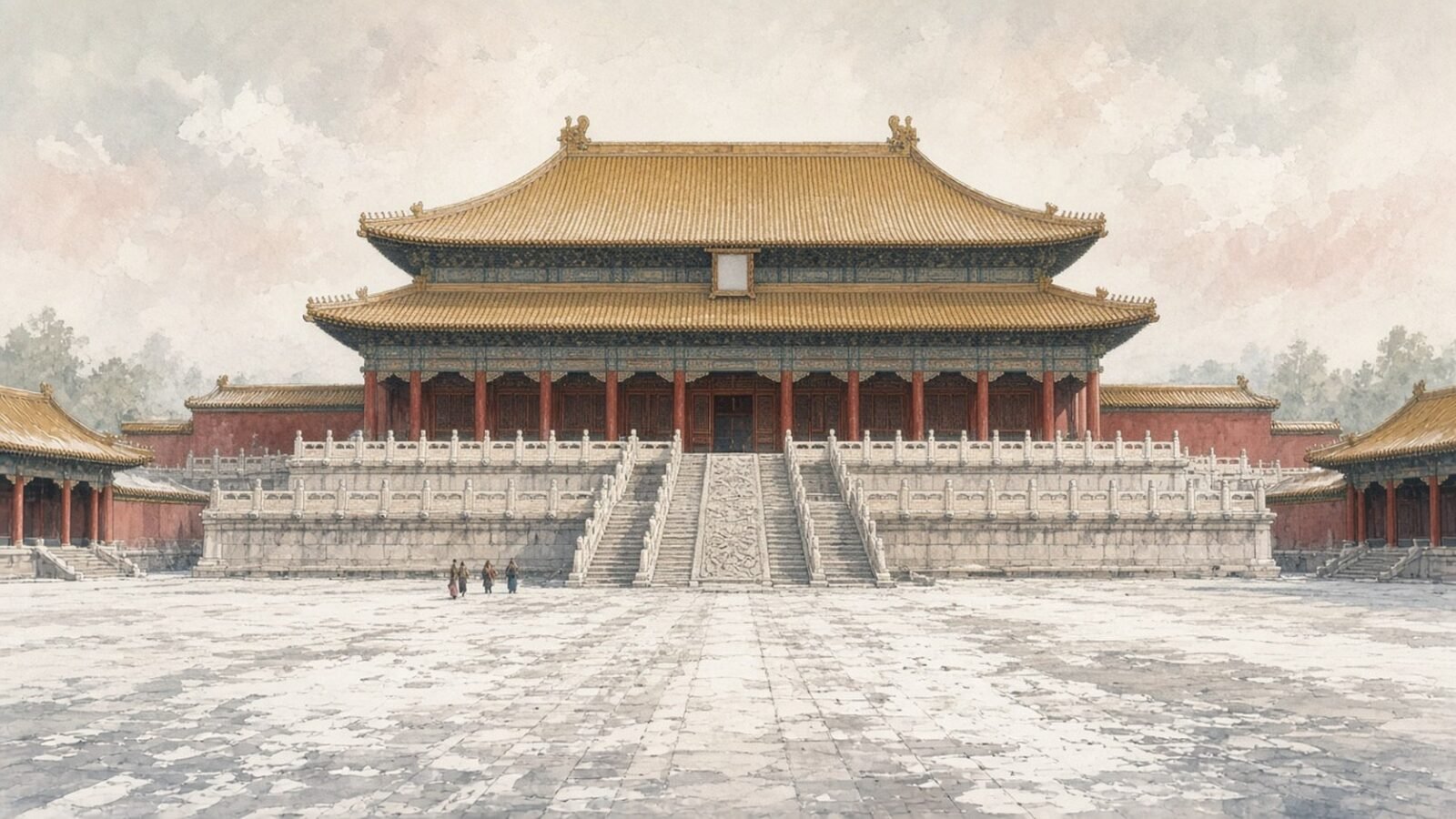
The buildings follow a strict hierarchical order. Along the central axis, in sequence from south to north, stand the three great halls of the Outer Court — the Hall of Supreme Harmony (Tàihé Diàn 太和殿), the Hall of Central Harmony (Zhōnghé Diàn 中和殿) and the Hall of Preserving Harmony (Bǎohé Diàn 保和殿). Behind them, separated by a transitional courtyard, lie the three palaces of the Inner Court — the Palace of Heavenly Purity (Qiánqīng Gōng 乾清宮), the Hall of Intersecting Harmony (Jiāotài Diàn 交泰殿) and the Palace of Earthly Tranquility (Kūnníng Gōng 坤寧宮). The progression from “supreme harmony” at the south to “earthly tranquility” at the north is itself a cosmological diagram: heaven at the apex of yang, earth at the base of yin, with the emperor moving between them through ritual.[2]
3. III. The Outer Court and the Inner Court
The Outer Court (wài cháo 外朝) was the imperial stage. It was here, in the Hall of Supreme Harmony, that the most important state ceremonies took place: the emperor’s enthronement, the announcement of the new reign-name at the start of an emperor’s reign, the imperial wedding, the issuing of imperial edicts at New Year, and the winter solstice. The hall itself — thirty-five metres tall, the highest building in the complex — sits on a three-tiered marble terrace, the famous dragon and phoenix staircases carved with dragons playing in clouds and waves, which the emperor ascended only on certain prescribed occasions.
The Hall of Supreme Harmony was rebuilt in its present form in 1695–97 under the Kangxi emperor of the Qing, after a fire destroyed its Ming predecessor. The throne inside, set beneath a canopy and flanked by incense burners, bronze tortoises, cranes and ceremonial vessels, was occupied perhaps two or three times a year; the rest of the year the hall stood empty, a stage awaiting its next performance. Behind it, the smaller Hall of Central Harmony served as the emperor’s preparation chamber, where he would pause to compose himself before the great ceremonies; further north, the Hall of Preserving Harmony hosted the final stage of the imperial examination (the palace examination, diànshì 殿試) and major banquets.[3]
The Inner Court (nèi tíng 內廷) was the emperor’s private world. Behind the Gate of Heavenly Purity a wall once separated the public from the private; the gate was inscribed with the words “be upright and sincere” in the Qianlong emperor’s hand, a reminder that the emperor’s moral self-cultivation was the foundation of imperial rule. The three palaces of the Inner Court served the imperial household: the Palace of Heavenly Purity as the emperor’s residence until the Yongzheng emperor moved it to the smaller Hall of Mental Cultivation (Yǎngxīn Diàn 養心殿) in the early eighteenth century, partly because the larger palace had been the scene of the violent deaths of several Ming emperors; the Hall of Intersecting Harmony as the ceremonial storage for the imperial seals; and the Palace of Earthly Tranquility, originally the empress’s residence, which under the Manchu Qing was partly converted into a shamanic ritual space reflecting the Qing rulers’ continuing attachment to their northern steppe traditions.
To either side of the three central palaces stood the Six Western Palaces and the Six Eastern Palaces, smaller courtyard residences that housed the emperor’s consorts and concubines, and — under the late Qing and especially in the nineteenth century — the offices of the imperial administration. The emperor’s sons, the imperial princes, lived further north still, in palaces outside the Forbidden City proper. At the very north of the complex lay the Imperial Garden (Yùhuā Yuán 御花園), a small but densely planted landscape of rock, ancient cypresses and pavilions, which offered the imperial household a contained version of the Jiangnan landscape far to the south.
4. IV. The cosmological code
What made the Forbidden City more than a palace was its systematic encoding of cosmological ideas into architectural form. The numbers of the buildings, the orientation of the halls, the colours of the tiles and the carved ornaments all participate in a continuous symbolic programme drawn from the Yìjīng 易經, the cosmology of yin and yang and the five phases (wǔxíng 五行), and the imperial ritual texts.
The central axis is the most fundamental element. Running for nearly eight kilometres through the heart of Beijing — from the Yongding Gate 永定門 in the south of the outer city, through the successive gates of the city wall, through Tiananmen and the Meridian Gate, through the Outer Court and Inner Court, and out through the Gate of Divine Prowess to the Drum and Bell Towers and the Jing Shan 景山 hill — this axis aligned the entire capital with the cosmological order. In Chinese imperial theory the emperor stood at the centre of the world because he stood at the centre of the capital, which stood at the centre of the world; the axis gave physical form to a metaphysical claim.
The numbers of the buildings continued the encoding. The Hall of Supreme Harmony is supported by seventy-two great pillars; the number is that of the seventy-two earthly spirits of the Shānhǎijīng 山海經 tradition, multiplied by the nine ranks of the celestial bureaucracy. The roof of the hall is supported by nine sets of dǒugǒng brackets in its principal bays. The throne is set beneath a canopy bearing five-clawed dragons — the imperial dragon, distinguished from the four-clawed dragons permitted to lesser princes — surrounding a pearl of wisdom. The colours follow the imperial rules: yellow for the imperial roofs (earth, centrality), red for the walls (fire, yang), white for the marble terraces (metal, west), and blue or green for the eaves painted with imperial dragons in flight.
The jiǔ-wǔ 九五 also encodes the five phases and the five directions. Nine, the supreme yang, is also the number associated with the dragon; five, the centre, is the number of the earth and of the emperor’s domain. The phrase jiǔ-wǔ zhī zūn 九五之尊, “the dignity of nine and five”, is the classical expression for the imperial person, and its application to the dimensions, brackets and ornaments of the Forbidden City is the architectural instantiation of a political theology. Even the dimensions of the central courtyard — roughly 200 by 300 metres — encode the relationship between yin and yang through their proportions.
The most arresting single ornament in the complex is the Nine-Dragon Wall (Jiǔlóng Bì 九龙壁) at the east side of the palace, a glazed-tile screen nearly twenty metres long, decorated with nine writhing dragons among clouds, mountains and waves. The wall is, in essence, a single Chinese character — long 龍, dragon — written in three dimensions. It is also a piece of imperial cosmology in material form: the dragons represent the yang energies of the cosmos, channelled and harmonised in the imperial precinct.
Even the layout of the surrounding city encoded the cosmic order. The Imperial City wall enclosed the palace and the principal offices of state; the inner city wall enclosed the residential quarters of the bannermen and officials; the outer city wall (added by the Jiajing emperor in the 1550s) enclosed the commercial and artisan districts. The concentric rings — like the rings of a mandala or the heavenly spheres of contemporary Chinese astronomy — made Beijing a small-scale cosmos in itself.
5. V. The fall and rebirth
By the early nineteenth century the imperial system that the Forbidden City encoded was visibly failing. The cost of the Qing empire’s frontier wars, the corruption of the bureaucracy, the unequal treaties imposed after the Opium Wars, and the rise of Western and Japanese military power all eroded the claim to cosmic centrality that the Forbidden City had been built to express. In 1860, during the Second Opium War, Anglo-French forces briefly occupied the Forbidden City and burned parts of the Old Summer Palace nearby; in 1900, during the Boxer Rebellion, the Eight-Nation Alliance again occupied the city and looted the palace.
The empire’s formal end came in the Hall of Supreme Harmony on 12 February 1912, when the last emperor, Puyi 溥儀, six years old, formally abdicated. The Republic of China, established under Sun Yat-sen and consolidated under Yuan Shikai, allowed the imperial household to remain in the Inner Court — a peculiar arrangement that left the young Puyi living as a private citizen inside the cosmic precinct until 1924, when the warlord Feng Yuxiang expelled him and his household entirely.
The palace’s transformation into a modern museum began in 1925, when the Palace Museum (Gùgōng Bówùyuàn 故宮博物院) was established by the Republican government. The new museum opened to the public for the first time in October of that year, allowing ordinary citizens — including former subjects — to enter the halls that had been closed to all but imperial persons for five centuries. The museum’s founding marked one of the great democratic gestures in modern Chinese history: the conversion of a sacred space of imperial rule into a public space of national heritage.[4]
The next decades were turbulent. The Japanese occupation of Beijing (1937–45) led to a partial removal of the most valuable artifacts, some of which were later moved to Taiwan with the Kuomintang government in 1949. After the establishment of the People’s Republic, the Palace Museum was reorganised under the new state. A long period of repair and restoration began in the 1950s and accelerated dramatically in the 2000s, culminating in a major programme of conservation work in the lead-up to the 600th anniversary of the palace’s completion in 2020.
6. VI. The Forbidden City in modern China
The Forbidden City in the twenty-first century is simultaneously a museum, a tourist attraction, a brand and a contested symbol. As the Palace Museum in Beijing it receives more visitors annually than almost any museum in the world — over seventeen million in 2019, before the pandemic disrupted global travel. The associated Palace Museum in Taipei (the Guólì Gùgōng Bówùyuàn 國立故宮博物院) holds perhaps a million more artifacts that the Republican government took to Taiwan in 1949; the two museums, separated by the Taiwan Strait, remain symbols of the divided national inheritance.
Since the 2000s the Palace Museum has also become a commercial brand. A range of Gugong Wenchuang 故宮文創 products — notebooks, calendars, silk scarves, lipsticks, smartphone cases — have made the museum one of China’s most successful cultural brands, with annual revenue measured in hundreds of millions of yuan. The brand’s success reflects both a genuine popular engagement with traditional aesthetics and a deliberate state strategy of promoting “traditional culture” as part of national identity.
The Forbidden City has also become a touchstone of contemporary political symbolism. The 2020 celebration of the palace’s 600th anniversary was explicitly framed by official discourse as a moment of national pride and civilisational continuity; the restoration of the Hall of Supreme Harmony and the reopening of additional sections of the complex were presented as acts of cultural stewardship. In the leadership’s formulation of the liǎng gè jiéhé 两个结合 — the combination of Marxism with Chinese specificities, and the second combination of Marxism with “China’s excellent traditional culture” — the Forbidden City has become a privileged site of official narrative.
The Forbidden City’s afterlife is therefore a study in the persistence and transformation of imperial symbolism. The complex built by the Yongle emperor to encode the cosmic centrality of the Son of Heaven has survived the dynasty that built it, the empire that inherited it, the Republic that overthrew it, and the People’s Republic that has claimed its inheritance. The halls that once announced the Mandate of Heaven now display the artifacts of the dynasties that claimed it; the throne on which the emperor sat in audience is now behind glass, viewed by millions of tourists each year. Yet the central axis remains, the wall stands, the Meridian Gate opens as it has for six centuries, and the dragon and phoenix staircases still bear the marks of imperial feet.
7. Conclusion, A City that Outlasted its heaven
The Forbidden City was built as a complete cosmological statement. Every dimension, colour and ornament expressed a claim: that the emperor stood at the centre of the world, that the world was harmoniously ordered, and that the dynasty that built this city had been charged by heaven to maintain that order. For nearly five hundred years — from the Yongle emperor’s enthronement in the Hall of Supreme Harmony in 1420 to the abdication of Puyi in the same hall in 1912 — the claim was made and believed.
What is striking is not that the claim was eventually abandoned but that the building that expressed it survived its abandonment so intact. The Forbidden City has outlived the Mandate of Heaven. It has outlived the Ming and Qing dynasties, the imperial system, the Republic, the warlord era, the Japanese occupation and the civil war. It has been looted, occupied, restored, repurposed, commercialised and contested — and yet its central axis still runs north-south for nearly eight kilometres through the centre of Beijing, its wall still rises ten metres above the surrounding plain, and its three great halls still face the south where the emperor once faced his subjects.
The Forbidden City is no longer a sacred precinct. It is now a museum, a heritage site, a brand and a contested symbol of national identity. Yet the act of walking through its gate, past its marble terraces and into the cool shade of its halls still produces something like the cosmological effect its builders intended — a sense of being at the centre of a very large and very old world. That, perhaps, is the deepest achievement of the Yongle emperor’s architects: not the cosmic claim itself, which no one now believes, but the city’s ability to make the claim feel true, six centuries later, to anyone willing to enter.
8. Timeline
In 1402 he had marched his army south, taken Nanjing 南京 by siege, and displaced his nephew — the Jianwen 建文 emperor, second of the Ming — in a coup that the official histories describe, with characteristic restraint, as the change of the jingtai 靖難 era .
In the spring of 1406, the Yongle emperor of Ming China issued an order that would consume the labour of perhaps a hundred thousand workers for fifteen years.
For nearly five hundred years — from the Yongle emperor’s enthronement in the Hall of Supreme Harmony in 1420 to the abdication of Puyi in the same hall in 1912 — the claim was made and believed.
The Hall of Supreme Harmony was rebuilt in its present form in 1695–97 under the Kangxi emperor of the Qing , after a fire destroyed its Ming predecessor.
In 1860, during the Second Opium War, Anglo-French forces briefly occupied the Forbidden City and burned parts of the Old Summer Palace nearby; in 1900, during the Boxer Rebellion, the Eight-Nation Alliance again occupied the city and looted the palace.
The Republic of China, established under Sun Yat-sen and consolidated under Yuan Shikai, allowed the imperial household to remain in the Inner Court — a peculiar arrangement that left the young Puyi living as a private citizen inside the cosmic precinct until 1924, when the warlord Feng Yuxiang expelled him and his household entirely.
The palace’s transformation into a modern museum began in 1925, when the Palace Museum ( Gùgōng Bówùyuàn 故宮博物院) was established by the Republican government.
The associated Palace Museum in Taipei (the Guólì Gùgōng Bówùyuàn 國立故宮博物院) holds perhaps a million more artifacts that the Republican government took to Taiwan in 1949; the two museums, separated by the Taiwan Strait, remain symbols of the divided national inheritance.
As the Palace Museum in Beijing it receives more visitors annually than almost any museum in the world — over seventeen million in 2019, before the pandemic disrupted global travel.