Yuan Shikai’s Eighty-Three Days of Empire and the National Protection War
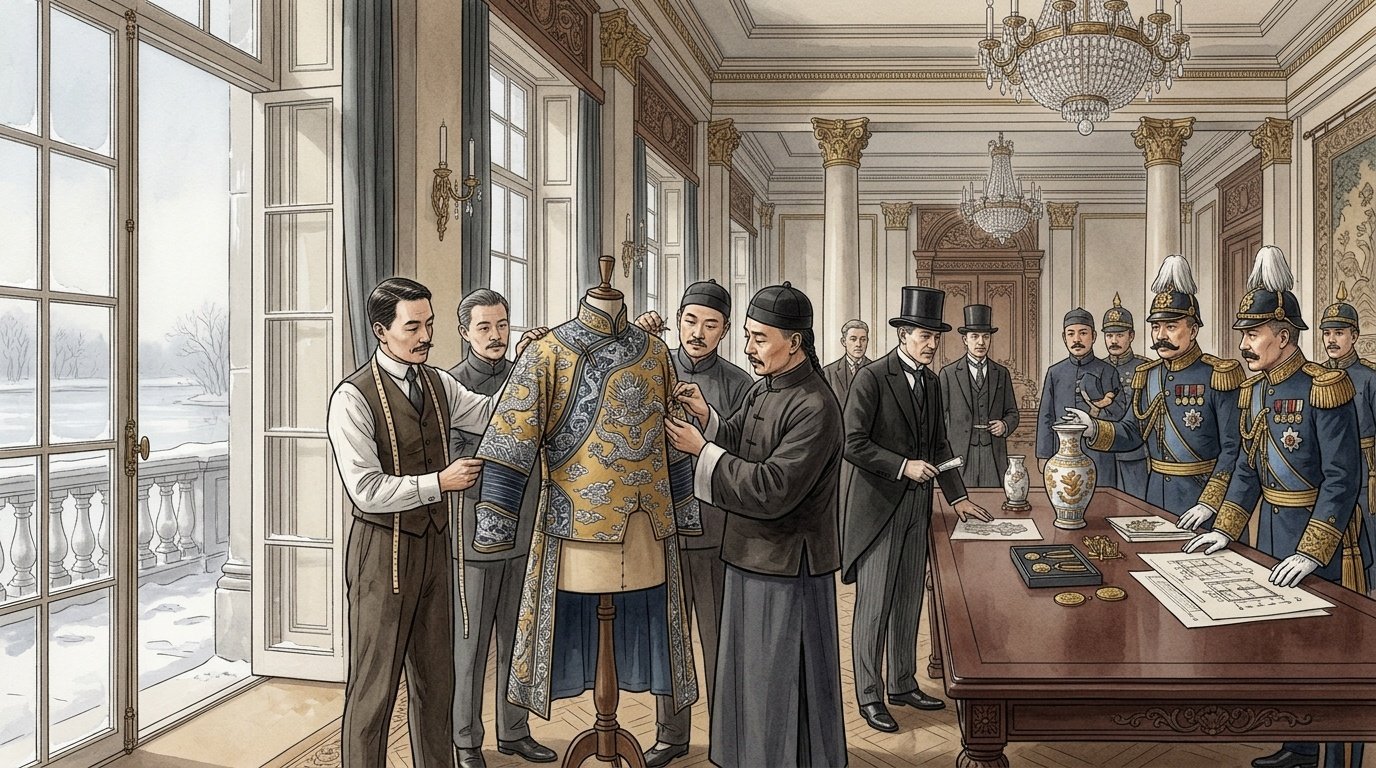
On the twelfth day of December in the fourth year of the Republic of China—1915 CE—inside the cavernous, silk-draped hall of the Renzhouluan (Hall of Benevolence and Longevity) within the Zhongnanhai presidential compound in Beijing, fifty-six-year-old Yuan Shikai (袁世凯, 1859–1916 CE) stepped forward to enact the most astonishing, tragic political regression in modern Asian history. Surrounded by kneeling monarchist petitions, foreign legal advisors, and high-ranking generals of the Beiyang Army dressed in ceremonial satin robes, the President of the Republic of China bowed his head three times and formally accepted the imperial crown of the Empire of China (中华帝国, Zhonghua Diguo).
In a brush-written imperial rescript promulgated across the telegraph wires of East Asia, Yuan proclaimed that the Republican calendar would cease at midnight on December 31. On New Year’s Day 1916, China would inaugurate a brand-new imperial dynasty under the auspicious reign title Hongxian (洪宪, meaning ‘Grand Constitutionalism’). In the imperial workshops of Beijing, tailor guilds laboured day and night to embroider twelve massive dragon robes sewn with pure gold thread and pearls; porcelain furnaces in Jingdezhen fired forty thousand pieces of imperial eggshell porcelain stamped with the seal Hongxian Nian Zhi (洪宪年制); while an extravagant European-style carved wooden throne, gilded in pure leaf gold, was hoisted into the Hall of Supreme Harmony in the Forbidden City.
Yuan Shikai genuinely believed that he was executing an act of patriotic salvation. A veteran statesman who had modernized the Qing military at Xiaozhan, negotiated the peaceful abdication of the Last Emperor Puyi in 1912, and held the fractured country together amidst the chaos of early republican politics, Yuan was convinced that China was culturally and socially unfit for American-style republican democracy. Confronted by the predatory encroachment of the Empire of Japan—which had forced Beijing to sign the humiliating Twenty-One Demands (二十一条) in May 1915—Yuan concluded that only a centralized, hereditary constitutional monarchy could unite four hundred million Chinese citizens, maintain social order, and defend national sovereignty against foreign imperialists.
Yet Yuan Shikai’s imperial dream was a fatal, hallucinatory miscalculation. The clock of history could not be turned back. Barely thirteen days after Yuan accepted the crown, on December 25, 1915, the southwestern border province of Yunnan declared open rebellion against Beijing, launching the National Protection War (护国战争, Huguozhanzheng). Led by the brilliant, incorruptible young general Cai E (蔡锷, 1882–1916 CE)—who had miraculously escaped house arrest in Beijing with the aid of the courtesan Xiao Fengxian—and backed by the intellectual thunderbolts of his mentor Liang Qichao (梁启超), the National Protection Army marched into the mountains of Sichuan to defend the Republic with their lives.
What followed was the sudden, total disintegration of Yuan’s political world. Province after province declared independence; foreign powers refused diplomatic recognition; and, most shattering of all, Yuan’s closest personal protégés—the senior Beiyang generals Duan Qirui (段祺瑞) and Feng Guozhang (冯国璋)—betrayed their master, refusing to march against the republicans. On March 22, 1916, after reigning as prospective emperor for barely eighty-three days, a broken, humiliated Yuan Shikai revoked the monarchy and cancelled the Hongxian era. Less than three months later, consumed by terminal uremia, shame, and despair, Yuan died at the age of fifty-six. His imperial folly destroyed the central authority of the state, plunging China into the dark, bloody chaos of the Warlord Era (1916–1928).
This monograph presents an exhaustive political, military, psychological, and institutional history of the Hongxian Monarchy and the National Protection War. We will explore Yuan Shikai’s rise from late Qing military modernizer to autocratic president; analyze the traumatic impact of the 1913 assassination of Song Jiaoren and the Second Revolution; examine the geopolitical humiliation of the 1915 Twenty-One Demands; investigate the monarchist propaganda machine orchestrated by Yang Du’s Peace Planning Society and Frank Goodnow’s memorandum; expose the grotesque domestic pantomime of Yuan Keding’s fake newspapers and beggar petitions; chronicle Cai E’s legendary escape and the military campaigns of the National Protection Army in Sichuan; trace the palace collapse and the revocation of the empire; and assess the profound historiographical legacy of Yuan’s failure in the development of modern Chinese constitutionalism and warlordism.
1. The Strongman of Xiaozhan: From Beiyang Modernizer to Dictatorial President
To comprehend how Yuan Shikai came to view himself as the indispensable emperor of China, one must trace his extraordinary thirty-year ascent through the late Qing state. Born in 1859 into a wealthy gentry-landlord clan in Xiangcheng, Henan, Yuan possessed zero talent for classical Confucian examination essays, failing the provincial licentiate examinations twice. Recognizing that his destiny lay in martial affairs, Yuan turned to the military, rising swiftly during the 1880s as the Qing imperial resident commissioner in Korea, where he demonstrated exceptional political courage, diplomatic ruthlessness, and administrative skill in countering Japanese encroachment.
In 1895, following the catastrophic defeat of the First Sino-Japanese War, the Qing court appointed Yuan Shikai to command the newly created Newly Created Army (新建陆军) at the Xiaozhan military training camp near Tianjin. Xiaozhan was the cradle of modern Chinese militarism. Discarding ancient spears, bows, and opium-smoking habits, Yuan constructed a modern army modeled strictly on the Prussian military system: hiring German instructors, equipping soldiers with modern Mauser rifles and Krupp artillery, and instituting modern staff colleges, field communications, and medical corps.
At Xiaozhan, Yuan forged the Beiyang Army (北洋军), ensuring that the junior officers—men like Duan Qirui, Feng Guozhang, Wang Shizhen, Cao Kun, and Zhang Xun—owed their personal careers, salaries, and promotions directly to him. When the 1911 Revolution erupted in Wuchang, the Qing imperial court discovery that its remaining banner armies were useless; the dynasty was forced to surrender all supreme military and civil power to Yuan Shikai, begging him to save the throne.
Yuan executed a masterclass in Machiavellian triangulation. Playing the weak Qing court against Sun Yat-sen’s revolutionary republican provisional government in Nanjing, Yuan extracted the maximum concession from both sides: in February 1912, he secured the peaceful abdication of the Last Emperor Puyi, ending two millennia of imperial monarchy; in exchange, Sun Yat-sen resigned as Provisional President in Nanjing, stepping aside to allow Yuan Shikai to be inaugurated as Provisional President of the Republic of China in Beijing.
However, Yuan Shikai had never believed in parliamentary democracy. Raised in the authoritarian administrative culture of the late Qing bureaucracy, Yuan viewed parliamentary parties, political debates, and constitutional checks as chaotic, unfilial, and dangerous nonsense. The fundamental conflict between Yuan’s autocratic vision and parliamentary republicanism erupted into bloodshed in early 1913.
In the first nationwide democratic parliamentary elections held in December 1912, the Nationalist Party (Kuomintang, 国民党), brilliantly organized by thirty-year-old Hunanese political genius Song Jiaoren (宋教仁, 1882–1913 CE), won an overwhelming landslide victory, capturing nearly half of all seats in the Senate and House of Representatives. Song Jiaoren was on the verge of becoming the first constitutional Prime Minister of China, boldly pledging to reduce the presidency to a ceremonial figurehead and place the Beiyang military under strict civilian parliamentary control.
On the night of March 20, 1913, as Song Jiaoren was preparing to board an express train at the Shanghai railway station to travel to Beijing to form his cabinet, an assassin stepped from behind a pillar and shot him in the abdomen with a poisoned bullet at point-blank range. Song died in agony two days later. The subsequent police investigation in Shanghai uncovered telegraphic correspondence, money transfers, and codebooks linking the assassin directly to Prime Minister Zhao Bingjun and the inner circles of Yuan Shikai’s presidential palace in Beijing.
When Sun Yat-sen and the Kuomintang launched the Second Revolution (二次革命) in the summer of 1913 to overthrow the presidential assassin, Yuan unleashed the Beiyang Army with ruthless efficiency. The revolutionary forces were crushed in two months; Sun Yat-sen and Huang Xing fled into exile in Japan; Yuan dissolved the National Assembly, banned the Kuomintang as a seditious organization, and promulgated the Constitutional Compact of 1914 (中华民国约法), which extended the presidential term to ten years with indefinite reelection, granted the president absolute command over the military, finances, and foreign treaties, and effectively converted the presidency into an autocratic, lifelong dictatorship.
The forensic investigation conducted in the Shanghai International Settlement Mixed Court uncovered an airtight paper trail of state-sponsored political murder. Police detectives raiding the lavish residence of conspirator Ying Guixin uncovered high-grade Browning automatic pistols matching the murder weapon, along with confidential telegraphic codebooks directly linking Ying to the Secretary of the Cabinet, Hong Shuzu (洪述祖), and Prime Minister Zhao Bingjun in Beijing. The telegrams contained explicit instructions: ‘The destruction of Song is the foremost priority; funds shall be remitted without delay upon confirmation.’ When Prime Minister Zhao Bingjun mysteriously died of sudden poisoning in Tianjin shortly after being implicated, public opinion across the nation recognized that the young Republic’s dream of constitutional legality had been drowned in blood by its own chief executive.
2. The Imperial Humiliation: The Twenty-One Demands (1915 CE)
The external catalyst that propelled Yuan Shikai toward the imperial throne was the predatory geopolitical assault unleashed by the Empire of Japan during the early months of the First World War. In late 1914, while the European powers were locked in suicidal trench slaughter on the Western Front, Japan entered the war on the Allied side, militarily seizing the German colonial naval base at Qingdao and occupying the German-built Jiaoji Railway across Shandong province.
On the evening of January 18, 1915, Japanese Minister to Beijing Hioki Eki (日置益) bypassed the Chinese Foreign Ministry, requesting an urgent private audience with Yuan Shikai inside the presidential palace. Handing Yuan a dossier written on watermarked paper featuring ominous silhouettes of imperial Japanese battleships, Hioki presented the infamous Twenty-One Demands (二十一条), demanding absolute secrecy and warning that any public leak would provoke immediate military retaliation.
The Twenty-One Demands were designed to reduce the Republic of China to a direct colonial protectorate of the Japanese Empire. Divided into five aggressive groups, the demands mandated:
- Group I: Transfer of all German railway, mining, and colonial privileges in Shandong directly to Japan;
- Group II: Extension of Japanese leases over Lushun (Port Arthur), Dalian, and the South Manchuria Railway to ninety-nine years, granting Japanese subjects exclusive rights to purchase land, settle, and exploit minerals in South Manchuria and Eastern Inner Mongolia;
- Group III: Conversion of China’s premier industrial steel complex, the Hanyeping Company (汉冶萍公司) in Hubei, into a joint Sino-Japanese corporate monopoly;
- Group IV: Prohibition of China from ceding or leasing any coastal bays or islands along the Chinese coast to any third foreign power;
- Group V (The Deadly Clause): The Chinese central government was required to employ influential Japanese political, financial, and military advisors; municipal police departments in major Chinese cities were to be placed under joint Sino-Japanese administration; China was to purchase over fifty percent of all its military munitions from Japanese arsenals; and Japanese Buddhist monasteries were granted unrestricted rights to acquire land and proselytize throughout the Chinese interior.
Yuan Shikai recognized that Group V meant the total destruction of Chinese sovereignty. For four agonizing months, Yuan executed a masterclass in diplomatic obstruction and delay: he secretly leaked the text of the demands to British and American diplomats and journalists, provoking international outrage; instructed his foreign negotiators, Lu Zhengxiang and Cao Rulin, to debate every comma and character line by line; and conceded minor commercial points while steadfastly rejecting Group V.
On May 7, 1915, Japan lost patience, delivering a forty-eight-hour military ultimatum backed by the mobilization of its fleet and twenty thousand troops in Manchuria and Shandong. Knowing that China possessed zero modern naval defenses and that the Beiyang Army was critically short of artillery ammunition, Yuan capitulated. On May 9, 1915, Yuan signed a revised treaty accepting Groups I through IV, while Japan agreed to ‘suspend’ Group V for future negotiation. May 9 was officially designated by Chinese patriotic students as National Humiliation Day (国耻日).
The trauma of the Twenty-One Demands exerted a profound psychological impact upon Yuan Shikai. He concluded that China was humiliated because the Republic was perceived by foreign powers as a fractured, weak, and illegitimate state governed by bickering politicians. In Yuan’s mind, only by ascending the Dragon Throne as a legitimate hereditary monarch could he centralize absolute national power, forge an unshakeable national identity, and build a powerful military capable of expelling the Japanese.
3. The Orchestration of Delusion: The Chou’anhui and the Fake Newspaper
To prepare domestic and international public opinion for his coronation, Yuan Shikai and his inner circle orchestrated one of the most bizarre, fraudulent propaganda campaigns in political history.
A. Frank Goodnow and the Intellectual Justification
In July 1915, Yuan’s American constitutional advisor, Dr. Frank J. Goodnow (1859–1939)—a distinguished professor of administrative law at Columbia University and President of Johns Hopkins University—submitted a formal memorandum on political theory to the presidential office. In his memorandum, Goodnow observed that republican democracy required high levels of public literacy, established legal habits, and civic consciousness—prerequisites that did not exist among China’s illiterate peasant masses. Goodnow concluded that a constitutional monarchy was vastly superior to a republic for China, as it provided an unbroken hereditary succession, preventing the bloody civil wars that routinely afflicted Latin American republics whenever a strongman died.
B. The Peace Planning Society (Chou’anhui 筹安会)
Armed with Goodnow’s memorandum, Yuan’s chief intellectual propagandist, Yang Du (杨度, 1875–1931 CE)—a brilliant classical scholar and constitutional theorist—founded the Peace Planning Society (筹安会, Chou’anhui) in August 1915 alongside five prominent intellectuals (celebrated as the ‘Six Monarchist Gentlemen’, 筹安会六君子), including Sun Yuyun and the renowned translator Yan Fu. Yang Du published an incendiary tract, On the Salvation of China through Constitutional Monarchy (《君宪救国论》), arguing that China had only two choices: Constitutional Monarchy or National Annihilation.
What followed was an absurd, state-directed pantomime of ‘popular will’. Across Beijing and the provinces, police runners and secret agents coerced professional guilds into submitting manufactured ‘Petitions for Enthronement’ (劝进表). Bizarre delegations marched to the presidential palace carrying silk banners: the ‘National Chamber of Commerce Petition’, the ‘National Women’s League Petition’, the ‘Chamber of Butchers Petition’, and even the grotesque ‘National Guild of Beggars’ and the ‘Eight Great Alleys Prostitutes’ League’, all declaring with solemn hypocrisy that their livelihoods depended upon Yuan Shikai becoming Emperor!
In the autumn of 1915, Yuan staged a sham referendum: a hand-picked ‘National Representative Convention’ (国民代表大会) of 1,993 delegates voted on the question of the state polity. Every single one of the 1,993 ballots cast was inscribed with the exact same four characters: ‘Respectfully Support the Emperor’ (推戴皇帝)—a unanimous, one-hundred-percent vote of synthetic adoration.
C. Yuan Keding and the Fake Shuntian Ribao
Yet the most pathetic, tragic deception occurred within Yuan Shikai’s own family. Yuan’s eldest son, thirty-seven-year-old Yuan Keding (袁克定, 1878–1958 CE), had been crippled in a horse-riding accident in his youth and was consumed by a pathological, burning ambition to become the Crown Prince of China. Knowing that his father deeply feared Japanese military opposition to the restoration of the monarchy, Yuan Keding executed a staggering fraud.
The most influential foreign-language newspaper in Beijing was the Shuntian Ribao (顺天时报), an influential daily published by the Japanese Foreign Ministry that was read religiously every morning by Yuan Shikai to gauge Japanese government policy. Yuan Keding secretly hired corrupt printers to produce a counterfeit, single-copy edition of the Shuntian Ribao every day! In this fake newspaper, specially printed on Japanese paper stock and delivered exclusively to Yuan Shikai’s breakfast table, Japanese editorials were forged, claiming that the Imperial Japanese Government fully supported Yuan’s coronation, that the Japanese Emperor welcomed the Hongxian Dynasty as a brother empire, and that Japan would immediately dispatch ambassadorial congratulations to the enthronement!
For months, Yuan Shikai lived inside this hermetically sealed bubble of delusion. The fraud was uncovered only in late 1915 when Yuan’s third daughter, Yuan Jingxue, sent a servant to the street market to buy roasted broad beans. The street vendor wrapped the broad beans in an ordinary discarded page of the real Shuntian Ribao. Reading the scrap of paper, the daughter was shocked to discover a scathing editorial by the Japanese government denouncing Yuan’s monarchy as an illegitimate usurpation! When she showed the real newspaper to her father, Yuan Shikai summoned Yuan Keding into the study, drew his leather horsewhip, and beat his screaming son across the floor, roaring in tears: ‘You wretched cripple! You have ruined your father and destroyed my house!’ Yet even then, the imperial juggernaut had gained too much momentum to halt.
4. Thunder from the Southwest: Liang Qichao and Cai E’s Escape
The moral and intellectual destruction of Yuan Shikai’s monarchy was delivered by the towering giant of modern Chinese letters: Liang Qichao (梁启超, 1873–1929 CE). When Yang Du and the Chou’anhui attempted to recruit Liang to write propaganda for the monarchy, offering him astronomical silver bribes, Liang flatly refused. On August 20, 1915, Liang published his immortal, devastating polemic in the Shanghai journal Dazhonghua: ‘How Bizarre Is This So-Called Question of the National Polity!’ (《异哉所谓国体问题者》).
‘所谓国体者,立宪民国也… 夫国体乃一国最根本之大法,不可一日而数更。今辛亥之变,全国流血以求共和,誓书墨沈未干,忽复议改君主,是视国家大器若儿戏也!国人其肯容之乎?吾虽不敏,誓不与贼俱生!’
— Liang Qichao, How Bizarre Is This So-Called Question of the National Polity! (August 1915 CE)
(‘What is our national polity? It is a constitutional republic!… The national polity is the most sacred, fundamental law of a nation; it cannot be altered several times in a single day! In the revolution of 1911, the entire nation shed hot blood to achieve a Republic; the ink upon our solemn oaths is not yet dry, and suddenly you propose to restore a monarchy—treating the grand vessel of state as child’s play! Can the citizens of our nation ever tolerate this? Ignorant though I may be, I swear never to live beneath the same heaven as these traitors!’)
Liang’s essay struck the nation like a thunderbolt, electrifying students, military officers, and constitutional reformers across the country. But moral polemics alone could not defeat eighty thousand modern Beiyang troops. The Republic needed a sword. That sword was forged by Liang Qichao’s favorite student: thirty-three-year-old General Cai E (蔡锷, courtesy name Songpo 松坡).
Cai E was a military prodigy. Born into an impoverished artisan family in Shaoyang, Hunan, Cai had studied under Liang Qichao at the Changsha Shiwu Xuetang, graduated with highest honors from the Imperial Japanese Army Academy (Shikan Gakko) in Tokyo, and served as Governor of Yunnan following the 1911 Revolution. Frail, slender, possessing a soft, refined voice and burning, intense eyes, Cai E was a master of mountain infantry tactics and was adored by his troops.
Recognizing Cai E’s dangerous military charisma, Yuan Shikai had recalled him to Beijing in 1913, granting him empty honorific titles while placing him under relentless, twenty-four-hour surveillance by presidential secret police. To lull Yuan’s paranoia, Cai E executed a brilliant romantic subterfuge: he began frequenting the luxurious brothels of the Eight Great Alleys (八大胡同, Bada Hutong) in southern Beijing, openly carousing with the famous, refined courtesan Xiao Fengxian (小凤仙). Cai E feigned drunkenness every night, quarrelled violently with his wife and mother in public until they departed for Hunan, and spoke only of poetry, opium, and lovemaking, convincing Yuan’s spies that the young military genius had degenerated into a pathetic, debauched romantic addict.
In November 1915, with the assistance of Xiao Fengxian and Liang Qichao, Cai E executed a daring escape. Slipping out of Xiao Fengxian’s boudoir in commoner’s clothing, Cai boarded an express train to Tianjin, took a Japanese steamer to Nagasaki, sailed to Shanghai, Hong Kong, and French Indochina (Haiphong), and crossed the mountainous border by train, arriving in Kunming on December 19, 1915.
On December 25, 1915—barely thirteen days after Yuan accepted the imperial crown—Cai E, Yunnan Military Governor Tang Jiyao (唐继尧), and General Li Liejun (李烈钧) issued a joint circular telegram to the nation, proclaiming the total independence of Yunnan and swearing to march on Beijing to exterminate the monarchist usurpation. They formed the National Protection Army (护国军, Huguojun): Cai E commanded the First Army advancing into Sichuan; Li Liejun commanded the Second Army advancing into Guangxi and Guangdong; while Tang Jiyao held the home base in Yunnan. The National Protection War was ignited.
1B. Limousines and Ancient Sacrifices: The 1914 Temple of Heaven Ritual
The visual and psychological precursor to the Hongxian monarchy occurred on the Winter Solstice—December 23, 1914 CE—when Yuan Shikai staged the revival of the most sacred liturgical rite of imperial China: the Imperial Sacrifice to Heaven (祭天大典) at the Temple of Heaven (天坛) in southern Beijing.
The ceremony was a bizarre, surreal fusion of early twentieth-century modern technology and archaic bronze-age ritualism. Yuan Shikai departed the presidential palace inside a bulletproof American armored limousine, escorted by two thousand elite cavalrymen trotting with drawn sabers through streets strewn with yellow imperial sand. Arriving at the Temple of Heaven, the President stepped from the motorcar, stripped off his Western military uniform, and donned an elaborate, specially tailored purple satin ceremonial robe modeled after the liturgical vestments of the ancient Western Zhou Dynasty, crowned with a flat ceremonial cap (冕旒) from which twelve strings of jade beads dangled before his eyes.
Accompanied by the eerie drone of ancient bronze bells, stone chimes, and chanting Daoist priests, Yuan slowly ascended the gleaming white marble tiers of the Circular Mound Altar (圜丘坛). Prostrating himself before the spirit tablet of the Supreme Sovereign of Heaven (皇天上帝), Yuan offered jade cups of wine, slaughtered oxen, and silk scrolls, burning prayers asking Heaven for national prosperity. The spectacle shocked Chinese and foreign journalists alike: under the statutory laws of two thousand years, only the Son of Heaven—the reigning Emperor—was permitted to sacrifice to Heaven; for a Republican President to perform the rite was an unmistakable, public declaration that Yuan intended to claim the imperial throne.
4B. The Courtesan of Bada Hutong: The Legend and Reality of Xiao Fengxian
The daring escape of General Cai E from Beijing has been immortalized in Chinese popular culture, theater, and cinema through the romantic legend of his partnership with the celebrated courtesan Xiao Fengxian (小凤仙, 1900–1954 CE, original name Zhu Shenglin 朱宪芳).
Residing in the prestigious brothel house Yunji Ban (云吉班) within the narrow alleys of the Shaanxi Lane (陕西巷) in Bada Hutong, Xiao Fengxian was barely fifteen years old when she met Cai E in 1915. Unlike ordinary courtesans, she was literate, skilled in playing the pipa, and possessed a quiet, stoic intelligence. Cai E discovered that beneath her demure exterior lay a woman of steely discretion who despised the corrupt politicians and warlords who frequented her salon.
When Cai E revealed his plan to escape Beijing to launch a rebellion against Yuan Shikai, Xiao Fengxian did not betray him to the secret police who guarded the lane; she actively managed the deception. On the night of his escape in November 1915, Xiao Fengxian staged an elaborate, noisy banquet in her second-floor parlor, serving wine to Yuan’s plainclothes spies in the courtyard, playing her pipa and singing ballads while Cai E slipped out the back alley in commoner’s garb. When news reached Beijing five months later that Cai E had died in Japan, Xiao Fengxian attended his memorial service at the Central Park (Zhongshan Park) in Beijing, dressed in austere white funeral silk, weeping as she presented two immortal elegiac couplets that entered the national folklore:
‘万里南天鹏翼,直上扶摇,那堪忧病侵寻,竟使英雄终抱恨;
— Xiao Fengxian, Elegiac Couplet for General Cai E (November 1916 CE)
九原暮雨松风,招魂涕泪,不信美人终薄命,古来侠女出风尘!’
(‘Ten thousand leagues across the southern skies his roc-wings soared, rising upon the gale—how could we bear that lingering illness would steal upon him, leaving the hero to embrace eternal regret?
Amidst the dusk rains and pine winds of the Nine Springs, I weep as I summon his soul—I believe not that beauties are doomed to early graves; since ancient times, the truest heroines have emerged from the red dust of the pleasure quarters!’)
5. The Crucible of Sichuan: Cai E’s Winter Campaign
The decisive theater of the National Protection War took place in the frozen, precipitous limestone canyons of southern Sichuan along the Yangtze River, centering on the strategic river bastions of Luzhou (泸州) and Xuzhou (Yibin 宜宾).
The military balance appeared hopeless for the republicans. Cai E’s First Army possessed barely twenty thousand mountain troops: poorly equipped, lacking heavy artillery, carrying barely two hundred rounds of ammunition per rifle, and marching in straw sandals through freezing mountain mud. Facing them was the full, terrifying might of Yuan Shikai’s Beiyang military machine: over eighty thousand veteran northern troops under supreme commander Cao Kun (曹锟), equipped with modern German Krupp rapid-firing artillery, Maxim machine guns, and boundless ammunition supplies shipped up the Yangtze on steam transports.
Yet Cai E executed a tactical masterpiece of mountain asymmetric warfare. Suffering from terminal throat tuberculosis—coughing up blood daily, his voice reduced to a raspy whisper, and running burning fevers—Cai E commanded from the frontline trenches. He divided his forces into nimble, fast-moving mountain columns, executing night marches along goat trails to scale the sheer cliffs of Naxi (纳溪) and Mianhuapo (棉花坡), repeatedly ambushing the lumbering, road-bound Beiyang columns from the rear and flanks.
For two brutal months—between January and March 1916—under freezing winter blizzards and torrential mud, the Battle of Naxi raged with savage intensity. Positions changed hands a dozen times in hand-to-hand bayonet combat. Although the Beiyang forces held overwhelming artillery supremacy, their soldiers possessed zero ideological motivation: northern conscripts asked themselves why they were freezing to death in the malaria-infested gorges of Sichuan merely to help Yuan Shikai wear a yellow dragon robe. Conversely, Cai E’s Yunnan troops fought with the fanatical, religious zeal of men defending the sacred honor of the Republic. Cai E’s famous battle order echoed through the trenches:
‘Our host marches not for personal power, nor for provincial gain, but solely to preserve the sacred name of the Republic of China for four hundred million brethren! We fight to the last man, and die with no regret!’
— Cai E, Address to the Officers of the First Army at Naxi (February 1916 CE)
By early March 1916, Cai E had halted the entire Beiyang offensive along the Yangtze, pinning down eighty thousand northern troops in an unwinnable quagmire.
6. The House of Cards Collapses: The Betrayal of the Beiyang Proteges
While Cai E was holding the line in Sichuan, the political foundations beneath Yuan Shikai’s feet dissolved into thin air:
- Provincial Independence: In January 1916, Guizhou declared independence; in March, the powerful military strongman of Guangxi, Lu Rongting (陆荣廷), expelled Yuan’s loyalist governor and joined the National Protection Army; Guangdong, Zhejiang, and Hunan followed in rapid succession;
- International Isolation: Japan, Britain, France, and the United States issued joint diplomatic memoranda warning Yuan that they would refuse diplomatic recognition to the Hongxian Empire and froze imperial customs silver surpluses in Shanghai banks;
- The Fatal Betrayal: The definitive death blow was delivered not by the republican rebels, but by Yuan’s own military creations: the Beiyang Generals.
Yuan’s foremost generals—Duan Qirui (the ‘Tiger of Beiyang’) and Feng Guozhang (the ‘Leopard of Beiyang’)—had spent twenty years serving Yuan as their military father. But they had supported Yuan as a President, not as an Emperor! If Yuan established a hereditary dynasty, the supreme succession would pass to his crippled son, Yuan Keding, and his descendants, permanently locking Duan and Feng out of supreme power.
Duan Qirui feigned illness, resigning his post as Minister of War and shutting himself inside his private mansion in Beijing, flatly refusing to command the armies against Cai E. In Nanjing, Feng Guozhang—commanding the wealthy provinces of the lower Yangtze—organized the famous ‘Five-General Telegram’ (五将军密电), secretly corresponding with southern revolutionaries and demanding that Yuan cancel the monarchy immediately. Yuan Shikai realized with chilling horror that he was an emperor without an army: the Beiyang machine he had built at Xiaozhan had turned against its creator.
7. Revocation and Death: The Eighty-Three Days of Hongxian
On March 22, 1916 CE—after eighty-three days of delusional imperial majesty—Yuan Shikai capitulated to reality. Sitting at his desk in Zhongnanhai with trembling hands, Yuan signed the humiliating Decree Revoking the Monarchy (撤销帝制令):
‘万方有罪,在予一人!… 承办人等,希图自固,酿成大衅。予之不德,复何多言!所有洪宪年号,即行废止,仍以本年为中华民国五年。’
— Yuan Shikai, Imperial Decree Revoking the Monarchy (March 22, 1916 CE)
(‘If the myriad realms have sinned, the guilt lies upon my person alone!… The promoters of the movement, seeking their own advancement, have ignited this grand calamity. Of my own lack of virtue, what more need be said? The Hongxian reign title is hereby immediately revoked and abolished; this year shall remain the Fifth Year of the Republic of China.’)
The porcelain vases, dragon robes, and coronation seals were hastily hidden away in palace storerooms. Yuan desperately hoped that by cancelling the monarchy, he could retain the presidency. But the southern provinces and the National Protection Army refused to negotiate: they demanded Yuan’s total resignation and exile as a traitor to the Republic.
The psychological shock shattered Yuan’s physical health. Racked by severe uremia, prostate infections, and kidney failure, refused medical treatment by traditional doctors who feared imperial censure, Yuan deteriorated rapidly. In his final hours, delirious from high fever, Yuan stared at the ceiling of his bedchamber and gasped out his final, cryptic deathbed lament: ‘He ruined me!’ (他害了我!)—an agonizing cry that posterity has debated ever since, referring either to his son Yuan Keding who forged the Japanese newspapers, or his chief ideologue Yang Du.
At ten o’clock on the morning of June 6, 1916, Yuan Shikai died at the age of fifty-six. Five months later, on November 8, 1916, his noble adversary, the heroic thirty-three-year-old Cai E, died of advanced throat tuberculosis in a hospital in Fukuoka, Japan. The hero and the usurper had both passed into history.
8. Historiographical Reflections: The Fall into the Warlord Abyss
In modern Chinese and international historiography, Yuan Shikai’s Hongxian fiasco is analyzed not merely as a ludicrous personal vanity project, but as the structural tragedy of early Chinese republicanism. Pioneering scholars—including Jerome Ch’en (Yuan Shih-k’ai), Ernest P. Young (The Presidency of Yuan Shih-k’ai: Liberalism and Dictatorship in Early Republican China), and Arthur Waldron (From War to Nationalism: China’s Turning Point, 1924–1925)—have illuminated the profound institutional vacuum left in Yuan’s wake.
Yuan Shikai was the sole figure in 1912 who commanded both the administrative loyalty of the northern conservative bureaucracy and the military command of the modernized Beiyang Army. Had he chosen to function as a genuine constitutional president—working with Song Jiaoren and building modern civil institutions—China might have navigated a peaceful, stable transition to modern nationhood.
Instead, by attempting to revive the sacred charisma of the imperial Dragon Throne, Yuan destroyed both the imperial mystique and the republican constitution. He demonstrated that supreme political power in modern China was determined neither by the Mandate of Heaven nor by the democratic ballot box, but purely by the barrel of a gun. With Yuan’s death, the Beiyang military machine shattered into rival regional warlord cliques: Duan Qirui’s Anhui Clique (皖系), Feng Guozhang’s Zhili Clique (直系), and Zhang Zuolin’s Fengtian Clique (奉系). For the next twelve years, China would be torn apart by incessant, bloody civil wars among rival warlords, leaving the nation vulnerable to the catastrophic invasion of Imperial Japan in the 1930s. The eighty-three days of dragon robes had plunged China into a twelve-year nightmare of warlord anarchy.
Ultimately, Yuan Shikai’s imperial failure demonstrated that modern political legitimacy in China could no longer be derived from the archaic cosmological theater of the Son of Heaven. The fires of the National Protection War forged an enduring republican conviction: that the modern Chinese nation belonged inviolably to its sovereign citizens, and that any despot who sought to resurrect the imperial past would be swept into the dustbin of history.
9. Chronology of the Hongxian Monarchy and the National Protection War (1912–1916 CE)
| Date / Year (CE) | Historical Event | Key Historical Figures | Constitutional & Military Significance |
|---|---|---|---|
| 1912 (Feb 12) | Puyi Abdicates; Republic Founded | Puyi, Yuan Shikai | Qing Dynasty ends; Yuan becomes Provisional President of the Republic of China |
| 1913 (Mar 20) | Assassination of Song Jiaoren | Song Jiaoren, Zhao Bingjun | KMT parliamentary architect shot in Shanghai; destroys constitutional democracy |
| 1913 (Jul–Sep) | The Second Revolution Crushed | Sun Yat-sen, Yuan Shikai | Beiyang Army routes KMT; Sun flees to Japan; parliament dissolved; dictatorship begins |
| 1914 (May) | Constitutional Compact of 1914 | Yuan Shikai | Presidential term extended to 10 years; grants Yuan autocratic executive dictatorship |
| 1915 (Jan 18) | The Twenty-One Demands Presented | Hioki Eki, Yuan Shikai | Japan delivers secret demands on dreadnought paper; seeks protectorate over China |
| 1915 (May 9) | National Humiliation Day (国耻日) | Yuan Shikai, Japanese Govt | Yuan signs ultimatum accepting Groups I-IV; convinces Yuan that monarchy is needed |
| 1915 (Jul) | Goodnow Memorandum Submitted | Frank J. Goodnow | Columbia scholar argues constitutional monarchy suits China better than a republic |
| 1915 (Aug) | Peace Planning Society Founded | Yang Du, Six Gentlemen | Chou’anhui launches nationwide monarchist campaign; orchestrates fake petitions |
| 1915 (Aug 20) | Liang Qichao’s ‘How Bizarre’ Essay | Liang Qichao | Immortal polemic eviscerates monarchy; rallies intellectual and military opposition |
| 1915 (Nov) | Cai E Escapes via Bada Hutong | Cai E, Xiao Fengxian | General uses courtesan romance to fool secret police; escapes Beijing to Yunnan |
| 1915 (Dec 12) | Yuan Accepts the Imperial Crown | Yuan Shikai | Empire of China proclaimed; reign Hongxian (‘Grand Constitutionalism’) decreed |
| 1915 (Dec 25) | Yunnan Declares Independence | Cai E, Tang Jiyao | National Protection Army (护国军) formed; National Protection War begins |
| 1916 (Jan 1) | Inauguration of Hongxian Era | Yuan Shikai | Imperial calendar begins; porcelain fired; Beiyang Army dispatched to Sichuan |
| 1916 (Jan–Mar) | Battle of Naxi (Sichuan Campaign) | Cai E, Cao Kun | Cai E’s 20,000 mountain troops pin down 80,000 Beiyang troops in freezing gorges |
| 1916 (Mar 15) | Guangxi Declares Independence | Lu Rongting | Southwest united against Yuan; Beiyang generals refuse to fight for the monarchy |
| 1916 (Mar 22) | Yuan Revokes the Monarchy | Yuan Shikai | Empire cancelled after 83 days; returns to presidency; southern rebels demand resignation |
| 1916 (Jun 6) | Death of Yuan Shikai | Yuan Shikai | Dies of uremia at 56; final words ‘He ruined me!’; Warlord Era begins |
| 1916 (Nov 8) | Death of General Cai E | Cai E | Hero of the Republic dies of tuberculosis at 33 in Japan; state funeral in Changsha |
10. Scholarly Bibliography and Primary Historical Sources
To substantiate the political records, trial transcripts, and military chronologies presented in this monograph, the following primary sources and academic monographs are recommended for further study:
- Second Historical Archives of China (comp. 1984), Archives of the Beiyang Military Government: The Hongxian Restoration and National Protection War (北洋军阀档案选辑: 洪宪称帝与护国战争), Jiangsu Ancient Books Publishing House: The definitive primary documentary foundation, containing original cabinet minutes, secret telegraphs, and referendum tallies.
- Liang Qichao (梁启超, 1936), Collected Works of Yinbingshi (饮冰室合集): Essential collection containing his famous polemic How Bizarre Is This So-Called Question of the National Polity! and his strategic correspondence with Cai E directing the Yunnan uprising.
- Yang Du (杨度, ed. Liu Qingbo, 1986), Collected Works of Yang Du (杨度集), Hunan People’s Publishing House: Indispensable primary texts on the ideological arguments of the Peace Planning Society (Chou’anhui) and monarchist constitutionalism.
- Ch’en, Jerome (1961), Yuan Shih-k’ai, 1859–1916: Brutus Assumes the Purple, Stanford University Press: The classic political and military biography detailing Yuan’s rise through Xiaozhan, his handling of the Twenty-One Demands, and his fatal psychological descent into monarchy.
- Young, Ernest P. (1977), The Presidency of Yuan Shih-k’ai: Liberalism and Dictatorship in Early Republican China, University of Michigan Press: Masterful institutional study analyzing the constitutional compromises, the Goodnow memorandum, and the structural failures of early Chinese republicanism.
- Fairbank, John King, and Denis Twitchett (eds. 1983), The Cambridge History of China, Volume 12: Republican China 1912–1949, Part 1, Cambridge University Press: Authoritative historical chapters on the Song Jiaoren assassination, the Second Revolution, and the warlord transition.
- Spence, Jonathan D. (1990), The Search for Modern China, W. W. Norton: Brilliant historical narrative capturing the cultural absurdity, political delusion, and tragic human drama of the Hongxian court and Xiao Fengxian.
- Waldron, Arthur (1995), From War to Nationalism: China’s Turning Point, 1924–1925, Cambridge University Press: Crucial contextual history exploring how the collapse of Yuan’s Beiyang machine created the fragmented warlord factions of modern China.
- Cai E (蔡锷, ed. Hunan Academy of Social Sciences, 1983), Collected Works of Cai Songpo (蔡松坡集): Primary military orders, field dispatches from the Sichuan trenches at Naxi, and circular telegrams defending the Republic.
- Goodnow, Frank J. (1915), “Reform in China,” The American Political Science Review, Vol. 9, No. 2: Original English academic memorandum written by Yuan’s constitutional advisor analyzing the institutional suitability of monarchy versus republicanism in East Asia.