Liaoshen, Huaihai and Pingjin in the Chinese Civil War
Between September 12, 1948, and January 31, 1949 CE—a span of precisely one hundred and forty-two breathless days—the geopolitical destiny of the world’s most populous nation and the strategic balance of the global Cold War were irrevocably decided. Across the freezing plains of Manchuria, the frozen mudflats of east-central China, and the ancient ramparts of Beiping and Tianjin, two colossal military machines clashed in the largest conventional ground campaigns fought anywhere on Earth since the fall of Berlin.
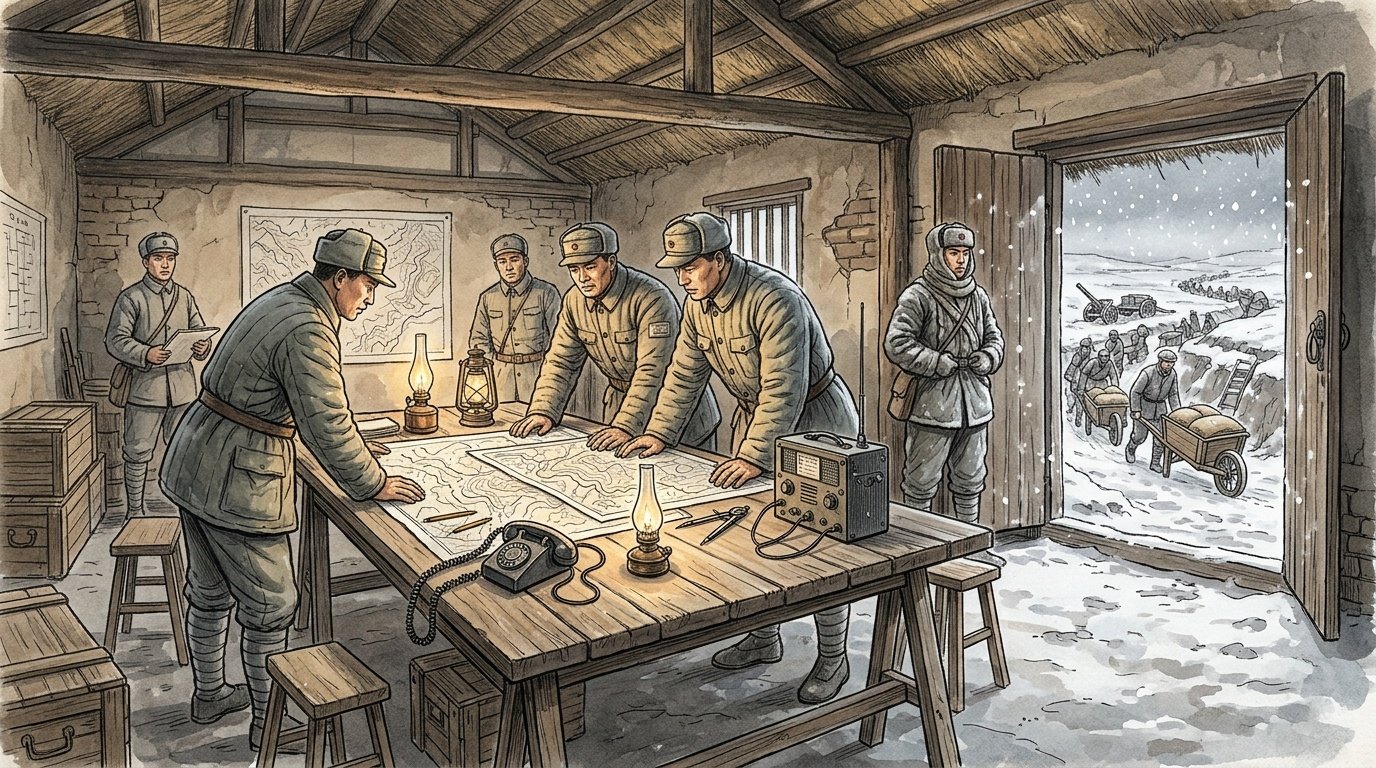
On one side stood the National Revolutionary Army (NRA) of Generalissimo Chiang Kai-shek (蒋介石, 1887–1975 CE), representing the internationally recognized Republic of China, backed by billions of dollars in American military aid, equipped with heavy Sherman tanks, motorized transport, 105mm howitzers, and undisputed air supremacy. On the other stood the People’s Liberation Army (PLA), directed from a humble earthen cave complex in Xibaipo by Mao Zedong (毛泽东, 1893–1976 CE) and his military mastermind Zhu De (朱德, 1886–1976 CE), commanding field armies of battle-hardened peasant soldiers whose mobility relied on foot marches and an unprecedented civilian logistical apparatus powered by millions of wooden wheelbarrows.
These titanic military operations are celebrated in Chinese military history as the ‘Three Great Campaigns’ (三大战役, San Da Zhan Yi): the Liaoshen Campaign (辽沈战役) in Northeast China; the Huaihai Campaign (淮海战役) across the plains of Jiangsu, Shandong, Anhui, and Henan; and the Pingjin Campaign (平津战役) in the northern capital region. In this ferocious whirlwind of maneuver, siege, and annihilation warfare, the PLA systematically obliterated over 1.54 million elite Nationalist combat troops, dismantled forty-five of Chiang Kai-shek’s best American-equipped divisions, and captured vast arsenals of modern weaponry.
By the conclusion of the Pingjin Campaign on January 31, 1949, the military backbone of the Nationalist regime was irreparably broken. Chiang Kai-shek had been forced into temporary retirement; the Yangtze River lay wide open to Communist crossing; and the ultimate proclamation of the People’s Republic of China on October 1, 1949, had become a mathematical certainty. The Three Great Campaigns stand alongside Stalingrad, Kursk, and Operation Bagration as masterpieces of grand operational strategy, massive troop movement, and total social mobilization.
This monograph provides an exhaustive operational, logistical, tactical, and political analysis of the Three Great Campaigns. We will trace the strategic shift from guerrilla defense to mobile warfare; dissect Lin Biao’s high-stakes gamble to seize Jinzhou and close the door on Manchuria; document the harrowing five-month starvation siege of Changchun; reconstruct the epic sixty-six-day meat-grinder of Huaihai and the genius of General Su Yu; examine the extraordinary civilian logistics of five million peasant wheelbarrows; detail the lightning 29-hour storming of Tianjin and the peaceful surrender of Beiping by General Fu Zuoyi; uncover the devastating communist intelligence infiltration inside the Nationalist High Command; and assess the enduring historiographical and military lessons of this epic conflict.
1. The Strategic Turning Point: Autumn 1948 and the Shift to Decisive Battles
When full-scale civil war erupted in June 1946 following the collapse of the Marshall Mission, few international observers predicted a Communist victory. The Nationalist Government commanded 4.3 million soldiers, enjoyed an overwhelming 3-to-1 superiority in manpower, possessed an undisputed monopoly on combat aviation and naval power, and controlled all major industrial centers, ports, and railway networks. Chiang Kai-shek confidently declared that the Communist ‘bandit forces’ would be exterminated within three to six months.
In response, Mao Zedong and the Central Military Commission adopted the defensive doctrine of Mobile Warfare (运动战). Adhering to the principle of ‘concentrating a superior force to destroy the enemy forces one by one’ (集中优势兵力,各个歼灭敌人), the PLA voluntarily abandoned territory—even evacuating their sacred revolutionary capital of Yan’an in March 1947—in order to lure overextended Nationalist columns deep into hostile rural terrain, where they were ambushed, cut off, and annihilated piecemeal.
By July 1948, after two years of brutal attritional warfare, the balance of power had shifted dramatically:
- Manpower Convergence: Nationalist combat strength had plummeted from 4.3 million to 3.65 million through combat casualties, mass surrenders, and rampant desertion. Conversely, the PLA had swelled from 1.2 million to 2.8 million troops, bolstered by radical land reform that inspired millions of liberated peasants to join the revolutionary ranks.
- Strategic Entrapment: In northern and northeastern China, Nationalist forces had completely lost control of the rural countryside. Over five hundred thousand elite Nationalist soldiers were huddled inside isolated, heavily fortified urban enclaves—Changchun, Shenyang, Jinzhou, Beiping, Tianjin, and Taiyuan—surrounded by hostile Communist territory and dependent on precarious aerial supply lines.
- Economic and Moral Collapse: In Nationalist-controlled cities, hyperinflation raged uncontrollably. The disastrous introduction of the Gold Yuan (金圆券) in August 1948 wiped out the life savings of the urban middle class, triggering food riots, bank runs, and general strikes. Morale among Nationalist conscripts and officers had reached rock bottom.
Meeting in the tiny village of Xibaipo (西柏坡) in Hebei Province in September 1948, Mao Zedong, Zhou Enlai, Zhu De, Liu Shaoqi, and Ren Bishi recognized that the hour for decisive, strategic showdown had arrived. The PLA was no longer a guerrilla force fighting for survival; it had evolved into a modern, mechanized army possessing heavy artillery captured from the Japanese and Nationalists. Mao made the daring calculation to bypass small peripheral engagements and launch three titanic, sequential campaigns to completely annihilate Chiang’s main field armies in northern China.
2. The Liaoshen Campaign: Locking the Door to Manchuria (Sept–Nov 1948)
The first and most geographically critical of the three campaigns was the Liaoshen Campaign (辽沈战役), fought between September 12 and November 2, 1948, for absolute control of Northeast China (Manchuria). Manchuria was China’s industrial powerhouse—containing the nation’s richest coal mines, iron and steel works, heavy machine factories, and extensive railway networks constructed by the Japanese puppet state of Manchukuo. Whichever faction controlled Manchuria possessed the industrial base to conquer all of China.
In Manchuria, the Northeast Field Army (东北野战军) was commanded by forty-one-year-old Lin Biao (林彪, 1907–1971 CE) and Political Commissar Luo Ronghuan (罗荣桓, 1902–1963 CE). Through rigorous training, Soviet-transferred Japanese weapons, and ruthless organization, Lin Biao had built an unstoppable force of 700,000 regular troops and 300,000 regional militia. Facing them were 550,000 Nationalist troops under General Wei Lihuang (卫立煌, 1897–1960 CE), distributed across three isolated pockets: Changchun in the north, Shenyang in the center, and Jinzhou on the southern corridor connecting Manchuria to north China.
Mao Zedong repeatedly sent urgent encrypted cables to Lin Biao, urging him to execute an audacious strategic maneuver: bypass Shenyang and Changchun, march hundreds of miles south, and strike directly at Jinzhou (锦州). Jinzhou was the narrow throat of the Liaoxi Corridor. As Mao famously put it: ‘Capturing Jinzhou is like shutting the door on a dog; once the throat is sealed, the five hundred thousand Nationalist troops in Shenyang and Changchun cannot escape to North China, nor can Chiang Kai-shek reinforce them!’
Lin Biao initially hesitated, fearing that striking Jinzhou would expose his rear to a pincer counterattack from Chiang Kai-shek’s sea-borne reinforcements at Huludao and Wei Lihuang’s armored spearhead from Shenyang. But on October 5, Lin committed fully. Deploying over 250,000 troops, Lin invested Jinzhou while fighting a legendary, bloody blocking battle at Tashan (塔山阻击战). For six ferocious days, Chinese Communist troops at Tashan endured round-the-clock naval bombardment from Nationalist cruisers, aerial bombing, and human-wave infantry assaults from nine Nationalist divisions, refusing to yield a single inch of ground.
With Tashan holding firm, Lin Biao unleashed a massive artillery bombardment against the fortified ramparts of Jinzhou on October 14. In thirty-one hours of ferocious urban fighting, the PLA shattered the defenses, capturing the city and taking 100,000 prisoners, including Nationalist commander Fan Hanjie. The door to Manchuria slammed shut with thunderous finality.
2a. The Tragedy of Changchun and the Annihilation of Liao Yaoxiang
The fall of Jinzhou instantly doomed the remaining Nationalist garrisons in Manchuria. In the northern fortress of Changchun, 100,000 Nationalist troops under General Zheng Dongguo had been encircled since May 1948 by PLA forces under Xiao Jinguang. Adhering to Lin Biao’s ruthless decree to ‘turn Changchun into a dead city’, the PLA maintained an impenetrable cordon around the city, cutting off all food, electricity, and fuel. Nationalist aircraft attempted to airdrop rations, but most drifted into Communist lines or were hoarded by Nationalist officers.
What followed was one of the most agonizing sieges in modern warfare. As grain reserves vanished, civilians were reduced to eating grass, tree bark, leather shoes, and pets. Tragically, when starving civilians attempted to flee through the lines, PLA sentries turned them back at bayonet point to avoid easing the garrison’s food burden, while Nationalist guards refused to let them re-enter. Trapped in the no-man’s-land between the lines, an estimated 120,000 to 160,000 innocent civilians starved to death. On October 17, following the fall of Jinzhou, General Zeng Zesheng led the Yunnanese 60th Army in defection to the PLA. Two days later, General Zheng Dongguo surrendered the remaining garrison. Changchun had fallen.
Meanwhile, in western Liaoning, Chiang Kai-shek had ordered Lieutenant General Liao Yaoxiang (廖耀湘, 1906–1968 CE) to lead the elite 9th Army Group—comprising China’s premier combat formations, the American-trained and equipped New 1st Army (新一军) and New 6th Army (新六军)—out of Shenyang to recapture Jinzhou. Instead of moving swiftly, Liao hesitated and was trapped in the open plains of the Liao River basin by Lin Biao’s converging columns. In a three-day running slaughter known as the Battle of Western Liaoning (辽西会战), the PLA completely encircled and annihilated Liao’s 100,000-man army, capturing Liao Yaoxiang alive.
On November 2, 1948, PLA troops entered Shenyang without major resistance. The Liaoshen Campaign concluded after fifty-two days of fighting. Chiang Kai-shek had lost 472,000 elite troops and the entirety of Manchuria’s heavy industrial heartland. The Northeast Field Army emerged from the campaign as an unstoppable colossus of nearly one million heavily armed veterans, ready to sweep south of the Great Wall.
3. The Huaihai Campaign: The Sixty-Six-Day Meat Grinder of East China (Nov 1948–Jan 1949)
Even before the final shots echoed across Manchuria, the largest, bloodiest, and most consequential confrontation of the entire civil war erupted on the boundless, frozen plains of east-central China: the Huaihai Campaign (淮海战役), known in Nationalist historiography as the Battle of Xuzhou-Bengbu (徐蚌会战).
Fought between November 6, 1948, and January 10, 1949, Huaihai was a titanic clash centered on the railway junction of Xuzhou, spanning northern Jiangsu, southern Shandong, eastern Henan, and northern Anhui. The strategic stakes were absolute: whoever controlled this gateway between the Yellow and Yangtze rivers controlled the approaches to the Nationalist capital of Nanjing and the commercial metropolis of Shanghai. If the Nationalists lost Huaihai, the capital was defenseless.
For this supreme contest, Chiang Kai-shek deployed 800,000 troops organized into five massive army groups and three pacification zones, commanded nominally by General Liu Zhi (刘峙)—a famously incompetent sycophant mockingly dubbed ‘the Pig General’—and field commander Lieutenant General Du Yuming (杜聿明, 1904–1981 CE). Facing them were 600,000 troops of the combined East China Field Army (华东野战军) and Central Plains Field Army (中原野战军). Strategic command of the Communist forces was vested in the five-member General Front Committee (总前委): Deng Xiaoping (Secretary, 邓小平), Liu Bocheng (the ‘One-Eyed Dragon’, 刘伯承), Chen Yi (陈毅), Su Yu (粟裕), and Tan Zhenlin (谭震林).
The operational architect of Huaihai was thirty-nine-year-old General Su Yu, universally regarded by military historians as the most brilliant tactical genius of the Chinese Civil War. Su Yu conceived the initial plan not as an all-out showdown, but as a limited offensive to isolate Xuzhou and destroy the Nationalist 7th Army Group east of the Grand Canal. However, as the campaign unfolded, Su Yu demonstrated breathtaking operational agility, transforming local successes into a campaign of total annihilation.
3a. The Three Stages of Huaihai: Nianzhuang, Shuangduiji, and Chenguanzhuang
The Huaihai Campaign unfolded in three distinct, bloody operational phases:
Stage One: The Annihilation of Huang Baitao at Nianzhuang (Nov 6–22, 1948): The campaign opened with the lightning encirclement of General Huang Baitao’s (黄百韬) 7th Army Group near Nianzhuang, east of Xuzhou. Huang’s troops dug into mud-walled villages, fighting with desperate ferocity. For fourteen days, in freezing sleet, Su Yu’s East China Field Army launched brutal human-wave assaults against fortified pillboxes and barbed-wire perimeters. Simultaneously, PLA blocking forces held off massive Nationalist relief columns commanded by Qiu Qingquan and Li Mi. On November 22, the perimeter collapsed. Huang Baitao shot himself in the head rather than surrender, and 100,000 Nationalist troops were annihilated.
Stage Two: The Destruction of Huang Wei at Shuangduiji (Nov 23–Dec 15, 1948): Sensing disaster, Chiang Kai-shek ordered General Huang Wei’s (黄维) elite 12th Army Group—equipped with heavy American artillery and Sherman tanks—to march from southern Henan toward Xuzhou. Demonstrating extraordinary maneuver warfare, the Central Plains Field Army under Liu Bocheng and Deng Xiaoping enveloped Huang Wei’s 120,000-man army inside a narrow pocket at Shuangduiji (双堆集) in northern Anhui. The Nationalists constructed an oval defensive ring of dug-in tanks and steel earthworks. After three weeks of ferocious siege warfare and tank duels, PLA assault teams breached the perimeter using homemade ‘flying thunder’ explosive barrels (飞雷炮). Huang Wei was captured, and his army was wiped out.
Stage Three: The Encirclement and Capture of Du Yuming at Chenguanzhuang (Dec 16, 1948–Jan 10, 1949): With his flanks crushed, General Du Yuming abandoned Xuzhou on November 30, attempting to retreat southward with 300,000 troops. However, weighed down by tens of thousands of civilian refugees and civil servants, Du’s columns moved at a crawl. Su Yu’s infantry executed a superhuman forced march, covering forty miles a day on foot, and completely surrounded Du’s entire force in the open fields of Chenguanzhuang (陈官庄).
Trapped in an open-air prison under howling blizzards and sub-zero temperatures, the Nationalist soldiers ran out of food, fuel, and ammunition. Men froze to death in their shallow slit trenches; horses were butchered for frozen meat; and soldiers fought vicious knife battles over airdropped bags of rice. The PLA blasted Christmas music and cooking smells across the lines, offering steaming pork buns and amnesty to anyone who surrendered. Over 14,000 soldiers crossed the lines voluntarily. On January 6, 1949, the PLA launched the final assault. General Qiu Qingquan was killed in battle, and General Du Yuming was captured hiding in a village hut. Over 555,000 Nationalist soldiers were wiped off the military map in sixty-six days. The road to the Yangtze was wide open.
4. Peasant Logistics: The Five Million Wheelbarrows that Won Huaihai
While the brilliant tactical maneuvering of Su Yu and Liu Bocheng was indispensable, the true engine of victory at Huaihai was an unprecedented, staggering feat of civilian mass mobilization. Following the campaign, Field Marshal Chen Yi famously declared to foreign correspondents:
‘The victory of the Huaihai Campaign was pushed out by the people using small wooden wheelbarrows!’ (淮海战役的胜利,是用小推车推出来的!)
— Field Marshal Chen Yi, 1949
To sustain 600,000 frontline combat troops across hundreds of miles of muddy, railway-less terrain during a brutal winter, the Communist Party mobilized the entire agrarian population of four provinces. Guided by the rural Communist cadres and inspired by the promise of permanent land ownership through the Agrarian Reform Law, over 5.43 million civilian laborers (民工) took to the roads.
This immense civilian army mobilized:
- 881,000 one-wheeled wooden wheelbarrows (独轮推车), their wooden axles screeching under the weight of grain sacks, artillery shells, and wounded comrades;
- 305,000 horse-drawn carts and 767,000 draft animals;
- 8,500 wooden river junks and sampans navigating the canals;
- 206,000 medical stretchers to carry casualties from the frontline back to field hospitals.
The statistical magnitude of this mobilization is staggering: for every single combat soldier holding a rifle at Huaihai, nine civilian peasants were on the roads supporting him. Over the course of the sixty-six-day campaign, these peasants transported over 434,000 tons of grain and 14.6 million tons of ammunition across unpaved dirt tracks churned into knee-deep mud by snow and rain. Peasant men pushed barrows for hundreds of miles, sleeping in ditch frost, while peasant women made five million pairs of cloth shoes and baked millions of flatbreads. In contrast, the Nationalist armies relied on motorized trucks that ran out of gasoline, railway lines that were sabotaged by guerrillas, and transport aircraft that could drop only a fraction of required supplies. Huaihai was not merely a clash between two armies; it was a total war between a hollow military elite and an organically mobilized agrarian society.
5. The Pingjin Campaign: The Capture of Tianjin and the Peaceful Liberation of Beiping
The third and final act of the epic trilogy was the Pingjin Campaign (平津战役), fought between November 29, 1948, and January 31, 1949, across the northern cultural and industrial heartland encompassing Beiping (Beijing), Tianjin, and Zhangjiakou.
Following the catastrophe in Manchuria, Chiang Kai-shek commanded the formidable North China Bandit Suppression Commander, General Fu Zuoyi (傅作义, 1895–1974 CE), to withdraw his 600,000 troops south to defend the Yangtze River. Fu Zuoyi, an exceptionally capable and independent-minded regional commander from Shanxi, refused. Fu believed that by entrenching his crack divisions along the narrow five-hundred-mile railway corridor between Zhangjiakou, Beiping, Tianjin, and the port of Tanggu, he could preserve a maritime escape route via the Bohai Gulf while maintaining a powerful bargaining chip.
Mao Zedong acted with lightning speed to prevent Fu Zuoyi from escaping by sea. Mao ordered Lin Biao’s massive Northeast Field Army—eight hundred thousand strong—to secretly slip through Shanhaiguan into North China weeks ahead of schedule. Marching only by night without lights and maintaining absolute radio silence, Lin Biao’s columns joined with Nie Rongzhen’s (聂荣臻) North China Field Army, completely severing the rail links between Beiping, Tianjin, and Tanggu before Fu Zuoyi even realized the Manchurian army had arrived.
Adhering to the classic strategic formula of ‘cutting off the wings before striking the head’, the PLA first struck the peripheral garrisons. At Xinbao’an (新保安), they encircled and annihilated Fu Zuoyi’s personal crack formation, the 35th Army. Next, on December 24, they liberated Zhangjiakou, annihilating another 54,000 troops. Fu Zuoyi’s forces were now compressed into two isolated, fortified cages: Tianjin and Beiping.
5a. The 29-Hour Storming of Tianjin and the Beiping Peace Accord
Tianjin, northern China’s premier commercial port and industrial hub, was defended by 130,000 crack Nationalist troops under General Chen Changjie. Believing the city’s concrete bunkers, barbed wire, and flooded moats were impregnable, Chen Changjie defiantly rejected all surrender ultimatums. On January 14, 1949, PLA Chief of Staff Liu Yalou (刘亚楼) unleashed a thunderous barrage of 500 heavy artillery pieces against the ramparts of Tianjin. Utilizing armor-infantry combat teams, the PLA breached the city walls from east and west simultaneously. In just twenty-nine hours of ferocious urban fighting, the PLA shattered the garrison, captured General Chen Changjie, and liberated the metropolis. The fall of Tianjin sent a chill of terror through the garrison in Beiping.
Beiping—the ancient imperial capital of the Ming and Qing dynasties—held two million civilians and the most precious architectural treasures of Chinese civilization: the Forbidden City, the Temple of Heaven, the Summer Palace, and dozens of historic universities. A devastating artillery assault would reduce these irreplaceable cultural wonders to ashes.
Recognizing this, the Communist leadership engaged in intense, secret negotiations with General Fu Zuoyi. Crucially, Fu’s own eldest daughter, Fu Dongju (傅冬菊), was an underground Communist Party member and journalist who worked tirelessly inside her father’s household to persuade him that continued resistance was futile suicide. Simultaneously, prominent scholars, including Tsinghua University professor Liang Sicheng, compiled a detailed cultural map for the PLA artillery commanders, marking every temple, library, and pagoda that must be shielded from bombardment.
Facing total military encirclement and shattered morale, General Fu Zuoyi made the noble, patriotic decision to surrender. On January 22, 1949, Fu signed the historic Beiping Peace Agreement. On January 31, 1949, amidst clanging cymbals, waving red flags, and the cheers of hundreds of thousands of university students and citizens, the battle-hardened soldiers of the PLA marched through the ancient gates of Deshengmen and Zhengyangmen. The imperial capital was liberated without a single shell hitting the Forbidden City. Over 520,000 Nationalist troops were neutralized, and Beiping was reclaimed as the capital of the emerging new China.
6. The Mole in the War Room: Communist Intelligence Infiltration
No operational analysis of the Three Great Campaigns is complete without examining one of the most astonishing espionage penetrations in global military history. Throughout 1948 and 1949, the PLA High Command at Xibaipo did not merely guess Chiang Kai-shek’s strategic plans; they read them before the Nationalist field commanders received them.
At the very apex of the Nationalist military establishment sat two high-ranking Communist sleeper agents:
- Lieutenant General Guo Rugui (郭汝瑰, 1907–1997 CE): Director of the Operations Department (Third Bureau) of the Ministry of National Defense—the exact office responsible for drafting all combat plans, troop deployments, and logistical routes for the entire Nationalist army. A secret Communist Party member since 1928, Guo personally drafted Chiang Kai-shek’s operational orders for the Liaoshen and Huaihai campaigns, sending copies via underground couriers directly to Zhou Enlai and Mao Zedong before the ink was dry.
- Major General Liu Fei (刘斐, 1898–1983 CE): Deputy Chief of Staff for Operations. Liu systematically sabotaged Nationalist troop deployments, deliberately recommending fragmented, uncoordinated movements that played directly into the PLA’s encirclement traps.
The brilliance of this intelligence apparatus meant that at Huaihai, General Du Yuming was terrified to speak on the telephone or commit plans to paper. Du privately warned Chiang Kai-shek that Guo Rugui was a Communist spy, but Chiang dismissed the warning, trusting Guo’s seemingly ascetic lifestyle and flawless administrative record. The Nationalist armies were functionally blind, fighting an enemy who possessed a complete blueprint of their every maneuver.
7. Political Collapse: The Resignation of Chiang and the Flight to Taiwan
The catastrophic annihilation of 1.54 million soldiers across the Three Great Campaigns shattered the Kuomintang regime to its foundations. On January 21, 1949—the day before Fu Zuoyi signed the Beiping surrender accord—a devastated Chiang Kai-shek bowed to insurmountable political pressure from the Guangxi Clique led by Li Zongren and announced his formal retirement as President of the Republic of China.
Chiang retreated to his ancestral home of Xikou in Fenghua, Zhejiang, but continued to exercise de facto control over the treasury, the air force, and the secret police. While Acting President Li Zongren engaged in desperate, futile peace negotiations with the Communists in Beiping in April 1949, Chiang quietly orchestrated the systematic transfer of the national gold reserves—over 3.5 million ounces of gold, foreign silver dollars, and the priceless art collections of the Palace Museum—from Shanghai and Nanjing to the island of Taiwan.
When the Nanjing government rejected the Communist twenty-four-point peace ultimatum, Mao Zedong and Zhu De issued the fateful order: ‘Advance Across the Entire Nation’ (向全国进军). On the night of April 20–21, 1949, one million PLA soldiers crossed the wide expanse of the Yangtze River in wooden boats, capturing Nanjing on April 23, Shanghai in May, and Guangzhou in October. The Nationalist government fled to Chongqing, Chengdu, and finally on December 8, 1949, evacuated the mainland entirely, establishing its temporary seat in Taipei.
2b. The Artillery Revolution: The Dalian Arsenal and the Special Arms Column
A persistent myth in Western military historiography is that the People’s Liberation Army triumphed in 1948–1949 purely through overwhelming human-wave infantry assaults. In reality, the decisive factor that broke the fortified concrete ramparts of Jinzhou, Tianjin, and Nianzhuang was a revolutionary transformation in heavy artillery firepower, industrial mass production, and technical specialization.
The architect of this artillery revolution was General Zhu Rui (朱瑞, 1905–1948 CE), known as the ‘Father of Chinese Artillery.’ Beginning in 1945 in the ruins of Japanese-occupied Manchuria, Zhu Rui collected over four thousand abandoned Japanese Type 38 field guns, Type 90 75mm guns, Type 96 150mm heavy howitzers, and motorized prime movers. Zhu established the Yan’an Artillery Academy in Mudanjiang, training thousands of illiterate peasant recruits in advanced ballistics, trigonometric surveying, and indirect fire coordination.
Crucially, this artillery apparatus was sustained by a massive, secret industrial ammunition pipeline based in Dalian (大连). Under joint Soviet-Chinese administration, the Jianguo Ironworks (建国铁工厂) and associated chemical facilities operated around the clock. Under the brilliant leadership of industrialist Liu Ding (刘鼎), Dalian factories manufactured over 540,000 heavy artillery shells, 200,000 mortar rounds, and millions of pounds of high explosives between 1947 and 1948. These munitions were transported by Soviet-crewed coastal steamships across the Bohai Gulf to the ports of Longkou and Weihai in Shandong, supplying Su Yu’s artillery batteries at Huaihai with endless trainloads of heavy ordnance.
When Lin Biao struck Jinzhou in October 1948, the PLA unleashed six hundred heavy field pieces firing simultaneously along an eight-hundred-meter front—an unprecedented concentration of firepower that pulverized Japanese-constructed reinforced concrete pillboxes in minutes. Tragically, Zhu Rui stepped on a landmine while personally inspecting captured Nationalist fortifications outside Jinzhou on October 1, 1948, becoming the highest-ranking PLA general killed during the entire civil war. His artillery legacy, organized as the elite Special Arms Column (特种兵纵队), provided the crushing technological hammer that decided the three campaigns.
3b. The Hell of Shuangduiji: Flying Thunder Cannons and Trench Warfare
Of all the ferocious battles that comprised the Huaihai Campaign, none surpassed the terrifying brutality of the siege of Shuangduiji (双堆集) in northern Anhui, where General Huang Wei’s 12th Army Group was encircled between November 23 and December 15, 1948. Shuangduiji was a cluster of impoverished, mud-walled farming hamlets surrounded by a flat expanse of freezing, treeless clay plains. Within this twenty-square-kilometer pocket, over 220,000 heavily armed combatants clashed in a murderous war of attrition that closely mirrored the blood-soaked trench lines of the Western Front in 1916.
Huang Wei, an unbending graduate of Whampoa’s first class who had studied mechanized warfare in the United States, turned Shuangduiji into a steel hedgehog. He dug rings of circular trenches, buried hundreds of American-supplied M3 Stuart and M4 Sherman tanks up to their turrets as stationary gun emplacements, strung endless barbed-wire entanglements, and deployed heavy flame-throwers that incinerated any frontal assault. When the Central Plains Field Army launched their initial attacks, Nationalist heavy machine guns and interlocking artillery fire cut down thousands of charging PLA soldiers in the frozen mud.
Recognizing that human charges were suicidal, General Liu Bocheng and Deng Xiaoping ordered their soldiers to adopt the ancient art of Sapping and Trench Infiltration (坑道作业). For two weeks, through blinding sleet and freezing blizzards, hundreds of thousands of Communist soldiers dug zigzag approach trenches toward the Nationalist perimeter. They dug while lying prone on their bellies, pushing wooden boards and woven wicker baskets ahead of them to deflect bullets. By early December, the PLA had excavated an astonishing four thousand kilometers of trenches, bringing their assault jumping-off points within twenty yards of Huang Wei’s pillboxes.
To shatter the Nationalist bunkers without air support, PLA combat engineers deployed their legendary improvised wonder-weapon: the ‘Flying Thunder Cannon’ (飞雷炮), colloquially known to the terrified Nationalist defenders as the ‘Sea-Calming Divine Needle’ (定海神针) or ‘Earth Dragon’. Fabricated from hollowed-out fifty-five-gallon steel gasoline drums buried in earthen revetments, these crude mortars used ten pounds of black powder to hurl massive, thirty-pound cylindrical packages of TNT hundreds of yards through the air. The resulting detonations produced an apocalyptic atmospheric shockwave: the concussion alone ruptured the eardrums, internal organs, and brains of Nationalist soldiers inside fortified concrete bunkers without leaving a single external shrapnel wound. The psychological terror of the Flying Thunder Cannons broke the morale of the defenders. On December 15, in a desperate, chaotic armored breakout in the dead of night, Huang Wei’s column was intercepted; Huang Wei was captured hiding in a drainage ditch, and the 12th Army Group ceased to exist.
5b. The Secret War for Beiping’s Soul: Liang Sicheng and the Red Circle Map
The bloodless surrender of Beiping on January 31, 1949, was not merely a military and political triumph; it was one of the greatest acts of cultural preservation in human civilization. Had the battle for Beiping mirrored the twenty-nine-hour artillery bombardment that pulverized Tianjin, the architectural soul of Chinese civilization—stretching back seven centuries to the Yuan dynasty’s Khanbaliq—would have been eradicated.
In mid-December 1948, as the PLA completely encircled the northern capital, two plainclothes PLA liaison officers arrived in the dead of night at the suburban Tsinghua University courtyard home of Liang Sicheng (梁思成, 1901–1972 CE), China’s foremost architectural historian, and his brilliant wife, architect Lin Huiyin (林徽因, 1904–1955 CE). The officers carried a secret personal letter from Premier Zhou Enlai. The Communist leadership requested that Liang Sicheng immediately compile an exhaustive, cartographic inventory of every historical monument, ancient pagoda, palace, imperial archive, and ancestral shrine within the walls of Beiping.
Working by flickering candlelight while artillery rumblings shook the window panes, Liang Sicheng and Lin Huiyin pored over imperial city blueprints. They produced the famous ‘Map of Cultural Relics of Beiping’, marking hundreds of historic structures with prominent red circles. They drafted meticulous technical guidelines for PLA artillery commanders: the Forbidden City, the Temple of Heaven, the Bell and Drum Towers, the Confucian Temple, and the Wanshou Temple were marked as absolute no-fire zones. The PLA High Command issued an iron directive: any artillery battery that fired a single shell inside a red circle without explicit written clearance from the Central Military Commission would face immediate court-martial.
Simultaneously, the psychological war inside the walled city was waged through General Fu Zuoyi’s eldest daughter, twenty-four-year-old Fu Dongju (傅冬菊). Working as an undercover operative reporting directly to Liu Ren, head of the CCP North China Urban Work Department, Dongju stayed by her father’s side day and night. She discreetly observed his agonizing mood swings, copied secret operational telegrams from his desk safe while he slept, and passed them to Communist couriers. More importantly, she constantly engaged her father in moral conversations, reminding him that firing artillery in the ancient capital would brand him an eternal villain in Chinese history books: ‘Father, if you destroy the Forbidden City and shed the blood of millions of citizens for Chiang Kai-shek’s doomed throne, the Chinese nation will never forgive you!’ Fu Zuoyi’s patriotic surrender preserved the treasures of China for future generations.
The peaceful surrender of Beiping established what Chinese military theorists celebrate as the ‘Beiping Model’ (北平方式) of revolutionary transition—the peaceful capitulation and integration of massive enemy military garrisons through political negotiation, psychological encirclement, and family mediation. This template was subsequently replicated across southern and western China, facilitating the bloodless defections of General Cheng Qian in Hunan, General Tao Zhiyue in Xinjiang, and General Lu Han in Yunnan, sparing countless millions from the devastation of prolonged urban warfare.
In addition, the capture of massive stocks of American military hardware across the three campaigns revolutionized the technological capabilities of the People’s Liberation Army. By February 1949, the PLA had captured over 54,000 artillery pieces, 860 tanks and armored cars, and hundreds of thousands of American M1 Garand rifles and Thompson submachine guns. Mao Zedong humorously proclaimed that Chiang Kai-shek had served as the PLA’s ‘Chief Logistics Officer’ (运输大队长), delivering American weaponry directly into the hands of the revolution.
8. Historiographical Reflections and Military Lessons of the Three Campaigns
The Three Great Campaigns of 1948–1949 represent the grandest operational synthesis of Clausewitzian total war, Marxist-Leninist political mobilization, and Sunzi’s ancient military philosophy ever recorded in Asian history. Western military historians, such as John Keegan and Lloyd Eastman, note several enduring lessons:
1. The Supremacy of Logistics and Agrarian Support: The Nationalists lost the war not because their soldiers lacked bravery or modern American weapons, but because their political system was incapable of inspiring or organizing the civilian population. The five million peasant wheelbarrows of Huaihai demonstrated that in continental warfare, an army rooted in genuine agrarian social revolution possesses an insurmountable logistical depth that mechanized supply lines cannot match.
2. Operational Decisiveness vs. Strategic Paralysis: While Chiang Kai-shek micromanaged his field commanders from hundreds of miles away via contradictory telegrams, paralyzing their operational initiative, Mao Zedong gave remarkable tactical autonomy to his field marshals—Lin Biao, Su Yu, and Liu Bocheng—once the broad strategic objectives were established.
3. The Transformation of Global Cold War Geopolitics: The outcome of the Three Great Campaigns fundamentally altered world history. By liberating all of mainland China, the PLA established a monolithic Eurasian Communist bloc stretching from East Berlin to Vladivostok, directly precipitating the outbreak of the Korean War in June 1950, reshaping American foreign policy toward containment in East Asia, and laying the military foundation for the modern Chinese state.
9. Chronology of the Three Great Campaigns (1948–1949 CE)
| Campaign / Date | Historical Battle / Milestone | Key Commanders Involved | Strategic Outcome & Significance |
|---|---|---|---|
| 1948 (Sep 12) | Liaoshen Campaign Begins | Lin Biao, Luo Ronghuan, Wei Lihuang | PLA Northeast Field Army launches strategic offensive in Manchuria |
| 1948 (Oct 14–15) | Fall of Jinzhou (锦州攻坚战) | Lin Biao, Fan Hanjie | Liaoxi Corridor severed; 100,000 KMT troops captured; gate to Manchuria closed |
| 1948 (Oct 19) | Surrender of Changchun (长春解放) | Xiao Jinguang, Zeng Zesheng, Zheng Dongguo | Brutal five-month siege ends; 60th Army defects; 100,000 garrison surrenders |
| 1948 (Oct 28) | Battle of Western Liaoning (辽西会战) | Lin Biao, Liao Yaoxiang | Elite New 1st and New 6th Armies annihilated; Liao Yaoxiang captured |
| 1948 (Nov 2) | Fall of Shenyang; Liaoshen Ends | Lin Biao, Wei Lihuang | Total liberation of Manchuria; 472,000 KMT troops eliminated in 52 days |
| 1948 (Nov 6) | Huaihai Campaign Begins | Liu Bocheng, Deng Xiaoping, Su Yu, Du Yuming | Greatest clash of the civil war begins around Xuzhou across four provinces |
| 1948 (Nov 22) | Annihilation at Nianzhuang (碾庄战役) | Su Yu, Huang Baitao | KMT 7th Army Group crushed; Huang Baitao commits suicide; 100,000 casualties |
| 1948 (Dec 15) | Battle of Shuangduiji (双堆集战役) | Liu Bocheng, Deng Xiaoping, Huang Wei | Elite KMT 12th Army Group crushed; Huang Wei captured; armor captured |
| 1948 (Dec 24) | Liberation of Zhangjiakou (平津战役) | Nie Rongzhen, Fu Zuoyi | North China Field Army severs Fu Zuoyi’s western flank; 54,000 KMT eliminated |
| 1949 (Jan 10) | Fall of Chenguanzhuang; Huaihai Ends | Su Yu, Du Yuming, Qiu Qingquan | Du Yuming captured; 555,000 KMT troops destroyed; road to Yangtze wide open |
| 1949 (Jan 15) | The 29-Hour Capture of Tianjin | Liu Yalou, Chen Changjie | PLA artillery smashes city walls; 130,000 garrison taken; Beiping isolated |
| 1949 (Jan 31) | Peaceful Liberation of Beiping (北京和平解放) | Fu Zuoyi, Lin Biao, Fu Dongju | Fu Zuoyi surrenders; 520,000 troops neutralized; ancient imperial palaces saved |
10. Scholarly Bibliography and Primary Historical Sources
To substantiate the troop deployment numbers, operational telegrams, and casualty statistics cited in this monograph, the following primary sources and academic monographs are recommended for further study:
- Military Academy of the PLA (comp. 1997), Operational History of the Three Great Campaigns (三大战役作战史), Military Science Press: The authoritative, multi-volume primary military record, compiling daily operational orders, combat loss tables, and Xibaipo telegram transcripts.
- Mao Zedong (毛泽东, 1961), Selected Military Writings of Mao Tse-tung, Foreign Languages Press: Contains the definitive operational directives, including ‘The Concept of Operations for the Liaoshen Campaign’ and ‘The Concept of Operations for the Huaihai Campaign’.
- Su Yu (粟裕, 1988), Memoirs of Su Yu (粟裕战争回忆录), PLA Publishing House: The masterly personal reflections of the East China Field Army commander, analyzing the tactical breakthroughs at Nianzhuang and Chenguanzhuang.
- Guo Rugui (郭汝瑰, 1997), Memoirs of Guo Rugui (郭汝瑰回忆录), Sichuan People’s Publishing House: Fascinating firsthand account by the KMT Director of Operations and undercover Communist intelligence operative, detailing the war room dynamics in Nanjing.
- Pepper, Suzanne (1999), Civil War in China: The Political Struggle, 1945–1949, Rowman & Littlefield: Foundational academic monograph analyzing the socioeconomic breakdown, student protests, hyperinflation, and agrarian mobilization.
- Westad, Odd Arne (2003), Decisive Encounters: The Chinese Civil War, 1946–1950, Stanford University Press: Masterful international history exploring Soviet and American diplomatic involvement, military strategy, and regional social dynamics.
- Tanner, Harold M. (2015), Where Chiang Kai-shek Lost China: The Liaoxi-Shenyang Campaign, 1948, Indiana University Press: The definitive English-language military study of the Liaoshen Campaign, examining the siege of Changchun and the battle of Jinzhou.
- Lew, Christopher R. (2009), The Third Generation of Guerrillas: PLA Operations in the Huaihai Campaign, Routledge: Granular military operational analysis detailing the tactical evolution, artillery concentration, and human-wave warfare at Huaihai.
- Eastman, Lloyd E. et al. (1991), The Nationalist Era in China, 1927–1949, Cambridge University Press: Comprehensive institutional history documenting the military blunders, factional infighting, and logistical breakdown of the Nationalist army.
- Levine, Steven I. (1987), Anvil of Victory: The Communist Revolution in Manchuria, 1945–1948, Columbia University Press: Essential political and economic study of Lin Biao’s state-building, land reform, and military modernization in the Northeast.