The Sounds Voyager Carried
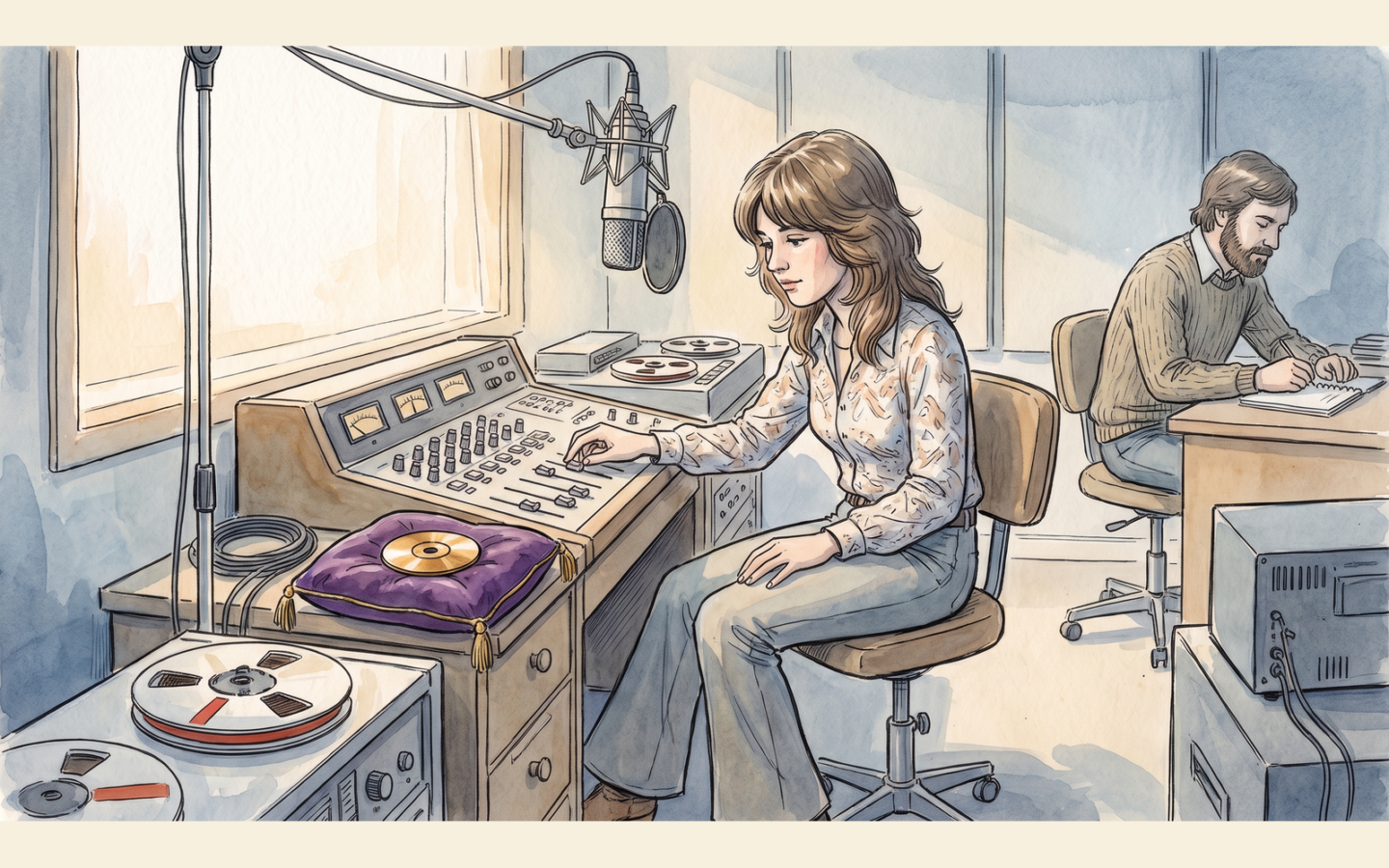
On the afternoon of 3 June 1977, in a small recording studio on the Upper West Side of Manhattan, a 28-year-old writer named Ann Druyan sat down in a chair with a set of electrodes attached to her scalp, and thought about falling in love. She had been, for the previous three weeks, working with a small team of scientists, musicians, and writers on the Voyager interstellar record, a gold-plated copper disc that was to be attached to each of the two Voyager spacecraft, then being prepared for launch from the Kennedy Space Center. The record would contain 115 images of Earth and the Earthlings, greetings in 55 languages, sounds of wind and sea and thunder and birds, and 27 musical tracks ranging from a Sumerian hymn of 3,000 BC to a Chuck Berry rock-and-roll number from 1958. Druyan, who was the creative director of the project, had decided to add a recording of her own brainwaves, the electrical signal that her brain produced as she thought, and the signal was, as she sat in the chair in the recording studio, being committed to a magnetic tape. The brainwave recording was to be compressed to one minute of audio, and was to be cut into the disc. Druyan, on 3 June 1977, thought about Earth’s history, the civilisations and the problems they face, and what it was like to fall in love. She was, in particular, thinking about a particular person, an astronomer at Cornell named Carl Sagan, with whom she had been working on the record project since the previous summer, and with whom she had, two days before, become engaged to be married. The brainwaves of Ann Druyan, recorded on 3 June 1977, are now, on a gold-plated copper disc, on their way out of the solar system at a speed of about 17 kilometres per second, on the side of the Voyager 1 spacecraft, which is, in 2026, the most distant human-made object in existence.
How the record came to be
The Voyager record was the second of two interstellar messages that NASA had attached to spacecraft in the 1970s. The first, the Pioneer plaque, was a small anodised aluminium plate attached to the Pioneer 10 and 11 spacecraft, which had been launched in 1972 and 1973. The Pioneer plaque was the work of Carl Sagan, his colleague Frank Drake, and the artist Linda Salzman Sagan, and it was a small visual thing: a line drawing of a man and a woman, a diagram of the hydrogen atom, a pulsar map that showed the location of the Sun in the galaxy, and a small representation of the spacecraft itself. The Pioneer plaque was a serious, dry, optimistic thing. NASA, however, was not entirely happy with it. The Pioneer plaque was, in NASA’s view, an unproven piece of communication, and the agency was unsure whether the public would support the next step. Sagan and Drake, in response, proposed something bigger: a small gold-plated copper disc, recorded with sounds, music, and images, that would be attached to the two Voyager spacecraft then being prepared for launch.
NASA approved the proposal in early 1977, and the project took about six months. The committee that assembled the record was chaired by Sagan (Cornell), with Frank Drake (Cornell) as technical director, Ann Druyan as creative director, Timothy Ferris (the journalist and author of The Red Limit) as producer, Jon Lomberg as designer, and Linda Salzman Sagan as greetings organizer. The committee had to assemble the record, get the recordings made, master the disc, and attach it to the spacecraft, all on a deadline set by the launch windows of the two Voyager missions. The launch of Voyager 2 was scheduled for 20 August 1977; the launch of Voyager 1, on a faster trajectory, was scheduled for 5 September 1977. The record had to be on the spacecraft before the launches. The committee worked, in the early months of 1977, on a series of intensive recording sessions in New York, in Ithaca, and at the Jet Propulsion Laboratory in Pasadena.
The Pioneer plaque that came before
The Voyager record was the second interstellar message NASA had approved in the 1970s. The first was the Pioneer plaque, a small anodised aluminium plate that was attached to the Pioneer 10 and Pioneer 11 spacecraft, launched in 1972 and 1973. The Pioneer plaque was the work of three people: the astronomer Carl Sagan, then at Cornell; his colleague Frank Drake, also at Cornell; and the artist Linda Salzman Sagan, who was Carl Sagan’s wife at the time. The three had, over a few weeks in early 1972, designed the plaque in response to a request from the Pioneer Programme office at NASA’s Ames Research Center, which was preparing the two Pioneer spacecraft for launch to Jupiter and beyond. The Pioneer plaque, in its final form, was a 6-by-9-inch plate, etched with a small set of line drawings in the manner of an astronomical chart. The drawings showed, on the left side, a man and a woman, the man with his right hand raised in a wave of greeting, the woman standing slightly behind him, both nude, both drawn in proportion to the spacecraft behind them; in the upper right, a diagram of the hydrogen atom in its two lowest energy states, with the connecting line and the digit 1, the transition frequency of which is 1,420 megahertz; in the lower right, a pulsar map showing the location of the Sun with respect to 14 pulsars, each marked with its period in binary; and in the lower left, a small representation of the Pioneer spacecraft itself, drawn to scale against the man and the woman. The plaque was, in design terms, a serious, dry, and optimistic thing.
The plaque was attached to the two Pioneer spacecraft in 1972 and 1973, and the two spacecraft, in due course, were launched from the Kennedy Space Center on a trajectory that would take them out of the solar system. Pioneer 10 was launched on 3 March 1972 and flew past Jupiter in December 1973; Pioneer 11 was launched on 6 April 1973 and flew past Jupiter in December 1974, then past Saturn in September 1979. Both spacecraft, after their planetary flybys, continued on trajectories that took them out of the solar system, into interstellar space. The plaque, in 2026, is on its way out of the solar system at the speed of the spacecraft it was attached to, in the case of Pioneer 10 at about 12 kilometres per second, in the case of Pioneer 11 at about 11 kilometres per second. The plaque is, in 2026, about 135 astronomical units from the Sun in the case of Pioneer 10, about 110 astronomical units in the case of Pioneer 11. The plaque is, in 2026, the most distant human-made object that has been deliberately inscribed with a message for any future recipient.
The plaque was, in its first weeks of public life, the subject of a small controversy. The nude figure of the woman was, in 1972, a cause for concern in some quarters of the American press, with at least one newspaper declining to print the plaque in its pages. The figure was drawn in proportion to the spacecraft behind it, with the man’s right hand raised in a wave, the woman’s right hand at her side. The drawing was based, by the artist’s own account, on classical Greek statuary. The controversy, which was to recur on the Voyager record in a milder form, did not affect the plaque’s flight. The plaque flew. The plaque is, in 2026, in interstellar space.
The Pioneer plaque was, in the design community, a learning experience for the designers. The plaque was designed in a few weeks, with no committee review, no public hearings, no formal consultation with NASA’s Office of Public Affairs. The designers, Sagan and Drake, had been given a small window of opportunity to attach a message to the Pioneer spacecraft, and had used it. The Voyager record was, by contrast, a more deliberate piece of communication. The Voyager record had a committee, a producer, a deadline, a budget, and a public review. The Voyager record was, in this sense, the institutional successor to the Pioneer plaque: more ambitious, more expensive, more carefully designed, and more thoroughly vetted. The Voyager record was, in the view of the designers, also more honest. The Pioneer plaque had been drawn by three people; the Voyager record had been recorded by a small committee of seven.
How the committee chose the music
The music for the Voyager record was selected by the committee that assembled the record, in a series of meetings in Ithaca, New York, and at the Jet Propulsion Laboratory in Pasadena, in the spring and summer of 1977. The committee had been asked by Carl Sagan, the chairman, to assemble a record of about 27 tracks that would, in his words, “represent the full range of human music” — from the ancient to the modern, from the East to the West, from the sacred to the secular. The committee was chaired by Sagan, with Ann Druyan as creative director, Timothy Ferris as producer, and Jon Lomberg as designer. The committee was supplemented, for the music selection, by a small group of musicologists and ethnomusicologists, including Robert E. Brown of the Center for Black Music Research, Alan Lomax of the Association for Cultural Equity, and several others. The committee had, in effect, about three months to assemble the music for the record. The deadline was set by the launch of Voyager 2, which was scheduled for 20 August 1977.
The music selection began with a long list of possible tracks, drawn from the musicological literature and from the personal recommendations of the committee members. The list was, by Ferris’s account in his book The Red Limit and in the Murmurs of Earth account, about 90 tracks long. The committee met, in the early months of 1977, in a series of weekend sessions in Ithaca, and worked through the list. The criteria for inclusion were: (a) the track had to be a recorded piece of music, available in a master tape of studio quality; (b) the track had to be representable, in some defensible way, as a piece of human music; (c) the track had to fit on the record, which had a total playing time of about 90 minutes; and (d) the track had to be cleared, in writing, by the rights holder for inclusion on the record. The criteria, in practice, were a series of constraints that the committee had to satisfy. The record could hold about 27 tracks at an average length of about three minutes; the rights clearance was, in 1977, a non-trivial exercise for most of the recordings the committee wanted to use.
The music, in its final form, was a sequence of 27 tracks. The sequence began, in the standard account of the record, with a Sumerian hymn of about 3,000 BC, performed by a contemporary Iraqi musician; then a piece of the second movement of Beethoven’s Fifth Symphony; then a Javanese court gamelan, recorded at the court of the Sultan of Yogyakarta; then a Peruvian panpipe melody, recorded in the highlands of Peru; then a Bulgarian shepherd’s song, recorded in the Rhodope Mountains; then an Australian aboriginal song, recorded in the Northern Territory; then a Navaho chant, recorded at a ceremonial site in Arizona; then a piece of Mozart’s Magic Flute, sung by a contemporary soprano; then a Senegalese percussion piece, recorded in Dakar; and, as the 27th and final track, Chuck Berry’s “Johnny B. Goode,” recorded in 1958. The “Johnny B. Goode” was, in the design history, the most contested track on the record. The committee was at first reluctant to include a piece of rock-and-roll in what was meant to be a serious, multi-cultural sampler of human music. Ann Druyan argued that any record meant to represent human music that did not include rock-and-roll would be incomprehensible to any future recipient, and Carl Sagan eventually agreed. The “Johnny B. Goode” was cut into the disc. The decision was, in the standard account, the right one. The decision was also the one that was to generate, in the press coverage of the record in 1977 and 1978, the most discussion.
The rights clearance for the music was, in 1977, a substantial exercise. The committee had to clear the rights for each track with the composer (or the composer’s estate), the performing musicians, the record label, and any other rights holders. The clearance was done by the committee in Ithaca, with the assistance of the record label Warner Communications, which had agreed to master the record at its studios in Los Angeles. The clearance, in most cases, was a matter of a few phone calls. In the case of Chuck Berry, the clearance was a matter of a personal phone call from Carl Sagan to Chuck Berry’s office in the Chelsea neighbourhood of Manhattan. Chuck Berry, by Sagan’s account in Murmurs of Earth, was amused, asked a few questions, and agreed. The clearance for “Johnny B. Goode” was, in the end, the simplest of the clearances.
The music was recorded, in most cases, from existing studio tapes. The committee had, in most cases, a master tape of the track it wanted to use, and the master tape was, in most cases, available from the record label or from the broadcasting archive. The committee had, in a few cases, to commission a new recording. The Javanese court gamelan, in particular, was recorded in Yogyakarta in early 1977, on a tape that the committee had commissioned from the court musicians. The Bulgarian shepherd’s song was recorded in the Rhodope Mountains in late 1976, on a tape that the committee had commissioned from the Bulgarian Academy of Sciences. The Navaho chant was recorded at a ceremonial site in Arizona in early 1977, on a tape that the committee had commissioned from the Navaho tribal council. The committee, in each of these cases, had to negotiate access, get the recording made, get the master tape, and get the rights clearance. The recordings, in each case, were done with portable studio equipment, in the field, by sound engineers who were familiar with the music. The committee had, in the end, the 27 tracks that were cut into the disc.
What is on the record
The Voyager record contains, in its final form, 115 images encoded in analogue form as a series of 512 vertical lines, a sound essay of about 12 minutes that includes the sounds of surf, wind, thunder, birds, whales, and other animals, greetings in 55 languages (from the ancient Sumerian Akkadian to a modern Chinese dialect), a printed greeting from the President of the United States (Jimmy Carter) and a printed greeting from the Secretary-General of the United Nations (Kurt Waldheim), 27 musical tracks, the brainwaves of Ann Druyan (compressed to one minute of audio), and a single Morse-code rendering of the Latin phrase “per aspera ad astra” (through struggle to the stars). The musical tracks include a Sumerian hymn of about 3,000 BC, a piece of the second movement of Beethoven’s Fifth Symphony, a Javanese court gamelan, a Peruvian panpipe melody, a Bulgarian shepherd’s song, an Australian aboriginal song, a Navaho chant, a piece of Mozart’s Magic Flute, a Senegalese percussion piece, and the Chuck Berry number “Johnny B. Goode.” The “Johnny B. Goode” was Ann Druyan’s insistence. The committee was at first reluctant to include a piece of rock-and-roll in what was meant to be a serious, multi-cultural sampler of human music. Druyan argued that any record meant to represent human music that did not include rock-and-roll would be incomprehensible to any future recipient, and Sagan eventually agreed. The “Johnny B. Goode” was cut into the disc.
The images, in their final form, were a sequence of 115 photographs and diagrams, encoded in analogue form. The sequence begins with calibration patterns that the recipient is expected to use to calibrate the playback equipment, then moves to a definition of the units of measurement (a hydrogen atom and its hyperfine transition, with the wavelength marked), then to images of the planets, the Earth, the Moon, the Sun, and the other solar system bodies, then to a series of images of human biology, human civilisation, and human culture. The images include diagrams of DNA, photographs of animals and plants, images of buildings, photographs of people at work, of children, of the Taj Mahal, of the Great Wall, of a woman in a supermarket, of a couple eating, of a man playing a cello, and of a mother nursing a baby. The 115 images are, like the rest of the record, a sampler. The record is not a complete portrait of the Earth; it is a sample, chosen by a committee of seven people in the first half of 1977.
What the cover says
The Voyager record is encased, in flight, in a small aluminium cover that protects the gold surface from micrometeorite impacts. The cover, which is the only part of the record that the spacecraft is supposed to show in any future encounter, is etched on its outer face with a set of instructions for playing the record. The instructions are written in a symbolic language, the way that the Pioneer plaque was written, using only basic physics and mathematics. The cover shows, in the upper left, a diagram of the record and the stylus that is included in the cover, with the stylus positioned at the start of the grooves. The diagram includes, near the top, a binary number that gives the time of one rotation of the record in milliseconds (about 3.6 seconds for the playing speed of 16 and 2/3 revolutions per minute). The cover shows, in the lower right, a drawing of the hydrogen atom in its two lowest energy states, with the connecting line and the digit 1, the transition frequency of which (1420 megahertz) is the fundamental time-scale for the rest of the message. The cover shows, in the lower left, a pulsar map that shows the location of the Sun in the galaxy with respect to 14 pulsars, each identified by its precise period, in binary. The pulsar map is, in effect, the address of the Sun in the galaxy, expressed in a coordinate system that any sufficiently advanced recipient can recover. The map is, by the way, the same map that was on the Pioneer plaque, with the same set of 14 pulsars, in the same configuration. The pulsar map is, in this sense, the second time the same address has been sent out of the solar system.
The cover does not say, in any human language, what the record is. The cover is, in fact, a piece of communication that is, by the standards of human communication, very nearly incomprehensible. The instructions on the cover are written in a symbolic language that is, in principle, derivable from the basic physics that any advanced civilisation would know. The pulsar map, similarly, is a piece of information that is, in principle, recoverable. The hydrogen atom diagram is, similarly, a piece of information that is, in principle, derivable. The Voyager record is, in this sense, an honest piece of communication: the cover does not say, in any human language, “we are here, this is us,” because the cover is a piece of communication that is meant to be read by something that does not know any human language. The cover is, in this sense, the most human-made object ever sent out of the solar system.
The greetings in 55 languages
The greetings section of the Voyager record is a sequence of short spoken greetings in 55 languages, recorded in the spring and summer of 1977 at the United Nations headquarters in New York. The greetings were assembled by Linda Salzman Sagan, who had been the artist on the Pioneer plaque and was now, in 1977, the greetings organiser for the Voyager record. Salzman Sagan recruited the speakers through the United Nations’ delegations, which had agreed to provide the greetings from members of their staffs. The greetings were recorded, in most cases, by the staff members themselves, in the languages they spoke most. The greetings were, in each case, short — typically a single sentence, lasting between two and five seconds, sometimes less. The greeting was, in each case, a hello to the recipient of the record, in the speaker’s own language, and sometimes a brief statement about the speaker’s own people, in the speaker’s own language. The 55 languages include the ancient Sumerian Akkadian, the modern Mandarin Chinese (in a Wu dialect, recorded by a staff member at the Chinese delegation), the modern English, the modern Hindi, the modern Arabic, the modern Hebrew, the modern Persian, the modern Turkish, the modern Russian, the modern Spanish, the modern Portuguese, the modern French, the modern German, the modern Italian, the modern Greek, the modern Swahili, the modern Zulu, the modern Japanese, the modern Korean, the modern Vietnamese, the modern Thai, the modern Burmese, the modern Indonesian, the modern Malay, the modern Tamil, the modern Telugu, the modern Bengali, the modern Punjabi, the modern Gujarati, the modern Marathi, the modern Kannada, the modern Sinhala, the modern Urdu, the modern Pashto, the modern Bengali, the modern Ukrainian, the modern Polish, the modern Czech, the modern Hungarian, the modern Romanian, the modern Bulgarian, the modern Serbian, the modern Albanian, the modern Finnish, the modern Swedish, the modern Norwegian, the modern Dutch, the modern Danish, the modern Welsh, the modern Gaelic, and several others.
The greetings were recorded on portable studio equipment, in the United Nations headquarters, over a period of about six weeks in the spring and summer of 1977. The recordings were made by Timothy Ferris and his assistant Ann Druyan, in a small studio set up in a vacant office in the United Nations Secretariat building. The speakers were, in most cases, professional diplomats and translators, and the recordings were, in most cases, made in the speaker’s first take. The greetings were recorded in the speakers’ first language, in the speakers’ own voice, with no interpretation and no translation. The greetings were, in this sense, unmediated: the sender and the recipient were, in the recording, the same person. The greetings were then mastered, in the Warner Communications studios in Los Angeles, in the same way that the music and the images were mastered. The greetings, in their final form, were a sequence of short spoken hellos, in 55 languages, on the Voyager record.
The greetings were, in the view of the committee, the most direct piece of communication on the record. The images, the music, and the sounds of Earth were, in the view of the committee, a sample of human culture; the greetings were a sample of human speech. The greetings were, in the view of the committee, the only part of the record that was, in the strict sense, addressed to the recipient. The images, the music, and the sounds of Earth were, in the view of the committee, a portrait of the Earth; the greetings were a portrait of the Earth in the voice of the Earth itself. The greetings were, in the standard phrase of the committee, the most human part of the record. The greetings were, in this sense, the part of the record that was meant to be the first thing the recipient would understand.
What the record has done since
The Voyager record was attached to the Voyager 1 and Voyager 2 spacecraft in the early autumn of 1977. The Voyager 2 spacecraft was launched on 20 August 1977; the Voyager 1 spacecraft was launched on 5 September 1977. The Voyager record has, in the nearly half-century since, travelled a very long way. Voyager 1 is, in 2026, about 25 billion kilometres from the Sun, and Voyager 2 is about 21 billion kilometres from the Sun. Both spacecraft are now in the interstellar medium, the region of space outside the heliosphere, and the Voyager record is, in effect, the most distant human-made object ever sent into interstellar space. The Voyager 1 spacecraft is, in 2026, the most distant human-made object in existence. The Voyager 2 spacecraft is the second most distant. The Voyager record is, in 2026, the most distant human-made piece of sound, image, and text. The record has, in the 49 years since it was cut, never been played in flight, and never will be. The Voyager record is not, in any operational sense, a working piece of equipment. The Voyager record is, in the most human sense, a bottle in the cosmic ocean.
References
- Sagan, Carl, Drake, Frank D., Druyan, Ann, Ferris, Timothy, Lomberg, Jon, and Salzman, Linda (1978). Murmurs of Earth: The Voyager Interstellar Record. Random House. Reissued in 1992 by Warner News Media with a CD-ROM.
- Voyager Golden Record Contents. NASA Science, Voyager Mission. The official NASA description of the record’s contents. https://science.nasa.gov/mission/voyager/golden-record-contents/
- Voyager Golden Record. Wikipedia. The compiled account of the record’s contents and production. https://en.wikipedia.org/wiki/Voyager_Golden_Record
- “Voyager Golden Record: Through Struggle to the Stars.” Smithsonian National Museum of American History music collection. The historical account of the record, including the Ann Druyan brainwave recording. https://music.si.edu/story/voyager-golden-record-through-struggle-stars
- “How to Make a Golden Record” - Science Friday transcript with Ann Druyan and Frank Drake, 2016. The oral-history account of the record’s production. https://www.sciencefriday.com/wp-content/uploads/2016/09/How-to-Make-a-Golden-Record-Transcript.pdf