The Refugee Who Built Shanghai
In the autumn of 1918, a twenty-five-year-old prisoner of war jumped from a moving train somewhere in Siberia and walked into the chaos of the Russian civil war with nothing but his wits and his drawing skills. He was László Hudec, a Hungarian officer of the Austro-Hungarian army, trained as an architect in Budapest, captured by the Russians on the Galician front in 1916, and now, with the empire he had served dissolving behind him, he did what the stateless and resourceful have always done: he headed for the one city in Asia that asked no questions. He reached Shanghai in November 1918, by way of Harbin, penniless, multilingual, and in need of work. Twenty years later he had designed more of the city than any other single hand, including its tallest building, its grandest cinema, its most beloved apartment house and its most luxurious private home, and he had done it without ever becoming a citizen of anywhere, a refugee whose buildings became the face of Shanghai. Shanghai in the 1920s and 1930s, the city this site’s last three essays have visited, the city of Club Obi Wan’s fantasy, of Ruan Lingyu’s cinema and Zhou Xuan’s songs, looked the way it looked largely because a young man once jumped off a train in Siberia.
The boy from Besztercebánya
The man Shanghai would adopt began far from any sea. László Hudec was born in January 1893 in Besztercebánya, a prosperous mining and market town in the Hungarian half of the Dual Monarchy, today Banská Bystrica in Slovakia, the son of a successful building contractor whose yards and scaffolds were the boy’s first school. He studied architecture at the Budapest Technical University, absorbing the disciplined eclecticism of the Austro-Hungarian tradition, and graduated in the fatal summer of 1914. Commissioned into the army, he was sent to the Galician front, decorated, and in 1916 captured by the Russians. The next two years he spent as a prisoner of war in Siberia, in the camps around Khabarovsk, where, by the accounts he later gave, his drafting skills made him useful to his captors and slightly less miserable than his comrades. Then the revolution dissolved the empire that was holding him. In the chaos of 1918, as the POW system collapsed into the civil war between Reds, Whites and Czechs along the Trans-Siberian, Hudec made his break: he slipped away from a transport train, acquired papers by means his biographers leave pleasantly vague, and crossed the disintegrating country to Harbin, the Russian-built railway city in Manchuria that was then the great entrepôt of the stateless. From Harbin he took ship south. He arrived in Shanghai in November 1918 with a profession, a suit of clothes, and no country worth the name, since the Hungary of his birth was itself in revolution. He was twenty-five years old.
The city that asked no questions
To understand Hudec’s career you have to understand what Shanghai was in 1918: a treaty-port city, the legacy of the settlements this series traced back to 1842, governed by foreign councils, booming on trade, and uniquely open to talent without papers. A man did not need a passport from a functioning state to work in Shanghai; he needed clients, and clients needed only competence. The city was then receiving one of the great migrations of talent in modern history, Russian refugees from the revolution, German and Central European exiles, Chinese merchants and craftsmen from the whole Yangzi delta, and its only entrance examination was the ability to do something useful well. Hudec found work almost immediately with R.A. Curry, an American architect with an established practice, made partner by 1920, and by 1925 had opened his own firm. He was, from the start, an unusually complete architect: technically superb, commercially shrewd, and possessed of a chameleon gift for style that suited a city of chameleon tastes. His early work was eclectic in the manner of the time, Mediterranean villas, Renaissance apartment houses, and he absorbed each new current of world architecture as it arrived, by journal and by travel, shifting through the 1930s from historicism to full-throated art deco and then to the streamlined modernism of the pre-war avant-garde. Shanghai was a demanding patron: foreign businessmen wanted buildings that announced their substance, Chinese compradors wanted the modern, and everyone wanted the latest thing. Hudec gave them all of it, and the city’s surviving fabric, the thing visitors now cross the world to see, is to a remarkable degree his portfolio.
The roll of his buildings is a tour of the era. In 1924, on a narrow wedge of land where two avenues met in the French Concession, he designed the Normandie Apartments, today called the Wukang Mansion, a ship-shaped Renaissance block whose prow sails down the fork of the streets and whose verandas were, for decades, the address of choice for film stars and officials; it is now, a century later, the most photographed building in Shanghai, its wedge framed in a million phone cameras each weekend. In 1926 came the Country Hospital, a graceful neo-Renaissance infirmary for the foreign community, still in medical use today. In 1931 he completed the Moore Memorial Church, a red-brick Gothic landmark whose bell tower anchored the city centre, and scattered his own neighbourhood, the villa district of Columbia Circle, with houses in every period manner, including his own residence and, nearby, the villa he designed for Sun Ke, the son of Sun Yat-sen. Each building was good; together they were a city within a city, and they made his name with the clients who mattered most, the bankers.
His office, by the late 1920s, was itself a small monument to the city’s hybridity: a Hungarian principal, European and American journals on the tables, Chinese draftsmen at the boards, and Chinese contractors on the scaffolds, for Hudec worked from first to last with the city’s Chinese building firms, whose craftsmanship in brick, terrazzo and tile was the unacknowledged co-author of everything he signed. His method was that of a man who could not travel constantly but refused to fall behind: he subscribed to the architectural press of three continents, kept clipping files on everything from Manhattan setbacks to German housing estates, and when a major commission demanded it, he travelled, his preparation for the Park Hotel included close study of the American skyscraper at first hand. The technical challenges were real and Shanghai-specific. The city stands on deep alluvial mud, and every tall building was an argument with the ground; Hudec’s foundations, forests of piles, heavy rafts, were as carefully considered as his facades, which is one reason his buildings, alone among so much of the era’s construction, have come through a century in first-class condition. He was also, contemporaries noted, a shrewd businessman in a city where an architect who could not read a balance sheet did not last a season: he ran his practice as a firm, not an atelier, delivered on time, and understood, as few of his rivals did, that a Shanghai client was buying an advertisement as much as a building.
The tallest building in the Far East
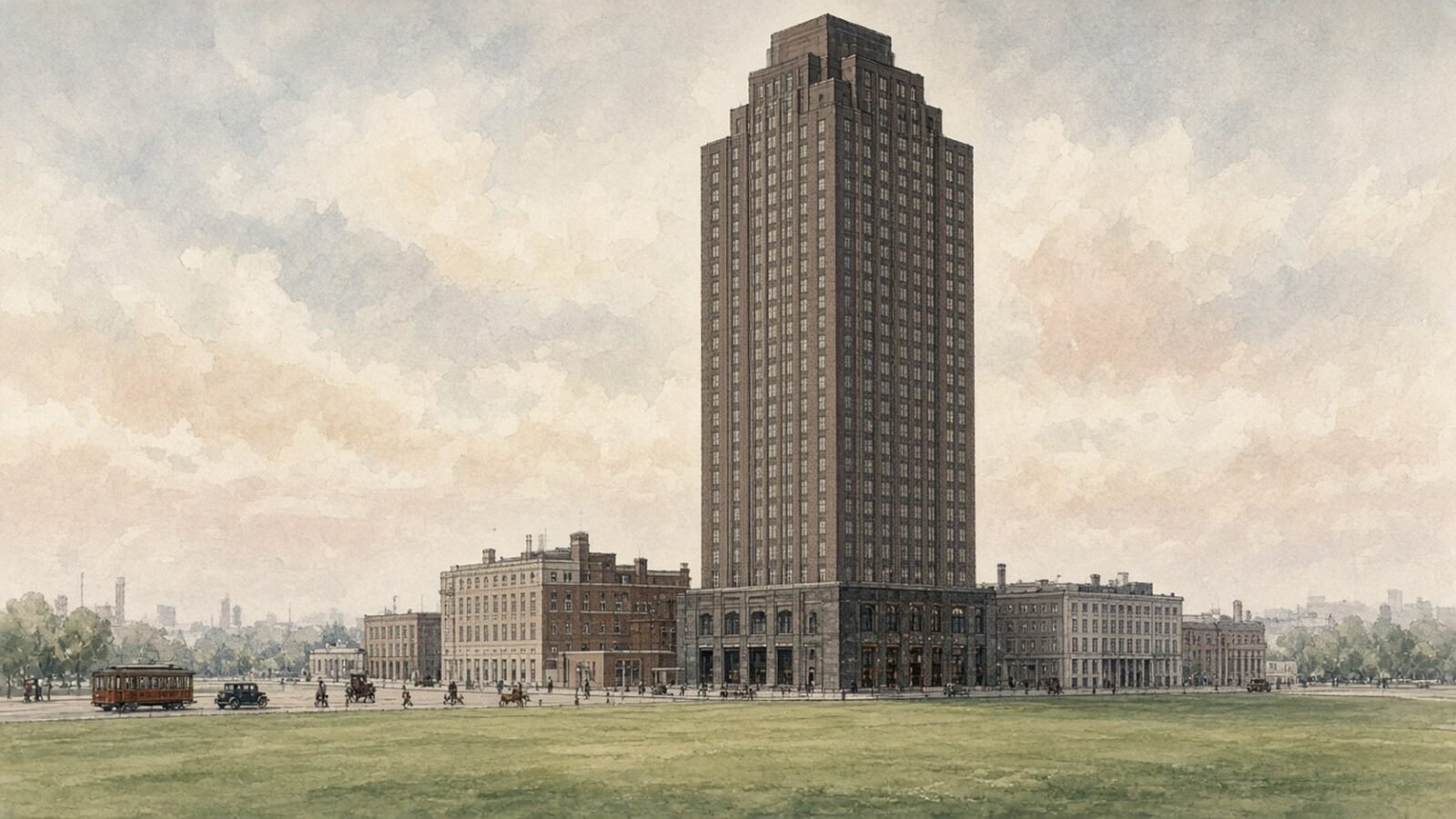
The masterpiece came in 1934. The United Savings Society, one of the new Chinese banks that were the muscle of the Nanjing decade’s economy, commissioned Hudec to build its headquarters on the city’s premier site, facing the racecourse at the heart of the International Settlement. What he gave them was the Park Hotel: twenty-two storeys of dark brown brick rising in tapering setbacks to a height of over eighty metres, the tallest building in Shanghai and, at its completion, the tallest in the Far East, a title it would keep, in Shanghai at least, into the 1980s. The Park Hotel was a declaration. Its silhouette was Manhattan’s, the setback skyscraper of the New York zoning laws translated to the Bund’s hinterland, and everything about it was aimed at the sky: the vertical lines, the observation deck, the sheer improbability of a steel tower on Shanghai’s notorious soft alluvial soil, which Hudec solved with a forest of piles driven deep into the mud. For half a century the building was the city’s fixed point, literally: the surveyors’ zero marker for Shanghai’s street grid was set in its lobby floor. The bankers who commissioned it had wanted an advertisement for Chinese modern capital, and they got one that no foreign firm on the Bund could ignore: the skyline’s highest point was now a Chinese bank’s headquarters, designed by a stateless Hungarian, in a style invented in America, on land recovered from a racetrack facing the old colonial clubs. If a single building sums up what Shanghai in the 1930s believed about itself, the Park Hotel is that building.
The hotel’s afterlife tracked the city’s. Through the war it stood over occupied Shanghai like a reminder; after 1949 it served the new government as guesthouse and landmark; when foreign visitors returned in the 1970s, Nixon’s people among them, they were put up in its deco rooms, and photographs of the Shanghai skyline in those years show Hudec’s tower still rising, dark and solitary, above a city that had stopped building upward. Only in the 1980s did new towers begin to pass it, and by the century’s end the building that had dominated the skyline for fifty years stood almost hidden among the glass, which is its own kind of compliment: the city had grown around the seed. The racecourse it once faced is now People’s Square, and the tower, restored, still takes guests, who ride the original-era elevators up through the setbacks to rooms whose windows frame the city that forgot its architect and then remembered him.
The year before it, 1933, had produced the companion piece: the Grand Cinema, the art-deco movie palace on Bubbling Well Road where the golden age of Chinese film, told in the earlier essay, played to its audiences. The Grand was Hudec in his deco prime: a sweeping curved facade, a glowing vertical tower that served as a beacon up and down the avenue, and an interior of chrome, light and perfect sightlines for two thousand patrons. Between the Park Hotel and the Grand Cinema, Hudec had built, in consecutive years, the vertical signature and the social heart of the modern city. And he was not done. In 1938, on the eve of the Pacific war, he designed the house that many consider his most perfect work: the residence for Wu Tongwen, a dye and pigment magnate, known ever after as the Green House for the shimmering green glazed tiles of its facade. The Green House is streamline moderne at full confidence, a sweeping ocean-liner of a building, all curves and horizontal lines, with a glass-walled sunroom, a rooftop deck, and gadgets, an early air-conditioning system, an elevator, that made its owner the toast of Shanghai society. It was called, at the time, the most luxurious residence in the Far East, and the claim was barely disputed. The house was also prophetic in its engineering: fully air-conditioned when almost nothing in Asia was, wired and plumbed to a standard decades ahead of its setting, it pointed straight at the architecture of the 1950s, which Hudec, with his luck for timing, would never practise. It was also the end of something: within three years the war had swallowed the world that commissioned such houses.
War, limbo, departure
Hudec’s war years are the quietest chapter of his life, and the least documented, but they complete the portrait. He stayed in Shanghai through the occupation, and from 1942 served as the honorary consul general of Hungary, his native country being then, in the chess game of the war, on the Axis side, a position that gave a man of his standing a modest protective authority in a city full of the desperate, including tens of thousands of Jewish refugees from Europe who had fled to the one port on earth that still admitted them without a visa. The full record of what Hudec did with that authority has never been written, but he used his offices, as others did, to ease lives where he could, and the architectural practice dwindled to maintenance and small commissions as the building economy collapsed under war and then hyperinflation. By 1945 the world that had made him was gone: the concessions were abolished, the foreign firms were leaving, and the civil war’s chaos was closing in. In 1947 Hudec left Shanghai with his family for the United States, nearly thirty years after he had arrived off the boat from Harbin. He settled quietly in California, built little, lectured occasionally, and died in 1958, aged sixty-five, in Berkeley. For decades afterwards his name meant almost nothing, even in Shanghai. The buildings stood; the architect was forgotten.
The second life
The rediscovery, when it came, was a civic phenomenon of the kind that only Shanghai could produce. In the 1990s and 2000s, as the city rebuilt itself at breakneck speed, a counter-current of preservation and nostalgia set in, and Shanghai began, quite self-consciously, to catalogue and celebrate the architecture of the concession era. In that process the researchers kept finding the same name on the blueprints. The wedge-shaped apartment house everyone photographed: Hudec. The old Park Hotel, still handsome on its racecourse site: Hudec. The Grand Cinema, the church, the green house, the hospital, the villas: Hudec, Hudec, Hudec. By the 2010s the city had a full-blown case of what local journalists called Hudec fever: books, exhibitions, walking tours, a memorial space in his restored Columbia Circle residence, plaques on his surviving buildings, and a steady stream of Hungarian and Slovak dignitaries, for his birthplace, Besztercebánya in the old kingdom, is today Banská Bystrica in Slovakia, arriving to claim their share of the fame. His family gave his papers and drawings to the city, and a man who had died in obscurity became, sixty years after his death, a Shanghai celebrity, the city’s own adopted master builder. The fever has its fixtures now. At the Shanghai Expo of 2010, the Hungarian pavilion presented Hudec to millions of visitors as a national hero, an irony he would have savoured, since Hungary had spent his productive decades indifferent to him. The Wukang Mansion, after a meticulous restoration, became the selfie capital of the French Concession, ringed on fine weekends by photographers, brides and influencers, a process the building’s elderly residents watch from their verandas with weary amusement. Hudec walking tours sell out; his bust stands in his old neighbourhood; and Shanghai schoolchildren are taught his name, which is more than can be said for most of the foreign architects who worked in the treaty ports.
It is worth asking why the fever took, because the answer says something about how Shanghai wants to remember itself. Hudec is the perfect hero for the city’s preferred self-image: a foreigner, but not a colonist; a refugee, but not a victim; a man who came with nothing, was asked nothing, and repaid the city’s indifference to his origins with love for its fabric. His career flatters the old treaty-port legend, the city as the open door, while standing at a clean remove from the century’s wounds: he built neither banks for the opium trade nor forts for the occupation, but hotels, cinemas, hospitals, churches and homes, the civilian architecture of urban pleasure and care. And his story has the narrative shape Shanghai treasures, the arc of the city itself: arrival with nothing, dazzling success, catastrophe survived, exile, and triumphant return, if only in memory. The Wukang Mansion’s prow sailing through a hundred years of photographs is the city’s own story told in brick.
The lesson of the skyline
There is a larger point here, and it connects this essay to the series it concludes. The long century this site has followed, from the gunboats to the treaty ports to the warlord years, was experienced by its Chinese citizens as a story of things done to China. Hudec’s story is a reminder of something equally true and easier to forget: that the same forced opening, with all its injustice, also created spaces where the twentieth century’s great experiment in cosmopolitanism was actually lived. A Hungarian prisoner of war, a Filipino saxophonist, a White Russian cellist, a Harbin refugee, a Songjiang cotton-weaver’s descendant, a banker from Ningbo: Shanghai was made by such people, and the city they made together was not a fake Europe on Chinese soil but something genuinely new, a hybrid that belonged to everyone who added to it. The buildings prove it. The Park Hotel is not a New York building transplanted; it is a Shanghai building, sited against the racecourse, scaled to the Bund, paid for by a Chinese bank, and made possible by a man three empires had discarded. That is the city’s real inheritance, and the reason its golden-age architecture is treasured now not as a relic of the unequal treaties but as the foundation of Shanghai’s own identity.
Walk down Bubbling Well Road today, it is Nanjing West Road now, and the itinerary of this site’s last four essays comes physically into view within a few blocks. There is the Grand Cinema, its deco tower restored and lit, still showing films. There is the Park Hotel, its lobby still holding the surveyors’ zero point of the city’s grid. The Paramount Ballroom, where the Golden Voice’s songs were danced, stands again after its restoration. The Wyandotte? No, that is elsewhere, but no matter: the point is that the world of the previous essays, the nightclubs, the studios, the stars, was housed, to a remarkable degree, in one refugee’s drawings. László Hudec jumped off a train in Siberia in 1918 with nothing but his craft, and the city that took him in, no questions asked, wore his work as its face for a century. The treaties that opened the door were unjust; the man who walked through it was a gift. Both things are true, and the skyline keeps the ledger.