The Northern Expedition and the 1927 Shanghai Massacre
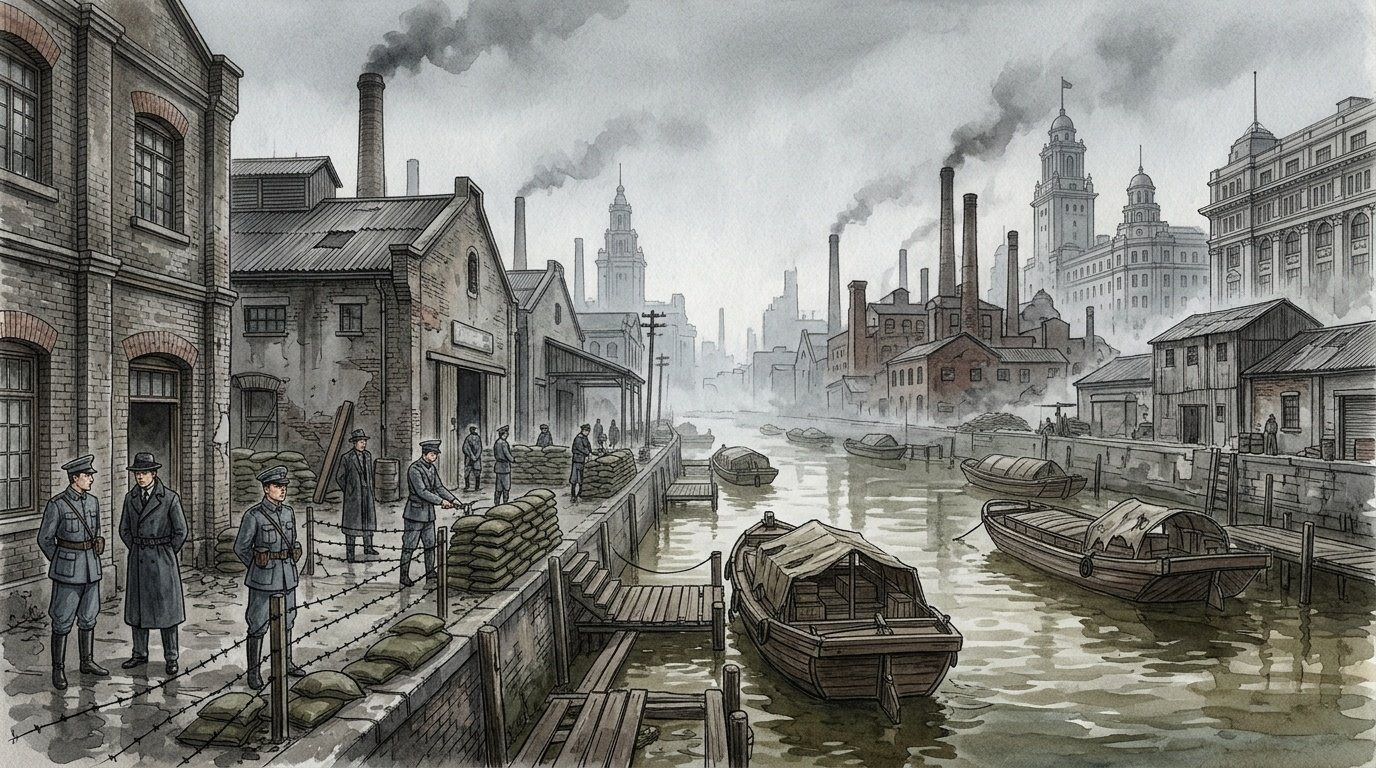
At four o’clock in the morning on April 12, 1927 CE—in the damp, mist-choked pre-dawn darkness of Shanghai—the sudden, piercing wail of a naval steam siren echoed across the Huangpu River from a gunboat anchored off the French Bund. In an instant, that solitary whistle blast detonated a synchronized, murderous ambush that altered the trajectory of modern Chinese history forever.
From the shadows of the French Concession, dozens of canvas-topped flatbed trucks carrying hundreds of armed men roared into the working-class industrial suburbs of Zhabei, Nanshi, and Wusong. The attackers were not regular soldiers: they were the ruthless hitmen, opium smugglers, and underworld enforcers of Shanghai’s notorious Green Gang (青帮, Qingbang), led by the underworld triumvirate of Du Yuesheng (‘Big-Eared Du’ 杜月笙), Huang Jinrong (‘Pockmarked Huang’ 黄金荣), and Zhang Xiaolin. Dressed in blue cotton laborers’ jackets and wearing white cloth armbands inscribed with the Chinese character for ‘Worker’ (工), the gangsters were armed with modern Mauser ‘Broomhandle’ automatic pistols and Thompson submachine guns supplied directly from foreign concession armories.
Converging upon the headquarters of the Shanghai General Labor Union (上海总工会) inside the Huxi Commercial Club and dozens of union picket posts, the gangsters opened fire without warning. Picket guards, sleeping workers, and trade union organizers were butchered with submachine gun bursts and iron axes. Barely an hour later, regular troops of the Nationalist Revolutionary Army’s 26th Army, commanded by generals loyal to thirty-nine-year-old Commander-in-Chief Chiang Kai-shek (蒋介石, 1887–1975 CE), arrived on the scene under the pretext of ‘disarming the rioters.’ Instead of arresting the gangsters, the soldiers turned their machine guns on the surviving workers, disarming the union pickets, seizing union headquarters, and dragging hundreds of young men and women into waiting prison vans. The April 12 Purge (四一二反革命政变)—known to world history as the Shanghai Massacre of 1927—had begun.
The following day, April 13, when over one hundred thousand unarmed workers, silk-mill women, and teenage students marched through torrential rain down Baoshan Road to petition the military headquarters for the release of their comrades, military riflemen opened fire at point-blank range, turning the street into a slaughterhouse. For three weeks, Shanghai drowned in an orgy of extra-judicial butchery known as the ‘White Terror’ (白色恐怖): over five thousand trade unionists, Communist organizers, and left-wing intellectuals were beheaded, shot, or bound in burlap sacks and thrown alive into the muddy currents of the Yangtze River.
The Shanghai Massacre was the violent, traumatic death of the First United Front (第一次国共合作). For three years, the Chinese Nationalist Party (Kuomintang, KMT) and the Chinese Communist Party (CPC) had marched shoulder-to-shoulder from their revolutionary cradle in Guangzhou, mobilizing workers and peasants in the triumphant Northern Expedition (北伐战争) to crush the corrupt feudal warlords and reunify the fragmented Chinese nation. By drowning his Communist allies in blood, Chiang Kai-shek broke the revolutionary left, secured the financial backing of Shanghai’s capitalist oligarchs and Western imperialist powers, and established his autocratic Nationalist Government in Nanjing.
Yet the massacre was also the catalyst that forged the destiny of modern China. It shattered forever the illusions of peaceful parliamentary cooperation, convincing a thirty-three-year-old Hunanese Communist named Mao Zedong (毛泽东) of an immutable historical law: ‘Political power grows out of the barrel of a gun’ (枪杆子里面出政权). The blood spilled on Baoshan Road led directly to the Nanchang Uprising of August 1, 1927, the founding of the Chinese Red Army, and a savage, twenty-two-year civil war that ended only when Mao’s armies entered Beijing in 1949.
This monograph presents an exhaustive political, military, financial, sociological, and ideological history of the Northern Expedition and the 1927 Shanghai Massacre. We will examine the birth of the First United Front and Sun Yat-sen’s alliance with Soviet Russia; trace the founding of the Whampoa Military Academy and the creation of the National Revolutionary Army; analyze the lightning campaigns of the Northern Expedition against warlords Wu Peifu and Sun Chuanfang; dissect the mass mobilization of the peasant associations and the Shanghai workers’ uprisings; explore the ideological schism between Chiang Kai-shek and the Wuhan Left Government; reconstruct the conspiracy between Chiang, the Green Gang, and Western concession authorities; provide an hour-by-hour account of the April 12 bloodbath; and evaluate the profound historiographical consequences of the massacre in the forging of the modern Chinese party-state.
1. The Alliance of Blood: Sun Yat-sen, Borodin, and the Whampoa Academy
The historical origins of the Northern Expedition were born out of the bitter political disillusionment of Sun Yat-sen (孙中山, 1866–1925 CE). Following the collapse of the 1911 Revolution and the rise of warlord anarchy, Sun had spent a decade wandering in exile or clinging to precarious military toeholds in Guangzhou, repeatedly betrayed by opportunistic southern warlords like Chen Jiongming. Sun had appealed desperately to the United States, Great Britain, and Japan for loans and diplomatic recognition to build a constitutional republic; in every instance, the Western democracies rejected him with icy contempt, preferring to deal with the corrupt, compliant warlords in Beijing who protected their treaty-port commercial concessions.
In 1922, Sun turned toward the only foreign power willing to treat China as an equal sovereign nation: Soviet Russia. Vladimir Lenin’s Bolshevik government had issued the famous Karakhan Manifesto, renouncing all Tsarist unequal treaties, extraterritorial privileges, and Boxer indemnities. In January 1923, Sun Yat-sen and Soviet diplomat Adolf Joffe signed the historic Sun-Joffe Manifesto (孙文越飞宣言), establishing the formal alliance between Soviet Russia and the Kuomintang.
Under Soviet guidance, Sun promulgated the revolutionary political formula known as the ‘Three Great Policies’ (三大政策):
- Alliance with Russia (联俄): Moscow provided millions of gold rubles in financial subsidies, tens of thousands of modern Mosin-Nagant rifles, artillery, ammunition, and top military and political advisors;
- Alliance with the Communist Party (联共): Members of the fledgling Chinese Communist Party (founded in 1921 with barely four hundred members) were permitted to join the Kuomintang as individuals while retaining their Communist membership—the institutional framework of the First United Front (第一次国共合作);
- Assistance to Workers and Peasants (扶助农工): The Kuomintang committed itself to mass revolutionary mobilization, organizing trade unions in the cities and peasant associations in the countryside.
In the autumn of 1923, Moscow dispatched its premier diplomatic operative to Guangzhou: Mikhail Borodin (鲍罗廷, 1884–1951), an experienced Bolshevik revolutionary who spoke fluent English. Borodin served as Sun’s supreme political advisor, reorganizing the chaotic Kuomintang from a loose fraternal society into a tightly disciplined, Leninist vanguard party operating on democratic centralism. Accompanying Borodin was a brilliant Soviet military general, Vasily Blyukher (known in China under the pseudonym General Galen, 加伦将军, 1889–1938), who took charge of strategic military planning.
Sun Yat-sen recognized that a revolutionary party could not survive without its own dedicated ideological army. In May 1924, on Changzhou Island in the Pearl River ten miles downriver from Guangzhou, Sun established the Whampoa Military Academy (黄埔军校, officially the Army Officer Academy of the Kuomintang). Financed by Soviet gold and equipped with Soviet weapons, Whampoa was the crucible of modern Chinese military leadership.
Sun appointed thirty-six-year-old Chiang Kai-shek—a disciplined Zhejiang military officer who had studied in Japan and spent three months inspecting the Red Army in Moscow—as the Academy’s first Commandant (校长). To ensure political indoctrination, twenty-six-year-old Communist intellectual Zhou Enlai (周恩来) was appointed Director of the Political Department, with fellow Communists like Ye Jianying and Nie Rongzhen serving as senior instructors. Cadets at Whampoa were drilled in modern artillery, infantry tactics, and night combat, while attending daily lectures on anti-imperialism, Sun’s Three Principles of the People, and the social revolution. Whampoa forged an elite, ideologically motivated officer corps ready to sacrifice their lives for the reunification of China.
2. The Juggernaut Advances: The Northern Expedition of 1926
On March 12, 1925, Sun Yat-sen died of liver cancer in Beijing, leaving behind his famous political testament: ‘The revolution is not yet achieved; comrades must continue to strive!’ (革命尚未成功,同志仍须努力). Following a complex internal power struggle in Guangzhou—climaxing in the mysterious Zhongshan Warship Incident (中山舰事件) of March 1926, in which Chiang arrested Communist naval commissars and purged Soviet advisors from his staff—Chiang Kai-shek consolidated undisputed supreme command over both the Kuomintang military and the National Revolutionary Army (NRA).
On July 9, 1926, before an assembly of fifty thousand cheering soldiers and citizens at the Dongshan parade grounds in Guangzhou, Chiang Kai-shek was sworn in as Commander-in-Chief of the National Revolutionary Army (国民革命军总司令). Raising the blue-sky-white-sun banner, Chiang formally launched the Northern Expedition (北伐战争), swearing to march north to destroy the feudal warlord cliques, tear up the imperialist unequal treaties, and unite China under the Nationalist government.
The geopolitical task confronting the NRA was daunting. Arrayed against Chiang’s one hundred thousand revolutionary troops were three colossal warlord coalitions commanding over seven hundred thousand veteran soldiers:
- Wu Peifu (吴佩孚, the ‘Jade Marshal’): Leader of the Zhili Clique, commanding two hundred thousand troops controlling Hunan, Hubei, and the strategic Beijing-Hankou Railway;
- Sun Chuanfang (孙传芳): Commander of the ‘Five-Province Coalition’ (Zhejiang, Fujian, Jiangsu, Anhui, Jiangxi), controlling two hundred thousand troops occupying the wealthy lower Yangtze delta and Shanghai;
- Zhang Zuolin (张作霖, the ‘Old Marshal’): Master of the Fengtian Clique, commanding three hundred thousand troops controlling Manchuria, Beijing, and northern China, backed by the Japanese Kwantung Army.
Under the brilliant operational direction of Soviet General Vasily Blyukher (Galen), the NRA executed a strategy of defeating the warlords in detail: first concentrating overwhelming force to annihilate Wu Peifu in central China, while neutralizing Sun Chuanfang through diplomatic pretense, before turning eastward to liberate Shanghai.
The advance of the NRA was a military hurricane without precedent in Chinese history. Within two months, the revolutionary vanguard swept through Hunan, capturing Changsha. At the precipitous mountain passes of Tingsisheng (汀泗桥) and Heshengqiao (贺胜桥), the elite Independent Regiment of the Fourth Army (叶挺独立团)—commanded by Communist officer Ye Ting (叶挺) and staffed almost entirely by Communist cadres—spearheaded suicidal bayonet charges against Wu Peifu’s entrenched machine-gun redoubts. Breaking the enemy lines, the Fourth Army earned the immortal, legendary moniker of the ‘Iron Army’ (铁军).
In October 1926, after a grueling forty-day starvation siege, the NRA captured the triple-city metropolis of Wuhan (Wuchang, Hankou, Hanyang), destroying Wu Peifu’s military empire. Turning east into Jiangxi, Chiang Kai-shek’s armies smashed Sun Chuanfang’s forces at Nanchang and Jiujiang. By the end of 1926, half of China south of the Yangtze River had been liberated by the revolutionary armies.
3. The Peasant Hurricane: Mao Zedong in Hunan
The secret weapon that powered the military triumph of the Northern Expedition was not foreign artillery, but the mass mobilization of the Chinese peasantry and industrial working class. Wherever the NRA advanced, Communist and left-wing Kuomintang political commissars fanned out into the rural villages and urban factories, organizing the oppressed masses into revolutionary unions.
In the province of Hunan, this rural awakening exploded into a revolutionary storm. In January and February 1927, thirty-three-year-old Mao Zedong, serving as Director of the Peasant Movement Training Institute in Guangzhou, spent thirty-two days walking on foot across five rural counties of Hunan, investigating the explosive rise of the Peasant Associations (农民协会, Nonghui). Mao found that over two million peasant households had enrolled in the associations, establishing a radical grassroots counter-government across the countryside.
In March 1927, Mao published his foundational masterpiece of Marxist-Leninist sociology: Report on an Investigation of the Peasant Movement in Hunan (《湖南农民运动考察报告》). Mao delivered an ecstatic, uncompromising defense of revolutionary peasant violence against the conservative Confucian landlord class:
‘宗法封建性的土豪劣绅,不法地主阶级,是几千年专制政治的基础,帝国主义、军阀、贪官污吏的墙脚。打翻这个封建势力,乃是国民革命的真正目标… 革命不是请客吃饭,不是做文章,不是绘画绣花,不能那样雅致,那样从容不迫,文质彬彬,那样温良恭俭让。革命是暴动,是一个阶级推翻一个阶级的暴烈的行动!’
— Mao Zedong, Report on an Investigation of the Peasant Movement in Hunan (March 1927 CE)
(‘The feudal-patriarchal local bullies, evil gentry, and lawless landlord class are the very foundation of two thousand years of autocratic politics, the cornerstones of imperialism, warlords, and corrupt mandarins. Overthrowing this feudal power is the true objective of the National Revolution!… A revolution is not a dinner party, or writing an essay, or painting a picture, or doing embroidery; it cannot be so refined, so leisurely and gentle, so temperate, kind, courteous, restrained, and magnanimous. A revolution is an insurrection, an act of violence by which one class overthrows another!’)
Peasants formed armed spear brigades (梭镖队), seized clan granaries to distribute grain to the starving, arrested rapacious landlords and paraded them through village markets wearing tall paper dunce-caps (戴高帽游乡), abolished usurious debts, and banned footbinding and opium smoking. Yet this radical peasant hurricane terrified the traditional gentry, landlord families, and merchant oligarchs of southern China. Crucially, the vast majority of the officer corps of Chiang Kai-shek’s National Revolutionary Army were the sons of these very same landlord and gentry families. Every day, Whampoa officers received frantic letters from their fathers in Hunan and Jiangxi weeping that the peasant associations had confiscated their ancestral estates, seized their grain, and paraded their uncles through the mud. A deep, volcanic counter-revolutionary rage began festering within the officer corps against their Communist allies.
4. Red Shanghai: The Three Armed Uprisings of the Working Class
While the countryside was in flames, the industrial working class of Shanghai was executing one of the most astonishing proletarian insurrections in world history: the Three Armed Uprisings of the Shanghai Workers (上海工人三次武装起义).
Shanghai in 1927 was the undisputed economic heart of China: home to over half of the nation’s modern textile mills, tobacco factories, mechanical shipyards, and banking capital, manned by over eight hundred thousand industrial proletarians living in squalid, disease-ridden slums in Zhabei and Putuo. Governed by the brutal northern warlord Sun Chuanfang, labor strikes were suppressed by summary public decapitations in the streets.
Under the direct, underground leadership of Zhou Enlai, Zhao Shiyan (赵世炎), Luo Yinong (罗亦农), and labor leader Wang Shouhua (汪寿华), the Shanghai General Labor Union organized three successive urban uprisings to liberate the city and welcome the advancing Northern Expedition:
- The First Uprising (October 1926): Launched prematurely; ruthlessly suppressed by Sun Chuanfang’s execution squads;
- The Second Uprising (February 1927): Over three hundred and sixty thousand workers launched a massive general strike; brutally crushed after three days of street fighting;
- The Third Uprising (March 21–22, 1927): The masterpiece of urban insurrection. Over eight hundred thousand workers walked off the job in a total general strike, cutting electrical grids and railway tracks. Zhou Enlai organized thousands of armed worker pickets (工人纠察队) equipped with concealed revolvers and iron bars. The pickets attacked twenty-two police stations, captured the northern railway station, stormed warlord armories, and engaged Sun Chuanfang’s elite garrisons in thirty hours of vicious, room-to-room street combat.
By noon on March 22, the warlord garrison was completely routed, fleeing toward Nanjing. The workers of Shanghai had liberated China’s greatest metropolis through their own blood, establishing an autonomous, democratic municipal government: the Shanghai Provisional Citizens’ Government (上海特别市临时市政府). When Chiang Kai-shek’s vanguard troops under General Bai Chongxi entered Shanghai two days later, they found the streets already flying revolutionary flags and policed by disciplined armed workers.
5. The Great Schism: Wuhan Left vs. Chiang’s Reaction
The liberation of Shanghai and Nanjing in March 1927 brought the brewing ideological schism within the Kuomintang to an explosive boiling point. The revolutionary camp split into two irreconcilable, hostile power centers:
A. The Wuhan Left Government
In early 1927, the civilian leadership of the Kuomintang—headed by Sun Yat-sen’s charismatic left-wing successor Wang Jingwei (汪精卫), Sun’s widow Soong Ching-ling (宋庆龄), Sun’s son Sun Fo, and Soviet advisor Mikhail Borodin—relocated the national government from Guangzhou to Wuhan. The Wuhan government remained committed to the First United Front, appointing Communist leaders to cabinet posts: Mao Zedong managed the peasant department, while labor leader Su Zhaozheng was appointed Minister of Labor. In March 1927, the Wuhan Central Executive Committee stripped Chiang Kai-shek of his post as Chairman of the Standing Committee, seeking to subordinate the military commander-in-chief to civilian party control.
B. Chiang Kai-shek’s Military Clique
Chiang Kai-shek, stationed with his military headquarters in Nanchang and marching toward Shanghai, was terrified by the radicalism of the Wuhan Left. Chiang was an authoritarian nationalist whose primary loyalty was to the social preservation of the Chinese property-owning class. In Shanghai, Chiang saw his nightmare realized: armed proletarian pickets patrolling the streets, labor unions demanding wage increases, and radical intellectuals preaching class warfare.
Furthermore, the Nanjing Incident of March 24, 1927—in which rogue NRA troops entered the foreign consulates in Nanjing, looting property and killing six foreigners, provoking British and American gunboats to shell the city, killing dozens of Chinese civilians—threatened an immediate, full-scale imperialist military intervention. An armada of thirty foreign warships, carrying thirty thousand British, American, French, and Japanese marines and troops, deployed in the Huangpu River off Shanghai, bristling with naval artillery. The foreign imperialists made it abundantly clear: either Chiang Kai-shek crushed the Communist labor unions, or foreign gunboats would shell Shanghai and crush the revolution themselves.
In late March, inside the opulent mansions of Shanghai’s French Concession, Chiang held secret, high-stakes conferences with three powerful conservative constituencies:
- The Zhejiang Banking Syndicate: Headed by tycoon Yu Xiaqing (虞洽卿) and banker Chen Guangfu, representing the wealthiest financial oligarchs of China. The bankers offered Chiang Kai-shek an immediate, staggering credit line of fifteen million silver dollars—enough to pay his entire army for months—on one non-negotiable condition: the immediate, total eradication of the Communist trade unions in Shanghai;
- Foreign Concession Authorities: The Municipal Councils of the International Settlement and French Concession agreed to close their eyes to Chiang’s actions, granting Chiang’s agents special permits to pass through the concessions with armed men and armored cars;
- The Underworld Triad: The Green Gang.
6. The Pact with the Underworld: Du Yuesheng and the Green Gang
Because regular National Revolutionary Army soldiers could not openly attack their own revolutionary union allies without provoking widespread mutinies among patriotic troops, Chiang Kai-shek outsourced the wet-work of the counter-revolution to the most formidable criminal syndicate in Asia: the Green Gang (青帮).
At the center of this criminal alliance was thirty-eight-year-old Du Yuesheng (‘Big-Eared Du’ 杜月笙, 1888–1951 CE). Du was the undisputed emperor of the Shanghai underworld: controlling thousands of opium dens, brothels, gambling halls, and protection rackets across the French Concession, backed by an army of tens of thousands of violent disciples. Chiang Kai-shek had ancestral personal ties to the Green Gang: in his impoverished youth as a stock speculator on the Shanghai exchange in 1920, Chiang had formally prostrated himself before Pockmarked Huang Jinrong as a disciple, presenting the customary red paper card of allegiance (拜帖).
In early April 1927, Chiang met with Du Yuesheng, Huang Jinrong, and Zhang Xiaolin. Chiang granted the three mobsters high-ranking military ranks as Senior Advisors to the Military Commission, promising that in exchange for exterminating the Communist unions, the Green Gang would receive the total, unmolested monopoly over the multi-million-dollar opium traffic of Shanghai, along with high government positions in the new regime.
Du Yuesheng executed the conspiracy with terrifying, Machiavellian cunning. On the evening of April 11, Du sent an urgent, polite invitation to Wang Shouhua (汪寿华), the charismatic twenty-six-year-old Chairman of the Shanghai General Labor Union. Du claimed that he wished to negotiate a peaceful compromise between the workers and General Chiang Kai-shek over tea at Du’s lavish private residence on Rue Wagner in the French Concession.
Despite warnings from Zhou Enlai that it was an obvious trap, Wang Shouhua insisted on attending in the hope of averting bloodshed. The moment Wang stepped into the courtyard of Du’s mansion, Green Gang assassins pounced upon him from behind the door. Wang was beaten with iron clubs, throttled with a rope, stuffed into a burlap sack while still breathing, loaded onto a truck, and driven to the desolate outskirts of Longhua, where he was buried alive in a lime pit. The general staff of the working class had been decapitated.
7. The Bloodbath of April 12 and the Baoshan Road Massacre
At four o’clock in the morning on April 12, 1927, the naval siren sounded, and the massacre was unleashed. Over three thousand Green Gang thugs, reinforced by plainclothes soldiers of the 26th Army under General Bai Chongxi, stormed the General Labor Union headquarters at the Commercial Club and dozens of union picket posts across Zhabei and Nanshi.
Armed with Mauser pistols, submachine guns, and broadswords, the attackers massacred the unarmed pickets inside their dormitories. Picket guards who fought back were bayoneted; union safes were blasted open; ledgers were seized; and over two hundred worker leaders were shot dead on the spot. By dawn, the General Labor Union was occupied, its leadership arrested or slaughtered, and military curfews declared across the city.
On the morning of April 13, under torrential, freezing spring rain, an extraordinary spectacle of proletarian courage and tragedy unfolded. Over one hundred thousand workers, women textile weavers, and teenage students gathered at the Qingyun Temple in Zhabei, unfurling white banners and marching down Baoshan Road (宝山路) toward the military headquarters of the 26th Army. The crowd marched in absolute discipline, unarmed, chanting: ‘Return our union headquarters! Release our workers! Down with the new warlords!’
As the front ranks of the procession approached the intersection of Baoshan Road and Xingji Lane, regular soldiers of the 2nd Division had deployed behind sandbag barricades with Maxim machine guns. The bugle sounded; without issuing a single warning, the machine guns opened a relentless, continuous crossfire directly into the packed, unarmed human crowd.
The scene was a slaughterhouse. Rows of workers fell like scythed wheat under the hail of lead; screams of agony echoed through the rain; young women holding umbrellas were severed in two by heavy machine-gun bullets; and the crowd stampeded in terror, trampling hundreds into the bloody mud. Over one hundred citizens were murdered on Baoshan Road in barely ten minutes, and several hundred were gravely wounded. Rain washed the crimson blood of the workers into the street gutters for hours.
What followed over the subsequent three weeks was the ‘White Terror’ (白色恐怖) across Shanghai. Armed squads of Green Gang gangsters and military police raided universities, bookstores, hospitals, and residential tenements. Anyone possessing a copy of New Youth, anyone who had participated in a labor strike, or any young girl with short-bobbed hair (branded as a Communist degenerate) was dragged into the street. Hundreds were summarily beheaded with broadswords in front of cheering foreign concession police, their severed heads hung from bamboo poles along the tramways. Among those arrested and brutally martyred were the brightest young intellects of the Communist movement: Chen Yannian (陈延年), the twenty-nine-year-old eldest son of Chen Duxiu, who was hacked to death with sabers after refusing to kneel before his executioners; and Zhao Shiyan (赵世炎), who walked to the scaffold singing The Internationale. Zhou Enlai was arrested inside a Buddhist temple, escaping execution only when a sympathetic former Whampoa cadet officer who recognized his teacher helped him slip out the back gate disguised as a common coolie, fleeing aboard a British cargo steamer to Wuhan.
8. The Nation Drowns in White Terror: From Nanchang to Beijing
The bloodbath in Shanghai was not an isolated incident; it was the signal for a nationwide, coordinated counter-revolutionary purge across China:
- Guangzhou (April 15): General Li Jishen surrounded the provincial labor unions, disarming and massacring over two thousand workers;
- Beijing (April 28): Warlord Zhang Zuolin, encouraged by Chiang’s purge, raided the Soviet Embassy compound in Beijing, arresting the supreme theological co-founder of the Chinese Communist Party, Li Dazhao (李大钊). Li was subjected to agonizing torture for three weeks before Zhang Zuolin had him hanged with a piano wire in the central prison courtyard;
- Changsha (May 21, The Daying Incident 马日事变): General Xu Kexiang launched a ferocious pogrom against the peasant associations of Hunan, slaughtering over ten thousand peasant activists in a matter of weeks;
- The Wuhan Defection (July 15): On July 15, 1927, Wang Jingwei and the Wuhan government, discovering secret Comintern instructions from Joseph Stalin (the ‘May Instructions’) ordering Chinese Communists to seize land and build an independent Red Army, officially broke with the CPC, launching the ‘Seven-One-Five Purge’ (七一五分共), expelling Soviet advisor Mikhail Borodin and driving the Communists completely underground.
In total, between April and December 1927, an estimated three hundred thousand workers, peasants, students, and revolutionary intellectuals were slaughtered across China. The Chinese Communist Party was nearly exterminated: its membership collapsed from sixty thousand in early 1927 to fewer than ten thousand scattered survivors by the end of the year.
On April 18, 1927, amidst the smoke of the Shanghai massacres, Chiang Kai-shek stood before the Sun Yat-sen Memorial Hall in Nanjing, formally proclaiming the founding of the Nanjing Nationalist Government (南京国民政府). Chiang declared that the revolution was completed: the Communists had been purged, the warlords pacified, and the Republic united under the one-party rule of the Kuomintang. The Nanjing Decade (1927–1937) had begun.
6B. Concession Complicity: Stirling Fessenden and the Foreign Police
The operational execution of the April 12 bloodbath was made possible only through the active, clandestine collusion of the foreign concession authorities in Shanghai. For decades, the International Settlement and the French Concession had functioned as inviolable colonial sanctuaries, protected by extraterritorial treaties, British gunboats, and multinational municipal police forces.
In early April 1927, the Chairman of the Shanghai Municipal Council—an influential American corporate lawyer named Stirling Fessenden (1875–1944)—along with the Director of the French Municipal Police, held secret midnight conferences with Chiang Kai-shek’s chief military liaison, General Bai Chongxi, and Green Gang mobster Du Yuesheng. Fessenden and the foreign consuls were terrified by the spectre of a Communist-controlled Shanghai: they had witnessed the seizure of the British concessions in Hankou and Jiujiang by revolutionary crowds in January 1927, and feared that Zhou Enlai’s eight hundred thousand armed workers would storm the International Settlement.
The foreign municipal authorities agreed to an extraordinary, illegal operational pact with the underworld:
- Arming the Mob: Foreign concession authorities secretly supplied hundreds of modern Mauser automatic pistols, British Lee-Enfield rifles, and thousands of rounds of ammunition to Du Yuesheng’s gangster squads;
- Transit Immunity: The French Municipal Police and Shanghai Municipal Police issued hundreds of special diplomatic gate passes, curfews waivers, and unmarked police permits to Green Gang trucks, allowing armed gangsters to transport weapons and strike squads freely through the foreign concessions to attack Chinese working-class quarters in Zhabei from the rear;
- Closing the Gates: When the massacre commenced on April 12, foreign municipal police closed the iron defensive gates connecting Chinese Zhabei with the International Settlement, deploying barbed wire and armored cars. When terrified, wounded workers and weeping factory girls fled toward the concessions to escape gangster machetes, foreign police bayoneted the refugees back into the slaughter zone, handing captured union leaders directly over to Chiang Kai-shek’s military executioners.
7B. The Barricades of Zhabei: The Commercial Press Last Stand
Despite the sudden treachery of the attack, the armed workers of Shanghai did not submit without heroic, suicidal resistance. The epicenter of working-class defiance was the massive industrial complex of the Commercial Press (商务印书馆, Shangwu Yinshuguan) in Zhabei—the largest, most advanced printing and publishing house in Asia, employing over four thousand highly literate, politically conscious workers.
When Green Gang gangsters and soldiers of the 26th Army stormed the Commercial Press workers’ club at dawn on April 12, the printing workers fought back with savage tenacity. Barricading the iron gates with heavy lead printing presses, paper rolls, and wooden type-cases, the workers held the upper floors. Armed with concealed revolvers, iron wrenches, lead type-slugs fired from slingshots, and bottles of boiling industrial lye, the workers repelled three separate infantry assaults. Only when regular army commanders brought up heavy Krupp field artillery and opened a point-blank bombardment on the printing halls, collapsing the masonry and setting the vast paper warehouses ablaze, was the redoubt overwhelmed.
Over two hundred printing workers died defending the complex. The surviving union leaders were dragged into the courtyard and executed by firing squad. The printing presses that had manufactured China’s modern textbooks, scientific journals, and vernacular dictionaries were drenched in the blood of the men who operated them.
8B. Madame Sun Yat-sen’s Defiance: Soong Ching-ling’s Rupture
The moral repudiation of Chiang Kai-shek’s counter-revolution was delivered by the most revered woman in modern China: thirty-four-year-old Soong Ching-ling (宋庆龄, Madame Sun Yat-sen, 1893–1981 CE). Soong Ching-ling was Sun Yat-sen’s widow, a member of the supreme revolutionary dynasty of the Soong family, and a passionate defender of her late husband’s alliance with the workers and peasants.
When news of the Shanghai bloodbath reached Wuhan, Soong Ching-ling stepped forward to denounce Chiang Kai-shek before the world. In July 1927, she published her immortal, scathing manifesto: ‘Statement in Protest Against the Violation of Sun Yat-sen’s Revolutionary Principles’, severing all personal and political ties with Chiang Kai-shek:
‘Sun Yat-sen’s Three Great Policies—Alliance with Russia, Alliance with the Communists, and Assistance to the Workers and Peasants—were the sacred soul of our National Revolution. Today, Chiang Kai-shek has betrayed my husband’s memory, slaughtered our worker comrades, and dragged the blue-sky-white-sun flag through an ocean of innocent blood!… He has formed a corrupt unholy alliance with the criminal triads of the underworld, the compradors, and the foreign imperialists. I refuse to be an accomplice to this counter-revolutionary crime; I withdraw from this treasonous government!’
— Soong Ching-ling, Statement on Chiang’s Betrayal (July 1927 CE)
Soong Ching-ling immediately departed China for Moscow and Berlin in self-imposed exile, refusing to return to China even when Chiang Kai-shek married her younger sister, Soong Mei-ling (宋美龄), in December 1927, permanently dividing the most powerful family in modern Chinese history along the bloody fault line of April 12.
9. Historiographical Reflections: The Gun Barrel and the Divided Soul of Modern China
In modern Chinese and global revolutionary historiography, the 1927 Shanghai Massacre represents the central tragedy and turning point of twentieth-century East Asia. Pioneering historians—including Harold Isaacs (The Tragedy of the Chinese Revolution, 1938), Frederic Wakeman Jr. (Policing Shanghai, 1927–1937), and Arif Dirlik—have analyzed the event as the moment the Chinese Revolution lost its democratic and mass soul.
By purging the mass peasant and labor movements through an alliance with criminal triads and foreign imperialist capital, Chiang Kai-shek permanently alienated the vast, agrarian working-class majority of the Chinese nation. The Kuomintang, originally conceived by Sun Yat-sen as a dynamic, anti-imperialist mass movement of national liberation, degenerated into a bureaucratic, corrupt, military-police dictatorship dominated by urban bankers, rural landlords, and military cliques, entirely incapable of carrying out the fundamental land reforms required to modernize an impoverished agrarian continent.
Conversely, for the Chinese Communist Party, April 12 was the crucible of iron and blood that purged all theoretical naivety. Up until 1927, the Comintern in Moscow had insisted that the Chinese Communists remain a peaceful, unarmed propaganda wing within the Kuomintang. The blood of Baoshan Road proved with brutal finality that in modern China, without an independent revolutionary army, the people possessed nothing.
Out of the ashes of the Shanghai Massacre arose the modern Red Army. On August 1, 1927, Zhou Enlai, He Long, and Ye Ting led thirty thousand revolutionary troops in the Nanchang Uprising (南昌起义), firing the opening shots of the Chinese Red Army. In September, Mao Zedong led the Autumn Harvest Uprising (秋收起义) in Hunan, marching the surviving miners and peasants into the mist-shrouded mountain redoubts of the Jinggangshan (井冈山) to forge the doctrine of ‘Encircling the Cities from the Countryside’ (农村包围城市). The gun that Chiang Kai-shek fired on Baoshan Road in April 1927 would ricochet through twenty-two years of civil war, returning to drive the Nationalist regime into exile across the Taiwan Strait in 1949.
10. Chronology of the Northern Expedition and the 1927 Shanghai Massacre (1923–1928 CE)
| Date / Year (CE) | Historical Event | Key Historical Figures | Revolutionary & Political Significance |
|---|---|---|---|
| 1923 (Jan 26) | Sun-Joffe Manifesto Signed | Sun Yat-sen, Adolf Joffe | Alliance with Soviet Russia formalized; First United Front born |
| 1924 (May 5) | Whampoa Military Academy Founded | Sun Yat-sen, Chiang Kai-shek, Zhou Enlai | Soviet-financed academy opens; forges ideologically motivated revolutionary officer corps |
| 1925 (Mar 12) | Death of Sun Yat-sen in Beijing | Sun Yat-sen | Founding father dies of cancer; leaves famous testament: ‘Revolution not yet achieved’ |
| 1926 (Mar 20) | Zhongshan Warship Incident | Chiang Kai-shek | Chiang purges Communists from Whampoa staff; consolidates supreme military control |
| 1926 (Jul 9) | Northern Expedition Officially Sworn | Chiang Kai-shek, Vasily Blyukher | NRA departs Guangzhou; vows to destroy warlords Wu Peifu, Sun Chuanfang, Zhang Zuolin |
| 1926 (Aug 27) | Battle of Tingsisheng | Ye Ting, ‘Iron Army’ | Communist-led Independent Regiment breaches mountain passes; destroys Wu Peifu’s army |
| 1926 (Oct 10) | Capture of Wuhan Metropolises | NRA Forces, Wu Peifu | Triple-city hub of central China liberated after 40-day siege; becomes Left KMT capital |
| 1927 (Jan–Feb) | Mao’s Hunan Peasant Investigation | Mao Zedong | Mao inspects rural peasant associations; publishes historic report: ‘Revolution is insurrection’ |
| 1927 (Mar 21–22) | Third Shanghai Workers’ Uprising | Zhou Enlai, Zhao Shiyan | 800,000 workers stage general strike; armed pickets liberate Shanghai before NRA arrives |
| 1927 (Mar 24) | The Nanjing Incident | NRA Troops, Foreign Gunboats | Consulates looted; Anglo-American warships shell Nanjing; imperialists threaten intervention |
| 1927 (Apr 5) | Chiang Strikes Deal with Green Gang | Chiang Kai-shek, Du Yuesheng | Chiang secures 15M silver credit from bankers and contracts Green Gang to crush unions |
| 1927 (Apr 11) | Murder of Wang Shouhua | Du Yuesheng, Wang Shouhua | Labor union leader lured to Du’s mansion; strangled and buried alive in lime pit |
| 1927 (Apr 12) | The Shanghai Massacre Begins | Green Gang, 26th Army | Gangsters attack union posts at 4:00 AM; 5,000 workers slaughtered across city |
| 1927 (Apr 13) | The Baoshan Road Slaughter | General Bai Chongxi, Unarmed Workers | Machine guns mow down 100,000 unarmed marching petitioners; streets run red with blood |
| 1927 (Apr 18) | Nanjing Nationalist Government Founded | Chiang Kai-shek | Chiang proclaims anti-Communist government; Nanjing Decade (1927–1937) begins |
| 1927 (Apr 28) | Martyrdom of Li Dazhao | Li Dazhao, Zhang Zuolin | CPC co-founder hanged with piano wire in Beijing after Soviet Embassy raided |
| 1927 (Jul 15) | Wuhan Left Splits with CPC | Wang Jingwei, Mikhail Borodin | Wuhan KMT expels Communists and Soviet advisors; First United Front permanently dies |
| 1927 (Aug 1) | The Nanchang Uprising (南昌起义) | Zhou Enlai, He Long, Ye Ting | 30,000 troops mutiny; birth of the Chinese Red Army (PLA Navy/Army Day) |
| 1927 (Sep) | Autumn Harvest Uprising | Mao Zedong | Mao leads Hunan miners and peasants; retreats to Jinggangshan to pioneer rural revolution |
| 1928 (Jun) | NRA Enters Beijing; China Reunified | Chiang Kai-shek, Zhang Xueliang | Zhang Zuolin bombed at Huanggutun; young marshal declares allegiance; Northern Expedition ends |
11. Scholarly Bibliography and Primary Historical Sources
To substantiate the political records, trial transcripts, and military chronologies presented in this monograph, the following primary sources and academic monographs are recommended for further study:
- Second Historical Archives of China (comp. 1986), Selected Archives of the Northern Expeditionary War (北伐战争档案选编), 2 vols, Jiangsu Ancient Books Publishing House: The definitive primary documentary foundation, containing original NRA military orders, telegraphic correspondence between Chiang and Bai Chongxi, and cabinet minutes.
- Mao Zedong (毛泽东, 1991), Selected Works of Mao Zedong (毛泽东选集), Vol. 1, People’s Publishing House: Contains the definitive text of the Report on an Investigation of the Peasant Movement in Hunan (March 1927) and early strategic writings on guerrilla warfare.
- Isaacs, Harold R. (1938), The Tragedy of the Chinese Revolution, Secker & Warburg: The classic, monumental eyewitness account of the 1925–1927 revolution, detailing the Shanghai workers’ uprisings, the Comintern errors of Stalin, and the April 12 bloodbath.
- Wakeman, Frederic Jr. (1995), Policing Shanghai, 1927–1937, University of California Press: Masterful archival investigation into the underworld alliance between Chiang Kai-shek, Du Yuesheng’s Green Gang, and French Concession police.
- Wilbur, C. Martin (1983), The Nationalist Revolution in China, 1923–1928, Cambridge University Press: The authoritative military and institutional history of the Northern Expedition, Whampoa Academy, and the KMT-CPC schism.
- Jordan, Donald A. (1976), The Northern Expedition: China’s National Revolution of 1926–1928, University of Hawaii Press: Comprehensive tactical and political study of the NRA campaigns against Wu Peifu, Sun Chuanfang, and the warlords.
- Spence, Jonathan D. (1990), The Search for Modern China, W. W. Norton: Brilliant historical synthesis capturing the social ferment of Shanghai, the mass rallies, and the tragic fracturing of the Chinese revolution.
- Zhou Enlai (周恩来, 1980), Selected Works of Zhou Enlai (周恩来选集), Vol. 1, People’s Publishing House: Invaluable primary documents detailing his operational direction of the Shanghai Workers’ Uprisings and the Nanchang Uprising.
- Martin, Brian G. (1996), The Shanghai Green Gang: Politics and Organized Crime, 1919–1937, University of California Press: The definitive academic study of Du Yuesheng, the opium traffic, and the Green Gang’s role in the 1927 White Terror.
- Dirlik, Arif (1989), The Origins of Chinese Communism, Oxford University Press: Foundational intellectual history exploring the ideological debates, the May Fourth legacy, and the tragic collision of the First United Front.