The Discovery of Penicillin
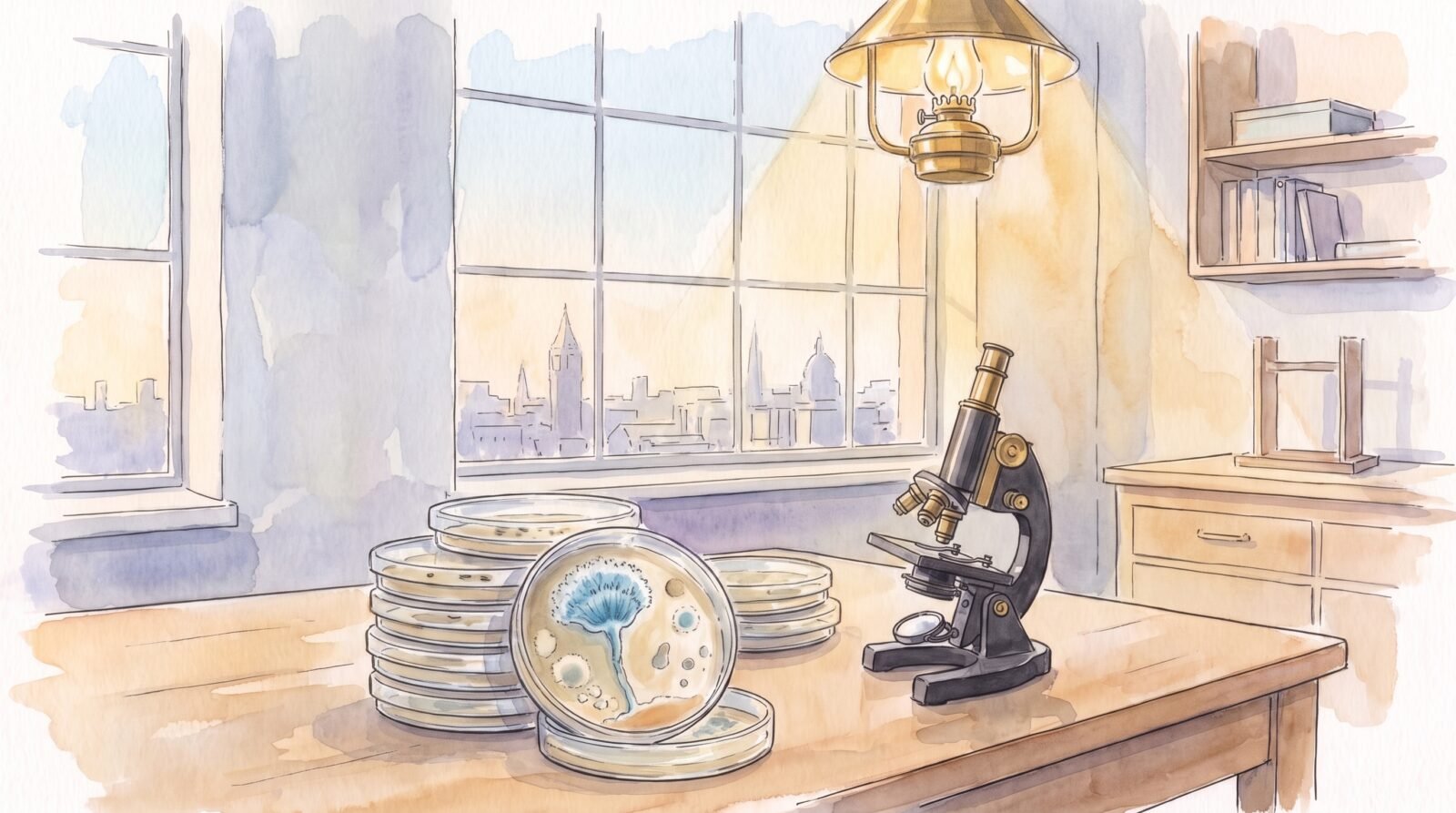
St Mary’s Hospital in 1928
St Mary’s Hospital in Paddington, London, in the late summer of 1928 was one of the most productive bacteriology labs in Britain. The hospital, a Victorian teaching institution attached to the medical school of the University of London, had for two decades housed the Inoculation Department, a research unit founded by Sir Almroth Wright (1861-1947) in 1902 with the support of a small group of clinicians and a substantial endowment from outside the institution. Wright, a Belfast-born bacteriologist whose early work on typhoid vaccination had won him a fellowship of the Royal Society, had built the Inoculation Department around a single broad conviction: that the body’s own immune cells, once understood, could be mobilised against bacterial infection more effectively than the chemical antiseptics favoured by his surgical colleagues. The conviction had put Wright at odds with most of the London teaching hospitals, which in the early twentieth century had treated bacterial wounds with carbolic acid and similar agents, but the conviction had also won Wright a devoted following among a small group of young researchers whom he recruited into his laboratory at St Mary’s.
Alexander Fleming (1881-1955) was the longest-serving of these researchers. Born in Ayrshire, Scotland, to a farming family, Fleming had come to London as a young man and had studied medicine at St Mary’s, qualifying in 1906. Wright, recognising in Fleming a careful and patient observer of bacterial culture plates, had kept him on at the Inoculation Department, where Fleming had spent the next twenty-two years investigating everything from the action of salvarsan in syphilis (a project that had given him extensive first-hand experience of the chemical agents Wright’s rivals favoured) to the role of neutrophils in wound infection. Fleming’s output in those years had been prodigious, even if most of his papers had attracted only modest attention. He had not, by 1928, made the discovery that would make his name familiar to every reader of a general-audience science book. He had earned a reputation as an unusually clean bacteriologist, whose bench did not harbour the contaminations that plagued other workers, and whose glassware was almost always put away.
The Inoculation Department sat on the second floor of a brick building that opened onto Praed Street, and the laboratory occupied a corner room whose windows faced roughly north-west across the rooftops toward the railway sheds of Paddington. The windows could be opened onto a small balcony, and the windows were, in the summer of 1928, frequently left open for ventilation. The room was shared among several researchers and several technicians, and the room contained the customary benches of a bacteriology lab: benches of polished wood, brass gas taps at intervals along each bench, ranks of incubators and autoclaves against the wall, glass-fronted cabinets for stock cultures, and a sink at the end of each bench. Bacteriology in 1928 was a manual craft, and the cleanliness of the work depended on the cleanliness of the bench.
Fleming’s own bench, at the front of the room near the window, was crowded with stacks of Petri dishes at various stages of analysis. Fleming had, in the weeks before September 1928, been investigating the bacterium Staphylococcus aureus, the common cause of boils, wound infections, and several forms of septicaemia. The investigation was a continuation of his long interest in the body’s defences against bacterial infection, and the investigation had involved growing cultures of Staphylococcus on agar plates in standard fashion. The cultures had been made in July and August, and the cultures had been incubated, examined, photographed, and discarded at the end of each working week. The work was, by September, in its routine phase, and Fleming had begun to think about moving on to other questions. He had, however, decided to take his annual holiday in September, and he had arranged for the cultures to be left on the bench until his return, in accordance with his usual habit of leaving plates for a few days so that any contaminating organisms would have time to grow into visible colonies.
The contaminated Petri dish
Fleming returned from his holiday, on 3 September 1928, to find his desk piled with the usual backlog of correspondence and his bench, much to his annoyance, crowded with the accumulated Petri dishes he had left a fortnight earlier. Fleming began, that morning, to clear the bench, and he began by lifting each dish in turn and inspecting the agar for any bacterial growth or any sign of contamination. Most of the dishes, by the time of his inspection, had begun to dry out at the edges and had begun to develop some saprophytic growth on the agar. The dishes were, in sum, the usual mess of an over-long July, and most of them were, by the standards of the laboratory, ready for the autoclave.
One dish, however, was different. The dish, a standard glass Petri dish about ten centimetres in diameter, contained a culture of Staphylococcus aureus that had been heavily contaminated with a mould that had grown into a greenish-grey mass at one edge of the agar. The mould had clearly grown into the dish after the Staphylococcus colonies had already been established, and the mould had grown into the dish with the speed of a vigorous fungal contaminant. The dish was, by any normal standard, an example of a spoiled plate, and the dish should have been discarded along with the others.
Fleming, however, did something unusual. As Fleming later reported, he picked up the dish and held it up to the light and observed that, around the edge of the mould, the bacterial colonies of Staphylococcus had become translucent, and the colonies had, as he put it, appeared to be in the process of dissolution. Fleming had not previously observed a mould that appeared to dissolve bacterial colonies, and the observation was, in his reading, unusual enough to require closer inspection. Fleming took the dish to the laboratory’s incubator and placed the dish under a low-power microscope, and Fleming examined the edges of the colonies at higher magnification. The observation was confirmed. The mould, whatever it was, was producing a substance that was killing the bacteria in its vicinity. The dish was, in Fleming’s later characterisation, the kind of result that one occasionally observed in the course of routine work, and the result was, in his judgment, worth following up.
Fleming’s first task was to identify the mould. The mould, on the basis of its morphology and its appearance, was, in the identification of Fleming and his colleague at the Inoculation Department, the species Penicillium notatum, a species of the genus Penicillium that had been known to botanists and to mycologists since the late nineteenth century. The species had been so named because of the brush-like appearance of its conidial structures, in which the spores were produced on branched conidiophores that resembled a small painter’s brush. The species was a common contaminant of bacterial cultures and of stored food in the early twentieth century, and the species was familiar to bacteriologists in the 1920s. The species was, however, unusual in the degree to which it appeared to inhibit the growth of Staphylococcus, and the species was, in Fleming’s judgment, worth further investigation.
Fleming’s next task was to attempt to isolate and to grow the active substance. Fleming had, by the standard procedures of the bacteriology of the period, attempted to grow the mould in bulk culture, had attempted to extract the active substance from the bulk culture by a number of standard chemical methods, and had attempted to test the activity of the extracted substance against a number of bacterial species. The attempts had, by 1929, produced a substance that Fleming had named penicillin, after the genus Penicillium, and the substance had been shown by Fleming and by his assistants to inhibit the growth of Staphylococcus, of Streptococcus, of Pneumococcus, and of several other bacterial species. The substance had also been shown, in the preliminary tests that Fleming had carried out, to be non-toxic to laboratory animals and to white blood cells, and the substance had been shown to be more potent against bacterial cells than against animal cells. The results had been published, in 1929, in the British Journal of Experimental Pathology, in a paper by Fleming that had reported the discovery of the substance and the preliminary tests of its activity. The paper had attracted some attention, but the attention had been modest, and the substance had not, in 1929, appeared to have immediate therapeutic implications.
Fleming’s attempts and their limits
The story of penicillin from 1929 to 1938 is, in the standard accounts of the discovery of the substance, a story of slow progress. Fleming had, in 1929, published the results of the initial observation and of the preliminary characterisation of the substance, and Fleming had continued, in the years that followed, to attempt to characterise the substance in greater detail and to attempt to produce the substance in a form that could be used clinically. The attempts had, however, encountered a number of difficulties. The chief difficulty had been the instability of the substance, which had appeared to lose its antibacterial activity when stored, which had appeared to lose its activity when purified by the standard chemical methods of the period, and which had appeared to lose its activity when exposed to the standard solvents and the standard pH ranges. The instability had been a major obstacle to the clinical use of the substance, and the obstacle had not been overcome in Fleming’s laboratory by 1939.
A second difficulty had been the difficulty of producing the substance in bulk. Fleming had, in 1929 to 1939, attempted to grow the mould in bulk on the surface of liquid culture media in standard flasks, and the attempts had produced only modest quantities of the substance. The substance was, in the bulk cultures, present at low concentrations, and the substance was, in the subsequent attempts to purify it, lost in the standard chemical purification procedures. The combination of low yield and difficulty of purification had made the substance impossible to produce in clinically useful quantities, and the combination had been the principal obstacle to the clinical use of the substance by 1939.
A third difficulty had been the difficulty of demonstrating the substance’s clinical efficacy in a controlled trial. Fleming had, in 1929 to 1939, attempted to demonstrate the clinical efficacy of the substance in a number of cases of superficial infection, and the cases had produced some encouraging results. The cases had, however, been uncontrolled, and the cases had been difficult to interpret, and the cases had not been sufficient to establish the clinical efficacy of the substance in a controlled trial. The clinical evidence had, in sum, remained suggestive but inconclusive through 1939.
The reception of Fleming’s 1929 paper had been, in the standard accounts, modest. The paper had been cited in subsequent bacteriological literature, but the paper had been cited mostly in the context of contamination studies rather than in the context of therapeutic development. Fleming had continued to receive inquiries about the substance from clinicians and from other bacteriologists through the 1930s, and Fleming had, in response to the inquiries, sent small samples of the substance to a number of laboratories, but the inquiries had not produced the major clinical trial that would have established the substance’s therapeutic efficacy. The inquiries had, however, kept the substance from being entirely forgotten, and the inquiries had, in 1939, been the basis for the rediscovery of the substance by the Oxford team of Howard Florey and Ernst Chain.
Fleming himself, by the late 1930s, had largely moved on to other questions. Fleming had continued his research on the body’s defences against bacterial infection, and Fleming had continued his clinical work at St Mary’s, but the bulk of his research had shifted away from penicillin and toward other questions. The shift had been a natural consequence of the slow progress of the bulk production of penicillin and of the difficulty of demonstrating the clinical efficacy of the substance. The shift had not, however, been an abandonment of the substance, and Fleming had continued to receive inquiries about the substance and to send small samples to inquiring laboratories. The inquiries had, in 1939, included the inquiry that brought the substance to the attention of Howard Florey and Ernst Chain.
Florey, Chain, and the Oxford team
Howard Florey (1898-1968) was an Australian-born pharmacologist and pathologist who, in 1935, had been appointed to the chair of pathology at the Sir William Dunn School of Pathology at the University of Oxford. Florey had, before his appointment at Oxford, conducted extensive research on the inflammation and on the function of white blood cells, and Florey had built a substantial research group around himself at Oxford. One of Florey’s early appointments at Oxford had been Ernst Chain (1906-1979), a German-Jewish refugee biochemist who had left Germany in 1933 after the dismissal of the Jewish scientists from the German universities and who had arrived at Cambridge in 1933 on a fellowship from the British Council for the Assistance of Refugees from Germany. Chain had, in the years before his move to Oxford, been investigating the biochemistry of enzymes at Cambridge, and Chain had developed an unusually broad expertise in the biochemistry of biologically active substances.
Chain, at Oxford, was looking for substances with antibacterial activity that could be developed into clinical agents. Chain was, in this context, familiar with the earlier literature on antibacterial substances, and Chain had, in 1938 to 1939, been reviewing the literature systematically. Chain had come across Fleming’s 1929 paper on penicillin, and Chain had been struck by the potential of the substance for clinical use, despite the difficulties that Fleming had reported. Chain had, with the agreement of Florey, undertaken a systematic investigation of the substance, and Chain had begun the investigation by attempting to purify the substance using the modern methods of biochemistry that had been developed in the 1930s. The investigation had, by 1939, produced a substance that had, in Chain’s tests, a substantially higher activity than Fleming’s earlier preparations, and the substance had, in Chain’s tests, been effective against a number of bacterial species in a controlled laboratory setting.
The next step had been a test in animals. Florey had, in May 1940, with the outbreak of the Second World War, been aware of the urgent need for an effective antibacterial agent that could be used to treat the wound infections that had been the principal killer of soldiers in the First World War. Florey had arranged a controlled test of the Oxford penicillin in mice that had been infected with a lethal dose of Streptococcus pyogenes, and Florey had run the test on 25 May 1940. The test had produced a striking result: the mice that had received the penicillin had survived, and the mice that had not received the penicillin had died. The result had been replicated in subsequent tests, and the result had been a major breakthrough in the development of the substance.
The next step had been a test in humans. Florey had, on 12 February 1941, treated a patient, a 43-year-old woman named Agnes Savill, with a severe staphylococcal infection that had not responded to the standard treatments of the period. The patient had been given the Oxford penicillin in a series of intravenous injections, and the patient had, over the course of the next two weeks, shown a remarkable improvement. The patient had begun to recover from the infection, and the patient had begun to gain weight and to regain her appetite. The patient had, however, ultimately died, because the supply of penicillin had run out before the infection had been completely cleared. The death had been a setback, but the setback had not, in the judgment of Florey and Chain, been a fatal setback, and the setback had been addressed by the development of methods for the bulk production of penicillin at Oxford.
The development of the bulk production methods had become a major task for the Oxford group. The methods that had been developed at Oxford had been based on the surface culture of the mould in large numbers of flasks, and the methods had produced penicillin at a rate of approximately one litre per week by the end of 1941. The methods had been, however, time-consuming and labour-intensive, and the methods had not produced penicillin at the rates required for widespread clinical use. The required rates had been, in the judgment of Florey, orders of magnitude greater than the rates that had been available at Oxford, and the rates had required a major industrial effort.
Mass production and the wartime effort
The industrial effort had been undertaken jointly by the British and the American governments during the Second World War. The British effort had been constrained by the wartime demands on British industry, and the British effort had been, in the early 1940s, modest. The American effort had been, in contrast, substantial, and the American effort had been led by two pharmaceutical companies: Merck & Co. and the then-named E.R. Squibb & Sons, both of which had received contracts from the United States government to develop the large-scale production of penicillin. The contracts had been arranged by the Office of Scientific Research and Development (OSRD) under Vannevar Bush and by the National Research Council’s Committee on Chemotherapy, and the contracts had been a major feature of the American wartime scientific effort.
The development of the large-scale production of penicillin had required, in addition to the industrial effort, the development of a number of new methods for the production and the purification of the substance. The methods had included deep-tank fermentation, in which the mould was grown in large, stirred, aerated tanks rather than on the surface of culture media in flasks, and the methods had included improved methods for the extraction of the substance from the fermentation broth and for the purification of the substance by chromatography and by other methods. The methods had, by the end of 1942, produced penicillin at rates that were, in the judgment of the American pharmaceutical companies, sufficient for clinical use, and the methods had, by the end of 1942, produced penicillin at rates that were sufficient for the treatment of the war wounds of the Allied forces.
The first major clinical results of the wartime effort had come in 1943, with the use of the American-produced penicillin in the treatment of wounded Allied soldiers in North Africa and Sicily. The clinical results had been striking. The wounded soldiers who had been treated with penicillin had, in the judgment of the medical officers, recovered from wound infections that had previously been almost uniformly fatal, and the wounded soldiers had, in many cases, been saved by the penicillin. The clinical results had been a major vindication of the wartime effort, and the clinical results had been a major factor in the subsequent effort to develop the substance further.
The Peoria connection had been a major feature of the wartime effort. The Northern Regional Research Laboratory (NRRL), a federal laboratory of the United States Department of Agriculture in Peoria, Illinois, had, in 1942, been tasked with the development of improved methods for the production of penicillin by deep-tank fermentation. The NRRL had, in 1942, developed a method based on the use of corn-steep liquor (a by-product of the corn-milling industry) as a culture medium for the mould, and the method had substantially increased the yield of penicillin per unit of culture medium. The NRRL had also, in 1942 to 1943, screened a number of strains of Penicillium for higher yields, and the screening had identified a strain of Penicillium chrysogenum that had produced substantially higher yields than Fleming’s original Penicillium notatum. The combination of the improved culture medium and the improved strain had, by 1943, increased the yield of penicillin by approximately a hundredfold, and the increase had been a major factor in the subsequent industrial success of the substance.
The Peoria connection had also, in 1943, led to a search for additional strains of Penicillium that had produced higher yields. The search had been assisted by the United States Army Air Force, which had flown a number of researchers around the world in search of strains of Penicillium, and the search had identified a strain of Penicillium chrysogenum that had produced the highest yields of any strain tested at the time. The strain had, in the judgment of the researchers, been the strain that had produced the basis for the subsequent industrial production of penicillin, and the strain had been the basis for the industrial production of penicillin at Merck and at the other American pharmaceutical companies through the rest of the 1940s.
The antibiotic era
The success of the wartime penicillin programme had been followed, in the late 1940s and the 1950s, by the development of a series of additional antibiotics. The development had included the development of streptomycin by Albert Schatz and Selman Waksman at Rutgers University in 1944, and streptomycin had been the first effective antibiotic against tuberculosis. The development had included the development of the tetracyclines and the development of erythromycin in the early 1950s, and the antibiotics of the 1950s had been added to the arsenal of the clinical medicine of the period. The development had, in sum, been a major feature of the clinical medicine of the mid-twentieth century, and the development had been one of the principal reasons for the dramatic decline in mortality from bacterial infections in the period.
The antibiotic era had, however, also produced one of the major challenges of the late twentieth and the early twenty-first centuries: the rise of antibiotic resistance. The use of antibiotics in clinical and in agricultural settings had, by the 1950s, begun to select for strains of bacteria that were resistant to the antibiotics, and the rise of antibiotic resistance had, by the 1970s, become a major feature of the clinical and the public-health landscapes of the period. The rise of antibiotic resistance had, in turn, produced a renewed interest in the search for new antibiotics, and the renewed interest had, by the early twenty-first century, produced a small number of new antibiotic classes that had been added to the arsenal of clinical medicine of the period.
The discovery of penicillin had, in sum, been one of the most consequential accidents in the history of scientific discovery. The discovery had, on the basis of the standard accounts, been an unexpected observation that had been made by a careful bacteriologist in the course of routine work, and the observation had, after a decade of slow progress and a major wartime effort, been the basis for the development of a new class of medicines that had, by the second half of the twentieth century, saved tens of millions of lives and that had, by the second half of the twentieth century, transformed the clinical and the public-health landscapes of the modern world. The discovery had, in 1945, been recognised by the award of the Nobel Prize in Physiology or Medicine to Fleming, to Florey, and to Chain, and the award had been a major vindication of the collaborative effort that had produced the substance. The discovery is, in sum, one of the central events in the history of modern medicine, and the discovery is the event that decisively shaped the subsequent history of clinical medicine in the modern world.
References
- The Mold in Dr. Florey’s Coat: The Story of the First Miracle Drug — Eric Lax, Henry Holt, 2004.
- Penicillin: A Short History — Robert Bud, Cambridge University Press, 2007.
- Alexander Fleming: The Man and the Myth — Gwyn Macfarlane, Oxford University Press, 1984.
- Howard Florey and the Development of Penicillin — Trevor I. Williams, Oxford University Press, 1984.
- The Oxford Penicillin Group: A Reappraisal — Robert Bud, in Notes and Records of the Royal Society, 1996.
- The Wartime Production of Penicillin in the United States — Robert P. Swain, in Bulletin of the History of Medicine, 1986.
- The Peoria Connection: Antibiotic Development at the Northern Regional Research Laboratory — Robert D. Coghill, in Journal of Industrial Microbiology, 1991.
- Ernst Chain and the Biochemistry of Penicillin — Robert Bud, in Trends in Biochemical Sciences, 1989.
- St Mary’s Hospital and the Inoculation Department — L. J. Ludovici, William Heinemann, 1952.
- Almroth Wright and the Bacteriology of the Early Twentieth Century — Michael J. C. Martin, in Medical History, 1978.
- The Discovery and the Initial Reception of Penicillin — Robert Bud, in Social History of Medicine, 1998.
- The Clinical Trials of Penicillin in 1941 and 1942 — R. I. C. Speirs, in British Medical Journal, 1978.
- The Antibiotic Era: A History — Scott H. Podolsky, Harvard University Press, 2015.
- Selman Waksman and the Discovery of Streptomycin — Pauline M. Vaillancourt, in Journal of the History of Medicine, 2000.
- The Rise of Antibiotic Resistance in the Twentieth Century — Michael A. Kohanski et al., in Nature Reviews Microbiology, 2010.
- The Nobel Prize in Physiology or Medicine 1945 — Nobel Foundation, 1945.