The Discovery of Anaesthesia
For most of the history of surgery the binding constraint on an operation was not the surgeon’s skill but the patient’s tolerance of pain, and the clock every ambitious procedure had to beat was the clock of the patient’s endurance. It took the better part of a century, and the accumulated accident of chemists, showmen, dentists and rivals, to produce a drug that lifted that constraint, and the demonstration at the Massachusetts General Hospital in October 1846 was the moment it visibly broke.
What followed is less a clean discovery than a scramble for credit, and then a long and lethal argument about how the new drug should be given. The story runs from the laughing gas parties of the 1820s, through chloroform and the royal birthing room, into the speciality that grew out of the disasters, and on to the machines and monitors of modern operating theatres.
The Pain That Made the Clock
Until the middle of the nineteenth century the surgeon’s art was shaped by a physiological fact: a human being in pain cannot be asked to hold still. Operations had to be fast, because speed was the only anaesthetic there was. Assistants held the patient down, the surgeon worked against blood loss and struggling, and the repertoire of procedures that could survive those conditions was very small. There was no way to open the abdomen without a fight. Pain was not a side effect of surgery; it was the limiting factor that decided what surgery was.
The chemical that would change that was in the hands of chemists before anyone thought to use it on a patient. In 1772 Joseph Priestley, working on gases released from the “nitreous air” of the atmosphere, produced what he called dephlogisticated nitrous air. It was not the pure gas that would later carry the name of nitrous oxide but a mixture containing it, and Priestley noted only that it made people laugh and sing. The gas then sat in the laboratory for most of a century as an amusing curiosity and a mild intoxicant.
The man who turned it into a serious proposal was Humphry Davy. Working with Thomas Beddoes and the engineer James Watt, Davy supervised gas manufacture at the Pneumatic Institution at Hotwells near Bristol, established by Beddoes in 1798 to treat disease by inhalation. It was a peculiar enterprise: a laboratory treating patients with gases, some useful, some lethal. In 1799 Davy inhaled nitrous oxide himself, found that it relieved a toothache, and published the observation. His book of 1800, Researches, Chemical and Philosophical, chiefly concerning Nitrous Oxide, argued that a surgeon who could render a patient insensitive could abolish the suffering of an operation. It also gave the gas its popular name.
For three decades the gas was mostly a party drug, and the parties were serious business. In Britain the fashionable inhaled it for the giddiness and the euphoria; in the United States it spread faster, and George Poe was among the earliest American producers and the first to liquefy the gas. Travelling lecturers worked the towns with it. By the late 1830s a distinct institution had appeared: the “ether frolic”, a gathering at which nitrous oxide was inhaled in company, and where participants were observed afterwards to bruise themselves badly and remember nothing of the pain.
It was at a frolic that two young men from Rochester, New York, first understood what they were looking at. William Edward Clarke and William Morton, classmates, watched fellow students come round from an evening of inhaling the gas with injuries they could not account for. The inference was available to anyone who made it: if a person can injure himself and not feel it, then a surgeon can cut without the patient feeling it. Clarke acted first. In January 1842, a few months before Morton, he administered ether to a young woman while the dentist Elijah Pope extracted a tooth, the first time an inhaled anaesthetic was used for a surgical procedure. Clarke never published the case.
Crawford Long saw the same inference and acted on it in the same year, with more permanence. Long was a physician and pharmacist in Jefferson, Georgia, trained in Philadelphia, where ether was part of the currency of student talk. On 30 March 1842 he removed a tumour from the neck of a nineteen-year-old youth named James Venable, and his account is matter-of-fact in a way later readers found almost shocking: the anaesthetic was ether, poured on a towel, the towel held over the patient’s face, and the operation went ahead. Long also experimented on the enslaved people on his plantation, and those cases appear in his own published account.
Long’s priority claim is the strongest of the three and the least persuasive, for a reason that has nothing to do with the truth. He told the story in a letter of 1842 to a medical friend in Philadelphia, noting also that a dentist and a surgeon from Boston had been using the gas. Then he published nothing for seven years, and when his paper appeared in 1849 the world he was describing had been overtaken. Long petitioned the Senate through Senator William Crosby Dawson of Georgia and never got a national reward. He had the earliest date; what he lacked was the thing that turns a date into a discovery, a public and repeatable demonstration strangers can verify.
The third claimant solved that problem and created a different one. Horace Wells was a Hartford dentist, and in December 1844 he attended a public demonstration of nitrous oxide by a former pupil of his own, Gardner Quincy Colton, at Union Hall. One volunteer, an apothecary clerk named Samuel Cooley, injured his leg without noticing, and when the bleeding was pointed out Wells grasped what had happened. The following day Wells had a tooth extracted, with the gas administered by Colton and the extraction done by the dentist John Mankey Riggs. His reported remark, that it was the greatest discovery ever made and that he had felt no more than the prick of a pin, captures the moment the gas stopped being entertainment. Wells went on to publish a book on nitrous oxide and surgical insensibility in 1847.
Then came the demonstration that ended his career. In late January 1845, with the exact day given differently in different accounts, Wells tried to repeat the trick in Boston, at Harvard and at the Massachusetts General Hospital, with John Collins Warren in the audience. The gas was badly given, or withdrawn too early, and the patient cried out. The Wood Library Museum of Medicine records that the hospital’s chief surgeon had sponsored the affair on the assumption that the effect was real. Wells was broken by it. He went to Paris seeking recognition, was admitted to the French Academy of Medicine in January 1848, twelve days before his death in New York at the age of thirty-three. In 1870 the American Medical Association resolved that the honour of the practical discovery of anaesthesia belonged to Horace Wells of Connecticut.
The forty years from Priestley’s gas to the Boston amphitheatre were not a failure of imagination. The substance was known, the effect was known, the delivery was trivial, and the inference had been drawn correctly by at least four people in three countries. What was missing was an institution: somewhere the effect could be tested reliably, where a patient could be watched, where the operator could not be fooled by his own enthusiasm, and where strangers could come and check.
Sixteen October 1846
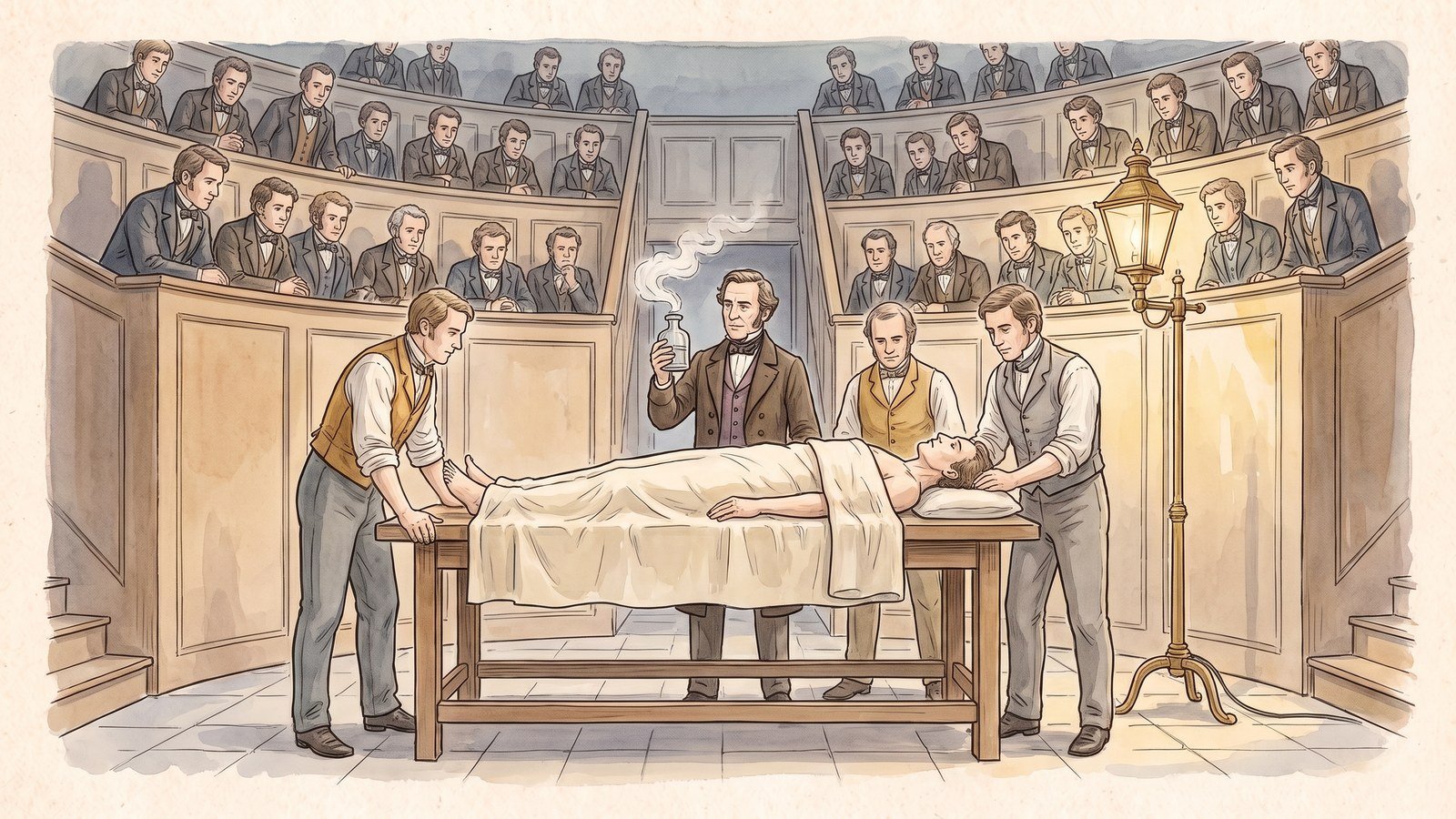
The theatre that satisfied the requirement was the surgical amphitheatre at the Massachusetts General Hospital in Boston, a steep semicircle of wooden benches above a single operating table, built for the medical students of Harvard and, from the 1840s, for a small standing audience of Boston physicians. The Wood Library Museum preserves it, and in 1965 it was registered as a National Historic Landmark, the recognition it deserved for being the place where a fraud and a fact were separated in about sixty seconds. The demonstration was arranged by Henry Jacob Bigelow, the surgeon who would make surgery a Harvard speciality.
The man who performed it was a dentist. William Thomas Green Morton had come to Boston from an apprenticeship in the west, had studied under Wells and under a dentist named Nathan Cooley Keep, and had entered Harvard Medical School in the autumn of 1844, where he attended the chemistry lectures of Charles Thomas Jackson and learned enough about ether to buy a bulb and a tube of the fluid. On 30 September 1846 Morton had already removed a tooth for a Boston music teacher named Ebenezer Hopkins Frost without pain, and the dentist praised the method so loudly that a colleague decided the public should see it. The colleague who arranged the Boston demonstration, the Wood Library Museum notes, was Wells’ former partner.
On 16 October 1846 Morton stood in the amphitheatre with his inhaler and John Collins Warren stood at the table. The patient was a young man named Edward Gilbert Abbott, described in the accounts as a printer and variously given as about twenty years old, with a vascular tumour of the neck. The precise diagnosis has been argued over ever since, itself a measure of how little was written down at the time. What is not in dispute is that the knife went across the neck, that the man on the table said nothing, and that the audience concluded that he could not feel it. Warren is reported to have turned to the benches and said: “Gentlemen, this is no humbug.”
Within weeks the news had crossed the Atlantic. On 19 December 1846, the same day an English claim was made at the Royal Infirmary in Dumfries in Scotland, James Robinson, a dentist working in London, administered ether to a patient named Miss Lonsdale at the house of Francis Boote, an American-born physician long established in England. Boote’s account, published in The Lancet in 1847, is remarkable medical writing: the young woman, he recorded, afterwards denied having felt anything at all, and Boote concluded that ether must act on the brain and the nerves rather than merely on the seat of the pain. Before the year was out the method had reached Launceston in Tasmania. Within four months of a demonstration in a wooden theatre in Boston, painless surgery was a practice with a market.
And then the argument started, and it has never entirely stopped. There were at minimum four claimants, each making a different kind of claim. Charles Thomas Jackson said he had told Morton about ether and that the dentist had taken his idea. Crawford Long said he had operated on 30 March 1842, two years before the Boston theatre, and had a letter to prove it. Horace Wells said he had discovered the principle, had published first, had been recognised in Paris, and had been killed by the recognition arriving too late. Morton said he had demonstrated it, in front of witnesses, in a hospital, with a result that could be repeated the following week. Behind all four sat a fifth presence the dispute never acknowledged: the anonymous body on the table, who had no claim at all and was the only one of the party who could not be cross-examined.
The dispute ran through the courts of two continents and through the United States Congress. Morton applied to Congress in December 1846 for a national reward and pursued the claim for years, including a suit against the United States argued by the future jurist Richard Henry Dana junior; the claim failed. Long petitioned the Senate through a Georgia senator and failed. Wells had already lost everything. The question was never formally adjudicated in any court that mattered, and the professional bodies that tried to settle it settled it in incompatible ways: the American Medical Association honoured Wells in 1870, while the technique that survived everywhere was Morton’s. Morton died in New York on 15 July 1868, and his monument carries an epitaph no committee ever wrote: “Before whom, in all time, surgery was agony; by whom, pain in surgery was averted; since whom, science has control over pain.”
Read the dispute correctly and it says something uncomfortable about how discoveries are made. Long had the earliest date and the least interest in publicity, because he was a country doctor with a pharmacy and no reason to travel. Jackson had the earliest conversation and no patent. Wells had the earliest insight into clinical use and the worst luck with the demonstration. Morton had the earliest successful public performance, a patent, and a talent for claiming. Nothing about the order of these facts corresponds to the order of importance, and nobody in 1846 could have told which would be vindicated, because the deciding instrument was not an argument at all. It was the ether dome itself, a theatre in which the same claim could be put to the same test before the same strangers.
Chloroform and the Cloth on the Face
Chloroform had been available for sixteen years before anyone gave it to a patient. The liquid was made around 1830 and 1831, independently and more or less simultaneously, by Samuel Guthrie in the United States, by Eugene Soubeiran in France and by Justus von Liebig in Germany; a German pharmacist, Moldenhawer, appears to have prepared it first, in 1830, but mistook it for chloric ether and lost the credit. In 1834 the chemist Dumas worked out its formula and gave it its name. It sat in the pharmacy as a liniment for aches, and its taste was reportedly not unpleasant, which mattered more than anything else about it.
Someone had already proved what it did. In 1842 Robert Mortimer Glover, a medical student in Edinburgh, wrote a Harveian Society prize essay on the physiological and medicinal properties of bromine and its compounds, and established experimentally that chloroform produced surgical anaesthesia in dogs. James Young Simpson was one of the examiners of the thesis, and later denied that he had read it. Glover’s response was a series of hot letters in 1847 and 1848 accusing Simpson of taking the discovery, and the two were still exchanging them when Glover died young. The Anaesthesia journal later published an account of him titled “The short, tragic life of Robert M. Glover”, a fair summary of how the history of anaesthesia treats the people it discarded.
Simpson was a busy Edinburgh obstetrician who had taken the chair of midwifery in 1840 and had begun using ether in labour. On 19 January 1847 he used it in a difficult labour and was not satisfied with it, and a local chemist, David Waldie, suggested trying chloroform instead. On 4 November 1847 Simpson, with George Skene Keith and James Matthews Duncan, inhaled the new agent in the dining room at 52 Queen Street, and all three collapsed. On 8 November he administered chloroform in a labour, on 10 November he reported the result to the Medico-Chirurgical Society of Edinburgh, and the pamphlet Account of a New Anaesthetic Agent came out in mid-November. Within weeks chloroform had very nearly displaced ether across Britain and Ireland.
Why it won is a question about apparatus, and it is the whole question. Ether needs a substantial quantity of fluid, a bulb or a sponge and a bellows, and ether vapour is flammable enough that a theatre has to think about lamps. Chloroform needs a teaspoon, a folded cloth and a hand. It is portable, cheap, quick-acting, non-flammable and requires no apparatus at all. The entire technology of the delivery collapsed to three objects, and one of them, the cloth, could be slipped into a surgeon’s pocket.
And that collapse is exactly what made chloroform lethal. With a bottle and a cloth, the concentration the patient breathed was not a number anybody could set. It depended on how much had been poured, how the cloth was folded, the temperature of the room, the distance from the nostrils and how long it was held. The administrator could watch the patient’s face, but the face is a late and ambiguous indicator: the signs of chloroform poisoning, which is to say of respiratory and cardiac depression, look very much like the signs of ordinary surgical sleep until the moment they do not. Every question the anaesthetic literature spent the following century arguing about is downstream of that single decision to make the delivery simple.
The opposition came fast and it came respectable. In December 1847 Simpson published a pamphlet answering the religious objections raised against anaesthetic agents in midwifery and surgery. In it he recorded how often patients had objected to the superinduction of anaesthesia in labour “on the assumed ground, that an immunity from pain during parturition was contrary to religion and the express commands of Scripture”, and noted that “Not a few medical men have, I know, joined in this same objection”. His conclusion was a prediction rather than an argument: “Medical men may oppose for a time the superinduction of anaesthesia in parturition, but they will oppose it in vain; for certainly our patients themselves will force the use of it upon the profession.”
The campaign in Scotland is usually described as having taken formal shape in a petition to the authorities asking that anaesthetic agents be withheld from obstetrics, with Simpson’s printed reply forming part of the record. How large and how well organised that campaign actually was has since been disputed, and recent scholarship argues that the scale of the clerical and medical alliance was inflated by later biographers keen to make Simpson’s triumph look hard-won. The objections were serious, they came from respectable people, and they were not only about scripture: there were objections about haemorrhage, about the infant, and about the safety of a substance nobody had characterised. In Scotland anaesthetics were commonly administered by medical students, while in English hospitals they were increasingly reserved to qualified doctors, a difference that made Edinburgh faster than London at exactly the moment when being fast was fatal.
The first deaths arrived in the new year. On 28 January 1848 Hannah Greener, a fifteen-year-old girl, died at her home near Newcastle after a doctor poured chloroform onto a tablecloth to remove an infected toenail. She died within minutes, the case went to an inquest, and the medical journals argued about it for months. Simpson, three hundred miles away, argued from the published account that the brandy used in the attempted resuscitation, not the chloroform, had killed her. The practitioner, Thomas Meggison, replied. An editor pointed out what was obvious and still is: nobody who had not been in the room could settle the cause of death, and everybody who had been in the room had an interest in the answer.
Snow kept the record, and his second entry is instructive. On 23 February 1848, at Cincinnati, Mrs Martha G. Simmons had four teeth extracted by two dentists who were not members of the medical profession, using an inhaler adapted from Morton’s ether globe, and she died about two minutes into the operation. Snow’s account of the post-mortem in 1858 records the blood in the heart fluid and the chambers empty: a heart that had stopped rather than a lung that had failed. He continued the sequence with a patient of John Griffith at the New York Hospital in January 1849. What the cases had in common was not the chemical but the dose, the distance, the absence of anyone trained watching the breathing, and the fact that the person administering the anaesthetic was breathing more of it than the patient was.
The Royal Endorsement and the Deadly Arithmetic
The man who turned the scattered cases into a body of knowledge was John Snow. He had trained as a surgeon, practised as a physician, and by the middle of the 1840s was the most accomplished and most careful anaesthetist in Britain. His apparatus of 1848 was designed to deliver a measurable dose rather than a saturated cloth, and from the beginning he kept case books recording dose, duration, operation and outcome. His fuller account, On Chloroform and Other Anaesthetics, appeared in 1858 after his death with a memoir by Benjamin Richardson: a founding document of the specialty, a book about the administration of a drug, written by a man who treated the administration as the thing that mattered.
His most famous patient was not a patient. On 7 April 1853 Queen Victoria gave birth to her eighth child, Prince Leopold, and Snow was summoned to Buckingham Palace and administered chloroform on a folded handkerchief, in small doses timed to the contractions, for about fifty-three minutes, without producing complete unconsciousness. The Queen came to describe the effect as “delightful beyond measure”, and she was summoned again for Princess Beatrice in April 1857. The royal endorsement was enormous as propaganda and real as fact: a drug a monarch used to relieve childbirth could no longer be called a frivolous experiment. But it should be kept in proportion. When Connor and Connor examined the contemporary medical literature in 1996 for evidence that the royal administrations had produced a decisive breakthrough, they found none. The Queen used chloroform because Snow was the best anaesthetist in Britain, not because using it had become safe.
The arithmetic of chloroform is the part of the story that has to be faced. For the first twenty years after its introduction the deaths existed only as a scatter of individual case reports in provincial journals, and their number was invisible. Snow began counting them, and by 1858 he had assembled some fifty published or reported deaths under chloroform. When the nineteenth century closed the tally was being taken properly: the Lancet ran an inquiry in 1890 and a full commission reported in 1893, and Ernst Gurlt surveyed the German literature for 1890 to 1897. Summarised by Adolf Killian in 1934, the figures put fatal complications under ether at somewhere between one in fourteen thousand and one in twenty-eight thousand, and under chloroform at somewhere between one in three thousand and one in six thousand. Chloroform was several times more lethal than ether, and it was the agent obstetrics had chosen.
Behind those numbers is a mechanism that took just as long to establish. The great nineteenth-century question was whether chloroform killed by stopping the breathing or by stopping the heart, and the answer decided what to do about it. In 1911 David Levy showed in animals that chloroform can precipitate ventricular fibrillation, which settled the cardiac question and, in the long run, ended chloroform’s reign in the West. In the meantime the scale of use was such that the death toll was not a set of tragedies but a rate: between 1865 and 1920 chloroform was used in somewhere between eighty and ninety-five per cent of all general anaesthetics in Britain and the German-speaking countries, and the practitioners who sat at the mask absorbed that rate along with their patients. The danger was invisible, because the drug was invisible and the failure was silent.
What emerged from the arithmetic was a speciality, and it emerged for a reason with nothing to do with scientific elegance. By the end of the nineteenth century anaesthesia had become a specialty of London medicine, while elsewhere it remained in the surgeon’s hands, delegated to a junior doctor, to a medical student, or to a nurse working to a standing order. The pressure to separate it came from three directions at once: the pharmacology, which demanded someone whose whole job was to watch the concentration and the patient; the apparatus, which demanded someone who could maintain and troubleshoot a machine; and the law, which made the surgeon’s own neck the shortest in the room. And the fourth pressure was the one that mattered most in the small hours: if the person giving the anaesthetic was also the person operating, the patient was being watched by the busiest pair of hands in the building.
The institutional response took shape in the early 1930s, when most anaesthetics in Britain were still being given by general practitioners as a sideline to a practice with no other way of earning money. The Association of Anaesthetists of Great Britain and Ireland was founded in 1932 by Henry Featherstone. It fought, slowly and at first unsuccessfully, for the anaesthetist to be recognised as a consultant rather than a technician, and it was instrumental in establishing the Faculty of Anaesthetists of the Royal College of Surgeons of England in 1947, the body that became the Royal College of Anaesthetists. Its motto translates the Latin on its coat of arms, in somno securitas: safe in sleep, and its Anaesthesia Heritage Centre in London holds more than four thousand five hundred objects, the earliest dated to 1774. The historical record of anaesthesia is unusually good, not because the participants were orderly but because they were litigious: every claim was written down, argued in print and answered in kind.
What Anaesthesia Made Possible
The first thing to say about the consequences of anaesthesia is that the numbers are hard to come by and the change in kind is not. Nineteenth-century hospital registers were kept for accounting, not for epidemiology, and it is largely because of that gap that the scale of the surgical expansion after 1846 is still argued over. But the direction and the mechanism of the change are not in doubt. The length of an operation stopped being set by the patient’s endurance, and the operative repertoire widened from the surface of the body to the inside of the abdomen. The clock that governed the theatre was replaced by a second clock, the anaesthetist’s.
The most dramatic consequences were in obstetrics and gynaecology, because chloroform was adopted there faster and more widely than anywhere else, and because the pain of childbirth was the one pain medicine had explicitly been expected to relieve. With the patient unconscious, forceps delivery became a controlled operation rather than a crisis, and repair of tears and evacuation of the uterus became possible at all. Simpson’s practice in Edinburgh became a destination, and the Royal Maternity and Simpson Memorial Hospital was opened in 1879 to carry on the work. The effect was not simply that women stopped suffering; it was that the pelvis and the birth canal ceased to be places where a surgeon had to improvise under time pressure.
The second consequence was the abdomen, and the airway work went hand in hand with it. A surgeon who cannot rely on the patient staying still cannot handle bowel or open a gallbladder, and relaxation of the abdominal wall was the most valuable thing anaesthesia gave to operative surgery. Frederick Trendelenburg performed the first elective tracheotomy for general anaesthesia in 1871, and William Macewen passed a tube from the mouth into the trachea in 1880. Chevalier Jackson’s laryngoscope in 1913 gave the anaesthetist a way to see the airway from the outside. Ivan Magill gave the specialty the nasotracheal tube and forceps for passing tubes blind; in 1928 Charles Guedel produced a cuffed endotracheal tube with a pilot balloon, which finally made a sealed airway possible; in 1943 Robert Macintosh gave it the curved blade that bears his name. Every one of those steps was a step towards taking over the breathing of a human being, and taking over safely.
The muscle relaxants arrived in the 1940s and changed the character of the specialty overnight. Curare had been a hunting poison for centuries and a puzzle to pharmacology; in 1942 the alkaloid d-tubocurarine was given to a patient at Bellevue Hospital in New York and the abdominal wall went slack. That observation did more for abdominal surgery than any drug before it, because it removed the last physiological reason to keep the patient conscious during an operation on muscle. It also made controlled ventilation possible, because a patient whose muscles were paralysed and whose airway was sealed could be breathed for by a machine.
And the ventilator is why anaesthesia gave birth to intensive care. The epidemics of poliomyelitis of the 1950s forced hospitals to ventilate paralysed patients in quantity, and the Copenhagen epidemic of 1952 was the decisive shock, because a great many young people were suddenly unable to breathe and hospitals had to build the machinery and the teams to help them. Those teams were anaesthetists, because anaesthetists already understood ventilation, airways and the management of the unconscious patient. The modern critical care unit is an anaesthetic technique applied at length, carrying the specialty’s characteristic habits with it: a machine at the head of the bed, a display that reports what the patient is actually doing, and a professional who watches those numbers continuously.
The drugs changed too. Barbital in 1902 gave a sedative that could be taken by mouth; sodium thiopental in 1934 put an anaesthetic into a syringe and made intravenous induction possible; meperidine in 1939 gave the specialty its own analgesic; and halothane in 1956 gave it a volatile agent that was not flammable, which with the cuffed airway and the ventilator completed the modern anaesthetic as it was used for the rest of the century. The later fluorinated ethers refined it further, trading speed and potency against the properties that matter in an ordinary list: blood pressure, airway reactivity, and the speed at which the patient comes back to himself.
The twentieth century also removed the fire risk and the occupational risk, and then invented the monitoring. The anaesthetic machine became the unit of organisation for the whole specialty: vaporisers to set the concentration, a ventilator to take over the breathing, a breathing circuit to connect the two, scavenging to carry waste gas out of the room, and pressure gauges to show what the machine was doing. The electrocardiograph, the blood pressure cuff, the pulse oximeter and the capnograph were the means by which the anaesthetist’s assumption, that the patient was tolerating the drug, stopped being an assumption. The dose became a number on a dial and the monitor reported what the number did, which is the whole difference between the chloroform cloth and a modern theatre in one sentence. Scavenging is a measure for the staff rather than the patient, since the anaesthetist at the mask breathes far more of the drug than the patient does.
Which brings the story back to where it started, and to the peculiar character of the discovery itself. The substance that removed pain from surgery spent its first forty years as a party drug with a bad name, tested on volunteers at frolics, on a boy in Georgia, on enslaved people on a plantation and on a printer’s boy with a tumour in his neck. It was made by a chemist, sold by a travelling lecturer, administered by a dentist, stolen and defended by rivals, blessed by a monarch, and killed more people than it saved for half a century. Nobody planned painless surgery. A great many people, each with their own interests, pushed the same substance in the same direction for forty years, and the reason we know so much about it is that every one of them was busy explaining why it had been their idea. The institutions that finally made it safe came later and were duller and more useful than the discovery itself: a speciality with its own examinations, a monitoring standard, a machine that fails safe, and a scatter of archives holding the letters, the minutes and the patents. The interesting thing about the route from Priestley’s retort to a modern anaesthetic machine is not that it was fast or slow but that it was so crowded.
References
- The Ether Dome — Wood Library Museum of Medicine, Harvard Medical School
- Nitrous oxide — Wikipedia contributors
- Anesthesia — Wikipedia contributors
- Horace Wells — Wikipedia contributors
- Crawford Long — Wikipedia contributors
- William T. G. Morton — Wikipedia contributors
- Account of a case of tooth extracted without pain — Francis Boote, The Lancet, 1847
- Account of a new anaesthetic agent [chloroform] as a substitute for sulphuric ether in surgery and midwifery — James Young Simpson, communicated to the Medico-Chirurgical Society of Edinburgh, 10 November 1847, Wellcome Collection
- Remarks on the superinduction of anaesthesia in natural and morbid parturition, with answers to alleged religious objections against the practice — James Young Simpson, Edinburgh, 1848, Internet Archive
- On chloroform and other anaesthetics — John Snow, with a memoir by Benjamin Richardson, London, 1858, Internet Archive
- Chloroform — Wikipedia contributors
- Chloroform anaesthesia, 1847 — Historia Medica, Royal College of Physicians of Edinburgh
- History of general anesthesia — Wikipedia contributors
- Association of Anaesthetists of Great Britain and Ireland — Wikipedia contributors