The Compact Disc
What the Compact Disc Was
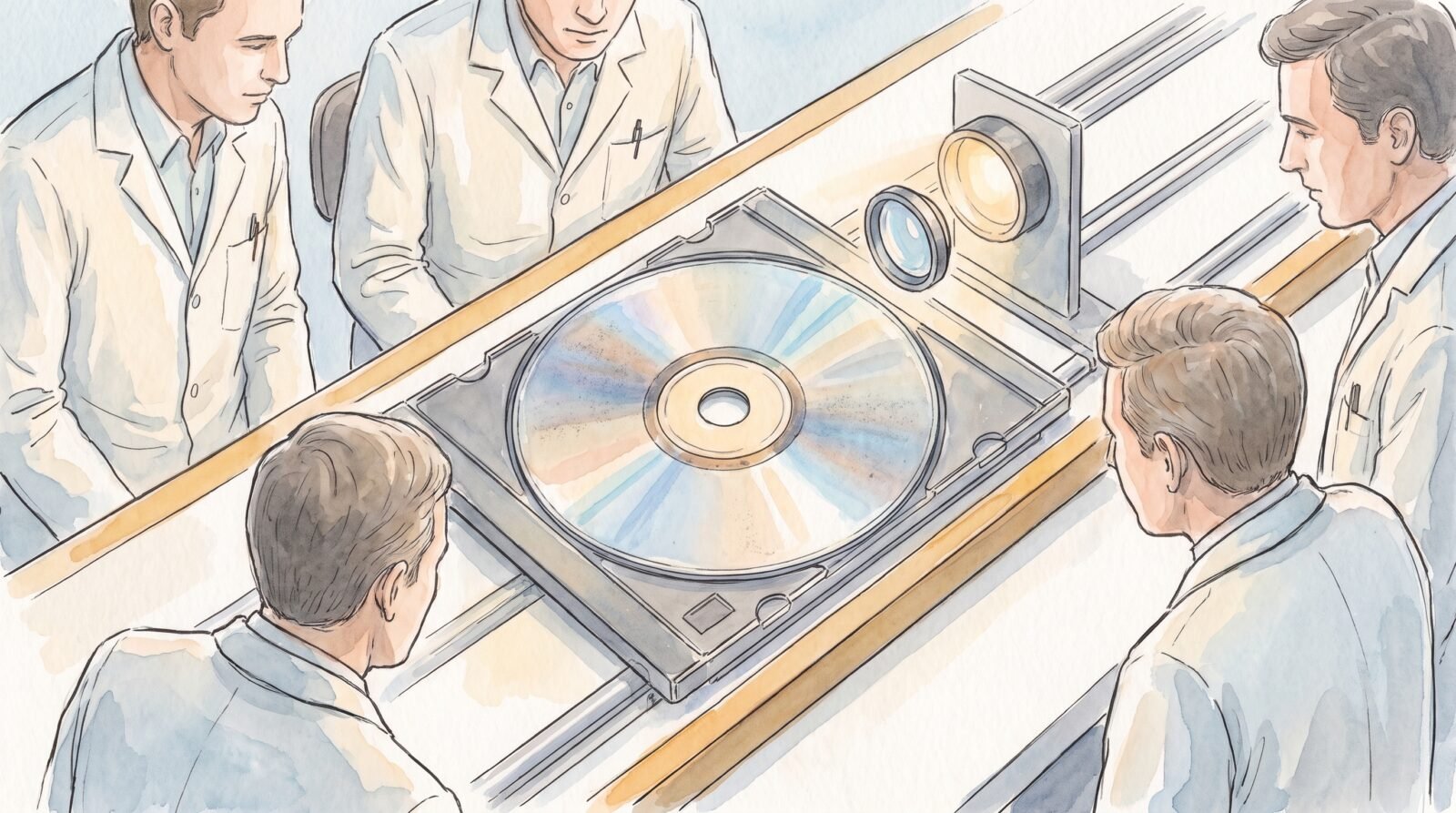
The Compact Disc was the consumer audio format that replaced the vinyl LP in the early 1980s. It was a five-inch, optically-read plastic disc that held seventy-four minutes of uncompressed stereo digital audio. It was the first major consumer product to bring optical storage to the mass market, and it was the bridge between the analogue audio culture of the twentieth century and the digital audio culture of the twenty-first. By the early 1990s, the CD had largely displaced the vinyl LP and the audio cassette in the developed-world consumer market; by the early 2000s, it was being displaced in turn by the compressed digital audio formats stored on computers and mobile devices. For a window of about twenty years, however, the Compact Disc was the dominant physical carrier of recorded music in the world. More than two hundred billion CDs were pressed in that period.
The Compact Disc was unusual in the history of consumer electronics in being a true collaborative standard. It was not developed by one company and licensed to others; it was developed jointly by two companies in two countries, and it was then published as a formal standard by a third body. The two companies were Philips, the Dutch electronics conglomerate, and Sony, the Japanese electronics conglomerate. The third body was the Digital Audio Disc Committee and, eventually, the International Electrotechnical Commission. The collaboration produced, in 1980, a document known as the Red Book, which specified every physical and logical parameter of the audio Compact Disc. The Red Book was then adopted, with minor amendments, as an international standard in 1987.
The collaboration between Philips and Sony was, in commercial terms, surprising. The two companies were direct competitors in several consumer-electronics categories, including portable audio and television. They had competing standards for video cassette recording (Philips’s V2000 and Sony’s Betamax). They had competing standards for video disc recording (Philips’s LaserVision and various Japanese systems). They had competed, in short, throughout the 1970s, with the result that several consumer-electronics categories had split markets and incompatible standards. The CD was different. The two companies agreed at an early stage that they would jointly produce a single standard, and that they would license that standard freely to other manufacturers. The decision was partly motivated by the experience of the video-cassette war of the 1970s, which had produced years of consumer confusion and had ultimately been resolved when Sony’s rival, Matsushita, agreed to back the VHS standard. Philips and Sony were determined to avoid that pattern.
The CD is, on one level, a piece of solid-state physics. The disc itself is a piece of clear polycarbonate plastic, 1.2 millimetres thick and 120 millimetres in diameter, with a small hole in the centre. One side of the polycarbonate is moulded with a continuous spiral of microscopic pits, each pit about 0.5 micrometres wide and between 0.83 and 3 micrometres long. The pit side of the polycarbonate is then coated with a thin layer of aluminium, then with a thin layer of lacquer, and then printed with the label. To play the disc, a small semiconductor laser, with a wavelength of 780 nanometres, shines through the polycarbonate from the underside and reads the pattern of pits by detecting the changes in reflected light. The pits and the spaces between them encode binary data; the binary data encodes audio. The whole operation is contactless, which is why a CD can be played thousands of times without wearing out.
The disc’s small dimensions are themselves remarkable. The Compact Disc is, despite its name, smaller than the vinyl LP it replaced. The standard LP was 12 inches (30 centimetres) in diameter; the standard CD is 4.7 inches (12 centimetres). The CD holds more music than the LP, in less space, with better fidelity, and with no contact between the pickup and the disc. The miniaturisation was made possible by the use of a shorter-wavelength laser (the infrared 780-nanometre laser, in place of the longer-wavelength styli that read vinyl), and by the use of a denser pit pattern than had previously been possible in a consumer product. The result was a disc that could fit in a jacket pocket and that could be carried in a small case alongside a portable player.
The CD is, on another level, a piece of error-correcting mathematics. The audio data on the disc is sampled at 44,100 samples per second, with 16-bit precision per sample, in stereo. That raw data rate, 1,411.2 kilobits per second, would be vulnerable to even the smallest physical defect on the disc — a fingerprint, a scratch, a dust speck. To make the disc usable in the real world, the audio data is interleaved with a Reed-Solomon error-correcting code, called CIRC (Cross-Interleaved Reed-Solomon Coding), which can reconstruct the audio data even if a substantial portion of the disc surface is unreadable. CIRC was the technical contribution of Sony to the standard. The related contribution of Philips was the eight-to-fourteen modulation, or EFM, which is the way the binary data is encoded onto the disc’s pit pattern. EFM and CIRC together are what made the CD work as a consumer product.
The Philips Optical Disc Programme Before the CD
The Compact Disc was not invented from a blank sheet. Both Philips and Sony had been working on optical disc recording for a decade before the CD, and both companies had optical disc products on the market when the CD project began. Philips had the LaserDisc, a thirty-centimetre analogue video disc that was launched in 1978. Sony had worked with Philips on the LaserDisc standard and had its own LaserDisc player, the Sony LDP-1, on the Japanese market. LaserDisc was the immediate technological ancestor of the CD: it used the same kind of optical pickup, the same kind of disc substrate, the same kind of mastering process. The CD is, in many respects, a smaller and digital version of the LaserDisc.
Philips had also been thinking about an audio-only optical disc since the early 1970s. The project began inside Philips’s research laboratories in Eindhoven in 1970, under the name ALP, for Audio Long Play. The ALP was conceived as a smaller, audio-only analogue disc that could hold an hour of music. The technical director of the Philips audio division, Lou Ottens, had the initial idea of making the audio disc the same size as the existing Compact Cassette, on the principle that consumers were familiar with the cassette and would find a similarly small disc intuitive. The disc was also a logical companion to the cassette: Philips had made its name with the Compact Cassette, and a Compact Disc would round out the product family.
The ALP project did not, however, produce a consumer product in the 1970s. The analogue optical audio disc proved difficult to manufacture at the necessary quality, and Philips’s management concluded in the mid-1970s that the project was not commercially viable in its original analogue form. The project was reset in 1977, partly because the digital audio recording technology that Philips and Sony had been developing in parallel had reached the necessary quality, and partly because the LaserDisc manufacturing infrastructure was now in place. The reset produced a digital audio disc rather than an analogue one, and the project acquired the name Compact Disc.
The name Compact Disc was, like the rest of the Philips product strategy, a deliberate reference to the Compact Cassette. The Compact Cassette had been Philips’s great consumer-audio success of the 1960s and 1970s; it had displaced the open-reel tape recorder in the home market, and it had become the dominant format for portable music. The Compact Disc name signalled that the new product was meant to do for music what the cassette had done for tape: take a relatively esoteric technology and make it portable, durable, and consumer-friendly. The choice of name was a marketing decision, but it was also a technical decision, because it implied that the CD would be a similar size to the cassette and would fit into similar consumer use patterns.
The 1979 Joint Task Force
Philips and Sony had been working on digital audio disc technology independently for several years before they joined forces. Sony had presented its technical details for a digital audio disc at the 62nd Audio Engineering Society Convention in Brussels in March 1979. A week later, Philips held a press conference in Eindhoven at which it demonstrated a working prototype of an optical digital audio disc. The two demonstrations were close enough in time, and similar enough in concept, that the Japanese Ministry of International Trade and Industry (MITI) decided to convene a meeting of the major consumer electronics companies to discuss whether a single common standard could be agreed. Philips travelled to Japan for the meeting and emerged with an agreement to collaborate with Sony on a single standard.
The joint task force was set up in 1979. It was led on the Philips side by Kees Schouhamer Immink, a Philips engineer who had been working on optical recording technology since the 1970s, and on the Sony side by Toshitada Doi, a Sony engineer who had been working on digital audio. The two engineers had very different technical backgrounds — Immink came from the optical-disc side, Doi from the digital-audio side — and the collaboration brought the two halves of the technology together. The task force met every two months, alternating between Eindhoven and Tokyo, and worked through every technical parameter of the proposed system. The meetings were intense; the disagreements were technical, not personal; and the resolution was, by all accounts, the result of patient and detailed engineering.
The first major decision was the disc diameter. Philips had initially proposed a disc 11.5 centimetres in diameter, on the principle that this was the diagonal measurement of the existing Compact Cassette and that the new disc should fit a familiar product envelope. Sony had been working with a 10-centimetre disc on the principle that smaller was more portable. The decision was eventually made to settle on a 12-centimetre disc, which would hold seventy-four minutes of audio. The reason for the seventy-four-minute figure is one of the most quoted pieces of audio trivia of the twentieth century. Sony executive Norio Ohga, who later became chief executive of Sony, was a serious amateur musician and a personal friend of the conductor Herbert von Karajan. Karajan had told Ohga that the CD should be able to hold Beethoven’s Ninth Symphony without interruption. The longest recording of the Ninth in the PolyGram archive, which was the Philips-owned record label, was a 1951 Bayreuth Festival performance conducted by Wilhelm Furtwängler that ran to about seventy-four minutes. The disc was therefore enlarged to accommodate it.
The seventy-four-minute figure is, however, contested in the literature. Some accounts place the Karajan conversation at a slightly different point in the decision process, and some accounts emphasise PolyGram’s commercial reasons for wanting a longer disc rather than the Karajan intervention. The figure is also convenient: seventy-four minutes at the chosen sampling rate and bit depth gives a disc capacity of about 680 megabytes, which is a round-ish number that became the standard CD-ROM capacity and the basis for later DVD and Blu-ray capacity standards. The seventy-four-minute figure may, in part, have been chosen because it gave a useful round number in computer terms. Whatever the precise reason, the disc was set at twelve centimetres and seventy-four minutes, and the standard was fixed.
The Red Book and the 1982 Launch
After about a year of negotiation and experiment, the joint task force published the Compact Disc Digital Audio standard in 1980. The standard was called the Red Book, after the colour of its cover. The Red Book specified every parameter of the audio Compact Disc: the physical dimensions of the disc, the optical parameters of the pickup, the sampling rate (44.1 kilohertz) and bit depth (16 bits) of the audio, the error-correction system (CIRC), the channel modulation system (EFM), the subcode channels, and the file structure of the audio data on the disc. The Red Book was, in effect, a complete specification of the audio CD, and any CD made to the standard would play in any CD player made to the standard.
The choice of 44.1 kilohertz as the sampling rate was itself the result of a compromise. The sampling rate had to be high enough to capture the full range of human hearing — roughly twenty hertz to twenty kilohertz — and the Nyquist theorem requires a sampling rate of at least twice the highest frequency to be captured. A sampling rate of 40 kilohertz would have been adequate for the audible range. Sony had been working with a 44.1 kilohertz rate because that was the rate that could be conveniently derived from the NTSC and PAL video frame rates used in professional digital audio recording. The choice of 44.1 kilohertz, rather than 48 kilohertz or 32 kilohertz, was therefore a practical decision about studio compatibility rather than an audiophile decision about sound quality. The choice has stuck.
The world’s first commercial Compact Disc was manufactured on 17 August 1982 at the Philips factory in Langenhagen, near Hanover in Germany. The first disc pressed was a 1979 recording of Chopin waltzes performed by the Chilean pianist Claudio Arrau. The first CDs to be marketed, in November 1982, were a mixture of classical and popular titles, including The Visitors by ABBA and a recording of Richard Strauss’s Alpine Symphony conducted by Herbert von Karajan. The catalogue at launch was around 150 titles, mostly classical music, because classical music was the format that was easiest to license and the audience that was most willing to pay a premium price for the new technology.
The first CD player was the Sony CDP-101, released in Japan in October 1982. Philips released its own first player, the CD100, at around the same time. The Japanese launch was followed by a US and European launch in early 1983. The first-generation players were expensive — equivalent to several hundred pounds or dollars at contemporary prices — but they were reliable and they sounded, to most listeners, noticeably cleaner and quieter than the vinyl LPs they replaced. The adoption of the format in the consumer market was rapid. By 1985, the CD was the dominant physical carrier of recorded music in the developed world. By 1990, the vinyl LP was a niche format and the CD was the default.
The launch was supported by a coordinated marketing campaign on both sides of the Atlantic. Philips and Sony agreed, very unusually for two competing companies, that they would license the standard freely to other manufacturers, on the principle that the format would succeed only if a wide range of compatible hardware and software was available. The licensing terms were generous: any manufacturer who paid the licence fee could make CD players or CDs. The result was a flood of third-party CD players from Japanese, European, and American manufacturers within a year of the launch. By the late 1980s, the CD had become a commodity format, and the price of CD players had fallen to a point where they were a routine consumer purchase.
The press coverage of the launch was also remarkable for the technology press of the early 1980s. Most of the major audio and electronics magazines ran cover stories on the CD, and the marketing of the format was, for the first year or two of its life, more enthusiastic than any consumer-electronics launch before or since. The reason was partly that the CD genuinely was a major technical achievement, partly that the audio magazines were starved of stories of comparable scale, and partly that the music industry saw the CD as a way out of the cassette-piracy problem that had been hurting record sales in the late 1970s. The CD was, in short, the right product at the right time.
How the Compact Disc Worked: Pits, EFM, and CIRC
The Compact Disc was, for its time, an extraordinary piece of engineering. The disc itself stored audio at a density that would have been considered impossible a decade earlier. The spiral of pits on a single CD runs for about five kilometres and contains about six billion bits of information. The pickup that reads those bits uses a semiconductor laser focused to a spot about one micrometre across, with a servo system that keeps the laser on the spiral as the disc spins. The disc spins at a variable rate, between about 200 and 500 revolutions per minute, so that the linear velocity of the spiral under the pickup stays roughly constant.
The pits are not, strictly speaking, what stores the data. The data is encoded in the transitions between pit and land, not in the pits or lands themselves. The nine-to-fourteen modulation, or EFM, takes each byte of audio data and replaces it with a fourteen-bit code chosen from a lookup table. The fourteen-bit code is then converted into a pattern of pit and land transitions, with merging bits added between codes to prevent long runs of identical states that would upset the clock recovery. The EFM encoding produces a stream of transitions at a rate of about 4.3 million transitions per second. The choice of which fourteen-bit codes to use is constrained so that there are never fewer than two or more than ten transitions between any two code words. This constraint is what allows the player to recover a stable clock from the disc, even with a damaged or dirty disc surface.
The CIRC error-correction system is the other half of the story. CIRC stands for Cross-Interleaved Reed-Solomon Coding, and it is the system that makes the CD robust against real-world disc damage. The audio data on a CD is organised into frames, each frame containing twenty-four audio samples plus eight bytes of error-correction parity. The frames are interleaved before they are written to the disc, so that any physical damage on the disc affects multiple frames, each with only a small portion of its data lost. The CIRC decoder in the player can reconstruct the missing data from the parity bytes and the surviving portions of the interleaved frames. CIRC can recover from errors up to about 3,500 consecutive incorrect bits, which corresponds to about 2.5 millimetres of track on the disc. CIRC can also interpolate, with reduced but still acceptable quality, when the damage is too severe for full correction. The interpolation is what gives a CD player its characteristic behaviour when it encounters a scratched disc: it interpolates rather than mutes, on the principle that brief interpolation is preferable to a gap in the music.
The CIRC system was Sony’s contribution to the standard. The choice of CIRC over other error-correction systems was made after the joint task force had compared several candidates. CIRC won partly because of its robustness and partly because of its compatibility with the EFM channel code. The combination of CIRC and EFM is what gives the CD its characteristic combination of high data density and high reliability. A standard CD, pressed correctly, can be played thousands of times without measurable degradation. The same CD, even when scratched or dirty, will usually play correctly because of CIRC.
The CIRC encoder, sitting inside the mastering system at the CD pressing plant, takes the raw audio data and adds the parity bytes that the player will use to reconstruct the audio. The CIRC decoder, sitting inside every CD player ever sold, applies the inverse operation. The decoder is, in hardware terms, a relatively simple circuit, and a CD player built in the early 1980s could fit all the digital signal processing onto a few chips. The CIRC system was therefore both effective and economical, which was one of the reasons that the joint task force selected it. A more capable but more complex error-correction system would have driven up the cost of CD players and slowed the adoption of the format.
The sampling rate and bit depth of the audio encoding were, as noted above, the result of compromises between technical requirements and practical constraints. The 16-bit linear PCM encoding gives a theoretical dynamic range of about 96 decibels, which is more than the dynamic range of a vinyl LP and more than the dynamic range of human hearing in most listening environments. The 44.1 kilohertz sampling rate gives a theoretical frequency response up to 22.05 kilohertz, which is at the upper end of human hearing for young listeners and well above it for older listeners. The choice of these parameters has been criticised by some audiophiles, who argue that higher sampling rates and bit depths would have produced better sound, but the choices were vindicated by the commercial success of the format. The Compact Disc, with its 44.1 kilohertz / 16-bit encoding, has remained the standard for consumer digital audio for more than forty years.
The audio encoding of the CD has been a subject of technical debate since the format was introduced. The 16-bit depth, in particular, was the maximum practical bit depth that could be encoded on a single disc within the bit budget that the Red Book allowed. Higher bit depths were technically possible but would have required either a lower sampling rate, a shorter playing time, or a denser pit pattern. The joint task force concluded that 16 bits at 44.1 kilohertz was the right balance. Subsequent audio formats, including the DVD-Audio and the Super Audio CD, used higher bit depths (up to 24 bits) and higher sampling rates (up to 192 kilohertz), but those formats never achieved the consumer-market penetration of the standard CD. The argument is, in some sense, settled by history: the 16-bit / 44.1-kilohertz format has been good enough to carry the bulk of commercial recorded music for over four decades.
The CD Family: CD-ROM, CD-R, and the Legacy
The Compact Disc spawned a family of related formats in the years after 1982. The most important of these was the CD-ROM, which adapted the Red Book physical format to the storage of computer data. The CD-ROM standard was published in 1985 as the Yellow Book. The CD-ROM used the same physical disc as the audio CD but added a layer of error correction to handle the higher reliability requirements of computer data. The CD-ROM rapidly became the dominant medium for software distribution in the personal computer industry, displacing floppy disks and magnetic tape. The CD-ROM’s capacity, about 680 megabytes, was roughly five hundred times that of the 1.44-megabyte floppy disk, and it could be manufactured at a fraction of the per-unit cost.
The CD-ROM was followed in the 1990s by the CD-R (recordable CD) and the CD-RW (rewritable CD). The CD-R used an organic dye layer in place of the aluminium reflective layer of the pressed CD; a high-power laser in a CD-R drive could write data to the dye layer by burning small pits into it. The CD-RW used a phase-change material that could be written, erased, and rewritten. The CD-R and CD-RW extended the Compact Disc format into the writable storage market and made the CD the default medium for backups, file transfers, and small-run publishing for nearly two decades.
The Compact Disc family culminated in the DVD (Digital Versatile Disc), published in 1995 as a joint Philips-Sony-Toshiba standard, and in the Blu-ray Disc, published in 2006 as a Sony-led standard. The DVD used a 650-nanometre laser instead of the CD’s 780-nanometre laser, allowing a smaller pit size and a higher data density. The DVD held 4.7 gigabytes on a single layer, about seven times the capacity of a CD. The Blu-ray Disc used a 405-nanometre blue-violet laser and held 25 gigabytes on a single layer. Both formats retained the basic CD design — a 120-millimetre optical disc, with pits read by a focused laser — and both were designed for backward compatibility with the CD.
The legacy of the Compact Disc is, however, more than just the family of optical formats it spawned. The CD demonstrated that a consumer electronics format could be developed and marketed through genuine collaboration between two competing companies, and that a properly licensed, properly standardised format could displace an entrenched incumbent (the vinyl LP) in a remarkably short time. The CD also demonstrated that the consumer market would pay a premium for a technology that offered tangible improvements over its predecessor. The audio CD sounded cleaner than the vinyl LP, was more durable than the cassette, and was smaller than either. Each of these advantages was real and was perceptible to ordinary listeners, and the cumulative effect was sufficient to drive a rapid format transition.
The Compact Disc was also, perhaps inadvertently, a moment of cultural transition. The CD was the last major consumer audio format to be launched before the internet became a mass-market distribution channel. CDs were sold in record shops, displayed in long-playing browser racks, and marketed through radio play, television advertising, and print reviews. The music industry of the 1980s and 1990s was, in a real sense, an industry organised around the CD. Album cover art was redesigned for the new format. Catalogue numbers were reorganised. Marketing campaigns were built around the new sound quality. The CD was, for two decades, the medium through which most recorded music reached most listeners in the developed world. That situation is now gone, but the period of the CD’s dominance remains a major chapter in the cultural history of recorded music.
The CD’s commercial life also shaped the music industry’s response to digital distribution. The first major wave of music piracy in the late 1990s and early 2000s — Napster, LimeWire, the early peer-to-peer networks — was, in effect, a response to a format that had become too easy to copy. The CD’s error-correction system was good enough that the audio could be recovered from the disc bit-for-bit. A CD-ROM drive on a personal computer could read the audio data directly. The MP3 compression format, developed in the early 1990s, could compress the resulting audio data to a tenth of its original size. The combination of CD-ROM drives, MP3 compression, and broadband internet produced the conditions for the music industry’s first major crisis. The industry’s eventual response, in the late 2000s and 2010s, was to move to streaming services — Spotify, Apple Music, and their competitors — which returned the music industry to a model in which the listener paid for access rather than ownership. The Compact Disc, in a sense, had been too successful for its own long-term good.
The Compact Disc was, in the end, both a technical success and a commercial success. The technical success was the more remarkable of the two, because the CD solved a number of engineering problems that had defeated earlier attempts at consumer optical audio. The commercial success was the more transformative, because the CD changed the way recorded music was manufactured, distributed, sold, and consumed. By the time the CD began to be displaced by digital downloads and streaming in the 2000s, it had been the dominant physical carrier of recorded music for about twenty years. By the time the last CD plant closed in the 2020s, the format had been in continuous production for more than forty years. Few consumer electronics formats in history have had that kind of run.
It is also worth noting what the Compact Disc did not do. It did not, despite the hopes of some industry observers in the early 1980s, replace the vinyl LP entirely. Vinyl survived as a niche format for audiophiles, DJs, and collectors. It did not, despite some hopes, replace the live performance. The CD’s convenience and quality did not turn recorded music into a substitute for live music. It did not, in any obvious way, change the kind of music that was popular. The CD was, in short, a format rather than a culture. It changed the way music was stored and sold, but it did not change the way music was composed, performed, or listened to. The Compact Disc is, in retrospect, a technical monument more than a cultural one.
The Compact Disc was, however, a technology that allowed music to be reproduced with unprecedented fidelity. The 16-bit / 44.1-kilohertz encoding captured more of the original recording than any previous consumer format. The CIRC error-correction system ensured that the captured data could be recovered even from a damaged disc. The optical pickup ensured that the recovered data could be replayed thousands of times without wear. Each of these technical properties was, in itself, a small revolution. Together, they were a large one. The Compact Disc was the first consumer format that could plausibly claim to be transparent — that is, to reproduce the original recording without audible loss. That claim was not always true in practice, because of mastering decisions and amplifier limitations, but it was approximately true in theory, and it was approximately true in practice for most of the recordings released on CD. The achievement was, by any reasonable measure, a triumph of consumer electronics, and one whose consequences for the music industry, the consumer-electronics industry, and the wider culture are still being worked out in the era of streaming and high-resolution audio.
References
- Compact Disc Digital Audio (Red Book) - Wikipedia, retrieved October 2026.
- CD player - Wikipedia, retrieved October 2026.
- How the CD was developed - BBC News, 17 August 2007.
- Philips celebrates 25th anniversary of the compact disc - Royal Philips Electronics press release, 16 August 2007.
- In 1979, Sony and Philips formalized the compact disc standard, turning digital audio into a home format - Times of India, retrieved October 2026.
- The CD is 30 years old today - What Hi-Fi?, retrieved October 2026.
- Compact disc - Wikipedia, retrieved October 2026.
- Kees Schouhamer Immink - Wikipedia, retrieved October 2026.
- CD-ROM - Wikipedia, retrieved October 2026.
- DVD - Wikipedia, retrieved October 2026.