Mendeleev and the Periodic Table
In February 1869 a chemistry professor in St Petersburg, trying to decide the order of chapters in a textbook, arranged the 63 elements then known into rows and columns and found that their properties repeated at regular intervals. Dmitri Mendeleev was not the first to try, but he went further than anyone: he left gaps for elements nobody had seen and described what they would be like. Within seventeen years three of them had been found. This essay follows the periodic table from that winter morning to its explanation in atomic physics, its extension to 118 elements, and the experiments now under way in 2026 to make the first element of an eighth row.
Key findings
- Mendeleev drew up his table on 17 February 1869 (Russian calendar), arranging the 63 elements then known by atomic weight and chemical family, and published it in the journal of the Russian Chemical Society the following month[1].
- He left gaps and predicted properties for missing elements; gallium (1875), scandium (1879) and germanium (1886) were found in his lifetime, close to his forecasts[1, 2, 3, 4].
- Lothar Meyer reached a similar arrangement independently, and the two men argued over priority for years[5].
- Henry Moseley’s X-ray measurements of 1913–14 replaced atomic weight with atomic number as the ordering principle; he was killed at Gallipoli in 1915, aged 27[6, 7, 8].
- IUPAC verified elements 113, 115, 117 and 118 in December 2015, completing the seventh row; in 2026 JINR in Dubna began an attempt to make element 119, and Berkeley Lab is preparing to try for 120[9, 10, 11, 12].
A textbook problem
By the 1860s chemists knew more than 60 elements and had a growing sense that they fell into families. Lithium, sodium and potassium behaved alike; so did chlorine, bromine and iodine. What they lacked was agreement on the basic numbers, because confusion over how to determine atomic weights defeated every attempt at a system[5]. The turning point was the first international chemistry congress, held at Karlsruhe in 1860. There the Italian chemist Stanislao Cannizzaro argued that Avogadro’s hypothesis, that equal volumes of gas contain equal numbers of molecules, gave a consistent way to fix atomic weights. A colleague handed out his pamphlet as the meeting broke up, and many who read it on the way home were converted[5, 13].
The congress had been called by August Kekulé, Charles-Adolphe Wurtz and Carl Weltzien to agree on what chemists meant by words such as atom and molecule. It did not go well: discussions wandered, most delegates held on to their own theories, and a closing vote left everyone free to use whatever notation they liked. Cannizzaro, the last speaker, addressed a tired audience; his ideas spread only through the pamphlet, the Sunto, that he had first published in 1858[13]. Mendeleev, who was 26 at the time, made no secret that his later table, built on a common set of atomic weights, owed much to Cannizzaro’s work[13].
Two young men at Karlsruhe would make the most of it. Julius Lothar Meyer, a German physician turned chemist, and Mendeleev had both worked in Robert Bunsen’s laboratory at Heidelberg, and both were impressed by Cannizzaro’s presentation[5]. Mendeleev had been born in Tobolsk in Siberia in 1834, the son of a teacher; his mother ran a glassworks and, after his father’s death, took him to St Petersburg to study[5]. In 1867, aged 33, he became professor of chemistry at the University of St Petersburg and began writing a textbook, Principles of Chemistry. Like Meyer, who had published a textbook of his own in 1864, he needed a logical order in which to introduce the elements[5, 14].
Mendeleev’s father had taught Russian literature, and the political exiles the boy met in Siberia gave him a lifelong attachment to liberal causes; the run of his mother’s glassworks gave him an interest in industrial chemistry. In St Petersburg he attended the Main Pedagogical Institute and the university, and after his time with Bunsen he taught at the St Petersburg Technological Institute, finished his doctoral dissertation, started an experimental farm and lectured on agriculture for the Free Economic Society[5].
Others had seen patterns before him. In 1862 the French geologist Alexandre-Émile Béguyer de Chancourtois wound the elements in order of weight around a cylinder and noticed that similar ones lined up vertically, but his paper was published without its diagram and in a geology journal, and few chemists saw it[1]. Meyer’s 1864 book arranged 28 elements in six families by valence, the number of bonds an atom tends to form, and left one blank[5]. The Science Museum counts five such attempts before Mendeleev’s[1].
The first hints were much older. In 1817 the German chemist Johann Wolfgang Döbereiner noticed that the atomic weight of strontium lay midway between those of calcium and barium, three elements that behave alike, and by 1829 he had found several such triads: lithium, sodium and potassium, where sodium’s 23 is close to the average of 7 and 39; chlorine, bromine and iodine; and sulfur, selenium and tellurium. The triads covered only a few of the roughly 54 elements then known[15].
In London, John Newlands, an analytical chemist who had spent 1860 fighting for Italian unification with Garibaldi rather than attending Karlsruhe, went further[16]. In a series of letters to Chemical News from 1863 he numbered the elements in order of atomic weight and noticed that “the eighth element starting from a given one is a kind of repetition of the first, like the eighth note of an octave in music”. In 1865 he named the pattern the “law of octaves”[17]. When he presented it to the Chemical Society on 1 March 1866, Professor G. C. Foster asked whether he had ever tried arranging the elements in alphabetical order, since any arrangement would throw up occasional coincidences. The society did not publish the paper, explaining later that it avoided purely theoretical papers[17]. Newlands’s scheme, unlike Mendeleev’s, left no gaps for undiscovered elements[17].
Seventeen February 1869
The story usually told, and supported by a document in the Mendeleev archive at St Petersburg State University, is that Mendeleev had spent most of a weekend trying to settle the order of his chapters. On the morning of 17 February 1869 by the Russian calendar, 1 March in western Europe, he was due to go on a tour inspecting cheese making. Instead he stayed at home and jotted rows of chemical symbols on the back of the invitation, which still survives with a tea stain[1]. By the end of the day he had a table of all 63 known elements, arranged by increasing atomic weight but broken into rows so that chemically similar elements fell into the same columns. It appeared in the journal of the newly founded Russian Chemical Society the following month[1].
Two features set Mendeleev’s table apart. First, he trusted the pattern over the data. Where an element’s accepted atomic weight put it in the wrong family, he concluded that the weight was wrong and moved the element; several such weights were later remeasured and found to be in error[5]. Second, where the pattern called for an element that did not exist, he left a space and marked it with a question mark and a predicted atomic weight[1]. In later papers, notably in 1871, he gave the missing elements provisional names using the Sanskrit prefix “eka”, meaning one, as in “one place beyond” a known element, and described their expected properties in detail[2, 18].
Meyer, meanwhile, was working on a fuller version of his own scheme. His paper of 1870 included a striking graph of atomic volume against atomic weight, a saw-tooth curve whose peaks fell at the alkali metals, which made the periodicity visible at a glance[5]. The two men carried on a long dispute over who deserved the credit. Meyer had the clearer physical picture; Mendeleev had the nerve to predict[5].
Meyer’s one conceptual advance over his predecessors, in the Science History Institute’s account, had been to see valence as the link within each family and as the pattern for ordering the families: in his 1864 scheme the valences of successive families, starting from the carbon group, ran 4, 3, 2, 1, 1 and 2[5]. Mendeleev kept revising his own table. The second volume of Principles of Chemistry, published in 1871, included a fold-out chart resembling a modern periodic table, and his wider fame came only after the predicted elements began to appear; in 1889 he set out “The Periodic Law of the Chemical Elements” in a lecture in London[14].
The gaps are filled
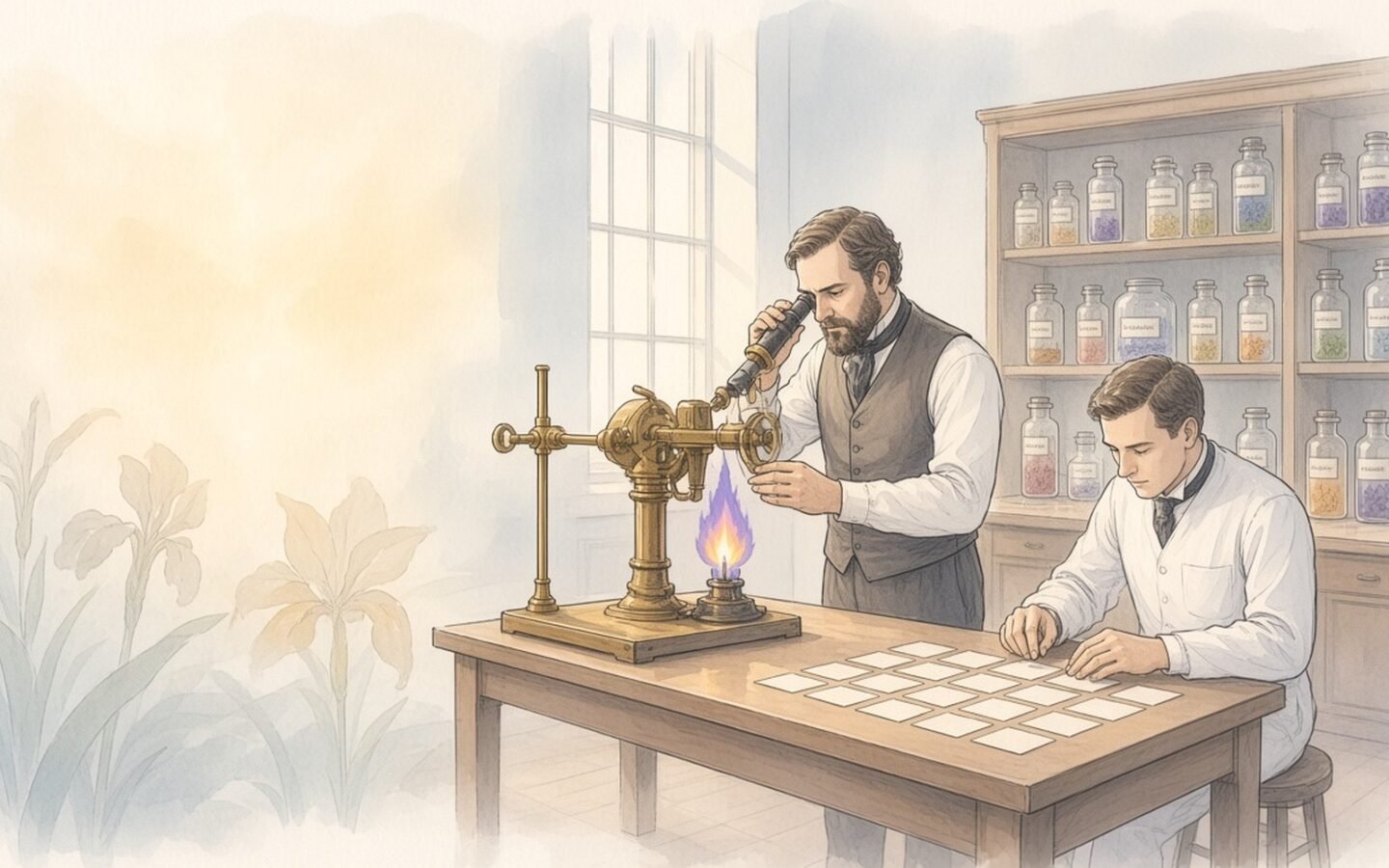
The first test came from France. In 1875 Paul-Émile Lecoq de Boisbaudran, an expert in spectroscopy, noticed a new violet line in the spectrum of zinc extracted from Pyrenean zinc blende. By November he had isolated a few milligrams of a metal like aluminium, and in December he announced it to the French Academy of Sciences. He named it gallium. He had not known that Mendeleev had predicted an element below aluminium with an atomic weight of about 68 and a density of 5.9 grams per cubic centimetre[2]. Today’s values are 69.7 and 5.91[2].
The work was painstaking. In the Royal Society of Chemistry’s account, the chemist Andrea Sella describes how Lecoq saw the new line at 417 nanometres, needed three weeks to collect a couple of milligrams from some 52 kilograms of ore, and later took his work to Adolphe Wurtz’s laboratory in Paris; just before Christmas he showed the Academy almost 600 milligrams, harvested from 450 kilograms of ore. He based the name on Gallia, the Latin for France, though it was soon pointed out that gallus, Latin for a cockerel, made a pun on “Lecoq”[2].
The second came from Sweden. Mendeleev had noted a gap between calcium, at 40, and titanium, at 48, and predicted an element of intermediate weight whose oxide would have the formula X₂O₃. In 1879 Lars Fredrik Nilson at Uppsala University, working through the rare-earth oxides in the mineral euxenite, found an oxide whose spectrum revealed an unknown metal. He named it scandium, and its oxide was Sc₂O₃, as predicted[3]. His colleague Per Teodor Cleve noticed the match with Mendeleev’s forecast[18]. Scandium metal itself was not produced until 1937[3].
In his papers of the early 1870s Mendeleev had predicted ten unknown elements and described four of them in detail. For eka-boron he expected an atomic weight of about 44, a single oxide of the form X₂O₃ and a carbonate that would not dissolve in water. Scandium has an atomic weight of about 45, and its carbonate is indeed insoluble[3].
The third, and the most persuasive, came from Saxony. In September 1885 a miner at the Himmelsfürst silver mine near Freiberg found an unusual ore. Analysing it, Clemens Winkler of the Freiberg Mining Academy found 75 per cent silver, 18 per cent sulfur, and 7 per cent he could not explain. By February 1886 he had isolated a new element and named it germanium. It was the element Mendeleev had placed below silicon, with a predicted atomic weight of about 71 and density of about 5.5[4]. The measured values are 72.6 and 5.32[4]. Doubters, including Bunsen, had questioned the periodic law at first; these discoveries, together with corrected atomic weights, gradually converted them[5].
The ore had first been recognised as a new mineral by Albin Weisbach of the Mining Academy, who passed it to Winkler; it is now called argyrodite, Ag₈GeS₆[4]. Germanium was the closest of all the forecasts. Besides its weight and density, Mendeleev had said that eka-silicon would have a high melting point and would be grey. Winkler first thought of calling it neptunium, after the recently discovered planet, but the name had already been claimed for a supposed element found in the mineral tantalite[4].
| Mendeleev’s name | Predicted atomic weight | Element found | Discoverer, place, year | Measured atomic weight |
|---|---|---|---|---|
| Eka-aluminium | about 68 (density 5.9) | Gallium | Lecoq de Boisbaudran, Paris, 1875 | 69.723 (density 5.91) |
| Eka-boron | between calcium (40) and titanium (48); oxide X₂O₃ | Scandium | Nilson, Uppsala, 1879 | 44.956; oxide Sc₂O₃ |
| Eka-silicon | about 71 (density 5.5) | Germanium | Winkler, Freiberg, 1886 | 72.630 (density 5.32) |
| Eka-manganese | below manganese | Technetium | Perrier and Segrè, Italy, 1937 (made artificially) | no stable isotope |
Not every prediction landed. Mendeleev also expected elements that do not exist, including some lighter than hydrogen[18], and the table gave no hint of a whole family that had not been found. In 1894 Lord Rayleigh, puzzled that nitrogen taken from air was slightly denser than nitrogen made from ammonia, and William Ramsay isolated argon. Henry Cavendish had noticed in 1785 that about one per cent of air refused to react, but nobody had followed it up[20, 21]. Argon fitted no existing column. Ramsay went on to isolate helium and then, using the table as a guide, neon, krypton and xenon, so that the table gained a new column rather than breaking[22]. In 1904 Rayleigh won the Nobel Prize in Physics, and Ramsay the chemistry prize “in recognition of his services in the discovery of the inert gaseous elements in air, and his determination of their place in the periodic system”[23].
Recognition in Britain came before the Nobel committees considered him. In 1882 the Royal Society gave its Davy Medal jointly to Mendeleev and Meyer. Newlands pressed his own claim in print, and in 1887 he received the same medal “for his discovery of the Periodic Law of the chemical elements”[16].
Mendeleev’s work went well beyond the table. In 1876 the Russian government sent him to Pennsylvania. He visited the Centennial Exposition in Philadelphia, where he exhibited a differential barometer, and then the oilfields, where he studied refineries and rock formations. Russia was then importing most of its kerosene from the United States, and his recommendations helped open the oil deposits around Baku to private companies, the most successful of them founded by Ludwig and Robert Nobel, brothers of Alfred Nobel. By 1883 Russian oil production had risen more than twentyfold in twelve years. Mendeleev later attacked the waste, since only 25 to 30 per cent of Baku crude could be refined into kerosene[14].
His politics caused trouble. In 1890 he left his professorship after an official rebuke for delivering a student protest to the education ministry, and he became director of the Central Board of Weights and Measures, advising on tariffs, shipbuilding, Arctic shipping routes, smokeless powder and heavy industry. When he died, students carried the periodic table in his funeral procession[5].
Mendeleev never won a Nobel Prize. The archive records nine nominations in chemistry, three in 1905, four in 1906 and two in 1907, from nominators including Jacobus van ’t Hoff and Adolf von Baeyer[24]. The 1906 prize went instead to Henri Moissan for isolating fluorine[25]. Mendeleev died in 1907[5]. His name is on element 101, mendelevium, seventeen atoms of which were made in an all-night experiment at Berkeley in 1955[26].
Why the table works
For all its success, Mendeleev’s table rested on a puzzle. Nobody knew why properties should repeat, and atomic weight was an imperfect guide: it rose in uneven steps, so nobody could be sure how many elements remained to be found[27]. The answer came from physics. In 1913 and 1914 Henry Moseley, working at Manchester and later Oxford, measured the X-rays given off by a long series of elements and found that the frequency rose in regular steps from one element to the next[6, 7]. The steps corresponded to a whole number, the atomic number, now understood as the charge of the nucleus. Ordering by atomic number removed the anomalies and showed exactly where elements were still missing[7, 27].
Moseley’s numbering showed exactly which places were still empty, among them 61 and 72[27, 28]. Element 72 was found in 1923 at the University of Copenhagen by George de Hevesy and Dirk Coster, hidden in zirconium minerals, and named hafnium after the Latin for Copenhagen[27]. Element 43, the eka-manganese of Mendeleev’s list, turned out to have no stable form at all; Emilio Segrè and Carlo Perrier identified technetium in 1937 in a sample of molybdenum from California that had been exposed to high-energy radiation[19]. Element 61, promethium, was produced at Oak Ridge in 1945 by Jacob Marinsky, Lawrence Glendenin and Charles Coryell[28]. Henry Moseley did not see any of this. He was killed in action at Gallipoli in 1915, aged 27[8].
Element 72 had a false start. The French chemist Georges Urbain claimed it in 1911, wrongly. Hevesy and Coster found it in a Norwegian zircon, and it proved so hard to separate from zirconium that zirconium’s accepted atomic weight turned out to be wrong and had to be measured again on hafnium-free material. The first pure hafnium was made in 1925[27].
The deeper explanation came from quantum theory. Niels Bohr’s quantum model of the atom, recognised by the 1922 Nobel Prize in Physics “for his services in the investigation of the structure of atoms”, began to explain the table in terms of electrons arranged in shells[29]. Elements in the same column share the same arrangement of outer electrons, and that arrangement governs how they react. The modern long form of the table, with its blocks named after the s, p, d and f electron orbitals, is a direct map of electron configuration[2].
Beyond uranium
Uranium, element 92, was long the heaviest element known. Elements beyond it had to be made. In 1940 and 1941 Glenn Seaborg and colleagues at the University of California, Berkeley, made and identified plutonium, element 94; Seaborg later recalled that the decisive chemical proof came on “the stormy night of Feb. 23, 1941”[22]. In 1945 he published a proposal to redraw the bottom of the table, moving actinium and the elements after it into a separate actinide row beneath the lanthanides, a change that, according to later accounts, made the chemistry of the new elements predictable and guided the search for the next ones[30]. He shared the 1951 Nobel Prize in Chemistry “for their discoveries in the chemistry of the transuranium elements”[31], and element 106, seaborgium, was named after him while he was still alive[22].
Each new element has been harder to make than the last. Beyond fermium, element 100, elements must be produced and studied one atom at a time, by firing a beam of one nucleus at a target of another and hoping that, very occasionally, they fuse[32]. Laboratories in the United States, Russia, Germany and Japan have competed and collaborated in the search, and the claims are judged by a joint working party of the International Union of Pure and Applied Chemistry and its physics counterpart. On 30 December 2015 IUPAC announced that the claims for elements 113, 115, 117 and 118 had been verified, crediting RIKEN in Japan with element 113 and collaborations of the Joint Institute for Nuclear Research in Dubna with two US national laboratories for the other three. With them the seventh row of the table was complete[9]. The names nihonium, moscovium, tennessine and oganesson were approved on 28 November 2016; oganesson honours Yuri Oganessian, who led the Dubna work[33].
The quantities were already tiny by the 1950s. The mendelevium experiment of 1955, by Albert Ghiorso, Bernard Harvey, Gregory Choppin, Stanley Thompson and Seaborg, bombarded einsteinium-253 with alpha particles and detected mendelevium-256, which has a half-life of about 78 minutes. The rivalry over the next elements between Berkeley, led by Ghiorso, and Dubna, led by Georgy Flerov, became known as the Transfermium Wars[26].
How a new element is made. To reach element 118, a beam of calcium-48 ions (20 protons) was fired at a target of californium-249 (98 protons): 20 + 98 = 118. Calcium-48 is unusually rich in neutrons, which helps the fused nucleus survive. The heaviest practical target is californium, so element 119 or 120 needs a heavier beam, such as titanium-50 (22 protons). That makes fusion much rarer, and a single atom may take months of continuous running to make[12, 33].
Testing the table at the bottom
At the bottom of the table, the patterns that Mendeleev relied on may begin to fail. In very heavy atoms the inner electrons move at a large fraction of the speed of light, and relativistic effects change their energies enough to alter chemical behaviour. The authors of one recent study note that this may mean the end of a predictive periodic table for the heaviest elements[32]. In 2025 a team at Lawrence Berkeley National Laboratory reported in Nature that it had, for the first time, directly identified individual molecules containing a heavy element, nobelium (102), by measuring their mass with an instrument called FIONA, and compared them with molecules of actinium[32]. The authors describe the technique as a route to testing the chemistry of superheavy elements atom by atom[32].
Making new elements needs the same patience. In July 2024 Berkeley Lab announced that it had made two atoms of element 116, livermorium, by firing titanium-50 at a plutonium target during 22 days of operation of its 88-Inch Cyclotron, the first time this beam had produced a superheavy element. “We needed for nature to be kind, and nature was kind,” said Reiner Kruecken, the director of its Nuclear Science Division, who estimated that element 120 would take about ten times longer to make[12, 34]. The laboratory plans to use a target of californium-249 for the attempt[12]. Element 120 would be the first element of an eighth row, and lies near the theorised island of stability, where certain combinations of protons and neutrons might survive much longer than their neighbours[12].
The Joint Institute for Nuclear Research has taken the other route, towards element 119. According to its weekly newspaper, experiments began at its Superheavy Element Factory in 2026, using a titanium-50 beam from the DC-280 accelerator on a target of berkelium-249 produced at a reactor in Dimitrovgrad, with the run expected to last several months and to continue in 2027 with a fresh target[10]. A report to the institute’s Scientific Council in September described a “successful start” of the experiment[11]. No new element has been claimed. Any claim would have to be verified by IUPAC and IUPAP before it could be named, a process that took several years for the last four elements[9].
A chart on every wall
The table soon moved from research papers to classrooms. In 2014 Alan Aitken, clearing a storeroom in the chemistry school at the University of St Andrews, found a rolled lecture chart, printed in Vienna, that is thought to be the oldest surviving classroom periodic table. University records show that the professor of chemistry, Thomas Purdie, bought it from a German catalogue for 3 marks in October 1888, and the historian Eric Scerri dated its contents to between 1879 and 1886, since it includes gallium and scandium but not germanium[35]. In 2019, the table’s 150th anniversary, the United Nations held an International Year of the Periodic Table, proclaimed by the General Assembly on 20 December 2017[36].
Today the table on the IUPAC website lists 118 elements in seven complete rows[37]. Its exact layout is still argued over, but its basic logic is the one Mendeleev set out in 1869: order the elements, group them by behaviour, and trust the pattern enough to look for what is missing.
Reading the modern table. Along a row, or period, the atomic number rises by one from each element to the next. A column, or group, collects elements whose outer electrons are arranged alike, which is why they react alike. The table is also divided into blocks by the type of orbital that holds the outermost electrons, named s, p, d and f after the sharp, principal, diffuse and fundamental lines in the spectra they produce[2]. The blocks are 2, 6, 10 and 14 columns wide, the number of electrons that each kind of subshell can hold[38]. A simple case is sodium, element 11: its electrons fill shells of 2 and 8 and leave one over, just as lithium (3 = 2 + 1) and potassium (19 = 2 + 8 + 8 + 1) do, which is why all three stand in group 1.
The exact layout is still argued over. Because published tables differ, IUPAC set up a project in 2015 to decide whether group 3 should contain scandium, yttrium, lanthanum and actinium, or scandium, yttrium, lutetium and lawrencium[37]. A provisional report published in 2021, written by Eric Scerri for the task group, concluded that “there is no objective means to adjudicate” between the two, that the choice is ultimately one of convention, and suggested the lutetium form as a compromise, since it keeps every element in order of atomic number and gives the blocks their quantum-mechanical widths[38].
What the table still predicts
Mendeleev’s achievement was less the discovery of periodicity, which several people glimpsed, than his willingness to treat the pattern as a law and to predict from it. Gallium, scandium and germanium turned a classification into a scientific theory, because it could have been proved wrong and was not. The explanation he lacked arrived half a century later with atomic number and quantum theory, and it explained why his law worked.
The same method is being used at the bottom of the table now. Theory predicts where elements 119 and 120 should sit and roughly how they should behave, and relativistic effects may make them behave differently. The experiments of 2026 in Dubna and Berkeley test whether an eighth row can be started at all, and how far a pattern found by ordering 63 elements in 1869 still holds.
References
- Cole, R. (2019, 29 January). The Year of the Periodic Table. Science Museum Blog. https://blog.sciencemuseum.org.uk/the-year-of-the-periodic-table/
- Royal Society of Chemistry. Gallium: element information, properties and uses. Periodic Table (history text by J. Emsley). https://periodic-table.rsc.org/element/31/gallium
- Royal Society of Chemistry. Scandium: element information, properties and uses. Periodic Table. https://periodic-table.rsc.org/element/21/scandium
- Royal Society of Chemistry. Germanium: element information, properties and uses. Periodic Table. https://periodic-table.rsc.org/element/32/germanium
- Science History Institute. Julius Lothar Meyer and Dmitri Ivanovich Mendeleev. Scientific Biographies. https://www.sciencehistory.org/education/scientific-biographies/julius-lothar-meyer-and-dmitri-ivanovich-mendeleev/
- Moseley, H. G. J. (1913). The high-frequency spectra of the elements. Philosophical Magazine 26(156), 1024 - 1034. doi:10.1080/14786441308635052 https://doi.org/10.1080/14786441308635052
- Moseley, H. G. J. (1914). The high-frequency spectra of the elements. Part II. Philosophical Magazine 27(160), 703 - 713. doi:10.1080/14786440408635141 https://doi.org/10.1080/14786440408635141
- Museum of the History of Science, Oxford (2015). ‘Dear Harry…’: Henry Moseley, A Scientist Lost to War (exhibition). https://www.mhs.ox.ac.uk/moseley/
- IUPAC (2015, 30 December). Discovery and Assignment of Elements with Atomic Numbers 113, 115, 117 and 118. https://iupac.org/discovery-and-assignment-of-elements-with-atomic-numbers-113-115-117-and-118/
- Joint Institute for Nuclear Research (2026, 2 July). Start of a big experiment, development of projects, modernization of facilities (report of the 63rd Programme Advisory Committee for Nuclear Physics, 18 - 19 June 2026). JINR Weekly, no. 28. https://jinrmag.jinr.ru/eng/2026/28/nb28.html
- Joint Institute for Nuclear Research (2026, 1 October). Significant scientific results, new projects, prospects (report of the 140th session of the Scientific Council, 24 - 25 September 2026). JINR Weekly, no. 41. https://jinrmag.jinr.ru/eng/2026/41/zn41.html
- Lawrence Berkeley National Laboratory (2024, 23 July). A New Way to Make Element 116 Opens the Door to Heavier Atoms. Berkeley Lab News Center. https://newscenter.lbl.gov/2024/07/23/a-new-way-to-make-element-116-opens-the-door-to-heavier-atoms/
- Shapiro, Z. (2010). Setting the Table. Distillations, Science History Institute. https://www.sciencehistory.org/stories/magazine/setting-the-table/
- Science History Institute. Braving the Elements: Why Mendeleev Left Russian Soil for American Oil. Distillations. https://www.sciencehistory.org/stories/magazine/braving-the-elements-why-mendeleev-left-russian-soil-for-american-oil/
- Döbereiner’s triads. Grokipedia (accessed 19 October 2026). https://grokipedia.com/page/D%C3%B6bereiner%27s_triads
- Giunta, C. J. (1999). J. A. R. Newlands’ classification of the elements: periodicity, but no system. Bulletin for the History of Chemistry 24, 24 - 31. doi:10.70359/bhc1999n24p024 https://doi.org/10.70359/bhc1999n24p024
- Giunta, C. J. (ed.). An Unsystematic Foreshadowing: J. A. R. Newlands (annotated texts of Newlands’s papers, 1863 - 1866). Elements and Atoms, chapter 11, Le Moyne College. https://web.lemoyne.edu/giunta/ea/newlandsann.html
- Mendeleev’s predicted elements. Grokipedia (accessed 19 October 2026). https://grokipedia.com/page/Mendeleev%27s_predicted_elements
- Royal Society of Chemistry. Technetium: element information, properties and uses. Periodic Table. https://periodic-table.rsc.org/element/43/technetium
- Royal Society of Chemistry. Argon: element information, properties and uses. Periodic Table. https://periodic-table.rsc.org/element/18/argon
- Rayleigh, Lord and Ramsay, W. (1895). Argon, a new constituent of the atmosphere. Philosophical Transactions of the Royal Society of London A 186, 187 - 241. doi:10.1098/rsta.1895.0006 https://doi.org/10.1098/rsta.1895.0006
- Nobel Prize Outreach (2019). Pioneers of the periodic table. NobelPrize.org. https://www.nobelprize.org/stories/pioneers-of-the-periodic-table/
- Nobel Prize Outreach. Sir William Ramsay: Facts. The Nobel Prize in Chemistry 1904. https://www.nobelprize.org/prizes/chemistry/1904/ramsay/facts/
- Nobel Prize Outreach. Nomination Archive: Dmitri Mendeleev. https://www.nobelprize.org/nomination/archive/show_people.php?id=6171
- Nobel Prize Outreach. The Nobel Prize in Chemistry 1906: summary. https://www.nobelprize.org/prizes/chemistry/1906/summary/
- Royal Society of Chemistry. Mendelevium: element information, properties and uses. Periodic Table. https://periodic-table.rsc.org/element/101/mendelevium
- Royal Society of Chemistry. Hafnium: element information, properties and uses. Periodic Table. https://periodic-table.rsc.org/element/72/hafnium
- Royal Society of Chemistry. Promethium: element information, properties and uses. Periodic Table. https://periodic-table.rsc.org/element/61/promethium
- Nobel Prize Outreach. Niels Bohr: Facts. The Nobel Prize in Physics 1922. https://www.nobelprize.org/prizes/physics/1922/bohr/facts/
- Seaborg, G. T. (1945). The chemical and radioactive properties of the heavy elements. Chemical & Engineering News 23(23), 2190 - 2193. doi:10.1021/cen-v023n023.p2190 https://doi.org/10.1021/cen-v023n023.p2190
- Nobel Prize Outreach. Glenn Theodore Seaborg: Facts. The Nobel Prize in Chemistry 1951. https://www.nobelprize.org/prizes/chemistry/1951/seaborg/facts/
- Pore, J. L. et al. (2025). Direct identification of Ac and No molecules with an atom-at-a-time technique. Nature 644, 376 - 380. doi:10.1038/s41586-025-09342-y https://doi.org/10.1038/s41586-025-09342-y
- IUPAC (2016, 30 November). IUPAC Announces the Names of the Elements 113, 115, 117, and 118. https://iupac.org/iupac-announces-the-names-of-the-elements-113-115-117-and-118/
- Gates, J. M. et al. (2024). Toward the Discovery of New Elements: Production of Livermorium (Z=116) with ⁵⁰Ti. Physical Review Letters 133, 172502. doi:10.1103/PhysRevLett.133.172502 https://doi.org/10.1103/PhysRevLett.133.172502
- University of St Andrews (2019, 17 January). World’s oldest periodic table chart found in St Andrews. University news. https://news.st-andrews.ac.uk/archive/worlds-oldest-periodic-table-chart-found-in-st-andrews/
- IUPAC (2017, 28 December). The United Nations Proclaims the International Year of the Periodic Table of Chemical Elements. https://iupac.org/united-nations-proclaims-international-year-periodic-table-chemical-elements/
- IUPAC. Periodic Table of Elements (accessed 19 October 2026). https://iupac.org/what-we-do/periodic-table-of-elements/
- Scerri, E. (2021). Provisional Report on Discussions on Group 3 of the Periodic Table. Chemistry International 43(1), 31 - 34. doi:10.1515/ci-2021-0115 https://doi.org/10.1515/ci-2021-0115