Macau Lives on a Gaming Licence
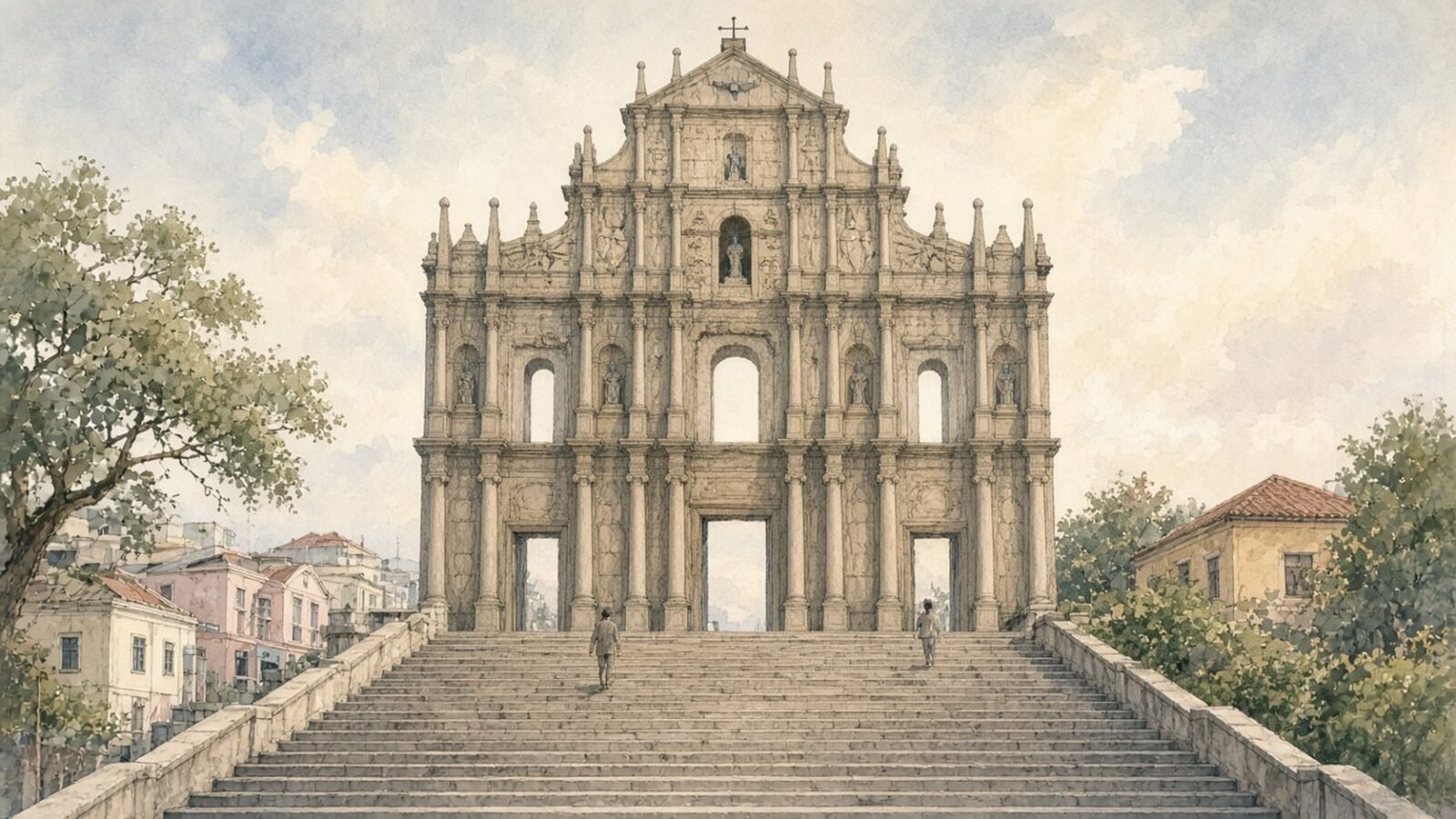
Macau, a historic Sino-Portuguese city, is the smallest and, by some measures, the richest territory in China, and it is still easiest to misread. Tourists see a Baroque facade above a street of egg tarts, then a skyline of casino towers on reclaimed land. Officials speak of a world centre of tourism and leisure, of the “1+4” diversification plan, and of Hengqin as the room the city never had. The more durable fact is narrower. For four centuries Macau has lived by permission: a Ming lease, a Portuguese administration, a gambling monopoly, and now a ten-year concession under the Basic Law. The city is real. The licence is what pays for it, and the public budget still rests on that ten-year gaming concession, a mainland visitor stream, and the land the city is borrowing at Hengqin.
That is not an insult. It is a description of how a rocky peninsula at the mouth of the Pearl River became a place of 686,500 people on 33.4 square kilometres, with an official sea area of 85 square kilometres and a currency, the pataca, that most of its visitors never need. Chinese and Portuguese are both official languages. The Historic Centre was inscribed by UNESCO in 2005. Gross gaming revenue in 2025 was 247.4 billion patacas, about 85 percent of the 2019 peak, and gaming tax still supplied the large majority of recurrent public revenue. A city can be culturally singular and fiscally a concession at the same time. Macau is both.
A lease, not a conquest
The Portuguese did not seize Macau the way Britain seized Hong Kong Island. From the 1550s they settled, with Ming acquiescence, on a spit of land already known for the A-Ma temple, and they paid an annual rent. The bargain was practical. Portuguese ships helped against pirates in the delta; the Ming gained a controlled window onto the Japan and Manila trades without opening Canton itself. Sovereignty stayed Chinese in form long after Portuguese governors behaved as if the city were theirs. Only in 1887, after the unequal-treaty decades had taught every foreign power the value of a signed concession, did the Sino-Portuguese treaty treat Macau as Portuguese territory.
The golden decades were the late Ming and early Qing, when Macau sat on the silver route that ran from Japan and the Americas into Chinese silk and porcelain. Jesuits used the city as a language school and staging post. Matteo Ricci passed through it. The College of St Paul, attached to the church whose facade still stands, was among the first Western-style colleges in East Asia. Japanese Christians, expelled from home, worked on that stone front. Dutch attacks in the seventeenth century produced the forts that still crown the hills. Then the Japan trade closed, Hong Kong opened after 1842, and the deep-water harbour that Macau never quite had became someone else’s fortune. What remained was a small, bilingual, slightly decayed port with a reputation for neutrality and a tolerance for games of chance.
Gambling was not invented by Stanley Ho. It was a local habit, taxed and sometimes banned, long before the twentieth century. What Ho did, with STDM in 1962, was turn a messy local concession into a monopoly that also built ferries, a hotel, and the habit of treating the public purse as a share of the tables. Henry Fok’s capital and the governor’s wish for a destination, rather than a backwater, did the rest. From the mid-1970s the government took a percentage of gaming receipts rather than a flat fee. By the late 1980s the tax take and the infrastructure obligations had risen together. The monopoly was lucrative and politically quiet. It was also a ceiling. One company does not build Cotai.
The 12-3 incident and a delayed return
Portuguese authority was already hollow before Lisbon admitted it. In December 1966, the 12-3 incident, a clash over a leftist school that became days of protest and a political humiliation for the governor, showed that Beijing could set terms in Macau without formally taking it. After the Carnation Revolution in 1974, Portugal offered the territory back. China declined. The timing was wrong, Hong Kong was still unresolved, and a quiet Portuguese administration was more useful than an early handover. The Sino-Portuguese Joint Declaration was signed only in 1987. Macau returned on 20 December 1999, the last European-administered territory on the Asian mainland, two years after Hong Kong and on a calendar Beijing chose.
The Basic Law promised a high degree of autonomy, a capitalist system, and the continuation of the legal order for fifty years. It also made clear, as Hong Kong’s document does, that defence and foreign affairs belong to the centre, and that the chief executive is chosen by a small election committee and appointed in Beijing. Edmund Ho, the first chief executive, was a banker from a local family, not a Portuguese governor in new clothes. The early SAR years were about cleaning up a reputation for triad violence around the casinos and about deciding what to do with a monopoly that was about to expire.
Ending the monopoly
In 2002 the government ended STDM’s exclusive right and awarded concessions, later multiplied by subconcessions, until six operators sat at the table: SJM, the Ho family’s successor vehicle; Galaxy; Wynn; Las Vegas Sands; Melco; and MGM, the last with Pansy Ho as the local partner who made the foreign licence politically legible. The point of the liberalisation was fiscal as much as moral. A competitive auction of the right to run games of chance would raise more money, and foreign operators would import a mass-market product that Stanley Ho’s VIP rooms had never really built.
Sheldon Adelson’s Sands Macao, opened in 2004, was the proof of concept: a casino that made its money on the main floor, not in a junket salon. The Venetian Macao followed on Cotai in 2007, on land that had not existed as land for most of the city’s history. Reclamation is Macau’s other oldest industry. The territory grew from 11.6 square kilometres in 1912 to 33.4 by 2025, counting the peninsula, Taipa, Coloane, and the Cotai strip stitched between the two islands. The University of Macau’s Hengqin campus added another square kilometre under Macau jurisdiction, an early hint that the city’s future acreage would be borrowed from Zhuhai.
The boom that followed is often told as a Las Vegas story. It was not. Las Vegas sells entertainment to a continental middle class that drives or flies in for a weekend. Macau sold, above all, proximity to mainland Chinese capital, first through junket-organised VIP play and later through a mass market of visitors who could cross a land border in an afternoon. By the early 2010s gross gaming revenue had left the Las Vegas Strip far behind. The 2013 peak, and the 2019 figure of about 292.5 billion patacas, were not the product of slot machines and showgirls. They were the product of a city that had been assigned, inside the People’s Republic, the unusual right to run legal casino gambling at scale, next to a country where it is a criminal offence.
Junkets, and the politics of who brings the players
The VIP system was the part of the concession that Beijing was always likeliest to discipline. Junket operators recruited high rollers on the mainland, extended credit, collected debts, and took a share of the rolling-chip turnover. At the peak they were not a colourful sideline. They were a large fraction of Macau’s gaming revenue and a channel through which capital left the mainland. That made them a financial problem and a political one. Campaigns against corruption after 2012 hit the VIP rooms first. The pandemic then closed the border. The subsequent prosecution of junket bosses, including the Suncity case, finished the old model.
What replaced it is a mass-market and premium-mass business: more visitors, smaller average bets, less dependence on a few promoters who could be arrested. In 2024 mass-floor revenue set a record and accounted for about three quarters of gaming receipts. VIP play has returned in a thinner form, much of it run directly by the concessionaires rather than by junkets. The city’s 2025 gross gaming revenue of 247.4 billion patacas was a recovery, up 9.1 percent on 2024, and still short of 2019. Analysts who treat that gap as failure are measuring the wrong decade. The old VIP machine is not supposed to come back. The new concession, which took effect on 1 January 2023 and runs to the end of 2032, was written to prevent it.
A ten-year licence with homework
The six winners of the renewed concessions are the same corporate families as before: SJM, Sands (Venetian), Galaxy, Wynn, Melco, and MGM. Continuity of names should not obscure the change in terms. The effective tax on gross gaming revenue is about 40 percent. Each concessionaire accepted a cap on tables and machines across the market, and each signed up to a non-gaming investment programme: hotels, entertainment, conventions, food, and the unglamorous work of making Macau a place a visitor might mention without mentioning baccarat. At the end of 2024 there were 30 casinos and about 53,000 gaming employees, including some 24,000 dealers, on wages that remain high by mainland standards and ordinary by the standards of a city whose public budget is a tax on the tables.
The fiscal arithmetic is blunt. In 2025 gaming tax produced about 94.9 billion patacas. That was more than four fifths of the government’s recurrent revenue. A surplus returned. So did the political fact that every school, hospital subsidy, cash handout, and infrastructure contract in Macau is downstream of visitors who come, in the main, from Guangdong and the rest of the mainland to gamble. Official figures put mainland visitors at roughly 70 percent of arrivals. In 2025 total arrivals passed 40 million. International visitors have grown quickly from a low base and are still a small share of the total. Macau’s “world city” vocabulary is ahead of its passport mix.
This is why diversification is a slogan with a deadline. The government’s “1+4” formula keeps tourism and gaming as the “1” and names four sectors that are supposed to grow beside it: traditional Chinese medicine and health, modern finance, high technology, and the meetings, incentives, conferences and exhibitions trade, with culture and sport attached. A development plan for 2024–2028 writes the ambition down. It does not repeal the tax system. Non-gaming revenue inside the concessionaires’ own accounts is still a small fraction of the gaming win. The honest reading is that Macau is trying to thicken the city around the licence, not to replace the licence. China was never going to stay at the thin end of other people’s value chains. Macau’s problem is different: it already sits at a very fat end of one chain, and it is being told to grow new ones before that end is trimmed.
Hengqin is the land question
A territory of 33 square kilometres cannot host a new industrial geography on its historic streets. The answer Beijing and Macau have chosen is Hengqin, the Zhuhai island immediately west of Cotai. The Guangdong–Macao In-Depth Cooperation Zone, established in 2021, is meant to be Macau’s hinterland: an education city, a traditional-medicine park, a financial experiment, a place where Macau residents and firms can operate under a hybrid regime while remaining inside the mainland’s customs frontier. In 2025 the zone’s GDP was about 54.7 billion yuan. That is not nothing. It is also not yet a second Macau economy. It is a construction site with a political timetable, including a five-year industrial plan published in 2025 and a longer outline running toward 2035.
The practical questions are dull and decisive. Who lives there. Whose law applies to a dispute. Whether a Macau graduate will actually take a job on the other side of the canal rather than a dealer’s uniform on Cotai. Whether mainland data rules, capital controls, and professional licensing will let “Macau finance” mean more than a signboard. The zone is the first serious attempt to give the SAR space without giving it sovereignty. If it works, Macau becomes a services platform for the western side of the Greater Bay Area. If it stalls, the city remains what the concession makes it: a high-tax tourism enclave with excellent Portuguese tiles.
What the streets still know
It would be a mistake, common among analysts who fly in for a results call, to treat the historic centre as decoration. The UNESCO inscription covers two zones: one from the A-Ma temple through Senado Square toward Camões, and one around Guia hill. Twenty-two principal monuments sit in a core of about 16 hectares, with a much larger buffer. Churches and temples face each other. The ruins of St Paul’s are a facade only, the church behind it having burned in 1835, which makes them a better emblem than a complete cathedral would have been. Macau’s Portuguese century is a front elevation. The life of the city is the Chinese and Macanese population that stayed, cooked, traded, and learned to live with successive landlords.
Macanese culture, in the narrow sense, is the creole world of Portuguese-Asian families, of patuá, of minchi and African-influenced sweets, of a community small enough to be sentimentalised and real enough to have its own clubs. Cantonese is the language of the street. Mandarin is the language of the visitor economy and of the liaison with Beijing. Portuguese survives in the law, in street names, and in a civil-service bilingualism that is more institutional than demographic. English is the language of the casino floor’s corporate layer. A visitor can cross all four before lunch. That layering is the actual heritage. The tiled facades are the part that photographs.
There is also a Macau that the gaming narrative flattens: the civil service, the light-rail line still being argued into usefulness, the airport on Taipa, the bridge to Hong Kong and Zhuhai that finally gave the west bank of the delta a fixed link, the universities, the Catholic schools, the shipyards that used to matter, the neighbourhoods of northern Macau that look like a dense Guangdong town and not like Cotai. Chengdu became a hub without a seaport by becoming a rail and air junction for a continental economy. Macau has a port and still depends on other people’s airports and other people’s borders. Its geography was always a privilege that could be switched off.
A SAR beside another SAR
Comparisons with Hong Kong are inevitable and usually lazy. Both are special administrative regions. Both returned at the end of the twentieth century under “one country, two systems.” Both have Basic Laws, chief executives, and a political class that must be acceptable in Beijing. There the useful similarity ends. Hong Kong was a global financial centre with a common-law tradition and a political argument about suffrage. Macau was a gaming concession with a civil-law tradition inherited from Portugal and a political argument that rarely reached the street. Hong Kong’s crisis after 2019 was about law, identity, and the scope of autonomy. Macau’s stress in the same years was about a closed border and a collapsed tax base. The city did not produce an equivalent mass movement. That absence is part of its political economy, not proof of deeper contentment.
Beijing’s interest in Macau is stable. The territory demonstrates that a SAR can be patriotic, orderly, and extremely profitable to the public budget without becoming a liberal city-state. It also demonstrates the risk of a monoculture. When gaming stopped in 2020, Macau had very little else to export except its residents’ patience. The recovery since late 2022 has been real. It has also been a reminder of who holds the tap. Visitor policy, anti-corruption campaigns, and the criminal law on cross-border gambling are mainland instruments. The concession contract is a local instrument. Macau governs the floor. Beijing governs the demand.
What to watch before 2032
The concession clock runs to 31 December 2032. Between now and then, four tests matter more than the monthly revenue prints.
The first is whether non-gaming spending becomes visible in the city’s own accounts, not merely in renderings of arenas and food halls. A concessionaire can meet a capital-expenditure promise and still earn almost all of its cash flow on the floor. The government will have to decide, before the next tender, whether it is buying buildings or buying a different visitor.
The second is Hengqin’s population and law, not its masterplan. If Macau people and Macau firms do not use the zone, it will remain a Zhuhai development area with a cooperation label. If they do, the SAR will have altered its economic geography for the first time since Cotai.
The third is the mix of visitors. Forty million arrivals are a recovery. A city that still draws seven in ten of them from one country, under one visa regime, has not diversified its risk. International routes, the airport expansion, and the Hong Kong–Zhuhai–Macau bridge are tools. They are not a strategy unless the product on offer is more than a cheaper, nearer Las Vegas for mainland customers.
The fourth is political succession inside a small elite. Sam Hou Fai, a former senior judge, became chief executive in 2024, after Ho Iat Seng. The gaming families, the civil service, the Fujianese and Cantonese business networks, and the liaison office do not always want the same emphasis on “appropriate” diversification. Appropriate is the operative word in the official documents. It means diversification that does not embarrass the concession, and a concession that does not embarrass the state.
A city, still
None of this cancels the pleasure of the place, or the point of its history. Macau is the longest-running site of a Chinese–European urban bargain on this coast. It fed the missions, the silver trade, a creole cuisine, and a legal bilingualism that Hong Kong never had. It survived the opening of Hong Kong by becoming something Hong Kong was not allowed to be. It survived the end of empire by becoming useful to the state that took it back. The ruins, the temples, the casinos, and the reclamation are not four separate stories. They are one story about a city that has always negotiated the terms on which outsiders, and then the centre, would let it make a living.
Call that a concession, a franchise, or a SAR. The word is less important than the constraint. Macau will prosper while the licence is valuable and the border is open. It will struggle when either is tightened. The task of the next decade is to make the city thicker than the licence without pretending the licence is a costume. Visitors can keep the egg tart. The dispatch is about what the tart is attached to.