Hong Xiuquan
Hong Xiuquan (洪秀全, 1814–1864) was a failed Hakka examination candidate from rural Guangdong who, after a series of Christian visions, raised the bloodiest civil war of the nineteenth century, declared himself the younger brother of Jesus Christ, and ruled a third of China from a reinvented Nanjing for eleven years before his kingdom collapsed around him in 1864. The Taiping Rebellion he led killed between twenty and thirty million people, more than the First World War, and redrew the political map of late-Qing China.[1][2][3][4][5]
Key findings
- Hong Xiuquan (1814–1864) was a Hakka farmer’s son who failed the imperial examinations four times between 1827 and 1837, suffered a nervous collapse, had Christian visions, and declared himself the second son of God in 1837.
- He founded the God Worshipping Society in 1844, a syncretic sect combining Protestant Christianity with Hakka folk religion and millenarian expectations.
- The Jintian Uprising of January 1851 launched the Taiping Rebellion. In March 1853 the Taiping army captured Nanjing and renamed it Tianjing, “Heavenly Capital.”
- The Taiping Heavenly Kingdom’s social programme — abolition of private property, prohibition of opium, separation of the sexes, a reformed calendar, simplified script — was the most radical restructuring of Chinese society ever attempted before 1949.
- Hong ruled for eleven years without leaving Nanjing. His regent Yang Xiuqing and the chief minister Wei Changhui were successively assassinated in internal purges that destroyed the regime’s military leadership.
- The death toll of the Taiping Rebellion, twenty to thirty million over fourteen years, is the largest for any war in human history and exceeds the death toll of the First World War.
1. Family background and the Hakka question
Hong Xiuquan was born on 1 January 1814 in Fuyuan, a small Hakka village in the Huaxian district of Guangdong, about fifty kilometres north of Guangzhou. His father, Hong Jingkang, was a subsistence farmer of modest landholdings; his mother, Wang, was the daughter of a neighbouring family. The family belonged to the Hakka — the “guest people” — a Han Chinese subgroup whose ancestors had migrated south from the Central Plains over several centuries and who lived as a diaspora community in the southern provinces, particularly Guangdong, Guangxi, and Fujian. The Hakka were frequently in conflict with the dominant Cantonese and Punti populations, who regarded the Hakka as latecomers and rivals. The persistent tension between the Hakka and the surrounding communities was, in the late Qing, a standing social fact of southern China, and it would prove to be a recruiting ground for the Taiping movement.[6][1][7][8][9][10][11][12][13][14][2]
The Hong family was poor but not destitute. Hong Jingkang had a small holding that produced rice and sweet potatoes, and the family supplemented its income through seasonal labour. The Hong household was literate to a limited degree: Hong Jingkang could read enough to manage the family’s simple accounts, and the family could afford to send their sons to a village school. Hong Xiuquan was the fourth of five brothers and had an elder sister; three of the brothers survived to adulthood. The family, in short, was typical of the lower edge of the rural gentry — too poor to be wholly secure, too literate to be wholly oppressed.
The most consequential fact about the Hong family, in retrospect, is that they were Hakka. The Hakka diaspora in Guangdong and Guangxi was the seedbed of several late-Qing millenarian movements, of which the Taiping was the most consequential. The Hakka had a strong tradition of clan organisation, of land reclamation in frontier zones, and of Hakka identity-as-persecuted-minority. The latter tradition, in particular, provided a ready frame for millenarian narratives: a people chosen by Heaven, called to a special destiny, suffering at the hands of infidels. The Taiping ideology grafted this Hakka frame onto a Christian millenarianism borrowed from Protestant missionaries, and the resulting hybrid was uniquely suited to the discontents of southern China in the 1840s.[1][11][9][2]
2. The imperial examinations and the failure trauma
Hong Xiuquan’s childhood ambition was to enter the imperial examination system and, through it, to acquire the jinshi degree that would lift his family into the literate gentry. The examination system had been the principal route of social mobility in imperial China for more than a thousand years, and for a poor Hakka family with literate sons, the examinations were the only realistic route. The first stage of the system was the xiucai — the county-level examination, held every three years. Success at the xiucai level conferred the right to enter the higher examinations; failure was a personal humiliation and a family setback.[15][16][2]
Hong sat the xiucai examination four times. He first sat, aged thirteen, in 1827 in Guangzhou, and failed. He sat again in 1830 and failed. He sat a third time in 1836 and failed. He sat a fourth time in 1837, again failed, and on his return from Guangzhou suffered what contemporary sources describe as a “great illness” — a combination of fever, delirium, and a profound psychological collapse. Hong was confined to bed for several months, and during the worst of his illness he had visions.[7]
The failure trauma, in retrospect, is the central psychological fact of Hong’s life. The examination system was unforgiving: most candidates failed, and a succession of failures at the xiucai level would have condemned an ambitious young man to the status of a permanent shengyuan aspirant. The four failures between 1827 and 1837 — when Hong was between thirteen and twenty-three years old — represented a decade of unremitting failure at the only task his family and his community expected him to accomplish. The pressure on the son of a poor Hakka farmer to succeed at the examinations was intense, and the repeated failure created the conditions in which a religious vision could be received as a personal revelation.
Hong was not, by all accounts, a particularly talented scholar. Contemporary sources describe him as competent at the rote-learning demands of the examination curriculum but lacking in the literary flair that examiners rewarded. The discrepancy between his actual ability and the social expectation that he would succeed was, in the Confucian moral economy, a serious personal failure. In the 1830s, as the Qing state was losing its grip on the southern provinces, the examination system was also losing its legitimacy as a route of social mobility: the number of candidates was growing faster than the number of degrees, and the rate of failure was increasing. Hong was one of thousands of similar young men across southern China for whom the examination system was no longer a credible path to advancement. The Taiping movement, and Hong’s role in it, must be understood in this context: a generation of marginalised young men, the product of an educational system that was failing them, and ripe for a millenarian alternative.[15][2]
3. The visions and the Christian tracts
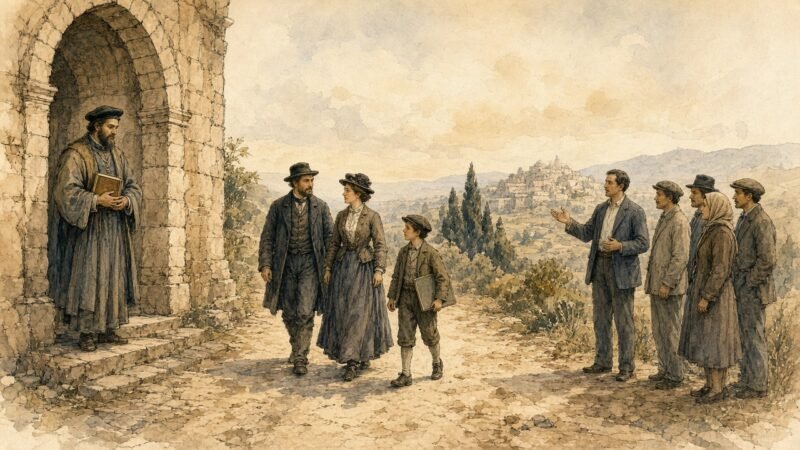
The content of Hong’s 1837 visions is preserved in a document Hong himself dictated in 1847, called the Tianqing Daoli Shilu — the “True Record of the Way of the Heavenly Father.” The visions were a set of dreamlike experiences: an old man with a long beard who came to Hong in his sickbed, an elder brother who instructed him in righteousness, and a sense of being called to a special mission. The visions are, in retrospect, easy to interpret as a complex of personal grievance, religious syncretism, and millenarian expectation. The “old man” had the iconographic features of the Jade Emperor of Chinese folk religion; the “elder brother” had the iconographic features of Jesus Christ as Hong later came to know him. The visions were the religious core of what would become the Taiping theology.[17][18]
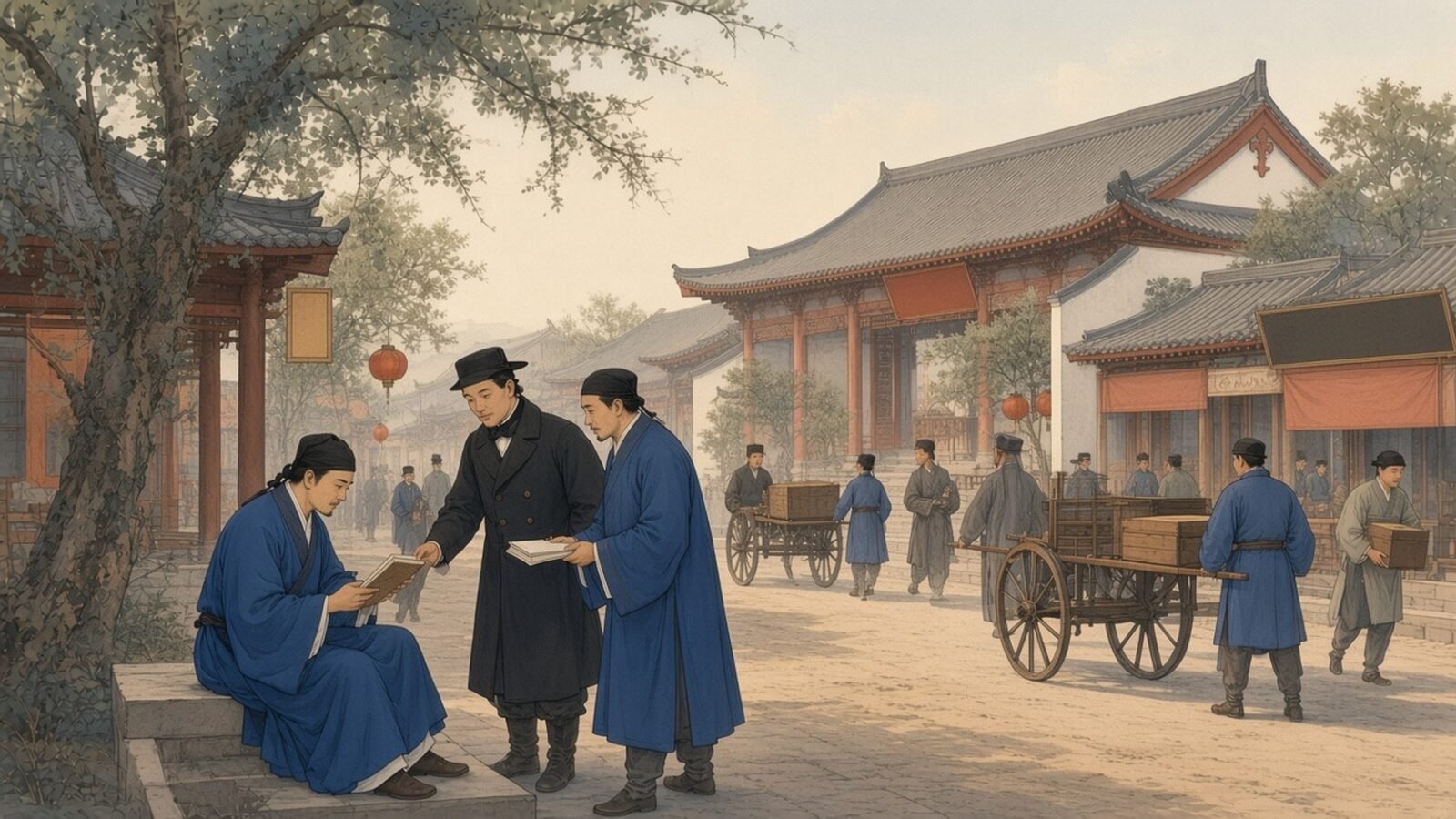
In 1843, six years after the visions, Hong opened a box of Christian tracts that had been left with one of his cousins some years earlier by the American Southern Baptist missionary Issachar Jacox Roberts. Roberts had been working in Guangdong since the late 1830s and had distributed tracts in the Hakka villages as part of his evangelical work. Hong read the tracts — which were translations of portions of the Bible and short expositions of Protestant doctrine — and concluded that the visions he had experienced in 1837 had been a direct encounter with the Christian God. He concluded, further, that he himself was the second son of God, sent to cleanse China of demons and to establish a heavenly kingdom on Earth.[1][2]
Hong’s reading of the Christian tracts was selective and idiosyncratic. He accepted the Protestant framework of a single God, of Jesus Christ as the saviour, and of an apocalyptic struggle between good and evil. He rejected the standard Protestant theology of sin and grace, replacing it with a Chinese millenarianism in which the Heavenly Father would directly intervene in human affairs to support his chosen people. The resulting theology was, in the judgment of later Christian missionaries, both unorthodox and unstable. It was, however, intensely appealing to the Hakka peasantry of southern China, who received it as a Chinese revelation with a Christian vocabulary.[2]
The syncretism was not random. Hong’s theology drew on several distinct sources: the Old Testament narratives of the Israelites’ struggle against Philistine oppressors; the New Testament narrative of Jesus’s struggle against the Pharisees and Romans; the Hakka folk religion’s traditions of spirit possession and exorcism; and the Chinese millenarian traditions of the Maitreya and the White Lotus. The combination was uniquely suited to the discontents of southern China in the 1840s: an economic depression following the First Opium War, an ethnic tension between Hakka and Punti, and a political crisis in which the Qing state was visibly losing control.[19][20][21][22][2][23][24]
4. The God Worshipping society
In 1844 Hong Xiuquan and his cousin Feng Yunshan founded the God Worshipping Society — Bai Shangdi Hui — in the Hakka villages of Guangxi. The society’s theology held that the Heavenly Father had created the world and that his son Jesus Christ had been sent to save humanity. The society held that Hong himself was the second son of the Heavenly Father, sent to cleanse China of demons. The society’s ritual practice was austere: daily prayer, communal meals, the singing of hymns composed by Hong, and the ritual destruction of idols.[25][26][11][18][2]
The God Worshipping Society grew rapidly in Guangxi over the next five years. The growth was driven by several factors: the sect offered a millenarian hope to a population suffering economic distress; the sect’s anti-idolatry program appealed to Hakka villagers who were fed up with the expense of local temple festivals; and the sect’s communal meals and mutual aid appealed to a population whose own families could no longer provide them. By 1850 the God Worshipping Society had several tens of thousands of members, organised in cells of twelve to fifteen families each. The cells were led by jiazhong — household heads — who reported to a hierarchy of regional leaders.[11]
The society was, in its early years, persecuted by the Qing state. The Qing authorities, alarmed by the heterodox theology and the secret-society character of the movement, began a campaign of suppression in 1847 and 1848. The persecution drove the movement underground and forced Hong and Feng to flee to the Thistle Mountain area, where they prepared for armed insurrection. The persecution also provided the movement with a sense of identity as a persecuted minority, which strengthened the millenarian conviction that the Heavenly Father would intervene on their behalf.[24]
5. The Jintian Uprising
In January 1851 Hong Xiuquan and his followers — by then numbered in the tens of thousands — declared the Taiping Heavenly Kingdom at Jintian in Guangxi, and proclaimed Hong the “Heavenly King” of the new order. The declaration was both religious and political: the Heavenly Kingdom was a divinely sanctioned realm, and the Heavenly King was its divinely appointed ruler. The declaration marked the beginning of the Taiping Rebellion — the bloodiest civil war of the nineteenth century.[27][11][4]
The early Taiping army was a formidable fighting force. The army was organised in a system borrowed from the Qing Bing system, with a hierarchical structure of jun, shi, lü, and wei (regiment, battalion, company, squad). The army was initially successful because it was ideologically motivated: the soldiers believed they were fighting under the direct command of the Heavenly Father, and their willingness to fight and die was correspondingly high. The army was also successful because it was led by a generation of capable commanders, of whom the most important were Yang Xiuqing, Wei Changhui, Shi Dakai, and Li Xiucheng.[24][28][29][30][31][32]
The early Taiping strategy was simple: march north and east, capture Nanjing, declare it the capital of the Heavenly Kingdom, and continue the conquest from there. The strategy was carried out with remarkable speed. Between January 1851 and March 1853 — a little over two years — the Taiping army marched more than 1,500 kilometres, fought dozens of major battles, and captured the largest city on the Yangtze. The march culminated in the siege of Nanjing in March 1853, which ended when the Qing garrison surrendered after a brief resistance. Hong entered Nanjing in triumph, renamed it Tianjing — “Heavenly Capital” — and proclaimed the Heavenly Kingdom.[3][33][24]
The early Taiping victories were not, however, decisive. The Taiping army captured Nanjing and established a state, but it did not capture Beijing. The Qing imperial capital remained in Qing hands, and the Qing court was able to organise a response. The Taiping army was, in addition, increasingly stretched along its line of communications: the army had to garrison the cities and towns it had captured, and the garrisons tied down troops that might otherwise have been used for further conquest. The Taiping army was, in this sense, the victim of its own success: it had created a state, and the state required an army to defend it.[3][34][24]
6. The Heavenly Kingdom’s social programme
The Taiping Heavenly Kingdom was, in its early years, the site of the most radical social experiment in Chinese history. The Heavenly Kingdom’s programme was codified in a series of edicts issued by Hong Xiuquan between 1851 and 1854. The programme included:[27]
- Abolition of private property. Land was to be held in common and distributed according to need. The actual implementation of this policy was limited, but the policy itself was unprecedented in Chinese history.
- Abolition of the imperial examination system. The Confucian examinations were replaced by Taiping examinations based on the Christian scriptures and on Hong’s own writings.
- Prohibition of opium. The Taiping were the first Chinese government in history to enforce a strict prohibition of opium. The prohibition was effective and the Taiping army was notably free of the opium addiction that plagued the Qing armies.
- Prohibition of alcohol. Alcohol was forbidden to Taiping followers, and the prohibition was enforced.
- Abolition of foot-binding. Foot-binding was forbidden to Taiping women, and the prohibition was enforced. The Taiping army included substantial numbers of women, and many of the women fought alongside the men.
- Separation of the sexes. Men and women were forbidden to have sexual contact except within marriage, and even within marriage sexual contact was restricted. The Heavenly King himself was exempted from this rule, and his harem was legendary.
- A new calendar. The Taiping calendar was based on the Judeo-Christian year, with the first year of the Taiping era set at 1851. The calendar was used in all official documents.
- A simplified script. Hong Xiuquan attempted to replace the Chinese characters with a simplified form of writing, but the attempt was largely unsuccessful.
The social programme was, in some respects, ahead of its time. The abolition of foot-binding, the prohibition of opium, the inclusion of women in the army, and the simplified script were all measures that would later be adopted by the Republic of China and the People’s Republic of China. In other respects, the programme was authoritarian: the Heavenly King was the supreme authority, and the Heavenly Father’s will was communicated through Hong and his subordinates. The programme was also unstable: it relied on the charisma of the Heavenly King, and the Heavenly King’s charisma was a limited resource.[35]
7. Yang Xiuqing and the regent crisis
The most serious internal crisis of the Taiping regime began in 1853, the year of the Nanjing capture. Yang Xiuqing, one of Hong’s most capable military commanders, began to claim that he could communicate directly with the Heavenly Father. The claim was initially treated as a useful instrument: Yang’s communications gave him a degree of prophetic authority that reinforced the regime’s ideological claims. By 1856, however, Yang had used his prophetic authority to challenge Hong himself. Yang claimed that the Heavenly Father had designated him as the regent of the Heavenly Kingdom, and he began to issue orders in the Heavenly Father’s name.[3][29][36]
The confrontation came to a head in September 1856. Hong Xiuquan, in a palace coup, ordered Yang Xiuqing assassinated. The assassination was carried out by Wei Changhui, the chief minister of the Heavenly Kingdom, and it was accompanied by the massacre of Yang’s family and supporters. The massacre killed several thousand people, including many of Yang’s followers. The assassination removed Yang as a rival to Hong, but it also removed one of the most capable military commanders of the Taiping army. The Yang Xiuqing assassination is the first of the two great Taiping purges; the second is the Wei Changhui assassination two months later.[30]
The Wei Changhui assassination was a consequence of the Yang Xiuqing purge. Wei had been the instrument of Yang’s death, and he had expected to be rewarded. Hong Xiuquan, however, viewed Wei as a potential threat. In November 1856, Hong ordered Wei assassinated in a second palace coup. The Wei Changhui assassination was accompanied by the massacre of Wei’s family and supporters, killing several thousand more. The two purges — Yang in September and Wei in November — eliminated most of the original Taiping leadership. Shi Dakai, the most capable of the remaining commanders, was himself killed in 1863. By the time the Qing siege of Nanjing began in earnest in 1863, the Taiping regime was a husk of its former self, with Hong as the nominal ruler of a state whose remaining commanders were unable to coordinate a defence.[3]
8. The Qing response
The Qing response to the Taiping Rebellion was initially feeble. The Qing military system — the Green Standard army and the Eight Banners — had been decaying for a century, and the Qing forces were no match for the motivated Taiping army. The Qing court attempted several times to organise a response, but the early Qing attempts to suppress the Taiping were defeated. The turning point came in 1853, when the Qing court authorised the organisation of local militia forces — the tuanlian — to supplement the regular army. The most important of these militia forces was the Xiang Army, organised by the Hunan official Zeng Guofan.[24][4][37][28][38][39][40]
Zeng Guofan was a Confucian scholar and Hunan-area elite who was deeply conservative in his personal politics and deeply innovative in his military organisation. Zeng recognised that the Green Standard was incapable of defeating the Taiping, and he organised a new army, the Xiang Army, based on the local gentry and the local militia tradition. The Xiang Army was initially less motivated than the Taiping, but it was better supplied and better led. Zeng was supported by two of his most capable subordinates, Li Hongzhang and Zuo Zongtang, both of whom would later play important roles in the late-Qing state. The three of them — Zeng, Li, and Zuo — would be known as the “three great Xiang Army leaders.”[41][39][37][38][42][43]
The Qing reconquest proceeded slowly. The Xiang Army captured the Taiping city of Wuchang in 1854, but the Taiping counter-attacked and recaptured it. The Xiang Army besieged but did not capture Nanjing for nearly a decade, from 1860 to 1864. The siege was a war of attrition: the Xiang Army built a series of earthworks around the city, gradually tightened the encirclement, and waited for the city to starve. The Taiping defenders, under Li Xiucheng, fought with great tenacity, but the loss of the surrounding countryside to the Xiang Army and the progressive loss of supply made the defence increasingly difficult.[24][44][3][32]
9. The siege of Nanjing and Hong’s death
By early 1864 the situation inside Nanjing was desperate. The city was surrounded by Xiang Army earthworks, the food supply had collapsed, and the remaining Taiping army was reduced to a fraction of its peak strength. Hong Xiuquan, by this time, was a broken man. He had not left the walls of Nanjing in eleven years. He had withdrawn from public life, leaving the conduct of the war to his subordinates. He had retreated to his palace, where he issued edicts in a routine that was no longer followed and where he indulged an increasingly grotesque personal life. He had taken many wives and concubines, and the accounts of his final years describe a man who had lost all contact with reality.[3]
Hong died on 1 June 1864, six weeks before the fall of Nanjing. The circumstances of his death are unclear. The most common account is that he died by suicide, having refused to flee the city. A competing account, supported by the Qing sources, is that he died of food poisoning. A third account, supported by some later Taiping loyalists, is that he was assassinated by subordinates who feared he would surrender the city. The truth is unknowable. His body was buried in the imperial mausoleum outside Nanjing, and his grave was discovered by Zeng Guofan‘s soldiers when the city fell.[3][40]
Nanjing fell on 19 July 1864. The Xiang Army, having broken through the encirclement, stormed the city, and the remaining Taiping defenders — perhaps 10,000 of them — fought to the death. The fall of Nanjing marked the formal end of the Taiping Heavenly Kingdom, though scattered Taiping forces continued to resist in southern China until 1866. The post-Nanjing mopping-up was carried out by Li Hongzhang and Zuo Zongtang and included the massacre of large numbers of Taiping prisoners.[3][2][42][43]
10. The death toll and the demographic consequences
The Taiping Rebellion is the deadliest civil war in human history. The death toll is conventionally estimated at twenty to thirty million, with some estimates higher. The deaths were caused by direct combat, by famine resulting from the disruption of agriculture, and by disease. The demographic consequences of the rebellion were catastrophic: the population of the affected provinces — Jiangsu, Anhui, Zhejiang, Jiangxi, and Hubei — was reduced by perhaps a third, and some rural areas were depopulated entirely. The demographic loss was not made up for several generations.[4][45][46][47][48][49]
The death toll was made worse by a second Taiping-era catastrophe: the Taiping Heavenly Kingdom coincided with a series of natural disasters that compounded the war’s destruction. The most important of these was the Northern Chinese Famine of 1876-1879, which killed an additional thirteen million people and which occurred in part because the Qing state’s resources had been drained by the Taiping war. The combination of the Taiping Rebellion and the subsequent famines created a demographic crisis that lasted for more than a generation and that shaped the politics of late-Qing and Republican China.[27][50][24][2]
11. Historical significance
The Taiping Rebellion is, by any measure, one of the most consequential events in modern Chinese history. The rebellion was, first of all, a demographic catastrophe: the death toll of twenty to thirty million exceeded the death toll of any other civil war in human history, and the demographic consequences shaped the politics of late-Qing and Republican China. The rebellion was, second, a fiscal catastrophe: the Qing state was bankrupted by the cost of the war, and the resulting fiscal crisis set the conditions for the Self-Strengthening Movement, the Hundred Days’ Reform, and the 1911 Revolution. The rebellion was, third, a military revolution: the Xiang Army and its successor formations became the basis of the Beiyang Army, which would dominate Chinese politics for the first half of the twentieth century.[4][2][24][51][52][53][38][54]
The rebellion was, fourth, a religious revolution. The Taiping theology was, in the judgment of the missionaries who encountered it, a syncretic and unorthodox form of Christianity. But the Taiping theology was also one of the first sustained attempts to graft a Christian millenarianism onto a Chinese political movement, and it established a template that later movements would follow. The Boxer Rebellion of 1899-1901, the Taiping-style millenarian movements in the late Qing, and the early Communist millenarianism all drew, in different ways, on the Taiping precedent.[55][21]
The rebellion was, fifth, a precedent for the 1911 Revolution and the Chinese Communist Revolution. The Taiping demonstrated that the Qing state could be seriously challenged, and the Taiping’s combination of millenarian religion and military organisation was a model that the Kuomintang and the Chinese Communist Party both drew on, in different ways. The Taiping legacy in the Chinese Communist tradition is, in particular, significant: the Taiping’s anti-feudal programme, its anti-Manchu stance, its land-reform proposals, and its emphasis on peasant mobilisation all resonate with the Chinese Communist Party‘s later practice. The Taiping’s religious millenarianism, by contrast, was replaced by Marxist-Leninist ideology.[53][56][24][57][58][59]
12. Hong himself
The most striking fact about Hong Xiuquan, in retrospect, is the gap between his actual achievement and the historical weight of his name. He was a failed examination candidate, a village preacher, and a charismatic leader of a millenarian sect. He was, in his final years, a remote and increasingly disconnected figurehead who issued edicts to a court that no longer obeyed them. He was, in his death, the leader of a defeated regime whose capital had just been sacked and whose population had been reduced by a third. He was, in the judgment of his contemporaries and of later historians, not a great ruler in the Confucian sense. He was, however, the founder of a movement that killed more people than any other civil war in human history, and he was the proximate cause of the end of the Qing dynasty.[60][24]
Hong’s historical significance is, in this sense, out of proportion to his personal capacities. He was, in the long run, a vehicle for forces larger than himself: the discontents of the late-Qing peasantry, the appeal of Christian millenarianism, the weakness of the Qing state, the rivalries of the late-Qing military elite. The forces that produced the Taiping Rebellion would have produced a different rebellion without Hong, and the resulting disaster would have been similar. Hong’s distinctive contribution was to articulate the rebellion in a form that proved both attractive and durable, and to keep the rebellion going long enough to become a state.[24][4]
Hong died on 1 June 1864 at the age of fifty. His body was buried in the imperial mausoleum outside Nanjing, and his grave was found by the Xiang Army when the city fell in July 1864. The body was exhumed and the corpse was verified by Zeng Guofan, who confirmed the identification. The body was then cremated, and the ashes were scattered. The tomb was destroyed, and the site is now the location of a small museum. The story of the Taiping Rebellion, and of its founder, was largely suppressed in Qing historiography, and the rebellion was not seriously studied in China until the twentieth century. The Western historiography of the rebellion, in contrast, has been substantial, and the Western historians’ verdict on Hong has been mixed: a remarkable figure in some respects, a tragic figure in others, and a cautionary tale in many.[3][38][40][24][2]
13. Closing thoughts
The Taiping Rebellion and its founder Hong Xiuquan are, in the long run, among the most consequential episodes in modern Chinese history. The rebellion killed more people than any other civil war in human history, drained the Qing state of its remaining resources, and set the political conditions for the end of imperial rule in 1912. The rebellion also produced one of the most radical social programmes ever attempted in China, and the programme’s elements — the abolition of foot-binding, the prohibition of opium, the inclusion of women in the army, the simplified script — have all been incorporated into modern Chinese state practice. The rebellion was, in this sense, both a failure and a precedent: it failed as a state, but it succeeded in establishing a model of radical social transformation that later movements would follow.[4][60][24][2]
Hong Xiuquan himself remains, in the popular memory of China, a contradictory figure. He is sometimes celebrated as a proto-revolutionary who challenged the Qing and as a folk hero who stood up for the Hakka peasantry. He is sometimes condemned as a megalomaniac and a religious fanatic who deluded himself and his followers. The two views are not mutually exclusive, and the historical record supports both. Hong was, in the end, both a man of his times and a man of extraordinary personal qualities, and the Taiping Rebellion is, in the end, both a Chinese tragedy and a Chinese precedent.[2][24][4]
14. Timeline
-
He first sat, aged thirteen, in 1827 in Guangzhou , and failed.
-
Hong read the tracts — which were translations of portions of the Bible and short expositions of Protestant doctrine — and concluded that the visions he had experienced in 1837 had been a direct encounter with the Christian God.
-
In 1844 Hong Xiuquan and his cousin Feng Yunshan founded the God Worshipping Society — Bai Shangdi Hui — in the Hakka villages of Guangxi .
-
The Heavenly Kingdom’s programme was codified in a series of edicts issued by Hong Xiuquan between 1851 and 1854.
-
The most serious internal crisis of the Taiping regime began in 1853, the year of the Nanjing capture.
-
The Xiang Army captured the Taiping city of Wuchang in 1854, but the Taiping counter-attacked and recaptured it.
-
By early 1864 the situation inside Nanjing was desperate.
-
The most important of these was the Northern Chinese Famine of 1876-1879 , which killed an additional thirteen million people and which occurred in part because the Qing state’s resources had been drained by the Taiping war.
-
The Boxer Rebellion of 1899-1901, the Taiping-style millenarian movements in the late Qing, and the early Communist millenarianism all drew, in different ways, on the Taiping precedent.
-
The rebellion killed more people than any other civil war in human history, drained the Qing state of its remaining resources, and set the political conditions for the end of imperial rule in 1912.
References
- Grokipedia, “Guangdong” ↩
- Grokipedia, “China” ↩
- Grokipedia, “Nanjing” ↩
- Grokipedia, “Taiping Rebellion” ↩
- Grokipedia, “World War I” ↩
- Grokipedia, “hua county” ↩
- Grokipedia, “Guangzhou” ↩
- Grokipedia, “wang” ↩
- Grokipedia, “Hakka people” ↩
- Grokipedia, “North China Plain” ↩
- Grokipedia, “Guangxi” ↩
- Grokipedia, “Fujian” ↩
- Grokipedia, “Cantonese people” ↩
- Grokipedia, “Punti” ↩
- Grokipedia, “Imperial examination” ↩
- Grokipedia, “Jinshi” ↩
- Grokipedia, “Jade Emperor” ↩
- Grokipedia, “Jesus” ↩
- Grokipedia, “Old Testament” ↩
- Grokipedia, “New Testament” ↩
- Grokipedia, “Maitreya” ↩
- brill.com, “White Lotus” ↩
- Grokipedia, “First Opium War” ↩
- Grokipedia, “Qing dynasty” ↩
- Grokipedia, “Feng Yunshan” ↩
- Grokipedia, “God Worshipping Society” ↩
- Grokipedia, “Taiping Heavenly Kingdom” ↩
- Grokipedia, “Eight Banners” ↩
- Grokipedia, “Yang Xiuqing” ↩
- Grokipedia, “wei changhui” ↩
- Grokipedia, “Shi Dakai” ↩
- Grokipedia, “Li Xiucheng” ↩
- Grokipedia, “Yangtze” ↩
- Grokipedia, “Beijing” ↩
- Grokipedia, “People’s Republic of China” ↩
- Grokipedia, “Regent” ↩
- Grokipedia, “Green Standard Army” ↩
- Grokipedia, “Xiang Army” ↩
- Grokipedia, “Hunan” ↩
- Grokipedia, “Zeng Guofan” ↩
- Grokipedia, “Confucianism” ↩
- Grokipedia, “Li Hongzhang” ↩
- Grokipedia, “Zuo Zongtang” ↩
- Grokipedia, “Wuchang, Wuhan” ↩
- Grokipedia, “Jiangsu” ↩
- Grokipedia, “Anhui” ↩
- Grokipedia, “Zhejiang” ↩
- Grokipedia, “Jiangxi” ↩
- Grokipedia, “Hubei” ↩
- Grokipedia, “Northern Chinese Famine of 1876 - 1879” ↩
- Grokipedia, “Self-Strengthening Movement” ↩
- Grokipedia, “Hundred Days’ Reform” ↩
- Grokipedia, “1911 Revolution” ↩
- Grokipedia, “Beiyang Army” ↩
- Grokipedia, “Boxer Rebellion” ↩
- Grokipedia, “Chinese Communist Revolution” ↩
- Grokipedia, “Kuomintang” ↩
- Grokipedia, “Chinese Communist Party” ↩
- Grokipedia, “Marxism - Leninism” ↩
- Grokipedia, “Hong Xiuquan” ↩