Five Centuries of Jewish Printing and Publishing
The history of the printed book and the history of the Jewish people have been bound together almost from the beginning. Within a generation of Johannes Gutenberg’s Bible, Jewish printers in Italy were setting Hebrew type, and over the following five centuries Jewish printers, editors and publishers shaped the presentation of sacred texts, the spread of vernacular literature, the modern newspaper, the illustrated art book and the paperback. Their work moved with the communities that sustained it, from the small towns of Lombardy to Venice and Constantinople, from Amsterdam to the printing towns of Poland and Lithuania, and from Berlin and Vienna to London and New York.
This essay traces that history. It begins with the first Hebrew presses of the fifteenth century and the Soncino family, follows the great Venetian editions of Daniel Bomberg, and describes the printing centres of Amsterdam and Eastern Europe, including the Romm press of Vilna and the Yiddish publishers of the nineteenth and twentieth centuries. It then turns to the German-Jewish publishing houses of the Weimar period, to the émigré publishers who transformed British publishing after the 1930s, and to the American houses founded by Jewish publishers in the first half of the twentieth century. It closes with a new publishing venture founded in London and New York in 2026.
The first Hebrew presses
Printing in Hebrew began in Italy in the 1470s. The earliest dated Hebrew book is generally agreed to be an edition of Rashi’s commentary on the Pentateuch, completed at Reggio di Calabria in February 1475 by Abraham ben Garton. Other presses appeared within a few years in Piove di Sacco, Mantua, Ferrara and Bologna, and on the Iberian Peninsula at Guadalajara, Híjar and Lisbon. Books printed before 1501 are known as incunabula, and around 150 Hebrew incunabula editions survive, many in only a handful of copies. They include prayer books, legal codes, biblical commentaries and editions of the Pentateuch, and their typography owed a great deal to the scribal hands of the manuscripts they replaced.
The early printers faced particular technical problems. Hebrew is written from right to left, and a full text of the Bible carries vowel points beneath and above the letters and cantillation marks that guide its chanting. Setting all of these in metal type required many more sorts than a Latin text, and a high degree of skill from the compositor. Early printers often omitted vowels altogether or printed them only in biblical texts, and the problem of presenting a vocalised and accented Hebrew Bible on the printed page occupied several generations of printers.
The most important of these early families took its name from Soncino, a small town in Lombardy between Cremona and Bergamo. The family was of German Jewish origin and had settled in the town in the middle of the fifteenth century. Under Joshua Solomon Soncino and his relatives the press issued the tractate Berakhot of the Babylonian Talmud in 1483 or 1484, the first printed Talmud tractate, and in 1488 the first complete printed Hebrew Bible with vowels and accents. The 1488 Bible became a model for later editions, and a copy of a later Soncino Bible, printed at Brescia in 1494, is said to have been the one Martin Luther used for his translation of the Hebrew Scriptures.
The most prolific member of the family was Gershom ben Moses Soncino, who worked as a printer for more than forty years. His career shows how dependent Jewish printing was on the shifting tolerance of the states around it. He worked at Soncino, Brescia, Barco, Fano, Pesaro, Ortona and Rimini, printing not only Hebrew books but also Latin, Greek and Italian works, and he employed the type designer Francesco Griffo, who had cut the italic type for the Venetian printer Aldus Manutius. In the 1520s Gershom left Italy for the Ottoman Empire, where he printed in Salonica and Constantinople. He died around 1534. His descendants continued to print in Constantinople and later in Cairo, and the Soncino name became so closely associated with Hebrew printing that it was adopted by later publishers, among them the London Soncino Press, which issued an English translation of the Babylonian Talmud in the 1930s and 1940s.
The movement of Hebrew printing to the Ottoman Empire was a consequence of the expulsions from Spain in 1492 and Portugal in 1496 to 1497. Refugees from the Iberian Peninsula brought presses, type and skills to Constantinople and Salonica, where David and Samuel ibn Nahmias are usually credited with the first Hebrew book printed in the Ottoman lands, an edition of Jacob ben Asher’s legal code the Arba’ah Turim, dated 1493 or a few years later. These eastern presses sustained Hebrew printing through much of the sixteenth century and supplied books to communities across the Mediterranean.
Daniel Bomberg and the Venetian editions
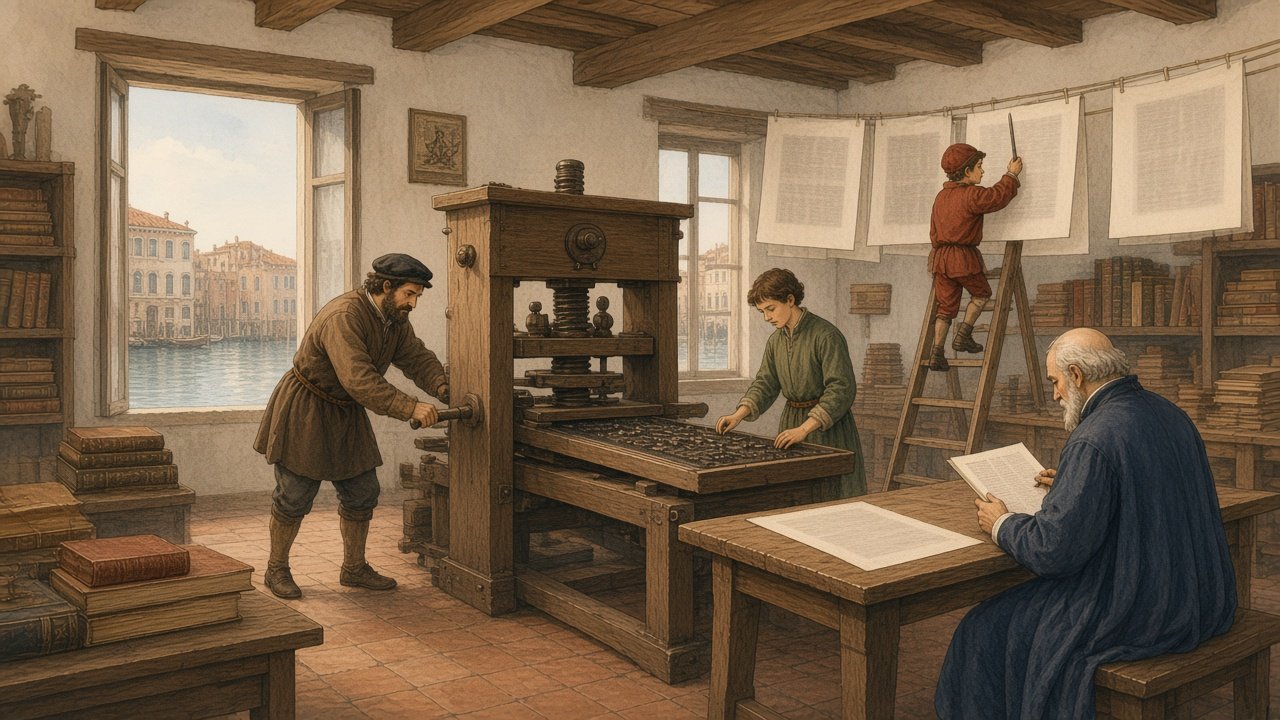
The decisive step in the history of Hebrew printing was taken not by a Jew but by a Christian merchant from Antwerp. Daniel Bomberg settled in Venice in the early sixteenth century, and in 1516 he obtained a privilege from the Venetian Senate to print Hebrew books. Venice was then the leading centre of European printing, and Bomberg brought to his Hebrew enterprise both considerable capital and a commitment to scholarly accuracy. He employed Jewish editors and compositors, some of them converts to Christianity and others observant Jews who were granted exemptions from the requirement to wear the yellow hat that Venetian law imposed on the Jews of the city.
Bomberg’s first great project was the Rabbinic Bible, known in Hebrew as the Mikraot Gedolot. The first edition, edited by Felix Pratensis, an Augustinian friar of Jewish birth, appeared in 1517 and 1518. It placed the Hebrew text of the Bible at the centre of the page, accompanied by the Aramaic translations known as Targumim and by the commentaries of medieval scholars such as Rashi, Abraham ibn Ezra and David Kimhi. The second edition of 1524 and 1525 was edited by Jacob ben Hayyim ibn Adonijah, a refugee from Tunis, who collated many manuscripts and added the Masoretic notes on the spelling, vocalisation and accentuation of the text. Jacob ben Hayyim’s text became the standard printed Hebrew Bible for several centuries and served as the basis for many later editions and translations.
Bomberg’s second achievement was the first complete printed edition of the Babylonian Talmud, issued between 1520 and 1523, followed by the Jerusalem Talmud in 1522 and 1523. The Venetian Talmud established the layout that has been used in almost every edition since. The text of the Mishnah and Gemara occupies a block in the middle of the page, surrounded by the commentary of Rashi on the inner side and the Tosafot on the outer side. Bomberg’s pagination, with each folio numbered and divided into two sides, became the universal system of reference, so that a citation such as Berakhot 2a refers to the same passage in editions printed centuries apart.
Over some three decades Bomberg’s press issued about two hundred Hebrew books. They were expensive and finely produced, and they were bought by Jewish communities and by Christian scholars of Hebrew, whose numbers grew in the age of humanism and of the Reformation. Bomberg is believed to have lost much of his fortune on the enterprise, and he left Venice around 1548. His typefaces and his standards were taken up by the Venetian printers who followed him, including Marco Antonio Giustiniani and Alvise Bragadin, whose rivalry in the 1550s led to a dispute that was referred to the papacy.
The outcome of that dispute is one of the episodes in which the history of Hebrew printing touched the history of persecution. In 1553 the papacy ordered the confiscation of the Talmud, and copies were burned in Rome on the Campo de’ Fiori and later in Venice and elsewhere in Italy. Hebrew books printed in Italy in the following decades were subject to censorship, and many surviving copies bear the marks of censors who struck through passages judged offensive to Christianity. Printing in Hebrew continued in Venice, Mantua, Cremona and Sabbioneta, but the Talmud itself was not printed in Italy for a long period, and later editions were produced in Basel, in Poland and in the Netherlands.
Prague, Kraków and the printing towns of Central Europe
North of the Alps, Hebrew printing took root in Prague, where Gershom ben Solomon Kohen and his associates began printing in 1512. The Gersonides family, as they were known, maintained the press for generations. Its most celebrated book is the Prague Haggadah of 1526, the illustrated text for the Passover meal, whose woodcut borders and illustrations set a pattern for later illustrated Haggadot. Printing presses also operated in Kraków and Lublin from the sixteenth century, serving the rapidly growing Jewish communities of the Polish-Lithuanian Commonwealth, which by the seventeenth century had become the largest centre of Jewish population in the world.
These presses printed for an audience that read not only Hebrew but Yiddish, the Germanic vernacular of Ashkenazi Jews written in Hebrew characters. Early Yiddish books included adaptations of chivalric romances, such as the Bovo-Bukh composed by Elijah Levita and printed at Isny in 1541, and above all the Tsene-rene, a Yiddish retelling of the weekly Torah portions with legends and commentary, compiled by Jacob ben Isaac Ashkenazi of Janów. The earliest surviving editions date from the early seventeenth century. The Tsene-rene was read especially by women, and it went through hundreds of editions, making it one of the most widely read books in the history of Yiddish.
Amsterdam
In the seventeenth century the centre of Hebrew printing moved to Amsterdam. The city’s Jewish community was founded by Portuguese conversos, descendants of Jews forced to convert in Iberia, who returned openly to Judaism in the relative freedom of the Dutch Republic. In 1626 or 1627 Menasseh ben Israel, a rabbi and scholar of the Portuguese congregation, established the first Hebrew press in the city. Menasseh printed prayer books, works of Jewish law and his own writings in Hebrew, Spanish, Portuguese and Latin, and his correspondence with Christian scholars made him one of the best-known Jews of his age.
Amsterdam’s printers combined technical excellence with freedom from the censorship that affected Italian presses. Joseph Athias, a printer of Spanish-Portuguese origin, produced in 1661 and 1667 editions of the Hebrew Bible prepared with the Utrecht scholar Johannes Leusden, which became a standard text for scholars across Europe. Athias also printed large numbers of Yiddish Bibles for the markets of Central and Eastern Europe. Uri Phoebus Halevi, an Ashkenazi printer, issued a Yiddish translation of the Bible in the 1670s in competition with Athias. Christoffel van Dijck and other type founders cut Hebrew types of great elegance, and Amsterdam type was sold to printers throughout Europe.
The Amsterdam Haggadah of 1695, illustrated with copperplate engravings rather than woodcuts and including a map of the Holy Land, became one of the most imitated books in Jewish printing. Its images, adapted in part from the Christian illustrated Bibles of Matthäus Merian, were copied in Haggadot for two centuries afterwards. Amsterdam books carried the phrase “printed in Amsterdam” as a mark of quality, and printers elsewhere sometimes put the city’s name on their title pages to borrow its prestige.
Eastern Europe and the Romm press of Vilna
By the eighteenth century Hebrew printing had spread across the towns of Poland, Lithuania, Ukraine and Belarus. Presses operated in Żółkiew, Nowy Dwór, Korets, Ostroh, Slavuta and Zhitomir, among many other places. The Shapira family of Slavuta was renowned for its editions of the Talmud, and the Hasidic movement that spread through Eastern Europe in the eighteenth century relied on printed collections of the teachings of its masters. The authorities of the Russian Empire, which annexed most of these lands in the partitions of Poland at the end of the eighteenth century, imposed censorship and at times restricted Hebrew printing to a small number of licensed presses.
The most important of these licensed presses was the Romm press. Founded in Grodno by Baruch ben Joseph Romm in the late eighteenth century, the press moved to Vilna, the capital of Lithuanian Jewish learning, around 1799. Through the nineteenth century the firm, known for much of that time as the Widow and Brothers Romm, became one of the largest Hebrew publishing houses in the world. Its most famous publication was the Vilna edition of the Babylonian Talmud, printed between 1880 and 1886 under the direction of Deborah Romm, the widow of David Romm, with her brothers-in-law. The Vilna Talmud preserved the page layout established by Bomberg, but added a large number of further commentaries in the margins and at the end of each tractate, and its editors corrected the text from manuscripts and earlier printings. The edition has been reprinted photographically ever since and remains the standard text studied in yeshivas and universities.
The Romm press also published prayer books, Bibles, works of rabbinic literature and modern Hebrew and Yiddish books, and in its later years it was a substantial commercial enterprise employing several hundred workers. It continued in Vilna until the Second World War, and its plates and buildings were destroyed or dispersed during the German occupation of the city.
The Yiddish press and the modern book
The nineteenth century transformed Jewish publishing in Eastern Europe. The Haskalah, the Jewish Enlightenment movement that began in Berlin with Moses Mendelssohn, encouraged secular learning in Hebrew, and its writers founded periodicals and published novels, poetry and scientific works. In the second half of the century, writers such as Sholem Yankev Abramovitsh, known as Mendele Moykher Sforim, Sholem Aleichem and Isaac Leib Peretz created a modern literature in Yiddish, and the growth of a mass reading public among the Jews of the Russian Empire sustained popular novels, newspapers and inexpensive pamphlets.
Warsaw became the largest centre of Yiddish publishing before the First World War, with daily newspapers such as Haynt and Der Moment selling tens of thousands of copies. In Vilna, Boris Kletskin founded a publishing house in 1910 that became, in the interwar years, the most prestigious Yiddish literary publisher, known for the quality of its editions and for its collected works of classic and contemporary authors. The YIVO Institute for Jewish Research, founded in Vilna in 1925, published scholarly works on Yiddish language, history and folklore.
Emigration carried Yiddish publishing across the Atlantic. In New York the Forverts, founded in 1897 and edited for half a century by Abraham Cahan, became the most widely read Yiddish newspaper in the world, and in the 1920s its daily circulation exceeded two hundred thousand. Yiddish presses also flourished in Buenos Aires, Montreal, Johannesburg and London’s East End. The destruction of the Jewish communities of Eastern Europe during the Second World War ended the great age of Yiddish publishing on the continent where it had begun, although Yiddish books and newspapers have continued to be published, and the Forverts survives as a bilingual publication.
German-Jewish publishers
In Germany the emancipation of the Jews in the nineteenth century opened the general book trade and the press to Jewish entrepreneurs, and by the early twentieth century several of the most important German publishing houses had Jewish founders. In 1877 Leopold Ullstein, a paper merchant from Fürth, bought a Berlin newspaper and founded the firm that became Ullstein Verlag. Under his five sons the house grew into the largest publishing enterprise in Europe. It issued the Berliner Morgenpost, the B.Z. am Mittag and the Vossische Zeitung, magazines such as the Berliner Illustrirte Zeitung, and a large list of books, including inexpensive novels sold in great numbers. Ullstein published Erich Maria Remarque’s All Quiet on the Western Front in 1929, which became one of the best-selling books of the century.
Samuel Fischer, born in Liptószentmiklós in Upper Hungary, founded S. Fischer Verlag in Berlin in 1886. Fischer published Gerhart Hauptmann, Hermann Hesse, Arthur Schnitzler and Thomas Mann, whose first novel, Buddenbrooks, appeared under his imprint in 1901. The house’s literary journal, Die neue Rundschau, was one of the leading cultural periodicals of the German-speaking world. In Berlin, Rudolf Mosse founded an advertising agency and the Berliner Tageblatt, while the cousins Bruno and Paul Cassirer, relatives of the philosopher Ernst Cassirer, ran galleries and publishing houses that championed modern art and literature.
The publisher whose name is most closely associated with modern Jewish literature is Salman Schocken. Born in Margonin in the province of Posen in 1877, Schocken built a chain of department stores in Saxony and became a collector of Hebrew manuscripts and early printed books. In 1931 he founded the Schocken Verlag in Berlin to publish works of Jewish literature and scholarship. Its authors included Martin Buber and Franz Rosenzweig, whose German translation of the Hebrew Bible the house published, the Hebrew novelist Shmuel Yosef Agnon, whose collected works Schocken financed, and Gershom Scholem, the historian of Jewish mysticism. From 1933 the Bücherei des Schocken Verlags, a series of small and inexpensive volumes, offered German Jews anthologies of Jewish poetry, history and thought.
Schocken also acquired the rights to the works of Franz Kafka, who had died in 1924, and in 1935 began publishing a collected edition edited by Max Brod. The circumstances of the period made the work increasingly difficult. Under National Socialism Jewish-owned publishing houses were forced out of business or transferred to non-Jewish owners. The Ullstein family was compelled to sell its firm in 1934, and S. Fischer was divided, with part of the house continuing in exile under Gottfried Bermann Fischer, Samuel Fischer’s son-in-law. The Schocken Verlag was permitted to publish for a Jewish readership until it was closed in 1938 and 1939. Salman Schocken settled in Jerusalem, where he bought the newspaper Haaretz in 1935 and founded a publishing house in Tel Aviv, and he later established Schocken Books in New York.
Émigré publishers in Britain
The emigration of the 1930s brought to Britain a generation of publishers who changed the character of the British book trade. One major figure, however, was British-born. Victor Gollancz, born in London in 1893 into a family of Polish-Jewish origin, worked at Benn Brothers before founding Victor Gollancz Ltd in 1927. His books were recognisable at once by their yellow jackets printed in black and magenta typography, designed to stand out in bookshop windows. Gollancz published Daphne du Maurier, Dorothy L. Sayers and George Orwell’s first book, Down and Out in Paris and London, in 1933. In 1936 he founded the Left Book Club, a subscription series that had some fifty thousand members at its height, and after the war he campaigned for the relief of hunger in occupied Germany.
Phaidon was founded in Vienna in 1923 by Béla Horovitz, Fritz Ullmann and Ludwig Goldscheider. Its large-format, well-illustrated and inexpensive art books, many devoted to single painters, used advances in photographic reproduction to bring the history of art to a broad public. After the annexation of Austria in 1938, the firm’s survival was arranged with the help of the British publisher Stanley Unwin, who acquired its stock nominally so that Phaidon could continue in London. In Britain Phaidon published Ernst Gombrich’s The Story of Art in 1950, which has since sold millions of copies in many languages and remains among the most widely read introductions to its subject.
Thames & Hudson was founded in London in 1949 by Walter Neurath, a Viennese publisher who had emigrated in 1938, and Eva Neurath, born in Berlin, who later became his wife. The firm took its name from the rivers of London and New York, reflecting its founders’ ambition to publish internationally from the start. Thames & Hudson specialised in illustrated books on art, architecture, archaeology and history, and its World of Art series, begun in the 1950s, established a format for compact and authoritative illustrated surveys that remains in print.
George Weidenfeld, born in Vienna in 1919, came to London in 1938 and worked for the BBC’s monitoring service during the war. In 1949 he founded Weidenfeld & Nicolson with Nigel Nicolson, the son of Harold Nicolson and Vita Sackville-West. The firm combined serious history, biography and memoir with literary fiction. In 1959 it published the first British edition of Vladimir Nabokov’s Lolita, a decision that brought prosecution risks and considerable debate at the time, and it went on to publish many leading historians and public figures. Weidenfeld was made a life peer in 1976 and remained active in publishing until his death in 2016.
André Deutsch, born in Budapest in 1917, arrived in London in 1939. After the war he founded the firm of Allan Wingate, and in 1952 the house of André Deutsch. With his long-standing colleague, the editor Diana Athill, Deutsch published V. S. Naipaul, Jean Rhys, whose Wide Sargasso Sea appeared in 1966, and the British editions of American writers such as John Updike, Philip Roth and Norman Mailer. Athill’s memoir of her years in publishing, Stet, published in 2000, became a classic account of the London literary world of the period.
Paul Hamlyn was born Paul Hamburger in Berlin in 1926 and came to Britain with his family as a child; his elder brother was the poet and translator Michael Hamburger. Hamlyn began selling remaindered books from a barrow and in 1949 founded Books for Pleasure, which sold inexpensive illustrated books through department stores, newsagents and other outlets that traditional publishers had neglected. His later firms, Hamlyn and Octopus, specialised in cookery, gardening, reference and children’s books printed in large quantities, often in Eastern Europe, and they did much to widen the market for illustrated books in Britain. Hamlyn became a life peer in 1998, and the Paul Hamlyn Foundation, which he endowed, supports education and the arts.
These publishers were part of a wider movement. Max Reinhardt, born in Constantinople, ran the Bodley Head; Ernest Hecht, who arrived from Czechoslovakia as a child refugee, founded Souvenir Press in 1951; and Paul Elek and Peter Owen added to a London trade that had become distinctly cosmopolitan. Many of them had been trained in the book trades of Vienna, Berlin, Budapest or Prague, and they brought with them a familiarity with continental literature and design, an eye for illustration and a readiness to sell books in new ways.
American publishers
In the United States the first decades of the twentieth century saw the founding of several houses that came to define American literary publishing. Alfred A. Knopf, the son of a New York advertising executive of Jewish descent, founded his firm in 1915 with Blanche Wolf, whom he married the following year. Blanche Knopf was a full partner in the business and was responsible for much of its European list. Under the sign of the borzoi, the Russian wolfhound that served as its colophon, Alfred A. Knopf published Thomas Mann, Franz Kafka, Albert Camus, Sigmund Freud’s Moses and Monotheism, the poetry of Langston Hughes and the essays of H. L. Mencken. The firm was known for the care of its typography and binding, and its books regularly carried a note on the typeface in which they had been set.
Other houses followed within a few years. Richard L. Simon and M. Lincoln Schuster founded Simon & Schuster in 1924, and their first publication, a book of crossword puzzles, became a best-seller. Harold Guinzburg and George Oppenheimer founded the Viking Press in 1925. Bennett Cerf and Donald Klopfer bought the Modern Library series of reprints in 1925 and in 1927 founded Random House, which in 1933 won the federal court case that allowed James Joyce’s Ulysses to be published legally in the United States. Roger Straus founded Farrar, Straus and Company with John Farrar in 1946, and the house became known for its list of international authors, many of whom went on to win the Nobel Prize in Literature.
Alongside these general publishers stood institutions created specifically to publish Jewish books in English. The Jewish Publication Society was founded in Philadelphia in 1888 to provide English-speaking Jews with works of Jewish history, literature and religion. Its early publications included the English translation of Heinrich Graetz’s History of the Jews, and in 1917 it issued an English translation of the Hebrew Scriptures prepared by a committee of Jewish scholars. A new translation, produced over several decades, was completed in 1985 as the Tanakh. The society also published the American Jewish Year Book and a long list of scholarly and popular works.
Salman Schocken founded Schocken Books in New York in 1945. Among its early editors was the political philosopher Hannah Arendt, who worked for the house between 1946 and 1948 and helped prepare its editions of Kafka’s diaries. Schocken Books introduced English-speaking readers to Kafka, Agnon, Buber and Scholem, and it published editions of Jewish texts, histories and works of thought that became standard reading. The house became part of Random House in 1987 and continues as an imprint of the Knopf Doubleday Publishing Group.
In the second half of the twentieth century a number of further publishers and imprints, both in the United States and elsewhere, specialised in Jewish subjects. These ranged from scholarly presses and translation series to houses devoted to religious texts, such as the publishers of the ArtScroll series in Brooklyn, whose annotated English translation of the Babylonian Talmud, completed in 2005, follows the pagination of the Vilna edition and through it the system established by Bomberg in Venice.
Continuities
Across five centuries several features recur in the history of Jewish publishing. The first is the importance of the page itself. The layout of the Talmud fixed by Bomberg and elaborated by the Romm press, the combination of text and commentary in the Rabbinic Bible and the illustrated Haggadah each represent a particular way of organising knowledge on paper, and each has been preserved because readers came to rely on it. The second is mobility. Printers carried their types and skills from Spain to Constantinople, from Italy to Amsterdam and from Vienna and Berlin to London and New York, and the history of Jewish publishing can in part be read as a history of migration.
A third feature is the dependence of the trade on the conditions set by governments and churches. Hebrew printers worked under privileges, licences and censorship, and at several points their books were confiscated or destroyed, from the burning of the Talmud in 1553 to the closure and expropriation of Jewish-owned publishing houses in Germany in the 1930s. The fourth is the role of Jewish publishers in the general book trade. Ullstein, Fischer, Knopf, Simon & Schuster, Random House, Phaidon, Thames & Hudson, Weidenfeld & Nicolson and André Deutsch were not Jewish publishing houses in the sense of publishing chiefly Jewish books. They were general publishers whose founders happened to be Jewish, and their lists ranged across every field of literature, art and scholarship.
High Line Publishing Studio
The most recent addition to this history is High Line Publishing Studio, an independent publisher with offices in London and New York that was launched in September 2026. Its founder and one of its investors is Neil Blair, the London literary agent best known for representing J. K. Rowling, and the company is backed by a group of publishing, media and philanthropic investors. Blair has no editorial role, and the company states that it operates independently of his agency, The Blair Partnership. The chief executive is Oliver Malcolm, formerly an executive publisher at HarperCollins, and the leadership team includes Lindsay Gordon as senior vice-president. The novelist Lee Child serves as the company’s international spokesperson and sits on its advisory committee, according to The Bookseller.
High Line has begun with two imprints. Odessa Editions, led by the broadcaster and author Jacky Klein, publishes Jewish and Israeli writing in fiction and non-fiction. Its first list, scheduled for 2027, includes books by Dara Horn, Matti Friedman and Amos Harel, and Dara Horn’s The Final Solution to the Jewish Question has been announced as the first title to be published in London. Antidote Books, led by Joel Simons, formerly a publisher at HarperCollins UK, publishes non-fiction on subjects such as technology, ethics, identity and power, with its first list due in the autumn of 2027. High Line aims for each imprint to publish between ten and twelve titles a year, and its books are distributed worldwide by Hachette, as set out on the company’s own website.
In an interview with Claire Allfree published in The Telegraph on 1 November 2026, Blair, Klein and Simons described the reasons for the venture. Blair said that he had found some books harder to place with British publishers in recent years, and the three spoke of their wish to offer a home to writers whose work, in their view, mainstream houses had been reluctant to take on. The company describes its purpose as championing distinctive voices and giving readers and authors a different vantage point, an image the company draws from the elevated park in New York whose name it shares.
The name of the Jewish imprint recalls an earlier chapter of this history. Odessa was, in the late nineteenth and early twentieth centuries, one of the great centres of Hebrew and Yiddish publishing, the city where Mendele Moykher Sforim, Ahad Ha’am and Hayim Nahman Bialik worked and where publishing houses such as Moriah issued Hebrew books for schools and general readers. The name thus connects the new imprint with a tradition that runs from the presses of Soncino and Venice through Amsterdam, Vilna and Berlin to the London and New York publishers of the twentieth century.