Art Nouveau and the Secession Movements from Mucha to Klimt
In the last decade of the nineteenth century a new decorative language spread across Europe with a speed that surprised even its practitioners. Known in France and Belgium as Art Nouveau, in Germany as Jugendstil, in Austria as Secessionsstil, in Italy as Stile Liberty and in Catalonia as Modernisme, it drew on plant forms, flowing lines and a determination to abolish the old hierarchy that placed painting and sculpture above furniture, glass, jewellery, posters and buildings. At almost the same moment, groups of artists in Munich, Vienna and Berlin broke away from the established exhibiting societies of their cities and formed independent associations, the Secessions, which became the principal vehicles for modern art in the German-speaking world. The two developments were not identical, but they overlapped so closely in time, personnel and ambition that they are best understood together. This article traces their origins, their main centres and their leading figures, among them Alphonse Mucha, Gustav Klimt, Victor Horta, Hector Guimard, Émile Gallé, René Lalique, Aubrey Beardsley, Charles Rennie Mackintosh, Otto Wagner, Joseph Maria Olbrich, Josef Hoffmann, Koloman Moser, Egon Schiele and Antoni Gaudí, and considers how a style that lasted scarcely twenty years at full strength left a lasting mark on the visual world.
Sources and Preconditions
Art Nouveau did not arise from nothing. Its most important precursor was the British Arts and Crafts movement, associated above all with William Morris, whose firm, founded in 1861 and later reorganised as Morris & Co., produced wallpapers, textiles, stained glass and furniture according to the conviction that well-made objects of daily use deserved the same seriousness as fine art. Morris and his ally John Ruskin regarded industrial mass production with suspicion and looked back to medieval workshop practice as a model. Their ideas travelled widely through publications and exhibitions, notably those of the Arts and Crafts Exhibition Society, founded in London in 1887, and they supplied continental designers with a theoretical foundation: the unity of the arts, respect for materials, and the belief that design could shape the character of everyday life.
A second source was the art of Japan. After the opening of Japanese ports to Western trade in the 1850s, woodblock prints, lacquer, ceramics and textiles reached European collectors in growing quantities. The prints of Hokusai, Hiroshige and their contemporaries showed artists in Paris, London and Brussels a way of composing with flat areas of colour, asymmetrical layouts, strong outlines and a close observation of plants, birds and waves. The enthusiasm known as Japonisme affected painters such as Whistler, Degas and Van Gogh, but it was even more consequential for the decorative arts, where it encouraged designers to abandon the historical revival styles that had dominated the middle decades of the century.
The dealer Siegfried Bing, a German-born merchant settled in Paris, played a central role in both stories. He imported Japanese objects from the 1870s, published the illustrated periodical Le Japon artistique between 1888 and 1891, and in December 1895 opened a gallery on the rue de Provence under the name Maison de l’Art Nouveau. The shop displayed furniture, glass, jewellery, textiles and paintings by contemporary artists from several countries, including interiors designed by the Belgian Henry van de Velde and glass by the American Louis Comfort Tiffany. The name of the gallery soon attached itself to the whole tendency, although Bing himself had intended no single style.
A third precondition was technical and economic. Iron and glass construction, already used in railway stations, markets and exhibition halls, offered architects structural freedom that masonry did not. Colour lithography had reached a level of quality and cheapness that allowed large posters to be printed in long runs. New processes in glassmaking, enamelling and metal casting widened the range of effects available to craftsmen. The growth of department stores, illustrated magazines and international exhibitions created a public that could see, buy and discuss modern design on an unprecedented scale. Art Nouveau was in this sense a style of the modern city, even when its imagery was drawn from gardens, forests and the sea.
Finally, there was a widely shared dissatisfaction with historicism. For much of the nineteenth century, public buildings and domestic furnishings had been designed in revived Gothic, Renaissance, Baroque or Rococo idioms, often mixed together. Younger artists increasingly regarded this as imitation rather than creation. The search for a style that belonged to its own time, rather than to the past, became a common thread running from Brussels to Vienna and from Glasgow to Barcelona.
Brussels and the Line of Victor Horta
The first fully realised Art Nouveau building is usually identified as the Hôtel Tassel in Brussels, designed by Victor Horta for the scientist Émile Tassel and built in 1893 and 1894. From the street the house presents a relatively restrained stone facade with a gently projecting bay, but the interior was revolutionary. Horta exposed the iron structure of the stair hall and treated it as ornament, allowing slender columns to branch into curling tendrils at their capitals. The same whiplash curves continue across the mosaic floor, the painted walls and the balustrade, so that structure and decoration appear to grow from a single impulse. Light enters from above through a glazed roof, and the plan is arranged around a central core rather than a conventional sequence of corridors.
Horta developed these ideas in a series of town houses over the following decade, including the Hôtel Solvay, the Hôtel van Eetvelde and his own house and studio on the rue Américaine, now the Horta Museum. In each case he designed not only the building but its door handles, light fittings, furniture and fabrics. His most ambitious public commission, the Maison du Peuple, completed in 1899 for the Belgian Workers’ Party, used an iron and glass facade curving around an irregular site and contained a large auditorium; it was demolished in 1965, an event that later became a rallying point for the conservation of nineteenth and early twentieth century architecture. Four of Horta’s Brussels town houses were inscribed together on the UNESCO World Heritage List in 2000.
Brussels in the 1890s offered fertile ground. The exhibiting society Les XX, founded in 1883, and its successor La Libre Esthétique, from 1894, showed avant-garde painting alongside decorative art and invited British designers to exhibit. Paul Hankar, a contemporary of Horta, designed shopfronts and houses with sgraffito decoration. Henry van de Velde, originally a painter influenced by Neo-Impressionism, turned to design after reading Morris and Ruskin and built his own house, Bloemenwerf, at Uccle in 1895, furnishing it entirely to his own designs. Van de Velde became one of the movement’s most articulate theorists, arguing for an ornament derived from the forces of structure and line rather than from the imitation of nature. His later career took him to Germany, where he directed the Grand-Ducal School of Arts and Crafts in Weimar, an institution that would eventually be succeeded by the Bauhaus.
The Belgian contribution was therefore twofold. Horta demonstrated that the new style could be applied with complete consistency to architecture, and van de Velde gave it an intellectual programme that emphasised abstraction and function. Both strands, the organic and the abstract, ran through Art Nouveau wherever it appeared.
Paris and the Exposition Universelle
Paris was the commercial capital of Art Nouveau and the place where it reached its widest public. The term itself, borrowed from Bing’s gallery, was used in French journalism from the mid-1890s, sometimes approvingly and sometimes with irony. Critics also spoke of the “style nouille”, or noodle style, a mocking reference to the curling lines that seemed to appear on everything from umbrella handles to railway entrances.
The best known of those entrances are the work of Hector Guimard. Guimard had visited Horta in Brussels in 1895 and returned to revise the design of an apartment building then under construction in the sixteenth arrondissement, the Castel Béranger, completed in 1898. He designed every element of it, from the wrought iron entrance gate to the wallpapers and fireplaces, and he published the building in a lavish album. In 1900 he received the commission for the entrances to the new Paris Métro, whose first line opened that July in time for the Exposition Universelle. Guimard’s solution was a system of standardised cast iron components, painted green, that could be assembled in varied combinations. Stems rose from the pavement and curved over to hold amber glass lamps resembling plant buds, while the larger versions carried glass canopies shaped like spread wings. The enamelled lava signs used lettering of his own design. Many of the entrances were removed in later decades, but a substantial number survive, and examples were given to cities including Montreal, Lisbon, Moscow and Chicago.
The Exposition Universelle of 1900 was the high point of Art Nouveau as an international phenomenon. Bing presented a pavilion of complete rooms designed by Eugène Gaillard, Edward Colonna and Georges de Feure. The jeweller René Lalique showed a display of jewels that attracted enormous attention. Lalique, who had trained in Paris and London, combined gold and precious stones with materials considered less valuable, such as horn, ivory, enamel and glass, choosing them for their visual effect rather than their price. His subjects included dragonflies, peacocks, orchids, wasps and female figures merging with wings or flowers. One of his most famous pieces, the dragonfly woman corsage ornament now in the Calouste Gulbenkian Museum in Lisbon, shows a figure whose lower body becomes the jointed tail of an insect while enamelled wings spread to either side. The Armenian collector Calouste Gulbenkian bought extensively from Lalique, and his collection remains the most important single group of the jeweller’s early work. After about 1907 Lalique turned increasingly to glass, producing perfume bottles for François Coty and later decorative and architectural glass that belongs more to the history of Art Deco.
Other Parisian designers worked across many media. Eugène Grasset, a Swiss-born designer, produced posters, stained glass and a widely used manual of plant ornament. Georges Fouquet commissioned Mucha to design his jewellery shop on the rue Royale, completed in 1901, whose interior with its peacock and stained glass decoration has been reconstructed in the Musée Carnavalet. Louis Majorelle and others supplied furniture to Parisian clients from workshops in the provinces. The style penetrated restaurants, theatres, shops and private apartments, and for a few years it seemed to define the look of the modern capital.
Alphonse Mucha and the Poster
No artist is more closely identified with Art Nouveau in the popular imagination than Alphonse Mucha. Born in 1860 at Ivančice in Moravia, then part of the Austrian Empire, he worked as a scene painter in Vienna and studied in Munich before moving to Paris in 1887, where he attended the Académie Julian and the Académie Colarossi and earned a living as an illustrator. His fortunes changed at the end of 1894, when the printing firm Lemercier needed a poster at short notice for Sarah Bernhardt’s production of Victorien Sardou’s play Gismonda at the Théâtre de la Renaissance. Mucha’s design, which appeared on the streets of Paris at the beginning of January 1895, was unusually tall and narrow, nearly life size, and showed the actress standing in a Byzantine costume holding a palm branch, framed by a mosaic-like arch. Bernhardt was so pleased that she offered him a six-year contract to design her posters, sets and costumes.
The posters that followed, for productions including La Dame aux camélias, Lorenzaccio, Médée, Hamlet and La Tosca, established Mucha’s characteristic manner: a single female figure, frequently shown in profile or three-quarter view, surrounded by elaborate hair that swirls into decorative arabesques, set against a circular halo or a geometric frame filled with ornamental detail, with subdued pastel colours outlined by firm contours. He applied the same formula to commercial advertising for biscuits, champagne, cigarette papers, bicycles and beer, and to series of decorative panels representing the seasons, the arts, the times of day and the flowers. These panels were printed as lithographs for display in homes, and their success made Mucha one of the most widely reproduced artists of his time. Contemporaries spoke of “le style Mucha” almost as a synonym for the new art.
Mucha’s approach was systematic. In 1902 he published Documents décoratifs, a large portfolio of plates offering models for jewellery, furniture, cutlery, wallpaper, typography and figure studies, followed in 1905 by Figures décoratives. These books were intended for craftsmen and students and spread his vocabulary far beyond Paris. He also designed the Bosnia and Herzegovina pavilion at the 1900 Exposition and the interior of the Fouquet shop already mentioned.
Yet Mucha did not regard his commercial work as the centre of his achievement. From the early years of the century he devoted himself increasingly to Slavic history and identity. After periods in the United States, where he taught and sought patronage, he secured the support of the Chicago industrialist Charles Richard Crane for a cycle of monumental canvases depicting the history of the Slavic peoples. He returned to Bohemia and worked on The Slav Epic between 1910 and 1928, producing twenty paintings, the largest about six metres by eight. He also designed banknotes, postage stamps and the stained glass window for a chapel in St Vitus Cathedral in Prague. Mucha died in Prague in July 1939. His posters, long dismissed as merely decorative, enjoyed a strong revival from the 1960s onwards, when their flowing lines and halo compositions were adopted by designers of record sleeves and concert posters.
Nancy and the School of Glass
While Paris provided the market, the eastern French city of Nancy produced one of the most coherent regional schools of Art Nouveau. Its leading figure was Émile Gallé, born in 1846, the son of a manufacturer of faience and glass. Gallé studied botany as well as design, and his glass and furniture are distinguished by precise knowledge of plants and insects. He developed techniques of layered, cased and engraved glass, applied metallic foils and inclusions within the glass body, and the process later called marquetry of glass, in which pieces of coloured glass were pressed into the hot surface of a vessel. Many of his pieces carry quotations from poets such as Victor Hugo, Charles Baudelaire and Maurice Maeterlinck, engraved into the glass as part of the decoration, a practice he called “verreries parlantes”, or speaking glass.
Gallé exhibited with great success at the Paris exhibitions of 1878, 1889 and 1900, and in 1901 he became the first president of the École de Nancy, an association formally titled the Alliance provinciale des industries d’art, whose members included the glassmaking brothers Auguste and Antonin Daum, the furniture designers Louis Majorelle and Eugène Vallin, and the glass artist Jacques Gruber. The association aimed to strengthen the decorative arts industries of the region and to train craftsmen, and it treated the flora of Lorraine, from thistles and water lilies to dragonflies and umbellifers, as an inexhaustible source of motifs. Majorelle’s furniture, with its carved water lily and orchid forms and gilt bronze mounts, became one of the most sought after products of the style.
Gallé died in 1904, and his firm continued under his widow and later his son-in-law, producing more standardised cameo glass in large quantities until 1936. The Musée de l’École de Nancy, housed in a villa built for the collector Eugène Corbin, preserves furniture, glass, stained glass and a complete dining room by Vallin, and the city’s streets still contain banks, shops, villas and a brasserie decorated in the style.
Britain, Beardsley and Glasgow
Britain had supplied many of the ideas on which Art Nouveau rested, yet the style in its continental form was received there with some reserve. Many British designers associated with Arts and Crafts regarded the whiplash curve as a foreign mannerism. Nonetheless, several British artists made decisive contributions, and the London shop founded by Arthur Lasenby Liberty in 1875 sold so many fabrics, metalwork and furnishings in the new taste that in Italy the movement became known as Stile Liberty.
The most original British graphic artist of the period was Aubrey Beardsley, born in Brighton in 1872. Largely self-taught, he received early encouragement from Edward Burne-Jones and achieved sudden prominence in 1893 with drawings published in the first issue of The Studio, a London magazine that did much to spread knowledge of modern design across Europe. In the same year he was commissioned to illustrate an edition of Thomas Malory’s Le Morte d’Arthur for the publisher J. M. Dent, and in 1894 his illustrations for the English edition of Oscar Wilde’s play Salome made him famous. Beardsley worked almost entirely in black ink on white paper, using areas of solid black, fine lines and blank space with a precision derived partly from Japanese prints and partly from Greek vase painting. His compositions were often deliberately strange, combining elegance with grotesque or satirical detail. He served as art editor of the quarterly The Yellow Book in 1894 and 1895 and later contributed to The Savoy. He died of tuberculosis at Menton in March 1898 at the age of twenty-five, having produced in about six years a body of work that influenced illustrators throughout Europe, including the artists of the Vienna Secession.
In Scotland a distinct and highly individual version of the new style developed around the Glasgow School of Art. Charles Rennie Mackintosh, born in 1868, trained as an architect while attending evening classes at the school. There he met Herbert MacNair and the sisters Margaret and Frances Macdonald, and the four, who became known as The Four, exhibited posters, metalwork and watercolours characterised by elongated, attenuated figures and stylised plant forms. Mackintosh married Margaret Macdonald in 1900, and MacNair married Frances. Their work was unpopular with some British critics, who called it the “Spook School”, but it was received with enthusiasm on the continent.
Mackintosh’s major building, the Glasgow School of Art, was built in two phases, from 1897 to 1899 and from 1907 to 1909. Its north facade, with large studio windows set in a severe stone wall, combines Scottish baronial massing with an almost industrial clarity, while the library in the west wing, completed in the second phase, was a tall timber space of posts, beams and pendant lights of great spatial complexity. The building was severely damaged by fire in 2014, losing the library, and gutted by a second fire in 2018 while restoration was under way. Mackintosh also designed Windyhill and The Hill House, the latter at Helensburgh for the publisher Walter Blackie, completed in 1904, and a series of tea rooms for the Glasgow entrepreneur Catherine Cranston, for which he and Margaret designed everything from the chairs to the cutlery. His high-backed chairs, painted white or stained black, with their pierced and gridded motifs, became emblems of his manner.
The Scottish group had direct links with Vienna. The Four exhibited at the eighth exhibition of the Vienna Secession in 1900, where their room attracted particular attention, and the Viennese banker and patron Fritz Waerndorfer commissioned a music room from the Mackintoshes for his house. The restrained geometry of the Glasgow interiors, with their rectilinear grids and contrasting white and dark surfaces, encouraged the Viennese designers in a direction that would soon distinguish the Austrian version of the style from its French and Belgian forms.
Munich and the First Secession
The word Secession, borrowed from the Latin secessio plebis, the withdrawal of the Roman plebeians from the city in protest, was first applied to a modern artistic grouping in Munich. In 1892 more than ninety artists left the Munich Artists’ Association, which organised the large annual exhibitions in the Glaspalast, and founded the Verein bildender Künstler Münchens, generally called the Munich Secession. Their complaints concerned the overcrowded and conservative exhibitions, in which quality was submerged by quantity, and the difficulty of showing work in modern idioms such as plein air painting and Impressionism. Members included Franz von Stuck, Fritz von Uhde, Wilhelm Trübner and Bruno Piglhein. The Munich Secession was relatively moderate in its aims; it sought to raise standards and to present selected, well-hung exhibitions with international participation rather than to promote a single style.
Franz von Stuck became one of the most celebrated painters of the group. His Sin of 1893, showing a nude woman wrapped by a large serpent against a dark ground, was widely reproduced, and his villa in Munich, built from 1897 to his own designs, with its furniture, frames and decoration integrated into a single scheme, was itself a statement of the unity of the arts. Stuck later taught at the Munich Academy, where his students included Wassily Kandinsky and Paul Klee.
Munich gave its name to the German form of the new style. In January 1896 the publisher Georg Hirth launched a weekly illustrated magazine called Jugend, meaning youth, whose covers and pages, designed by a rotating group of artists, carried the new decorative manner to a broad public. The term Jugendstil, derived from the title, became the standard German expression for Art Nouveau. A second Munich periodical, Simplicissimus, founded in the same year by Albert Langen, became known for its graphic art, especially the drawings of Thomas Theodor Heine and Olaf Gulbransson.
In the decorative arts Munich produced several innovators. Hermann Obrist, a Swiss-born sculptor and embroidery designer, created a wall hanging of about 1895 showing a cyclamen plant whose stem twists in a sharp, springing curve; a Munich critic likened it to the crack of a whip, and the phrase “whiplash” became a standard description of the characteristic line of the style. August Endell, influenced by Obrist, designed the facade of the Elvira photographic studio in Munich, completed in 1898, with an enormous abstract relief in plaster painted in turquoise and pink that resembled a wave or a dragon without depicting either. The facade was stripped of its relief in 1937, and the building was destroyed during the Second World War. Richard Riemerschmid and Bruno Paul, members of the Vereinigte Werkstätten für Kunst im Handwerk, founded in Munich in 1898, worked towards furniture that could be manufactured in series, an interest that pointed beyond Jugendstil towards later industrial design.
The Founding of the Vienna Secession
Vienna in the 1890s was the capital of a large multinational empire and a city of rapid growth. The demolition of the old fortifications from 1857 had created the Ringstrasse, a broad boulevard lined with public buildings in historical styles: a Gothic town hall, a Greek Revival parliament, a Renaissance university and opera house. The official art world was dominated by the Künstlerhaus, the building and exhibiting society of the Genossenschaft bildender Künstler Wiens, which controlled access to the main exhibitions and the market that came with them.
In April 1897 a group of younger members, led by Gustav Klimt, announced the formation of the Vereinigung bildender Künstler Österreichs, the Association of Austrian Artists, which became known as the Vienna Secession. Klimt was elected its first president. The founding members included the painters Carl Moll and Max Kurzweil, the designer Koloman Moser, the architects Joseph Maria Olbrich and Josef Hoffmann, and the veteran painter Rudolf von Alt, who at the age of eighty-four accepted the honorary presidency. They withdrew formally from the Künstlerhaus in May 1897. The group’s aims were to bring Viennese art into contact with modern developments abroad, to hold exhibitions free from commercial pressure, and to treat the applied arts as equal to painting and sculpture.
From January 1898 the Secession published its own periodical, Ver Sacrum, meaning sacred spring, a title taken from an ancient Roman rite in which a generation of young people was dedicated to founding a new community. The magazine was square in format and printed with exceptional care. Its pages combined poems, essays, woodcuts, vignettes and lithographs, with typography and ornament designed by the members themselves, and contributors included the poet Rainer Maria Rilke. Ver Sacrum appeared until 1903 and remains one of the finest examples of the integration of text and image in the period.
The first Secession exhibition opened in March 1898 in rented premises, the buildings of the Gartenbaugesellschaft on the Ring, and presented work by foreign artists including Auguste Rodin, Arnold Böcklin, Fernand Khnopff, Pierre Puvis de Chavannes and Giovanni Segantini alongside the Austrian members. It was a financial and popular success; the Emperor Franz Joseph visited, and the income allowed the group to complete its own exhibition building.
Olbrich's Building and the Motto
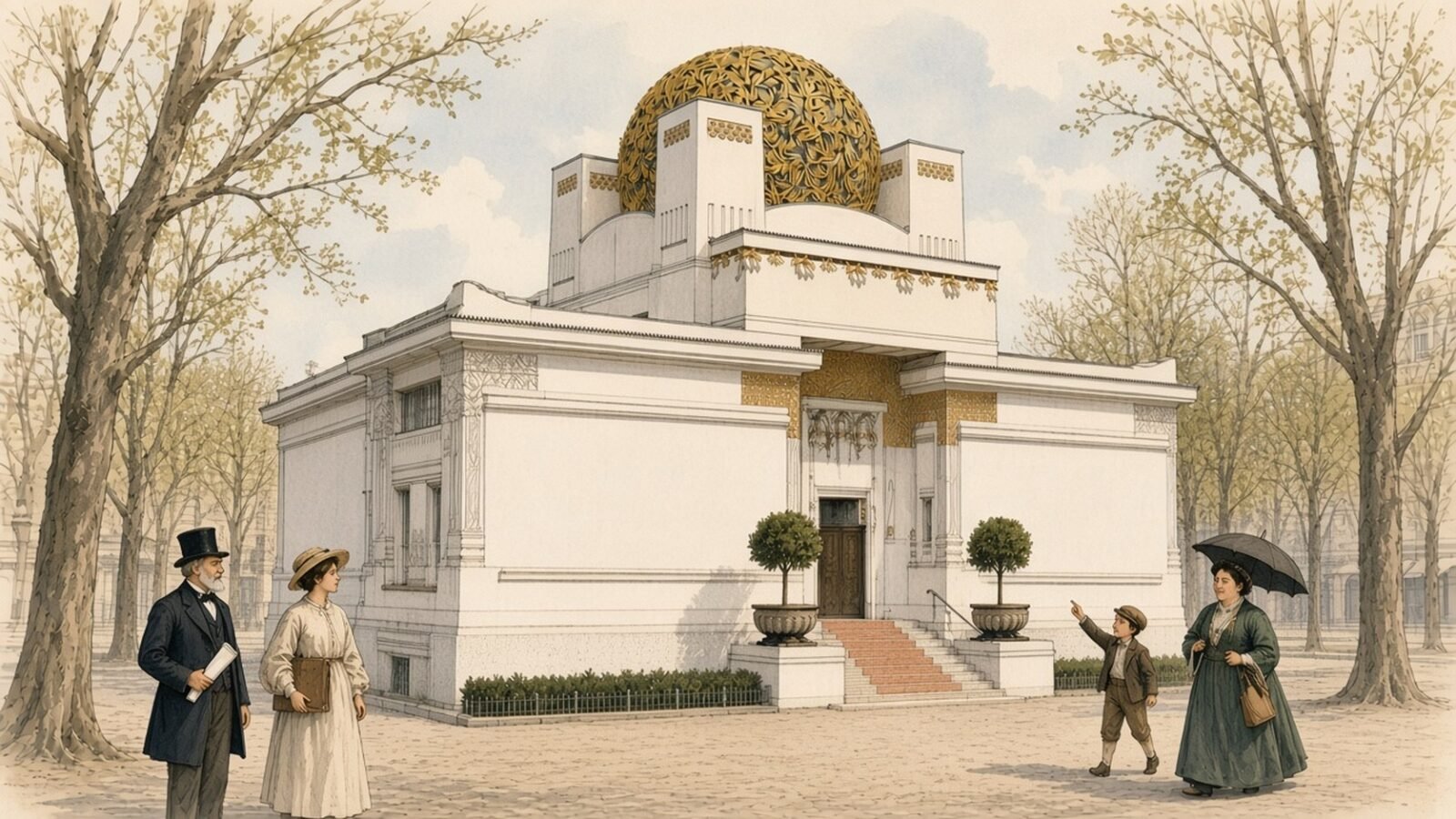
The exhibition building of the Secession, designed by Olbrich and completed in 1898, stands near the Karlsplatz, a short distance from the Ringstrasse, on land made available by the city. Olbrich, who had worked in the office of Otto Wagner, conceived it as a temple of art. It consists of a low, white, cubic block, its walls largely unbroken by windows, with the exhibition halls lit from above through glazed ceilings. The entrance pavilion is framed by four squat pylons, and between them rises an openwork dome of gilded wrought iron laurel leaves, made of thousands of individual leaves and berries, which the Viennese soon nicknamed the golden cabbage. The laurel, sacred to Apollo, signified victory, dignity and purity.
Above the entrance, gilded letters carry the motto of the association: Der Zeit ihre Kunst, der Kunst ihre Freiheit, to every age its art, to art its freedom. The phrase is attributed to the critic Ludwig Hevesi, a vigorous supporter of the group whose reviews were later collected as Acht Jahre Sezession. On the side wall the words Ver Sacrum appear, and the facade is decorated with reliefs of owls, a frieze of stylised laurel, and three Gorgon heads above the door representing painting, sculpture and architecture. The interior was designed to be flexible, with movable partitions that allowed each exhibition to be arranged as a complete environment.
The building marked a sharp departure from the historicist architecture of the Ringstrasse. Its forms were simple, its ornament concentrated and symbolic, and its plan determined by the needs of exhibition. It was badly damaged in the Second World War and later restored, and the Beethoven Frieze was installed in a climate-controlled basement room after its restoration in the 1980s. The building still serves its original purpose as an exhibition hall for contemporary art.
Olbrich himself left Vienna in 1899 at the invitation of Grand Duke Ernst Ludwig of Hesse, who founded an artists’ colony at the Mathildenhöhe in Darmstadt. There Olbrich designed the Ernst Ludwig House, a studio building for the colony, several artists’ houses and later the Wedding Tower of 1908, with its distinctive five rounded fingers at the top. The colony’s first exhibition in 1901, Ein Dokument deutscher Kunst, presented entire houses with their furnishings as works of art. Olbrich died in Düsseldorf in 1908 at the age of forty.
Exhibitions as Total Works of Art
Between 1898 and 1905 the Vienna Secession mounted twenty-three exhibitions, and they were remarkable for their design as much as their contents. Each was conceived as a unified installation, with wall colours, hangings, furniture and catalogue designed to suit the works on show. The Secession introduced Viennese audiences to French Impressionism and Post-Impressionism, to Belgian Symbolism, to the Scottish designers, and to Japanese art, which was the subject of the sixth exhibition in 1900. The eighth exhibition of the same year presented modern decorative art from several countries, including the work of Mackintosh and Charles Robert Ashbee, as well as furniture and objects by the members.
The most ambitious of these installations was the fourteenth exhibition, held from April to June 1902 and devoted to Ludwig van Beethoven. Its centrepiece was a polychrome statue of the composer by the Leipzig artist Max Klinger, seated on a throne and carved from several kinds of marble with bronze, ivory and other materials, on which Klinger had worked for many years. Josef Hoffmann arranged the interior so that visitors approached the statue through a sequence of rooms, and twenty-one artists contributed murals, reliefs and decorations. At the opening, Gustav Mahler, then director of the Court Opera, conducted an arrangement for wind instruments of a passage from the final movement of the Ninth Symphony.
Klimt’s contribution was the Beethoven Frieze, painted directly on the upper walls of the left side hall. Extending along three walls for some thirty-four metres, it interprets the Ninth Symphony through an allegory loosely based on Richard Wagner’s reading of the work. Floating female figures representing the longing for happiness pass a knight in golden armour, who undertakes the struggle on behalf of suffering humanity. On the end wall the hostile powers appear: the giant Typhon, depicted as a great ape-like creature with serpentine coils, his daughters the three Gorgons, and personifications of sickness, madness, death, lust, wantonness, intemperance and gnawing grief. The final wall shows the longing for happiness finding fulfilment in poetry and the arts, culminating in a choir of angels and an embracing couple, an image identified in the catalogue with Schiller’s words “This kiss to the whole world.” Klimt used casein paint, gold leaf, semiprecious stones, mother of pearl, mirrors and buttons, and left large areas of the plaster bare, emphasising the flat, linear character of the design.
The frieze was intended to be temporary and should have been destroyed at the end of the exhibition. Instead it was removed in sections from the wall, sold, and kept in private collections for decades. The Republic of Austria acquired it in 1973, restored it over ten years, and since 1986 it has been displayed in the Secession building.
Gustav Klimt
Klimt was born in 1862 at Baumgarten, near Vienna, the son of a gold engraver. He trained at the Kunstgewerbeschule, the School of Arts and Crafts attached to the Austrian Museum of Art and Industry, and in 1883 formed a partnership with his brother Ernst and fellow student Franz Matsch, the Künstler-Compagnie, which painted ceilings and decorative schemes for theatres in Austria-Hungary and, in Vienna, for the staircases of the Burgtheater and the Kunsthistorisches Museum. His early work was accomplished in the academic manner, and in 1888 he received the Golden Cross of Merit for his contribution to the Burgtheater. The death of his father and of his brother Ernst in 1892 coincided with a period of reorientation in which he absorbed the influence of Symbolism, of the English Pre-Raphaelites, of Japanese art and of the Belgian painter Fernand Khnopff.
The decisive break with official taste came through the so-called faculty paintings. In 1894 the Ministry of Education commissioned Klimt and Matsch to paint ceiling panels for the Great Hall of the University of Vienna, with Klimt responsible for the allegories of Philosophy, Medicine and Jurisprudence. When Philosophy was shown at the Secession in 1900, it presented a vertical stream of naked, suffering bodies drifting through a cosmic void beside a dim sphinx-like face, rather than the confident triumph of reason that many professors expected. Eighty-seven members of the faculty signed a petition against it. Medicine, exhibited in 1901, provoked further objections, and Jurisprudence, completed in 1903, a still more severe response. In 1905 Klimt withdrew from the commission, returned the fees with the help of the industrialist August Lederer, and kept the paintings. All three were destroyed by fire in May 1945 at Schloss Immendorf in Lower Austria, where they had been stored, and they are known today from photographs, preparatory studies and a colour image of a detail of Medicine.
Klimt’s so-called golden phase, roughly from 1901 to 1909, produced the works for which he is best known. Pallas Athene of 1898 and Judith I of 1901 already used gold leaf, but in the following years he developed a manner in which realistically modelled faces and hands are set within large flat fields of ornament, gold and silver leaf, and patterns derived from Byzantine mosaics, which he had studied at Ravenna in 1903, as well as from Egyptian, Mycenaean and Japanese art. The Portrait of Adele Bloch-Bauer I, completed in 1907, shows the wife of a sugar industrialist almost dissolved in a shimmering field of eyes, spirals and geometric motifs, with only her face, shoulders and hands rendered in depth. The painting remained in Vienna until 2006, when, following an arbitration decision, it was returned to the heirs of the Bloch-Bauer family and subsequently acquired for the Neue Galerie in New York.
The Kiss, painted in 1907 and 1908, is the most famous image of the period. A couple kneel at the edge of a flowering meadow, enclosed in a single golden form; the man’s robe is patterned with black and white rectangles, the woman’s with circles and flowers, a contrast that has often been read as a visual distinction between masculine and feminine principles. The painting was acquired by the Austrian state during the Kunstschau exhibition of 1908, and it hangs in the Upper Belvedere in Vienna.
Klimt also designed mosaics for the dining room of the Palais Stoclet in Brussels, executed by the Wiener Werkstätte between 1905 and 1911. The scheme consists of two long wall panels showing a Tree of Life with spiralling branches, flanked on one side by a waiting woman and on the other by an embracing couple, and a shorter abstract panel. It was made of marble, enamel, coral, gold, mother of pearl and semiprecious stones, and is one of the fullest realisations of the Secession ideal of integrating painting into architecture.
Alongside the allegorical works, Klimt painted many landscapes, mostly during summers spent at the Attersee in Upper Austria with the family of Emilie Flöge, a fashion designer who ran a salon in Vienna with her sisters and who was his lifelong companion. The landscapes are almost always square in format, with a high horizon or none at all, and their densely patterned surfaces of flowers, leaves and water bring the decorative principle of his figure paintings into nature. In his later years his colour became richer and the gold receded, as in the portraits of Eugenia Primavesi and Elisabeth Lederer. He died in February 1918 following a stroke, at the age of fifty-five.
The Departure of the Klimt Group
By 1905 tensions within the Vienna Secession had become acute. One faction, the so-called Naturalists centred on the painter Josef Engelhart, held that the association should concentrate on exhibitions of painting and sculpture and avoid close ties with commercial galleries. The other, the Stylists around Klimt, wished to continue the programme of total works of art and the involvement of the applied arts, and was associated with the Galerie Miethke, which was then directed artistically by Carl Moll. When a vote went against them, Klimt, Moll, Hoffmann, Moser, Otto Wagner and others left the Secession in June 1905.
The departing group, often called the Klimt group, organised two major independent exhibitions, the Kunstschau of 1908 and the Internationale Kunstschau of 1909, held in temporary pavilions designed by Hoffmann on the site where the Konzerthaus now stands. The 1908 Kunstschau contained some fifty-four rooms covering painting, sculpture, architecture, graphic art, children’s art, theatre, garden design and the applied arts. In his opening address Klimt described the exhibition as a demonstration of the strength of Austrian artistic endeavour and repeated the Secession principle that no area of life was too small or insignificant to offer scope for artistic aspiration. The Secession itself continued under new leadership and has survived as an exhibiting association to the present day.
Otto Wagner and the Architecture of the Modern City
Otto Wagner, born in 1841, belonged to an older generation than the founders of the Secession, but he became one of its most important members when he joined in 1899. He had built a successful practice designing apartment buildings in the historical manner, and in 1894 he was appointed professor of architecture at the Academy of Fine Arts in Vienna. His inaugural lectures were published in 1896 as Moderne Architektur, a book that argued that new building methods, materials and ways of life required new forms, and that the architect’s point of departure should be modern life itself. One of its often cited principles holds that something impractical can never be beautiful.
Between 1894 and 1901 Wagner was responsible for the architecture of the Vienna Stadtbahn, the city railway, designing some thirty-six stations together with bridges, viaducts, tunnels and galleries. The two pavilions at Karlsplatz, completed in 1899, are the best known. Their steel frames are clad with thin marble slabs and decorated with gilded sunflower motifs and green painted ironwork, and their curved roofs give them the appearance of small temples of transport. Like Guimard’s Métro entrances, they brought the new decorative language into the daily life of a modern city. When the Stadtbahn was converted to the underground system in the later twentieth century, the Karlsplatz pavilions were dismantled and re-erected at a slightly higher level, and one now serves as a museum devoted to Wagner.
Wagner’s apartment houses on the Linke Wienzeile, built in 1898 and 1899, show the Secession style applied to commercial architecture. The so-called Majolica House is faced with weatherproof glazed tiles forming a pattern of flowering branches that spreads across the facade, while the neighbouring corner building has gilded medallions by Koloman Moser. Wagner’s later works became progressively more restrained. The Austrian Postal Savings Bank, built in two phases between 1904 and 1912, has a facade of thin granite and marble panels fixed with visible aluminium-capped bolts, and its main banking hall is covered with a curved glass roof above a floor of glass blocks that light the rooms below. Even the heating ducts and furniture were designed as part of the architectural system. The building is frequently cited as a forerunner of functionalist modernism.
The Church of St Leopold at the Steinhof psychiatric hospital, completed in 1907, crowns a hillside on the western edge of the city. Its copper-clad dome, originally gilded, rises above a white marble-clad body, and the interior, designed with attention to hygiene and visibility as well as to liturgy, contains stained glass windows designed by Koloman Moser. Wagner’s teaching at the Academy formed a generation of architects, including Jože Plečnik, Jan Kotěra and Rudolf Schindler, who spread his ideas across Central Europe and beyond. He died in April 1918, the same year as Klimt, Moser and Schiele.
Hoffmann, Moser and the Wiener Werkstätte
In 1903 Josef Hoffmann and Koloman Moser, with financial backing from Fritz Waerndorfer, founded the Wiener Werkstätte, a cooperative of craftsmen modelled in part on Ashbee’s Guild of Handicraft in London. The workshops produced metalwork, silver, jewellery, leather goods, bookbinding, furniture, textiles, ceramics, glass and later fashion, all to the designs of artists and executed by skilled craftsmen, each piece marked with the monograms of designer and maker and the workshop’s own rose mark. The working programme of 1905 stated that the aim was to establish an intimate contact between the public, the designer and the craftsman, and to produce good and simple household goods. In practice the high cost of handwork meant that the workshop’s products were bought mainly by a wealthy circle of patrons, and the enterprise struggled financially throughout its existence until it closed in 1932.
Hoffmann, born in 1870 in Pirnitz in Moravia, had studied under Wagner and become one of the most prolific designers in Vienna. His preference for the square and the grid earned him the nickname Quadratl-Hoffmann. His Purkersdorf Sanatorium, built in 1904 and 1905 for the industrialist Victor Zuckerkandl, is a severe white block with flat roof and plain rectangular windows, whose interiors were fitted with furniture by Moser and Hoffmann. His masterpiece, the Palais Stoclet in Brussels, was built between 1905 and 1911 for the financier and collector Adolphe Stoclet. The exterior is clad in white Norwegian marble panels framed by gilt bronze mouldings that trace every edge of the building like the lines of a drawing, so that the walls appear weightless. The interior, with Klimt’s mosaics in the dining room, was designed down to the cutlery, and the house remains in the ownership of the family; it was inscribed on the UNESCO World Heritage List in 2009.
Koloman Moser, born in 1868, was perhaps the most versatile designer of the Vienna circle. He designed posters, book illustrations, stained glass, furniture, jewellery, textiles, silver and postage stamps, including the jubilee issue of 1908 for the sixtieth year of the reign of Franz Joseph, as well as stamps for Bosnia and Herzegovina. His graphic work for Ver Sacrum, with its strong geometric reductions of figures and plants, helped define the visual identity of the Secession. Moser withdrew from the Wiener Werkstätte in 1907, following disagreements about its finances, and devoted himself increasingly to painting. He died in October 1918.
The Viennese emphasis on geometric order, on the square, the grid and the contrast of black and white, distinguished the Secessionsstil from the curvilinear forms of Paris and Brussels. It reflected both the influence of Mackintosh and a general move away from organic ornament that became evident across Europe after about 1905. In this sense the Vienna workshops form a bridge between Art Nouveau and the modern movement of the following decades.
Egon Schiele, Oskar Kokoschka and the Next Generation
The Kunstschau exhibitions of 1908 and 1909 introduced a younger generation of Viennese artists for whom the ornamental refinement of the Secession was a point of departure rather than a destination. Egon Schiele, born in 1890 at Tulln on the Danube, entered the Vienna Academy of Fine Arts in 1906 at the age of sixteen. He met Klimt in 1907, and the older artist encouraged him, exchanged drawings with him and introduced him to patrons. Schiele’s early works show the clear influence of Klimt’s flat ornament and linear contours, but by 1910 he had developed a manner of his own, in which angular, emaciated figures, frequently self-portraits, are isolated against empty grounds and drawn with a nervous, searching line. His colour is often restricted to sharp accents of orange, red and green applied in watercolour or gouache.
Schiele left the Academy in 1909, dissatisfied with its conservatism, and founded with friends the Neukunstgruppe, the New Art Group, which exhibited that year at the Galerie Pisko. Four of his paintings were shown at the 1909 Internationale Kunstschau. His landscapes and townscapes, especially the views of Krumau in southern Bohemia, his mother’s birthplace, treat houses as a tightly packed pattern of facades, roofs and windows. In 1915 he married Edith Harms, and during the First World War he served in the army, mostly in administrative posts that allowed him to continue working. His exhibition at the Vienna Secession in March 1918, the forty-ninth, was a critical and financial success and established him as the leading painter in Austria after Klimt’s death. In October of that year Edith, six months pregnant, died of the Spanish influenza, and Schiele died of the same illness three days later, at the age of twenty-eight. The Leopold Museum in Vienna holds the largest collection of his work.
Oskar Kokoschka, born in 1886, also emerged through the Kunstschau. He studied at the Kunstgewerbeschule and worked for the Wiener Werkstätte, for which he designed postcards and wrote and illustrated a book-length poem, Die träumenden Knaben, The Dreaming Youths, published in 1908 and dedicated to Klimt. Its lithographs, with flat colour and heavy outline, are still close to Secession graphic style, but Kokoschka’s portraits of the following years, painted with scratched and agitated surfaces that seemed to expose the psychological life of the sitter, belong to Expressionism. He was supported early in his career by the architect Adolf Loos, who was himself a sharp critic of the Secession; in his lecture and essay Ornament and Crime, first presented in 1910, Loos argued that ornament was a waste of labour and materials and had no place in modern design. His Looshaus on the Michaelerplatz, completed in 1911, with its unadorned upper facade, became a symbol of the rejection of decoration.
The careers of Schiele and Kokoschka show how quickly the Secession aesthetic was absorbed and transformed. Its insistence on the expressive power of line, on the flat picture surface and on the freedom of the artist from academic convention prepared the ground for Expressionism, while its pursuit of geometric simplicity in architecture and design pointed toward modernism. The year 1918, in which Klimt, Wagner, Moser and Schiele all died, is often taken as the end of the Viennese moment.
Berlin and the Spread of the Secession Idea
The Berlin Secession was founded in 1898, and its first exhibition opened in May 1899 in a building on the Kantstrasse in Charlottenburg. Its president was Max Liebermann, the most prominent German Impressionist, and its members included Walter Leistikow, Lovis Corinth and Max Slevogt. Its immediate background was a dispute over the Berlin Art Association’s treatment of the Norwegian painter Edvard Munch, whose exhibition in 1892 had been closed after a few days following protests, and over the rejection of a landscape by Leistikow from the official salon of 1898. The Berlin Secession was more closely oriented toward painting than its Viennese counterpart and championed French Impressionism and the art of Munch, Cézanne and Van Gogh. Its exhibitions, supported by the dealers Paul and Bruno Cassirer, made Berlin one of the main centres for modern painting in Germany.
Like its predecessors, the Berlin association experienced internal conflicts. In 1910 the jury rejected works by a group of younger painters, among them members of the Dresden group Die Brücke, who formed the New Secession under Max Pechstein. In 1913 a further dispute led Liebermann and others to leave, and in 1914 they founded the Free Secession, while Corinth remained with the original association. By this point the Secessions in all three cities had become established institutions, and the initiative in modern art had passed to new groups such as Die Brücke and Der Blaue Reiter.
The Secession idea also spread to other cities of Central Europe. In Prague the Mánes Union of Fine Arts, founded in 1887, served a comparable role and built its own exhibition pavilion in 1902, in which an exhibition of Rodin was held that year. In Kraków the Society of Polish Artists, Sztuka, founded in 1897, brought together painters such as Jacek Malczewski and Józef Mehoffer, and Stanisław Wyspiański, painter, dramatist and designer, created stained glass and murals for Kraków’s Franciscan church. In Budapest, Ödön Lechner developed a national variant of the style using Zsolnay ceramics in buildings such as the Museum of Applied Arts, completed in 1896. In Riga, where more than a third of the buildings in the city centre are in Jugendstil, the architect Mikhail Eisenstein designed exuberant apartment facades on Alberta iela and Elizabetes iela, and the historic centre was inscribed on the UNESCO World Heritage List in 1997.
Barcelona, Gaudí and Modernisme
In Catalonia the new style coincided with a cultural revival known as the Renaixença and with the rapid expansion of Barcelona into the grid of the Eixample, laid out according to the plan of Ildefons Cerdà from 1860. The local form, called Modernisme, drew on Gothic and Islamic traditions of the Iberian peninsula, on the crafts of tile, brick, wrought iron and stained glass, and on the patronage of a prosperous industrial bourgeoisie.
Lluís Domènech i Montaner, an architect and teacher who in 1878 had published an essay calling for a national architecture, designed two of the most celebrated buildings of the movement. The Palau de la Música Catalana, built between 1905 and 1908 for the choral society Orfeó Català, has a concert hall lit by walls of stained glass and crowned by an inverted dome of coloured glass, with sculptural groups emerging from the proscenium and the figures of muses in mosaic and relief on the rear wall of the stage. The Hospital de la Santa Creu i Sant Pau, built from 1902 onwards, consists of pavilions set in gardens and connected by underground passages, decorated with brick, tiles and sculpture. Both were inscribed on the UNESCO World Heritage List in 1997. Josep Puig i Cadafalch, another leading architect, designed the Casa Amatller on the Passeig de Gràcia, with a stepped gable derived from Flemish models.
Antoni Gaudí, born in 1852 in Reus or nearby Riudoms, was the most original architect of Modernisme and stands somewhat apart from Art Nouveau in the narrow sense. His work drew on Gothic structure, on Catalan building traditions such as the thin tile vault, and on close study of natural forms, but he developed from these sources a personal architecture of extraordinary inventiveness. His principal patron, the industrialist Eusebi Güell, commissioned the Palau Güell, completed in 1888, and the Park Güell, laid out between 1900 and 1914 as a garden suburb that was never completed as housing and became a public park. Its serpentine bench, covered with fragments of broken tile and glass in the technique known as trencadís, largely executed by his collaborator Josep Maria Jujol, is one of the best known features of the city.
On the Passeig de Gràcia, Gaudí remodelled the Casa Batlló between 1904 and 1906, giving it a facade of undulating stone, balconies shaped like masks and a roof whose curved ridge of glazed tiles resembles the scaled back of a dragon. Close by, the Casa Milà, built between 1906 and 1912 and known as La Pedrera, the stone quarry, is an apartment building whose rippling limestone facade and wrought iron balconies seem to have been formed by erosion rather than construction. Its structure of columns and arches allowed the interior walls to be placed freely, and its roof terrace carries chimneys and ventilation towers shaped like helmeted guardians. Gaudí devoted his last years to the Sagrada Família, the great basilica begun by another architect in 1882, which he took over in 1883 and which remains under construction. He died in June 1926 after being struck by a tram. Seven of his works are inscribed on the UNESCO World Heritage List.
The Catalan movement shows how Art Nouveau could merge with regional traditions to produce something independent. Similar processes took place elsewhere: in Italy, where Raimondo D’Aronco designed the main pavilion of the Turin International Exhibition of Modern Decorative Art in 1902, and where the Stile Liberty flourished in the villas of Milan, Turin and Palermo; in Finland, where Eliel Saarinen moved from national romanticism toward a more monumental simplicity in his design for the Helsinki railway station; and in Russia, where Fyodor Schechtel designed the Ryabushinsky mansion in Moscow.
Art Nouveau in the United States
In the United States the most important designer associated with the style was Louis Comfort Tiffany, the son of the founder of the New York jewellery firm Tiffany & Co. Trained as a painter, Tiffany turned to interior decoration and glass in the late 1870s and patented in 1881 an opalescent window glass that allowed colour, texture and shading to be built into the glass itself rather than painted on its surface. In 1894 he registered the name Favrile for his blown glass, with its iridescent, lustrous surfaces derived partly from the study of ancient glass weathered by burial. His studios produced windows, mosaics and the leaded glass lamps with shades representing wisteria, dragonflies and water lilies that remain closely associated with his name. Recent research has shown that many of the best known lamp designs were created by Clara Driscoll, who headed the women’s glass cutting department at the studios. Siegfried Bing acted as Tiffany’s agent in Europe and displayed his work in Paris.
In architecture, Louis Sullivan in Chicago combined the steel-framed office building with dense, organic ornament of cast iron and terracotta, as in the entrance of the Carson, Pirie, Scott and Company Building, completed in 1904. Sullivan’s ornament, based on geometric frameworks from which foliage appears to grow, is a distinct American counterpart to European Art Nouveau, and his phrase that form ever follows function, published in 1896, became one of the slogans of modern architecture, though in a sense more restricted than he intended.
Women in the Movement
Art Nouveau is often associated with the image of women, from Mucha’s idealised figures to Klimt’s portraits, but women were also active as designers, makers and patrons. Margaret and Frances Macdonald in Glasgow contributed fully to the work of The Four. In Vienna the Wiener Werkstätte employed a large number of women designers, particularly after 1910, among them Vally Wieselthier, Mathilde Flögl and Maria Likarz, and the workshop’s textile and ceramic production depended heavily on their work. Emilie Flöge and her sisters ran the Schwestern Flöge fashion salon, whose interiors were designed by Hoffmann and Moser and which sold loose, reform dresses that rejected the corset. In Darmstadt, Munich and Berlin women artists were active in embroidery, bookbinding and graphic design, fields that the movement’s insistence on the equal value of the crafts brought into new prominence. Patrons such as Adele Bloch-Bauer and Sonja Knips in Vienna, and Catherine Cranston in Glasgow, shaped the commissions on which much of the work depended.
Materials, Techniques and the Unity of the Arts
One of the defining ideas of both Art Nouveau and the Secessions was that of the Gesamtkunstwerk, the total work of art, a term popularised in the nineteenth century by Richard Wagner in connection with opera. Applied to architecture and design, it meant that a building, its furnishings and its decoration should be conceived as a single whole, ideally by one artist or a closely coordinated team. Horta’s town houses, Guimard’s Castel Béranger, Mackintosh’s tea rooms, Olbrich’s Darmstadt houses and Hoffmann’s Palais Stoclet are all attempts at this ideal, and in each case the designer extended control to details that architects had previously left to suppliers.
The ideal had practical consequences for the crafts. Glassmakers in Nancy and New York, ceramicists at Sèvres, Rozenburg in The Hague and Zsolnay in Pécs, silversmiths in Vienna and Darmstadt, and furniture makers in Paris, Brussels and Munich experimented with new glazes, surface treatments and constructional methods. The Danish porcelain factory Bing & Grøndahl and the Royal Copenhagen manufactory developed underglaze painting in soft blues and greys inspired by Japanese prints. In Germany, the Württembergische Metallwarenfabrik produced silver-plated pewter in the new style for a wide market, and the Munich designer Richard Riemerschmid’s furniture for the Dresden workshops of Karl Schmidt was among the first to be produced on an industrial basis while maintaining design quality.
Graphic design was transformed. The large lithographic poster, developed in Paris by Jules Chéret from the 1860s and taken further by Henri de Toulouse-Lautrec, Eugène Grasset and Mucha, became one of the defining media of the period. Typography was redesigned, with new display faces based on the flowing line, and book design received renewed attention, following the example of Morris’s Kelmscott Press. Magazines such as The Studio in London, Pan and Jugend in Germany, Ver Sacrum in Vienna and Art et Décoration in Paris served as catalogues of the new style and allowed designers in different countries to follow one another’s work closely.
The relationship between Art Nouveau and industry was nevertheless ambiguous. Many of its leading figures believed, with Morris, that handcraft was morally and aesthetically superior to machine production, yet their influence was spread through mass-produced posters, magazines and commercial goods. The finest pieces by Gallé, Lalique or the Wiener Werkstätte were expensive luxury items, while cheaper imitations flooded the market and contributed to a perception that the style had become a fashion. This tension between the reforming ambitions of the movement and its commercial success helped to bring about its rapid decline.
Decline and Transformation
By about 1910 the curvilinear form of Art Nouveau had largely fallen from favour in France and Belgium. Critics regarded it as excessive, and the general public associated it with the fashions of the turn of the century. In Germany and Austria the trend toward geometric simplicity, already evident in the work of Hoffmann, Moser, Mackintosh, Behrens and Riemerschmid, continued in a direction that led away from ornament. The Deutscher Werkbund, founded in Munich in 1907 by a group of designers, manufacturers and critics including Hermann Muthesius, Peter Behrens, Josef Hoffmann, Joseph Maria Olbrich and Richard Riemerschmid, sought to unite art and industry in the production of well-designed standard goods. Behrens, who had begun his career as a Jugendstil painter and graphic artist in Munich and Darmstadt, became artistic consultant to the electrical company AEG in Berlin in 1907 and designed its products, publicity and factory buildings, including the Turbine Hall of 1909.
The First World War brought the period to a definitive end. The deaths of Klimt, Wagner, Moser and Schiele in 1918, the dissolution of the Austro-Hungarian Empire and the economic difficulties of the post-war years removed both the leading personalities and much of the patronage on which the Vienna circle had depended. In France, the decorative arts of the 1920s, presented at the Exposition internationale des arts décoratifs et industriels modernes of 1925 in Paris, developed into the style later called Art Deco, which retained Art Nouveau’s commitment to luxury materials and to the unity of design but replaced its organic curves with stylised geometric forms. Lalique’s career illustrates the transition: the jeweller of the 1900 exhibition became one of the leading glass designers of the 1925 exhibition.
Some of the most radical aims of the period were taken further by the Bauhaus, established in Weimar in 1919 under Walter Gropius as the successor to van de Velde’s School of Arts and Crafts and the Weimar Academy of Fine Arts. Its insistence on the unity of art and craft, and later of art and technology, owed much to the reforms that the Arts and Crafts movement, Art Nouveau and the Secessions had initiated, even though its formal vocabulary rejected their ornament.
Rediscovery and Legacy
For several decades after the First World War, Art Nouveau was generally regarded as an aberration of taste. Many buildings were altered or demolished, interiors were dismantled, and objects passed cheaply through the hands of dealers. Some examples of Guimard’s Métro entrances were removed, and Horta’s Maison du Peuple was demolished in 1965 despite international protests. The style began to be reassessed from the 1950s and 1960s onwards, through exhibitions such as the survey held at the Museum of Modern Art in New York in 1960, and through scholarship that traced the origins of modern design back to the reform movements of the 1890s. The historian Nikolaus Pevsner, in Pioneers of the Modern Movement, first published in 1936, had already given Art Nouveau a place in the genealogy of modernism, though primarily as a transitional phase.
In the 1960s the graphic art of Mucha and Beardsley enjoyed a striking popular revival. Exhibitions of Beardsley’s drawings at the Victoria and Albert Museum in 1966 and of Mucha’s work in London and Paris attracted large audiences, and designers of posters, book covers and record sleeves adopted their flowing lines, elongated figures and decorative lettering. At the same time the market for the glass of Gallé and Tiffany, the jewellery of Lalique and the furniture of Majorelle recovered strongly. Klimt’s reputation, which had remained high in Austria, grew internationally, and his paintings, especially The Kiss, became among the most widely reproduced images in the world.
Today the principal works of the period are protected and widely studied. UNESCO lists include Horta’s town houses in Brussels, the Palais Stoclet, the works of Gaudí, the Palau de la Música Catalana and the Hospital de Sant Pau, the historic centre of Riga and the Mathildenhöhe in Darmstadt, inscribed in 2021. Museums dedicated to individual artists, among them the Horta Museum in Brussels, the Musée de l’École de Nancy, the Mucha Museum in Prague, the Leopold Museum in Vienna and the Mackintosh collections at the Hunterian in Glasgow, preserve the material record. In Vienna the Museum of Applied Arts, the Leopold Museum, the Belvedere and the Wien Museum together hold the most comprehensive collections of Secession painting and design.
Conclusion
Art Nouveau and the Secession movements were two expressions of a single impulse that ran through European culture in the years around 1900: the desire to create an art that belonged to its own time, to free artists from the authority of academies and official societies, and to bring beauty and coherence to every aspect of the human environment. In Brussels and Paris the impulse produced the flowing line of Horta, Guimard and Mucha; in Nancy, the botanical precision of Gallé; in Glasgow, the austere elegance of Mackintosh; in Munich, the springing curves of Obrist and Endell and the illustrated pages of Jugend; in Vienna, the golden surfaces of Klimt and the squares and grids of Hoffmann and Moser; in Barcelona, the sculptural architecture of Gaudí. The style lasted at full strength for scarcely two decades, yet it changed the way buildings, posters, books, glass, jewellery and furniture were conceived, and it prepared the ground for both Expressionism and the modern movement. The motto inscribed over the door of Olbrich’s building, to every age its art, to art its freedom, remains an apt summary of what these artists sought.