Compass and Straightedge in the Origins of Arabic Geometry
Geometry in the medieval Middle East was neither a simple copy of Greek learning nor an invention out of nothing. Between the eighth and the fifteenth centuries scholars writing mainly in Arabic, and later in Persian, gathered the geometrical traditions of Greece, India and Iran, translated and corrected them, and then carried them in directions their predecessors had not taken. They did so in cities as far apart as Córdoba and Samarkand, under patrons who wanted accurate calendars, reliable maps, sound buildings, fair divisions of property and handsome ornament, and in a society whose astronomers, surveyors and builders faced practical problems which only mathematics could solve. This essay traces where that geometry came from, why it was pursued with such energy, who its principal figures were, and how it eventually reached Latin Europe.
The inheritance from Greece
When the Abbasid dynasty founded Baghdad in 762, the Greek geometrical tradition was already more than a thousand years old. Its central text was the Elements of Euclid, compiled in Alexandria around 300 BCE, which arranged the known geometry of plane figures, proportion, number and solids into a deductive sequence of definitions, postulates and propositions. Alongside it stood the Conics of Apollonius of Perga, a study of the curves produced when a plane cuts a cone, and the treatises of Archimedes on the sphere and cylinder, the measurement of the circle and the quadrature of the parabola. Later Alexandrian authors such as Hero, Menelaus, Pappus and Ptolemy had added practical mensuration, spherical geometry and the trigonometric apparatus of astronomy.
This body of work had not vanished with the decline of Alexandria. Greek manuscripts survived in Byzantine libraries, and a good deal of Greek science had been carried eastwards in Syriac by Syriac-speaking scholars who taught logic, medicine and some astronomy in schools at Edessa, Nisibis and Qinnasrin. The Persian academy of Gondishapur, whatever its precise character, is remembered in Arabic sources as a centre of medicine where Greek, Syriac and Indian learning met. When Arabic-speaking rulers took an interest in these texts, therefore, there were living communities able to read them, and a long tradition of commentary to draw upon.
What the Greeks offered above all was a method. Euclid’s propositions moved from stated assumptions to demonstrated conclusions, and that model of proof became the standard by which scholars in Baghdad judged mathematical knowledge. It is significant that the Arabic word handasa, used for geometry, came to stand for exact reasoning in general, and that later Arabic bibliographers placed geometry among the foundations of all the mathematical sciences.
Indian and Persian contributions
Greek geometry was strong in proof and weak in calculation. The tradition of India supplied what it lacked. Indian astronomers had developed the sine function, which they called jya, as a more convenient replacement for the Greek table of chords, and works such as the Aryabhatiya of Aryabhata (499 CE) and the Brahmasphutasiddhanta of Brahmagupta (628 CE) contained sine tables, rules for the areas of triangles and cyclic quadrilaterals, and methods for astronomical computation. Indian mathematicians also used the decimal place-value system with a sign for zero, which made long calculation far easier than with Greek or Roman numerals.
According to the historian Ibn al-Adami, an Indian astronomer arrived at the court of the Abbasid ruler al-Mansur around 773 with a Sanskrit astronomical work, which was translated into Arabic as the Sindhind. Through this and similar texts, the sine and the decimal numerals entered Arabic science, and within a century they had become standard tools. The Arabic term jayb, itself derived from the Sanskrit, was later rendered in Latin as sinus, from which the modern word comes.
Persia contributed in other ways. The Sasanian empire had produced astronomical tables known as the Zij-i Shah, and Persian administrative practice included sophisticated methods of land measurement and taxation which the early Abbasid state inherited along with its bureaucrats. Persian also became, from the eleventh century onward, a second language of science, and some of the most important geometrical work of the later period was written in it or by scholars whose first language it was.
From chords to sines
The change from Greek chords to Indian sines may seem a small technical matter, but it reshaped the mathematics of astronomy. Ptolemy computed with the chord subtended by an arc in a circle of radius sixty, and every astronomical problem had to be expressed in terms of such chords, which often required doubling and halving arcs at awkward stages of a calculation. The sine, which is half the chord of double the arc, allowed many relations to be written directly. Ninth-century astronomers such as Habash al-Hasib added the tangent and cotangent, which arose naturally from the study of shadows cast by a vertical gnomon, and tables of these functions, sometimes called the tables of the shadow, became standard.
Equally important was the move from the plane to the sphere. Most astronomical problems concern arcs on the celestial sphere, and the Greek tool for handling them, the theorem of Menelaus, relates six segments of a figure formed by four intersecting great circles. It is general but unwieldy. In the tenth century several mathematicians, among them Abu al-Wafa, Abu Nasr Mansur ibn Iraq and Kushyar ibn Labban, found simpler relations between the sides and angles of a single spherical triangle, notably the sine theorem. Disputes over priority were sharp, which is itself a sign that the discovery was recognised as significant. With these theorems the bearing between two cities, the hour of the day and the position of a planet could be computed more directly, and spherical trigonometry became the working language of Arabic astronomy.
The House of Wisdom and the translation movement
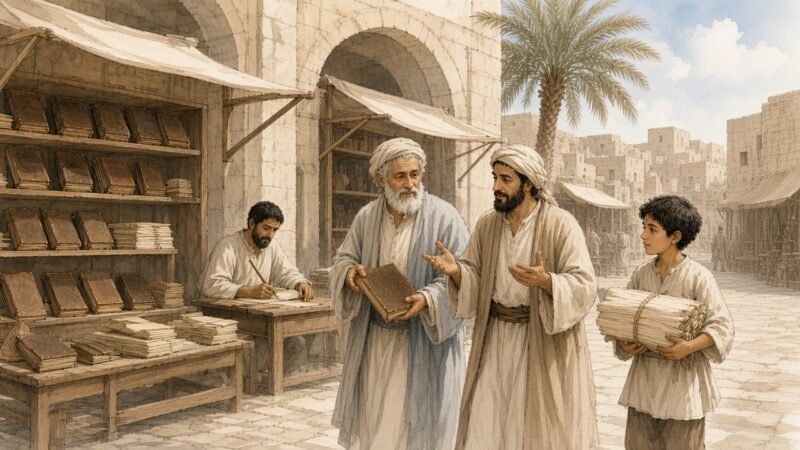
The systematic translation of Greek science into Arabic is one of the remarkable intellectual undertakings of the Middle Ages. It began under al-Mansur, gathered pace under Harun al-Rashid and reached its height under al-Ma’mun (reigned 813–833). The institution usually associated with it is the House of Wisdom (Bayt al-Hikma) in Baghdad. Modern historians, notably Dimitri Gutas, have cautioned that this was probably a palace library and bureau rather than a research academy in the modern sense, and that the translation movement was supported by many patrons, including officials, physicians and wealthy families, not by the ruler alone. The scale of the enterprise, however, is not in doubt.
The Elements was translated at least twice. Al-Hajjaj ibn Yusuf ibn Matar produced a version under Harun al-Rashid and revised it under al-Ma’mun. Later in the ninth century Ishaq ibn Hunayn made a new translation which Thabit ibn Qurra then corrected, and this Ishaq–Thabit version became the standard Arabic Euclid. The Conics was translated in the same period, with the first four books rendered under the supervision of the Banu Musa brothers and books five to seven by Thabit ibn Qurra. The eighth book is lost in Greek, and survives only in an Arabic reconstruction. Archimedes reached Arabic readers partly through translation and partly through epitomes, and some of his works, including the treatise on the construction of the regular heptagon, are known today only from their Arabic versions.
Translation was itself a scholarly act. Translators had to establish reliable Greek texts, often by comparing several manuscripts, and to coin an Arabic technical vocabulary for figures, ratios and constructions. Hunayn ibn Ishaq, the most celebrated of them, described travelling through Mesopotamia, Syria and Egypt in search of a complete manuscript of a single medical work. The best translators were themselves mathematicians, and they frequently added explanatory notes, alternative proofs and criticisms. By the end of the ninth century the main corpus of Greek geometry was available in Arabic, and a generation of readers was already writing commentaries upon it.
Why geometry mattered to astronomers, surveyors and builders
The translation movement had many motives, including court prestige, the needs of physicians and the interest of scholars in Greek logic. Geometry, however, flourished for reasons that went beyond fashion. Astronomy and timekeeping set problems of direction, time and calendar that were, at bottom, problems of spherical geometry, and the administration of a large empire set problems of measurement and division that required arithmetic and plane geometry. Historians of science such as David A. King have shown in detail how these civil and scientific needs created a sustained demand for mathematical expertise.
Direction and distance
Travellers, map makers and builders all needed to know the direction and distance from one city to another. Over short ranges these can be found by local custom, but for places as far apart as Spain, Central Asia and India they are a genuine problem. On a sphere, the direction from one point to another is given by the initial bearing of the great circle joining them, which depends on the latitudes of both places and the difference in their longitudes. Early buildings were often aligned by traditional methods, such as facing the direction of a particular sunrise, and the results varied widely. From the ninth century onward, mathematicians produced exact solutions using spherical trigonometry, approximate formulas for everyday use, and eventually tables giving bearings for every degree of latitude and longitude. A remarkable set of such tables, computed in fourteenth-century Damascus and later associated with the astronomer al-Khalili, covered nearly three thousand localities. In the seventeenth century, instrument makers in Isfahan produced brass world maps from which bearings and distances could be read directly.
Timekeeping and the calendar
The divisions of the day were reckoned from the position of the sun, and the hours change with latitude and season. The afternoon, for instance, was often marked by the moment when the shadow of an object exceeds its noon shadow by its own length. To compute such moments in advance one needs to know the sun’s altitude as a function of time, which again involves spherical trigonometry. The office of the muwaqqit, or professional timekeeper, emerged in Egypt and Syria in the thirteenth century, and its holders compiled extensive tables and designed sundials and instruments for the purpose.
The civil calendar of the region was lunar, and each month began with the first sighting of the crescent moon after conjunction. Predicting whether the crescent will be visible on a given evening is a difficult problem involving the relative positions of sun and moon and the geometry of the horizon. Astronomers from the ninth century onward developed criteria for visibility, and the problem kept mathematical astronomy in close contact with everyday life throughout the period.
Astronomy and instruments
These problems drew mathematicians into astronomy, and astronomy in turn drew them into geometry. The astrolabe, inherited from late antiquity, is a model of the heavens projected onto a flat plate by stereographic projection, and its design and use require a thorough understanding of how circles on a sphere map onto a plane. Instrument makers in Baghdad, Cairo and Córdoba refined it, produced universal versions that worked at any latitude, and wrote treatises explaining its theory. Observatories were founded with official support, beginning with al-Ma’mun’s programmes at Baghdad and Damascus, which among other things attempted to measure the length of a degree of latitude on the plain of Sinjar.
Inheritance and land
The law of the period set out detailed shares in which an estate must be divided among heirs, and applying those rules in complicated cases requires careful arithmetic with fractions. Al-Khwarizmi devoted a large part of his book on algebra to such problems. Land surveying, the assessment of taxes on cultivated land and the measurement of canals and fields were also routine government tasks. Manuals of practical mensuration, often written for scribes and officials rather than scholars, explained how to find the areas of irregular fields and the volumes of excavations, and they formed a bridge between the theoretical geometry of Euclid and the daily work of administration.
Architecture and ornament
Builders and architects used geometry to lay out plans, construct domes and arches and design decoration. Much of the finest ornament of the region was based on calligraphy, vegetal scrolls and, above all, geometric pattern, while figurative painting flourished in palaces and manuscripts. Geometric patterns built from stars and polygons spread across walls, ceilings, wooden screens and metalwork, and their construction posed real mathematical questions about symmetry, the division of circles and the tiling of the plane. A treatise by Abu al-Wafa, discussed below, was written specifically to help craftsmen carry out such constructions correctly, and records discussions between mathematicians and artisans.
Al-Khwarizmi
Muhammad ibn Musa al-Khwarizmi (c. 780–c. 850), a scholar of Khwarazmian origin who worked in Baghdad under al-Ma’mun, is best known for two books. His treatise on Indian numerals, which survives only in Latin translation, introduced the decimal place-value system to the Arabic-speaking world and later to Europe, and his name, in the form algorismus, gave rise to the word algorithm. His Compendious Book on Calculation by Completion and Balancing gave algebra its name, from the word al-jabr in its title.
Al-Khwarizmi’s algebra is closely bound up with geometry. He solved quadratic equations by rules expressed in words, but he justified those rules by geometrical diagrams, completing a square on the sides of a figure in a manner reminiscent of Greek geometrical algebra. The book also contains a section on mensuration, giving rules for the areas of triangles, quadrilaterals and circles and the volumes of solids, and a long section on inheritance. He compiled astronomical tables based largely on Indian methods, and a geographical work revising the coordinates given by Ptolemy. In each case his aim was practical, and he took from the Greek and Indian traditions whatever served it.
The Banu Musa
The three sons of Musa ibn Shakir, known collectively as the Banu Musa, were among the most influential patrons and practitioners of science in ninth-century Baghdad. Muhammad, Ahmad and al-Hasan grew up under the protection of al-Ma’mun and became wealthy officials who financed translations, sent agents to buy Greek manuscripts in Byzantine territory and employed translators, Thabit ibn Qurra among them.
Their own geometrical work is preserved in a treatise on the measurement of plane and spherical figures. In it they determined the area of a circle and the surface and volume of a sphere using methods derived from Archimedes, and gave procedures for trisecting an angle and finding two mean proportionals between two lines, classical problems that cannot be solved with straightedge and compass alone. The book was translated into Latin by Gerard of Cremona in the twelfth century as the Liber trium fratrum, and was read by European mathematicians such as Fibonacci and Jordanus de Nemore. The brothers also wrote on mechanics, including a celebrated book of ingenious devices, and on the theory of the ellipse, and they took part in al-Ma’mun’s geodetic measurements.
Thabit ibn Qurra
Thabit ibn Qurra (836–901) came from Harran in northern Mesopotamia, where he belonged to the Sabian community, which preserved an old astral tradition and a heritage of Greek learning. Muhammad ibn Musa met him on a journey and brought him to Baghdad, where he became one of the most productive scholars of his age. He translated or revised translations of Euclid, Apollonius, Archimedes, Ptolemy and Nicomachus, and wrote original works on geometry, number theory, astronomy and statics.
Thabit’s geometrical contributions were considerable. He generalised the theorem of Pythagoras to all triangles, studied the areas and volumes of figures generated by conic sections in ways that anticipate the integral calculus, and wrote on the sections of the cylinder. He was also among the first to examine critically Euclid’s fifth postulate, the parallel postulate, attempting to prove it from the other assumptions by considering the motion of a line. Such attempts were mistaken in their aim, since the postulate cannot be proved, but they opened a line of inquiry that ran through Arabic mathematics for four centuries. In number theory he discovered a rule for generating pairs of amicable numbers, which was rediscovered in Europe much later.
Abu al-Wafa al-Buzjani
Abu al-Wafa al-Buzjani (940–998), born in Khurasan, worked in Baghdad under the Buyid rulers and conducted astronomical observations there. He is a central figure in the history of trigonometry. He worked systematically with all six trigonometric functions, compiled sine tables of improved accuracy, and gave a clear proof of the sine theorem for spherical triangles, which replaced the cumbersome theorem of Menelaus that astronomers had used until then.
Abu al-Wafa also wrote two practical books addressed to working professionals. One explained the arithmetic needed by scribes and businessmen. The other, On the Geometric Constructions Necessary for the Artisan, set out ways of constructing regular polygons, inscribing figures in one another and dividing squares and other shapes into pieces that could be rearranged. Some of its constructions use a straightedge and a compass of fixed opening, a constraint closer to the workshop than the idealised compass of Euclid. The book records sessions at which geometers and craftsmen met, and notes where the craftsmen’s approximate methods went wrong, giving a rare glimpse of the exchange between theory and practice that underlay the ornament of the period.
The geometers of the tenth century
Between Thabit ibn Qurra and Ibn al-Haytham stands a group of tenth-century geometers whose work shows how far Arabic mathematics had moved beyond translation. Ibrahim ibn Sinan, Thabit’s grandson, who died young in 946, wrote on the area of the parabola by a method simpler than Archimedes’, on the construction of sundials and on the analysis and synthesis of geometrical problems, discussing how a geometer should search for a solution as well as how he should prove it. Abu Sahl al-Kuhi, who worked at the Buyid court in Baghdad, studied the volumes of paraboloids, designed a perfect compass for drawing conic sections and solved problems of constructing figures with given properties that Archimedes and Apollonius had left open.
Abu Sa’id al-Sijzi corresponded with al-Kuhi and with al-Biruni and wrote on the construction of the regular heptagon, on the intersection of conics and on an astrolabe based on the idea that the earth moves, which al-Biruni reported as a hypothesis that had been seriously proposed. Al-Sijzi also collected and studied the proofs of many propositions, comparing alternative demonstrations of the same result. These men formed a scholarly community in which problems were posed, solutions exchanged and rivalries pursued by letter, much as they would be in European mathematics in the seventeenth century.
A characteristic interest of this period was the use of conic sections to solve problems that could not be solved with straightedge and compass. Trisecting an angle, constructing a regular heptagon or nonagon, and finding two mean proportionals all reduce to cubic equations, and the geometers of the tenth century found that the intersection of a circle with a hyperbola or of two parabolas would supply the required points. This body of practice prepared the ground for Omar Khayyam’s systematic theory a century later.
Ibn al-Haytham
Abu Ali al-Hasan ibn al-Haytham (c. 965–c. 1040), known in Latin as Alhazen, was born in Basra and spent much of his career in Fatimid Cairo. His Book of Optics transformed the study of vision by combining a geometrical analysis of light rays with careful experiment, and it was among the most influential scientific books of the Middle Ages in Europe.
In pure geometry, Ibn al-Haytham worked on the problem, inherited from Ptolemy, of finding the point on a spherical mirror at which light from a given source will be reflected to a given observer. Known in Europe as Alhazen’s problem, it leads to an equation of the fourth degree, which he solved by intersecting a circle with a hyperbola. He also wrote on the quadrature of lunes, on the measurement of the paraboloid, where he summed the fourth powers of integers, and on the parallel postulate. His approach to the postulate defined parallels through a quadrilateral with three right angles, considering whether the fourth angle could be acute, right or obtuse. That is essentially the same figure later associated with Lambert, and it led directly into the territory of the non-Euclidean geometries discovered in the nineteenth century.
Al-Biruni
Abu Rayhan al-Biruni (973–after 1050), born in Khwarazm, was a scholar of astonishing range who wrote on astronomy, geography, mineralogy, chronology, pharmacology and the culture of India. His geometrical work was deeply practical. In his treatise on the determination of the coordinates of cities, written to establish the coordinates and bearings of Ghazni, he set out the methods of spherical trigonometry and geodesy in detail. He described a method of measuring the earth’s radius from the dip of the horizon seen from a mountain of known height, and applied it near Nandana in what is now Pakistan, obtaining a value close to the modern one.
His work on India, based on years spent in the subcontinent following the campaigns of Mahmud of Ghazni, describes Indian mathematics and astronomy with unusual sympathy and precision. His Canon of astronomy, dedicated to the Ghaznavid ruler Mas’ud, contains extensive trigonometry, including tables and methods of interpolation. Al-Biruni also wrote on the projection of the sphere onto the plane for maps and astrolabes, and on the construction of the regular heptagon and nonagon, problems which lead to cubic equations.
Omar Khayyam
Omar Khayyam (1048–1131), now remembered in the English-speaking world chiefly through Edward FitzGerald’s free version of his quatrains, was a mathematician and astronomer of the first rank. Working under the Seljuk sultan Malik-Shah, he led the reform of the Persian solar calendar, producing the Jalali calendar, which was more accurate than the Gregorian reform introduced in Europe five centuries later.
His Treatise on Demonstrations of Problems of Algebra gave a systematic classification of cubic equations and solved each type geometrically by the intersection of two conic sections, such as a circle and a parabola or two hyperbolas. In doing so he united the algebra of al-Khwarizmi with the geometry of Apollonius in a single theory. He also wrote a commentary on the difficulties in Euclid’s postulates, in which he criticised Ibn al-Haytham’s use of motion and examined the same quadrilateral with two equal sides perpendicular to a base, now known in the West as the Saccheri quadrilateral. He discussed the theory of ratio and proportion as well, arguing that ratios could be treated as numbers, a step towards the modern concept of real numbers.
Nasir al-Din al-Tusi and the Maragha observatory
The Mongol conquest of the eastern lands in the thirteenth century was destructive, and Baghdad was sacked in 1258. Yet the Mongol ruler Hulagu Khan also became the patron of one of the most important scientific institutions of the Middle Ages. In 1259 he funded the construction of an observatory at Maragha in north-western Iran under the direction of Nasir al-Din al-Tusi (1201–1274). The Maragha observatory had large instruments, a library said to hold many thousands of volumes, and a staff of astronomers drawn from across the Middle East and beyond, including at least one scholar from China. Its observations produced the Zij-i Ilkhani, a set of astronomical tables completed in 1272.
Al-Tusi was a prolific author. His Treatise on the Quadrilateral was the first work to treat trigonometry as a mathematical discipline in its own right, independent of astronomy, and it gave a complete account of the solution of plane and spherical triangles, including the sine rule. He produced revised editions of Euclid, Archimedes, Apollonius, Menelaus, Ptolemy and other authors, known as the intermediate books, which became standard teaching texts across the Middle East. He also wrote on the parallel postulate, and a work attributed to his school was printed in Rome in 1594 and read by John Wallis and Giovanni Saccheri.
In astronomy, al-Tusi devised a geometrical device now called the Tusi couple, in which a small circle rolls inside a larger circle of twice its radius, so that a point on the small circle moves back and forth along a straight line. The construction allowed astronomers at Maragha and their successors to build planetary models that avoided the equant, a feature of Ptolemy’s system which they considered physically objectionable. Very similar devices appear in the work of Copernicus, and historians continue to study whether and how the Maragha models reached him.
Al-Kashi and Samarkand
The last great centre of medieval Arabic and Persian mathematical astronomy was Samarkand, where Ulugh Beg, grandson of Timur and governor of the city, founded a college and an observatory in the 1420s. Its most brilliant mathematician was Ghiyath al-Din Jamshid al-Kashi (c. 1380–1429).
Al-Kashi’s Treatise on the Circumference calculated the ratio of the circumference of a circle to its diameter, which we call pi, by finding the perimeters of inscribed and circumscribed polygons with more than eight hundred million sides. He obtained a value correct to sixteen decimal places, a record that stood for about a hundred and eighty years. In his Key to Arithmetic he used decimal fractions systematically, and gave methods for extracting roots and for mensuration, including the measurement of arches, vaults and the stalactite vaulting known as muqarnas, which shows how closely mathematicians were still engaged with building. He also computed the sine of one degree to great accuracy by an iterative method for solving a cubic equation, a technique of considerable sophistication.
Geometry in the schools and the workshops
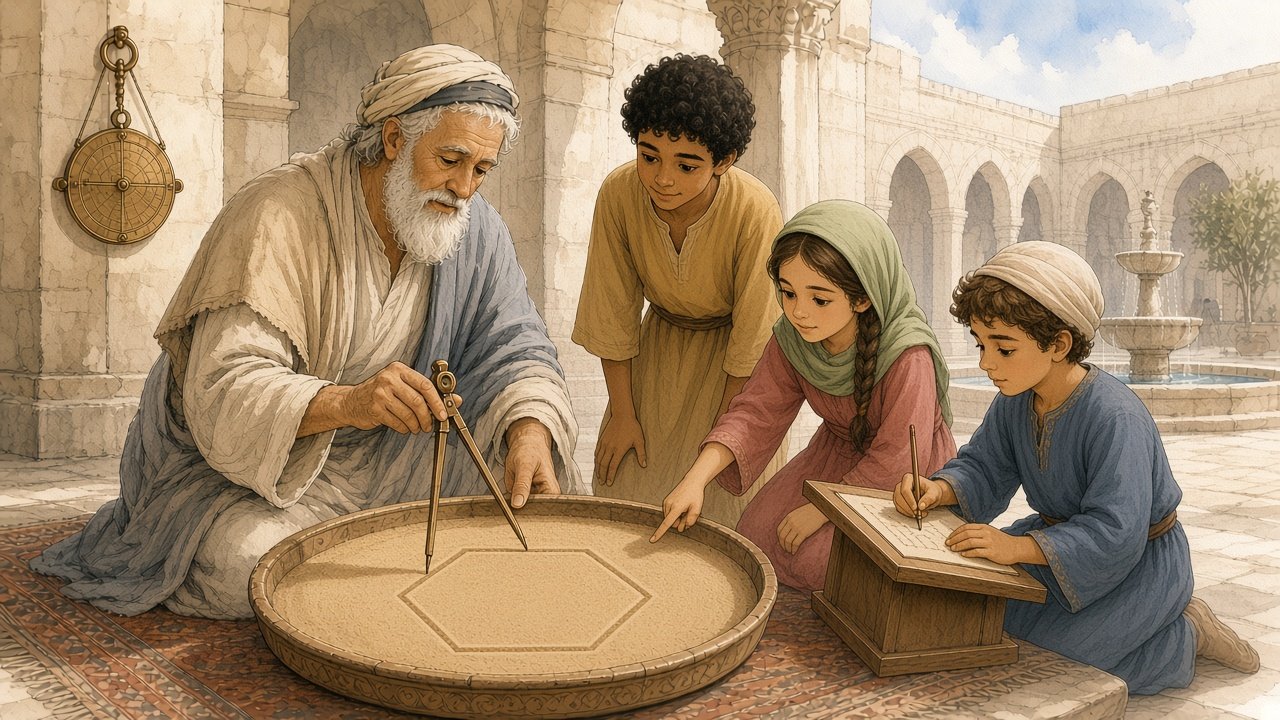
Geometry was taught in several settings. The colleges that multiplied from the eleventh century were primarily devoted to law and letters, but many taught arithmetic and the calculation of inheritance shares, and some offered astronomy and geometry as subsidiary subjects. Observatories, hospitals and private circles of study around a learned teacher provided other venues. The standard curriculum, as it settled after al-Tusi, began with the Elements, continued through the intermediate books and culminated in Ptolemy’s Almagest, with commentaries at each stage.
Scholars disagreed about the status of the mathematical sciences. Some scholars regarded parts of Greek philosophy with suspicion, and the historian Ibn Khaldun, writing in the fourteenth century, warned against astrology and alchemy. Geometry itself, however, was generally respected. Ibn Khaldun remarked that geometry enlightens the intellect and sets the mind right, because its proofs are clear and orderly, and he repeated the tradition that Plato’s Academy had admitted no one ignorant of geometry. The scholar al-Ghazali, a sharp critic of the philosophers, accepted that mathematics consisted of demonstrations which could not be denied once understood.
In the workshops, by contrast, geometry was transmitted through practice and pattern books rather than proofs. Master builders and tile cutters learned constructions by apprenticeship, and large designs were transferred from drawings to walls using grids and templates. The vaulted ceilings known as muqarnas, which cover domes and portals with tiers of small niches like a honeycomb, were planned on the ground as two-dimensional projections and then assembled in three dimensions. A plaster plate found at the Takht-i Sulayman palace in Iran, dating from the thirteenth century, shows such a plan incised on its surface. The relation between the mathematicians who wrote about these forms and the craftsmen who built them remains a subject of research, but documents such as Abu al-Wafa’s treatise and al-Kashi’s chapter on the measurement of muqarnas show that the two worlds were in contact.
Girih and the geometry of ornament
The geometric ornament of the Middle East reached a high point between the twelfth and fifteenth centuries. The style known as girih, from the Persian word for knot, consists of interlacing straplines that form stars and polygons, typically with ten-fold or twelve-fold symmetry. Craftsmen drew such patterns with compass and straightedge, and a fifteenth-century scroll now in the Topkapi Palace Museum in Istanbul preserves a collection of designs, with the construction lines still visible, used by architects and designers.
In 2007 the physicists Peter J. Lu and Paul J. Steinhardt published a study in the journal Science arguing that many such patterns were constructed not by drawing lines directly but by fitting together a set of five tile shapes, now called girih tiles, each decorated with lines. They showed that patterns on a portal in Isfahan built in 1453 come close to the quasi-periodic tilings described by Roger Penrose in the 1970s, which have five-fold symmetry and never repeat exactly. Historians of art have debated how far the medieval designers understood the mathematical properties of what they made, but the study made plain that the artisans were working with geometrical ideas of real depth, and that the collaboration between mathematicians and craftsmen recorded by Abu al-Wafa had borne lasting fruit.
Mapping the world
Geography offered another field in which geometry and administration met. A large empire needed to know the distances between its cities, the routes of its post roads and the positions of its provinces. Ptolemy’s Geography had shown how to locate places by latitude and longitude and how to project the curved surface of the earth onto a flat map. Al-Khwarizmi’s Book of the Form of the Earth revised Ptolemy’s coordinates, correcting among other things the exaggerated length of the Mediterranean, and later scholars compiled ever larger tables of coordinates.
Determining longitude was especially difficult, since it required simultaneous observations of an event such as a lunar eclipse from two places. Al-Biruni arranged such an observation with Abu al-Wafa in 997, one observing at Kath in Khwarazm and the other in Baghdad, and used the difference in local times to compute the difference in longitude. He also discussed several methods of map projection, including forms resembling what are now called the azimuthal equidistant and the globular projections. The twelfth-century geographer al-Idrisi, working in Palermo for the Norman king Roger II, produced a great world map and a description of the known world which drew on Arabic, Greek and Latin sources and on the reports of travellers, and which illustrates how such knowledge could cross the boundaries between peoples and kingdoms.
Al-Andalus and the Maghrib
The Arabic-speaking west developed a distinctive mathematical culture of its own. In Córdoba, Maslama al-Majriti revised the astronomical tables of al-Khwarizmi for the meridian of Córdoba and wrote on the astrolabe. His pupils spread mathematical learning to Toledo, Granada and Zaragoza. In Zaragoza the ruler al-Mu’taman ibn Hud, who reigned from 1081 to 1085, composed a large geometrical compendium called the Book of Perfection, which reworked material from Euclid, Archimedes, Apollonius, Thabit ibn Qurra and Ibn al-Haytham and included a version of the theorem now associated with Giovanni Ceva, proved in Europe only in 1678.
In Toledo the astronomer al-Zarqali, known in Latin as Arzachel, built water clocks, designed a universal astrolabe plate known as the safiha and contributed to the Toledan Tables, which were translated into Latin and used across Europe for two centuries. In North Africa, mathematicians in Marrakesh, Bijaya and Tunis developed symbolic notation for algebra and wrote widely used manuals of arithmetic and calculation. It was in Bijaya, in present-day Algeria, that the young Fibonacci, son of a Pisan customs official, first learned the Hindu-Arabic numerals that he would later introduce to Italian merchants.
Transmission to Europe
Arabic geometry reached Latin Europe chiefly through Spain and, to a lesser extent, Sicily and the Levant. Ibn Mu’adh al-Jayyani, who wrote on spherical trigonometry in eleventh-century Jaén, belongs to the Andalusian tradition already described. After the Castilian capture of Toledo in 1085, the city’s libraries became accessible to scholars from across Europe.
During the twelfth century a wave of translation from Arabic into Latin took place, in some respects mirroring the earlier movement from Greek into Arabic. Adelard of Bath, who had travelled in the eastern Mediterranean, produced the first Latin version of the full Elements from Arabic around 1120, as well as a version of al-Khwarizmi’s astronomical tables. Gerard of Cremona, working in Toledo, translated an extraordinary range of works, including the Elements, Ptolemy’s Almagest, al-Khwarizmi’s algebra, the treatise of the Banu Musa and works on optics. Robert of Chester translated al-Khwarizmi’s algebra in 1145. Through these translations Latin readers gained access to Greek geometry as edited and commented upon by Arabic scholars, as well as to the original achievements of Arabic and Persian scholars.
The influence can be traced in many fields. Leonardo of Pisa, known as Fibonacci, learned Hindu-Arabic numerals in North Africa and drew on Arabic sources for his Liber abaci of 1202 and his Practica geometriae. Ibn al-Haytham’s optics, translated as De aspectibus, shaped the work of Roger Bacon, John Pecham and Witelo, and was printed in 1572. The trigonometry of al-Tusi and the Andalusian authors informed the work of Regiomontanus in the fifteenth century. In the seventeenth century, Wallis studied the Arabic arguments on the parallel postulate, and his successors carried that discussion forward until the eventual discovery of non-Euclidean geometry by Gauss, Bolyai and Lobachevsky.
The vocabulary of modern mathematics still bears witness to this history. Algebra comes from al-jabr, algorithm from al-Khwarizmi, sine from jayb, and many star names, such as Aldebaran, Altair and Vega, from Arabic. The decimal numerals now used throughout the world are called Arabic numerals in European languages because they reached Europe through Arabic texts, even though their origin was Indian.
Assessment
Historians have sometimes described the medieval Middle East as a mere custodian of Greek science, preserving it until Europe was ready to receive it. The record does not support that view. Arabic and Persian scholars did preserve, translate and teach the Greek classics, and much of Greek mathematics would be lost without their work. They also combined Greek proof with Indian calculation, created trigonometry as an independent discipline, joined algebra to geometry, pursued the parallel postulate further than anyone before the eighteenth century, computed with a precision unmatched for centuries and developed an architectural ornament of great mathematical subtlety.
The reasons for this achievement lay in a particular combination of circumstances. A vast empire brought together peoples and traditions that had previously been separate. Wealthy patrons, from rulers to officials and Mongol khans, valued science for its prestige and its usefulness. Astronomy, timekeeping and the law of inheritance posed precise questions about direction, time and division that demanded mathematical answers. Administration required surveyors and accountants, and builders required geometers. Arabic provided a common language of scholarship from the Atlantic to Central Asia. Within that setting, geometry served the observatory and the building site, the workshop and the treasury, and its practitioners regarded it as at once a practical craft and a training of the mind in demonstrative reasoning.
Further reading
- Dimitri Gutas, Greek Thought, Arabic Culture (Routledge, 1998).
- Roshdi Rashed (ed.), Encyclopedia of the History of Arabic Science (Routledge, 1996).
- David A. King, In Synchrony with the Heavens, 2 volumes (Brill, 2004–2005).
- The MacTutor overview of Arabic mathematics, University of St Andrews.