The Seven-Kelvin Mirror – JWST Cryogenic Optics
To peer back through 13.6 billion years of cosmic time and capture the first ghostly starlight ignited after the Big Bang, astronomers faced a cruel, uncompromising physical trap: the physics of thermal infrared radiation. Because the expansion of the universe stretches the wavelengths of light traveling across cosmological distances—shifting ultraviolet and visible photons from the first stars and infant galaxies deep into the near- and mid-infrared spectrum—the cosmic dawn can only be observed with an infrared telescope. Yet, in the infrared domain, temperature itself is light. In accordance with Planck’s blackbody law, any object warmer than absolute zero glows with its own thermal infrared radiation. A space telescope operating at room temperature is an optical absurdity: it is the equivalent of building an optical telescope out of brilliant, glowing fluorescent light bulbs, blinding its own detectors in a blinding fog of self-emitted heat. To see the faintest whisper of an infant galaxy across the chasm of time, an observatory must be cold—colder than the frozen plains of Pluto, colder than liquid nitrogen, plunging toward the absolute stillness of deep space. Launched on Christmas Day 2021, the James Webb Space Telescope (JWST) represents the supreme masterpiece of cryogenic engineering and precision space optics in human history. Operating 1.5 million kilometers from Earth at the Second Lagrange Point (L2), JWST conquered the thermal demon through two breathtaking technological miracles: a five-layer, tennis-court-sized Kapton sunshield that dissipates three hundred degrees Celsius of solar furnace heat down to forty Kelvin, and an active closed-loop helium pulse-tube cryocooler that chills the Mid-Infrared Instrument down to an astonishing 6.7 Kelvin. Combining gold-coated beryllium mirror segments polished with cryogenic pre-compensation and aligned to nanometer precision by robotic hexapod actuators, JWST has permanently dismantled the infrared barrier, revealing the hidden universe with unprecedented clarity.
1. The Infrared Imperative – Why We Must See the Heat
To understand why the James Webb Space Telescope had to become the coldest optical observatory ever launched into space, one must examine two fundamental astrophysical phenomena: Cosmological Redshift and Interstellar Dust Extinction.
When the first stars (Population III) and the earliest proto-galaxies coalesced approximately 200 to 400 million years after the Big Bang, they burned intensely hot, radiating the vast majority of their energy as high-energy ultraviolet and visible light. However, as those photons traversed the expanding fabric of spacetime for over 13.5 billion years to reach modern Earth, the wavelength of the light stretched continuously with the expansion of the universe, governed by the cosmological redshift parameter redshift.
For the earliest galaxies residing at redshifts between redshift 10 and redshift 20, starlight is stretched by a factor of 11 to 21 times! The Lyman-alpha ultraviolet emission line of hydrogen (emitted at 121.6 nanometers) is stretched completely out of the ultraviolet and visible spectrum, landing squarely in the near-infrared between 1.3 and 2.5 micrometers. Visible-light space telescopes like the Hubble Space Telescope are fundamentally blind to this primordial epoch; their detectors perceive only an impenetrable, pitch-black void.
Furthermore, in the modern universe, the most dynamic astronomical events—the gravitational collapse of molecular clouds, the birth of stars, and the accretion of rocky exoplanets within protoplanetary disks—occur deep inside dense cocoons of cosmic dust. In classical optics, Rayleigh scattering of light off sub-micron silicate and carbon dust grains scales inversely with the fourth power of wavelength (I_scat proportional to lambda⁻⁴). While visible starlight is completely scattered and extinguished by dark nebulae, infrared light possesses wavelengths much larger than the dust grains, gliding effortlessly through cosmic clouds to reveal hidden stellar nurseries and planetary atmospheres.
2. The Thermal Demon – Planck’s Law and Self-Blinding Telescopes
While the astrophysical imperative to observe the infrared is clear, the physical obstacle is catastrophic: Thermal Self-Emission. All physical matter at a finite thermodynamic temperature T > 0 Kelvin continuously radiates electromagnetic energy, governed by Planck’s Blackbody Spectral Radiance Law.
The total radiated thermal power scales with the fourth power of temperature according to the Stefan-Boltzmann law (P = epsilon σ A T⁴), while the peak emission wavelength is determined by Wien’s Displacement Law.
Consider the devastating implications for an infrared telescope operating at ambient room temperature (T approximately 300 Kelvin, or +27^°C): – The peak of its thermal blackbody emission lands at lambda_maximum approximately 9.7 micrometers—right in the center of the critical mid-infrared astronomical observation window! – The telescope’s mirrors, structural struts, camera housings, and detectors radiate intense, multi-kilowatt infrared photon noise in all directions. – In modern infrared detectors (such as arsenic-doped silicon or mercury-cadmium-telluride arrays), incoming photons are detected when they excite electrons across a narrow bandgap. At room temperature, random thermal vibrations of the crystal lattice continuously kick valence electrons across the bandgap, generating a massive Thermal Dark Current that completely swamps the faint trickle of photons arriving from a distant galaxy 13 billion light-years away!
To detect cosmic infrared photons, the telescope’s primary mirror and Near-Infrared Camera (NIRCam) must be chilled below 50 Kelvin (-223 degrees Celsius). Even more demanding, the Mid-Infrared Instrument (MIRI), which observes wavelengths from 5 to 28 micrometers, must be cooled down to an extraordinary 6.7 Kelvin (-266.5 degrees Celsius)—less than seven degrees above absolute zero! At 6.7 Kelvin, thermal lattice vibrations cease, and the detector dark current drops to less than one electron per pixel per minute.
3. The Sanctuary – Why JWST Lives at the Sun-Earth L2 Point
To achieve cryogenic stillness, an infrared space observatory cannot orbit the Earth. The Hubble Space Telescope operates in Low Earth Orbit (LEO) at 540 kilometers altitude, circling the globe every 96 minutes. In LEO, the telescope is continuously assaulted by intense thermal radiation: – One side is scorched by direct sunlight (irradiance approximately 1,361 W/m²). – The other side is bathed in thermal infrared heat radiated directly by the warm Earth (T approximately 288 K, thermal flux approximately 240 W/m²), plus bright reflected sunlight (Earth albedo approximately 0.3). – The telescope alternates violently between blazing sunlight and freezing orbital eclipse every 45 minutes, creating thermal shockwaves that make stable cryogenic equilibrium impossible.
To escape this planetary thermal furnace, NASA, the European Space Agency (ESA), and the Canadian Space Agency (CSA) dispatched JWST to the Second Sun-Earth Lagrange Point (L2), situated 1.5 million kilometers (one million miles) directly behind the Earth on the night side.
L2 is a gravitational equilibrium point in the circular restricted three-body problem. At L2, the combined gravitational pull of the Sun and the Earth provides the exact centripetal force required for a spacecraft to orbit the Sun with an orbital period of exactly 365 days, keeping pace with Earth. The monumental advantage of L2 for an infrared observatory is Geometric Collinearity: looking from L2, the Sun, the Earth, and the Moon all sit permanently in the exact same direction in the sky!
This celestial alignment enabled a revolutionary architectural design: instead of enclosing the telescope inside a heavy, refrigerated vacuum thermos tank of liquid helium (which would boil away within a few years, as occurred with ISO, Spitzer, and Herschel), engineers could mount the telescope completely naked to the vacuum of space, using a single, permanent, flat sunshield to block the Sun, Earth, and Moon simultaneously!
4. The Five-Layer Sunshield – Dissipating a Furnace into the Void
The technological spine of the James Webb Space Telescope is its legendary Five-Layer Kapton Sunshield. Measuring 21.2 meters long by 14.2 meters wide—roughly the dimensions of a regulation tennis court—the sunshield acts as an impenetrable thermal barrier between the blazing solar environment and the frozen telescope.
The thermal performance required of the sunshield defies belief: – The sun-facing front layer (Layer 1) absorbs direct solar radiation, heating to over +85 to +110 degrees Celsius (358 to 383 Kelvin). – The telescope-facing back layer (Layer 5) drops to -233 degrees Celsius (40 Kelvin)! – Across a physical distance of less than a few feet, the sunshield establishes and maintains a permanent temperature drop of over 300 degrees Celsius (540 degrees Fahrenheit), dissipating approximately 200,000 watts of solar energy down to a mere 0.023 watts (23 milliwatts) reaching the telescope—an effective Sun Protection Factor (SPF) exceeding one million!
Material Physics of the Kapton Membranes
Each of the five sunshield layers is fabricated from an ultra-thin aerospace polyimide film: Kapton E, manufactured by DuPont. Kapton was selected for its exceptional mechanical dimensional stability, tear resistance, and retention of ductility at cryogenic temperatures:
- Membrane Thickness: Layer 1 (the outer sun-facing membrane) is just 0.050 millimeters (50 micrometers / 0.002 inches) thick—about the thickness of a single human hair. Layers 2 through 5 are even thinner, measuring an astonishing 0.025 millimeters (25 micrometers / 0.001 inches) thick!
- Vacuum-Deposited Aluminum (VDA) Coating: Every layer is coated on both sides with a 100-nanometer vapor-deposited film of pure aluminum (aluminum), reflecting over 97% of thermal infrared radiation.
- Doped Silicon Coating: The sun-facing side of Layer 1 and Layer 2 features an additional 50-nanometer layer of conductive silicon doped with antimony. Silicon has a high optical emissivity (epsilon approximately 0.85) in the infrared while reflecting solar visible light, maximizing radiative heat rejection while dissipating electrostatic charge build-up from solar wind protons.
- Ripstop Grid Pattern: To prevent micrometeoroid punctures from propagating into catastrophic tears across the membrane, the Kapton sheets are reinforced with an ultrasonic heat-bonded grid of ripstop seams spaced every few feet, confining punctures to localized, millimeter-scale pinholes.
The Vacuum Gap Geometry – Heat Bouncing to Infinity
Why use five separate layers instead of a single thick insulating blanket? In the vacuum of space, heat cannot conduct through air; it transfers strictly through radiative photon emission and absorption (P proportional to T⁴).
If the five layers touched, heat would conduct straight through. Instead, the five Kapton membranes are held apart by automated spreader bars and tensioned cables, separated by precision vacuum gaps that widen from the center toward the perimeter. Layer 1 absorbs sunlight, heats up, and re-radiates thermal photons. Crucially, the layers are tilted at subtle angles relative to each other: photons radiating into the gap between Layer 1 and Layer 2 bounce between the shiny aluminum surfaces at oblique angles and are guided sideways out into the empty void of space!
Layer 2 receives only a tiny fraction of the heat, dropping to roughly 275 K. Layer 3 drops to 200 K, Layer 4 to 120 K, and Layer 5 reaches a steady-state radiative equilibrium of 39 Kelvin (-234 deg C). The multi-layer geometry acts as an optical heat-funnel, discarding solar energy into deep space without consuming a single watt of electrical power.
5. Beryllium Optics – Sculpting the Golden Primary Mirror
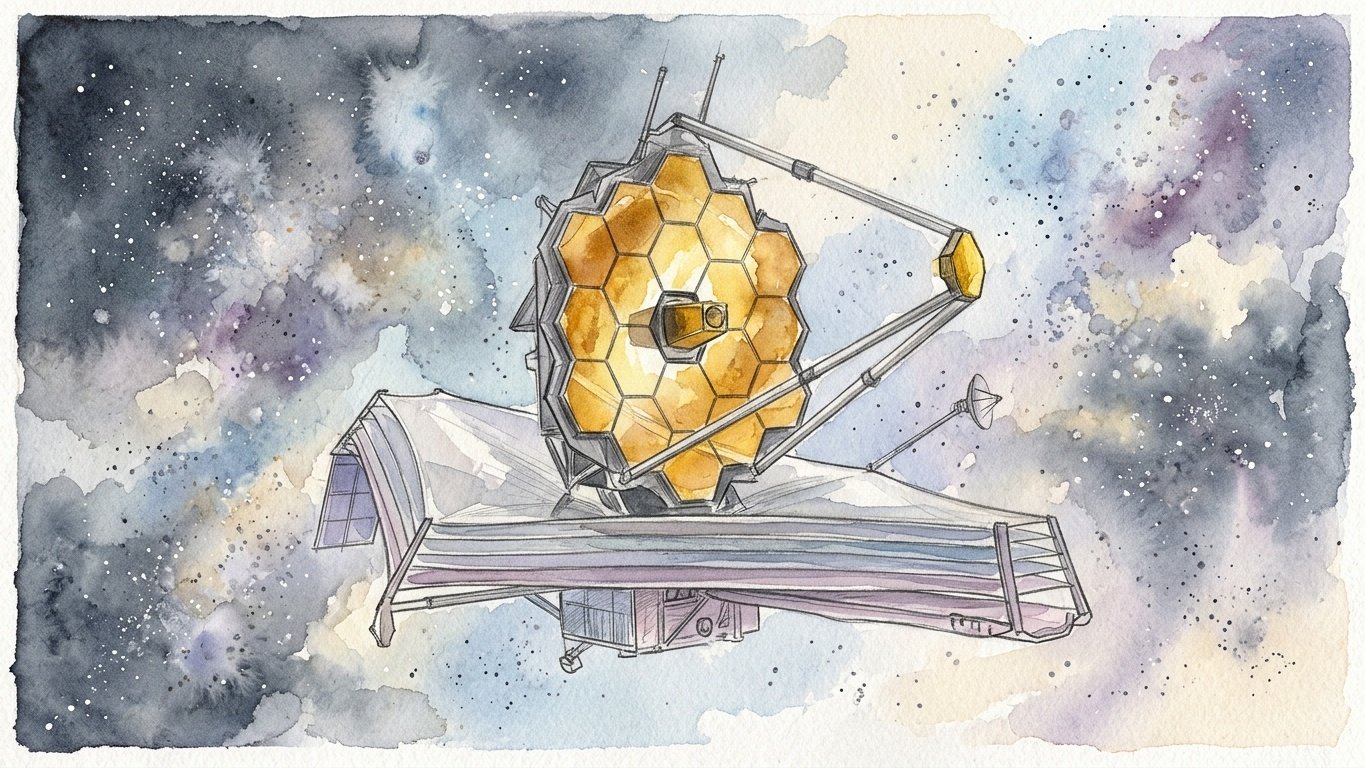
Positioned behind the frozen sanctuary of the sunshield sits the primary optical assembly of JWST: the 6.5-meter (21.3-foot) Gold-Coated Primary Mirror. With an optical collecting area of 25.4 square meters (more than six times larger than Hubble), the mirror had to be engineered under extreme mass constraints: the entire primary mirror assembly could weigh no more than 705 kilograms.
Fabricating a 6.5-meter monolithic glass mirror was impossible; no rocket fairing was wide enough to hold it, and a solid glass mirror would weigh tens of tons. NASA engineered an audacious segmented folding mirror constructed from an exotic metal: Beryllium.
Beryllium was selected for three paramount physical properties: 1. Ultra-Low Density: Beryllium has a density of only 1.85 grams per cubic centimeter—lighter than aluminum, and nearly identical to water. 2. Exceptional Specific Stiffness: Beryllium possesses an elastic modulus of 303 GPa, giving it one of the highest stiffness-to-weight ratios of any structural element. 3. Near-Zero Cryogenic Thermal Expansion: Below 50 Kelvin, beryllium’s coefficient of thermal expansion (α) drops to virtually absolute zero. Once the mirror cools to its operational temperature, it becomes dimensionally immutable, immune to thermal warping.
The manufacturing process of the 18 hexagonal mirror segments (each measuring 1.32 meters flat-to-flat and weighing just 20 kilograms) pushed metallurgy to its physical limits: – High-purity spherical beryllium powder (O-30 grade) was consolidated inside a high-temperature autoclave under 1,000 atmospheres of pressure in a process called Hot Isostatic Pressing (HIP), creating an isotropic, grain-boundary-free metal billet. – Massive CNC computer-controlled milling machines carved out 92% of the metal from the backside of each segment, creating a delicate, lightweight open-isogrid honeycomb structure with ribs mere millimeters thick. – Cryogenic Polishing (Cryo-Null Figuring): When cooled from room temperature (+20 deg C) to operational cryogenic temperature (40 K), beryllium shrinks slightly and warps due to microscopic crystalline stresses. At the Tinsley Laboratories in California, engineers polished the mirrors at room temperature, deliberately polishing them with the inverse mathematical optical distortion predicted by cryogenic finite element models! When the mirrors were later chilled down to 40 Kelvin inside the colossal Chamber A cryogenic vacuum tank at NASA Johnson Space Center, the mirrors shrank and warped into absolute, atom-perfect paraboloids with an optical surface roughness of less than 20 nanometers.
6. The Vaporized Gold Coating – Maximizing Infrared Reflectivity
Once polished to atomic flatness, the beryllium mirrors were placed inside a high-vacuum thermal evaporation chamber. The mirrors received a 100-nanometer-thick reflective coating of Pure Gold ($99.999% Au).
While classical optical mirrors use silver or aluminum, aluminum is relatively inefficient at reflecting infrared light (about 92%), and silver tarnishes. Pure gold is the ultimate infrared mirror: it reflects over 98.5% to 99% of all photons across the entire 0.8 to 28 micrometer infrared spectrum.
Because gold is applied via atomic vapor deposition across a thickness of only 100 nanometers, the total mass of gold coating all 18 primary mirror segments, the secondary mirror, the tertiary mirror, and the fine steering mirror totals a mere 48 grams—about the mass of a single golf ball! To protect the soft, delicate gold from microscopic scratches, the gold was capped with an ultra-thin, transparent 100-nanometer protective layer of amorphous silicon dioxide (SiO₂).
7. Hexapod Micro-Actuators – Nanometer Wavefront Alignment
When the 18 hexagonal gold-coated beryllium segments unfolded in deep space, they did not form a single coherent optical mirror; they were 18 independent, misaligned mirrors pointing in slightly different directions. To combine these 18 separate images into a single diffraction-limited wavefront, NASA engineered the Hexapod Mirror Actuation System.
Mounted on the back of each mirror segment are six precision mechanical hexapod actuators arranged in a Stewart platform geometry, plus a seventh central actuator that physically pulls or pushes on the center of the segment to adjust its radius of curvature. Each actuator is driven by a cryogenic stepper motor paired with a high-ratio harmonic drive gearbox and a flexible mechanical lever system.
The mechanical precision of these actuators is mind-boggling: – A single motor step moves the mirror by an incremental distance of just 7.7 nanometers—less than one-tenth the wavelength of ultraviolet light, and roughly 1/10,000th the thickness of a human hair! – The actuators control seven degrees of freedom: X, Y, Z translation, pitch, yaw, roll rotation, and radius of curvature.
Using NIRCam images of a bright calibration star (HD 84406), optical algorithms executed a seven-step wavefront alignment sequence: Segment Identification, Segment Alignment, Image Stacking, Coarse Phasing (using dispersed fringe sensing), Fine Phasing, and Full-Field Optimization. Over several weeks, the algorithms adjusted the 132 actuators, bringing the 18 hexagonal mirrors into phase alignment within an aggregate optical wavefront error of less than 50 nanometers RMS—forming a single, monolithic 6.5-meter virtual eye operating at the theoretical diffraction limit.
8. The MIRI Cryocooler – Achieving 6.7 Kelvin with Closed-Loop Helium
While the passive radiative cooling of the sunshield easily brought the primary mirror and three of JWST’s instruments (NIRCam, NIRSpec, and NIRISS) down to 39 Kelvin, the fourth instrument—the Mid-Infrared Instrument (MIRI)—confronted a fundamental semiconductor physics barrier.
MIRI observes cosmic photons in the mid-infrared from 5 to 28 micrometers. To detect these long-wavelength photons, MIRI utilizes Arsenic-Doped Silicon (Si:As) Impurity Band Conduction (IBC) Detectors. The ionization energy required to excite an electron from the arsenic impurity band into the conduction band is a microscopic 54 millielectron-volts (meV). At 40 Kelvin, thermal kinetic energy (k_B T approximately 3.5 meV) is high enough that electrons spontaneously jump into the conduction band, generating an overwhelming dark current that blinds the camera. MIRI can only operate if chilled strictly below 6.7 Kelvin (-266.5 degrees Celsius).
To reach 6.7 Kelvin without carrying hundreds of kilograms of expendable liquid helium that would evaporate in years, NASA’s Jet Propulsion Laboratory (JPL) and Northrop Grumman engineered the MIRI Active Closed-Loop Cryocooler—one of the most sophisticated thermodynamic machines ever flown in space.
Thermodynamic Architecture of the MIRI Cryocooler
The MIRI cryocooler is an advanced Three-Stage Pulse-Tube Cryocooler paired with a Joule-Thomson (JT) Loop circulating ultra-pure Helium-4 gas (helium-4):
- Vibration-Free Compressor Assembly (Warm End): Located on the warm service module of the spacecraft, two horizontally opposed acoustic piston compressors pump helium gas at high pressure. The pistons move in opposite directions, canceling mechanical vibrations down to micro-Newtons to prevent optical jitter.
- Three-Stage Pulse Tube Pre-Cooler: The helium gas passes through three regenerative heat-exchange stages, using acoustic standing-wave expansion cycles to drop the gas temperature from room temperature down to approximately 18 Kelvin.
- The Cold Transfer Line: Chilled 18 K helium is pumped across a 10-meter-long, ultra-thin stainless steel refrigerant line traversing the deployable tower from the warm spacecraft bus into the frozen heart of MIRI.
- The Joule-Thomson Expansion Valve (The Cold Head): At MIRI’s instrument core, the cold helium gas at 18 K is forced through a microscopic porous restriction—the Joule-Thomson valve. As the gas abruptly expands from high pressure to low pressure across the valve, the negative Joule-Thomson coefficient of helium at 18 K causes spontaneous, intense endothermic cooling! The gas temperature plunges to 6.0 Kelvin, absorbing thermal heat from MIRI’s detectors through gold thermal straps and maintaining the sensor arrays at a steady 6.7 Kelvin (± 0.005 K).
The warm helium gas is then pumped back up the transfer line to the compressors to repeat the cycle indefinitely. With zero expendable cryogens and zero mechanical moving parts in the cold instrument bay, the MIRI cryocooler will operate continuously for decades.
9. The Unfolding Dance – 344 Single-Point Failures
The launch and deployment of JWST represented the most terrifying mechanical sequence in space exploration history. Because an 6.5-meter mirror and a 21-meter sunshield could never fit inside the 5-meter payload fairing of an Ariane 5 rocket, the entire observatory had to be folded like a massive piece of origami.
Engineers identified 344 Single-Point Failures (SPFs)—mechanical deployments, release actuators, cable tensioners, and latches where a single mechanical failure would permanently destroy the multi-billion-dollar mission. Over thirty days of nail-biting cruise toward L2, JWST executed its automated choreography:
- Deploying the forward and aft sunshield pallet structures.
- Extending the deployable tower assembly to thermally isolate the telescope from the warm bus.
- Firing 107 non-explosive release actuators to release the five folded Kapton membranes.
- Extending mid-boom spreader arms and tensioning all five Kapton layers with electric winches.
- Deploying the tripod secondary mirror support structure.
- Swinging open the left and right primary mirror wings, locking the 18 beryllium segments into place.
Every single one of the 344 single-point failure mechanisms executed with 100% mechanical perfection. When the sunshield tensioned and the telescope turned into the deep shadow, the cryogenic laws of physics took over, and the observatory settled gracefully into its frozen, seven-Kelvin operating regime.
10. Scientific Discoveries – Breaking Cosmic Dawn
From the moment JWST opened its golden eyes in July 2022, its cryogenic sensitivity shattered the foundations of observational astrophysics:
- The Impossible Early Galaxies (JADES-GS-z14-0): JWST discovered luminous, massive galaxies existing a mere 290 million years after the Big Bang (redshift 14.32)! These primordial galaxies were hundreds of millions of years older, far brighter, and far more chemically enriched in oxygen and carbon than standard cosmological galaxy formation models predicted, forcing theorists to revise models of cosmic dark matter halo collapse and star formation rates.
- Exoplanet Atmospheric Spectroscopy: Using transmission spectroscopy, JWST detected carbon dioxide (CO₂), water vapor (H₂O), sulfur dioxide (SO₂, photochemically created by starlight), and methane (CH₄) in the atmospheres of alien exoplanets, including the famous TRAPPIST-1 terrestrial planetary system and the hot gas giant WASP-39b.
- Protostellar Jets and Carbon Chemistry: MIRI penetrated the dense dust pillars of the Eagle Nebula (The Pillars of Creation) and the Orion Nebula, mapping polycyclic aromatic hydrocarbons (PAHs) and water ice grains, tracing the organic chemical precursors of life in the earliest stages of planetary system formation.
12. Multi-Object Spectroscopy – The Micro-Shutter Array (MSA)
While imaging cosmic fields produces breathtaking aesthetic photographs, the true quantitative engine of astrophysics is Spectroscopy: decomposing light into its constituent wavelengths to measure chemical elemental abundances, ionization states, velocities, and cosmological redshifts. In classical space observatories, a spectrograph could observe only one or two celestial targets simultaneously through fixed physical slits.
To analyze hundreds of primordial galaxies simultaneously in a single astronomical pointing, NASA’s Goddard Space Flight Center engineered one of the most brilliant MEMS (micro-electro-mechanical systems) devices ever flown in space: the Micro-Shutter Array (MSA) aboard the Near-Infrared Spectrograph (NIRSpec).
The MSA is a mosaic of four micro-machined silicon arrays containing a total of 248,320 individually addressable microscopic shutters. Each micro-shutter measures just 100 by 200 micrometers—the width of a couple of human hairs—consisting of a silicon nitride torsion leaf coated with magnetic iron-cobalt and gold electrodes:
- An actuated magnetic sweep bar sweeps physically across the array, opening all 250,000 shutters simultaneously.
- As the bar sweeps, digital voltage signals apply electrostatic holding voltages to specific target shutters corresponding to the sky coordinates of interesting galaxies.
- When the magnetic bar retreats, uncharged shutters snap shut under mechanical spring tension, blocking out the blinding glare of foreground stars and empty sky.
- The open shutters (typically 100 to 200 per exposure) allow starlight from selected distant galaxies to pass through diffraction gratings, projecting hundreds of simultaneous, un-corrupted spectra onto the detector arrays!
Operating flawlessly at 38 Kelvin without mechanical stiction or vacuum freezing, the MSA boosted spectroscopic observation efficiency by nearly a factor of one hundred, enabling the deep galaxy surveys that redefined early cosmic history.
13. The Carbon-Composite Backplane – Structural Stability Below 32 Nanometers
Holding 18 gold-coated beryllium mirror segments, the secondary mirror tripod, and the multi-ton scientific instrument module in precise optical alignment in the vacuum of space requires an ultra-rigid structural skeleton: the Primary Mirror Backplane Support Structure (PMBSS).
The engineering requirements demanded that under extreme thermal cooldown—from room temperature integration at +20 degrees Celsius down to operational cryogenic temperatures of 35 Kelvin—the entire 24-foot backplane structure could not distort or expand by more than 32 nanometers (less than one-tenth the wavelength of light)!
To achieve this near-zero thermal expansion, prime contractor Northrop Grumman fabricated the backplane from an advanced M55J High-Modulus Carbon-Fiber Reinforced Polymer (CFRP) composite paired with specialized cyanate ester resins. The carbon fiber plies were laid up in complex quasi-isotropic multi-directional laminates engineered so that the negative thermal expansion of carbon fibers along their longitudinal axis perfectly cancelled the positive thermal expansion of the resin matrix.
The hollow carbon-composite struts are connected by precision invar and titanium fittings, creating a featherweight, diamond-stiff space truss weighing just 500 kilograms, yet capable of supporting 7,300 pounds of cryogenic mirrors and instruments with sub-atomic dimensional immutability.
14. Micrometeoroid Bombardment and Damage Mitigation
Operating an open, unshielded 6.5-meter mirror at the L2 Lagrange point exposes the delicate gold surfaces to a continuous cosmic hazard: Micrometeoroid Bombardment.
In interplanetary space, microscopic dust grains and cometary fragments travel at relative speeds between 10 and 30 kilometers per second. While small, sub-micron impacts are routine and anticipated, in May 2022, JWST experienced an unexpectedly energetic impact on Segment C3: a dust grain larger than pre-flight statistical hazard models had predicted struck the mirror, causing localized physical cratering and slight optical surface deformation.
To mitigate the impact, telescope operators executed wavefront optimization: – Using the hexapod actuators on Segment C3, engineers adjusted its curvature and tip/tilt to cancel out the localized wavefront distortion across the rest of the segment. – NASA implemented operational flight rules: the telescope’s observation schedule was reconfigured to minimize pointing in the direction of the Micrometeoroid Avoidance Zone (MAZ)—the orbital vector where the telescope faces forward into the orbital dust stream—ensuring that the majority of observations are taken pointing backward or sideways relative to orbital motion, safeguarding the golden mirrors for decades of future science.
15. Cryogenic Lubrication and Vacuum Tribology
A classic hazard of cryogenic mechanical engineering in ultra-high vacuum is Mechanical Cold Welding and Stiction. In terrestrial machinery, rotating bearings and gears rely on liquid hydrocarbon oils and greases. In the hard vacuum of deep space (P < 10⁻¹⁴ Torr) and at 40 Kelvin, standard liquid oils freeze into brittle solids or boil away into vapor, which would subsequently condense as an opaque frost onto the cold mirrors!
Furthermore, in vacuum, clean metal surfaces stripped of native oxide films undergo solid-state cold welding: touching metal parts fuse together permanently on atomic contact. To allow hundreds of release actuators, solar array hinges, and mirror hexapod gearboxes to operate reliably, JWST utilized advanced Solid-State Dry Film Lubricants:
- Molybdenum Disulfide (MoS₂): A two-dimensional layered material resembling graphite. Lamellar sheets of molybdenum disulfide shear effortlessly across one another along basal planes, providing ultra-low friction coefficients (µ < 0.05) in high vacuum at cryogenic temperatures down to 4 Kelvin without outgassing.
- Lead and Gold Thin-Film Coatings: Sputtered metallic coatings mere nanometers thick applied to bearing races. Under shear loads, the soft metal coats deform plastically, preventing metal-to-metal contact and preventing cold welding.
- Diamond-Like Carbon (DLC) Coatings: Ultra-hard, low-friction amorphous carbon films applied to high-load sliding latches and deployment hinge pins.
16. Deep Space Telemetry and High-Gain Ka-Band Communications
Beaming terabytes of uncompressed 16-bit scientific data from 1.5 million kilometers in deep space back to terrestrial observatories requires a robust interplanetary communications subsystem. JWST is equipped with a steerable 0.6-meter High-Gain Antenna (HGA) operating in the Ka-Band (25.5 to 27.0 GHz).
Every day, the telescope’s onboard solid-state recorder (a 68-gigabyte radiation-hardened flash memory array) fills with astronomical observations. Twice per day, during scheduled communication passes with NASA’s Deep Space Network (DSN) 34-meter and 70-meter dish antennas in Goldstone, Madrid, and Canberra, the Ka-band transmitter beams scientific data at a sustained downlink speed of 28 Megabits per second.
Crucially, the high-gain antenna must track the Earth continuously without transmitting mechanical vibrations to the telescope. The antenna is mounted on a two-axis gimbal mechanism driven by micro-stepper motors engineered with low-pass mechanical vibration isolation dampers, allowing continuous multi-megabit data downlinks without blurring the nanometer-scale wavefront of the primary mirror.
17. Exoplanet Biosignatures – The Search for Alien Atmospheres
While capturing the earliest galaxies was JWST’s primary cosmological mission, the observatory has emerged as humanity’s premier platform for Atmospheric Characterization of Alien Exoplanets.
When an exoplanet transits across the face of its host star, starlight filters through the planet’s atmospheric ring. Chemical molecules in the atmosphere absorb specific infrared wavelengths, imprinting an optical fingerprint onto the stellar spectrum in a technique called Transmission Spectroscopy. Using NIRSpec and MIRI, JWST has achieved chemical breakthroughs across nearby planetary systems:
- WASP-39b: JWST produced the first complete molecular inventory of an exoplanet atmosphere, detecting water vapor, carbon monoxide (CO), carbon dioxide (CO₂), sodium, potassium, and the first-ever detection of Sulfur Dioxide (SO₂)—proving that photochemical reactions driven by starlight occur in alien atmospheres just as ozone is created on Earth.
- The TRAPPIST-1 System: Observing the seven Earth-sized rocky planets orbiting an ultra-cool red dwarf star 40 light-years away. MIRI thermal emission measurements of TRAPPIST-1b and 1c measured daytime surface temperatures, demonstrating that these inner planets lack thick, primordial atmospheres, helping astrobiologists determine whether habitable zone planets (TRAPPIST-1e, f, and g) can retain water and life-supporting atmospheres beneath active stellar flare bombardment.
- K2-18b: Detection of methane and carbon dioxide in the atmosphere of a habitable-zone sub-Neptune, with potential hints of carbon-bearing molecules like dimethyl sulfide (DMS), igniting intense ongoing investigations into potential biosignatures on ocean-covered worlds.
18. The Next Horizon – Habitable Worlds Observatory (HWO) and LUVOIR
The flawless success of JWST’s deployable optics and cryogenic sunshields has charted the engineering architecture for humanity’s next flagship space telescopes: the Habitable Worlds Observatory (HWO) and the Large Ultraviolet Optical Infrared Surveyor (LUVOIR), planned for the late 2030s and 2040s.
While JWST was optimized for the infrared, HWO will operate across the ultraviolet, optical, and near-infrared bands from the same L2 Lagrange point. Equipped with an 8-meter or 12-meter segmented primary mirror and an advanced internal coronagraph capable of suppressing host starlight by a factor of ten billion to one ($10¹⁰:1), HWO will directly photograph Earth-like rocky exoplanets in the habitable zones of Sun-like stars.
HWO will utilize ultra-stable closed-loop laser metrology capable of maintaining mirror segment alignment down to picometers, searching the light reflected from pale blue dots across our galactic neighborhood for the unmistakable combined atmospheric biosignatures of life: water vapor, oxygen (O₂), ozone (O₃), and methane. The cryogenic technologies, sunshield physics, and segmented mirror robotics pioneered by JWST have laid the foundation for the telescope that will finally answer whether humanity is alone in the universe.
20. Celestial Orbit Dynamics – The Halo Orbit and the Momentum Flap
While the L2 Lagrange point is mathematically a gravitational equilibrium position, it is an unstable saddle point in celestial mechanics. Left uncorrected, any spacecraft at L2 will slowly accelerate and drift away into interplanetary space after a few weeks.
JWST does not sit motionless at the exact point of L2. Instead, the observatory travels in a looping, periodic Halo Orbit around the mathematical L2 point, tracing an elliptical path with an orbital radius of approximately 800,000 kilometers—larger than the orbit of the Moon around the Earth! This halo orbit serves two vital operational purposes: 1. It keeps the spacecraft permanently outside the Earth’s shadow cone (umbra and penumbra), guaranteeing that the solar panels on the warm bus receive uninterrupted, 24/7 sunlight to generate continuous electrical power. 2. It avoids gravitational eclipse alignments that would cause sudden, disruptive thermal transients on the sunshield.
Maintaining this halo orbit requires periodic Station-Keeping Thruster Burns every 21 days, firing small hydrazine and dinitrogen tetroxide thrusters to add a few centimeters per second of velocity (delta v about 2.5 cm/s). Thanks to the ultra-precise launch injection delivered by Arianespace’s Ariane 5 rocket on Christmas Day 2021, JWST saved virtually all of its onboard propellant reserves, extending its projected mission lifetime from an initial baseline of 10 years to over 25 years of continuous science operations.
Furthermore, because the sunshield is a vast, 300-square-meter sail reflecting solar photons, solar radiation pressure exerts a continuous aerodynamic-like torque that pushes against the front of the observatory. To counteract this solar torque without wasting precious attitude-control propellant, engineers installed a deployable Aft Momentum Flap at the bottom of the sunshield. Acting like an aerodynamic trim tab on an airplane wing, the momentum flap balances the center of solar photon pressure with the spacecraft’s center of mass, neutralizing solar torques and preventing the internal reaction wheels from saturating.
21. The Chamber A Crucible – Testing the Telescope in Hurricane Harvey
Before JWST could be trusted to unfold in deep space, its entire 6.5-meter optical assembly and science instruments had to be physically validated under simulated deep-space conditions inside the largest thermal vacuum chamber in the world: Chamber A at NASA’s Johnson Space Center in Houston, Texas.
Originally constructed in the 1960s to test Apollo spacecraft, Chamber A is a cavernous steel cylinder measuring 17 meters (55 feet) in diameter and 37 meters (120 feet) tall. The test sequence was the most grueling cryogenic trial in aerospace history: – The giant chamber door was hermetically sealed, and multi-stage vacuum turbomolecular and cryopump systems evacuated hundreds of tons of air over several weeks, pulling the chamber to an ultra-deep vacuum of $10⁻⁸ Torr. – Internal shrouds circulated liquid nitrogen and liquid helium, chilling the interior down to 35 Kelvin (-238 degrees Celsius). – For 100 continuous days in the pitch-black vacuum, laser interferometers mounted on vibration-isolated towers inside the chamber directed optical test beams down into the 18 beryllium mirror segments, mapping their wavefront figures as the telescope cooled.
In August 2017, in the middle of the cryogenic vacuum test, Category 4 Hurricane Harvey slammed into Houston, dumping over 50 inches of rain and triggering catastrophic catastrophic flooding across the city. The Johnson Space Center was isolated by impassable floodwaters. Yet, a dedicated cadre of NASA engineers and technicians—the ‘Chamber A Ride-Out Team’—slept in cleanroom hallways, keeping backup diesel generators running, monitoring liquid nitrogen deliveries, and safeguarding the chilled telescope 24 hours a day without losing a single hour of cryogenic vacuum. The test proved that when chilled to 35 Kelvin, the beryllium mirrors, the carbon backplane, and the laser wavefront control systems performed with absolute optical perfection.
22. Cosmological Epistemology – Rewriting the Timeline of the Universe
The philosophical impact of JWST’s early cosmological discoveries has shaken theoretical physics to its foundations. Under the standard Lambda Cold Dark Matter (Lambda-CDM) cosmological framework, the formation of cosmic structures is a slow, hierarchical process: dark matter halos merge gradually over hundreds of millions of years, slowly pulling in baryonic gas to ignite the first small dwarf galaxies.
JWST’s deep-field observations revealed that at redshifts z > 10—when the universe was less than 400 million years old—there already existed massive, luminous galaxies packing tens of billions of solar masses of stars! Furthermore, these galaxies hosted supermassive black holes containing hundreds of millions of solar masses—black holes so colossal that they should have required billions of years of Eddington-limited accretion to grow from stellar-mass remnants.
These discoveries have ignited a revolution in theoretical cosmology: – Heavy Seed Black Holes: Theorists are re-evaluating whether early supermassive black holes formed not from exploding stars, but through the Direct Collapse of Pristine Gas Clouds (DCBHs), bypassing the stellar phase entirely to form black hole seeds of 100,000 to 1,000,000 solar masses directly in the early universe. – Super-Eddington Accretion: Gas clouds in the early universe may have funneled into growing black holes in dense, hyper-critical accretion flows uninhibited by standard radiation pressure limits. – Dark Stars: The intriguing hypothesis that the earliest luminous objects were powered not by nuclear fusion, but by self-annihilating dark matter particles trapped inside primordial hydrogen clouds.
By peering through the infrared veil and showing that the early universe was vastly more active, dynamic, and mature than previously conceived, the James Webb Space Telescope has proven that our scientific understanding of the cosmos is not a finished book, but a living, evolving inquiry into the infinite depths of reality.
Through this extraordinary union of thermodynamic mastery, atomic materials science, and orbital choreography, the James Webb Space Telescope has secured its legacy as one of the supreme monuments of human civilization. It has demonstrated that the furthest boundaries of our knowledge are determined not by the limits of the physical universe, but by the daring, precision, and relentless curiosity of our species.
As the observatory continues to gaze into the ancient dawn, every captured photon from the infant universe serves as a testament to the thousands of engineers, scientists, and technicians who dared to conquer the seven-Kelvin frontier.
23. Conclusion – The Frozen Monument to Human Curiosity
The James Webb Space Telescope stands as the supreme cathedral of modern aerospace and cryogenic engineering. It proved that humanity can master the thermal physics of the cosmos—taking the blazing furnace of the Sun and the cold void of deep space and balancing them across five micro-thin sheets of gold and plastic to create an oasis of near-absolute-zero stillness.
Operating in the quiet shadow of its tennis-court shield, chilled to seven degrees above the beginning of heat itself, JWST’s golden beryllium mirror has expanded the visual horizon of human consciousness to the very edges of the cosmos. In capturing starlight that has traveled across the dark void for 13.6 billion years, this frozen sentinel reminds us that with sufficient daring, vision, and scientific rigor, human ingenuity can pierce any darkness and illuminate the dawn of creation itself.