The Polymerase Chain Reaction
At some point on a night in April 1983, on a mountain road in northern California, a young biochemist working for a small biotechnology company in Berkeley stopped his car, did a sum in his head, and said something to a passing god. The sum was this: a human genome contains roughly three billion base pairs, and a particular reaction of the kind he was already working with would produce about a billion copies of a given sequence after thirty cycles. Thirty cycles was, at that time, a lot of cycles. If you could make a reaction copy itself thirty times over, then a single molecule of DNA would become a billion molecules, and the entire problem of working with DNA – that it exists in vanishingly small quantities – would disappear. The reaction in question was the polymerase reaction, the business of copying DNA. What he had realised, sitting in a car at half past one in the morning, was that you could make it run in circles, and that the output of each round could become the input of the next.
The name of the young biochemist was Kary Mullis, and the method he had just described to himself in the dark became the polymerase chain reaction. Almost nothing about the technique that resulted is sophisticated. It has three steps, repeated a few dozen times, and it requires nothing more exotic than a thermostable enzyme, two short pieces of DNA and a box that can change temperature. It took the scientific world some years to understand what had happened. Mullis received the Nobel Prize in Chemistry in 1993 for it, along with a share of the credit that he always considered his alone and his colleagues always considered partly theirs; the technique went to court; and by 2020 the three letters PCR had become, to an unusual degree for a laboratory method, a word in the vocabulary of the general public, attached to queues, to case numbers and to the central anxiety of a pandemic year. This is the story of how the simplest possible copy machine became the most powerful tool in modern medicine, and of what it cost the people who built it.
Mile Marker 46.7
Mullis was born in Lenoir, North Carolina, on 28 December 1944. He took a chemistry degree at the Georgia Institute of Technology in 1966 and a doctorate in biochemistry at Berkeley, probably in 1972, and spent the years afterwards in a series of academic posts in Kansas and San Francisco that left him, by his own account, a scientist without a field. He was, in his own telling, the sort of researcher who wanted to be doing something that mattered and found himself doing something else. In 1979 he took a job at Cetus Corporation in Emeryville, a company founded three years earlier by a physicist, a businessman and Donald Glaser, who had made his money inventing the laser and now wanted to apply biotechnology to it. Cetus was small, entrepreneurial, and full of people who were better at raising money than at deciding what to do with it. Mullis became, by his own description, a “technical writer” – a common title in the biotech industry of the early 1980s for a scientist whose real job was to read the literature, write the patent applications and then leave when the experiment started.
The famous account of the invention appears in two places: Mullis’s Nobel lecture in December 1993 and a first-person article in Scientific American in April 1990, and the two differ in instructive details. What both versions agree on is that he was driving at night on a road into the redwood country, with his colleague Jennifer asleep in the passenger seat, and that he woke her and told her he had thought of something extraordinary. In the Nobel lecture he places the moment precisely: he had pulled off at mile marker 46.7 on Highway 128 and, with the arithmetic of two to the thirtieth power turning over in his head, addressed Thor. The Scientific American version puts the drive in April 1983, on a moonlit mountain road, and supplies the scientific content of the thought: he had been trying to design a DNA sequencing assay, which requires large amounts of the sequence to be read, and it had occurred to him that a method for making large amounts of a specific DNA sequence already existed in his own field, in the form of the polymerase reaction. The innovation was not the copying. It was the looping.
What followed was a period that reads like a comedy of errors and is usually told as one. His first attempt, made at exactly midnight on 9 September 1983, used human DNA and primers taken from a gene for nerve growth factor, in a tube with a purple screw cap. He boiled the tube for a few minutes to separate the DNA strands, cooled it, added about ten units of DNA polymerase, and left it at 37 degrees. There was no product by noon the next day. He worked on it sporadically for three months, then switched to a short piece of plasmid DNA called pBR322, and on 16 December 1983 – his then-wife’s birthday – the first successful experiment worked. The enzyme he was using was the Klenow fragment of E. coli DNA polymerase I, which does not survive being boiled. Every cycle therefore required a fresh addition of enzyme by hand, which is why early PCRers spoke about running perhaps a dozen cycles before the reaction fell apart. Mullis told Cetus’s patent attorney, Albert Halluin, that he had invented something; he presented the idea at an in-house seminar the following summer; and nobody got excited.
Two things about that story deserve emphasis, because both were true for the rest of his life. The first is that the invention was, in Mullis’s own telling, a piece of luck arrived by accident during a moment of boredom. He was not trying to invent anything. He was trying to get to sleep and his mind went somewhere he had not sent it. The second is that almost nobody around him agreed it was an invention. The method required a polymerase that could stand being boiled, a machine to do the boiling, and a protocol precise enough to produce a clean product; none of those things existed, and the man who had the idea was, by the standards of his own company, a man who did not have a laboratory. Mullis was given a technician, Fred Faloona, a young mathematician who helped set up the first successful reactions and was told the news afterwards. The story of the invention is therefore a story about a theory without a machine, and about how long it can take for the two to meet.
A Styrofoam Box and a Hot Spring
Consider what the reaction actually does. It has three steps, and each one is simple. The tube is heated to about 94 or 95 degrees, which is enough to break the hydrogen bonds holding the two strands of the target DNA apart; that is denaturation. It is cooled to somewhere between 50 and 65 degrees, allowing two short synthetic pieces of DNA – the primers – to bind to the region of interest, one on each side, with their growing ends pointing inward; that is annealing. It is heated again, to about 72 degrees, and an enzyme reads the template strand and builds its complement; that is extension. Then the cycle repeats.
The logic is the part that is genuinely elegant. Each newly synthesised strand is a perfect copy of the one it was copied from, so it can serve as a template in the next round. One molecule becomes two, two become four, four become eight, and after n cycles there are 2^n copies. At thirty cycles that is a little over a billion. At forty it is a trillion. In practice the amplification flattens out somewhere in the region of thirty-five to forty cycles, because the reagents run out, because the product strands start to find each other and re-anneal, and because the enzyme eventually loses the will. It also stops well short of the theoretical figure, because the first few cycles produce a mixture of long and short products. But the exponential character is real, and it is what turns a trace of genetic material into something you can put on a gel and see.
The primers are where the difficulty lives. You need two of them, and they have to sit on either side of the target with their synthesising ends facing each other, because DNA polymerase can only add nucleotides to a free three-prime end. If the primers are badly designed they will bind in the wrong places, and the reaction will amplify something else, or nothing; if their ends are complementary to each other they will stick together and manufacture a short product that runs away with the reaction, a artefact known as a primer dimer. Good primers run about twenty to twenty-five nucleotides long and have matched melting temperatures. This is unglamorous work, and it is most of what laboratory molecular biology actually is.
And then there was the enzyme. Mullis’s first reactions used an enzyme that denatured at the temperature required to separate the strands, so the polymerase had to be added by hand after every cycle, which made the method an exercise in tedium rather than automation. The breakthrough came from a hot spring. Thomas Brock and his colleagues isolated the bacterium Thermus aquaticus from the hot springs of Yellowstone National Park in 1969, sampling water at about 69 degrees, and isolated its DNA polymerase in 1976. The enzyme proved to have two properties that transformed the method. It did not fall apart at 95 degrees, so it could be added once and left there; and it worked best around 72 degrees, exactly the temperature at which extension happens. Once you have a polymerase that survives the denaturation step, the reaction becomes a machine rather than a craft, and the machine can be programmed to do thirty cycles overnight while nobody is watching.
The automation followed quickly. Cetus and Perkin-Elmer formed a joint venture to build instruments that would run the cycles unattended, and the first commercial thermal cycler, the DNA Thermal Cycler, was on the market by the end of 1987. The papers came out in quick succession: the first demonstration of the method, on beta-globin sequences and the diagnosis of sickle cell anaemia, in Science in December 1985; and the demonstration with the thermostable enzyme, in Science in January 1988, under the title “Primer-directed enzymatic amplification of DNA with a thermostable DNA polymerase”. A method that began as a boiling tube in a car park was, within five years, a boxed instrument with a lid and a digital display.
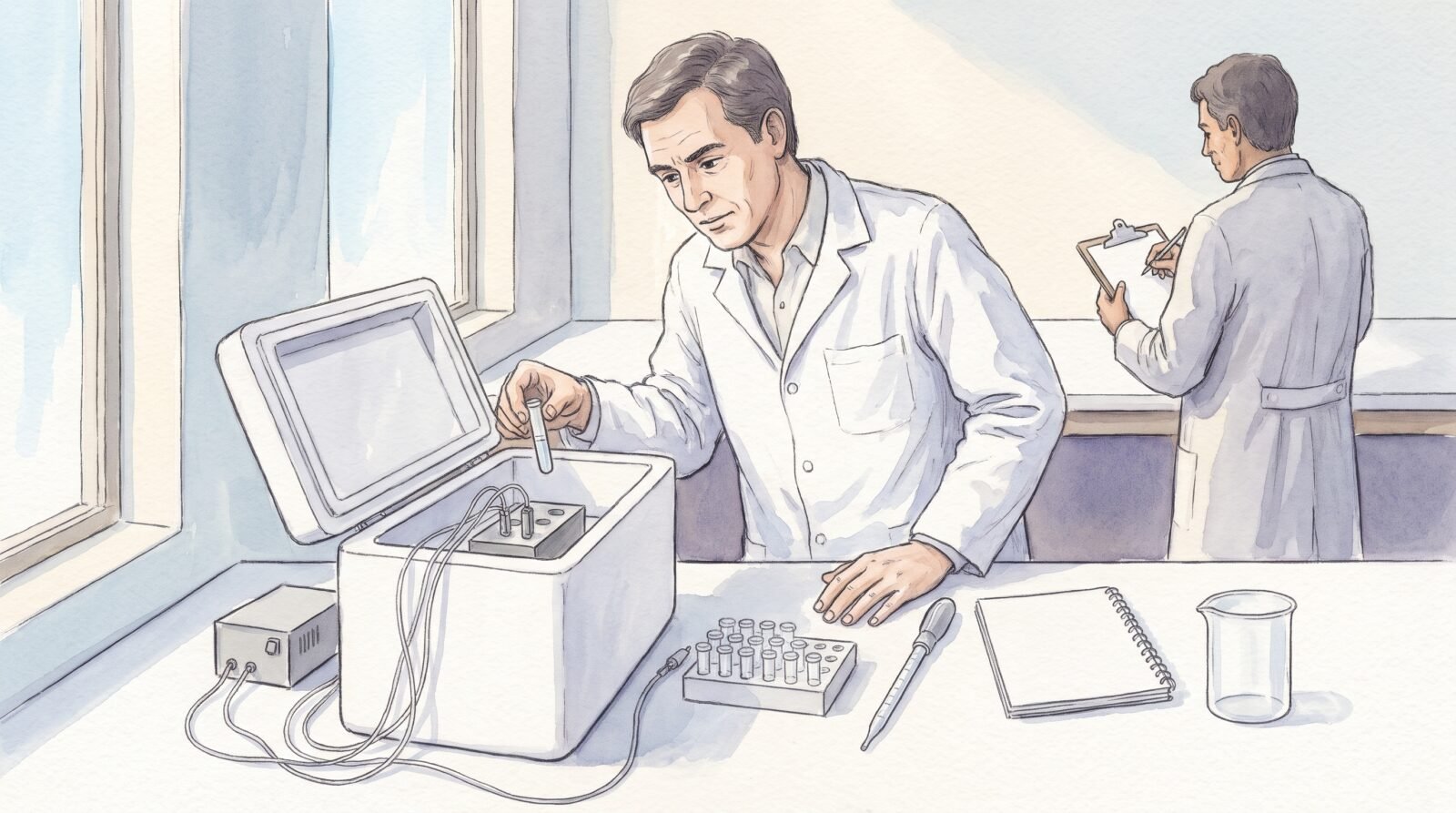
There is a footnote to the story of the machine, and it is a useful one, because it shows how ordinary the foundations were. Before Taq, the thermal cycler was often assembled by hand: a block of aluminium drilled to accept the tubes, a heat source, and a way to raise and lower the temperature. Popular accounts, including Mullis’s own memoir, describe an early apparatus built around a polystyrene cooler. Whether that particular rig was ever the one that ran the first cycles is impossible to check, but the point stands: the machine that would make PCR automatic was, for a while, a hobbyist’s construction. Almost everything about the method was available in 1983. The only genuinely missing ingredient was an enzyme from a hot spring, and that had been sitting in a culture collection for seven years.
Who Owns a Molecule
The method was published in December 1985 and the patent was granted in July 1987: two United States patents, 4,683,195 and 4,683,202, for a process of amplifying nucleic acid sequences, with later patents on the thermostable enzyme. Cetus, for its part, was busy assembling a business around it, and in 1990 the joint venture with Perkin-Elmer had twenty-six million dollars of equipment and reagent sales, and Cetus had licensed the technology to Hoffmann-La Roche for diagnostics. Cetus was, in other words, an early and successful biotechnology company, sitting on a piece of intellectual property that was worth more than everything else it had.
DuPont disagreed. In August 1989 it sued, attacking the core patents on the ground that the invention was obvious over earlier work – in particular a 1971 paper by Kleppe, Kielland, Botha, El-Greedy and Khorana showing that DNA polymerase could synthesise DNA using oligonucleotides as primers, which is close to the heart of the method and had been published in the Journal of Molecular Biology. Mullis had cited the earlier work in his own papers; the DuPont defence argued that what he had done was to notice that the reaction could be iterated. The United States Patent and Trade Office re-examined the patents and upheld them in August 1990. A jury returned for Cetus on 28 February 1991.
The litigation is a business history dressed as a patent case, and the most readable contemporaneous accounts are not court opinions but two short pieces of journalism by Marcia Barinaga in Science, published a fortnight apart in 1991: “Biotech Nightmare: Does Cetus Own PCR?” in February, and “And the winner: Cetus does own PCR” in March. The fear, which was widely shared, was that a successful challenge to the PCR patents would make the technique too expensive to use, and that a field of medicine – foetal screening, cancer diagnostics, the identification of inherited disease – would be held back by a handful of lawyers. The verdict settled the legal question and did not settle the social one.
What followed was not a royalty settlement but an outright purchase. In December 1991 Roche Molecular Systems bought Cetus’s PCR-related business for three hundred million dollars in an asset purchase. The litigation continued: the Taq patent was held invalid in 1999 after a jury found that Cetus had been grossly negligent in failing to test for contamination; and in 2004 a verdict found that MJ Research had infringed the thermal cycler patents and had done so wilfully. Roche’s ownership meant that the fee for using PCR was set by a single company, and that a great deal of money flowed to that company, and that a great deal of money did not flow to the laboratory scientists, the clinicians and the public health programmes who used the technique. The anthropologist Paul Rabinow spent years with the people in this story and wrote the book Making PCR: A Story of Biotechnology, which is less concerned with who owns the patent than with the strange social life that gathered around the technique itself.
And there is the other claim, which is personal rather than financial, and which has never been resolved. Mullis believed for the rest of his life that the invention was his alone, and that colleagues at Cetus – Randall Saiki, David Erlich, Tom White – had taken credit for work he had done, and he called them vultures in a retrospective interview published by California Magazine in 2019, the year he died. The Nobel Committee resolved the question by awarding the prize for PCR to Mullis alone, and the other half of the chemistry prize to Michael Smith for the oligonucleotide-based site-directed mutagenesis that made it possible to change a gene one letter at a time. That choice was itself contested, because the Nobel citation was worded as “for contributions to the development of methods within DNA-based chemistry”, a formulation broad enough to sit awkwardly over a dispute about who had actually invented what. Mullis accepted the prize and gave a Nobel lecture in which he told the story in his own terms, including the drive and the arithmetic and the hot words to Thor. The medal itself is the standard Nobel medal, with Alfred Nobel in profile on the obverse and Nature emerging from the clouds on the reverse; there is no DNA helix on it, whatever the commemorative merchandise may suggest.
The Machine That Became a Verdict
PCR did not matter, for most of the twenty years after 1985, because it was fast. It mattered because it changed what could be known. The clearest demonstration came from Alec Jeffreys at the University of Leicester, who on the morning of Monday 10 September 1984 noticed something on an X-ray of DNA that he had been trying to interpret for months: a pattern of inherited bands that varied from person to person and passed from parent to child like a barcode. His first papers appeared in Nature in June and July 1985, describing hypervariable “minisatellite” regions and individual-specific DNA “fingerprints”.
The method he used was not PCR – it was the older restriction-fragment technique – but the principle is the same and the effect on the law was immediate. In 1986 the police in Leicestershire asked Jeffreys to test a man who had confessed to the murder of a fourteen-year-old girl; the test excluded him, and it was the first time in Britain that DNA evidence was used to exonerate a suspect rather than convict one. A mass screening of roughly five thousand local men produced no match until two men turned out to have shared a flat: Colin Pitchfork, and Ian Kelly, who had supplied a blood sample on his friend’s behalf. Pitchfork was convicted in 1988 and is usually described as the first murderer caught by DNA, though the distinction depends on which criterion is used, since Robert Melias had been convicted in Britain in November 1987 with DNA as a critical element of the case.
PCR arrived in forensics later and in a quieter way, through the shift from minisatellite fingerprinting to the analysis of short tandem repeats, which could be run on the small, degraded samples that crime scenes actually yield. The modern forensic DNA profile is a PCR-based STR analysis. Its significance was as much in the courtroom as in the laboratory, and the statistics of it are still being argued over: the 2009 report of the National Research Council, Strengthening Forensic Science in the United States: A Path Forward, said that with the exception of nuclear DNA analysis no forensic method had been rigorously shown to have the capacity to connect evidence to a specific individual with a high degree of certainty, and the 2016 review by the President’s Council of Advisors on Science and Technology pressed the point about error rates with even greater force.
The other side of that coin is the exoneration rate. Kirk Bloodsworth was convicted in Maryland in March 1985 of the rape and murder of a nine-year-old girl and sentenced to death. Convicted on the testimony of a jailhouse informant who later recanted, he came within a year of execution. PCR testing in 1992 and 1993 excluded him; he was released on 28 June 1993, pardoned in December, and compensated three hundred thousand dollars in 1994, and the man who had actually done it pleaded guilty in 2004. Bloodsworth was the first death row prisoner exonerated by DNA, although Jimmy Ray Dotson and David Vasquez had both been exonerated in 1989, so which was “first” depends on whether one counts death row. The scale of the effect is now well documented: the Innocence Project and other organisations have arranged post-conviction DNA testing for hundreds of wrongly convicted people, and Brandon Garrett’s Convicting the Innocent, published in 2011 on the first two hundred and fifty of them, found that seventy-one per cent involved testimony from forensic scientists and that in sixty per cent of the transcripts he examined, the analysts had overstated what their evidence showed.
PCR’s second great application was in medicine, and it was there that the technique stopped being a laboratory convenience and became a public service. The 1993 Nobel announcement itself noted that PCR was being used, among other things, for discovering the human immunodeficiency virus. Commercial assays for quantifying HIV RNA in blood – viral load, which is what tells a clinician whether a treatment is working – were on the market from the late 1980s. In tuberculosis the effect was even more dramatic. The GeneXpert platform, launched in 2004 and running the Xpert MTB/RIF assay from 2009, could detect the bacterium and its resistance to rifampicin in under two hours, and the trial that established it reported 98.2 per cent sensitivity in smear-positive and 72.5 per cent in smear-negative pulmonary disease. For a disease that had killed millions every year, where laboratory confirmation meant weeks of culture on a slide the size of a thumbnail, this was a structural change in what medicine could do, and the World Health Organization endorsed it as the initial diagnostic test for suspected drug-resistant tuberculosis in December 2010.
Then came 2009. The H1N1 pandemic virus was first detected in the United States in April 2009 in two children in San Diego, and its genome turned out to be a quadruple reassortant: segments borrowed from North American avian influenza, from human seasonal influenza, and from two lineages of swine. Reassortment is precisely the phenomenon that PCR surveillance networks exist to catch, and the global system that was built after 2009 – sequencing influenza isolates from national influenza centres, running them against real-time assays, watching the sequences change – was a direct descendant of the capability that Cetus and Perkin-Elmer had commercialised in 1987. The machines that made it affordable had been invented by a man driving through the redwoods at one in the morning.
The Test That Ate the World
Then, on 31 December 2019, the World Health Organization’s China country office was told of a pneumonia of unknown cause in Wuhan. On 7 January 2020 the cause was announced as a novel coronavirus. On 10 January the viral genome was posted on virological.org, with four more deposited in the GISAID database on 12 January. By 20 January, 282 laboratory-confirmed cases had been notified to WHO, and confirmed cases had been reported in travellers from Wuhan in Thailand, Japan and Korea.
The diagnostic assay that would define the next two years was assembled in about a fortnight. A group led by Christian Drosten at the Charite in Berlin published the protocol on 23 January 2020 in Eurosurveillance, under the unassuming title “Detection of 2019 novel coronavirus by real-time RT-PCR”. It used two targets, with a third for confirmation; it used synthetic RNA, because no isolate and no patient specimen was yet available; it ran forty-five cycles; and it was checked against 297 clinical samples from five laboratories with no false positives. The first version went to WHO on 13 January. The acknowledgements thank the China CDC and a long list of Chinese virologists, including George Gao, and the paper notes explicitly the willingness of Chinese scientists to share genome information before formal publication. The first European case, in Bavaria, was confirmed in Berlin in January 2020, and the date most commonly given for that positive result is 13 January.
By March the world had closed. PCR became the gate, the queue, the paper certificate and the political argument, and almost nobody outside the laboratory had any idea what the method involved. The laboratory reality was a refinement of something quite small: a machine, a kit, a swab and forty-five cycles of heating and cooling, producing a fragment of viral RNA in sufficient quantity to be read by an instrument. The assay detects viral RNA. It does not detect infectious virus, it does not measure how ill a person is, and a positive result in an asymptomatic person means that viral genetic material was present in the sample.
That distinction became the central controversy of 2020 and 2021, and it is worth stating precisely, because the version that circulated was wrong in both directions. The substantive scientific objection is real: a high cycle threshold means few template molecules were present, and RNA can persist after a virus has stopped being viable, so a positive result at a high Ct is weak evidence of current infectiousness. The procedural climax came on 27 November 2020, when an international group of scientists led by Pieter Borger asked Eurosurveillance to retract the Corman paper, listing ten alleged methodological flaws including the forty-five-cycle threshold and the absence of a stated cut-off for calling a sample positive. The journal issued an editorial note, excluded two co-authors who sat on its board, and in February 2021 published a formal response concluding that five external experts had judged the article scientifically adequate for its purpose and that the criteria for retraction had not been fulfilled. The argument was not settled by decree; it was aired in public, which is how scientific disputes should be handled, and the underlying point about fragments and infectivity was never retracted either.
The World Health Organization’s interim guidance, updated on 8 January 2021, put the same distinction in its own cautious language, advising that the most robust evidence of viral infection came from the detection of fragments of the virus through virological testing and cautioning against the use of testing for mass screening of asymptomatic people. What the guidance did not say, and what the petition did not establish, is that the method was invalid. By the end of 2021, billions of PCR tests had been run worldwide. They had made some things possible that were impossible before – the sequencing of the virus from a single sample, the tracking of lineages, the first warning that an unfamiliar pattern was circulating in Wuhan – and they had also made it possible for a state to ask a person to prove something about their body in order to go to work.
The lab-leak question ran alongside all of this, and the dates matter. It was not in 2020 that the American press reported intelligence about the Wuhan Institute of Virology; it was in May 2021, when the Wall Street Journal reported that three researchers at the institute had sought hospital care in November 2019, a claim the Chinese foreign ministry called completely untrue. In June 2023 the Office of the Director of National Intelligence concluded that both a natural origin and a laboratory-associated origin remained plausible, while dismissing the claim about the three researchers as consistent with ordinary illness. Nothing in that assessment depended on PCR, but everything about it was argued with the instruments PCR had made possible.
There were other technical problems that never made the news and never stopped mattering. It is worth pausing on how little of this was in the original design. The first reaction ran with an enzyme that had to be topped up by hand, in a tube on a bench, on a motorway outside Berkeley, in the dark. Everything that followed – the thermostable enzyme, the machine, the real-time chemistry, the digital chambers, the CRISPR chemistries – was added by other people, in other decades, for their own reasons. The invention survived because it was useful enough to attract improvement, which is the most reliable definition of a good invention that there is, and because its flaws were of a kind that engineering can remove. A method that had needed a human being to add enzyme every cycle would still be a curiosity. A method that needed a human being to add enzyme every cycle, and then did not, became the most widely used technique in molecular biology and eventually in medicine. The distance between those two sentences is the whole story of the polymerase chain reaction, and it was crossed by a hot spring, a patent lawyer and a great deal of money. Because the reaction amplifies whatever is present, a stray molecule of product from a previous run can dominate a new one; laboratories therefore separate pre- and post-amplification areas strictly, move in one direction only, and run controls. The failure of Cetus to test for contamination became a matter of court record when the Taq patent was invalidated in 1999. And the measurement itself has been refined twice over, once in 1993 when real-time amplification with fluorescent probes made it possible to watch the reaction as it ran, introducing the cycle threshold into everyday laboratory language, and again in 1999 when the partitioning of samples into thousands of wells allowed molecules to be counted absolutely rather than estimated against a standard curve. A decade later, CRISPR gave the field a wholly different chemistry again, in which a protein that cuts DNA in response to a matching sequence releases a reporter that lights up the reaction – first in the SHERLOCK system, which combined the laboratories of Jennifer Doudna and Feng Zhang, and then in DETECTR, from Doudna’s group alone.
And in August 2019, in a care home in Los Angeles, Kary Mullis died at the age of seventy-four. He had spent his last years insisting that the invention had been his, and writing about the dark star hypothesis and about the possibility that the human genome said something about the universe. He had also publicly disputed the consensus on HIV and AIDS, which was a controversy outside the boundaries of the method. The chemistry prize had put three letters into the language permanently, and for a while the letters seemed to mean two different things. In a laboratory they meant a machine, a kit and forty-five cycles of heating and cooling. Everywhere else they meant a queue, a certificate, an argument about whether you were well enough to enter a building. Both meanings are real, and the distance between them is the distance that a biochemist drove through on a moonlit road in April 1983, thinking about nothing in particular.
References
- The Nobel Prize in Chemistry 1993 - Royal Swedish Academy of Sciences, NobelPrize.org, 13 October 1993
- The Polymerase Chain Reaction - Nobel Lecture by Kary B. Mullis, Nobel Foundation, 8 December 1993
- Kary Banks Mullis (1944-2019) - biographical, Nobel Foundation, 2019
- The unusual origin of the polymerase chain reaction - Kary B. Mullis, Scientific American 262(4), April 1990
- Enzymatic amplification of beta-globin genomic sequences and restriction site analysis for diagnosis of sickle-cell anemia - Saiki, Scharf, Faloona, Mullis, Horn, Erlich and Arnheim, Science 230, 20 December 1985
- Primer-directed enzymatic amplification of DNA with a thermostable DNA polymerase - Saiki, Gelfand, Stoffel, Scharf, Higuchi, Horn, Mullis and Erlich, Science 239, 29 January 1988
- Biotech Nightmare: Does Cetus Own PCR? - Marcia Barinaga, Science 251, 15 February 1991
- And the winner: Cetus does own PCR - Marcia Barinaga, Science 251, 8 March 1991
- The effects of business practices, licensing, and intellectual property on development and dissemination of the polymerase chain reaction - Fore, Wiechers and Cook-Deegan, Journal of Biomedical Discovery and Collaboration 1, 2006
- Board of Trustees of the Leland Stanford Junior University v. Roche Molecular Systems - Supreme Court of the United States, 563 U.S. 776, 2011
- The history of genetic fingerprinting - Alec Jeffreys and the University of Leicester, accessed 31 October 2026
- Alec Jeffreys - Wikipedia, Wikipedia, accessed 31 October 2026
- Kirk Bloodsworth - Innocence Project, case file, accessed 31 October 2026
- Strengthening Forensic Science in the United States: A Path Forward - National Research Council, National Academies Press, 2009
- Detection of 2019 novel coronavirus by real-time RT-PCR - Corman and others, Eurosurveillance 25(3), 23 January 2020
- Response to retraction request and allegations of misconduct and scientific flaws - Eurosurveillance editorial team, Eurosurveillance 26(5), 4 February 2021
- Diagnostic testing for SARS-CoV-2: interim guidance - World Health Organization, 8 January 2021
- Policy statement: automated real-time nucleic acid amplification technology for rapid and simultaneous detection of tuberculosis and rifampicin resistance, Xpert MTB/RIF system - World Health Organization, 2011
- Kinetic PCR Analysis: Real-time Monitoring of DNA Amplification Reactions - Higuchi, Fockler, Dollinger and Watson, Nature Biotechnology 11, September 1993
- Digital PCR - Vogelstein and Kinzler, PNAS 96, 3 August 1999
- Nucleic acid detection with CRISPR-Cas13a/C2c2 - Gootenberg and others, Science 356, 2017
- CRISPR-Cas12a target binding unleashes indiscriminate single-stranded DNase activity - Chen and others, Science 360, 2018
- The Nobel Prize medal for physics and chemistry - Nobel Foundation, accessed 31 October 2026
- Polymerase chain reaction - Wikipedia, Wikipedia, accessed 31 October 2026