Newton and the Crucial Experiment on Light
The Plague Year of 1665–1666 in Woolsthorpe Manor and the Darkened Chamber
In the late summer of 1665, the University of Cambridge closed its gates as bubonic plague swept southern England. The epidemic, which had devastated London throughout the sweltering summer months, was spreading northward into Cambridgeshire. Among the scholars dispersed to the countryside was twenty-two-year-old Isaac Newton, a Bachelor of Arts of Trinity College who had completed his undergraduate studies without public notice. Newton retreated to Woolsthorpe Manor, his family home in Lincolnshire, sixty miles north of Cambridge. There, free from collegiate obligations, Newton embarked upon his celebrated annus mirabilis—an extraordinary period of solitary creativity during which he laid the foundations for infinitesimal calculus, universal gravitation, and a revolutionary science of light.
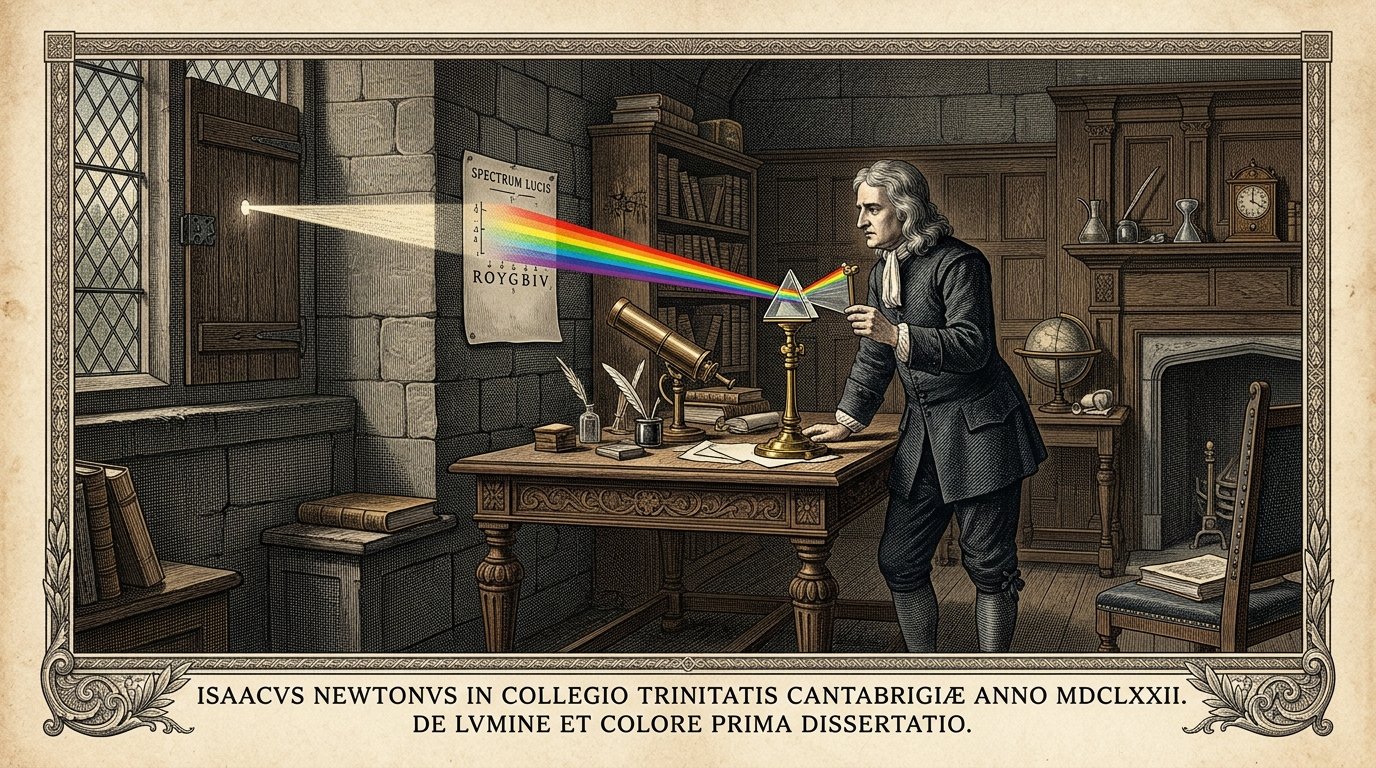
The domestic architecture of Woolsthorpe provided the theater for this optical transformation. In an upstairs bedchamber facing south, Newton undertook a sustained assault on received optical doctrines. To conduct his investigations with geometrical rigor, he converted the room into a camera obscura, sealing the casements with heavy wooden shutters to plunge the interior into darkness. Into one shutter, Newton bored a circular puncture, approximately one-third of an inch in diameter. Through this aperture, a slender pencil of sunlight entered, tracing a straight cylinder of light across the chamber before casting a circular spot of white light on the opposite wall. This humble puncture served as a threshold between ancient qualitative philosophy and modern experimental physics.
Newton had already broken with the classical curriculum of Cambridge. His student notebook, Quaestiones quaedam philosophicae, reveals a young scholar who had read Aristotle only to turn decisively toward modern mechanical philosophers such as René Descartes, Pierre Gassendi, and Robert Boyle. At the head of his notebook, Newton inscribed his personal motto: Amicus Plato amicus Aristoteles magis amica veritas (“Plato is my friend, Aristotle is my friend, but truth is a greater friend”). Rejecting scholastic disputes over formal qualities and occult virtues, Newton explored the concrete geometry of matter and motion, purchasing glass prisms at country fairs such as Stourbridge to study the refraction of light.
These investigations culminated in his first public scientific paper. In February 1672, Newton communicated his discoveries to the Royal Society, published in the Philosophical Transactions under the title “A Letter of Mr. Isaac Newton… containing his New Theory about Light and Colors.” At the heart of this treatise stood the experimentum crucis—the crucial experiment. By isolating individual spectral rays and measuring their refraction through a second prism, Newton delivered an empirical verdict that dismantled two thousand years of optical dogma.
Classical Theories of Optics: Aristotle, Descartes, and the Modification Hypothesis
To understand the revolutionary impact of Newton’s discovery, one must grasp the optical paradigm he challenged. From classical antiquity through the seventeenth century, natural philosophers held an unquestioned foundational premise: natural sunlight is primitive, uniform, and homogeneous. White light was the supreme archetype of purity and simplicity. Colors were regarded as secondary modifications, corruptions, or contaminations impressed upon pure light when interacting with material bodies, refracting surfaces, or shadows. This conceptual framework, known to historians as the Modification Hypothesis, governed optical thought from Aristotle to Robert Hooke.
In the Peripatetic tradition codified by Aristotle in De Anima, De Sensu, and the Meteorologica, light was the actualization of the transparent state (to diaphanes) in a medium. Color was an active quality at the surface of bodies that actualized the medium to affect the eye. Within this qualitative framework, colors arose from the mingling of light and darkness. Aristotle posited a linear scale bounded at one end by white (the absolute presence of light) and at the other by black (the total privation of light). Intermediate hues represented progressive degradations of light: red stood closest to white, followed by yellow, green, and blue, with violet bordering upon total obscurity.
Medieval scholars refined optical geometry without abandoning this qualitative doctrine. In the fourteenth century, Theodoric of Freiberg conducted experiments with water-filled glass spheres, explaining the primary and secondary rainbows through refractions and internal reflections within raindrops. Yet even Theodoric remained captive to the modification paradigm, asserting that refraction weakened the solar ray and that contact with surrounding darkness generated the observed colors.
In the seventeenth century, the mechanical philosophy translated the Modification Hypothesis into the language of matter and motion. In La Dioptrique and Les Météores (1637), René Descartes explained light as a mechanical pressure transmitted through a plenum of subtle spherical particles (“second element”). To account for color, Descartes attributed to these globules both translational motion and axial spin. Oblique refraction across a material boundary exerted differential friction, altering their rotational speed: accelerated spin produced red, while retarded or reversed spin produced blue.
In Micrographia (1665), Robert Hooke proposed a wave-pulse alternative. Light consisted of rapid vibrational pulses in an elastic aether. Oblique refraction skewed the pulse front into a trapezoidal shape: the leading edge struck the eye with a sharp impulse, generating red; the trailing, weakened edge generated blue. Despite their mechanical differences, Aristotle, Descartes, and Hooke shared the identical dogma: white light was primitive and homogeneous, and color was an accidental modification impressed from without.
The Initial Apparatus: The Circular Shutter Aperture, the Glass Prism, and the Oblong Spectrum
Newton’s experimental assault began with deceptively simple apparatus. In his rooms at Trinity College near the Great Gate, Newton darkened his chamber by securing the window shutters. In one shutter facing the sun, he pierced a circular hole approximately one-third of an inch (eight millimeters) in diameter. When the sun illuminated the casement, a cylindrical beam of direct sunlight entered the room, casting a circular white image of the Sun on the opposite wall.
Directly into the path of this solitary beam, close to the shutter puncture, Newton placed a triangular glass prism. Seventeenth-century glassmaking was an artisanal trade plagued by internal flaws, air bubbles, and thermal stresses that could distort light. Newton selected his prisms with painstaking care, examining their transparency, polishing their flat faces, and measuring their refracting angles to prevent optical artifacts from corrupting his results.
Under the established laws of geometrical optics, the outcome should have been straightforward. Willebrord Snell in 1621 and René Descartes in 1637 had formulated the sine law of refraction: for any two transparent media, the ratio of the sine of incidence to the sine of refraction is constant (&sin; i / &sin; r = n). Under the Modification Hypothesis, homogeneous white light possessed a single refractive index in glass. Because solar rays enter through a circular aperture in a cone diverging by the Sun’s angular diameter (roughly 31 arcminutes), the refracted beam at minimum deviation was expected to preserve a symmetrical circular cross-section, projecting a round or slightly elliptical spot on the wall.
What Newton observed upon the opposite wall, at a distance of twenty-two feet (6.7 meters) from the prism, was utterly confounding. Instead of a circular spot, he beheld a vivid oblong spectrum. The lateral borders of the image were straight, sharply demarcated, and parallel, while the top and bottom ends terminated in semicircles. The colors formed an incandescent sequence from red at the bottom, through orange, yellow, green, blue, and indigo, to intense violet at the top. The spectrum measured thirteen and one-quarter inches long, but only two and five-eighths inches wide—an aspect ratio of roughly five to one!
In his 1672 letter to the Royal Society, Newton described his bewilderment:
“It was at first a very pleasing divertisement, to view the vivid and intense colours produced thereby; but after a while applying my selfe to consider them more circumspectly, I became surprised to see them in an oblong form; which, according to the received laws of Refraction, I expected should have been circular.”
This fivefold elongation was a profound anomaly. If the sine law applied uniformly to homogeneous sunlight, such stretching along the plane of refraction was mathematically impossible. Newton recognized that either the received law of refraction was flawed, or the simplicity of white light was an illusion.
The Geometry of Anomalous Elongation: Why the Circular Beam Formed an Oval Image Five Times Long
The Trigonometrical Discrepancy
Newton subjected this physical anomaly to quantitative trigonometrical analysis. To determine why a circular beam formed an image five times longer than its width, he calculated the theoretical dimensions dictated by geometrical optics and compared them against his measurements.
The solar disc subtends an angular diameter in the sky of approximately thirty-one minutes and forty seconds of arc (31′ 40″, or roughly 0.528 degrees). Solar rays passing through a circular aperture form an expanding cone diverging at this angle. Over a throw distance of twenty-two feet (264 inches), this divergence produces a linear broadening given by: 264 × tan(31′ 40″) ≈ 2.43 inches. Adding the one-third-inch aperture diameter (0.33 inches) yields a total predicted image width of approximately 2.76 inches.
Newton’s measured horizontal width of the spectrum was 2.625 inches (two and five-eighths inches). The agreement along the horizontal axis was near-perfect, confirming that perpendicular to the plane of refraction, the beam behaved in strict accordance with the known geometry of the Sun and aperture. However, along the vertical axis—the plane of refraction—the image measured 13.25 inches. Subtracting the aperture width and calculating the vertical divergence across 264 inches revealed an angular spread of approximately two degrees and forty-nine minutes (2° 49′). The vertical divergence was more than five times greater than the Sun’s apparent diameter.
The Systematic Elimination of Mechanical Perturbations
To identify the cause of this discrepancy, Newton deployed the Baconian method of exclusions, systematically eliminating every conceivable extraneous perturbation:
Variation in glass thickness: Newton directed the beam through different regions of the prism—the thin apex, the middle, and the thick base. In every trial, the dimensions and color distribution of the spectrum remained completely identical, proving that thickness did not cause the elongation.
Prism surface curvature: To verify that the prism faces were optically flat rather than curved, Newton observed the sunlight reflected directly from the polished exterior faces. The reflected spot was crisp and perfectly circular, showing no trace of elongation. Flat surfaces in reflection could not act as curved lenses in refraction.
Aperture size and shape: Newton substituted apertures of various geometries—pinholes, broad circles, squares, triangles, and slits. While the sharpness of the terminal caps varied, the five-to-one elongation ratio along the axis of refraction persisted undiminished.
Curvature of rays in air: Newton tested whether rays might bend along curved trajectories in air, analogous to a spinning ball curving in flight (an allusion to Descartes’ rotating globules). Measuring the spectrum at intermediate distances across the room, Newton found that its dimensions expanded in strict linear proportion to distance. The rays traveled in straight Euclidean lines.
Having eliminated glass thickness, surface curvature, aperture geometry, and curved ray paths, Newton reached an inescapable conclusion: the elongation was an innate, original property of the light itself.
The Experimentum Crucis of 1672: The Two-Prism Arrangement and the Isolation of Monochromatic Rays
The Two-Board and Two-Prism Configuration
Having cleared the ground through the method of exclusions, Newton designed an experiment to resolve the central question of optics: does the prism physically modify and corrupt homogeneous light, or does it merely separate preexisting components of a composite beam? To decide between these competing hypotheses, Newton executed his celebrated experimentum crucis.
The term originated in Francis Bacon’s Novum Organum (1620) as instantia crucis—a crossroads signpost directing the traveler toward the true path while excluding the false. Robert Hooke applied the phrase in Micrographia (1665), but Newton established it as the archetype of modern empirical demonstration.
Newton’s apparatus was an engineering triumph of geometric control. At the window shutter, his first prism refracted the sunbeam into an elongated spectrum. Behind this prism stood a board with a small aperture (Aperture A). Twelve feet away stood a second board with an identical aperture (Aperture B), behind which sat a second identical glass prism and a receiving screen. Crucially, both boards, both apertures, the second prism, and the screen remained strictly stationary throughout the trial, fixing an immutable axis of incidence onto the second prism.
The Decisive Invariance of Differential Refraction
To test different regions of the spectrum, Newton mounted the first prism in a rotating cradle. Turning it about its longitudinal axis caused the elongated spectrum to sweep across the first board. By careful rotation, Newton positioned Aperture A over any desired color band, isolating a single monochromatic pencil.
Newton first rotated the prism until deep red light fell upon Aperture A. The red pencil traversed the twelve-foot gap, passed through Aperture B, and struck the second prism at a fixed angle of incidence, casting a mark upon the screen. Next, rotating the first prism without moving the rest of the apparatus, Newton directed violet light along the identical path, striking the second prism at the exact same angle of incidence.
Under the Modification Hypothesis, both rays should have refracted identically and split anew into colors. Instead, the second prism refracted violet light through a distinctly greater angle than red light, while neither ray altered its color: red remained red, and violet remained violet, each forming a sharp circular spot.
In his 1672 paper, Newton recorded the conclusion that followed from this demonstration:
“The true cause of the length of that Image was no other, then that Light consists of Rays differently refrangible, which, without any respect to a difference in their incidence, were, according to their degrees of refrangibility, transmitted towards divers parts of the wall.”
The experimentum crucis proved that the prism does not create colors by modifying light; it merely analyzes a composite beam into its preexisting, immutable components.
The Invariant Refrangibility of Pure Colors: Demonstrating That White Light is Heterogeneous
The theoretical structure that Newton erected upon the experimentum crucis was encapsulated in two revolutionary propositions: first, ordinary white sunlight is not a simple, homogeneous substance, but a heterogeneous mixture of rays endowed with different, innate refrangibilities; second, to each specific degree of refrangibility belongs an invariant, unchangeable color. Color is not an accidental modification stamped upon light by material bodies, but an original, intrinsic physical property inherent to each individual ray from the moment of its emission.
Newton established an exact correspondence between refrangibility and spectral hue. Red rays are the least refrangible of all solar rays; violet rays are the most refrangible; while orange, yellow, green, and blue occupy intermediate positions along this continuum. Newton designated these isolated spectral components “homogeneal” or “simple” light, contrasting them with the “heterogeneal” or “compound” nature of ordinary sunlight.
To demonstrate the immutability of simple rays, Newton subjected isolated colors to rigorous physical tests. He passed monochromatic red rays through additional prisms; they underwent further refraction according to their fixed refrangibility, but their color never shifted. He illuminated blue and green pigments with pure red light; the pigments appeared dull red or dark, reflecting only the incident red rays without altering their hue. He passed monochromatic rays through colored liquids, reflected them from metallic mirrors, and compressed them through microscopic apertures. In every trial, simple rays proved indestructible: neither reflection, refraction, absorption, nor transmission could alter their original color or refrangibility.
In seventeenth-century science, physical analysis required confirmation by synthesis. If white light was an aggregate of these diverse colored rays, it should be possible to reconstitute white light by recombining them. Newton achieved this through a celebrated synthetic experiment. Placing a large biconvex lens in the path of the dispersed spectrum, he focused the diverging colored rays back toward a common focal point. At the exact focal plane where all the dispersed rays intersected and overlapped, the individual colors vanished completely, replaced by a circular spot of pure, spotless white light. When an inverted prism was placed at this convergence point, the recombined white beam emerged with parallel boundaries, completely indistinguishable from raw sunlight.
To demonstrate that this synthetic whiteness required the entire spectrum, Newton inserted an opaque obstacle (such as a card or comb) to intercept only the red, green, or violet rays before convergence. The instant any single component was blocked, the white spot at the focal point dissolved into a colored hue. Whiteness required the simultaneous presence of all spectral colors in their natural proportions.
This completed an ontological inversion of classical philosophy. For two millennia, white had represented simplicity and purity, while darkness was privation and colors were corruptions. Newton inverted this metaphysics entirely: white light is not primitive simplicity, but the ultimate physical complexity—a heterogeneous plenitude containing all colors simultaneously. Darkness is the physical absence of radiant energy, and the perceived simplicity of sunlight is an illusion of human sensory perception.
The Mechanical Resistance of the Royal Society: Robert Hooke’s Wave Challenge and Christiaan Huygens’ Doubts
Hooke’s Wave Challenge and Pulse Modification
On February 6, 1671/72, Newton sent his optical paper to Henry Oldenburg, Secretary of the Royal Society. Two days later, Oldenburg read the manuscript before the assembled Fellows in London, and the Society ordered it published in the Philosophical Transactions. Yet despite praise for his experimental skill, Newton’s doctrine provoked immediate resistance from leading European natural philosophers.
The fiercest opposition came from Robert Hooke, the Society’s Curator of Experiments. Hooke regarded optics as his personal domain following his 1665 treatise Micrographia. Within a week, Hooke delivered a dismissive critique, arguing that Newton had merely demonstrated a variation of his own pulse theory. Hooke maintained that only two primary colors existed—red (an undisturbed pulse in the aether) and blue (a diluted, weakened pulse)—from which all other hues were generated. To Hooke, Newton’s hypothesis of an infinity of distinct, immutable rays seemed an extravagant complication that violated mechanical parsimony.
Huygens’ Doubts and the Jesuit Opposition
In Paris, Christiaan Huygens raised equally serious objections. Huygens, developing his wave theory of secondary wavelets (published in his 1690 Traité de la lumière), found an infinity of distinct rays mechanically implausible. In letters to Oldenburg, Huygens argued that the human eye perceives white when stimulated by yellow and blue alone, questioning whether nature truly required an infinite continuum of immutable rays rather than a simpler wave disturbance.
An even more exasperating challenge came from the English Jesuit College at Liège, led by Franciscus Linus and Anthony Lucas. Linus claimed that Newton’s oblong spectrum was a trivial error caused by clouds in the English sky, asserting that on a clear day the image would be circular. After Linus died, Lucas claimed that the spectrum was elongated far less than Newton reported, having used a prism with a different refracting angle and glass composition without replicating Newton’s geometry.
Epistemological Demarcation: Separating Laws from Hypotheses
These disputes caused Newton acute distress, as he recoiled from public criticism. In a celebrated 1676 letter to Oldenburg, Newton lamented his plight:
“I see I have made myself a slave to philosophy; but if I get free of Mr. Linus’s business, I will resolutely bid adieu to it eternally, excepting what I do for my private satisfaction, or leave to come out after me; for I see a man must either resolve to put out nothing new, or to become a slave to defend it.”
Yet this controversy forced Newton to articulate a foundational epistemological distinction. In his rebuttals, Newton drew a strict line between experimentally demonstrated mathematical properties (the invariant relation between color and refrangibility) and speculative physical hypotheses (corpuscles versus waves). He insisted that the heterogeneity of light was an empirical truth, independent of any mechanical model of light’s ultimate substance. This methodological discipline became the hallmark of modern physics, culminating in his famous dictum in the Principia: Hypotheses non fingo (“I frame no hypotheses”).
The Reflecting Telescope (1668): Bypassing Chromatic Aberration in Lenses Through Speculum Metal Mirrors
The Problem of Chromatic Aberration in Dioptric Lenses
Newton’s optical experiments were directly linked to practical instrumentation. Ever since Galileo turned his spyglass toward the heavens in 1609, astronomers had struggled against the severe optical limitations of refracting telescopes.
The foremost obstacle was chromatic aberration. Because glass refracts different colors by unequal amounts, a simple convex lens cannot focus all colors to a single point along the optical axis. Violet rays, being more refrangible, come to a focus closer to the lens than red rays (fviolet < fred). Consequently, celestial objects were surrounded by blurry, iridescent halos of purple and yellow light, washing out planetary details.
Astronomers attempted to mitigate this by building aerial telescopes with focal lengths of 50 to 150 feet. Constructed by Christiaan Huygens and Johannes Hevelius, these unwieldy instruments suspended lenses from towering wooden masts, swinging violently in the wind with tiny fields of view.
Newton’s prism trials revealed that chromatic aberration was intrinsic to refraction. However, Newton also drew a mistaken conclusion: assuming dispersive power was strictly proportional to refractive index across all media, he concluded that secondary lenses could never correct dispersion without canceling net refraction. This delayed achromatic refractors until Chester Moore Hall (1733) and John Dollond (1758) demonstrated differences in crown and flint glass.
Speculum Metal and the Newtonian Catoptric Architecture
Believing lenses to be a dead end, Newton turned to catoptrics. The law of reflection (θincident = θreflected) is strictly geometrical and completely achromatic: a concave mirror reflects all colors at the exact same physical angle, bringing them to an identical focal point with zero chromatic aberration. While James Gregory had proposed a reflecting telescope in Optica Promota (1663), contemporary artisans could not grind the required aspherical mirrors.
Newton undertook the metallurgy and construction himself in Cambridge. He formulated speculum metal, an alloy of six parts copper, two parts tin, and one part white arsenic, producing a hard, silver-white metal that took a brilliant polish without rapid tarnishing. Newton cast the mirror blank and ground the concave spherical surface by hand using pitch laps and tin oxide abrasive.
To view the image without obstructing incoming light, Newton mounted a small flat diagonal mirror at a forty-five-degree angle near the prime focus, directing the light out through a side aperture to a plano-convex eyepiece. This was the birth of the Newtonian reflector.
Completed in late 1668, Newton’s telescope was a miniature triumph: its tube was barely six inches long and its primary mirror measured only 1.3 inches across, yet it achieved a magnification of forty diameters, matching the clarity of a six-foot refracting telescope. Through it, Newton observed the Galilean satellites of Jupiter and the crescent phases of Venus. In late 1671, Newton sent a replica to the Royal Society, where it caused a sensation and led directly to his election as a Fellow in January 1672.
Opticks (1704) and the Queries: From the Experimentum Crucis to Corpuscles and the Aether
Axiomatic Structure and Corpuscular Rectilinearity
Although Newton completed the foundations of his optical theory by the mid-1670s, he maintained public silence on the subject for nearly three decades. Bruised by his controversies with Hooke and the Jesuits, Newton vowed never to publish a comprehensive treatise while Hooke lived. In 1704, one year after Hooke’s death and following his election to the Presidency of the Royal Society, Newton finally published Opticks: or, A Treatise of the Reflections, Refractions, Inflections and Colours of Light.
Unlike the Latin geometry of the Principia (1687), Opticks was composed in accessible English prose. Structured in Euclidean fashion—Definitions, Axioms, Propositions, and Proofs—it served as the eighteenth century’s manual of experimental physics, presenting an exhaustive demonstration of the heterogeneity of light, the physics of prisms, and the geometry of the rainbow.
The most enduring section was appended to Book Three: the famous Queries. Having excluded speculative hypotheses from his mathematical demonstrations, Newton used the Queries to propose bold conjectures about nature. The Queries expanded from sixteen questions in 1704 to thirty-one extensive essays in the 1717/1718 second edition.
In Queries 28 and 29, Newton argued against the wave theory of light. If light consisted of waves propagating through a fluid medium like sound or water, it would bend around obstacles into shadows (diffraction). Because light casts sharp shadows and travels in straight lines across cosmic distances, Newton concluded that light consists of discrete physical corpuscles. In Query 29, he asked:
“Are not the Rays of Light very small Bodies emitted from shining Substances? For such Bodies will pass through uniform Mediums in right Lines without bending into the Shadow, which is the Nature of the Rays of Light.”
Fits of Easy Transmission and Proto-Quantum Periodicity
Yet Newton also confronted phenomena that challenged simple corpuscular models. In Book Two, he analyzed the iridescent concentric rings formed when a convex lens is pressed against a flat glass plate—Newton’s rings. He discovered that the rings appeared at periodic intervals of air-film thickness corresponding to arithmetic progressions of the squares of ring diameters.
To explain this periodic interference without adopting wave theory, Newton introduced fits of easy transmission and easy reflection. He proposed that light corpuscles excite periodic vibrational waves in an ethereal medium that overtake the corpuscle, alternately assisting transmission or disposing it to reflect. In this hypothesis, Newton created an uncanny precursor to wave-particle duality: a corpuscle governed by an associated wave field, anticipating de Broglie pilot waves and quantum probability amplitudes.
In Query 31, Newton outlined a grand vision of the material cosmos, speculating on short-range attractive and repulsive forces between microscopic particles, predicting chemical affinity, cohesion, and the atomic constitution of matter. Through the Queries, the empirical rigor of the experimentum crucis expanded into a universal mechanical philosophy.
The Legacy in Modern Physics: Dispersion, Wave-Particle Duality, and the Foundations of Spectroscopy
From Cauchy’s Dispersion Formula to Fraunhofer Lines
The historical trajectory of Newton’s optical discoveries over three centuries illustrates the evolving dialectic of physical science. In the nineteenth century, optical theory underwent a transformation that seemed to repudiate Newton’s corpuscular ontology. Thomas Young demonstrated optical interference in his 1801 two-slit experiment, and Augustin-Jean Fresnel established a mathematical wave theory of diffraction and polarization in 1819. Light was recognized as an undulatory wave, and Newton’s particles were widely abandoned.
Yet the empirical truths established by Newton’s experimentum crucis remained unassailable. In 1836, Augustin-Louis Cauchy synthesized Newton’s refrangibility with wave optics, deriving Cauchy’s dispersion equation for refractive media:
n(λ) = A + B / λ2 + C / λ4 + …
Cauchy’s formula provided the exact mathematical link: Newton’s “degree of refrangibility” was simply refractive index n expressed as a function of optical wavelength λ. Red light, with a longer wavelength (λ ≈ 700 nm), undergoes less refraction; violet light, with a shorter wavelength (λ ≈ 400 nm), undergoes greater refraction.
Furthermore, Newton’s darkened chamber and shutter aperture were the direct mechanical ancestor of modern spectroscopy. In 1802, William Hyde Wollaston noted dark gaps in the solar spectrum, and in 1814, Joseph von Fraunhofer perfected the apparatus by replacing the circular aperture with a narrow slit and viewing the dispersed beam through a telescope. Fraunhofer mapped 574 dark absorption lines across the solar spectrum.
In 1859, Robert Bunsen and Gustav Kirchhoff established that each chemical element emits and absorbs light at characteristic spectral wavelengths. By analyzing spectral lines from celestial bodies, astronomers could determine the chemical composition of distant stars and galaxies. Newton’s prism had become the primary analytical tool of modern astrophysics, quantum chemistry, and cosmology.
The Quantum Synthesis and Methodological Paradigm
In the twentieth century, quantum mechanics completed the synthesis. Max Planck’s 1900 quantum hypothesis and Albert Einstein’s 1905 explanation of the photoelectric effect resurrected Newton’s corpuscular intuition in the concept of the photon. Light exhibits wave-particle duality: it propagates as an electromagnetic wave while exchanging energy in discrete quanta: E = hν = hc / λ. Newton’s proposition that color is an innate, immutable property of each ray was vindicated in the quantized energy levels of atomic physics.
Beyond specific conclusions, the experimentum crucis established the paradigm of modern physical methodology: designing an experiment that isolates a single parameter, eliminates competing hypotheses through geometric controls, and separates mathematical laws from ontological speculation. Three and a half centuries after Woolsthorpe Manor, Newton’s prism remains an enduring monument to human reason illuminating nature.
Scholarly References and Historical Source Editions
- A Letter of Mr. Isaac Newton, Professor of the Mathematicks in the University of Cambridge; containing his New Theory about Light and Colors — Isaac Newton, Philosophical Transactions of the Royal Society, Vol. 6, No. 80, February 19, 1671/72, pp. 3075–3087.
- Opticks: or, a Treatise of the Reflections, Refractions, Inflections and Colours of Light — Isaac Newton, London, Printed for Sam. Smith and Benj. Walford, 1704 (Fourth edition, corrected, London, William Innys, 1730; Dover Publications reprint, 1952).
- The Optical Papers of Isaac Newton: Volume 1, The Optical Lectures, 1670–1672 — Alan E. Shapiro (ed.), Cambridge University Press, 1984.
- Never at Rest: A Biography of Isaac Newton — Richard S. Westfall, Cambridge University Press, 1980.
- The Newtonians and the English Revolution, 1689–1720 — Margaret C. Jacob, Cornell University Press, 1976.
- Micrographia: or Some Physiological Descriptions of Minute Bodies Made by Magnifying Glasses — Robert Hooke, London, Printed by J. Martyn and J. Allestry for the Royal Society, 1665.
- Discours de la méthode pour bien conduire sa raison, et chercher la vérité dans les sciences; plus La Dioptrique, Les Météores et La Géométrie — René Descartes, Leiden, Jan Maire, 1637.
- Traité de la lumière — Christiaan Huygens, Leiden, Pierre van der Aa, 1690.
- The Correspondence of Isaac Newton, Volume I: 1661–1675 — H. W. Turnbull (ed.), Cambridge University Press, 1959.
- Newton’s ‘Crucial Experiment’ — J. A. Lohne, Notes and Records of the Royal Society of London, Vol. 23, No. 2, 1968, pp. 169–199.
- Glass Works: Newton’s Prisms and the Uses of Experiment — Simon Schaffer, Notes and Records of the Royal Society of London, Vol. 43, No. 1, 1989, pp. 67–104.
- Newton’s Theory of Color: Philosophy, Science, and Experiment — Alan E. Shapiro, Isis, Vol. 71, No. 2, 1980, pp. 211–235.
- Isaac Newton: Eighteenth-Century Perspectives — A. Rupert Hall, Oxford University Press, 1999.
- The Newtonian Revolution — I. Bernard Cohen, Cambridge University Press, 1980.
- Newton’s Principia and Its Predecessors — Michael Nauenberg, Physics Today, Vol. 47, No. 10, 1994, pp. 38–43.
- The Rise of the Wave Theory of Light: Optical Theory and Experiment in the Early Nineteenth Century — Jed Z. Buchwald, University of Chicago Press, 1989.
- Newton’s Optical Studies in the Cambridge Lectures — D. T. Whiteside, Isis, Vol. 61, No. 2, 1970, pp. 228–230.
- Theodoric of Freiberg: De Iride et Radialibus Impressionibus — Joseph Würschmidt (ed.), Beiträge zur Geschichte der Philosophie des Mittelalters, Band XII, Heft 5–6, Münster, 1914.
- Optica Promota, seu Abdita radiorum reflexorum & refractorum Mysteria, geometrice enucleata — James Gregory, London, J. Hayes, 1663.
- The Structure of Scientific Revolutions — Thomas S. Kuhn, University of Chicago Press, 1962 (Third edition, 1996).