Tyndall and the Greenhouse Effect
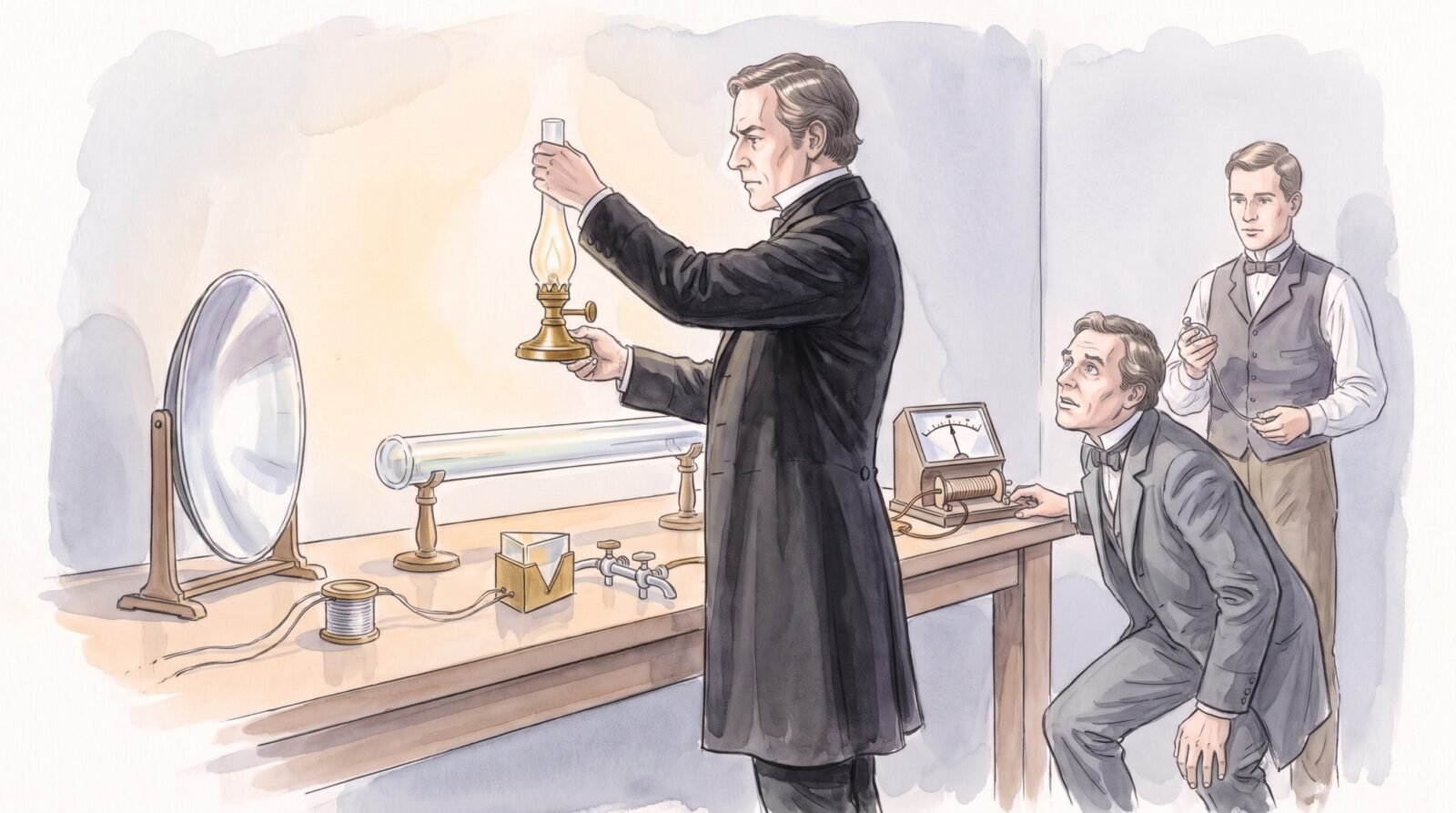
On 10 June 1859 a physicist stood in front of the Royal Institution in London and demonstrated that the air we breathe is warm enough to live in only because of a handful of impurities in it. John Tyndall had spent seven weeks that spring filling a brass tube with different gases and shining a lamp through them, and the numbers he had obtained were so unexpected that the instrument alone told the story: oxygen, nitrogen and hydrogen are effectively transparent to the infrared, while water vapour and carbon dioxide absorb it with an appetite that changes the temperature of a planet. The effect he had measured is what we now call the greenhouse effect. He had found it, he had measured it, and then, as so often happens with a discovery whose mechanism is not yet understood, the world largely forgot about him for the better part of a century.
The Question That Would Not Go Away
John Tyndall was born on 2 August 1820 at Leighlinbridge in County Carlow, in a part of Ireland that was then still under the same Crown as the rest of the country. He was a schoolmaster’s son, and his own schooling was interrupted by a move to England and back again, to a place near his father’s farm, where he taught school and studied chemistry and physics by his own device. He was largely self-made, and by the middle of the 1850s he was one of the most visible scientists in Britain. His early work was on diamagnetism, the strange property by which bismuth and other substances appear to repel a magnet, and it established his reputation in a way that led, in 1853, to the chair of physics at the Royal Institution, the institution Faraday had made famous and where Tyndall would work for the rest of his life. He became Fullerian Professor of Physics in 1867, and also held a professorship at the Royal School of Mines, where he taught working students rather than gentlemen, which was very much his own taste.
But the work that made him a celebrity was the glaciers. In the late 1850s Tyndall became absorbed in the Alps, and in 1859 he delivered a Royal Institution discourse on the glaciers of the Swiss Alps that was published as a book and made him, as his obituary in the Proceedings of the Royal Society put it, “one of the most popular scientific writers of the day”. He measured the way ice transmits light, how deeply sunlight penetrates a glacier, how the density of snow changes with altitude, how the melting front moves through a mass of ice in summer. It was superb science, and it was also, he discovered, a way into a much larger question.
The question was this. The surface of the sun is hot enough to melt anything that stood on it, and the light that arrives at the earth has spread out over a sphere enormously larger than the sun itself, so that the energy arriving on any square metre of the ground is enormously diluted. If the earth’s surface were simply in equilibrium with the sunlight falling on it, with nothing else intervening, it would be a frozen planet. Something is keeping it warm, and the obvious candidate had been on the table since the beginning of the century. The atmosphere itself, Tyndall reasoned, must be doing it. Sunlight arrives mostly in the visible part of the spectrum and passes through the air with little loss. The earth, warmed by that sunlight, radiates energy back outwards, mostly in the long infrared, where molecular absorption in the air is much stronger. The air therefore heats itself at the expense of the ground and radiates part of that heat back downwards. The atmosphere is a blanket, and the blanket has a chemistry.
That much was not Tyndall’s discovery. Joseph Fourier had set out the general argument in his Theorie analytique de la chaleur, first published in 1822 and reaching its definitive second edition in 1827, and he had treated the atmosphere as a diathermanous envelope whose behaviour had to be accounted for in any theory of the earth’s heat. Claude Pouillet had measured the sun’s constant and the fraction of sunlight actually reaching the ground, thereby showing how much the atmosphere absorbs. Horace Benedict de Saussure had built his whole science of hygrometry around the fact that the air’s content of water vapour governs how much heat the surface of the earth retains. Tyndall said as much himself. The researches on glaciers, he wrote in his Bakerian Lecture, directed his attention in a special manner to the observations and speculations of De Saussure, Fourier, Pouillet and Hopkins on the transmission of solar and terrestrial heat through the earth’s atmosphere, and gave practical effect to a desire he had previously entertained to make the mutual action of radiant heat and gases of all kinds the subject of an experimental inquiry.
What nobody had done was the experiment. The physical question was whether particular gases and vapours absorb radiant heat strongly enough to matter, and by how much. And the reason nobody had done it was an obvious one that took Tyndall some time to solve: the effect, if it was there, was very small, and the instruments of the 1850s were not sensitive enough to see it.
A Brass Tube, a Salt Plate and a Needle
The state of knowledge when Tyndall started was thin. There were, he noted, only two relevant experiments in the literature. Macedonio Melloni, with his admirable thermo-electric apparatus, had inferred that over a distance of eighteen or twenty feet the absorption of radiant heat by atmospheric air was “perfectly insensible”. And a Dr Franz of Berlin had found that air in a tube three feet long absorbed 3.54 per cent of the heat sent through it from an Argand lamp. Tyndall thought Franz’s result was due to “an inadvertence in his mode of observation”, and he was right: Franz used a blackened tube, and a blackened surface radiates as well as absorbs, which contaminates the measurement. Tyndall’s polished tubes gave roughly one tenth of Franz’s absorption. The correct answer was about a third of one per cent, and it had to be found with an instrument that could see it.
That instrument was a galvanometer, and getting one was the first of Tyndall’s difficulties. His instrument was constructed by Sauerwald of Berlin, a workman whose skill he praises at length. The needles were suspended independently of the shade, and the shade was built to enclose the smallest possible amount of air so that currents of air would not disturb them. A plane glass plate formed the cover of the instrument and sat close to the needle, so that its position could be read off with the naked eye or with a magnifying lens.
The trouble was not the mechanics but the wire. The coil’s copper had come from a galvano-plastic manufactory in the Prussian capital, but it was not free from magnetic metals. The consequence was that when the needles were perfectly astatic they still deviated as much as 30 degrees to the right and left of the neutral line. Tyndall neutralised this with a compensator, a small magnet that drew the needle gently back to zero in opposition to the magnetism of the coil. But the arrangement cost him almost all the instrument’s delicacy, and accurate quantitative measurement became impossible. He tried a better coil from Mr Becker, which reduced the lateral deflection from 30 degrees to 3 degrees. Even that residue was intolerable, and for a time, he said, he almost despaired of obtaining pure copper wire.
Then he had the idea that turned the whole project round. Pure copper is diamagnetic, which means that a magnet will repel it rather than attract it, and so a magnet is a perfect test of the fitness of the wire for the purpose. He tested every fragment he was given. The Berlin wire was strongly attracted; Becker’s wire, covered with its green silk, was attracted too, though much more feebly. He removed the green silk and tested the naked wire, which was repelled. The silk had been the culprit all along: some iron compound had been used in dyeing it. He had the green coating removed and the wire overspun with white silk, clean hands being used in the process. The result, in his own words, was that “a perfect galvanometer is the result”: the needle returns accurately to zero when released, and the coil exerts no magnetic action on it at all.
With the galvanometer solved, the rest of the apparatus followed from a second problem. How do you close a tube containing a gas so that the gas can be studied, without closing it with something that stops the radiation you are trying to measure? Melloni had already answered that: a glass plate one tenth of an inch in thickness intercepted all the rays emanating from a source at the temperature of boiling water, and fully 94 per cent of the rays from a source at 400 degrees Centigrade. A tube closed with glass plates would be scarcely more suitable than one stopped by plates of metal. Rock salt was the answer, but plates of the right size and transparency were exceedingly difficult to obtain, and Tyndall’s acknowledgements on this point read like a page of a donor’s list: he was indebted to the Trustees of the British Museum for the material of one good plate, to Mr Harlin for another, and to Mr Letsom, at the instance of Mr Darker, for a piece of salt from Germany from which two fair plates were taken. It is a reminder that nineteenth-century experiment was a social undertaking as much as a technical one.
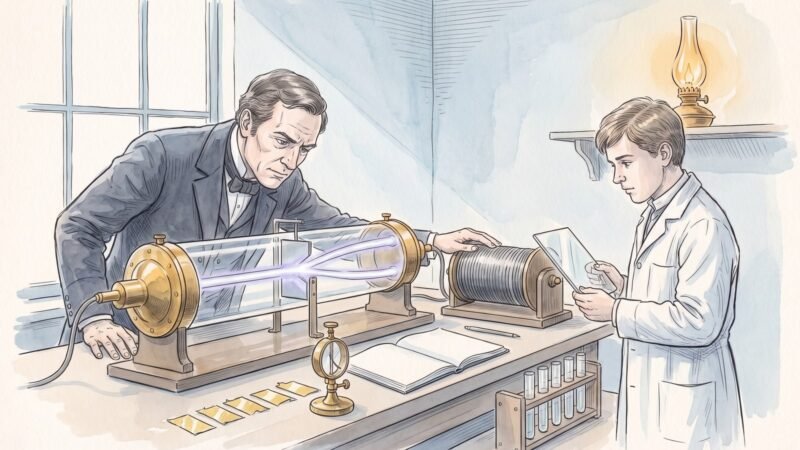
The tube itself was made of tin, polished inside, four feet long and two and a half inches in diameter, with brass appendages at the ends to receive the salt plates, each pressed against a flange by a bayonet joint and separated from it by a washer of vulcanised india-rubber. A T-piece attached to the side communicated on one side with a good air pump and on the other with the external air, or with a vessel containing the proper gas.
The measuring principle was the simplest possible one. A Leslie’s cube containing hot water was placed close to one end of the tube and an excellent thermo-electric pile, wired to the galvanometer, was presented to the other. With the tube exhausted, the rays from the cube fell on the pile and produced a permanent deflection of 300 on the galvanometer’s scale. Dry air was then admitted and the needle watched. Even with the aid of a magnifying lens, Tyndall could not detect the slightest change of position. Oxygen, hydrogen and nitrogen, subjected to the same test, gave the same negative result. He varied the intensity of the source across deflections from 10 to 70 degrees, and in no case did the admission of air produce any sensible change in the position of the needle.
Here Tyndall ran into a piece of bad luck that was really good luck. The galvanometer’s scale was not uniform: the quantity of heat necessary to move the needle from 60 degrees to 61 degrees was about twenty times that required to move it from 11 to 12. With a small deflection the needle was sensitive but the heat passing through the tube was negligible; with a large deflection there was plenty of heat but the needle was insensitive. He wanted a powerful flux of heat and maximum delicacy at the same time.
The answer was to make the galvanometer differential, with two wires wound side by side so that a current could be sent through either independently. The thermo-electric pile was placed at one end of the tube and one of the wires connected to it, while a copper ball heated to low redness was placed at the other end, driving the needle to its stops near 90 degrees. The ends of the second wire were then attached to a second pile, which was brought nearer to the copper ball until the current it excited passed through the coil in the direction opposite to the first. When the two currents were nearly equal the needle sat close to zero. Now there was a powerful flux of heat through the tube, and the needle was in the position best calculated to reveal any absorption of it.
And on the first attempt with this arrangement, the result came. The air used came direct from the laboratory, and the first impulsion of the needle was probably due to the aqueous vapour precipitated as a cloud by the sudden exhaustion of the tube. When, before admission, the air was passed over chloride of calcium, or over pumice-stone moistened with sulphuric acid, no such effect was observed. The needle moved steadily in one direction until its maximum deflection was attained, and this deflection showed that in all cases radiant heat was absorbed by the air within the tube. The air of the laboratory, in other words, was not transparent. Something in it was eating the infrared.
The next six weeks were consumed with the source of radiation, which Tyndall needed to be steady. He first used copper cubes containing fusible metal or oil raised to a high temperature and was not satisfied with them. He finally had a lamp constructed which poured a sheet of gas flame along a plate of copper, and to keep the flame constant a gas regulator specially constructed for him by Mr Hulett was used. With this apparatus he determined approximately the absorption of nine gases and twenty vapours during the summer of 1859. These experiments were commenced in the spring of 1859 and continued without intermission for seven weeks, the whole period being, in his own phrase, “an incessant struggle with experimental difficulties”, during which he worked from eight to ten hours daily.
Two Kinds of Air
The results were published in the Bakerian Lecture for 1861, read to the Royal Society on 7 February 1861, which Tyndall chose to title “On the Absorption and Radiation of Heat by Gases and Vapours, and on the Physical Connexion of Radiation, Absorption, and Conduction”. The printed lecture survives in the Royal Society’s own archive under the shelfmark PT/63/1, and a facsimile of the text is in wide circulation. The title is the story of his life in miniature: he wanted the laboratory result tied to a mechanism, and he would not have the mechanism until physics caught up with him decades later.
The first comparison Tyndall drew was between the atmosphere as it actually is and the atmosphere as it would be without its variable constituents. Air drawn in over the drying train, freed of its moisture and its carbonic acid, produced an absorption of about one degree on the galvanometer. Air taken direct from the laboratory, with all the carbonic acid and aqueous vapour that a Victorian laboratory contained, produced an absorption of fifteen degrees. The arithmetic that followed is the famous one. Deducting the effect of the gaseous acids, Tyndall found that the quantity of aqueous vapour diffused through the atmosphere on the day in question produced an absorption at least equal to thirteen times that of the atmosphere itself.
So the largest single component of the atmosphere, the nitrogen, which makes up more than three quarters of it, and the oxygen, which makes up most of the rest, are practically transparent to infrared radiation. The heat is held by the trace constituents: water vapour and carbon dioxide. Tyndall made the point with characteristic directness in the case of carbonic acid, measuring its absorption as about one hundred and fifty times that of oxygen in small quantities, and estimating that at atmospheric tensions it probably absorbs nearly one hundred times as much as oxygen. The contrast with olefiant gas, now known as ethylene, was even more dramatic: more than seven ninths of the total heat was cut off by the olefiant gas, or about 81 per cent. Ether vapour, he found, was more than twice the absorption of olefiant gas at the same tensions, and up to a hundred times that of bisulphide of carbon at maximum density.
One result is worth singling out because it is easy to misread. Tyndall summed the absorptions of the gases he had studied and concluded that the total absorption by the ordinary constituents of the atmosphere amounted to about one third of one per cent of the heat passing through a four-foot tube. That sounds negligible, and it is, and it is the point. The atmosphere is not a heavy blanket that blocks the sun. It is an almost perfectly transparent sheet through which a vanishing fraction of the radiation is caught. But the radiation it catches is the radiation the earth sends back, and the earth sends back at a particular wavelength, and the small and the large come together in a way that is easy to miss.
Two further results strengthened the argument. For small quantities of any gas, the absorption was exactly proportional to the density of the gas, which is what you would expect if the effect were due to the number of molecules in the beam. And the absorption was selective: ozone, for instance, absorbed three times as much as oxygen. The absorbing power of a gas depended not on how much of it there was but on its molecular structure, and that dependence on structure was precisely what would later turn out to be governed by quantum mechanics. Tyndall also noted the “physical connexion” promised in his title: the molecular constitution that made a gas absorb certain radiations also made it emit them, which is why a gas that absorbs the earth’s infrared is also a gas that radiates in the infrared and so returns heat to the ground.
The conclusion Tyndall drew was stated in his own memorable words. The atmospheric envelope acts very differently on the heat coming from the sun to the earth and on the heat radiated from the earth into space, and the differential action is “vastly augmented by the aqueous vapour of the atmosphere”. He put it more plainly in his Royal Institution discourse of 10 June 1859: solar heat crosses the atmosphere freely, but when the heat is absorbed by the planet it is so changed in quality that the rays emanating from the planet cannot get back into space with the same freedom.
So Tyndall had the answer, and the reason it did not change anything for forty years is instructive. He had measured an effect without a mechanism. He knew which gases absorbed and by how much, and he knew the consequence for the earth’s temperature. But he could not say why water vapour and carbon dioxide absorbed and nitrogen and oxygen did not, because the answer lay in the quantum theory of molecular vibration, which would not arrive until the 1920s. Without a mechanism there was no way to predict what would happen if the amount of carbon dioxide changed, which was exactly the question that mattered. Tyndall’s achievement was a measurement that waited eighty years for the physics that could use it.
A Confident Man with a Note of Caution
Tyndall was in no doubt about the significance of what he had found, and he went further than most of his contemporaries in drawing a conclusion about the past and future of the planet’s climate. If the absorption by the atmosphere depends on its variable constituents, then changes in climate need no appeal to changes in the density or height of the whole atmosphere. A slight change in the water vapour and carbon dioxide would suffice, and such changes, he wrote, may in fact have produced all the mutations of climate which the researches of geologists reveal.
But he tempered it, and his tempering deserves attention, because the temptation to read a modern conclusion backwards into a nineteenth-century result is one of the commonest errors in the history of science. Tyndall knew that he had measured absorption in a four-foot tube at laboratory pressure and laboratory temperature. He knew that the atmosphere was not four feet long. He knew that the quantities of water vapour in the real atmosphere vary enormously with latitude, altitude, season and weather, and he had no satisfactory theory of how the absorption in a long, wet, cold column of real air compares with the absorption in his laboratory tube. So he declined to attach a number to the effect, and he said so. The discovery was sound. Its magnitude remained, in his own formulation, doubtful.
That caution is the reason to read Tyndall as a scientist rather than as a prophet. He had wanted to make the mutual action of radiant heat and gases the subject of an experimental inquiry, and he had succeeded brilliantly at the first half of that. But the second half, the connection to the physics of molecules, eluded him for the rest of his career. In 1862 he was still working on the absorption and radiation of heat by gaseous matter, and in the 1870s he wrote of those nine years that heat and light were handled throughout by him, not as ends, but as instruments by the aid of which he sought to pierce the veil of the molecular world. He never fully lifted that veil, though he did get the chemistry of the laboratory right in a way that mattered: from his measurements of the absorption of radiant heat by gases he developed a method of estimating the carbon dioxide in a sample of exhaled human breath, and the basic principle of that method is in daily use in hospitals today for monitoring patients under anaesthesia.
Others were reaching the same territory at the same time. Eunice Foote, an American whose experiments on gases and sunlight were published in 1856, found that a cylinder of carbonic acid gas heated more in sunlight than a cylinder of ordinary air, and in 1857 she argued that the carbon dioxide then being produced by industry would raise the earth’s temperature. Her work was discussed by Tyndall and then largely forgotten for a century.
The most consequential of the successors was Svante Arrhenius. In 1896, working at the Stockholm University College and using infrared observations of the moon made by Frank Very and Samuel Langley at the Allegheny Observatory, Arrhenius applied physical chemistry to the question directly. He used the law named after Stefan and Boltzmann to work out how much infrared radiation is captured by carbon dioxide and water vapour in the atmosphere, and he derived a rule that is still quoted: if the quantity of carbonic acid increases in geometric progression, the augmentation of the temperature will increase nearly in arithmetic progression. His numerical conclusions were startling. He calculated that if the carbon dioxide in the air should sink to one half of its present percentage the temperature would fall by about four degrees, and that a diminution to one quarter would reduce it by eight degrees; conversely, any doubling of the carbon dioxide would raise the temperature of the earth’s surface by four degrees, and a fourfold increase by eight degrees. He also noted the ocean’s regulatory role in absorbing carbon dioxide, and observed that the slight percentage of carbonic acid in the atmosphere might, by the advances of industry, be changed to a noticeable degree in the course of a few centuries.
That Arrhenius was building directly on Tyndall is not in doubt. Fourier, Tyndall and Pouillet are the three names he names as his predecessors. The chain of reasoning that runs from a brass tube in the Royal Institution to a numerical projection of the temperature of the earth runs straight through the middle of the nineteenth century without a break.
The Long Road to the Modern Greenhouse Effect
It took another half century for the effect to become a working instrument of climate science rather than a curiosity, and the reason is again a matter of mechanism. To predict what doubling carbon dioxide would do, you need to know where in the spectrum the carbon dioxide absorbs, and how the water vapour already in the atmosphere interacts with it. None of that was available in 1896: the absorption spectrum of a gas was known only as a set of measured numbers, not as a consequence of molecular structure.
The physics arrived in the 1920s and 1930s, when quantum mechanics explained molecular vibration and rotation and so predicted, from the shape of a molecule, exactly which infrared frequencies it would absorb. Water vapour and carbon dioxide turned out to be strongly absorbing in the long-wave infrared, in the region where the earth itself radiates most of its heat, and to be comparatively transparent in the visible and near infrared where the sun’s beam lies. The Earth’s own outgoing radiation therefore passes through a window that these two gases can close, a band of wavelengths known as the atmospheric window. Once the band structure was understood, it became possible to say that a change in carbon dioxide mattered not for how much extra infrared it absorbed, but for how much of the currently escaping radiation it trapped on the way out.
The second half of the century did the work of assembling the picture. In 1941 E.O. Hulburt published an analysis of the role of water vapour and carbon dioxide in the temperature of the atmosphere, which established the central result that carbon dioxide alone changes little because the regions it can absorb are already saturated by water vapour, and that carbon dioxide matters chiefly through its effect on how much water vapour the atmosphere can hold. That is a statement about feedback, and feedback is the reason the modern numbers are larger than Arrhenius’s four degrees for a doubling.
In 1965 a report prepared for the United States Weather Bureau examined the meteorological effects of various atmospheric insulating properties, and set out the alternatives: a doubling of carbon dioxide with no feedback from water vapour and clouds, and a doubling with the feedbacks operating. In 1967 Syukuro Manabe and Richard Wetherald published the first calculation of the equilibrium temperature of the atmosphere with a given distribution of relative humidity, and used it to show the effect of increasing carbon dioxide on a model that included the water vapour and ice feedbacks. Their result was considerably larger than Arrhenius’s four degrees, because the feedback was in it. Five years later, in 1975, they published “The Effects of Doubling the CO2 Concentration on the Climate of a General Circulation Model”, which performed the same experiment in a three-dimensional model of the atmosphere, and which is among the most-cited papers in the history of the subject. Manabe shared the Nobel Prize in Physics in 2021 with Klaus Hasselmann, the citation being for the discovery of the physical foundation of climate change, which is precisely what that 1967 paper and the ones that followed it established.
What Tyndall had found in 1859 is now called the greenhouse effect, and the phrase is used loosely, but the underlying mechanism he identified has not changed. Sunlight arrives at the surface with very nearly its full energy content. The surface converts it to heat and radiates it back as longwave infrared. Water vapour and carbon dioxide absorb much of that outgoing radiation and re-emit it in all directions, including downwards. The surface must therefore run hotter than it otherwise would for the energy budget to balance. It is a warming of about thirty-three degrees that the greenhouse effect provides, and without it the mean surface temperature would be around minus eighteen degrees Celsius rather than the present figure near fifteen. The ozone layer contributes to the same effect, but only slightly, and it is a different story; there is a separate piece on this site about the hole in the ozone layer and what caused it.
It is a strange history. The mechanism was measured in 1859 and not explained until the 1930s. The climate consequence was calculated in 1896 and not modelled properly until 1967. The carbon dioxide concentration of the atmosphere was measured accurately only from 1958, when Charles Keeling began the record at Mauna Loa that continues without interruption and that NOAA’s Global Monitoring Laboratory still maintains. And for the whole of that time, the person who had done the decisive experiment was a Victorian populariser of glaciers and mountaineering, remembered above all for the spectacular and laborious use of lime light to demonstrate the presence of life in the air.
Tyndall died on 4 December 1893, aged seventy-three, at Haslemere in Surrey. The cause was an accidental overdose of chloral hydrate, which he had been taking for insomnia, administered by his wife. The story of his last moments has passed into the lore of Victorian science: when he realised what had happened, he said to her, “My darling, you have killed your John.” He is commemorated by a stone memorial on the slopes above Belalp at an elevation of 2340 metres, in sight of the glacier he studied. A long-delayed biography of his life, published in 2018, described him as a pioneering climate researcher and science advocate, and it is a phrase that does him justice. He was not an advocate of a cause. He was a man who put a lamp through a tube of air and would not let the world forget what he had found.
References
- I. The Bakerian Lecture. On the Absorption and Radiation of Heat by Gases and Vapours, and on the Physical Connexion of Radiation, Absorption, and Conduction - John Tyndall, Philosophical Transactions of the Royal Society, Vol. 151, 1861, pp. 1-36
- On the Absorption and Radiation of Heat by Gases and Vapours, and on the Physical Connexion of Radiation, Absorption, and Conduction - John Tyndall, full text of the 1861 Bakerian Lecture, California Institute of Technology archive
- On the Absorption and Radiation of Heat by Gases and Vapours - John Tyndall, archive record PT/63/1, Royal Society, London
- Theorie analytique de la chaleur - Joseph Fourier, first published 1822, second edition 1827, Pierre Didot, Paris
- On the Influence of Carbonic Acid in the Air upon the Temperature of the Ground - Svante Arrhenius, The London, Edinburgh, and Dublin Philosophical Magazine and Journal of Science, Vol. 41, No. 251, April 1896, pp. 237-276
- Contributions to Molecular Physics in the Domain of Radiant Heat - John Tyndall, collected scientific papers, Longmans, Green and Co., London
- The Glaciers of the Alps - John Tyndall, 1861 edition, Ticknor and Fields, Boston
- Obituary Notice of John Tyndall - Edward Frankland, Proceedings of the Royal Society of London, Vol. 55, 1894, pp. xviii-xxxiv
- A long-awaited biography does justice to John Tyndall, a pioneering climate researcher and science advocate - Sandra Dry, Science, Vol. 360, No. 6394, June 2018, p. 1307
- Thermal Equilibrium of the Atmosphere with a Given Distribution of Relative Humidity - Syukuro Manabe and Richard T. Wetherald, Journal of the Atmospheric Sciences, Vol. 24, No. 3, March 1967, pp. 241-259
- The Effects of Doubling the CO2 Concentration on the Climate of a General Circulation Model - Syukuro Manabe and Richard T. Wetherald, Journal of the Atmospheric Sciences, Vol. 32, No. 1, January 1975, pp. 3-15
- Syukuro Manabe: Facts - The Nobel Prize, The Royal Swedish Academy of Sciences
- Trends in Atmospheric Carbon Dioxide - NOAA Global Monitoring Laboratory
- John Tyndall - Wikipedia, biography and bibliography
- Greenhouse effect - Wikipedia, historical summary of the discovery of infrared absorption by gases
- Eunice Foote - Wikipedia, the 1856 and 1857 experiments on gases and solar heating
- Atmospheric window - Wikipedia, the wavelength band through which the earth radiates directly to space