Rutherford and the Nuclear Atom
In the spring of 1909 a New Zealand student named Ernest Marsden was sent to Manchester University to find out why alpha particles, fired at a sheet of gold foil, sometimes came flying back the way they had come. The answer he and Hans Geiger found was that the atom is not the soft, uniform pudding with electrons floating in it that J.J. Thomson had supposed, but something very much harder and stranger: a tiny, dense, positively charged core with the electrons in orbit around it. Rutherford called it the nuclear atom. Very nearly every piece of chemistry, metallurgy and geology written since has been built on top of that picture. This is the story of how the experiment was made, what it actually showed, and what the man who read it made of it.
The Cavendish and the Man Who Came Back
Ernest Rutherford was born on 30 August 1871 at Brightwater, a small station on the South Island of New Zealand where his father ran a flour mill. He was the fourth of twelve children, one of whom died at birth and four of whom died young. He won a scholarship to Canterbury College, Christchurch, and in 1892 he arrived in Cambridge as a research student at the Cavendish Laboratory, then under the direction of Joseph John Thomson. He was not a distinguished undergraduate. He failed his Tripos in 1893 and was placed in a class that the examiners were said to have wanted to suppress. What he was, in every other sense, was relentless: the Cavendish became, in his hands, a machine for making instruments and then using them to break open the behaviour of the natural world.
What he found there in 1897 was that the so-called cathode rays, streaming from the negative electrode of a sealed tube, were not a form of light at all but streams of particles carrying negative charge and mass. Thomson established that these particles were far smaller than the atom, and it was Rutherford who worked out that they were much lighter than the hydrogen atom and therefore a universal building block of matter. That work has its own place in this journal’s history. But the young Rutherford was really pursuing a second question, about the radiation thrown off by uranium, which he took up with Frederick Soddy in 1898.
Soddy, who was to win a Nobel Prize of his own in 1921, noticed that the radioactivity of a given sample did not fade away smoothly but declined in steps, as if the heavy atoms were breaking into other heavy atoms. Rutherford supplied the interpretation. Radioactive substances were not emitting energy; they were transmuting. One heavy element was turning into another, and the rate of the process was a fixed property of the particular substance, independent of how much of it there was and of its chemical form. Uranium, thorium and their compounds, he and Soddy showed, belonged to two distinct families with their own characteristic half-lives, and each family was a chain in which one member turned into the next. It is an extraordinary idea to arrive at by experiment rather than by speculation, and it split physics in two. The Nobel Prize in Chemistry went to Rutherford in 1908 for his work on the disintegration of the elements, and he shared the 1908 Nobel lecture with no one, in a field that had not existed five years earlier.
By then he had moved. Rutherford had gone to McGill University in Montreal in 1898, and in 1901 became the first holder of a chair of physics there. Working with the ionising effects of different types of radiation, he separated what came out of uranium into two kinds and named them, in 1899, for the first letter of the Greek alphabet. Alpha rays were the ones that were stopped by a sheet of paper and were bent by an electric field toward the positive plate. Beta rays passed through paper, were bent the other way, and were soon understood to be electrons moving at great speed. A third kind, gamma rays, was neutral, penetrating and, as it turned out later, not a particle at all but a photon.
The alpha particle was the instrument that made everything else possible, and Rutherford spent years establishing what it was. He showed that it was a helium atom with the electrons stripped off, so that it was a bare nucleus of helium with a net charge of twice the electron charge. In 1908 he and Hans Geiger, who had come to Manchester as a research student the previous year, measured that charge directly and found it to be about 3.2 x 10^-19 coulombs. In the same period they devised the first particle counter, a tube with a wire running down its centre and a fine wire gauze around it. When an ionising particle passed through, a current was briefly carried, and the counter could be made to click. Alpha particles, previously counted by eye over a zinc sulphide screen, could now be counted by ear, and rates of thousands a second became measurable.
Rutherford was by then at Manchester, where he had gone in 1907 to take charge of a laboratory with a formidable reputation for physics and a rather strained relationship with his old Cavendish master. The Cavendish chair had gone to J.J. Thomson, and Rutherford, who had hoped for it, took instead the chair of physics at Manchester, where the work of his group over the next few years would be the most consequential in the history of the laboratory. He would return to Cambridge in 1919, as Cavendish Professor, and would run the place for eighteen years, until his death in 1937. In those years the laboratory would fire the first artificial splitting of an atom, under Cockcroft and Walton in 1932, and would see Chadwick’s identification of the neutron, also in 1932. But the work that made the nuclear atom was done in Manchester, and the crucial instrument for it was the counter that Geiger had invented for counting alpha particles one at a time.
A Counter, a Foil and a Screen
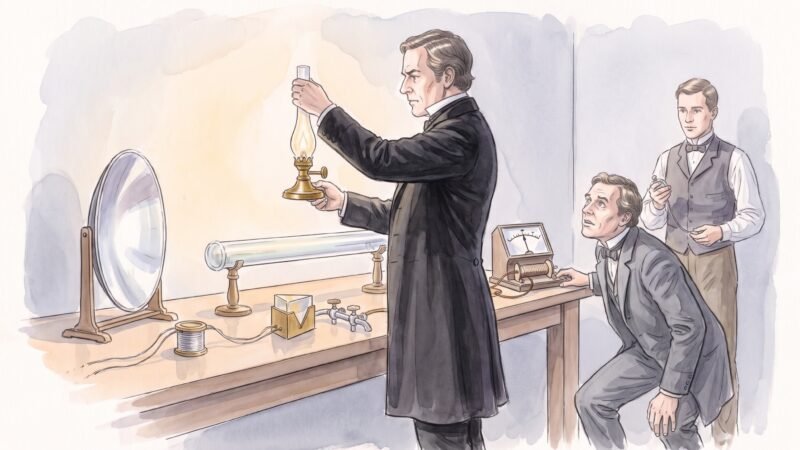
Ernest Marsden arrived at Manchester in 1909 as an undergraduate from New Zealand, hoping to do a PhD under Rutherford. Rutherford assigned him to work with Geiger, and gave them what seemed a simple problem. Alpha particles from a radioactive source were made to strike a thin sheet of gold foil. Most went straight through. Some were deflected a little. Geiger and Marsden were to find out exactly what happened to the rest, and in particular how many came back.
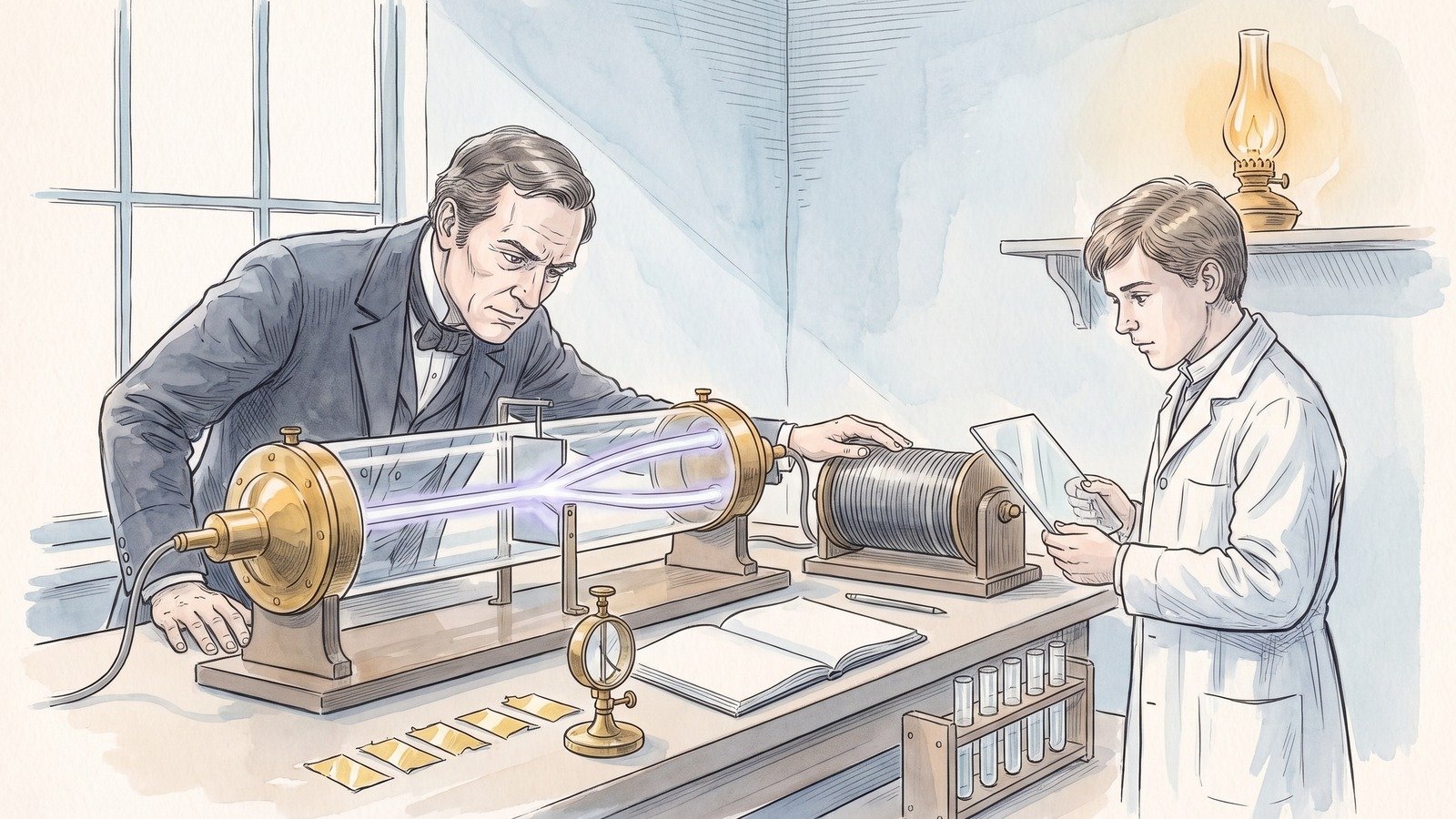
The apparatus was elementary and the method was ingenious. The source was a radon or thorium emanation in a small tube, and the alpha particles were stopped by a thin sheet of mica with a silver deposit on it, so that they fell on a small zinc sulphide screen in a vacuum chamber. Each alpha particle landing produced a tiny flash. The screen was viewed through a microscope, and the flashes were counted by eye. The counting was the slow part. To get a usable statistic the experimenters had to count thousands of flashes, and for every one of them they also had to note the position of the impact relative to a set of reference marks, so that the angle of deflection could be worked out afterwards.
Their first finding was that the scattering was in every direction. Rutherford had expected a beam, more or less, and a modest spreading. What they saw was a diffuse reflection, with particles scattered through large angles and some thrown right back. Geiger and Marsden found that for gold foil, of some thousands of particles counted, only a handful were turned through more than ninety degrees, and only a very few more were turned back towards the source. Their 1909 paper in the Proceedings of the Royal Society, “On a Diffuse Reflection of the alpha-Particles”, reported the result and left the interpretation to Rutherford.
Rutherford was not slow to interpret it, and what he produced was a paper so different from anything before it that its title alone announced the change: “The Scattering of alpha and beta Particles by Matter and the Structure of the Atom”, published in the Philosophical Magazine in April 1911.
He began by discarding the model he had been taught. Thomson’s atom was a sphere of positive electricity with the electrons embedded in it, a pudding with the electrons stuck in the pudding. Rutherford’s first objection was quantitative. If positive charge and mass were spread evenly through the atom, then the large-angle deflections that Geiger and Marsden had measured simply could not happen. A particle moving at about a twentieth of the speed of light carries enormous momentum, and a diffuse spread of positive charge cannot reverse it. The observed data demanded something compact and something heavy.
His second step was to take the scattering at face value and work backwards from the number of large-angle events to what the atom must look like. He supposed that the positive charge and nearly all the mass of the atom were concentrated in a single point. An alpha particle passing at some distance from that point would be pushed aside by the Coulomb repulsion; work out the impulse, compare it with the momentum of the alpha particle, and you have the angle through which it is turned. Turn the argument around and, given an observed angle, you can calculate how close the particle came to the centre, and the closer it came, the more tightly the charge had to be concentrated.
The formula that falls out is short and memorable: the cotangent of half the deflection angle is proportional to the impact parameter. Or, put the other way, the closest approach for a particle scattered through an angle is proportional to the square of the cotangent of half that angle. From the rare events that were thrown right back, Rutherford could read off the closest approach that had ever been achieved, and with it the size of the nucleus.
Here the arithmetic has to be handled with care, and it is worth saying plainly that Rutherford got the order of magnitude right and the precise value wrong. He had to assume a central charge for gold of the order of a hundred times the charge on the electron, where the true figure is seventy-nine times, because the evidence available in 1911 did not support anything better. Even on that over-estimate, the closest approach implied a radius of the central body smaller than about 3.4 x 10^-14 metres. The atom as a whole is about 10^-10 metres across. Rutherford was saying that the entire mass and positive charge of an atom of gold were squeezed into a sphere something like thirty thousand times smaller than the atom itself. The true nuclear radius for gold is nearer 7 x 10^-15 metres, so his figure was several times too large, but he had found the right scale and the right shape of the answer, and nothing since has overturned the shape of it.
The comparison Rutherford used is the one that has stayed in the textbooks: it was as if you fired a large naval shell at a piece of tissue paper and it came flying back at you. The account is generally credited to Rutherford and is reported from those who were there. The point is not a metaphor. The gold foil was, to the alpha particle, almost empty space, with only occasional atoms presenting a small, dense, strongly repelling core. The vast majority of particles met nothing at all and passed through undisturbed, which is why the foil was so nearly transparent to them. The small fraction that came back had met a core head-on and been thrown off by it.
It is worth pausing on the zinc sulphide screen, because it was itself a piece of Rutherford’s own invention and without it the whole experiment would have been impossible. Rutherford and Frederick Soddy, with John Crowther, had developed the radium screen at Montreal in 1903: a disc of zinc sulphide, which glows with a sharp flash when a single alpha particle strikes it. Before that, the standard method of detecting an alpha particle was a photographic plate, and the plate could tell you that particles had arrived but not how many, or from which direction, or at what angle. The screen turned a spray of particles into a countable, directional event. Its virtue was that the flash was brief and localised, so that a microscope trained on a marked screen could pick out individual impacts against the general glow. Geiger and Marsden were not measuring a weak average signal. They were counting individual alpha particles, one at a time, and writing down where each one landed.
Geiger and Marsden checked the model over the following years with a series of experiments on different metals, and found that the relative scattering powers went up sharply with atomic weight in the way the Coulomb law required. The prediction was quantitative and it held. That is the reason the nuclear atom survived: it made a number of falsifiable predictions, and they were confirmed.
One of the two men who did the experiment did not live to see its full vindication. Marsden left Manchester for Cambridge in 1913 to work with Rutherford again, and later returned to New Zealand, where he became the second Director of the Department of Scientific and Industrial Research and was made a life peer. He was a devoted and modest man, and the Marsden Medal of the Institute of Physics is named for him. Geiger went on to build the counter that bears his name and, in the improved form worked out with Walther Muller in 1928, the Geiger-Muller tube that made the nuclear age detectable. Rutherford liked Geiger, who had left Manchester after a disagreement over a co-authorship, and the two were colleagues again in the 1920s, Geiger visiting Rutherford’s Cavendish laboratory regularly. Rutherford wrote that Geiger had left a gap in Manchester that could never be filled.
The Model of 1911
Rutherford’s 1911 paper is a short paper, running to about twenty pages, and it is worth remembering that it was written in a hurry by a man with a heavy teaching load and a full laboratory of students. It contains no graphs of the kind that later made his reputation. Its argument is carried by a handful of equations and one very large assumption, and it made almost no attempt to justify itself in the ordinary way. It worked because it was right.
The model it proposed was this. The atom has a central body, small and positively charged, containing nearly all the mass. Around it, at a distance of about 10^-10 metres, the electrons move. Rutherford did not specify how they moved, and he was careful not to. The paper is, in this respect, almost silent, and the silence turned out to be its greatest strength, because it left the orbital problem to someone else. Within two years that someone was Niels Bohr.
The derivation of the scattering law that carries Rutherford’s name is the technical heart of the paper. In the differential scattering cross-section, the chance of a particle being scattered into a small patch of solid angle is proportional to the inverse fourth power of the sine of half the scattering angle. That law carries its name into every laboratory that does atomic or nuclear physics today. Rutherford also noted, in a passage added while the paper was in proof, that the same law follows for the scattering of electrons as for alpha particles, since the force is the inverse square in both cases; the nucleus is an arrangement of matter that has the same effect on an electron as it does on an alpha particle, which is why Rutherford could treat beta particles in the same paper as alpha ones and get the same answer.
What the model did not do was explain why the electrons in orbit did not radiate. Classical electrodynamics says that a charge in circular motion radiates, and does so at a rate that would destroy any atom in a fraction of a billionth of a second. Rutherford knew this perfectly well. He put it to one side with a sentence, effectively conceding the problem to future physics, and that sentence is one of the most famous in the history of science: he wrote that the new model was, in the case of the atom, “a very small, positively charged body” and that the electrons, “in order to satisfy the laws of electrodynamics,” would have to be treated in a way that the old physics could not yet provide.
The other thing the model did not do was say what the nucleus was made of. That was less a gap than a recognition that there was nothing to put inside it yet. Rutherford had established that the nucleus carried the mass and the positive charge, but whether it was one particle or many, and what those particles were, remained open. It was Moseley’s work on X-ray spectra in 1913-1914 that established the nuclear charge as the atomic number, and Chadwick’s discovery of the neutron in 1932 that established that the nucleus is made of protons and neutrons in roughly equal numbers, with the mass concentrated in the neutrons.
Rutherford did return to the question of size, because the size mattered for the chemistry he was trying to explain. In a paper of 1914 he tightened the estimate using the observed energies of alpha particles and beta particles, and concluded that the radius of the nucleus of gold was not greater than 3 x 10^-12 centimetres. That is 3 x 10^-14 metres, the same order as the 1911 figure. This is the number that became canonical, and it was quite good: a gold nucleus has a radius of about 7 x 10^-15 metres, so Rutherford was within a factor of four or five.
It is worth being clear about how this was achieved, because the elegance of it is often lost. Rutherford did not have a model of the nucleus. He had a model of the atom as a whole, with an unknown central charge and an unknown central mass, and the observed angular distribution of scattered alpha particles. From that distribution he extracted the closest approach that had occurred in the experiments, and from the closest approach he got the product of the charge and the size. He then used the fact that the alpha particle is itself a helium nucleus, so that its own closest approach in an alpha-alpha encounter could be compared with the alpha-gold encounter, and that comparison separated the charge from the size. The alpha particle had carried its charge on the outside, where the scattering could see it; the gold nucleus had it inside, where the geometry also hid it. The two experiments together gave a number for the nuclear charge, and the number that came out was of the right order for gold.
The immediate consequence was a new model of chemistry. If the number of protons in the nucleus fixes the element, and the number of electrons around it fixes the charge, then the entire periodic table becomes a set of consequences rather than a set of coincidences. Atoms of the same element differ only in the arrangement of a few outer electrons, which is why they behave alike chemically. The nuclear atom converted the periodic table from an empirical curiosity into a structure with a mechanism. It is difficult to overstate how strange this was to the physicists of 1911, who had been thinking of elements as substances with quite different internal characters rather than as variations on a single theme.
It also explained radioactivity, and in a way that was immediately actionable. If the atom’s instability lives in the nucleus, then the alpha particle is a piece of nucleus flying off, and the radiation that follows is the nucleus rearranging itself. Every heavy element is a nuclear reactor running out of fuel, at its own rate, and no amount of chemical trickery will stop it, because the chemistry has nothing to do with it. The practical test came in 1919, when Rutherford’s group at Manchester fired protons from their new accelerator at nitrogen and found that they were converting one element into another. Rutherford announced it with some relish: the transmutation of the elements, which alchemists had sought for a thousand years, had been achieved in a laboratory, and it was done by knocking atoms with other atoms rather than by any alchemical means. The proton was the tool because the nucleus had turned out to be full of charge, and a charged projectile could be aimed at it.
Bohr Builds an Atom on a Nucleus
Rutherford’s paper left the electrons without a job. They had to be in the atom, because the atom was neutral, and they had to be held near the nucleus, but nothing in the model said why they stayed there or what they did. Rutherford’s own instinct was that this was not a problem for a nuclear physicist. He was, as he put it, not interested in the arrangement of the electrons; the arrangement, as he wrote to Bohr, “ought to be settled by Bohr” and could be left to the theoretical people.
Niels Bohr, who had spent a year in Rutherford’s laboratory at Manchester in 1912 and had come away convinced that Rutherford was wrong to dismiss it, took it as his central problem. His solution, published in three papers in the Philosophical Magazine in 1913, is among the most audacious pieces of reasoning in physics. Bohr kept Rutherford’s nucleus and did three things with the electron. He assumed, against all classical precedent, that the electron’s angular momentum was quantised: it could take only certain allowed values, whole multiples of a fixed constant h divided by 2 pi. He assumed that in each of these stationary states the atom radiated nothing at all. And he assumed that light was emitted or absorbed only when the electron jumped between two such states, carrying an energy equal to the difference between them, with the frequency fixed by Planck’s relation between a photon’s energy and its frequency.
What this bought was the hydrogen spectrum. The Balmer formula, the Rydberg constant, the whole ladder of lines in the visible spectrum of hydrogen, had been known as a pattern for decades and had no explanation. Bohr derived it. The Rydberg constant comes out of the model with the right value, and comes out for the right reason, because it is built from the electron mass, the electron charge, Planck’s constant and the speed of light. And the hydrogen atom acquires an ionisation energy and a spectrum of lines that agree with experiment to a precision that had no precedent in the subject. The Bohr atom and the Rutherford nucleus together form the picture that ran physics for a generation, and the image most people still carry of an atom, a set of shells of electrons around a tiny dense centre, is exactly this one.
Bohr took the greatest risk of all, and it was the risk that made the model work. The nuclear charge for hydrogen had to be exactly the charge on the electron, and Bohr showed that it was, to high accuracy, when the model was applied to the spectrum. That is not a trivial statement: the nucleus of hydrogen has a mass some 1836 times the electron’s, and Bohr had to show that the discrepancy was real rather than an artefact. The measured isotope shifts of the spectrum in fact confirmed it, and the prediction was vindicated in a strikingly direct way when Rutherford’s own group, in 1932, fired protons at lithium and split it into two helium nuclei, showing that the nuclear charge was indeed twice the electronic charge for helium and confirming the arithmetic of the Bohr atom at a stroke.
It is important, though, not to present the Bohr atom as the finished article. It could not calculate the intensities of spectral lines. It could not describe an atom with more than one electron. It gave the wrong answer for the fine structure of the spectrum and had nothing to say about the Stark effect. And it was, in a sense, a house of cards built on a contradiction: it postulated stationary orbits that classical physics says cannot exist, and it did so without explaining how the electron avoided radiating on the way in. Bohr knew this and called the device a “formal assumption” that would be replaced. Within a decade it was replaced, first by de Broglie and Heisenberg, then by Schrodinger, and the nucleus that Rutherford had found stayed exactly where it was in the middle of it.
Rutherford and Bohr met in person at the Solvay Conference in Brussels in the autumn of 1913, and the exchange was warm. Whatever the two men thought of each other’s physics, they were in agreement about the nucleus. Rutherford had found it; Bohr had made it the foundation of the atom; and in 1919 Rutherford was offered the Cavendish Professorship at Cambridge and went home to run the laboratory where he had started.
The Shadow of His Own Success
It is tempting to end a story like this at the point where the model becomes permanent, and to leave out what happened next. But what happened next matters, because Rutherford lived until 1937 and watched the consequences of his own work arrive with a speed and a direction he had not chosen.
He had been unusually clear about the energies of the atom from the beginning, and unusually clear about what he did not want done with them. In 1933, speaking to the British Association, he is reported to have issued “one timely word of warning” to those looking for sources of power in atomic transmutations, adding that such expectations were “the merest moonshine”. The remark is usually quoted as evidence that Rutherford was serene about the bomb, and it is quoted out of context. The context is that he had said for more than a decade that the energies involved in splitting atoms were fantastically smaller than the energies available in ordinary chemical reactions, and that anyone expecting a new source of power from them was mistaken. He was not thinking about weapons; he was thinking about engineers. In a widely reported letter of 1916 he wrote that he was hopeful the country would not find a way of exploiting atomic forces “until man was living at peace with his neighbour”. Whether that hope was naive is a separate question, and one that his own laboratory made moot: the Cavendish group, under his supervision and with his encouragement, had supplied much of the physics that fission was built on. James Chadwick, Mark Oliphant, and others of his school are in the story of the British contribution to the atomic bomb.
What is certain is that Rutherford died on 19 October 1937, four years before the Trinity test and eight years before the bombing of Hiroshima, and that he did not live to see the question he had raised about atomic energy turned from an academic curiosity into the organising fact of the twentieth century. His health had been poor for years; a burst eardrum had led to an infection of the joint of his knee, and the treatment of the infection damaged his heart. He was seventy-one when he died at his home in Newlands, Cambridge. The Science History Institute’s short biographical note on him is one of the more recent attempts to set out the whole life, and it is unsparing about those final years.
By the time he died, the laboratory he had returned to in 1919 had become the most productive in the world. In 1932 John Cockcroft and Ernest Walton used the Cavendish proton accelerator to fire protons at lithium and split it into two helium nuclei, doing the thing the atomic model predicted would be possible, and were given a Nobel Prize for it in the same year. It was Rutherford’s last great theme: the nucleus was real, it could be struck, and atoms could be made to change. That same year the laboratory produced James Chadwick’s neutron, filling in the missing piece of the nuclear picture. Chadwick was Rutherford’s student and successor in the chair, and when he hesitated in 1937 Rutherford told him to stay if the laboratory needed him. The laboratory did. Rutherford died within the year.
There is a small detail about the man that fits him better than any of the physics. Rutherford was an archivist by instinct, a man who could not bear to lose a scrap of paper. His notebooks are famous for being written in a script that other scientists could not read, and for the fact that his research students were made to keep them properly, because Rutherford’s memory for what he had done was notoriously unreliable while his records were not. When he died he left a large body of manuscript, and the letter to his family expressed characteristic anxiety about it: it should be looked after, he said, because it was worth more than his own life. The Rutherford papers are now held in the Churchill Archives Centre at the University of Cambridge, and they remain one of the most valuable single collections of twentieth-century physics. There is something fitting about the fact that the man who discovered the nucleus is best remembered, outside the history of science, for refusing to throw anything away.
References
- The Scattering of alpha and beta Particles by Matter and the Structure of the Atom - Ernest Rutherford, Philosophical Magazine, Series 6, Vol. 21, No. 126, April 1911, pp. 669-688
- On a Diffuse Reflection of the alpha-Particles - Hans Geiger and Ernest Marsden, Proceedings of the Royal Society A, Vol. 82, No. 550, 1909, pp. 495-500
- On the Constitution of Atoms and Molecules - Niels Bohr, Philosophical Magazine, Series 6, Vol. 26, No. 151, July 1913, pp. 1-25
- Ernest Rutherford: Facts - The Nobel Prize, The Royal Swedish Academy of Sciences
- Ernest Rutherford: Biographical - The Nobel Prize, The Royal Swedish Academy of Sciences
- Ernest Rutherford - Science History Institute, New York
- Cavendish Laboratory - Wikipedia, Department of Physics, University of Cambridge
- Rutherford model - Wikipedia, summary of the 1911 nuclear model and its nuclear radius estimate
- Ernest Marsden - Wikipedia, biography of the New Zealand physicist who worked on the gold foil experiment
- Geiger-Muller counter - Wikipedia, history of the particle counter developed by Geiger and Muller
- Department of Physics, University of Cambridge - institutional home of the Cavendish Laboratory