The Metre and the Meridian
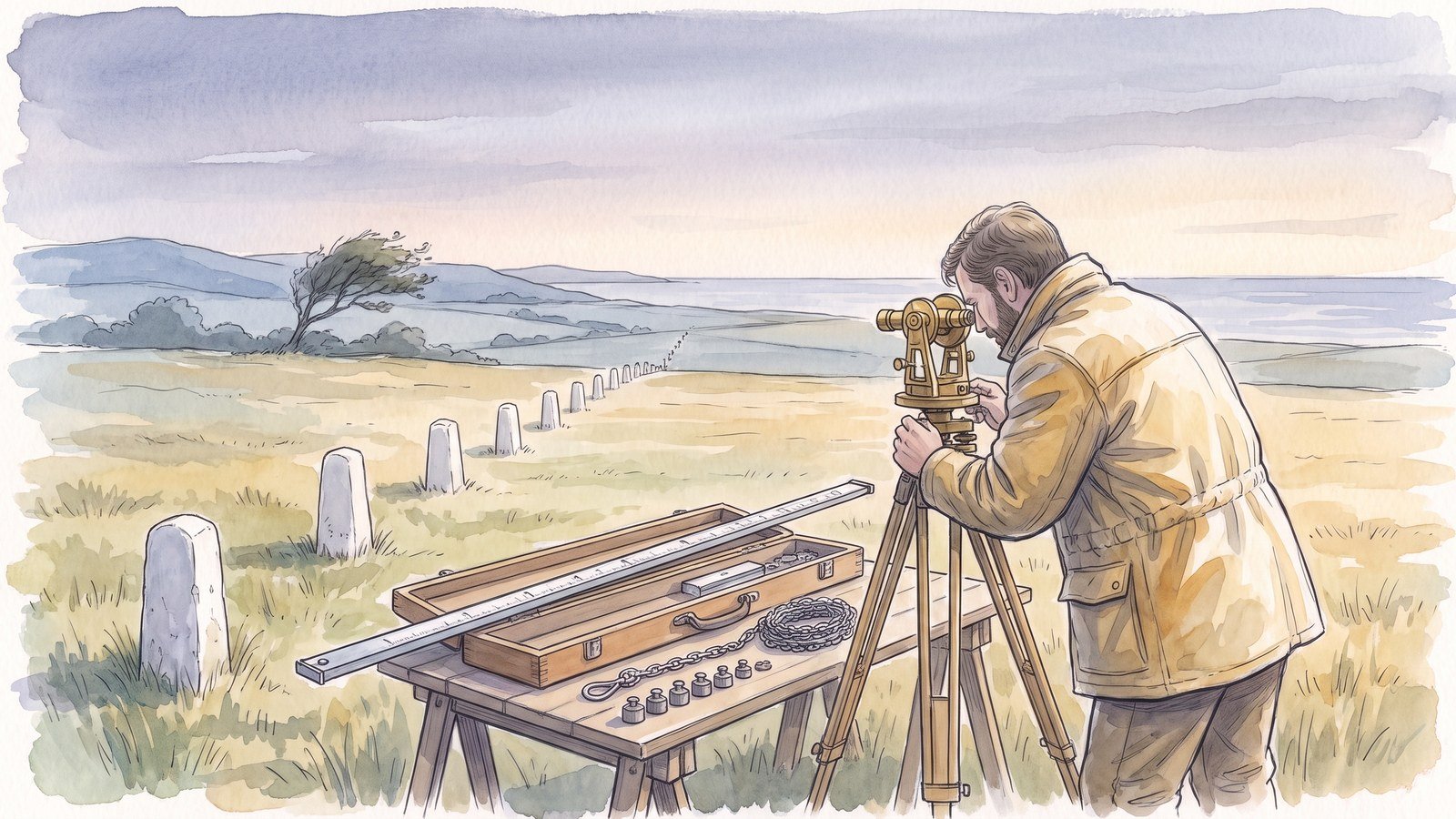
On the first of August 1793 the National Convention voted to abolish every French unit of length and replace the lot with a single one, defined as one ten-millionth of the distance from the equator to the north pole. The line that had to be measured in order to fix that unit ran, in principle, from the belfry of the church of Saint-Éloi in Dunkirk, far to the north, down through the Paris Observatory and over the Pyrenees to the Montjuïc fortress at Barcelona, a total of something over a thousand kilometres of terrain containing mountains, marshes, hostile villages and a small war. Two surveyors were sent out to measure it, and the number they brought back is still, to within a fifth of a millimetre, the number we use.
A unit taken from a body
France before the Revolution had a large number of different ways to say how long something was, and almost none of them agreed with each other. A toise might be the toise of the Châtelet in one town and the toise of the Academy in the next. A French foot was not an English foot. A rod of one guild was shorter than a rod of another, and the words that named them — toise, pied, ligne, pouce — hid a tangle of local custom going back to the Middle Ages, when the measure of a thing was very often the width of some particular hand, or the length of some particular foot, or the barrel of some particular cask. Nothing was hidden about the arrangement. It simply was how measurement worked, and it had the effect of making the length of a bolt of cloth depend on which town you were standing in.
When the question of what to do about it was handed to the French Academy of Sciences, the commission it appointed was chaired by Jean-Charles de Borda and included Lagrange, Laplace, Gaspard Monge and the Marquis de Condorcet — a remarkable concentration of the mathematical power of the age on a question of practical housekeeping. The commission considered two candidate definitions and rejected one of them. It could have defined the unit by a pendulum: a rod carrying a weight that swings once a second, its length being some chosen fraction of the resulting period. That was attractive because it connected length to time, which was already well kept. But it fails badly, because the length of a seconds pendulum depends on the local pull of gravity, and the pull of gravity varies over the surface of the Earth by roughly one part in three hundred. A pendulum standard would have been a different length in Paris than in Quito. The commission knew this. It was precisely because they knew it that they reached for something else.
What they reached for was the planet itself. The metre was to be one ten-millionth of the length of a quarter of a meridian — a quadrant, in the plain sense of a quarter circle — measured along the meridian passing through Paris, at the longitude of the Paris Observatory. A meridian is simply a line of longitude, a great circle running pole to pole through a given point; a quadrant is a quarter of it, running from the equator to the pole. Define the metre as a fraction of that arc and you have taken a piece of the Earth out of the ground and declared it to be a ruler. The appeal is easy to state and very hard to beat. Every other standard in France was an object: a rod in a cupboard, a church door, a weight in a case. Any such object can be stolen, melted, worn, or lost in a fire. The Earth cannot. It is the one measuring instrument guaranteed to still be there in a thousand years, unchanged by any act of ours, and it was available to anyone with a theodolite and the patience to walk a meridian.
There was a long European tradition behind the choice. Jean Picard had measured the length of a seconds pendulum at the Paris Observatory in 1671 and proposed that the unit be derived from it, calling the result the “astronomical radius”. Newton had argued from theory that the Earth was an oblate spheroid — flattened at the poles — which meant that a degree of latitude near the equator must be shorter than the same degree near the Arctic Circle. The French Cassini family, by contrast, had measured degrees along their meridian and found the degree growing as you went north, suggesting a prolate Earth. Cassini’s result had been attacked by English observers as carelessly done, and Maskelyne had defended it; the question was live and politically charged, because it was also the question of whether Greenwich or Paris would eventually win.
To settle it, the Academy sent two expeditions. One went to Ecuador, to measure a degree of latitude near the equator; the other went to Lapland, to measure one near the Arctic Circle. If Newton was right, the Lapland degree would be the longer of the two. The equatorial party was large and slow: Charles Marie de La Condamine, Pierre Bouguer and Louis Godin, joined by two Spanish officers, Jorge Juan and Antonio de Ulloa, who had been sent along by the Spanish crown partly to make sure the results did not become French private property. They left in 1735, spent years climbing and triangulating in the Andes, and worked under conditions that included the flight of a mutinous crew, a war between Spain and Portugal, and a catastrophic flood that destroyed most of their equipment. They carried with them a standard bar of their own, the toise of Peru, which afterwards became the royal standard in France and whose official name is generally given as the Toise de l’Accord or, more usually, the toise of the Academy.
The Lapland party was small and fast, and led by Pierre Louis Maupertuis, who took the astronomer Anders Celsius with him as the Swedish representative. They arrived at Tornio in June 1736, worked their way north up the Torne valley laying out a triangulation, and reached Kittisvaara in the autumn. They laid an 8.4-mile baseline in the snow and measured it with wooden rods to an accuracy of four inches, which was respectable work under the circumstances. The result was the famous comparison: a degree of latitude came out at 57,422 toise in Lapland against 56,734 toise in Ecuador, and Picard’s older figure of 57,060 toise in northern France fell neatly between them. Maupertuis wrote to James Bradley with a flatness that could hardly be concealed: “Thus, Sir, You See the Earth is Oblate, according to the Actual Measurements, as it has been already found by the Law of Staticks: and this flatness appears even more considerable than Sir Isaac Newton thought it.” Newton was vindicated, Cassini was not, and the meridian of Paris became the spine of a system that would eventually be exported to the whole world.
Measuring the meridian
With the shape of the Earth settled in principle, the French meridian still had to be measured in practice, and that was the job given in 1791 to two men: Jean-Baptiste-Joseph Delambre, who was to take the northern half, and Pierre Méchain, who was to take the southern. The division of the work was not equal, and was not intended to be. Delambre drew 742.7 kilometres, from Dunkirk down to Rodez Cathedral. Méchain drew 333.0 kilometres, from Rodez to the Montjuïc fortress in Barcelona. Méchain’s sector was less than half the length of Delambre’s, but it contained the Pyrenees and a stretch of Spanish territory on which nobody had ever run a proper survey, and it would have to be done while Spain was convulsed by the War of the Roussillon. Delambre had the long, comparatively civilised run; Méchain had the short, dangerous one.
What both of them were actually measuring cannot be done by walking a distance. The trick, which had been available since the previous century, is triangulation. You lay out a baseline — a genuinely measurable straight line — then observe from its ends to a distant hilltop, and from that hilltop back to other distant hilltops, and so on. Angles and a single known length give you every other length in the chain. Delambre chose his baseline on the straight road between Melun and Lieusaint, and measured 6,075.90 toises of it in an operation that took six weeks. A toise is about 1.949 metres, so that is close to 11.8 kilometres. He laid it out with four platinum rods, each two toises long. Each rod was a bimetallic ruler, platinum and brass fixed together at one end so that the differential expansion of the two metals would register any change in temperature — a self-documenting thermometer built into the ruler, since a metal standard that is not at a known temperature is not a standard at all but merely a number. Méchain’s baseline, between Vernet and Salces on the road south of Perpignan, came out at 6,006.25 toises by the same method.
Everything then hung on traceability, which is to say on the endless chain of comparisons that establishes that your ruler is genuinely related to everyone else’s ruler. Borda’s double-toise number one, a four-toise master bar that had itself been compared against the toise of Peru, became the reference against which all geodetic baselines in France were measured. The Borda repeating circle, an instrument developed from a reflecting circle by Borda’s assistant Étienne Lenoir and made equal in quality to Ramsden’s great theodolite, did the angle work. Where possible the two surveyors reused the triangulation points that Lacaille had established in 1739 and 1740, which was both economical and a check on themselves.
What they could not reuse was any peace. The Revolution consumed both men. Delambre was arrested in the south and thrown into a Spanish fortress; on another occasion he was arrested by French revolutionaries and thrown into a French one, a habit of the period that obliged him on at least one occasion to produce a copy of the minister’s own order before he was permitted to obey it. Méchain was also imprisoned. By the end of November 1798 they were both back in Paris with their data, which was the substance of what the Academy needed. Méchain did not survive the work. He went back to northern Spain in 1804 to try to improve his original figures, caught yellow fever there, and died. So the measurement of the meridian was completed by a man who did not live to see what became of it, and the man who completed it had spent a third of the intervening years in prison.
The survey claimed an accuracy of a genuinely impressive kind, and it delivered. When the full distance from Dunkirk to Barcelona was computed, the quadrant of the Earth came out at 5,130,740 toises. Of the total error in that figure, less than two per cent is attributable to the arc measurement itself; three per cent comes from a wrong assumption about the flattening of the Earth; and the overwhelming majority — around ninety-five per cent — comes from something the surveyors had no way of knowing about. That residual turned out to be the most interesting thing about the whole enterprise, and it was not a blunder in the ordinary sense.
The argument about the error
The problem was the plumb line. A geodesist’s latitude comes down to the question of how far north or south a point is, and in 1792 there was essentially one way to answer it astronomically: observe the stars, work out the local time, and convert. But there is another, older way — measure the angle of a hanging weight from true vertical — and that is the method the surveyors themselves preferred, because it was quick. It is also wrong. Gravity is not quite the same everywhere, because the Earth’s mass is not distributed quite symmetrically, and because the planet is spinning. A plumb line does not point exactly at the centre of the Earth; it leans. Geodesists now call that lean vertical deflection, and on the French meridian it is large enough to have mattered at the level of a fifth of a millimetre in the unit that resulted.
The discrepancy was noticed early and it was noticed by the wrong person first. Adrien-Marie Legendre, examining the finished arc, compared the surveyors’ 5,130,740 toises against a figure of 5,132,430 toises that he extrapolated from Lacaille’s own measurements of a single degree at 45 degrees latitude — the degree which had been used to fix the provisional metre. The two numbers did not agree; the gap amounted to about two kilometres of real distance across the whole quadrant. Legendre diagnosed the cause correctly, suspecting that the plumb line had been deflected by a local gravity anomaly in the region where the effect was largest, which is to say in the mountains in the southern half of the arc. Later analysis broadly confirmed him. The surveyors had done their triangulation well; the shape of the mountain range they had been standing on had quietly pulled their plumb lines.
What happened next is a useful lesson in how standards get defended. In 1836 Louis Puissant told the French Academy of Sciences that Delambre and Méchain had made outright errors in the triangulation of the arc — not merely a systematic effect nobody had modelled, but mistakes. It is generally attributed to Puissant’s having misunderstood, or chosen to present, an arc that had been reduced onto a different segment of the meridian. The charge sat uncomfortably on a foundational number, so it could not simply be waved away. Antoine Yvon Villarceau spent the years from 1861 to 1866 going back over the geodetic operations at eight separate points of the Paris meridian, recomputing them. He corrected some of Delambre’s and Méchain’s arithmetic. He also confirmed that the bulk of the result stood.
The residual error was estimated in the early twenty-first century by the historian Ken Alder, whose book on the survey makes the point the picturesque way: the legal metre is about 0.2 millimetres shorter than it should have been according to the definition it was created to satisfy. More precisely, the metre as realised today is 0.197 millimetres short of one ten-millionth of the meridian quadrant. The realisation itself is not to blame. Each redefinition of the metre was deliberately calibrated to agree with its predecessor, so the discrepancy has been carried forward unchanged ever since 1799. The metre is not wrong. It is a slightly wrong metre that has been copied faithfully for two hundred years, which is a different and more interesting thing.
The arithmetic of the error, in the end, is instructive. Wrong assumption about the Earth’s flattening: about three per cent. Error in the arc measurement: under two per cent. Gravity pulling the plumb lines sideways in the Pyrenees: about ninety-five per cent. The measurement was not defeated by carelessness but by the planet being slightly more interesting than the model of it the surveyors were working from, which is a recurring feature of this subject and will come back once more before the end.
From law to prototype
The survey took longer to finish than the law took to pass. On 1 August 1793 the Convention decided to disseminate the new decimal metric system; on 7 April 1795 legislation fixed a provisional metre at 443.44 lignes of the toise of Peru, taken at thirteen degrees on the Réaumur scale then in use. Bars of that length were manufactured and distributed in France through 1795 and 1796, and one was installed under the arcades of the rue de Vaugirard, almost opposite the entrance to the Senate. When the definitive calculation was finished, a bar whose length was closest to the meridional definition — the Mètre des Archives, equal to 0.513074 toise, or three feet and 11.296 lines of the toise of Peru — was selected and placed in the National Archives on 22 June 1799, which was 4 messidor of Year VII in the Republican calendar. Alongside it went another platinum metre and twelve iron secondary standards. One of the iron standards travelled to the United States in 1805 and became known as the Committee Meter; it was the standard of length for the United States Coast Survey until 1890.
That was the arrangement that worked for most of the nineteenth century, and it worked through an international committee that had no permanent home, met in whatever city was convenient, and was repeatedly boycotted by one power or another. Its weakness was that France held all the artefacts, which the French were conscious of as a diplomatic problem in the years immediately after 1870, and which the Germans were conscious of as a reason to want the whole business moved somewhere neutral. The alloy was a problem too. On 6 May 1873 Henri Étienne Sainte-Claire Deville cast a 20-kilogram platinum-iridium ingot at the École Normale Supérieure, and on 13 May 1874 a 250-kilogram block was cast at the Conservatoire national des arts et métiers for the national prototypes. Chemical analysis then found the metal contaminated by ruthenium and iron, and the International Committee rejected the 1874 prototypes outright in 1877. It seemed at that moment that the X-shaped cross-section the designer Henri Tresca wanted could only be produced by extrusion, which was also what introduced the iron; it was subsequently found that the section could be milled instead, which is how the final bars were made.
The settlement came on 20 May 1875, when seventeen sovereign states signed the Metre Convention in Paris: Argentina, Austria-Hungary, Belgium, Brazil, Denmark, France, Germany, Italy, Peru, Portugal, Russia, Spain, Sweden-Norway, Switzerland, the Ottoman Empire, the United States and Venezuela. The treaty created the International Bureau of Weights and Measures at the Pavillon de Breteuil, answerable to a General Conference and supervised by an International Committee. The politics were not hidden. France had lost control of the metric system as a national affair and made sure it became an international affair instead, with the headquarters remaining in France. The German, Russian and Austrian representatives had been boycotted out of the old Permanent Committee to force exactly this outcome, and when the Swiss delegate Adolphe Hirsch argued for a permanent bureau in France despite French reluctance, he was doing so with the assent of Italy and Spain.
The international prototype of the metre was approved at the first General Conference in 1889. The bars are 90 per cent platinum and 10 per cent iridium, an alloy chosen because iridium makes platinum harder without surrendering its resistance to oxidation. Their cross-section is an X, the “Tresca section”, which gives a bar of great stiffness in bending for a given weight of metal and which minimises the torsional strain that would otherwise distort a length comparison. The line standard itself — the distance between two fine lines marked on the neutral plane of the bar, rather than the distance between its end faces — dates from William Simms and the burning of the old Parliament buildings in 1834. The first castings were again unsatisfactory; the commission went to the London firm of Johnson Matthey, which succeeded in producing thirty bars to specification. Bar number 6 was found to be identical in length to the Mètre des Archives and was designated the international prototype; the rest were calibrated against it and distributed to the signatory states.
United States bar number 27 is one of the survivors and can still be seen. The National Institute of Standards and Technology records its calibrated length as 0.9999984 metres plus or minus 0.2 micrometres, one and a half micrometres short of the prototype, and notes that it was formally presented to President Benjamin Harrison on 2 January 1890. Because a bar’s length changes with temperature, the national standards were issued with careful thermometers, and comparisons had to account for the temperature of both bars being compared. The fate of many of the original national bars is not uniformly well documented; the record is clearer for the international prototype, which is still kept at the Bureau, and for the French and American bars, and vaguer elsewhere. The one comprehensive round of comparison at the physical prototype — the only full re-comparison of the national standards against bar number 6 — was carried out between 1921 and 1936, and found the unit preserved to within about 0.2 micrometres. That is the accuracy regime the bar regime delivered, and it is the ceiling that the bar was approaching as better instruments were invented to overtake it.
The metre learns to be a number
The idea that did the overtaking was that the metre should be tied to a wavelength of light. Charles Sanders Peirce was the first to tie the metre experimentally to the wavelength of a spectral line, and Albert Abraham Michelson took up the idea and improved it. Michelson and Jean-René Benoît made the first interferometric measurements against the international prototype in 1892 and 1893, and Benoît, Fabry and Perot followed in 1906, both groups using the red line of cadmium. The result was that the wavelength of the cadmium line could be stated as so many millionths of the metre, and it turned out to be about 644 nanometres. Michelson’s success in measuring the prototype metre to within one part in ten billion of a wavelength — less than a tenth of a micrometre — was one of the reasons he received the Nobel Prize in Physics in 1907.
The 1927 General Conference, the seventh, made the bar definition formal at last. The 1889 decision had said only that the prototype “at the temperature of melting ice” should represent the unit; it had been vague about how the bar should actually be supported. The 1927 text is the first metre definition that specifies the support points, and it is worth reading as a whole because it shows what a definition looked like when it still had a solid object in it: “The unit of length is the metre, defined by the distance, at 0 °C, between the axes of the two central lines marked on the bar of platinum-iridium kept at the Bureau International des Poids et Mesures and declared Prototype of the metre by the 1st Conférence Générale des Poids et Mesures, this bar being subject to standard atmospheric pressure and supported on two cylinders of at least one centimetre diameter, symmetrically placed in the same horizontal plane at a distance of 571 mm from each other.” Every clause is about how to hold a piece of metal.
By the 1950s interferometry had become the method of choice for precise length measurement, and the bar had a problem it could not solve. A wavelength measured interferometrically came out naturally in ångströms, the tenth of a nanometre unit that had been created in 1907 for spectroscopy precisely because light is naturally described in wavelengths — and then the result had to be converted back into metres using a conversion factor that was itself an experimental measurement. That conversion was an extra, real, unavoidable uncertainty sitting on top of the interferometry. The way out was to stop converting and start defining: to make the metre be a count of wavelengths in the first place. Advances in technique and theory showed that the cadmium line that everyone had been using was actually a cluster of closely spaced lines, because natural cadmium contains eight isotopes; the correct fix was a single isotope with an even number of protons and even number of neutrons, giving zero nuclear spin and a clean line. Krypton won on practical grounds — it is a gas at room temperature, so the isotope could be enriched more easily and the lamp could run colder, which narrowed the line and reduced the Doppler broadening.
The eleventh General Conference did it in 1960, and the wording is worth having exactly: “The metre is the length equal to 1650763.73 wavelengths in vacuum of the radiation corresponding to the transition between the levels 2p10 and 5d5 of the krypton 86 atom.” The real work was done in the traceability, not the definition. The krypton line was not measured directly against the prototype metre; instead the ratio of the krypton line to the cadmium line was determined in a vacuum, and then compared against the 1906 Fabry–Perot determination of the cadmium line in air, with a correction applied for the refractive index of the air. That chain links the new definition both to the old bar and to the old ångström, which is how the change was made without a discontinuity anyone would notice. The physical realisation was a krypton-86 discharge lamp operating at the triple point of nitrogen, at 63.14 kelvin, or about 210 degrees below zero, cold enough that the emitted line was exceptionally sharp. A metre became a number you could count, and any laboratory that could make the lamp and the interferometer could have the metre.
Then the lasers arrived, and the question of what to count became awkward. A laser gives a far cleaner and more reproducible line than any discharge lamp, but different lasers have different wavelengths, so there is no obvious reason to prefer one. The physicists found that the best of them — a helium–neon laser stabilised by a methane transition, reaching a wavelength of about 633 nanometres — corresponded to a frequency that, combined with the value of the speed of light then being used, implied a value for that speed slightly inconsistent with the one obtained from other lasers. The krypton line itself was slightly asymmetrical in shape, which meant that where on the profile you chose to measure from made a difference. In 1975 the fifteenth General Conference settled the argument by convention rather than measurement, adopting the conventional value of the speed of light as exactly 299,792,458 metres per second. The seventeenth General Conference then removed the ambiguity altogether, in 1983: “The metre is the length of the path travelled by light in vacuum during a time interval of 1/299,792,458 of a second.” Since 2019 the same idea has been restated in a single continuous formulation, the metre being defined by fixing the numerical value of the speed of light at 299,792,458 when expressed in metres per second, where the second is in turn defined in terms of the caesium frequency.
It is worth being explicit about how strange that is, because it is strange. A length is now defined by a duration and a velocity, and the velocity has been assigned a value by international agreement rather than measured. Nothing in that sentence refers to anything anywhere. There is no object, no event, no place. It is a purely relational statement: this many seconds times this speed equals this many metres. The standard cannot be lost, because there is nothing to lose; it cannot be defaced, because there is nothing to deface; it cannot drift, because it is not a thing that can drift. It is a rule for generating a length, and every laboratory that follows the rule generates the same one, which is the entire point and also, for anybody who imagines standards as physical objects, a genuine loss.
What measuring a metre has become
Realising the modern metre is not measuring a bar. It is measuring a frequency and dividing. The second is defined by the caesium hyperfine transition, the frequency at which the two magnetic substates of the ground state of the caesium-133 atom flip between one another under radiation — 9,192,631,770 cycles per second, exactly, by definition. An optical frequency comb, the device that made this practical, is an ordinary laser whose output is split into a very large number of evenly spaced frequencies, like the teeth of a mechanical comb in frequency rather than in space. Count how many teeth fall in a second and you have the laser’s frequency with extraordinary precision; count how many wavelengths of light fit into one of those teeth and you have the wavelength, with a precision no physical ruler has ever approached. Length becomes a time. The transition from bar to number was, in operational terms, a transition from touching something to counting.
The comparison regime that runs underneath this is no longer a set of bars but a schedule of frequency comparisons between laboratories, coordinated by the Bureau and reported as key comparisons, with the results forming the traceability chain that a national measurement eventually hangs from. A length measurement starts at a primary standard, an optical frequency comb tied to a caesium clock, and descends through a series of comparisons whose uncertainties are budgeted and published. The system’s quality is now the quality of its worst link in a chain that may run through half a dozen laboratories and several months.
Two experiments from the end of the nineteenth century sit oddly in this story but are genuinely part of it, because they are the reason the definitions could keep being improved. The Michelson–Morley experiment of April to July 1887 was designed to detect the Earth’s motion through the supposed aether by comparing the speed of light along perpendicular arms of an interferometer; Michelson had been building toward it since 1881 and made the high-quality optics in John Brashear’s shop. It found nothing, and the null result has been read ever since as the first strong evidence against aether theories and the beginning of the road to special relativity, to the point where Einstein said that without Michelson–Morley’s embarrassment no one would have regarded relativity as anything more than half a redemption. The Kennedy–Thorndike experiment of 1932 took the same apparatus and made one arm shorter than the other, which does not test whether the speed of light depends on orientation but whether it depends on the velocity of the apparatus. It also found nothing. That matters here because a length standard is only meaningful if the universe is not quietly changing the rules depending on where the measuring apparatus happens to be moving; Michelson–Morley and Kennedy–Thorndike, and the modern cavity and lunar laser ranging tests that descend from them, are the reason that assumption is safe. The original experiment bounded orientation dependence at about one part in a hundred million; the current ones reach roughly one part in a hundred billion.
There is an unresolved question underneath all this, and it is not a technical one. Was the intent of the first definition honoured? The surveyors set out to cut a length out of the Earth, and what they cut was short by two hundredths of a millimetre because the Earth turned out to pull on their plumb lines in a way they had not modelled. Every subsequent definition has been anchored to theirs rather than to the Earth, so the continuity has been perfect and the fidelity to the original intent is imperfect, permanently and by exactly that amount. One can hold that the modern metre is the direct descendant of the meridional metre, in which the discrepancy is a single historical blemish inherited by choice; or one can hold that the metre is now something else entirely — a quantity derived from a time interval and a fixed numerical constant — which merely happens to agree with the Earth to within two parts in ten million. Both readings are defensible. The Bureau itself has generally been careful not to claim the first, on the grounds that the original intent was never to define a number but to define a procedure, and the procedure has changed.
Which returns the story to its shape. The metre was defined from the Earth, so that no human artefact could be the thing that could be lost. Within a century the metre had left the Earth entirely, and in a second century it left matter entirely, and the object that is actually used to measure a length is no longer a bar, a wavelength, or a natural phenomenon but a set of instructions: hold a caesium atom in a magnetic field, count its flips, fix a speed, divide. The deepest thing the French commissioners achieved was not any particular number. It was the idea, adopted before they knew what it cost and never entirely given up since, that a unit of measurement should be defined by a procedure that anyone in the world can repeat. That is why the metre never had to be kept. It only had to be written down.
References
- History of the metre - Wikipedia contributors, Wikimedia Foundation, accessed 22 October 2026
- Arc measurement of Delambre and Méchain - Wikipedia contributors, Wikimedia Foundation, accessed 22 October 2026
- French Geodesic Mission to the Equator - Wikipedia contributors, Wikimedia Foundation, accessed 22 October 2026
- French Geodesic Mission to Lapland - Wikipedia contributors, Wikimedia Foundation, accessed 22 October 2026
- Metre Convention - Wikipedia contributors, Wikimedia Foundation, accessed 22 October 2026
- Michelson - Morley experiment - Wikipedia contributors, Wikimedia Foundation, accessed 22 October 2026
- Kennedy - Thorndike experiment - Wikipedia contributors, Wikimedia Foundation, accessed 22 October 2026
- Resolution 1 of the 7th CGPM (1927): Definition of the metre by the international Prototype - Bureau International des Poids et Mesures, 1927
- Resolution 6 of the 11th CGPM (1960): Definition of the metre - Bureau International des Poids et Mesures, 1960
- Declaration of the 1st CGPM (1889) on the international prototype of the metre - Bureau International des Poids et Mesures, 1889
- The International System of Units (SI Brochure), Section A.1, 17th CGPM resolutions - BIPM, Metanorma source repository, accessed 22 October 2026
- The Measure of All Things: The Seven-Year Odyssey and Hidden Error That Transformed the World - Ken Alder, Basic Books, 2002 (Open Library catalogue record)
- Meter Bar 27 - National Institute of Standards and Technology, image and historical record
- Museum of Length - National Institute of Standards and Technology, historical document
- Book review: The Measure of All Things - Physics Today, American Institute of Physics, 2002
- On This Day: the metre was defined - Royal Society of Chemistry Education