The Ozone Hole
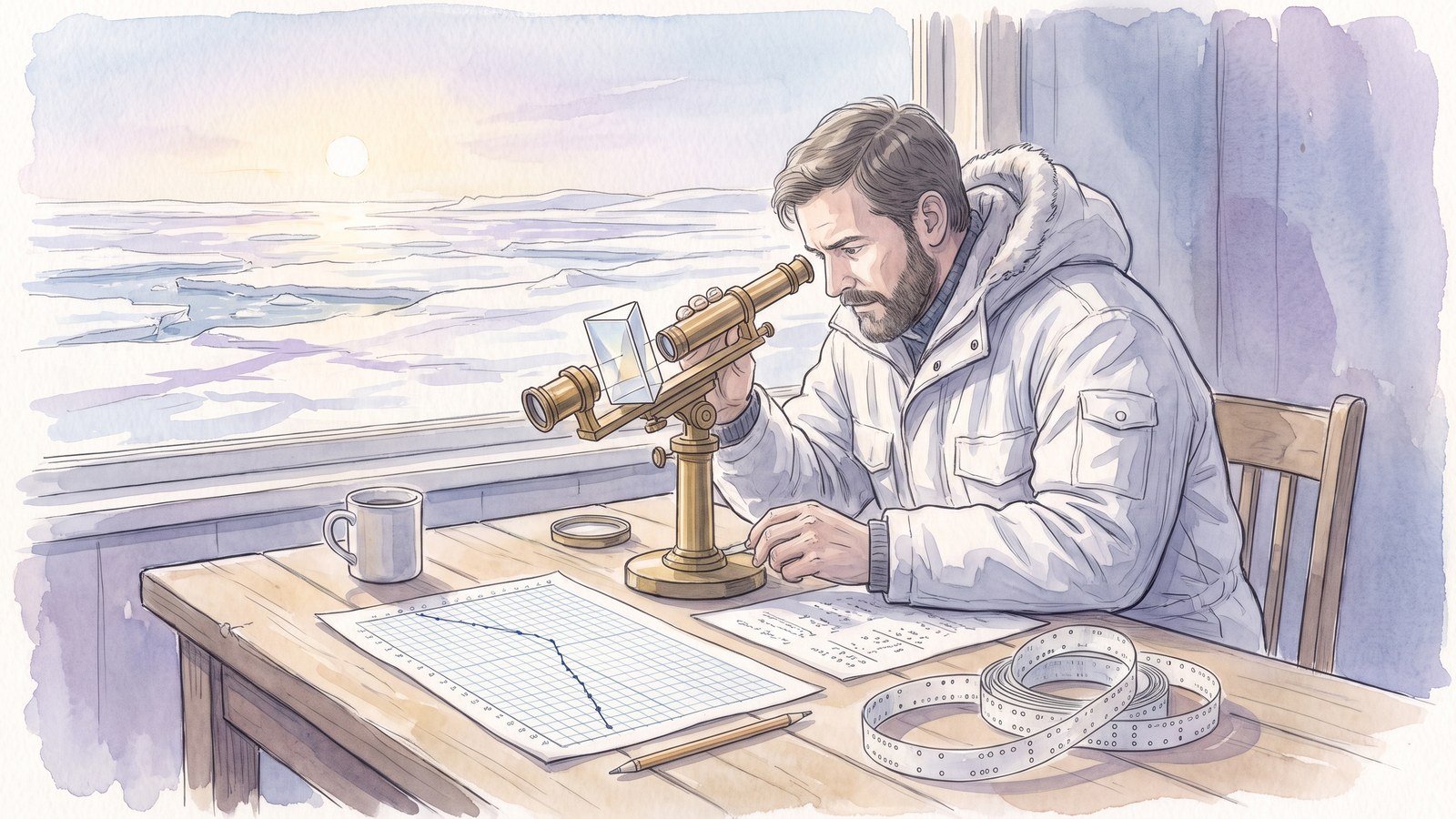
For most of the twentieth century the atmosphere’s ozone layer was treated as a solved problem. The chemistry was worked out in the 1930s, the instruments to measure it were built, and a steady global monitoring network reported reassuringly small year-to-year variations. Then, in the middle of the 1980s, a group of scientists working in a hut on an ice shelf at the bottom of the world looked at a graph and realised that the line was going down. Not slowly, not with weather noise around it, but in a way that had been there for years and had been sitting in the raw data the whole time. The ozone hole was not found by a theory coming true. It was found by somebody finally plotting the measurements properly. Six years after the discovery, nearly every country on earth had signed a treaty to stop manufacturing the chemicals responsible. It remains the fastest and most complete environmental agreement ever concluded, and the reasons it worked are worth taking seriously, because the reasons it nearly did not are more instructive still.
The Molecule That Holds the Sky Together
Ozone is three oxygen atoms bonded together. It is unstable at the surface of the Earth and comparatively long-lived fifteen to thirty kilometres up, which is the band of the atmosphere known as the stratosphere. Its entire job is to intercept ultraviolet radiation before it reaches the ground. The mechanism is elegant: a photon of short-wavelength ultraviolet strikes an oxygen molecule, splits it into two atoms, and one of those atoms combines with a second oxygen molecule to form ozone. The ozone then absorbs a further photon and reverts to two oxygen molecules, which can split again. The cycle is self-sustaining and is called the Chapman cycle, after the British physicist who worked it out in the 1930s.
The stratosphere is exactly as thick as it needs to be. Because the concentration of ozone varies strongly with altitude, a small change in the amount of ozone translates into a large change in the total amount of radiation absorbed. The system is also temperature-stratified, which matters later: the stratosphere warms with altitude because ozone absorbs radiation and the gas heats as it absorbs. That makes the ozone layer simultaneously the thing that blocks the Sun’s harmful light and the reason the upper atmosphere is warm, and it makes the layer vulnerable to anything that changes the temperature at which its chemistry runs.
Measuring it is straightforward in principle and difficult in practice. Ground-based instruments take the spectrum of the sunlight reaching the ground and compare it with a modelled spectrum of what would arrive without absorption. The difference gives the total column of ozone overhead. The unit is the Dobson unit, named after Sidney Dobson, an Oxford physicist who built the first practical instrument of this kind in the 1920s, and a full, undamaged column over most of the world runs at around 300 Dobson units. An ozone hole is not a hole in any literal sense. It is a region where the measured column falls to perhaps a third of normal for a few weeks each spring. Everything about the scientific detection of the ozone hole depends on understanding that number: what is normal, how it varies with season and latitude, and how much of a departure counts as real.
From the middle of the century onwards, a network of ground stations measured total ozone routinely, mostly in order to track long-term trends. The stations recorded their numbers carefully. That is the part of the story that people forget when they imagine a dramatic moment of discovery. There was no alarm bell. There was a series of printed tables, and in the tables, September readings at the two Antarctic stations were quietly getting worse.
The unit in which those numbers were recorded deserves a note of its own, because it is an elegant piece of metrology and it is the reason the worldwide comparison worked at all. A Dobson unit is defined by how much of the Sun’s spectrum a given thickness of pure ozone would absorb, and it was constructed so that a reading of 300 meant a column of ozone that would absorb exactly as much of the beam as one centimetre of pure ozone at standard temperature and pressure. The number is therefore an odd unit that depends on an agreed physical standard rather than on a mass or a length, and it means the same thing in every country with a Dobson spectrophotometer in the field. Having a common, slightly peculiar unit is what allowed a technician with no theoretical training, reading a drum in the Antarctic, to produce a number directly comparable with one taken in the Arctic, in Europe, or in the tropics. The hole was found by the infrastructure of standardised measurement before it was found by anybody’s insight.
There was also an unusually direct human stake in the readings, which is why the story is not only a story about chemistry. Ultraviolet radiation is the cause of the majority of skin cancers, and the incidence of melanoma and non-melanoma skin cancer rises measurably with increased ultraviolet exposure. The ozone layer absorbs essentially all of the UV-C, most of the UV-B and part of the UV-A that reaches the ground, and the fraction it lets through is the variable being tracked. Depletion of ozone does not create a new hazard. It moves an existing one closer to the surface and closer to everyone. Models projecting a doubling of skin cancer cases, and the appearance of a visible hole in satellite imagery of the southern spring, turned a column of atmospheric chemistry into a public health argument that governments could not easily ignore.
The Perfect Molecule
The villain of the piece was invented by Thomas Midgley, an American engineer working for General Electric, in the mid-1920s. Midgley was looking for a safe refrigerant. The gases then used, ammonia and sulphur dioxide and chloromethane, were effective coolants and repeatedly lethal when they leaked, which mattered a great deal in the new domestic refrigeration industry. Midgley proposed chlorofluorocarbons, molecules built from carbon, fluorine and chlorine with no hydrogen at all, and they were a triumph of industrial chemistry.
They were non-toxic, non-flammable, chemically inert under ordinary conditions, thermally stable, non-corrosive to metal, and inexpensive. Every one of those properties was exactly what a refrigerant, a propellant, and a foam-blowing agent needed. Freon, the trade name DuPont used, went into refrigerators, hair spray, spray paint, foam, and eventually into aircraft de-icing and the foam used in fire extinguishers. By the 1970s the CFCs were among the most successful industrial chemicals ever produced, and they were close to universal.
The properties that made them commercially perfect are the same properties that made them cosmically catastrophic. Chemical stability under ordinary conditions means stability under ultraviolet bombardment at altitude. A molecule that will not react with anything in a wet warehouse at room temperature will, given enough energetic radiation, break apart in the rarefied upper atmosphere. The designers had optimised for exactly the wrong conditions.
This could not have been detected by reasoning alone. It required an instrument that could see molecules at fantastically low concentrations. That instrument came from James Lovelock, who developed the electron capture detector in the 1950s for a different purpose entirely and who used it to argue, from the late 1950s onwards, that the CFCs were accumulating in the atmosphere rather than dispersing. Lovelock’s broad thesis, that a material too stable to break down would eventually become a planetary-scale pollutant, was the conceptual breakthrough. It reframed the problem from what a chemical does to the fluorine and chlorine it contains.
The scale of what had been built is what made the eventual reversal difficult. The point at which the first CFCs would have needed to be abandoned was decades before anyone was able to detect the problem, by which time the manufacturing base, the appliance industry, the foam sector and the aerosol market were all enormous and heavily invested. Midgley’s molecule made refrigeration affordable for ordinary households and effectively eliminated a common cause of accidental death in the home, which was a real and substantial public good, delivered on an industrial scale that could not be reversed without enormous waste.
The history of Midgley is worth one further sentence, because it has become a standing reference point in environmental ethics. Having helped industrialise the CFCs, he went on to champion the addition of tetraethyl lead to petrol, on the reasoning that a small quantity of a lead compound would improve the antiknock properties of gasoline and let engines run at higher compression. The case for leaded petrol was made on the same kind of reasoning that had been used for the CFCs: the compound was stable, it did what was wanted, and the consequences were not measurable with the tools then available. He died in 1944, having been largely airbrushed out of public view by the industry he had served. He is now routinely cited, by people who have no particular interest in chemistry, as an example of how unintended consequences work. He is more accurately a warning about how much worse a mistake becomes when the scale of production is large enough that reversing it is the main problem.
1974: The Paper Nobody Believed
In 1973, Mario Molina joined F. Sherwood Rowland’s group at the University of California, Irvine, as a postdoctoral fellow. Rowland had been measuring atmospheric trace gases for years and had noticed that the CFC figures were climbing. Molina, a Mexican chemist, worked out the argument, and they published it in Nature in September 1974 under a title that understated everything: Stratospheric Sink for Chlorofluoromethanes: Chlorine Atomic-Catalysed Destruction of Ozone.
The reasoning runs like this. The CFCs are inert in the lower atmosphere, which is exactly why they accumulate there. But they cannot accumulate indefinitely without consequence, because the lower atmosphere mixes into the stratosphere over years. Once up there, they are exposed to ultraviolet light of a wavelength that is powerful enough to break the carbon-chlorine bond. What is released is a free chlorine atom. And chlorine destroys ozone catalytically, meaning that a single chlorine atom can destroy many thousands of ozone molecules before it is finally sequestered. Molina and Rowland also noted the related point about the scale: even a very small abundance of chlorine, if it were catalytic, would matter enormously relative to the ozone.
They were not the only ones to see the mechanism. Stolarski and Cicerone had proposed chlorine catalytic cycles earlier in 1974, and Paul Crutzen had in work from 1970 and 1971 shown that oxides of nitrogen did something similar in the stratosphere, which established the general principle that trace gases could control ozone abundance through catalytic cycles. Crutzen would later share a Nobel Prize with Molina and Rowland for exactly this body of work. What the Molina and Rowland paper did was attach the mechanism to a specific molecule that industry was manufacturing in enormous and growing quantities.
The reception was hostile, and the hostility was organised. The chemical industry had invested billions in CFC manufacture and had a legitimate interest in the answer being no. A notorious 1975 internal DuPont document dismissed the ozone theory in terms that became permanently quoted in this argument. The industry’s serious response, however, was to fund better measurement, and the result was the confirmation it had hoped for: atmospheric CFC concentrations were real, global, and rising, and the observed stratospheric chlorine burden was smaller than Molina and Rowland’s estimate. By the late 1970s the measurement problem had been substantially solved and it was generally accepted that the chemistry was broadly right, while almost nothing was being done about it.
That gap, between an established and unchallenged chemical mechanism and zero regulatory action, ran for eleven years. Molina and Rowland paid part of the price for it. Molina left academic research, partly discouraged by the reception, and eventually became an advocate rather than a laboratory scientist; he has said plainly that he considered the period from 1974 to the mid-1980s a time in which scientific findings were systematically and effectively disregarded. Their paper had predicted that significant additional ozone loss would occur around forty kilometres altitude. When the hole was eventually found it was at around twenty kilometres, and the mechanism turned out to involve polar stratospheric clouds and heterogeneous chemistry that nobody had properly worked out at the time. Molina and Rowland were wrong about where. They were right about what, and they were right that the loss would be severe.
The Vortex: Why Only the Bottom of the World
The reason the polar story is different from a global one took another decade to establish. The Antarctic in winter is the coldest place on the planet. The stratosphere over the pole is isolated from the rest of the atmosphere by a strong circumpolar vortex, a ring of westerly winds that rotates around the continent and prevents air from mixing in from lower latitudes for months. The consequence is that temperatures inside the vortex fall to around 190 Kelvin, roughly minus eighty degrees Celsius, far below any temperature measured outside it.
At those temperatures polar stratospheric clouds form. These are not clouds in the ordinary meteorological sense. They are very thin, high-altitude clouds composed of water, nitric acid and other compounds, visible only faintly in twilight. Their importance is chemical rather than meteorological: their ice particles provide surfaces on which reactions that cannot occur in the gas phase become possible. Nitric acid, chlorine monoxide and hydrogen chloride react on the particle surfaces, and the hydrogen chloride that is produced fails to release the chlorine in the normal way. The result is that large quantities of chlorine are converted from a harmless form, in which it cannot destroy ozone, into an active form.
When the sun returns at the end of the Antarctic winter in September, the light strikes the still-frozen stratospheric clouds and the sequestered chlorine is released in an activated state. In the absence of any chlorine the stratosphere in spring simply re-forms ozone at normal rates. With activated chlorine present, the destruction vastly exceeds the replenishment, and the total column of ozone falls to a fraction of normal in the space of a few weeks. The chlorine is then removed again as sunlight destroys it, and the hole closes. That is why the phenomenon is seasonal, why it peaks in September and October, and why it can be absent in a warm year and catastrophic in a cold one.
This mechanism was not known in 1985. The discovery was empirical, based on measurement, and the explanation arrived afterwards. That ordering is important. Had the polar chemistry been worked out in advance, the natural reaction would have been to doubt the measurements until the theory could explain them. Instead the measurements stood on their own and forced the theory to catch up.
1985: Reading the Graph Paper
The British Antarctic Survey has maintained ozone measurements at Halley Bay since the International Geophysical Year of 1957-58. For most of that period the Dobson spectrophotometer, an ageing and temperamental instrument that had to be pointed manually at the sun and read by eye off a rotating drum, produced a steady seasonal cycle. In the late 1970s the September values at Halley and at Faraday began to fall. Nobody acted on it, for the ordinary reason that nobody had yet assembled the picture.
Jonathan Shanklin, a young scientist at the Survey, argued that the readings might be an instrument fault. The sensible test was to compare the old Dobson instrument with a newer and more reliable device, the Brewer-Brewer spectrometer. In 1982 he was granted permission to go to Halley and check one against the other. His return was delayed by the Falklands War. When he finally got the data, the new instrument and the old one agreed with each other, which removed the instrument-fault explanation. He then went back through the archive and plotted the historical September readings on ordinary graph paper, and the result was a curve that had been falling steadily since the late 1970s.
He took the result to Joe Farman and Brian Gardiner, and in May 1985 the three of them published in Nature a paper reporting large losses of total ozone over Antarctica. The September 1984 column at Halley was about 40 per cent below the historical average, and roughly a third thinner than earlier decades. They did the brave thing and attached a cause. They suggested that the loss was connected to chlorofluorocarbons, noting that the region’s extreme winter temperatures made it uniquely sensitive to chlorine chemistry in the atmosphere. They got the broad attribution right and the mechanism wrong, proposing an interaction they assumed required sunlight even at the time of maximum depletion.
There was a parallel effort. A NASA team had been measuring chlorine monoxide from aircraft and was getting results consistent with severe chlorine chemistry over Antarctica. They planned to present at a conference later in 1985. The British Antarctic Survey paper beat them to publication, which made Farman, Gardiner and Shanklin the accepted discoverers, and the sequence prompted a certain amount of unproductive argument about priority afterwards. What mattered more was the timing of the policy response. The Vienna Convention for the Protection of the Ozone Layer was opened for signature in March 1985, a few weeks before the Nature paper appeared. It agreed only to research and coordination, and it contained no controls.
The smoking gun arrived in 1987. Aircraft measurements showed chlorine monoxide dimerising at the rate that the polar mechanism predicted, tying the chlorine chemistry directly to the observed loss. That data was not available when the Montreal Protocol was signed on 16 September 1987, which is worth remembering. The treaty went through as an act of precaution, signed by countries that had not yet seen the definitive evidence, at the moment when the British research planes were still in the air over the southern ocean collecting it.
The Treaty and Its Discontents
The Montreal Protocol is unusual in the history of environmental law for a simple reason: it worked, and it worked quickly. Countries agreed to freeze production and consumption of the major ozone-depleting substances, then to phase them out, with chlorofluorocarbons and halons eliminated in developed countries by 2000 and methyl chloroform by 2005. Production and consumption of CFCs are effectively zero in the world today.
Two design decisions explain most of that. The first was the recognition that common but differentiated responsibilities mattered. Developing countries could not be asked to phase out refrigerants while their populations were still acquiring them and their economies could not afford the substitutes. The protocol therefore gave developing country signatories longer deadlines and created a multilateral fund, financed largely by the signatories that were phasing out fastest, to pay for the transition. This is often described as a compromise, and it was one, but it is also the reason the developing world ended up inside the regime rather than outside it.
The second was that the treaty controlled production and consumption rather than emissions. Regulating what is manufactured is far easier to verify than regulating what is released, and it is far easier to enforce against a small number of producers than against billions of end users. Because the production base was concentrated in a handful of chemical companies, national phase-outs translated quickly into global reductions. An emissions regime would have been politically impossible and probably would not have been honoured by anyone.
The 1990 and 1992 amendments accelerated the schedule after it became clear the original deadlines were adequate but the substitution technologies were available sooner than expected. The 2007 and 2009 amendments brought the major hydrofluorocarbons under control as well, since those are the gases that replaced the CFCs in refrigeration and air conditioning and which are potent greenhouse gases. That last step is the reason the Montreal Protocol still functions as a live treaty rather than a historical document.
The criticisms are real and should be stated. Production of the regulated substances did not go to zero immediately, because the protocol controlled legal production and an illegal trade in used CFCs developed, particularly for servicing the enormous stock of equipment manufactured before the ban. The insistence on differentiation meant that the largest ozone-depleting consumers during part of the transition were not the signatories that had agreed to move fastest. And the protocol’s compliance mechanisms are weaker than its environmental logic deserves. None of these objections has changed the central fact, which is that a global atmospheric chemical was essentially eliminated within a decade and a half of being identified as a problem.
The reach of the agreement is easy to underestimate. It is the only United Nations treaty with universal membership, and effectively the entire world population lives under it rather than merely being invited to sign it. Almost every country that produces goods for export is manufacturing under its rules, which means the protocol’s production controls reach far beyond the jurisdictions that agreed to them. That is why the transition happened at the speed it did: the rule was not a set of targets that countries met or missed, it was a change in what could legally be manufactured, and once the permitted supply dried up the substitution was forced on the whole supply chain.
The Kigali Amendment, agreed in 2016 and in force from 2019, took a further step by bringing the hydrofluorocarbons under control. Those gases filled the gap left when CFCs were banned, and because hydrogen-containing fluorinated gases absorb strongly in the infrared they turned out to be potent greenhouse gases. Regulating them was necessary for the ozone layer and, almost incidentally, for the climate. The three-day meeting in Kigali that achieved it is one of the better examples of a treaty designed well enough that its provisions were easier to sign than to reject.
None of this makes the process painless for the countries that moved fastest. Western manufacturers lost a profitable market, spent heavily on substitutes, and then found that substitutes which were environmentally preferable for the ozone layer, such as the early hydrofluorocarbons, were unacceptable for the climate. The industry that had spent decades persuading governments that the ozone science was wrong had to fund the research that eventually displaced its own product. That is the usual pattern of industrial transition, and it is worth noticing that the industries which resist the earliest evidence are frequently the ones that end up leading the eventual replacement.
Recovery, and the Argument About It
Because the ozone layer takes decades to rebuild, recovery is a long project measured against moving baselines. The 2018 quadrennial assessment by the World Meteorological Organization and the United Nations Environment Programme reported, for the first time, detectable signs that the Antarctic was beginning to recover. The 2022 assessment strengthened that finding while adding important qualifications.
Those qualifications are about variability rather than trend. The Antarctic ozone hole is governed to a large extent by the meteorological conditions of each particular year, and those have been running large and late-lasting. The 2019 hole was the smallest since 2002. The 2020 hole was the longest-lived on record, closing on 28 December. The 2021 hole was the eighth largest on record and lasted until 23 December. The 2022 hole closed around mid-December and ranked twelfth. Three consecutive unusual years in a row, during a period in which the overall trend was towards improvement, is precisely the situation in which it is easy to lose sight of what the long-term data are showing.
Volcanic eruptions complicate the picture further. The 1991 eruption of Pinatubo injected sulphate aerosols high into the stratosphere, where they increased the surface area available for the heterogeneous reactions that activate chlorine, and measurably worsened Antarctic depletion. Any attempt to read a single year’s number as a verdict on the treaty runs into this kind of confounding, which is one reason the assessment process looks at multi-decadal trends instead.
The projection from the 2022 assessment, assuming full compliance with the protocol and a middle-of-the-road climate scenario, is that total column ozone returns to 1980 values around 2040 for the near-global average, around 2045 for the Arctic, and around 2066 for the Antarctic. The Antarctic figure has a wide range, from roughly 2049 to 2077, because springtime polar ozone depends heavily on modelled dynamical variability. Climate change itself is expected to have a small effect on Antarctic timing and a stronger one in the Arctic, where springtime ozone is more sensitive to greenhouse gas scenarios.
What is genuinely unsettled, and worth watching, is the effect of a warming climate on the polar stratosphere. Cooling has been one of the drivers of Antarctic depletion, because cold temperatures favour the formation of polar stratospheric clouds and the reactions on their surfaces. A warmer Arctic stratosphere could in principle reduce polar depletion at the same time as increasing the transport of ozone-depleting substances into the region, and the two effects pull in opposite directions. Nobody claims to have resolved that yet, and the honest position is that the Arctic numbers remain too variable for a statistically significant trend to be identified over the period so far.
It is worth comparing the two environmental stories that have dominated the last half century. The Kyoto Protocol and its successors approach climate change by setting targets for future emissions, which requires measuring what has not yet happened and negotiating against national interests on a timeline of centuries. The Montreal Protocol approached ozone depletion by stopping a specific manufactured substance, which required knowing exactly what to stop and who was making it. Both approaches have merit. Only one produced a near-complete solution, and the difference is instructive rather than a comment on the sincerity of anyone involved.
What the Story Teaches
The most quoted account of this period is that scientists were ignored for eleven years, and there is real evidence for it. The gap between the 1974 publication and the 1987 treaty is often cited as a failure of institutions. But the record is more complicated than the slogan suggests, because the eleven years were not idle. They were the period in which atmospheric CFC concentrations were measured and confirmed, the chlorine catalytic mechanism was clarified by several independent groups, the observational record was maintained by stations that were funded through that decade for reasons that had nothing to do with ozone, and replacement technologies were developed. The gap was not eleven years of nothing. It was eleven years in which the science matured faster than the policy, and in which the industry used the uncertainty in the early years to argue for more measurement, which is not a reprehensible position in the abstract even when it is used to delay.
What made the difference after 1985 was not that the science became better. The Farman paper was striking but incomplete, and the mechanism was still wrong. What changed was that a measured, visible, annual phenomenon made the risk concrete in a way that a projected percentage of ozone loss in 2070 did not. A hole in the sky can be photographed from orbit and shown on television. A model output cannot. The change in political behaviour tracked the change in vividness rather than the change in knowledge.
It is worth being precise about the timing of the mechanism as well, because the interval is where the real lesson sits. The polar stratospheric cloud chemistry was worked out between 1985 and 1988, and in that window the treaty was already drafted, negotiated and signed. By the time the science could explain, in complete detail, why the Antarctic was so catastrophically sensitive, the world had already decided to act. The sequence was not science followed by policy. It was an adequate science producing a sufficient alarm, followed quickly by policy, followed by better science that justified the alarm retrospectively. Many environmental problems would move faster if they could reproduce that sequence, and the reason so many do not is usually that the alarm never becomes sufficient, not that the science turns out to have been wrong.
It is also worth noticing what did not happen. There was no catastrophic collapse in the period when the science was uncertain. Nobody was visibly harmed by the eleven years of delay, in the sense that there was a documented cohort of people whose lives were measurably worse for having waited. The damage that did occur was diffuse, statistical, and spread across a population, which is the ordinary shape of slow environmental harm and precisely why it is so hard to motivate action in advance. The ozone case solved this problem by accident, through the arrival of an image that carried more political weight than any projection could manage. Whether anything else will ever acquire an image of comparable force remains the open question, and it is a question about communication rather than about chemistry.
That is a genuinely uncomfortable lesson for anyone who has to communicate uncertainty. The argument for restricting CFCs was strongest when it was least well evidenced, and the evidence that finally made it politically effective came after the policy had already been decided in principle. If you are trying to explain why acting early on a slow-moving environmental risk is hard, this is the case study, and it does not flatter anybody.
There is a final irony that most retellings miss. When the ozone hole was found, the two things that had gone wrong were an entirely stable industrial chemistry and an unusually cold pole. The first has been dealt with by regulation, substitution and enforcement, and the world now manufactures almost none of the offending molecule. The second is climate, and it is not under any kind of control. The Antarctic stratosphere is warming, which should eventually make polar depletion less severe even as ozone declines for other reasons elsewhere. The most successful environmental treaty in history was signed to fix a problem with two causes, and it has fixed one of them.
That is not an argument against treaties. It is an argument for noticing which problems are caused by decisions and which are caused by physics. The decision was chlorofluorocarbons. The physics is the cold. We proved in about two years that we can agree to stop doing something, and we have not yet managed to arrange anything comparable for the other one. The ozone layer is a good demonstration that the first kind of problem is genuinely solvable, which is at least a reason to keep trying at the second.
References
- Large losses of total ozone in Antarctica reveal seasonal ClOx/NOx interaction - J. C. Farman, B. G. Gardiner and J. D. Shanklin, Nature 315, 207-210, 1985
- Stratospheric sink for chlorofluoromethanes: chlorine atomic-catalysed destruction of ozone - Mario J. Molina and F. Sherwood Rowland, Nature 249, 810-812, 1974
- The discovery of the Antarctic ozone hole - Nature, 20th anniversary retrospective, 2019
- Do look up: how science and international cooperation closed the ozone hole - Nature, 2025
- Chlorofluorocarbons and Ozone Depletion - American Chemical Society, National Historic Chemical Landmark
- F. Sherwood Rowland: A man of science, vision, integrity, and service - PubMed Central, 2012
- What happened to the world’s ozone hole? - BBC Future, 21 March 2022
- On humble graph paper, Jonathan showed a downward trend that would change the world - ABC News, 8 November 2021
- World Ozone Day: 30th anniversary of Montreal Protocol - British Antarctic Survey, 2017
- Scientific Assessment of Ozone Depletion: 2022, Executive Summary - World Meteorological Organization and United Nations Environment Programme, 2022
- Three peculiar Antarctic ozone hole seasons in a row: what we know - Copernicus Atmosphere Monitoring Service, 13 December 2022
- Ozone layer recovery is an environmental success story - World Meteorological Organization, 2021
- A hole in the sky - Science in School, European Molecular Biology Organization, 2010