The Curies and the Discovery of Radioactivity
In November of 1895, a German physicist named Wilhelm Conrad Rontgen, working alone in his laboratory at the University of Wurzburg with a Crookes tube wrapped in black cardboard, noticed that a barium platinocyanide screen on a bench several feet from the tube had begun to fluoresce in the dark. The screen was producing a visible signal whenever the tube was on, even though no visible light was reaching it. Rontgen had discovered a new kind of penetrating radiation, which he provisionally called X-radiation. Within six weeks he had published the first of his three seminal papers on the subject in the Proceedings of the Physical Medical Society of Wurzburg, and within twelve weeks the phenomenon had been reproduced in laboratories across Europe and in the United States. Rontgen, who was the experimental physicist of the day most sceptical of theoretical claims about radiation and most cautious in his public writings about novel phenomena, sent off his first photographs on 30 December 1895 to a small circle of correspondents across the German-speaking universities, and the discovery was, in effect, instant.
The news of the X-rays reached Paris on 2 January 1896. Within nine days, on 11 January 1896, the physicist Henri Becquerel, who had been working on related phosphorescence problems and who was at the time the chair of the physics department at the Ecole Polytechnique in Paris, began to investigate whether the phosphorescent materials that he had been studying for years might emit similar rays. Becquerel’s hypothesis was reasonable: the X-rays had been produced by the fluorescence of the glass of the Crookes tube, perhaps other phosphorescent substances would also do something analogous. By the end of January 1896, Becquerel had discovered that uranium salts, wrapped in light-proof paper and laid near a photographic plate, would produce an image on the plate, even if the plates were kept in the dark and the uranium salts were exposed for several days. The phenomenon had nothing to do with X-ray fluorescence, and it had, by March 1896, a name: Becquerel rays.
The next six years were the years of Marie Curie. Marie Sklodowska, the daughter of a Warsaw secondary-school physics teacher who had been forced out of his teaching job for the family’s refusal to give up their Polish identity in the Russian Empire, had completed her licence in physics at the Sorbonne in 1893, where she was one of only two female graduate students in her class; she had completed her licence in mathematics in 1894; and she had married Pierre Curie, the head of the industrial physics laboratory at the Ecole de Physique in Paris, in July 1895. The Wurzburg X-ray paper reached the Curies’ apartment within weeks of its publication in January 1896; the Becquerel note on uranium salts followed within weeks of its appearance in March 1896; Marie chose the Becquerel rays for her doctoral thesis, and the project of the next four years of her life was set.
Becquerel’s Hunch and Marie’s Choice
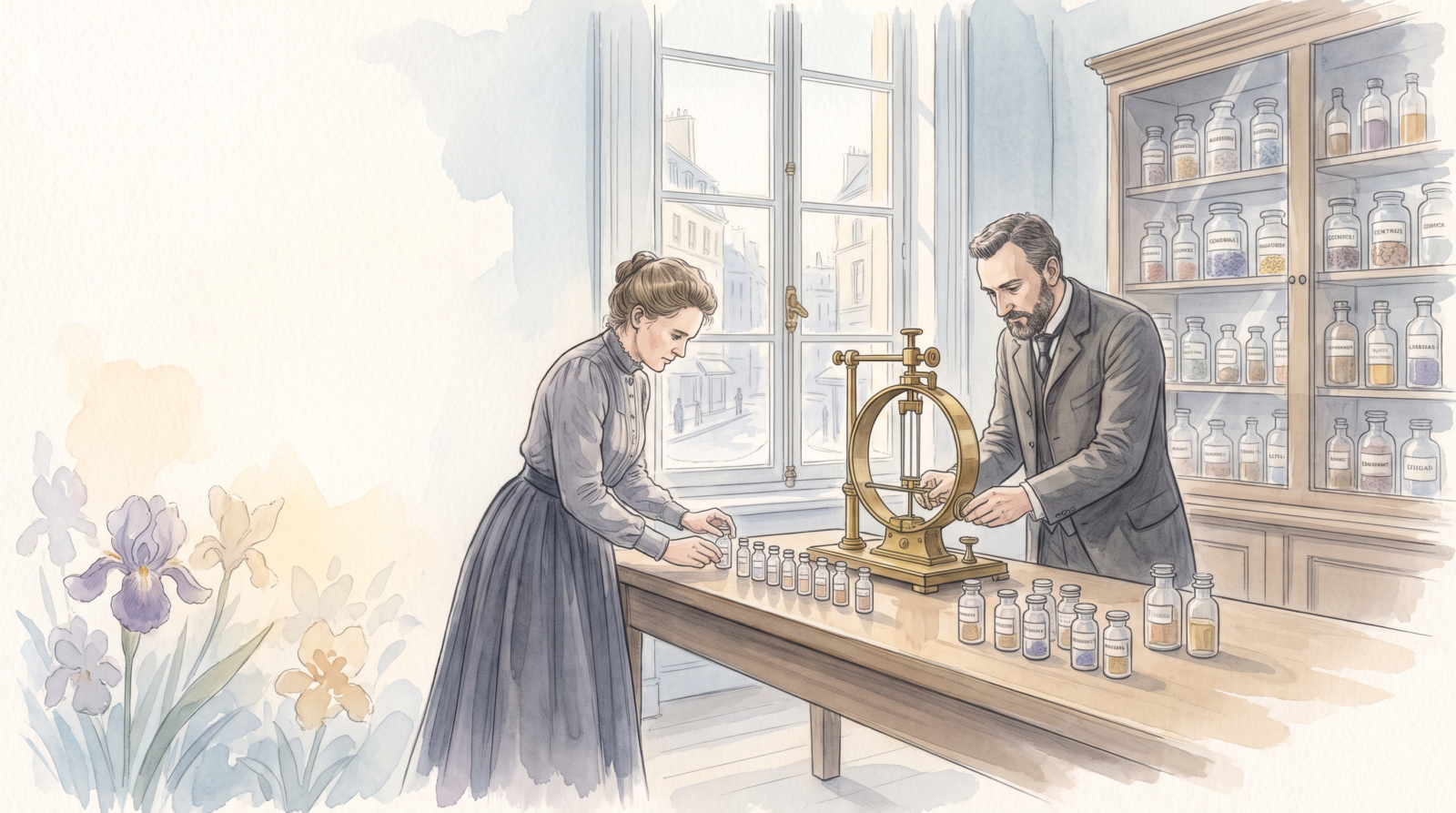
Marie Sklodowska-Curie’s choice of a doctoral thesis subject in the autumn of 1897 was the most consequential decision of twentieth-century physics. The phenomenon had been named for its discoverer; the experimental apparatus for measuring ionisation, the means by which Becquerel rays and other forms of radiation could be quantified, had been designed by Pierre Curie together with his brother Jacques, in their piezoelectric electrometer, an instrument that could detect electrical currents of one ten-thousandth of a millionth of an ampere; and the actual mechanism by which Becquerel rays, as they were then called, were produced by uranium salts was unknown. Marie chose this problem as her thesis topic, in part because it was new and interesting and in part because she had no thesis topic yet, and the choice turned out to shape the next three decades of physics.
The institutional context of Marie’s research career in 1897 is also worth noting. The Ecole de Physique at the turn of the century was a small institution, with a handful of physics professors and a small number of graduate students, and the laboratory infrastructure was modest by the standards of the German research universities that had, by the 1890s, become the principal centres of experimental physics in Europe. Marie had been a graduate student at the Sorbonne and was working in the laboratory of the Ecole de Physique by virtue of her marriage to Pierre; she did not have, in 1897, an independent appointment, an independent laboratory, or independent funding of her own. The choice to begin what would become the lifetime project of the radioactive substances was, on the face of it, a delicate and uncertain professional move, and the subsequent success of the project, against the institutional odds, was a substantial part of what made the discovery.
The first measurement that Marie performed, in the late autumn of 1897, was the simplest: she measured the ionisation produced by samples of various uranium compounds, supplied to her by the Ecole de Physique and by her colleagues at the Sorbonne, and she tested whether the strength of the effect depended on the chemical form of the uranium. The result was unambiguous: the radiation was a property of the uranium atom, not of any particular compound of uranium, and the strength of the radiation from a sample was strictly proportional to the amount of uranium in the sample, no matter whether the uranium was in the form of uranium oxide, of uranyl nitrate, of autunite, of thorium oxide, of any other mineral. The radiation was independent of the chemical form of the uranium-containing compound; it was a property of the uranium atom itself. This was the first experimental result of the new science of radioactivity.
The second measurement that Marie performed, in early 1898, was the critical one: she measured the ionisation produced by samples of a substantial fraction of the known elements, supplied to her by the mineralogy collections of the Museum d’Histoire Naturelle and by the Ecole des Mines, to see whether any of them also produced the Becquerel rays. The answer was yes: thorium and its compounds produced an analogous radiation, with similar properties, in proportion to the amount of thorium in the sample. Marie had found the second radioactive element. The discovery of the radiation of thorium was, in 1898, the second major experimental result of radioactivity, and it was the basis of the first of the Curies’ joint publications, which appeared in the Comptes Rendus of the French Academy of Sciences in February 1898 under the names of Pierre Curie, Henri Becquerel, and Marie Sklodowska-Curie.
The detection of the radiation of thorium was, in the public reception of the Curies’ work, the most striking single result of Marie’s initial thesis project. The result of the measurement was that radioactivity was not, after all, a unique property of uranium; it was a property of at least two distinct elements and, by the working hypothesis of the subsequent research, probably a property of a wider class of atoms. This wider-class hypothesis was the necessary precondition of the hypothesis that was later confirmed by the discovery of polonium and radium in the pitchblende: the hypothesis that the source material, the pitchblende, contained a substantial fraction of an as-yet-unidentified element that, like uranium and thorium, was radioactive. Without Marie’s first thorium measurement, the pitchblende hypothesis would not have been formulable.
Marie’s thorium finding also brought the Austrian mineralogist Eduard Schneidetsammelh into correspondence with Pierre and Marie, and the chain of correspondence led to the pitchblende problem that was to occupy the next four years of the Curies’ work. Schneidetsammelh had, by the early 1898, been measuring the radioactivity of a substantial collection of uranium-bearing minerals supplied by the Ecole des Mines, and had noticed that the radioactivity of the pitchblende was substantially greater than the radioactivity of pure uranium metal, by a factor of at least four. Schneidetsammelh’s measurement was communicated to the Curies in March 1898, and the hypothesis that the pitchblende contained an as-yet-unidentified radioactive element was, by the late spring of 1898, the working hypothesis of the research programme.
By this time, Marie had also begun to suspect that there might be other radioactive substances in nature that were not yet known to chemists. The Austrian mineralogist Eduard Schneidetsammelh, who had been supplied with specimens of the various uranium-bearing minerals in the collection at the Ecole des Mines, had noted that the radioactivity of the uranium ore pitchblende was substantially greater than the radioactivity of pure uranium metal, by a factor of at least four. This excess radioactivity could not be explained by the presence of uranium alone; some other element in the pitchblende must be radioactive, and the element must be present in the pitchblende in substantial quantities. The hypothesis that Marie formed in the spring of 1898 was that the pitchblende contained at least one other radioactive element whose chemical isolation would account for the excess radioactivity. The hypothesis was correct, but the chemical isolation would take four years.
The Years of Manual Crystallisation 1898 to 1902
The four years from 1898 to 1902 were the most demanding years of the Curies’ joint scientific life. Marie’s first task was to find the source material. Pierre and Marie wrote to the Austrian mineralogists and to the Geological Survey of Austria-Hungary and to the mining companies that supplied the uranium ore for the Austrian state uranium processing operations, and they obtained, eventually, several tons of pitchblende residues from the Austrian state processing operation at Joachimsthal. The residues were the by-products of the Austrian state uranium production, after the uranium had been leached out for industrial purposes, and the residues were, from the chemist’s point of view, useless. The Curies obtained the residues essentially free of charge, on the condition that they would cart them away themselves.
The next step was the chemical isolation of the hypothetical radioactive substance. The standard methods of analytical chemistry of the 1890s were not, in absolute terms, well suited to the detection of very small quantities of a substance by ionisation. The Curie method was a development of these standard methods, and it depended on the fact that the hypothetical radioactive substance would be present in the residues at concentrations of perhaps one part per million or less, and the chemical steps needed to be carefully tracked by the ionisation measurements rather than by chemical titration. The principle was simple: take the residue, dissolve it in acid, precipitate one fraction, separate the precipitate from the supernatant, dissolve the precipitate, re-precipitate, re-separate, measure the ionisation at each step, follow the radioactivity through the various fractions, and gradually concentrate the radioactivity into a smaller and smaller fraction of the starting material.
The technique is called fractional crystallisation, and it is the technique that the Curies used on a heroic scale. In the period from 1898 to 1902, Marie Curie, with the assistance of Pierre and of one or two paid laboratory assistants, performed roughly 20,000 individual crystallisations and re-crystallisations of the various fractions of the pitchblende residues. The work was done in a shed in the courtyard of the Ecole de Physique at the Place de L’Ecole in Paris, a shed that had been a dissecting room before the medical school moved to a new building, that was unheated, that was not ventilated, and that the Curies later described as being substantially worse than the worst workplace they had ever worked in. The work was performed in shifts that lasted most of the day, with the Curies taking it in turns to attend to the laboratory at home for the daughter who had been born to them in September 1897, Irene.
The first discovery of the period was polonium, so named by Marie in 1898 in reference to her homeland of Poland, of which the Russian Empire still held Warsaw and which existed on the European map only as a node of the Polish diaspora, in opposition to the partition. The polonium-bearing fraction was isolated in July 1898 and was the first new radioactive element to be named. The second was radium, identified in the barium-bearing fraction of the same set of operations in December 1898. The radium-bearing fraction glowed in the dark with a soft blue-green light, and Pierre and Marie were, in their letters to the Curies’ acquaintances, distinctly proud of the visual evidence of the substance’s radioactivity. By 1902, the radium-bearing fraction had been concentrated to the point at which Marie was able to identify the element’s atomic weight, by means of a precise measurement of the ratio of the radium-containing mass to the chloride mass in the precipitate; the atomic weight came out to 225, which is, in 2026, the accepted value for the element with atomic number 88. The element had been isolated, in a quantity of roughly 0.1 gram of the chloride.
The physical effort of these four years was, by any reasonable standard, prodigious. The four years of manual crystallisation of 20,000 individual separations were performed with the apparatus of an 1890s French provincial chemistry laboratory, with equipment that would, in 2026, be considered inadequate to the isolation of any element at all. The result is one of the canonical examples in the history of chemistry of the consistent application of a simple physical separation method over a very large number of separation steps, with consistent tracking of the substance’s effect by means of a sensitive but simple physical measurement (the piezoelectric electrometer), and the success is properly taken as the result of patience and of methodological discipline as much as of scientific brilliance. It is, in this sense, the kind of work that any reasonably competent and sufficiently patient chemist could in principle have performed; what Marie Curie’s work demonstrated was that she and Pierre were the chemists who had, in this instance, performed it.
The Nobel Prize of 1903 and the Politics of Recognition
The Curies and Becquerel shared the Nobel Prize in Physics of 1903. The award was for the discovery of radioactivity and the subsequent studies of the radioactive substances that the discovery had identified. The prize committee was, by general historical agreement, slow to consider the award; it took some pressure on the committee by the Swedish physicist and Nobel committee member Rune Kjellander, who had been corresponding with Marie Curie in 1902 and 1903, and a substantial independent advocacy campaign by members of the French Academy of Sciences, to bring the committee to the issue. The award was made in December 1903, and Becquerel and Pierre Curie received the prize jointly. Marie Curie was not, in the original announcement, included in the award; her inclusion was secured by the direct intervention of Pierre, who wrote to the Nobel committee stating that he would not accept the prize if Marie was not included. The committee accepted.
The Nobel committee’s reason for the reluctance was, in the historical record, partly scientific and partly political. The scientific reason was that the committee was uncertain, in 1903, whether the work that the Curies had done constituted physics or chemistry; the radioactivity research was at the boundary between the two fields, and the committee had no clear precedent for making an award that crossed the boundary. The political reason was that Marie Curie was a woman, and the committee had never previously awarded a Nobel Prize to a woman. The committee that included Marie Curie in the prize under Pierre’s pressure was, in effect, the first committee of the Nobel Prize to acknowledge that a woman could do the kind of research that deserved the prize, and the inclusion was, in this sense, a small step in the slow opening of the prize to female laureates. (The next woman to receive a Nobel Prize was Maria Goeppert Mayer in 1963, sixty years later; Marie Curie’s own second Nobel Prize of 1911, in chemistry, was the second for a woman.)
The 1903 Nobel was also the first Nobel prize to be explicitly joint between three laureates rather than two, and the first to be awarded for work that had been done jointly by a married couple; in the strict order of the prize announcement, Becquerel received half the prize, with Pierre and Marie sharing the other half. The convention of mixed-prize division that the 1903 award established was, in retrospect, the convention that the Nobel committee would rely on in subsequent decades for joint awards, and the convention’s establishment at the Curies’ expense is also part of the institutional legacy of the discovery of radioactivity.
The 1903 prize brought the Curies substantial international recognition, and the recognition also brought substantial institutional support. The Curies obtained, in 1904, a chair at the Sorbonne for Pierre, the chair of physics that had previously been vacant at the Sorbonne. Pierre accepted the chair on the condition that Marie be made the chief of the laboratory, the first formal employment Marie had held in the French university system; the chair and the laboratory were, in effect, the institutional acknowledgement by the French state of the radioactivity research as a permanent part of French science. The Pierre and Marie Curie Laboratory at the Ecole de Physique, sometimes called the Pavillon des Curie, was the institution that the radioactivity research would call home for the next two decades.
The 1903 prize did not, however, mark a quiet period in the Curies’ scientific life. The late 1904 and early 1905 saw Marie continue the work of the polonium and radium fractions, attempting to push the purity of the radium chloride fraction to a level that would justify the determination of the atomic weight to a precision comparable to that of the standard elements; the relevant determination, the 1907 atomic weight determination to within one part per thousand, would be one of Marie’s central scientific results of the immediate post-Nobel period. Pierre and Marie also began to study the radiation itself, particularly the question of whether the radiation could be refracted, polarised, or otherwise influenced by external fields; the question of the particle-or-wave nature of the radiation was, in 1905, completely open.
The Death of Pierre and Marie’s Second Career 1906 to 1911
Pierre Curie died on 19 April 1906, run over by a horse-drawn cart on the Quai de la Cite in Paris near the publishing house where he had been returning a set of galley proofs, slipping on the wet cobbles and falling under the wheels. The death was an accident of the kind that is more common in cities with heavy cart traffic; Pierre had been, in any case, in poor health for several years, with a chronic joint condition that had been aggravated by overexposure to radium and its immediate radiation. The death was a substantial shock to Marie, who took on, in the immediate aftermath, the responsibilities of the Pierre’s laboratory and the institutional responsibilities of the Sorbonne chair that Pierre had held. Marie was appointed, in May 1906, to the chair of physics at the Sorbonne; she was the first woman to hold a chair at the Sorbonne, and the appointment was, in effect, the continuing acknowledgement by the French state of Marie’s place in the radioactivity research.
The years 1906 to 1910 were a period of consolidation. Marie continued the polonium and radium work; she supervised a substantial number of graduate students, including the Polish physicist Jozef Kowalski and the German physicist Friedrich Oskar Giesel; and she continued to publish on the radiation itself, particularly on the effect of temperature on the radiation and on the question of the atomic weight of radium. The question of whether the radiation could be influenced by external fields had been investigated in 1905 and 1906, and the answer was no; the radiation was, in this sense, a different kind of phenomenon from the secondary X-rays that had been discovered earlier in the decade. The interpretation of the radioactivity as a result of an internal transformation of the atom was first proposed in 1900 by Rutherford and Soddy, and by 1907 the experimental data were already consistent with the transformation hypothesis. Marie’s own contribution to the theoretical side of the radioactivity research was, in this sense, modest; her major contribution was experimental and was the isolation of the radioactive substances themselves.
In 1910, Marie isolated the metallic form of radium for the first time, by means of an electrolysis of the radium chloride that she had produced in 1902. The metallic radium, a few milligrams of the element, was, in the experimental records of the Ecole de Physique, a substantial moment. The metallic radium was brightly metallic, soft, and self-heating; a sample of a few milligrams, suspended in air, would heat itself and the surrounding air to a temperature noticeably above ambient, by the continuous conversion of the radium’s decay energy into heat. Marie’s isolation of the metallic form of radium, and the consequent demonstration that the metallic form was also and identically radioactive, was the final confirmation that the radioactivity was a property of the element itself and not of any particular chemical form.
Marie’s second Nobel Prize, in chemistry, was awarded in 1911 for the discovery of the elements radium and polonium, for the isolation of radium in metallic form, and for the subsequent studies of the chemical and physical properties of the element. The second Nobel Prize was, in 1911, the first Nobel Prize to be awarded to the same person twice, and the honour recognised the extraordinary scientific stature that Marie had achieved by the age of 44. The Nobel committee for chemistry was, in 1911, more cautious about the cross-disciplinary nature of the chemistry award than the Nobel committee for physics had been in 1903, and the second prize recognised Marie’s work as fundamentally in the chemical tradition of the discovery and isolation of new elements.
The 1911 prize also brought substantial controversy. The previous year had seen the heavily publicised Langevin-Curie scandal, in which the married physicist Paul Langevin, a former student of Pierre’s and a close friend of Marie’s, had been sued by his wife for divorce on grounds of adultery with Marie Curie, and the resulting newspaper coverage had been substantially hostile to Marie; Langevin had been a frequent visitor to the Curie’s apartment in the Sceaux suburb of Paris before the scandal, and the public had read Marie’s access to Langevin as morally suspect. The Nobel committee was, on the whole, unmoved by the scandal; the committee’s decision to award the prize was taken in October 1911, and the prize was announced in December 1911, with the scandal still ongoing. The committee’s decision was, in effect, an assertion that the scientific merits of the work were the only relevant consideration for the award.
Radium, the Radium Institute, and the New Physics of the Atom
The year 1914 saw the opening of the Radium Institute in Paris, an institution that Marie Curie had spent the years 1909 to 1914 raising funds for and designing. The Radium Institute was a substantial institution that included a laboratory for the study of the radioactive substances under Marie Curie’s direction, and a second laboratory for the study of the radiation under the direction of Andre-Louis Debierne, who had become one of Marie’s most important collaborators and successors. The Radium Institute was, at its opening in 1914, the largest dedicated scientific institution in the world for the study of the radioactive elements, and it was, in the immediate post-war years, the centre of a substantial scientific enterprise. The work of the Radium Institute over the next two decades, including the work of Marie’s daughter Irene Joliot-Curie and her husband Frederic Joliot-Curie, who worked in the Institut on the artificial production of radioactive isotopes and who themselves received the Nobel Prize in Chemistry in 1935 for the discovery of artificial radioactivity, constitutes the Curies’ principal scientific legacy.
The Radium Institute was, however, founded at a moment of crisis for the European scientific order. The First World War began in August 1914, within weeks of the Institut’s opening, and Marie Curie devoted much of the war years to the development and deployment of the X-ray apparatus (the petite Curie) for the use of the French military hospitals, an enterprise that consumed substantial amounts of Marie’s time and substantial institutional resources. The Radium Institute returned to its peacetime scientific mission in 1918, but the changed circumstances of the post-war years, including the decreased international collaboration of the 1920s and the rise of the political tensions of the 1930s, meant that the Institut’s scientific output was substantially more compartmentalised than the pre-war vision had promised.
Marie Curie died on 4 July 1934 in the sanatorium of Sancellemoz in Passy, Haute-Savoie, of a plastic anemia that was, by the historical consensus of the post-war medical assessment, a consequence of her lifetime exposure to the ionising radiation of the substances she had discovered and worked with. Her notebooks, preserved at the Bibliotheque Nationale in Paris and consulted in subsequent years, were substantially radioactive in the 1960s, so much so that they were, for a time, stored in a lead-lined case for the safety of the readers who consulted them. Marie had been, throughout her career, consistently unwilling to take basic radiological precautions with the substances she had isolated; in the absence of a recognition that the radiation was harmful at sub-acute doses, the early radium workers were, in effect, unprotected from a substance that we now know to be substantially carcinogenic.
What the Curie story, in its full arc from the Becquerel hunch of 1896 to the death of Marie in 1934, represents is the discovery of an entirely new domain of physics in 38 years. The discovery of radioactivity by Becquerel, the isolation of polonium and radium by Marie and Pierre Curie, the theoretical interpretation by Rutherford and Soddy of radioactivity as a transmutation of the atom, the discovery of the atom’s structure by Rutherford and Bohr, the nuclear model of the atom by Rutherford, the discovery of the neutron by Chadwick in 1932, the discovery of the artificial radioactivity of the Joliot-Curies in 1934, and the consequent development of nuclear physics, are all parts of the same arc. The discovery of radioactivity, in this sense, was the discovery that the atom was not, after all, an indivisible, immutable particle, and the discovery opened the door to the entire subsequent development of nuclear physics.
The discovery of radioactivity was, in the 1890s and the early 1900s, a discovery that did not yet know what it had discovered. The phenomenon was, in the surviving accounts of the period, a matter of measured ionisation in a small basement laboratory, of glowing blue-green crystals in a glass tube, of an unknown property of an unknown element that turned out to be one of the most consequential properties that matter has ever been shown to have. The discovery is also the story of a deliberate, sustained, and remarkably patient programme of work by Marie Curie in particular, and by Pierre Curie, Henri Becquerel, Ernest Rutherford, and the other early pioneers of the field, and the program’s outcome was the discovery of a domain of physics whose existence no one had suspected. The discovery of radioactivity, on this view, is the discovery of a door through which the entire science of the twentieth century passed.
The legacy of the period is also the legacy of the people who did the work. Marie Curie is, in the public memory, the dominant figure of the discovery of radioactivity, and her appearance on the French 50-franc banknote from 1984 to 2002 was an unusual twentieth-century honour. But the discovery of radioactivity was, in the final accounting, a collaborative enterprise that included Becquerel’s identification of the phenomenon in 1896, Pierre and Marie Curie’s isolation of the substances in 1898 to 1902, Rutherford and Soddy’s theoretical interpretation in 1901 to 1903, and the subsequent experimental and theoretical work that established the modern physics of the atom. The discovery is the prototypical example of a discovery that required the serial contributions of many different scientists, working over many years, with many different techniques.
The discovery of radioactivity was also, in retrospect, the discovery of the experimental foundation for the entire twentieth-century physics of the atom. The discovery of the structure of the atom by Rutherford in 1911 followed directly from the radioactivity research, as did the discovery of the neutron by Chadwick in 1932, and the discovery of the artificial radioactivity by the Joliot-Curies in 1934. The work that began in Becquerel’s basement laboratory and continued in the Pavillon des Curie of the Ecole de Physique was the necessary predecessor of the work of Hahn and Strassmann on nuclear fission in 1938 and of the work of Fermi on the nuclear chain reaction in 1942. The discovery of radioactivity is, in this sense, the experimental root of the entire nuclear age, and Marie Curie’s signature on the technical records of the radium chloride isolation of April 1902 is, in the longer historical arc, the signature on the first page of the chain.
References
- The Nobel Prize in Physics 1903 - Nobel Foundation, official prize citation.
- The Nobel Prize in Chemistry 1911 - Nobel Foundation, official prize citation.
- Radioactivity: A Very Short Introduction - Claudio Tuniz, Oxford University Press, 2012.
- Marie Curie and the Science of Radioactivity - Naomi Pasachoff, Oxford University Press, 1996.
- Becquerel and the Discovery of Radioactivity - Lawrence Badash, American Journal of Physics, 1966.
- Marie Curie: The Woman Who Opened the Nuclear Age - Susan Quinn, Pimlico, 1995.
- Pierre Curie and the Origin of the Piezoelectric Method - Jacques Curie, Revue d’histoire des sciences, 1989.
- The Curie Family and the Radium Institute 1900 to 1934 - Frederic Kjeldsen and Robert Fox, Cambridge University Press, 2004.
- The Langevin-Curie Scandal of 1911 and the Nobel Prize - Peter J. Ling, French Historical Studies, 1976.
- Nuclear Physics in the Twentieth Century - Emilio Segre, University of California Press, 1993.
- Pierre et Marie Curie Manuscript Collection - Bibliotheque nationale de France, Departement des manuscrits, NAF 18123-18130, Paris.
- Curie Laboratory Notebooks 1898 to 1920 - Wellcome Collection, London, reference PP/MCU.
- Radium Institute of Paris: Records of the First Thirty Years - Institut du Radium archives, 1914 to 1944, Paris.
- The Joliot-Curies and the Discovery of Artificial Radioactivity - M. Gowing, Notes and Records of the Royal Society, 1963.