The Voyager Mission and the Outer Planets
A Window That Opens Once
The two Voyager spacecraft would not have been launched in 1977 had the geometry of the solar system not obliged us to do so. Jupiter, Saturn, Uranus and Neptune are arranged around the Sun in a way that happens, once every 175 years, to make a four-planet fly-by possible using only the gravity of the inner planets to bend the spacecraft’s trajectory. The specific opportunity fell between the late 1970s and the early 1990s. The opportunity will not return until the twenty-second century. The two spacecraft were built and flown to take advantage of this opportunity, and they are still, at the time of writing, transmitting scientific data from interstellar space 48 years after launch.
The Grand Tour opportunity was first identified in 1965 by Gary Flandro, then a graduate student at the Jet Propulsion Laboratory, working through the trajectory possibilities for a future outer planets mission. A simple Hohmann transfer from Earth to Jupiter and on to Saturn had been considered since the mid-1960s for the early outer-planet missions that became Pioneer 10 and Pioneer 11. Flandro’s contribution was to notice that if a spacecraft were aimed not at the plane of the ecliptic but at the proper position for a Jupiter swing-by at the right time, the same Jupiter encounter could provide a gravity boost that would send the spacecraft on to Saturn, which in turn would provide another boost to Uranus, and Uranus to Neptune. He estimated that the alignment that made this possible would occur in the late 1970s and early 1980s, and that it would not recur for nearly two centuries. The opportunity was unique in the lifetime of any present-day space programme.
The Voyager programme that NASA eventually approved was the cheapest and most capable way to make use of the alignment. The Mariner Jupiter-Saturn programme, the project’s original working name, was authorised in 1972 as the Mariner-class successor to the Pioneer outer-planets probes. The two spacecraft that were eventually launched as Voyager 1 and Voyager 2 were, despite their different names, basically Mariner-derived vehicles: they used the same basic bus, the same power source, and most of the same scientific instruments as the Mariners of the previous decade, and the cost of building both was kept under $400 million in 1972 dollars by holding the bus design constant. This frugality is the only reason the programme was approved at all; the money for a wholly new outer-planet bus, or for a wholly new solar-system flagship, was not available in the early 1970s budget.
The Spacecraft
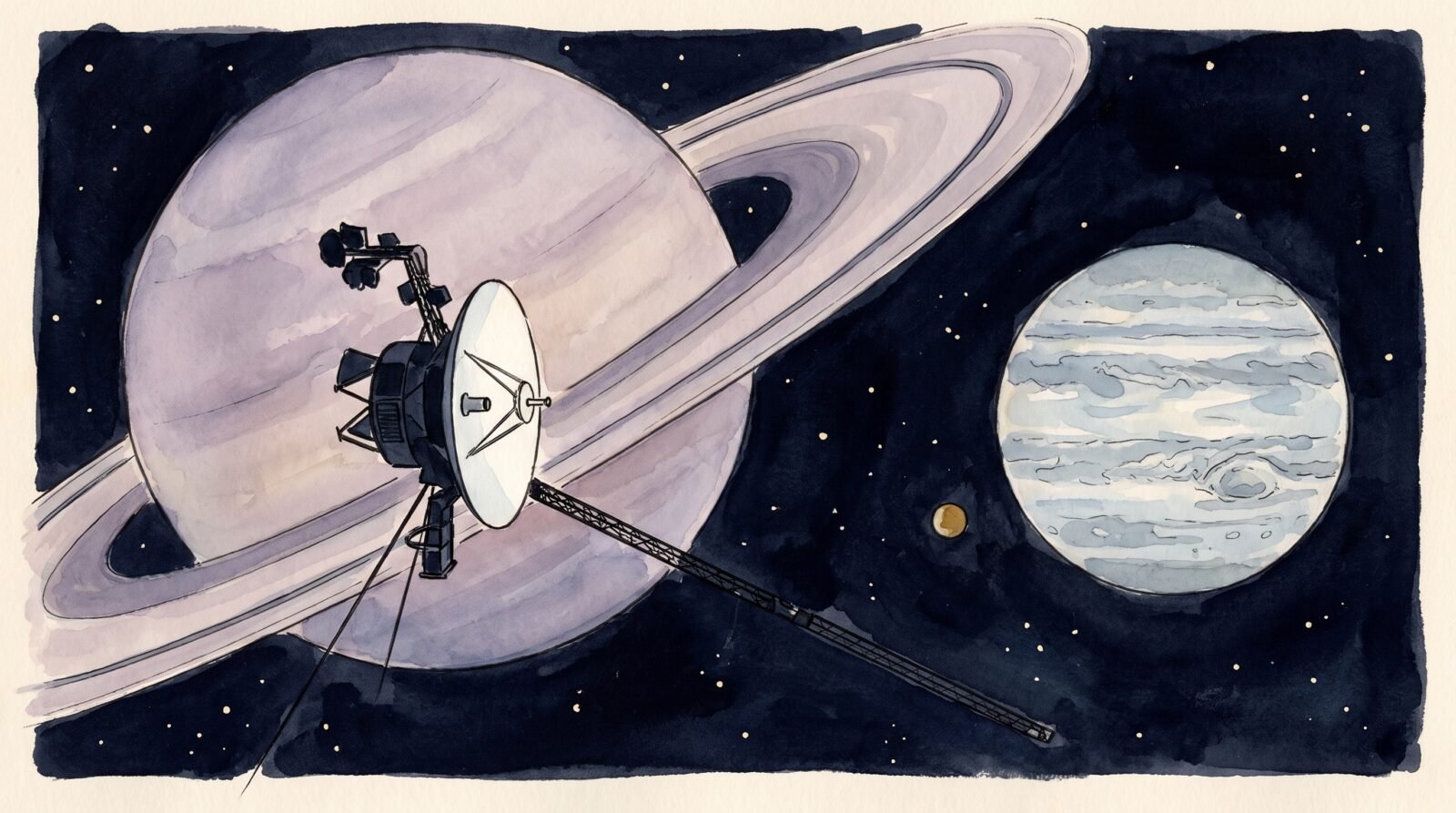
Voyager is a ten-sided aluminium compartment about 0.7 metres across, mounted on a 2.7-metre-high boom at one end and a 3.7-metre dish antenna at the other. The spacecraft weighs about 825 kilograms, including its fuel; without fuel it is just under 720 kilograms. The bus carries three radioisotope thermoelectric generators, two attached to the boom and one below the bus, which together provide about 290 watts of electrical power at launch. The current power is now less than 250 watts. The thermal balance is preserved by a system of louvres on the side of the bus that open and close as the spacecraft moves away from the Sun.
The high-gain antenna is the principal communication link back to Earth. A 3.7-metre parabolic dish, it transmits to the three deep-space network stations at Goldstone in the Mojave Desert, near Canberra in southeastern Australia, and near Madrid in Spain. At Jupiter the round-trip light time is about an hour and a half; at Neptune it is about eight hours. The dish points itself using a sun-tracker and a star-tracker that together provide absolute pointing to within 0.1 degree. The scan platform at the end of the boom carries the cameras and the principal optical instruments. It can be repointed to within 0.005 degree of accuracy, so that a planetary limb can be imaged to within about 30 kilometres of computed position at a hundred million kilometres range.
The instrumentation is the heart of the programme. Each Voyager carries eleven scientific instruments: a pair of imaging cameras, an ultraviolet spectrometer, an infrared spectrometer, a photopolarimeter, a radio science receiver, a magnetometer, a plasma wave receiver, a particle detector, a cosmic-ray detector, a low-energy charged particle detector, and a planetary radio astronomy receiver. Each instrument is built out of largely off-the-shelf 1970s electronics, with redundancy where it was cheap to add. The instrument package weighs about 100 kilograms, which is about an eighth of the spacecraft total mass. The instruments consume about 20 watts per spacecraft at start of mission; the power consumption has been preserved by careful duty-cycling.
Jupiter, March and July 1979
Voyager 1 crossed the orbit of the outermost Jovian satellites, Callisto and Europa, in early February 1979 and made its closest approach to the planet’s cloud tops on 5 March 1979. Voyager 2 made its closest approach on 9 July 1979. The two encounters were separated by four months so that the second spacecraft could see what the first had found; this staggered encounter pattern had the additional advantage that the data from the Voyager 1 encounter was downlinked to Earth before the Voyager 2 encounter began, so the second encounter could be replanned to focus on the new science found by the first.
Jupiter’s atmosphere turned out to be more dynamic, more colourful and more structured than the Pioneer 9 and 10 encounters had led the engineers to expect. The Voyager cameras captured, for the first time, the system of cloud bands that run between the equatorial jet and the higher latitudes. They captured, also for the first time, the little vortices that ride the boundaries between the bands: the brown elongated ovals in the northern hemisphere, the wisps of dark cloud that trail them, the large white oval that had formed by an atmospheric merger in 1939 and stayed in shape for forty years before being broken up by smaller ovals in 1998. The Great Red Spot, which had been observed telescopically for at least a century and a half, was shown to be a giant anticyclone, larger than the Earth, with winds at its rim that reach 600 kilometres an hour.
The satellite system was the bigger surprise. The four Galilean satellites had been known since 1610. The Voyager cameras revealed that Io, the innermost of the four, is the most volcanically active body in the Solar System. The plume of one of its eruptions was photographed silhouetted against the dark side of the disc, and the surrounding deposits of sulphur dioxide frost produce a colourful surface unlike any other in the Solar System. The volcanoes are heated by tidal friction, as the orbits of Io, Europa and Ganymede lock one against another in a resonance that tidally squeezes Io. Europa’s icy surface was shown to be cracked into blocks that have rotated into new positions, suggesting a subsurface ocean of liquid water. Ganymede and Callisto, the two outermost Galileans, were revealed to be ancient, heavily cratered worlds with their own independent histories of geological activity and contraction.
Saturn, November 1980 and August 1981
Voyager 1 made its closest approach to Saturn on 12 November 1980, and Voyager 2 followed on 25 August 1981. The two encounters were again staggered so that the second could be retargeted in light of the first. In the event, the Voyager 1 encounter was the encounter that produced the most surprising revelations, and the Voyager 2 encounter was the one that could be aimed to extend the discoveries. Voyager 1 was commanded to fly close to Titan, Saturn’s largest satellite, to determine whether Titan has an atmosphere. The Titan fly-by consumed much of the manoeuvring fuel and bounded Voyager 1’s trajectory out of the plane of the ecliptic, away from the rest of the Grand Tour. Voyager 2 therefore became the only spacecraft that would proceed on to Uranus and Neptune.
Saturn’s ring system was the unexpected principal discovery of the encounter. From Earth, Saturn had been observed to have a series of concentric rings with two prominent gaps, the Cassini division between rings A and B and the Encke division in ring A. The Voyager cameras revealed a far more complex structure. The rings are subdivided into thousands of narrower ringlets, each composed of ice or ice-coated debris of a particular size and density. There are spokes and ripples in some rings, suggesting that the ring particles are gravitationally perturbed by small satellites embedded in the rings. The F ring, a narrow ring just outside the A ring, was found to be kinked and braided in a way that the orbit theory of the time could not fully explain. The picture of Saturn’s rings that emerged from the Voyager encounters has been the working picture for all subsequent observation.
The Titan fly-by revealed that Titan has a thick, hazy atmosphere of nitrogen and methane. The Voyager instruments measured the surface atmospheric pressure as about one and a half bars, with a surface temperature of about 94 kelvins, cold enough that liquid methane exists at the surface as rain. The actual surface could not be seen because of the haze, and the surface remained unobserved until 2004, when the Huygens probe of the Cassini-Huygens mission descended through the haze and photographed a rocky, sandy terrain on the riverbed of what appeared to be a methane stream. Other Saturnian satellites revealed by Voyager include Enceladus, whose surface was found to be unusually bright and reflective and which is now known to be the source of one of Saturn’s rings; Hyperion, irregularly shaped and tumbling; and Phoebe, an outer satellite shown in the 1981 Voyager 2 data to be a captured body, more similar to a centaur than to the inner moons.
Uranus, January 1986
Voyager 2 crossed the Uranian system on 24 January 1986. The encounter was the test of whether the Grand Tour could continue. The spacecraft had been operating for nine years, four of them in the outer Solar System. Its radioisotope generators were still producing about 320 watts, sufficient for the imaging sequence. The cameras were still capable of resolving a planetary limb at a hundred thousand kilometres with their narrow-angle optics. The principal worry before the encounter was the alignment of the spacecraft’s high-gain antenna relative to the Earth, because Uranus’s magnetic pole was found in 1986 to be tilted by nearly sixty degrees from the rotation pole, and the planet’s rotation axis itself is tilted by nearly ninety-eight degrees, so that the radio dish would need to be repointed in a substantially new direction during the encounter.
Uranus was a featureless blue-green disc on the Voyager cameras. The atmospheric banding that is visible on Jupiter and Saturn is absent, and the planet’s atmosphere is thought to be relatively quiescent. The principal discoveries were made on the satellite and ring systems. Uranus was known to have at least five satellites before the encounter; Voyager 2 found ten more, all named for characters in the plays of Shakespeare and Pope, and all small dark icy bodies. The discovery of the satellite system in the late twentieth century (Miranda, the largest of the new moons, is about 470 kilometres in diameter) established that Uranus has a substantial system of small bodies, like a less-massive version of Saturn’s satellite system.
The ring system had been observed from Earth in 1977, when the planet occulted a star; the occultation produced unusual blinks that suggested the presence of a system of narrow rings. Voyager 2 found that the rings are composed of very dark material, mostly large chunks of ice and rock, and that they are confined to a narrow band between about 38,000 and 51,000 kilometres from the planet’s centre. The shepherd satellites discovered by Voyager 2 are responsible for the narrowness of the rings; their gravity keeps the ring particles from drifting. The magnetic field was revealed as remarkably asymmetric and offset from the planet’s centre, which produced a strongly tilted magnetosphere and created a complex auroral situation at the poles.
Neptune, August 1989
Voyager 2 made its closest approach to Neptune on 25 August 1989. The encounter completed the Grand Tour. The spacecraft is now on a trajectory out of the Solar System, in the general direction of the heliopause. The encounter data was the last planetary science that the programme would produce, and the result has been, in the nearly thirty-five years since, the most thorough survey ever made of Neptune and its system.
Neptune’s atmosphere, like that of Uranus, is mostly hydrogen and helium with about two per cent of methane. The Voyager cameras found a Great Dark Spot, an anticyclone the size of the Earth, in the southern hemisphere of the planet. The spot was a transient feature: subsequent observation with the Hubble Space Telescope in the mid-1990s showed it had vanished or been replaced by a different dark spot. The winds in the atmosphere at the time of the encounter were the fastest in the Solar System, with speeds up to 2,400 kilometres per hour in the equatorial jet, blowing in the same direction as the rotation. The principal remaining internal heat sources were also detected, with Neptune radiating about 2.7 times the energy it receives from the Sun.
The satellite system is dominated by Triton, a large satellite that orbits the planet in a retrograde orbit, suggesting it is a captured body. Triton was photographed with Voyager 2 showing a thin atmosphere of nitrogen with trace methane; a south polar cap of frozen nitrogen with an unusual pink colour; a surface with very few craters, indicating a young geological age; and a small number of what appear to be nitrogen geysers, with long dark plumes trailing southward in the thin atmosphere. The other small satellites of Neptune were also imaged, including Nereid, a small outer moon in an eccentric orbit, and a system of small inner moons that orbit close to the rings. The ring system of Neptune was confirmed by Voyager, with named Adams and Le Verrier, both consisting of very narrow dust rings maintained by the inner satellites.
Beyond Neptune: The Interstellar Mission
After the Neptune encounter Voyager 2 was renamed Voyager 2 Interstellar Mission, and Voyager 1 was retroactively renamed Voyager 1 Interstellar Mission. The official phase of the Grand Tour ended on 31 December 1989, and the interstellar phase began on 1 January 1990. The science that the two spacecraft are now doing is principally the study of the heliosphere and the interstellar medium beyond it.
Voyager 1 crossed the heliopause in August 2012, in a region of space where the solar wind gives way to the interstellar medium. The crossing was identified by a sudden increase in the cosmic ray flux and a sharp change in the magnetic field direction. Voyager 2 followed in November 2018. The two spacecraft are now both in the local interstellar cloud, and they are providing the only first-hand data on the conditions there. The new instrumentation is the simplest Voyager carries: the magnetometer, the cosmic ray detector, the particle detectors, and the radio receiver. The ultraviolet spectrometer was turned off in 2012. The plasma instrument was turned off in 2007.
Both spacecraft are expected to continue operating into the late 2020s, by which time the radioisotope generators will have decayed to a level below which the heaters cannot sustain the bus electronics. The engineering team has been power-cycling the spacecraft and disabling unused subsystems to extend the operating life. By the time the instruments are turned off for good, the two Voyager probes will have operated for nearly 50 years from launch. They will continue to coast, in their respective trajectories out of the Solar System, long after the power runs out.
The Legacy
The Voyager Mission was the most comprehensive survey of the outer Solar System ever flown. The numbers are stark. In the four-planet mission the spacecraft returned about 67,000 images, about 230 Gbits of science data, and worked in concert with the Pioneer and the later Cassini and New Horizons missions to extend the survey of the outer system. The instruments have been calibrated against the same star and the same laboratory standards before and after the planetary encounters, so that the data is still trusted in modern re-analysis.
The legacy is also an institutional one. The Voyager programme established the engineering and managerial template that the outer-planet missions of the twenty-first century have built on. The radiation hardening techniques developed for the Jupiter encounter are the foundations of the radiation hardening that the Europa Clipper mission uses to survive the radiation environment of Europa. The scan-platform pointing accuracy established on Voyager is the working specification for the scan-platform control of the Cassini probe. The trajectory planning techniques developed for the multi-planet Grand Tour are the foundations of the gravity-assist trajectory planning of every modern deep-space probe.
The Voyager Mission is also the legacy of one specific organisational choice: the willingness, in the early 1970s, to commit to a long, expensive programme that would not pay back until the late 1980s. The Voyager programme was, when it was approved in 1972, the most expensive unmanned space mission in the United States history. The decision to approve it was a forward commitment to a long-term science programme that did not exist before, and that the National Academy of Sciences has since built into the formal Decadal Survey process. The continuation of the Voyager programme as an interstellar mission in 1990 was, similarly, a forward commitment. The two spacecraft are the operational expression of that commitment.
The Imaging Subsystem
The Voyager imaging subsystem was the workhorse of the mission, and its performance defined much of the data on which the modern understanding of the outer solar system rests. There are two cameras on each spacecraft, sharing a single optical bench on the scan platform. The narrow-angle camera is a 1500-millimetre focal length Cassegrain telescope with a 0.4 degree field of view and a vidicon tube at the focal plane. The wide-angle camera is a 200-millimetre focal length refractor with a 3.0 degree field of view. Each camera uses the same 800-by-800-pixel vidicon. The frame format, the exposure sequence, and the spectral filtering are controlled by a separate computer that runs the imaging program on the scan platform.
The instruments had been calibrated before launch against the star field and against a set of laboratory test patterns, and the calibration has been re-validated against the same laboratory standards after the deep-space encounters. The narrow-angle camera at Jupiter could resolve about 30 kilometres per pixel at the closest approach; at Neptune the resolution was about 5 kilometres per pixel. The wide-angle camera’s image scale varied inversely with the square of the distance; at Jupiter it was about 200 kilometres per pixel, and at Neptune about 35. The exposure of each frame was set by the imaging computer from the brightness of the target; the cameras had a photometric dynamic range of about five magnitudes, controlled by an exposure sequence from 0.005 to 15 seconds and a filter-wheel set of seven bandpass filters spanning the visible and near-ultraviolet spectrum.
The total imaging record on the Voyager mission is about 67,000 frames spread between the two spacecraft. Most of the frames are of the four planetary encounters; a substantial fraction are of the satellite systems; the remainder are calibration images, dust images, and stellar images. The frames were returned to the Jet Propulsion Laboratory in three different exposure modes: high-bit-depth, medium-bit-depth, and low-bit-depth. Each mode produced different photometric precision and different volume of data. The high-bit-depth frames took longer to transmit to Earth but had higher photometric accuracy. The imaging computer was given priority at the spacecraft during the planetary encounters; the rest of the instruments shared the rest of the data rate as the imaging computer needed it.
The Trajectory Mechanics
The Voyager trajectory planning was the largest optimisation problem in space flight at the time of the launches. The basic geometry is a sequence of three Hohmann transfers linked by planetocentric gravity assists. The Hohmann transfer between Earth and Jupiter requires an injection velocity of about 9.4 kilometres per second from low Earth orbit. The Hohmann transfer between Jupiter and Saturn requires an injection velocity of about 5.8 kilometres per second relative to the Sun. The trajectory is adjustable in flight to take advantage of small changes in the arrival geometry and to use gravity assists at each planet to bend the spacecraft’s path without requiring additional fuel.
The encounter geometry is the difficult part. A gravity assist from Jupiter can add at most a few kilometres per second of velocity change to a fly-by spacecraft, depending on how close the swing-by comes to the planet’s centre of mass and how the encounter geometry is oriented relative to the departure planet. The Grand Tour was feasible because the swing-by geometries for Jupiter in 1979 and for Saturn in 1981 and for Uranus in 1986 and for Neptune in 1989 were each available at the right times and in the right directions for a single spacecraft to chain the four planets in sequence. The complete absence of any one of the swing-by geometries would have broken the chain. The fact that all of them lined up in the late twentieth century is a coincidence.
Voyager 1 was injected into its Earth-Jupiter trajectory on 5 September 1977 from launch complex 41 at Cape Canaveral, on a Titan III E / Centaur rocket. Voyager 2 followed on 20 August 1977, although the relative timing of the launches was reversed so that Voyager 1 was launched second but arrived first. The reason for the switch is that Voyager 2’s optimum trajectory to use the Jupiter-Saturn-Uranus-Neptune alignment required a different launch period, so Voyager 1 could be launched on a faster but different path that bypassed Uranus and Neptune. Both spacecraft were operational within weeks of launch, and both reached Jupiter in good condition. The mission planners made intensive use of trajectory correction manoeuvres over the years of cruise to keep the spacecraft on course; about a dozen such manoeuvres per spacecraft were required.
The Interstellar Mission in Detail
The Voyager interstellar mission is the longest-running deep-space project of the modern era. After the Neptune encounter in 1989, the two spacecraft continued on their outbound trajectories, passing the orbit of Pluto in the early 1990s. The principal science that the spacecraft can do in interstellar space is the study of the heliosphere, the magnetic bubble blown out by the solar wind, and the interstellar medium beyond it. The instruments that operate most usefully in interstellar space are the magnetometer, the plasma-wave instrument (turned off), the cosmic-ray instrument, and the low-energy charged-particle instrument. The ultraviolet spectrometer was turned off in 2012 to conserve power; the infrared spectrometer was turned off earlier. The planetary radio astronomy receiver was turned off in 2008. The photopolarimeter was turned off in 1982.
The Voyager 1 crossing of the heliopause was detected by a sudden change in the local magnetic-field direction, a sharp increase in cosmic ray flux, and a corresponding decrease in the flux of lower-energy particles. The crossing was on or about 25 August 2012 at a distance of about 121 astronomical units from the Sun. The Voyager 2 crossing was on or about 5 November 2018 at a distance of about 119 astronomical units. The two crossings were not identical: the heliopause is a complex boundary whose precise position and structure depend on the local interstellar magnetic field and the surrounding interstellar plasma conditions. Voyager 1’s crossing produced a one-sided signature, while Voyager 2’s crossing produced a more textbook double-sided signature, allowing the first direct sampling of both sides of the heliopause.
The principal finds of the interstellar mission have been the characterisation of the interstellar medium just beyond the heliopause, the discovery of a new region called the magnetic highway at the boundary where the magnetic-field lines of the Sun and of the interstellar medium connect, the measurement of the cosmic ray flux outside the heliosphere, the detection of plasma oscillations in the heliosheath and beyond, and the long-term monitoring of the magnetic field of the local interstellar medium. The Voyager 1 plasma instrument failure in 1980 meant that the plasma environment of the interstellar medium could not be measured at the Voyager 1 crossing; the Voyager 2 plasma instrument is functional and was used at its 2018 crossing. The two spacecraft are now in the local interstellar cloud and should continue to operate for another few years until the power runs out.
The Deep Space Network and the Engineering Template
The Voyager mission relied on a substantial ground infrastructure that the deep space network provided. The DSN stations at Goldstone, Canberra and Madrid, each built in the 1960s and upgraded through the 1970s and 1980s, provided continuous 360-degree coverage of the sky through three large dishes (70 metres, 70 metres and 70 metres after the upgrades of the late 1980s). The data rates from a Voyager spacecraft at Neptune were about 21 kilobits per second. The DSN stations at Neptune distance had to track the spacecraft for about nine hours per pass to return the planetary encounter data. The imaging computer on the spacecraft was given priority for the long planetary encounter returns.
The engineering template that the Voyager mission established has continued to define the design of subsequent outer-planet missions. The Galileo mission, which reached Jupiter in 1995, used a Voyager-derived bus for its high-gain antenna and scan platform. The Cassini mission, which reached Saturn in 2004, used a Voyager-derived scan platform for the imaging system. The New Horizons mission, which reached Pluto in 2015, used a Voyager-derived RTG and a Voyager-derived scan platform. The Europa Clipper mission, in flight as of the time of writing, uses a Voyager-derived RTG and a Voyager-derived radiation-hardened scan platform. The continuing adoption of Voyager engineering in the modern era is the strongest testimony to the influence of the mission on the engineering of outer-planet space flight.
The Cultural Legacy
The Voyager programme has had a long cultural afterlife as well as a scientific one. The Voyager Golden Record, attached to the Voyager 1 and 2 spacecraft, contains a curated set of images, sounds, and music intended as a message from the Earth to any extraterrestrial civilisation that might intercept the spacecraft in the distant future. The record itself was a Voyager-mission project, not a separate space programme, and its cultural influence has been substantial in the half-century since launch.
The idea of a Voyager Golden Record emerged from the late 1960s and early 1970s debates at NASA about the possibility of sending a message to the stars. Carl Sagan and the other scientists involved chose to use the Voyager missions as the carrier, since the Grand Tour trajectories would eventually take the spacecraft out of the Solar System. The record was assembled in 1977, shortly before the launches, and contains audio greetings in 55 languages, a set of natural and cultural sounds of the Earth, and a musical selection spanning Beethoven, Bach, Chuck Berry, and traditional music from around the world. The record is now about 48 light-years from the Earth and is moving in the general direction of the constellation of Ophiuchus. It will continue to drift out of the Solar System long after the spacecraft’s electronics have fallen silent.
The Voyager mission has also had an important role in the popular culture of the late twentieth century. The Voyager 1 photograph of the Earth as a pale blue dot, taken from beyond the orbit of Neptune in 1990 at Sagan’s prompting, has become a defining image of humanity’s small place in the Solar System. The Voyager 1 and Voyager 2 are now mentioned in nearly every elementary astronomy textbook. The mission is referenced in literature, cinema, and music, often in ways that emphasise the long timescale of the spacecraft’s journey out of the Solar System. The cultural presence of the Voyager missions is a substantial component of the modern imagination of the outer Solar System.
References
- Voyager program — Wikipedia, retrieved October 2026.
- Voyager 1 — Wikipedia, retrieved October 2026.
- Voyager 2 — Wikipedia, retrieved October 2026.
- Grand Tour program — Wikipedia, retrieved October 2026.
- Gary Flandro and the 1965 trajectory paper — Wikipedia, retrieved October 2026.
- Beatty, J. Kelly; Petersen, Carolyn Collins; Chaikin, Andrew (eds). The New Solar System — Cambridge University Press, 4th edition, 1999.
- Morrison, David. Voyage to Jupiter — NASA SP-439, 1980.
- Voyager 1: In Depth — NASA Solar System Exploration, retrieved October 2026.
- Voyager Mission (JPL) — Jet Propulsion Laboratory, California Institute of Technology, retrieved October 2026.
- Io volcanism — Wikipedia, retrieved October 2026.
- Europa subsurface ocean evidence — Wikipedia, retrieved October 2026.
- Titan atmosphere and Huygens landing — Wikipedia, retrieved October 2026.
- Neptune ring system — Wikipedia, retrieved October 2026.
- Heliopause crossing of Voyager 1 (2012) and Voyager 2 (2018) — Wikipedia, retrieved October 2026.