The Race for Fusion Power
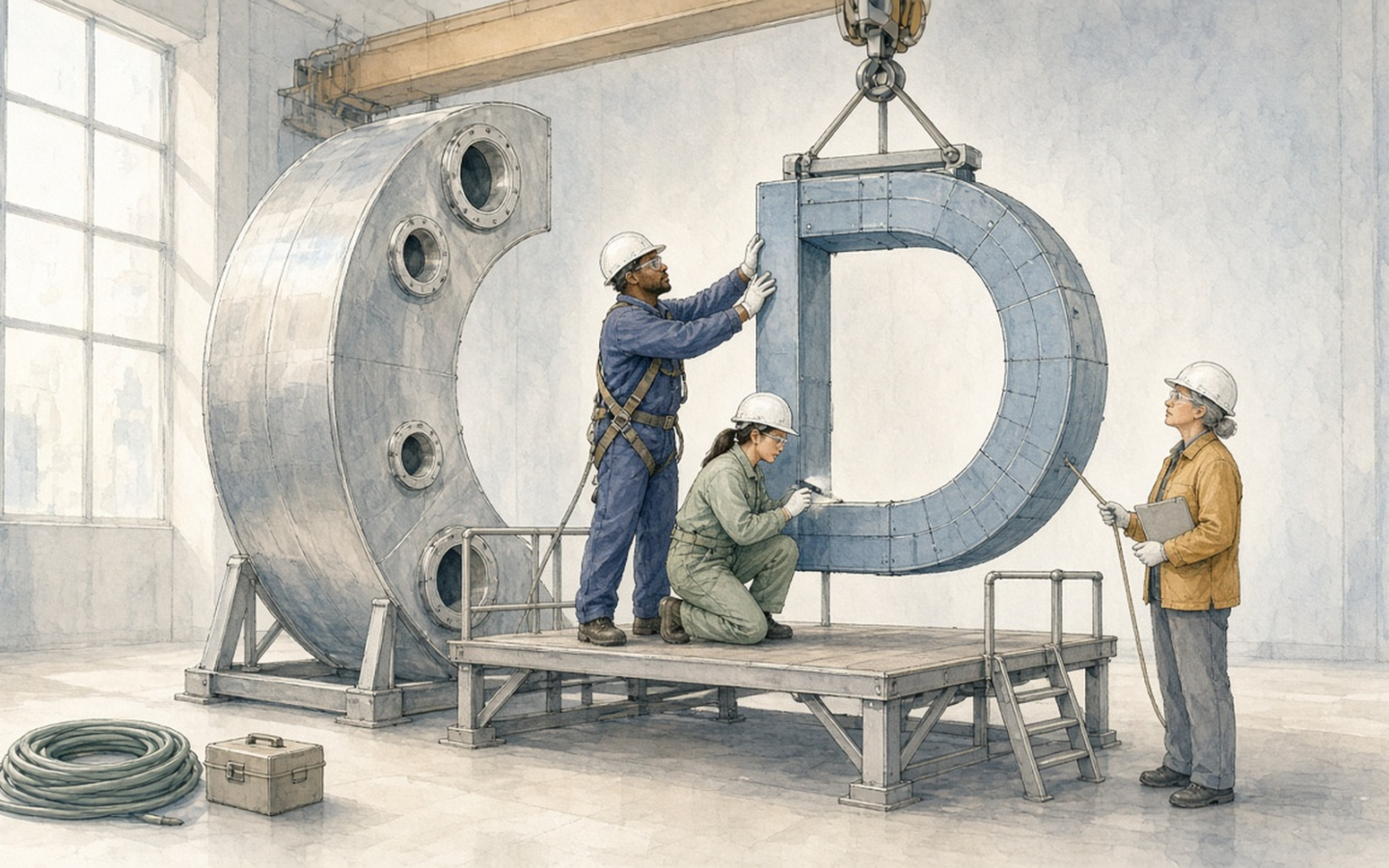
For seventy years fusion power has been the energy source that is always a few decades away. In the past four years that has started to change. A laser laboratory in Livermore has repeatedly made a fuel pellet release more energy than the laser light that struck it, a magnet factory in Devens is winding the coils that let tokamaks shrink, Hefei is more than halfway through assembling a tokamak meant to generate fusion power around 2030, and private companies have signed contracts to sell fusion electricity to Microsoft, Google and Eni. Yet no machine has produced more energy than its whole facility consumes, and the hardest engineering problems lie beyond that point. This is where the race stands in October 2026: the physics, the machines, the companies, the obstacles and the dates that the builders themselves are giving.
Key findings
- The National Ignition Facility has now achieved ignition 11 times; its record shot, on 7 April 2025, produced 8.6 MJ from 2.08 MJ of laser light, a target gain of 4.13[1].
- ITER’s 2024 baseline moved the start of deuterium–tritium operation from 2035 to 2039; six of its nine sector modules were in the tokamak pit by July 2026[2, 3].
- JET ended operations at the end of 2023 with a record 69 MJ of fusion energy from about 0.2 mg of fuel[4].
- Commonwealth Fusion Systems says SPARC is about 80% built and will begin operating in 2027; the company has raised $4 billion in total[5, 6, 7].
- Helion still plans initial operations at its Orion plant for Microsoft in 2028, but now says full 50 MW output will not come before 2029 or 2030[8, 9].
- A 1,000 MW fusion plant would burn about 55.8 kg of tritium a year, while all commercial heavy-water reactors together may hold only 0 to 27.7 kg for fusion in 2055[10, 11].
Why the Sun finds it easy
Nuclear fusion joins light atomic nuclei into heavier ones, and the small loss of mass in the process appears as energy. The Sun does it in its core at about 15 million °C, using ordinary hydrogen and the crushing pressure of its own gravity, turning roughly 600 million tonnes of hydrogen into helium every second[12]. The difficulty is that nuclei are positively charged and repel each other. To fuse, they must approach closely enough for the strong nuclear force to take over, which means climbing the Coulomb barrier or, in the Sun, slipping through it by quantum tunnelling. A star can afford to wait; a power plant on Earth cannot.
Laboratories therefore use the easiest reaction available, between two heavy isotopes of hydrogen, deuterium and tritium. Each reaction releases 17.6 MeV, of which 3.5 MeV goes to a helium nucleus (an alpha particle) and 14.1 MeV to a free neutron[13]. Even this easiest fuel needs temperatures of about 150 million °C, ten times hotter than the solar core, at which matter is a plasma of bare nuclei and free electrons[12]. Deuterium can be extracted from water. Tritium is radioactive, with a half-life of 12.32 years, so almost none exists in nature[10].
Heat alone is not enough. In 1957 the British physicist John Lawson set out the conditions a plasma must meet before its fusion output can outrun its losses[14]. In modern form the Lawson criterion is a triple product of density, temperature and the energy confinement time, which measures how well the plasma holds its heat. For a power plant the product needs to reach about 3 × 10²¹ keV s per cubic metre[15]. Progress is usually reported as a gain factor, Q: the fusion power produced divided by the heating power put into the plasma. Q = 1 is scientific breakeven. When the alpha particles produced by fusion heat the fuel enough to keep it burning, the plasma has ignited.
There is an important caveat in these definitions. Q counts only the heat delivered to the plasma or target, not the electricity drawn by the magnets, lasers, pumps and cooling systems around it. A commercial plant has to clear a much higher bar: it must export more electricity than the whole site consumes, reliably, for years.
Two ways to hold a star
The idea that stars run on fusion goes back to Arthur Eddington in the 1920s. By the 1950s researchers were trying to copy it[16]. In 1950 the Soviet physicists Andrei Sakharov and Igor Tamm proposed the tokamak, a doughnut-shaped vessel in which magnetic coils and a current driven through the plasma itself form a magnetic cage[16]. The name comes from a Russian acronym for “toroidal chamber with magnetic coils”[17]. In 1951 Lyman Spitzer, an astronomer at Princeton, conceived the stellarator, which twists the magnetic field with external coils alone and needs no large plasma current[18]. Fusion research was declassified in 1958, and tokamaks soon pulled ahead[16, 18].
The other family, inertial confinement, abandons the attempt to hold the plasma for long. Instead a tiny pellet of fuel is crushed so fast and so hard that it fuses before it can fly apart, held together only by its own inertia[1]. Between and around these two approaches sit hybrids such as magnetised target fusion and pulsed magnetic schemes, which several private companies are now pursuing.
Ignition at Livermore
The National Ignition Facility at Lawrence Livermore National Laboratory in California fires up to 192 laser beams into a centimetre-sized hollow cylinder called a hohlraum. The laser light is converted into X-rays, which blast the surface off a peppercorn-sized capsule holding frozen deuterium and tritium and drive the fuel inwards at more than 400 kilometres a second[1]. On 5 December 2022 a shot delivered 2.05 MJ of laser energy to the target and produced 3.15 MJ of fusion energy, the first time any laboratory had achieved ignition in this sense[1]. The result was published in Physical Review Letters in 2024[19].
It has since been repeated and improved. LLNL lists 3.88 MJ in July 2023, about 5.2 MJ in February 2024 and 5.0 MJ in February 2025, before the record shot of 7 April 2025: 8.6 MJ, give or take 0.45 MJ, from 2.08 MJ delivered, a target gain of 4.13. The 11th ignition, on 20 June 2026, produced 7.9 MJ with a gain of about 3.8[1]. LLNL credits the April 2025 record largely to a better capsule: synthetic diamond shells in which a trace of tungsten is ramped smoothly up and down through the wall instead of sitting in discrete layers, which removes a source of instabilities. The first full-scale test of this “continuous doping” was the 5 MJ shot of February 2025[20].
These figures need to be read carefully. The gain is measured against the laser energy that reaches the target, not the electricity that powers the laser. NIF’s capacitor banks deliver nearly 330 MJ to its flashlamps on each shot[21], roughly 40 times the record fusion yield. Nor is energy NIF’s main customer. LLNL presents ignition first as a tool for maintaining the US nuclear stockpile, and one ignition shot in October 2025 was a weapons-survivability experiment[1]. A planned upgrade, the Enhanced Yield Capability, would raise the laser energy from 2.2 MJ to 2.6 MJ and could make yields above 30 MJ possible[22].
JET’s farewell and ITER’s long build
For magnetic confinement, the benchmark machine for four decades was the Joint European Torus at Culham in Oxfordshire, which started operating in 1983[16]. In 1997 it produced 16 MW of fusion power from 24 MW of heating, a Q of 0.67 sustained for about a second, which is still the highest Q reached by a tokamak[16, 23]. An energy record of 59 MJ followed, announced in 2022[24]. In its final deuterium–tritium campaign, at the end of 2023, it sustained high fusion power for about five seconds and released 69 MJ using roughly 0.2 milligrams of fuel[4]. JET closed at the end of December 2023 after 105,842 pulses[4, 24].
Its successor is ITER, under construction at Saint-Paul-lez-Durance in southern France and funded by Europe, China, India, Japan, South Korea, Russia and the United States[3]. Its mission is to produce 500 MW of fusion power from 50 MW of heating (Q ≥ 10) in pulses of up to 400 seconds[2]. In 2024 the project replaced its 2016 schedule. Instead of a brief first plasma in 2025, it now plans a Start of Research Operation in 2034 with a more complete machine, deuterium–deuterium operation in 2035, full magnetic energy in 2036 and deuterium–tritium operation in 2039, four years later than before[2, 25]. The extra cost to the ITER Organization was put at €5 billion, a figure still under review by the members, and the first wall is switching from beryllium to tungsten[2].
Assembly has since gathered pace. Teams began lowering completed sector modules, each a vacuum-vessel sector with two toroidal field coils and thermal shielding, into the tokamak pit in April 2025. The sixth of nine went in on 28 July 2026, almost six months ahead of schedule, and the last is now expected by mid-2027 rather than December 2027[3]. The ninth and final vacuum-vessel sector arrived from Italy on 2 October 2026, so every major component of the core machine is now on site[26]. ITER’s director-general, Pietro Barabaschi, is candid about its place in climate policy: “Fusion cannot arrive in time to solve the problems our planet faces today,” he said in 2024, while arguing that it will matter when it comes[2].
Long pulses and twisted magnets
A power plant must run for hours, not seconds, and several machines are now testing that. On 20 January 2025 China’s EAST tokamak, run by the Chinese Academy of Sciences in Hefei, held a high-confinement plasma for 1,066 seconds at nearly 70 million °C[27]. Just over three weeks later, on 12 February, the CEA’s WEST tokamak at Cadarache kept a hydrogen plasma going for 1,337 seconds, about 22 minutes, at around 50 million degrees with 2 MW of heating, pumping 2.6 GJ of energy in and out through actively cooled tungsten walls[28, 29]. South Korea’s KSTAR held ions at 100 million °C for 48 seconds and sustained high-confinement mode for 102 seconds in its 2023–24 campaign, after fitting a tungsten divertor[30].
Stellarators avoid the large plasma current a tokamak needs, at the price of fiendishly complex magnets[31]. Wendelstein 7-X in Greifswald, run by the Max Planck Institute for Plasma Physics, uses 50 non-planar superconducting coils, is designed for plasmas lasting up to 30 minutes, and made its first plasma in December 2015[31]. On 22 May 2025 it held a record triple product for 43 seconds, refuelled by about 90 frozen hydrogen pellets, and in the same campaign it sustained a plasma for 360 seconds with an energy turnover of 1.8 GJ[15]. After publication, JET scientists reported unpublished long pulses of comparable quality lasting up to 60 seconds, so the institute now describes the two machines as joint leaders for long durations[15].
Germany is betting on the design. Proxima Fusion, a spin-out from the Max Planck institute, raised €411 million in July 2026 at a valuation of more than €2.4 billion to build Alpha, a demonstration stellarator near Garching. The plan, agreed with Bavaria and the utility RWE, depends on €1.2 billion of federal funding that has not yet been committed[32].
China builds at speed
In Hefei the Burning Plasma Experimental Superconducting Tokamak (BEST) entered its main assembly phase in 2026. Since July key components have been arriving, and the vacuum vessel, thermal shield and toroidal field magnets are being installed. State media reported on 1 October that more than half of the planned assembly tasks were complete[33]. Construction is due to finish by the end of 2027, and the aim is to demonstrate deuterium–tritium fusion power generation around 2030[33, 34].
In July 2025 the China National Nuclear Corporation set up China Fusion Energy Co. in Shanghai with registered capital of 15 billion yuan, about $2.1 billion[35]. At its first public appearance the company set a goal of commercial fusion power by 2050, and a source quoted by the news site The Paper said it hopes to complete an engineering experimental reactor around 2035 and a first commercial demonstration reactor around 2045[36]. These plans build on years of design work on the CFETR, a machine meant to complement ITER, starting at about 200 MW of fusion power and rising to 1 GW while breeding its own tritium[37]. Its engineering design was completed in 2020, but because BEST now overlaps with some of its goals, Chinese designers have moved on to a larger China Fusion Engineering Demo Reactor aimed at 1.5–3 GW and net electricity[38]. Private firms are moving too: in March 2025 the Shanghai start-up Energy Singularity reported 21.7 tesla from a large D-shaped high-temperature superconducting magnet[39].
Stronger magnets, smaller machines
Much of the recent optimism rests on magnets. ITER’s magnets, like most before them, use low-temperature superconductors that must be cooled to about 4 K[2, 40]. A newer class, high-temperature superconductors made as thin tape coated with rare-earth barium copper oxide (REBCO), can carry large currents in much stronger fields. A tokamak’s performance rises steeply with field strength: by one widely used scaling, doubling the field allows a machine about one-third the linear size for the same gain[39].
On 5 September 2021 MIT and Commonwealth Fusion Systems ramped a large-bore high-temperature superconducting magnet to 20 tesla. According to MIT, it matched the performance of a conventional magnet system of about 40 times the volume[40]. The test unlocked a $1.8 billion funding round, and a central-solenoid model coil followed in 2024[23]. CFS is now assembling SPARC, a compact tokamak at Devens, Massachusetts, designed for a Q above 10[23, 41]. The company said in August 2026 that SPARC was almost 80% complete, with magnets being installed and support systems running[5]. In September its cryogenic plant ran at the 8 K operating temperature[42]. CFS says SPARC will begin operating in 2027 and aims to reach Q > 1, which no magnetic confinement device has yet done[6, 23].
The commercial plant, ARC, is planned for Chesterfield County, Virginia, to supply about 400 MW to the grid in the early 2030s. Google has agreed to buy 200 MW of its output and Eni has signed a purchase agreement worth more than $1 billion[43, 44]. In July 2026 CFS raised a further $1 billion, taking its total to $4 billion, which it says is about 30% of all the capital the fusion industry has raised[7].
In Oxfordshire, Tokamak Energy pursues the spherical tokamak, a squat, cored-apple version of the doughnut. Its ST40 reached 100 million °C in 2022[45]. In September 2026 it completed a 14-month campaign on Demo4, a complete set of 44 high-temperature superconducting coils in a tokamak arrangement, reaching 13.7 tesla and running for about 10,000 hours, including deliberate fault tests[46]. It now also offers its magnets to other companies through a magnet business, and in April 2026 it became the magnet systems partner for Britain’s STEP programme[47].
The private bets
The Fusion Industry Association counted 56 private fusion companies in 2026. They raised a record $4.48 billion in the year to July, bringing the total since 2021 to $14.24 billion, and 71% of them expect the first plant to deliver commercial electricity in the 2030s[48]. Their approaches differ widely, and so does the evidence behind them.
Helion, based in Everett, Washington, and backed by Sam Altman[9], uses a pulsed field-reversed configuration, a self-contained ring of plasma squeezed by rapidly rising magnetic fields, with electricity recovered directly as the plasma pushes back, without a steam turbine[49]. In May 2023 it signed the first fusion power purchase agreement, with Microsoft, for a plant to come online by 2028 and reach at least 50 MW after a year’s ramp-up[50]. In February 2026 Helion reported that its seventh prototype, Polaris, had become the first privately built machine to produce measurable deuterium–tritium fusion, with plasma temperatures of 150 million °C[51]. Construction of Orion, the Microsoft plant at Malaga in Washington state, began in 2025[8].
Helion has also softened its claims. In 2021 it spoke of Polaris demonstrating “net electricity”; it now describes the goal as demonstrating electricity from fusion, saying the term “net” was not well defined[9, 49]. In September 2026 Axios reported that Helion now says Orion will “begin initial operations in 2028”, and that a company executive had acknowledged full 50 MW output would not come before 2029 or 2030[8, 9]. Two papers published in 2026 questioned the physics of Helion’s published design. Karl Lackner and colleagues argued that its assumption that the fuel ions stay much hotter than the electrons probably would not hold in a power plant, and Timothée Nicolas and colleagues concluded that such a machine would struggle to make enough fusion energy to overcome its losses[9, 52, 53, 54]. Helion has replied that it can recover energy far more efficiently than historical estimates assume, and finish each pulse before the hot ions cool[9].
TAE Technologies, in California, also uses field-reversed configurations but aims eventually at hydrogen–boron fuel, which the company says will leave no long-lived radioactive waste[55]. In April 2025 it reported in Nature Communications that its Norm machine could form the plasma with neutral beams alone, which the company says cuts the size and cost of a machine by up to half and de-risks its next prototype, Copernicus[56, 57]. In December 2025 it agreed an all-stock merger with Trump Media & Technology Group valued at more than $6 billion[58]. The registration statement was filed on 30 September 2026 but was not yet effective, so the deal had not closed[59]. TAE has toured candidate sites in Alabama, Ohio and Texas for a first plant generating about 50 MW of electricity, which it targets for the early 2030s[55].
Others have stumbled or changed course. General Fusion in Vancouver, backed by Jeff Bezos, compresses plasma mechanically with a lithium liner, a form of magnetised target fusion. In May 2025, days after first compressing a plasma in its LM26 machine, it cut about a quarter of its staff and appealed for $125 million[60]. In July 2026 it became the first fusion company listed on Nasdaq, with about $150 million in cash; LM26 has so far heated electrons to about 0.72 keV, short of its next goal of 1 keV[61]. First Light Fusion, an Oxford spin-out that fired projectiles at targets and set a pressure record on Sandia’s Z machine, dropped its plan to build a power plant in March 2025. It now plans to supply its amplifier technology and targets to other inertial fusion developers[62].
The engineering wall
Passing breakeven would prove the physics. Turning it into a power station raises at least four further problems, and the first is fuel. A fusion plant consumes about 55.8 kg of tritium for every 1,000 MW of fusion power each year[10]. The main commercial source today is Canada’s CANDU heavy-water reactors, which produce roughly 130 g per gigawatt of electrical output per year[10]. A 2018 UKAEA study, written before ITER’s new schedule, cited unofficial estimates that ITER will use about 12.3 kg over its lifetime, and estimated that between 0 and 27.7 kg will be commercially available for fusion in 2055[11]. Every deuterium–tritium plant will therefore have to breed its own tritium.
Breeding means surrounding the plasma with a blanket containing lithium, which absorbs neutrons and turns into tritium. A plant needs to make slightly more than it burns, to cover decay, losses and the start-up inventory of the next plant. A major review in Nuclear Fusion put the likely achievable tritium breeding ratio at about 1.05 to 1.15. It found that self-sufficiency is impossible if a plant is available less than 10% of the time, and achievable with reasonable confidence only if the plant runs more than half the time and more than about 2% of the tritium injected is burned (after allowing for fuelling losses)[10]. Demonstrating net tritium production in a blanket is the aim of UKAEA’s £220 million LIBRTI programme, which is building a test facility with a high-flux neutron source at Culham, and CFS joined in July 2026 as its first international partner[63].
The second problem is the neutrons themselves. At 14.1 MeV they are far more energetic than fission neutrons, which average under 2 MeV. They knock atoms out of place in steel and create hydrogen and helium inside it, and the damage might degrade structural materials after a few years of operation[64]. Materials scientists have long lacked a neutron source that reproduces these conditions for testing[64]. The international IFMIF-DONES facility near Granada, which will fire a deuteron beam into flowing liquid lithium to make fusion-like neutrons, began site works in September 2026[64, 65]. Its main building is due to be largely complete by 2029[65].
The third is heat on the walls. ITER’s divertor, the exhaust at the bottom of the vessel, must withstand 10 MW per square metre continuously and 20 MW during slow transients, about ten times the heat load on a spacecraft re-entering the atmosphere. It is armoured with tungsten, and its 54 cassettes will be replaced at least once by remote handling[66].
The fourth is cost. An analysis by Ben Lindley and colleagues in Energy Policy estimated that fusion would need to generate electricity at about $80–100 per MWh to compete after 2040. Early tokamak designs, it found, would cost more than $150 per MWh even after learning, because of pulsed operation, frequent replacement of vessel components and inefficient power cycles[67]. When the FIA asked companies how much they would need to make a plant commercially viable, the answers ranged from $100 million to $10.9 billion, with an average of $2.7 billion[48].
Britain’s STEP at West Burton
Britain’s answer is STEP, the Spherical Tokamak for Energy Production, a prototype plant to be built on the site of the former West Burton coal-fired power station in Nottinghamshire[68]. In 2025 the government announced £2.5 billion for fusion, including £1.3 billion for STEP[68]. In March 2026 the delivery company, UK Industrial Fusion Solutions, now becoming UK Fusion Energy, appointed ILIOS, a consortium led by Kier and Nuvia, as construction partner under a £200 million contract. Construction at the site is expected to employ up to 8,000 people at its peak[69]. Tokamak Energy is the magnet systems partner[47]. The programme aims to obtain consents so that construction can start in the early 2030s, to begin operating around 2040, and then to demonstrate net energy[68, 69].
| Programme | Approach | Best result so far | Next stated milestone |
|---|---|---|---|
| NIF (LLNL, US) | Laser inertial confinement | 8.6 MJ from 2.08 MJ on target, gain 4.13 (April 2025) | Laser upgrade to 2.6 MJ; yields above 30 MJ possible |
| JET (UK, closed 2023) | Tokamak | Q 0.67 (1997); 69 MJ in one pulse (2023) | None (closed); data used for ITER |
| ITER (France, 7 members) | Superconducting tokamak | Under assembly; 6 of 9 sector modules in pit | Research operation 2034; D–T 2039 |
| EAST / WEST / KSTAR | Superconducting tokamaks | 1,066 s and 1,337 s pulses (2025); 48 s at 100 million °C | KSTAR goal: 300 s above 100 million °C |
| Wendelstein 7-X (Germany) | Stellarator | Record triple product held 43 s; 360 s pulse (2025) | Plasmas lasting up to 30 minutes |
| BEST (China) | Superconducting tokamak | Under assembly | Completion end 2027; D–T power demo around 2030 |
| SPARC / ARC (CFS, US) | High-field HTS tokamak | 20 T model coil (2021); SPARC about 80% built | Operations 2027, then Q > 1; ARC early 2030s |
| Polaris / Orion (Helion, US) | Pulsed field-reversed configuration | D–T fusion, 150 million °C (2026) | Orion initial operations 2028; full power 2029–30 |
| Norm (TAE, US) | Beam-driven field-reversed configuration | Neutral-beam-only plasma formation (2025) | Copernicus prototype; about 50 MWe plant, early 2030s |
| LM26 (General Fusion, Canada) | Magnetised target fusion | Electrons heated to 0.72 keV | 1 keV, then 10 keV |
| STEP (UK) | Spherical tokamak | Design; construction partner appointed (2026) | Construction early 2030s; operation around 2040 |
When, realistically?
The dates now on the table come from the builders themselves, and they cluster. CFS aims to begin operating SPARC in 2027 and to connect ARC in the early 2030s[6, 7]. Helion says Orion will begin initial operations in 2028[8]. TAE targets its first plant for the early 2030s, and General Fusion aims to complete its next set of technical milestones in 2028[55, 61]. China’s BEST aims at fusion power generation around 2030[33]. The US Department of Energy’s fusion roadmap, finalised in June 2026, is built around pilot plants and commercial power in the mid-2030s, though it commits no funding[70]. The public megaprojects are slower: ITER’s deuterium–tritium phase begins in 2039, STEP is due to begin operating around 2040, and China Fusion Energy Co. aims at commercial fusion power by 2050[2, 36, 68].
Even optimistic dates leave fusion with only a small part to play in cutting emissions by mid-century. The CEA, which runs WEST, says it is unlikely that fusion will make a significant contribution to net-zero emissions by 2050, given the infrastructure needed and the economics still to be demonstrated[28]. What has changed is that the next few years should settle some long-standing questions with hardware rather than projections. The main tests are whether SPARC reaches Q > 1, whether Polaris and Orion turn fusion into electricity, how BEST performs, whether ITER closes its torus on its new schedule, and whether test blankets at Culham can breed tritium in useful amounts.
References
- Lawrence Livermore National Laboratory (2026). Achieving fusion ignition. Extreme Light, Matter, and Fusion (NIF timeline, updated after the 20 June 2026 shot). https://lmf.llnl.gov/science/achieving-fusion-ignition
- ITER Organization (2024, July). New baseline to prioritize robust start to exploitation. ITER Newsline. https://www.iter.org/node/20687/new-baseline-prioritize-robust-start-exploitation
- ITER Organization (2026, 29 July). Two-thirds of ITER tokamak core now in place. Press release. https://www.iter.org/two-thirds-iter-tokamak-core-now-place
- UK Atomic Energy Authority (2024, 8 February). Fusion research facility JET’s final tritium experiments yield new energy record. https://www.ukaea.org/news/fusion-research-facility-jets-final-tritium-experiments-yield-new-energy-record/
- Commonwealth Fusion Systems (2026, 5 August). SPARC progress, DOE milestone approvals reflect CFS power plant maturity. The Tokamak Times (company blog). https://blog.cfs.energy/sparc-progress-doe-milestone-approvals-reflect-cfs-power-plant-maturity/
- Commonwealth Fusion Systems. SPARC: proving commercial fusion energy is possible. Company website. https://cfs.energy/technology/sparc/
- Commonwealth Fusion Systems (2026, 30 July). Commonwealth Fusion Systems raises another $1 billion, bringing total capital raised to $4 billion. Press release. https://www.cfs.energy/news-and-media/commonwealth-fusion-systems-raises-another-1-billion-bringing-total-capital-raised-to-4-billion/
- Helion Energy. Orion: the world’s first fusion power plant. Company website (accessed 8 October 2026). https://www.helionenergy.com/orion
- Neuhauser, A. (2026, 8 September). Helion hedges on how soon it expects to sell electricity from fusion. Axios Pro. https://www.axios.com/pro/climate-deals/2026/09/08/helion-energy-fusion-net-electricity-date-year
- Abdou, M., Riva, M., Ying, A., Day, C. et al. (2021). Physics and technology considerations for the deuterium - tritium fuel cycle and conditions for tritium fuel self sufficiency. Nuclear Fusion 61(1), 013001. doi:10.1088/1741-4326/abbf35 https://doi.org/10.1088/1741-4326/abbf35
- Coleman, M. & Kovari, M. (2018). Global supply of tritium for fusion R&D. UKAEA preprint UKAEA-CCFE-CP(18)06. https://scientific-publications.ukaea.uk/wp-content/uploads/UKAEA-CCFE-CP1806.pdf
- ITER Organization. What is fusion? https://www.iter.org/fusion-energy/what-fusion
- International Atomic Energy Agency. Basic fusion physics. https://www.iaea.org/topics/energy/fusion/background
- Lawson, J. D. (1957). Some criteria for a power producing thermonuclear reactor. Proceedings of the Physical Society, Section B 70(1), 6 - 10. doi:10.1088/0370-1301/70/1/303 https://doi.org/10.1088/0370-1301/70/1/303
- Max Planck Institute for Plasma Physics (2025, June; updated 30 June 2025). Wendelstein 7-X sets new performance records in fusion research. https://www.ipp.mpg.de/5532945/w7x
- EUROfusion. History of fusion. https://euro-fusion.org/fusion/history-of-fusion/
- ITER Organization. What is a tokamak? https://www.iter.org/machine/what-tokamak
- Princeton Plasma Physics Laboratory. History. https://www.pppl.gov/about/history
- Abu-Shawareb, H. et al. (Indirect Drive ICF Collaboration) (2024). Achievement of target gain larger than unity in an inertial fusion experiment. Physical Review Letters 132(6), 065102. doi:10.1103/PhysRevLett.132.065102 https://doi.org/10.1103/PhysRevLett.132.065102
- Lawrence Livermore National Laboratory (2025). Target breakthrough enabled fusion record at NIF. NIF & Photon Science news. https://lmf.llnl.gov/news/target-breakthrough-enabled-fusion-record-nif
- Lawrence Livermore National Laboratory. How NIF works: power conditioning system. https://lmf.llnl.gov/about/how-nif-works/power-conditioning-system
- Lawrence Livermore National Laboratory (2025). National Ignition Facility. Annual Report FY2025. https://annual.llnl.gov/fy-2025/national-ignition-facility-2025
- Commonwealth Fusion Systems (2026, 28 August). Why CFS is confident we’ll demonstrate net fusion energy: Q>1. The Tokamak Times (company blog). https://blog.cfs.energy/why-cfs-is-confident-well-demonstrate-net-fusion-energy-q1/
- EUROfusion (2024, 8 February). Breaking new ground: JET tokamak’s latest fusion energy record shows mastery of fusion processes. https://euro-fusion.org/eurofusion-news/dte3record/
- ITER Organization (2024, 3 July). Press conference on the proposed new baseline: summary. https://www.iter.org/sites/default/files/media/2024-07/baseline_press_conference_summary_july-2024_b.pdf
- ITER Organization (2026, October). A remarkable chapter draws to a close. ITER Newsline. https://www.iter.org/node/20687/remarkable-chapter-draws-close
- ITER Organization (2025). Achievements at EAST and WEST. ITER Newsline. https://www.iter.org/node/20687/achievements-east-and-west
- CEA (2025, February). Nuclear fusion: WEST beats the world record for plasma duration! The Knowledge Factory. https://www.cea.fr/drf/english/Pages/News/Scientific-results/2025/nuclear-fusion-west-beats-the-world-record-for-plasma-duration.aspx
- CEA-IRFM (2025, February). WEST sets a new plasma duration record. https://irfm.cea.fr/en/2025/02/west-sets-a-new-plasma-duration-record/
- Korea Institute of Fusion Energy (2024). Green light on continuous fusion plasma operations technology: a new world record of 48 seconds at 100 million degrees. News release. https://www.kfe.re.kr/board.es?act=view&bid=0026&list_no=13813&mid=a20402000000
- Max Planck Institute for Plasma Physics. Wendelstein 7-X. https://www.ipp.mpg.de/w7x
- Max Planck Institute for Plasma Physics (2026, 8 July). Proxima Fusion raises 411 million euros. Press release. https://www.ipp.mpg.de/2026-proxima-411mio-en
- CGTN (2026, 1 October). China’s ‘artificial sun’ project enters key construction phase. https://news.cgtn.com/news/2026-10-01/China-s-artificial-sun-project-enters-key-construction-phase-1QSYBsXj0d2/p.html
- Global Times (2026, October). China’s ‘artificial sun’ hits new milestone with research campus delivered for use, targets 2030 for first electricity output. https://www.globaltimes.cn/page/202610/1371632.shtml
- Xinhua (2025, 24 July). China sets up state-owned fusion energy company amidst push for inexhaustible clean power. https://english.news.cn/20250724/213ed7ff0e954935bd5645b30a9dafe3/c.html
- The Paper, via Cailian Press (2025, 24 September). 核聚变“国家队”首次公开亮相,展示技术路线及业务布局 [The national fusion team makes its first public appearance] (in Chinese). https://m.cls.cn/detail/2154972
- Zhuang, G., Li, G. Q., Li, J. et al. (2019). Progress of the CFETR design. Nuclear Fusion 59(11), 112010. doi:10.1088/1741-4326/ab0e27 https://doi.org/10.1088/1741-4326/ab0e27
- Ding, R., Chan, V., Li, J. et al. (2025). Integrated physics design of conventional H-mode scenario for China Fusion Engineering Demo Reactor. Plasma Science and Technology 27(10), 100101. doi:10.1088/2058-6272/ade22a https://doi.org/10.1088/2058-6272/ade22a
- Energy Singularity (2025). Energy Singularity’s record-breaking 21.7T magnet to accelerate commercial fusion in China. Company news. https://energysingularity.cn/en/news/news-015.html
- Chandler, D. L. (2021, 8 September). MIT-designed project achieves major advance toward fusion energy. MIT News. https://news.mit.edu/2021/MIT-CFS-major-advance-toward-fusion-energy-0908
- Creely, A. J., Greenwald, M. J., Ballinger, S. B., Brunner, D. et al. (2020). Overview of the SPARC tokamak. Journal of Plasma Physics 86(5), 865860502. doi:10.1017/S0022377820001257 https://doi.org/10.1017/S0022377820001257
- Commonwealth Fusion Systems (2026, 16 September). Cryogenics: how we’ll make our fusion machine magnets colder than Pluto. The Tokamak Times (company blog). https://blog.cfs.energy/cryogenics-how-well-make-our-fusion-machine-magnets-colder-than-pluto/
- Commonwealth Fusion Systems (2025, 30 June). Google and Commonwealth Fusion Systems sign strategic partnership. Press release. https://www.cfs.energy/news-and-media/google-and-commonwealth-fusion-systems-sign-strategic-partnership/
- Commonwealth Fusion Systems (2025, 22 September). Eni and Commonwealth Fusion Systems sign $1 billion+ power purchase agreement. Press release. https://www.cfs.energy/news-and-media/eni-and-commonwealth-fusion-systems-sign-1-billion/
- Tokamak Energy (2022, 10 March). Tokamak Energy moves closer to commercial fusion: 100M degree plasma a world record for a spherical tokamak. Press release. https://tokamakenergy.com/2022/03/10/tokamak-energy-moves-closer-to-commercial-fusion/
- Tokamak Energy (2026, 9 September). Tokamak Energy completes world-leading fusion magnet campaign, validating technology for commercial HTS systems. Press release. https://tokamakenergy.com/2026/09/09/tokamak-energy-completes-world-leading-fusion-magnet-campaign-validating-technology-for-commercial-hts-systems/
- Tokamak Energy (2026, 14 April). Tokamak Energy named Magnet Systems Partner for STEP Fusion programme. Press release. https://tokamakenergy.com/2026/04/14/tokamak-energy-named-magnet-systems-partner-for-step-fusion-programme/
- Fusion Industry Association (2026, 13 July). Fusion industry attracts record annual funding of $4.48bn, raising total to $14.24bn. Press release on The Global Fusion Industry in 2026. https://www.fusionindustryassociation.org/fusion-industry-attracts-record-annual-funding-of-4-48bn-raising-total-to-14-24bn/
- Helion Energy. Polaris. Company website (accessed 8 October 2026). https://www.helionenergy.com/polaris
- Helion Energy (2023, 10 May). Helion announces world’s first fusion energy purchase agreement with Microsoft. Press release. https://www.helionenergy.com/newsroom/helion-announces-worlds-first-fusion-ppa-with-microsoft
- Helion Energy (2026, 13 February). Helion achieves new industry-first fusion energy milestones, accelerating path to commercial fusion. Press release. https://www.helionenergy.com/newsroom/helion-achieves-new-fusion-energy-milestones
- Lackner, K., Burhenn, R., Fietz, S., Müller, A. et al. (2026). Comments on the paper “Fundamental scaling of adiabatic compression of field reversed configuration thermonuclear fusion plasmas”. Journal of Fusion Energy 45, 12. doi:10.1007/s10894-026-00554-2 https://doi.org/10.1007/s10894-026-00554-2
- Nicolas, T., Goupil, C., Herbert, E. & Ball, J. (2026). The challenge for adiabatically heated FRC based D-³He fusion. Journal of Fusion Energy 45, 24. doi:10.1007/s10894-026-00565-z https://doi.org/10.1007/s10894-026-00565-z
- Kirtley, D. & Milroy, R. (2023). Fundamental scaling of adiabatic compression of field reversed configuration thermonuclear fusion plasmas. Journal of Fusion Energy 42(2), 30. doi:10.1007/s10894-023-00367-7 https://doi.org/10.1007/s10894-023-00367-7
- TAE Technologies (2026, 7 April). TAE Technologies completes multi-state site evaluation tour for first fusion power plant. Press release. https://tae.com/tae-technologies-completes-multi-state-site-evaluation-tour-for-first-fusion-power-plant/
- Roche, T., Dettrick, S., Fontanilla, A., Gupta, S. et al. (2025). Generation of field-reversed configurations via neutral beam injection. Nature Communications 16, 3487. doi:10.1038/s41467-025-58849-5 https://doi.org/10.1038/s41467-025-58849-5
- TAE Technologies (2025, 15 April). TAE Technologies delivers fusion breakthrough that dramatically reduces cost of a future power plant. Press release. https://tae.com/tae-technologies-delivers-fusion-breakthrough-that-dramatically-reduces-cost-of-a-future-power-plant/
- TAE Technologies and Trump Media & Technology Group (2025, 18 December). Trump Media & Technology Group to merge with TAE Technologies, a premier fusion power company, in all-stock transaction valued at more than $6 billion. Press release. https://tae.com/trump-media-and-technology-group-to-merge-with-tae-technologies/
- TAE Technologies and Trump Media & Technology Group (2026, 30 September). Trump Media & Technology Group and TAE Technologies file Form S-4 registration statement for proposed merger. Press release. https://tae.com/trump-media-technology-group-and-tae-technologies-file-form-s-4-registration-statement-for-proposed-merger/
- Soper, T. (2025, 5 May). General Fusion CEO asks for new investors as Bezos-backed energy company lays off employees. GeekWire. https://www.geekwire.com/2025/general-fusion-ceo-asks-for-new-investors-as-bezos-backed-energy-company-lays-off-employees/
- General Fusion (2026, 13 July). General Fusion becomes first publicly listed fusion company. Press release. https://generalfusion.com/post/general-fusion-becomes-first-publicly-listed-fusion-company/
- World Nuclear News (2025, 3 March). First Light Fusion switches strategy, drops plans to develop power plant. https://world-nuclear-news.org/articles/first-light-fusion-switches-strategy-drops-plans-to-develop-power-plant
- UK Atomic Energy Authority (2026, 1 July). CFS named first international partner in UKAEA’s LIBRTI programme. GOV.UK. https://www.gov.uk/government/news/cfs-named-first-international-partner-in-ukaeas-librti-programme
- Knaster, J., Moeslang, A. & Muroga, T. (2016). Materials research for fusion. Nature Physics 12(5), 424 - 434. doi:10.1038/nphys3735 https://doi.org/10.1038/nphys3735
- IFMIF-DONES España (2026, 17 September). IFMIF-DONES construction enters a new phase with the start of site works. https://ifmif-dones.es/dones-updates/ifmif-dones-construction-enters-a-new-phase-with-the-start-of-site-works/
- ITER Organization. Divertor. ITER machine systems. https://www.iter.org/machine/divertor
- Lindley, B., Roulstone, T., Locatelli, G. & Rooney, M. (2023). Can fusion energy be cost-competitive and commercially viable? An analysis of magnetically confined reactors. Energy Policy 177, 113511. doi:10.1016/j.enpol.2023.113511 https://doi.org/10.1016/j.enpol.2023.113511
- STEP Fusion (UK Fusion Energy). Frequently asked questions (accessed 8 October 2026). https://stepfusion.com/faqs/
- UK Industrial Fusion Solutions, UK Fusion Energy and Department for Energy Security and Net Zero (2026, 16 March). ILIOS appointment speeds delivery of STEP Fusion at West Burton. GOV.UK. https://www.gov.uk/government/news/ilios-appointment-speeds-delivery-of-step-fusion-at-west-burton
- U.S. Department of Energy (2026, June). Energy Department releases finalized Fusion Science and Technology Roadmap to accelerate commercial fusion power. https://www.energy.gov/articles/energy-department-releases-finalized-fusion-science-and-technology-roadmap-accelerate