The Discovery of Pulsars
The Discovery of Pulsars
Astronomers learned to listen to the radio sky in the late 1940s and 1950s. Karl Jansky of Bell Telephone Laboratories had picked up the first radio noise from outside the solar system in 1932-33; Grote Reber had produced the first maps of the radio sky in the early 1940s; and by 1960 radio astronomy was a thriving sub-discipline with its own observatories, its own textbook and its own bag of unexplained sources. Cambridge, where Martin Ryle had set up the Cavendish Laboratory’s radio astronomy group after the Second World War, was one of its centres. By the mid-1960s the group had produced the Third Cambridge Catalogue of radio sources (3C), a landmark which contained hundreds of distinct radio sources whose physical identification with quasars, radio galaxies and the like was already producing the recognition that the universe was a place of explosive rather than steady energy releases. The discovery of the first pulsar, on 28 November 1967 by a 24-year-old postgraduate student named Jocelyn Bell working under Antony Hewish, was the next major surprise from Cambridge; it led to the identification of a new class of celestial object whose existence had been theoretically predicted but never observed, won the 1974 Nobel Prize in Physics for Hewish and Martin Ryle, and laid the empirical groundwork for several subsequent results in relativistic astrophysics and high-energy astronomy.
The pulsar story is one of those rare cases in modern science where a single observation, properly followed up, made an entire sub-field possible. Before 1967 nobody had knowingly observed a pulsar. By 1970 more than fifty were known, and theoretical models that immediately became the standard interpretation had been worked out. By 1974 a pulsar in a binary star system had been discovered that would, over the following decade, provide the first empirical evidence for gravitational radiation. By the 1990s millisecond pulsars were being used as precision timing standards; in the 2020s they are the working material of pulsar timing arrays that have begun to detect the nanohertz gravitational-wave background. Every step of that sequence has built on the underlying identification of pulsars as rapidly rotating neutron stars. None of it would have happened without the careful observational work that Bell, her supervisor Hewish and their colleagues at the Mullard Radio Astronomy Observatory did in the second half of 1967.
The Interplanetary Scintillation Array
The instrument that Bell had helped to build was the Interplanetary Scintillation Array. Its purpose, when Hewish and his collaborators began construction in the mid-1960s, was to study how radio waves from distant compact sources scintillate in the same way that starlight twinkles when it passes through interstellar turbulence, except the scintillation in this case was due to the solar wind, the stream of charged particles that the Sun emits into interplanetary space. By measuring how strongly a compact radio source twinkled, the Cavendish group hoped to identify compact sources among the larger family of radio-emitting celestial objects. Compact radio sources are mostly the quasars and other distant active galactic nuclei whose angular size on the sky is smaller than the angular scale of the interplanetary medium’s inhomogeneities; extended radio sources like radio galaxies show much less scintillation. So by surveying the sky for scintillating sources, the Cambridge team expected to identify a population of distant compact objects without having to do high-resolution interferometry on each one.
The instrument itself was a four-and-a-half acre field at Lord’s Bridge, just outside Cambridge, in which nearly five hundred and seventy half-wave dipole antennae were arrayed in a regular grid, covering a total of about four and a half acres. The antennae were strung on wooden posts at a height of about two and a quarter metres and pointed at the sky. Each dipole fed a low-noise preamplifier; the signals were combined through a phasing network and then passed to a receiver. The array operated at a wavelength of about 3.7 metres, equivalent to a frequency of 81.5 MHz, which was a frequency low enough to be significantly affected by interplanetary scintillation at the angular scales the array was sensitive to. The detector’s output was not just a single voltage but a multi-channel recording of the radio signal as a function of sidereal time, with each channel corresponding to a different point on the celestial sphere being tracked. The output was recorded on a chart recorder running in real time, producing kilometres of chart paper a week that had to be inspected by eye for evidence of scintillating sources.
Bell arrived at the Cavendish Laboratory in 1965. She had taken a physics degree at the University of Glasgow and completed it through the Lunar Interplanetary Bureau of the Royal Observatory Edinburgh before moving to Cambridge as a postgraduate student. Her PhD thesis was the construction and use of the Interplanetary Scintillation Array; the work was supervised formally by Hewish, with daily supervision by a small group of academics and senior technicians. The team responsible for the construction and operation of the array included Hewish, Bell and four other postgraduates; the chart paper they generated ran for hundreds of metres every week, and analysing it was the routine clerical work that fell largely to Bell.
The chart paper and the bit of scruff
The routine of the array’s operation was, in Bell’s later recollection, tedious but rewarding. Once the array was working, Bell would set up the equipment at the start of each week, monitor its behaviour during the day, change chart rolls, write up notes, and analyse what was on the chart rolls in the evenings. The chart paper ran continuously: the recorder drew a line on the paper with a hot stylus whose horizontal position was sidereal time and whose vertical position was signal intensity. Steady sources appeared as constant vertical excursions on the chart; scintillating sources appeared as oscillating patterns that changed rapidly with sidereal time; interference appeared as characteristic spikes from terrestrial radio sources such as electric motors, microwave ovens and aircraft.
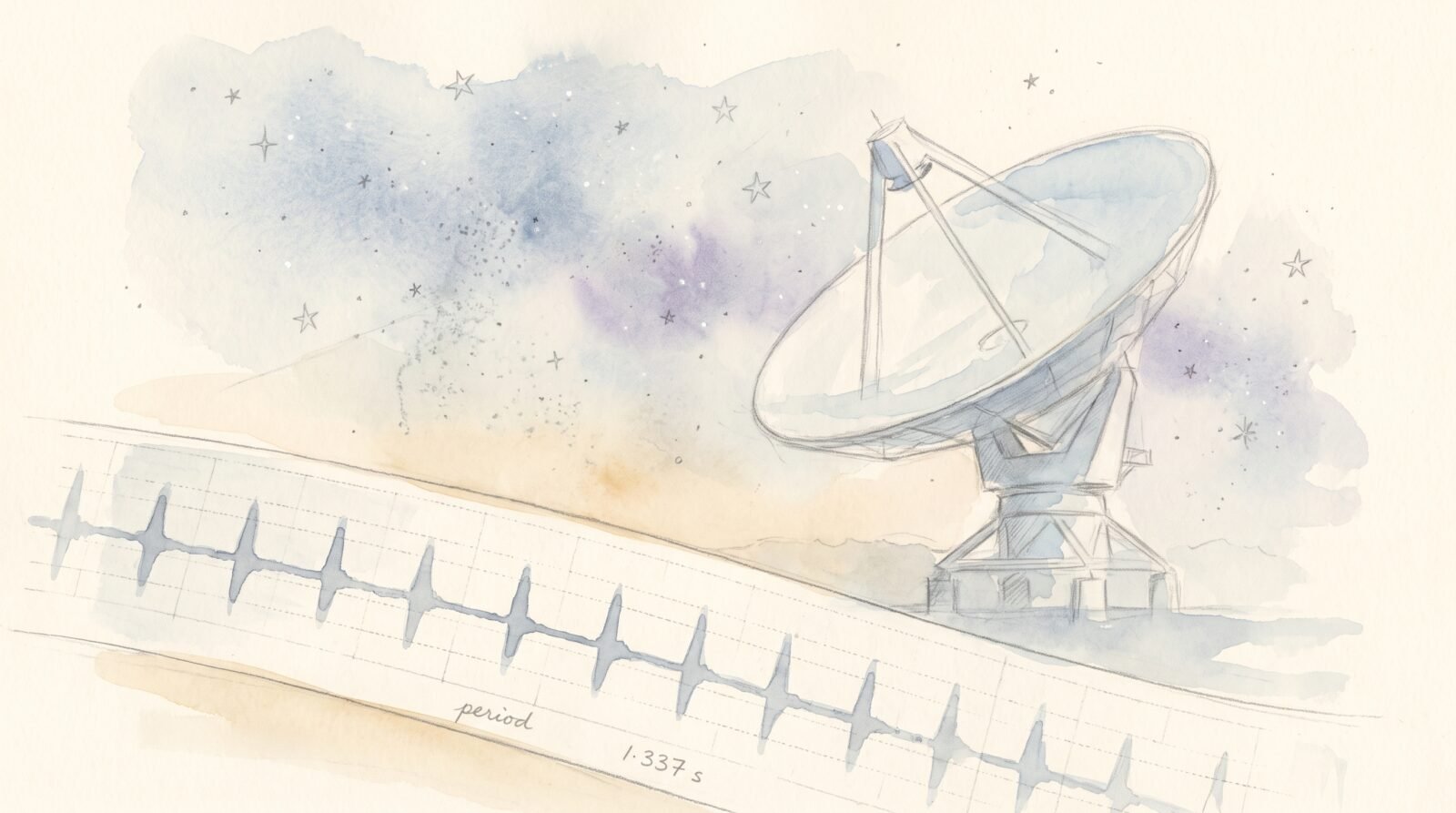
It was during the analysis of the chart paper from August 1967 that Bell first noticed a small but distinctive pattern of signals from somewhere in the constellation Vulpecula, in the summer sky. The pattern looked like a source whose scintillation was anomalous: it appeared to scintillate more than the array’s typical sources would at that position, and in a way that didn’t track the interplanetary scintillation pattern the array was designed to study. Bell flagged the position in her notes and started a routine of regular re-observation; when the array returned to that part of the sky a few months later, on 28 November 1967, the signal came again. This time it was clearer: a sequence of pulses, regular in spacing, with a period of about one and one-third seconds. Bell recorded the pulse train by setting the chart-recorder paper speed to its fastest setting and watching the source traverse the array’s field of view.
The signal was, on inspection, neither noise nor man-made interference. It pulsed. The pulse period was a fraction over 1.3 seconds. The pulses were sharp. They were not the diffuse twinkling that ordinary scintillating sources produced. And the period stayed exactly the same, to within the limits that the chart recorder could resolve, night after night. Bell later described the moment in informal interviews: she walked over to Hewish’s office, pointed at the chart, and said there was something she thought he should look at. The supervisor’s first reaction, she has recalled, was to suggest that she had not properly accounted for some artefact. Once the artefact theories were ruled out by careful instrument checking, both Bell and Hewish began to entertain a more unsettling possibility: that the signal was an attempt at communication by an extraterrestrial civilisation. They dubbed the source LGM-1, standing for Little Green Men 1.
Confirming the source was celestial
The first careful question about the source was whether it really was celestial. The pulse period was much too regular for any known natural source of radio emission, and the regular period was in those first weeks itself the most striking anomaly of the observation. Once Hewish and Bell had ruled out terrestrial interference and instrument artefact, the next step was to see if the source stayed at a fixed sidereal position on the celestial sphere. If a source is truly celestial, it will hold its celestial coordinates against the Earth’s rotation, appearing at the same right ascension and declination every night; if it is terrestrial, it will simply rise and set with the Sun. The Cambridge team set the array to track the region of sky in which the signal had appeared, and watched the signal return, at the same sidereal coordinates, night after night, through November and December 1967.
The question of whether the source stayed in the same celestial position was answered when, in early 1968, the team detected the same pulse period from three other sources in different parts of the sky. The announcement of the discovery, with five co-authors including Hewish, Bell and three other members of the Cavendish team, was published in the journal Nature in February 1968 as “Observation of a Rapidly Pulsating Radio Source.” A second Nature paper in the same month reported three further pulsars in other parts of the sky. The four sources catalogued by the Cambridge team by early 1968 were given the names CP 1919, CP 1133, CP 0950 and CP 0808 (CP standing for Cambridge Pulsar, with the four-digit number recording the right ascension in hours and minutes). CP 1919 was Bell’s original source. They are now designated in the modern pulsar catalogue as PSR B1919+21, PSR B1133+16, PSR B0950+08 and PSR B0808+55, in the standard catalogue notation that records the right ascension and declination in 1950 coordinates.
Once it was clear that the pulses were coming from fixed celestial positions, the Little Green Men theory was effectively retired. A single extraterrestrial transmitter was implausible; multiple transmitters at multiple celestial positions were exponentially more so, and the next obvious question, what class of celestial object this could be, became the central theoretical question that the rest of 1968 worked out.
What physical object pulses once and a third seconds
The pulse periods Bell had measured were short. Star-like objects do not ordinarily change their brightness once and a third seconds. White dwarf stars, the densest known stars at the time, oscillate or otherwise vary on characteristic periods of seconds to minutes. The Sun, an ordinary star, has a five-minute oscillation period. Neutron stars, hypothetical objects predicted by Baade and Zwicky in 1934 as the residue of supernova explosions, had never been observed, but they were theoretically expected to have diameters of about ten kilometres and so to be capable of much shorter vibration periods, on the order of milliseconds.
Two research groups took up the question of what kind of object could produce such short-pulse radio emission. The first paper was by the Italian theorist Franco Pacini, then a post-doctoral researcher at Cornell University; it appeared in Nature on 11 November 1967, just three weeks before Bell’s first confirmed detection of the regular pulses. Pacini’s paper suggested that the rotating magnetised neutron star could power the Crab Nebula’s continuing synchrotron emission. The Crab Nebula was a known supernova remnant, the visible remnants of a stellar explosion recorded by Chinese astronomers in the year 1054. Pacini argued that the neutron star at the centre of the nebula, by losing rotational energy through magnetic dipole radiation, would deposit exactly the right amount of energy to keep the nebula shining. His paper did not invoke pulsars (which had not yet been detected); it invoked a class of object which the pulsar discovery soon proved to be real.
The second paper, by Thomas Gold of Cornell, was published in 1968 after the Cambridge discovery was announced. Gold proposed that the pulsars were rapidly rotating neutron stars, with the radio emission being produced by charged particles being accelerated out of the magnetic polar regions of the star and the electromagnetic radiation being beamed by the strong magnetic dipole. Because the radiation was beamed rather than isotropic, it would sweep across the sky like a lighthouse beam; an observer on Earth would see a pulse every time the beam crossed the line of sight to the star. Gold’s model predicted that the pulses should slow down at a measurable rate as the neutron star lost rotational energy, and that more rapidly rotating pulsars should exist. Both predictions were dramatically confirmed within months of the pulsar announcement: a pulsar with a period of 89 milliseconds was found in the Vela supernova remnant and one with a period of 33 milliseconds in the Crab Nebula; and the Crab pulsar in particular was shown to be slowing down at a rate of about one part in 2400 per year, in good agreement with the rotational-energy-loss prediction.
The physical model of a pulsar as a rotating, magnetised neutron star has been the working interpretation ever since. The interior of a neutron star is mostly neutron matter at nuclear density; the exterior is a relatively thin crust of heavier nuclei; the magnetic field, originally generated during the supernova collapse by flux compression of the progenitor star’s field, is of order ten to one hundred billion Tesla. The star rotates with periods that range from the few-millisecond record-holders up to several seconds for the older, slower pulsars. The radio emission is produced near the magnetic poles, by a cascade process whose precise mechanism is still debated; the long-standing picture of a polar-cap, polar-emission geometry has been supplemented in recent years by alternative models involving outer-magnetospheric or current-sheet emission, but the basic rotating-magnet structure remains. For the broader observing community the central point is that the observed pulse period is a window into the rotational dynamics of an object whose bulk interior is in the realm of nuclear-density matter that no terrestrial laboratory can directly probe.
The Crab pulsar, the slowing-down, and the energy budget
Two confirmations within months of the Cambridge publication made the identification compelling. The first was the discovery of a pulsar in the centre of the Crab Nebula, reported in early 1969. The Crab Nebula had been known as an active radio and optical source for decades; it had also been known to contain a neutron star, the stellar residue of the supernova recorded in 1054, although the neutron star itself had not been visible. The detection of a 33-millisecond pulsar at the precise position of the nebula’s central star showed that the supernova residue was indeed a rotating neutron star and that the neutron star was consistent with being the energy source of the surrounding nebula. The Gold prediction was right.
The second confirmation was the slowing-down measurement. The Crab pulsar’s period was 33 milliseconds in early 1969 and grew steadily longer at a rate of about 36 nanoseconds per day. The slowing implied that the pulsar was losing rotational kinetic energy at about four times ten to the thirty-one watts, an enormous figure, well in excess of the rate at which the Crab Nebula was observed to emit electromagnetic radiation. The rotational-energy budget exactly matched the radiative-energy requirement of the Crab; the rotational-energy picture was therefore consistent with the observed energetics of the nebula. Within a year of Gold’s 1968 proposal, the rotating-neutron-star interpretation had been both qualitatively confirmed and quantitatively calibrated.
The Hulse-Taylor binary and the first evidence for gravitational waves
The pulsar story continued through the 1970s with discoveries that took the field in new directions. Russell Hulse and Joseph Taylor, then at the University of Massachusetts Amherst, were conducting a systematic pulsar survey at the Arecibo Observatory in Puerto Rico when, in 1974, they detected a pulsar whose pulse period was varying in a way that could not be explained by an isolated rotating neutron star. The pulse was reaching Earth consistently earlier when the pulsar was on one side of its orbit and consistently later when it was on the other, with the pattern repeating every 7 hours 45 minutes. The pulsar, catalogue name PSR B1913+16, was in a binary system with a companion star; the timing irregularities were Doppler shifts produced by the pulsar’s orbital motion.
The discovery of an isolated pulsar’s pulse-period variation required the rotation interpretation. The discovery of a binary pulsar required additional relativistic orbital mechanics. Within a few years of the discovery, Taylor and his collaborators had refined the pulsar timing to a high enough precision to map the orbit’s periastron advance: the orientation of the pulsar’s closest approach to its companion shifts by 4.2 degrees per year, much faster than the perihelion advance of Mercury, which the general theory of relativity predicts in 100 years. By the early 1980s Taylor and his colleagues had accumulated enough timing data that the orbital period of the binary was found to be decreasing by about 76 microseconds per year. The loss of orbital energy was, the scientists reported, in precise agreement with the energy that general relativity predicts would be radiated away by the binary in the form of gravitational waves. By 1982 the pulsar was arriving at its periastron more than a second earlier than would have been expected had the orbit not been shrinking; by 2010 the agreement between the observational data and the Einstein prediction reached an accuracy of about one part in a thousand.
The Hulse-Taylor binary pulsar produced the first empirical evidence for gravitational waves. Almost two decades later, in September 2015, the Laser Interferometer Gravitational-Wave Observatory (LIGO) detected gravitational waves directly from a stellar-mass binary black hole merger; another seventeen months of work produced the first binary neutron star merger detection in August 2017. Both direct detections were the kind of resolution-based instrumentation that Hulse and Taylor had predicted when they argued that gravitational-wave emissions from compact objects should produce measurable changes in binary orbits. The Hulse-Taylor pulsar is now a piece of textbook astrophysics: its fifteen years of timing data, taken at Arecibo and at smaller radio observatories, have provided four of the most stringent observational tests of general relativity ever carried out. Hulse and Taylor received the 1993 Nobel Prize in Physics for the discovery. The prize was the second Nobel associated with pulsars; together with the earlier 1974 prize to Hewish and Ryle, it signalled how thoroughly the pulsar phenomenon had integrated itself into the working toolkit of relativistic astrophysics.
Millisecond pulsars and the pulsar timing array
A second major strand in the pulsar story concerns millisecond pulsars. These are pulsars whose spin period is in the range of about one to ten milliseconds, much faster than the youngest pulsars such as the Crab. The first millisecond pulsar was discovered in 1982, with a pulse period of 1.6 milliseconds; a few hundred more have since been discovered, mostly through systematic searches conducted with the largest single-dish radio telescopes and with radio arrays. Millisecond pulsars are believed to have been spun up by accretion from a companion star in a close binary system; the donor star has typically been consumed or ejected, leaving the millisecond pulsar as an isolated rapidly-rotating neutron star. Their spin-down rates are extraordinarily low. Their pulse periods are among the most stable clocks known in nature; the rotation of a millisecond pulsar over decades resembles the rotation of a high-quality atomic clock.
This stability is what makes millisecond pulsars useful as the timing standards of a completely different kind of astronomical instrument, the pulsar timing array. The basic idea, which goes back to work by Foster and Backer in the early 1990s, is that if multiple millisecond pulsars are monitored simultaneously and continuously over years or decades, the timing data can be searched for an effect that should be common to all of them: a perturbation in the pulse times-of-arrival that has the signature of a gravitational wave passing through the Earth-pulsar system. The Hellings-Downs curve, theoretically predicted by R. W. Hellings and G. S. Downs in 1983, gives the angular dependence of the gravitational-wave-induced correlation in the timing residuals of pairs of pulsars; it is the signature that distinguishes a real gravitational-wave signal in pulsar timing data from any other systematic or noise effect. Detecting it requires millisecond pulsars, long timing baselines and many pulsars, because the expected timing perturbations are extremely small.
The North American Nanohertz Observatory for Gravitational Waves (NANOGrav) is one of the major pulsar timing array collaborations. It has been running since 2004 and has observed a steadily growing set of millisecond pulsars. By the time of its 12.5-year data release in 2020, NANOGrav had reported an enigmatic timing signal that was common to the pulsars in its array but too faint to confirm as the gravitational-wave background signature. By the time of its 15-year data release, published on 28 June 2023, the collaboration had assembled enough data to show that the timing residuals correlate between pairs of pulsars in the pattern predicted by general relativity for a stochastic background of gravitational waves. The 15-year data set drew on observations of 68 millisecond pulsars using the Arecibo Observatory, the Green Bank Telescope and the Very Large Array; the length of the timing baseline reached nearly 16 years for the best-observed pulsars. NANOGrav’s results were published simultaneously with reports of evidence for the same background by the European Pulsar Timing Array and the Parkes Pulsar Timing Array in Australia. The most likely physical source of the signal is the population of supermassive black hole binaries distributed across galactic nuclei throughout the universe. The detection marks the second gravitational-wave window to have been opened, after the high-frequency window that LIGO opened in 2015.
The 2018 Special Breakthrough Prize
A different strand of the pulsar story, and one that has its own substantial history, is the place of Jocelyn Bell’s name in the Nobel Prize record. The 1974 Nobel Prize in Physics was awarded to Antony Hewish and Martin Ryle for the discovery of pulsars. The Royal Swedish Academy’s press release described Hewish’s “decisive role” in the discovery. Bell, who was a PhD student at the time of the discovery and the second-named author on the Nature paper that reported it, was not included in the prize. Many astronomers argued at the time, and continue to argue, that this was a serious omission: the observation, the recognition that the pulses were regular, the careful check that the source was celestial and the comparison against instrument and terrestrial interference were substantially Bell’s own work. The omission raised a broader question about the recognition of work done by graduate students; it also raised a question specific to scientific institutions of the 1960s about the treatment of women in astrophysics.
Bell herself, then Jocelyn Bell Burnell (she married in 1969), has not publicly criticised the Nobel committee and has repeatedly stated that she considers the prize was given appropriately given her status as a graduate student at the time of the discovery. Her subsequent career has been substantial: she worked in gamma-ray astronomy at the Mullard Space Science Laboratory and at the Royal Observatory Edinburgh; she served as Dean of Science at the University of Bath and as Visiting Professor at several institutions. In 2018 the Special Breakthrough Prize in Fundamental Physics was awarded to Bell Burnell in recognition of her “fundamental contributions to the discovery of pulsars” and for her “years of dedicated leadership, stewardship and inspiriting mentorship.” She donated the three-million-pound award to fund scholarships for women and other under-represented groups in physics, an action that founded the Bell Burnell Graduate Scholarship Fund. The fund has, since 2018, supported more than a hundred graduate students in physics in the United Kingdom and Ireland who would otherwise have been unable to begin doctoral research.
The Bell Burnell fund is now part of the British physics landscape: it is administered by the Institute of Physics, it has been matched by additional funding from research councils and learned societies, and it functions as a small but recognisable intervention in the demographic structure of UK physics. The relatively modest scale of the intervention belies its intellectual importance; for a generation of physicists whose PhD funding was supported by the fund, the existence of the prize and its donor’s decision are themselves an artefact of the pulsar’s discovery. The pulsar story, in this sense, has produced not just data but institutions.
Modern instruments and ongoing questions
Three further developments extend the story into the present. The first is the very large telescope instrumentation that drives modern millisecond pulsar work. The MeerKAT telescope in South Africa, the Low-Frequency Array (LOFAR) spreading across Western Europe, the Five-hundred-metre Aperture Spherical Telescope (FAST) in Guizhou, China, and the CHIME detector in British Columbia are all producing systematic surveys of new pulsar populations. FAST in particular has added several hundred new millisecond and ordinary pulsars to the catalogue in the years since 2018.
The second is the loss of the Arecibo Observatory. The Arecibo telescope’s 305-metre primary dish, collapsed by a cable failure in August 2020 after decades of use as a pulsar survey instrument, has now been written off. NANOGrav’s 15-year data release was the last NANOGrav project that made substantial use of Arecibo; subsequent pulsar timing work has been re-distributed across the Green Bank Telescope, the Very Large Array and the CHIME telescope. The pulsar timing array community, in other words, has had to absorb the loss of one of its primary instruments and rebudget its observing time across other facilities.
The third is the multiplicity of sources for the nanohertz gravitational-wave background. The 2023 NANOGrav evidence was, as the collaboration papers emphasised, broadly consistent with the expected signal from a population of supermassive black hole binaries distributed across galactic nuclei throughout the universe. It is also consistent with a number of cosmological sources: a population of cosmic-string loops contributing gravitational-wave radiation in the early universe, phase transitions in the early universe producing a phase-transition gravitational-wave background, or inflation-era physics. The next decade of millisecond pulsar timing data, particularly the 20-year NANOGrav data set now in preparation, and the integration of NANOGrav with the Indian and Australian and Chinese pulsar timing arrays within the International Pulsar Timing Array (IPTA) collaboration, will be the route by which these alternative explanations are tested.
Why the discovery mattered
Five consequences stand out. First, the discovery opened up neutron stars as an empirical sub-field. Before 1967, neutron stars were a theoretical prediction. After 1967 they were regular observational objects whose population, distribution and physical characteristics could be studied by the same kinds of astronomical tools used for other stars.
Second, the pulsar mechanism established a class of cosmic laboratory for the study of matter at nuclear density. The mass and the radius of a neutron star are constrained by the same relativistic equations used in other contexts; the moment of inertia, the magnetic field strength, the rotational period and the slowdown rate are measurable. The pulsar population provides a series of independent determinations of the equation of state of nuclear-density matter, and the current theoretical debate about whether the equation of state is soft, medium or stiff is being driven by pulsar population studies rather than by laboratory nuclear physics.
Third, the Hulse-Taylor binary has been a precision test bed for general relativity. By measuring the orbital decay, the gravitational-mass loss predicted by Einsteinian gravitational-wave emission has been calibrated to a few parts per thousand against the simplest prediction of the theory. Several binary pulsars are now known, including several discovered by the Parkes Pulsar Timing Array, and they form a collection of independent tests of the same prediction.
Fourth, the pulsar timing array technique has opened the nanohertz gravitational-wave window. It is the lowest-frequency gravitational-wave window so far; future extensions include space-based interferometers (LISA, which has been adopted as ESA’s L3 mission), which will fill in the millihertz window, and the existing high-frequency ground-based interferometers (LIGO, Virgo, KAGRA), which cover the 10-to-1000 hertz window. The pulsar timing array is the only one of these three windows to use neutron stars themselves as the timing clock, and it is the only one to use millisecond pulsars specifically. The whole programme of multi-band gravitational-wave astronomy is, in this sense, the pulsar story at the cosmological level.
Fifth, the cultural and institutional legacy of the discovery has included the Special Breakthrough Prize, the Bell Burnell Graduate Scholarship Fund, the wide array of pulsar research groups at universities around the world, and the public understanding of stars that has built up around neutron stars. Pulsar research has been a stable sub-field of astrophysics for almost sixty years, with at least one observationally productive group at almost every major university. None of this institutional presence was predictable in 1967. The first detection on the chart paper at Lord’s Bridge produced much more than its authors could have imagined at the time.
What the chart paper has become
Looking back, the central scientific event of late November 1967 looks both small and large. It was small in the sense that it produced a single fact, a celestial position and a pulse period of one and a third seconds, on a chart-paper record about a quarter of an inch long. It was large in the sense that the fact has been built up into a class of objects that has driven a half-century of astronomical progress. The pattern by which a single observation produces an entire research field is familiar in astronomy (the discovery of quasars, the discovery of the cosmic microwave background) but it is not inevitable; it depends on having the right kind of instrument being run by the right kind of person who has the patience to do the clerical work properly. Bell has the patience; the instrument was the right one; the resulting objects have been the basis of a major research field. Sixty years later, the chart paper at Cambridge and the array at Arecibo are still visible in modern physics; the 2023 pulsar timing array results are themselves a form of the same observational discipline that produced the first 1967 detection.
For the future, the immediate programmes are the 20-year NANOGrav data set, the larger combined IPTA data sets, and the continued addition of new pulsars to the catalogue from MeerKAT, FAST, CHIME and LOFAR. The next decade is likely to produce more stringent constraints on the nanohertz gravitational-wave background and possibly the first individual supermassive black hole binaries within it. Beyond that, the pulsar timing arrays and the ground- and space-based interferometers will together compose a multi-band gravitational-wave window from nanohertz through to kilohertz; the windows will then be combined to study, jointly, the merger population of compact objects throughout cosmic history. The mechanism by which this will all happen was begun by Bell’s quarter-inch scruff on a chart, by the extraordinarily careful work that confirmed it as a celestial source, and by the theoretical recognition, by Pacini and Gold, of what a rotating magnetised neutron star would look like.
References
- Jocelyn Bell Burnell biographical entry (English Wikipedia) - Wikipedia, accessed 2026; covers her 1967 detection of the LGM-1 source, the publication of the Nature paper, and the special Breakthrough Prize in 2018.
- “Journeys of discovery: Jocelyn Bell Burnell and pulsars” (University of Cambridge) - University of Cambridge Communications, account of the November 1967 detection and the breakthrough-prize donation to the scholarship fund.
- Hulse-Taylor pulsar entry (English Wikipedia) - Wikipedia, accessed 2026; details the 7.75-hour binary orbit, the periastron advance of 4.2 degrees per year and the orbital-decay evidence for gravitational-wave energy loss.
- “PSR 1913+16 | binary star” (Encyclopaedia Britannica) - Britannica, accessed 2026; summary of the binary-pulsar discovery and its role as an empirical test of general relativity.
- “Scientists use Exotic Stars to Tune into Hum from Cosmic Symphony” (NANOGrav press release for the 15-year data release) - NANOGrav Physics Frontiers Center; details the 68-pulsar dataset and the Hellings-Downs correlation.
- Agazie et al., “The NANOGrav 15-year Gravitational-Wave Background Methods,” arXiv:2306.16223 - arXiv pre-print, submitted 28 June 2023; published in Phys. Rev. D 109, 103012 (2024).
- “Focus on NANOGrav’s 15 yr Data Set and the Gravitational Wave Background” - IOP Science Focus Issue (Astrophysical Journal Letters); June 2023; the suite of NANOGrav papers documenting the nHz gravitational-wave-background detection.
- Elena Amato and Niccolò Bucciantini, “Fifty years since Franco Pacini’s prediction” (INAF Osservatorio Astrofisico di Arcetri) - INAF outreach article; recalls the November 1967 Nature paper proposing a rotating magnetised neutron star as the energy source for the Crab Nebula.
- Pulsar entry (English Wikipedia) - Wikipedia, accessed 2026; covers the discovery and subsequent interpretation of pulsars as rotating neutron stars.
- Worldcat union catalogue search for the magnetised-rotating-neutron-star literature on pulsars - Worldcat reference tool.
- Worldcat union catalogue search for D. R. Lorimer and M. Kramer, Handbook of Pulsar Astronomy - Worldcat reference tool; the standard reference handbook for the field.