The LIGO Gravitational Wave Detection
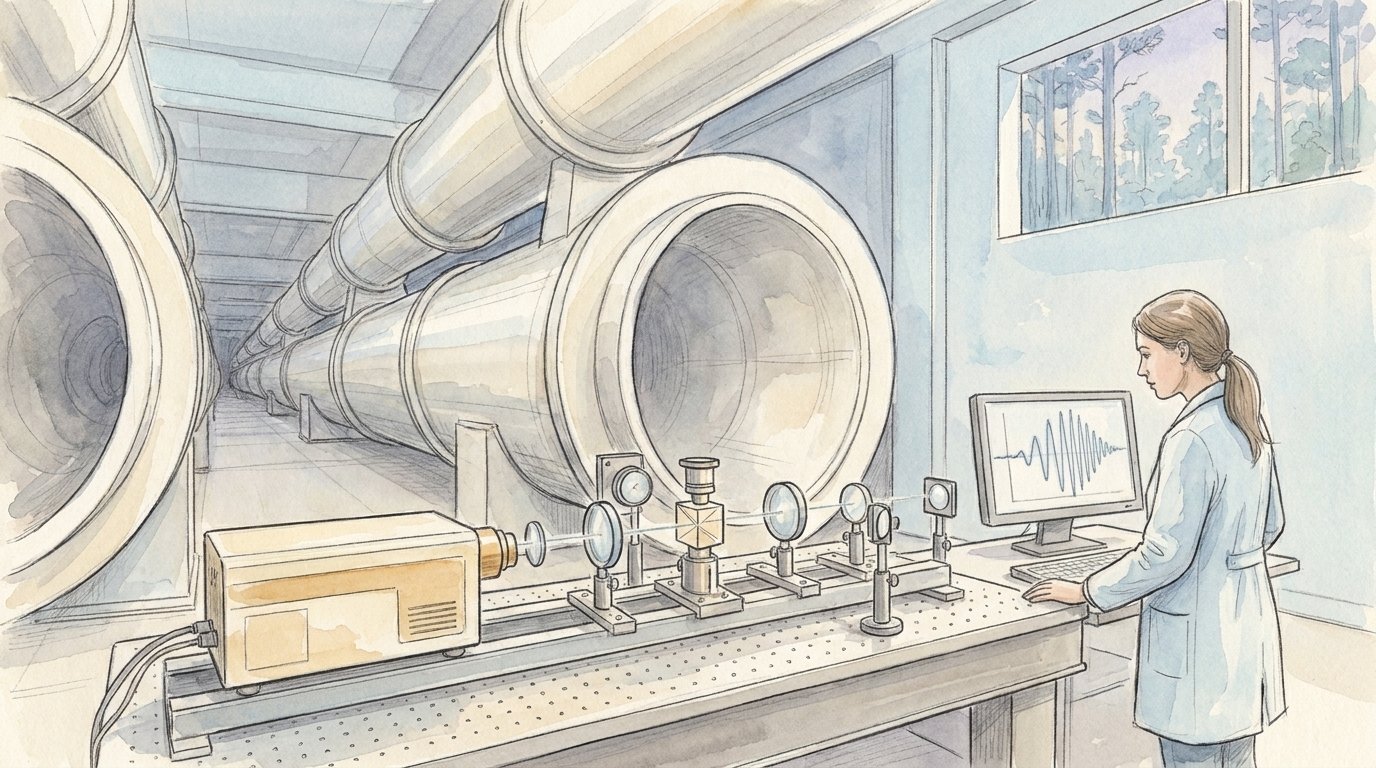
On 14 September 2015, at 09:50:45 UTC, the two detectors of the Advanced Laser Interferometer Gravitational-Wave Observatory recorded a signal that lasted a fifth of a second and changed the way humanity listens to the universe. The signal, named GW150914, was the first direct detection of gravitational waves – ripples in the geometry of spacetime predicted by Albert Einstein a century earlier. The detection opened a new window on the cosmos and was followed by dozens more, including the celebrated GW170817 event that combined gravitational-wave and electromagnetic observation of the same source.
This essay traces the path from Einstein’s 1916 prediction to the Advanced LIGO detection of 2015 and beyond. The story involves four intersecting histories. There is the history of general relativity as a physical theory. There is the history of the interferometer as an instrument. There is the history of the collaboration that built the detectors. And there is the history of the astrophysics of the sources that produce detectable gravitational waves – mostly the inspiral and merger of compact binary systems of black holes and neutron stars.
At a glance
Gravitational waves are transverse ripples of the spacetime metric that propagate at the speed of light. They are predicted by Einstein’s general theory of relativity, in which gravitation is the curvature of spacetime produced by mass-energy. The first indirect evidence for gravitational waves came from the Hulse-Taylor binary pulsar, observed from 1974 onwards, which showed orbital decay consistent with gravitational-wave emission. The first direct detection came on 14 September 2015 when Advanced LIGO, in its engineering run before formal observing, recorded GW150914 from the merger of two stellar-mass black holes approximately 1.3 billion light years away. The detection was announced in February 2016 and led to the 2017 Nobel Prize in Physics for Rainer Weiss, Barry Barish and Kip Thorne.
From Einstein to the interferometer
Einstein’s general theory of relativity, published in 1915 and 1916, treats gravitation as a feature of the geometry of spacetime. In Newtonian gravitation, mass attracts mass through a force. In general relativity, mass-energy curves the geometry of spacetime, and the curvature guides the motion of matter and light. The field equations of general relativity are nonlinear partial differential equations whose solutions describe the geometry of spacetime in terms of its matter content.
In 1916, Einstein considered the weak-field, far-field approximation of his equations – the regime in which the gravitational field is weak and the source is far away. He found that the linearised equations admit wave solutions, propagating at the speed of light, with two independent polarisation states. The waves are quadrupolar: they are produced by accelerating masses whose mass distribution changes asymmetrically. Spherically symmetric motion does not produce gravitational waves. Rotational motion does. The simplest astrophysical sources are binary systems of compact objects – two neutron stars, two black holes, or a neutron star and a black hole – orbiting each other.
Einstein himself oscillated on whether gravitational waves were real physical phenomena or artefacts of the coordinate freedom of general relativity. The debate continued into the 1950s and 1960s. It was settled by the work of Hermann Bondi, Felix Pirani, Ivor Robinson and Andrzej Trautman, who showed that gravitational waves carry energy and can produce observable effects on matter. The detection problem then became a problem of measurement: how to build an instrument that could detect the extraordinarily small strain produced by astrophysical sources.
The amplitude of a gravitational wave at a detector is conventionally described by the dimensionless strain h, the fractional change in length it produces across the detector. Astrophysical sources produce strains at Earth of order 10^-21 or smaller. The strain produced by GW150914 at the LIGO detectors peaked at around 10^-21. To detect such a strain, the detector must measure changes in length of approximately one part in 10^21 over a baseline of a few kilometres. The only practical technology for such a measurement is laser interferometry.
How LIGO hears spacetime
A laser interferometer gravitational-wave detector uses the principle of interference between two coherent laser beams. The beams are split, sent down two perpendicular arms, reflected back from mirrors at the ends of the arms, recombined, and the interference pattern is monitored. If the path lengths of the two arms are exactly equal, the beams interfere destructively and the output is dark. If a gravitational wave passes through the detector, it changes the relative path lengths of the two arms in a quadrupolar pattern, and the interference pattern brightens briefly. The intensity of the output is proportional to the strain.
The basic geometry is that of the Michelson interferometer, invented in 1881 and used famously in the Michelson-Morley experiment of 1887 to test for the luminiferous ether. The Michelson interferometer is sensitive to changes in path length. To detect gravitational waves, the arms are made long – four kilometres in the case of the LIGO detectors at Hanford, Washington and Livingston, Louisiana – and the light is recycled to increase the effective power circulating in the arms.
The detectors are more sophisticated than a basic Michelson interferometer. They include Fabry-Perot cavities in each arm, which increase the effective optical path length by storing the light for many round trips before returning it to the beamsplitter. They include a power-recycling mirror at the input, which returns the light reflected from the interferometer back into it, increasing the circulating power. They include multiple stages of seismic isolation, which reduce the noise from ground motion. And they include in-vacuum test masses of fused silica, suspended as pendulums, which serve as the mirrors and are isolated from environmental disturbances.
The strain sensitivity of the Advanced LIGO detectors in 2015 was approximately 10^-23 per root hertz at the most sensitive frequencies, around 100 to 300 Hz. The detectors were sensitive to a band of frequencies from approximately 10 Hz to a few kHz, with the best sensitivity in the middle of the band. The astrophysical sources of interest produce gravitational waves in this band. Stellar-mass black hole mergers produce signals that sweep upward in frequency from approximately 30 Hz to a few hundred Hz as the black holes inspiral. Neutron star mergers produce similar signals. Continuous sources, such as rotating neutron stars, produce signals at fixed frequencies. The LIGO band is the right band for the merger sources.
The detectors, Hanford and Livingston
The original LIGO detectors were proposed in the 1970s and 1980s by Rainer Weiss, Kip Thorne and Ronald Drever. Construction of the initial LIGO detectors was funded by the National Science Foundation and completed in 1999. The detectors reached design sensitivity in 2005 and operated in science mode from 2002 to 2010 without making a detection. The Advanced LIGO upgrade, with new laser systems, new mirrors, new seismic isolation, and a higher circulating power, was installed between 2010 and 2015.
The two detectors were built at separate sites, approximately 3,000 kilometres apart. The Hanford detector is in Washington state, in the desert of the Columbia Plateau. The Livingston detector is in Louisiana, in the pine forest east of Baton Rouge. The separation between the two sites was chosen so that a real gravitational-wave signal would be observed at both sites within approximately ten milliseconds of each other, while local noise sources – trucks, earthquakes, wind – would be uncorrelated between the two sites. The coincidence requirement is fundamental to the LIGO analysis pipeline.
The Advanced LIGO design sensitivity was approximately a factor of ten better than the initial LIGO sensitivity, increasing the volume of space accessible to the detectors by approximately a factor of a thousand. The upgrade was a major engineering project. The new laser system, based on a master-oscillator power-amplifier design, produced approximately 200 watts of input power, replacing the 10-watt laser of the initial detectors. The new mirrors, made of fused silica and polished to sub-atomic-level smoothness, replaced the original mirrors. The new seismic isolation extended the low-frequency sensitivity from approximately 40 Hz to 10 Hz.
The Advanced LIGO detectors achieved first lock in 2015 and began an engineering run in September 2015. The engineering run was a period of testing before the formal observing run, during which the detector operators were permitted to make adjustments and the analysis pipelines were tuned. The first detection, GW150914, occurred during this engineering run, ten days before the start of formal observing. The detection was quickly verified and the collaboration decided to announce it in February 2016.
The noise and the hunt
The fundamental challenge of gravitational-wave detection is noise. The strain-noise model already incorporated several sources – seismic noise at low frequencies, thermal noise in the mirrors and suspensions at intermediate frequencies, and photon shot noise at high frequencies. Beyond these known sources, there are unknown noise sources that must be characterised and either eliminated or vetoed. The noise budget for a gravitational-wave detector is not just a matter of improving the signal; it is a matter of understanding every source of disturbance that could mimic a signal.
The data analysis pipeline reflects this priority. The raw detector output is filtered for glitches, environmental disturbances, and other non-Gaussian noise sources. The cleaned data are then searched for signals from a template bank of waveform models. The template bank for compact binary mergers includes waveforms for binary black holes with component masses from a few solar masses to a few hundred solar masses, neutron-star-black-hole binaries, and binary neutron stars. The search is computationally intensive, and the LIGO analysis uses dedicated computer clusters at the detector sites and at collaborating institutions.
The detection criterion is statistical. A candidate signal must produce a signal-to-noise ratio above a threshold determined by the desired false-alarm probability. For the initial detection, the false-alarm probability required was less than one event per hundred thousand years of detector operation, equivalent to a false-alarm rate of less than approximately one per hundred thousand years. The candidate GW150914 had a combined signal-to-noise ratio across the two detectors of approximately 24, with a false-alarm rate of approximately one per two hundred thousand years.
The detection also required that the signal be consistent with a known astrophysical source. GW150914 matched the template of a binary black hole merger with component masses of approximately 36 and 29 solar masses, merging into a black hole of approximately 62 solar masses. The match was not perfect – real signals contain higher-order modes and precession effects that the template bank may not capture – but the match was good enough to make the detection convincing.
GW150914, the first detection
GW150914 was a binary black hole merger. The signal arrived at the Livingston detector approximately seven milliseconds before it arrived at the Hanford detector, consistent with the direction of arrival inferred from the relative amplitudes and phases. The signal began as a chirp, sweeping upward in frequency from approximately 35 Hz, reached a peak strain of approximately 10^-21 at merger, and then decayed as a ringdown, the quasinormal-mode oscillation of the final black hole.
The astrophysical interpretation was that two stellar-mass black holes, with masses of approximately 36 and 29 solar masses, had been orbiting each other for hundreds of millions of years in a tight binary system. As they lost energy to gravitational radiation, the orbit shrank. In the last seconds before merger, the orbit was in the LIGO band. The signal of approximately 0.2 seconds visible to LIGO was the last fraction of a second of the inspiral, the merger, and the first few cycles of the ringdown.
The detection confirmed several predictions of general relativity in a new regime. The waveform matched the predicted inspiral-merger-ringdown shape of general relativity for a binary black hole merger. The propagation speed was consistent with the speed of light. The polarisation matched the tensor polarisation of general relativity. The ringdown frequency was consistent with the mass and spin of the final black hole.
The detection also opened a new branch of astrophysics. Before the detection, stellar-mass black hole binaries were a theoretical prediction without observational confirmation. The detection confirmed that they exist, that they merge within a Hubble time, that they can be observed through gravitational radiation. The rate of such mergers inferred from the first observing run was approximately 9 to 240 per cubic gigaparsec per year, a rate consistent with population-synthesis predictions of binary stellar evolution.
What came after
The first observing run of Advanced LIGO, O1, lasted from September 2015 to January 2016 and detected GW150914 plus one additional candidate, GW151012, of lower significance. The second observing run, O2, lasted from November 2016 to August 2017 and added several more confident detections of binary black hole mergers. The third observing run, O3, began in April 2019 and ran until March 2020, increasing the catalogue to more than fifty candidate events.
The most celebrated event after GW150914 was GW170817, detected on 17 August 2017, a binary neutron star merger. The signal was observed in the LIGO-Virgo detector network and was followed within approximately two seconds by a short gamma-ray burst, GRB 170817A, detected by the Fermi Gamma-ray Space Telescope and the INTEGRAL satellite. The combined detection was the first multi-messenger observation of a gravitational-wave source, with the gravitational-wave signal and the electromagnetic counterpart providing complementary information.
The electromagnetic follow-up of GW170817 produced observations across the spectrum. Optical telescopes identified the host galaxy, NGC 4993, and located the kilonova, the optical transient powered by the radioactive decay of heavy elements produced in the merger. The spectrum of the kilonova showed broad features consistent with the r-process nucleosynthesis expected from a neutron star merger. The infrared observations confirmed the production of heavy elements. The X-ray and radio observations tracked the afterglow.
The detection also enabled a measurement of the Hubble constant independent of the traditional cosmic distance ladder. The gravitational-wave signal gives the luminosity distance to the source directly from the waveform. The electromagnetic redshift gives the recession velocity from the host galaxy’s spectrum. The ratio gives the Hubble constant, with GW170817 producing H_0 in the range 65 to 75 kilometres per second per megaparsec. The result is consistent with the local distance-ladder value and slightly below the cosmic microwave background value. The discrepancy is one of the open problems of modern cosmology.
The long road to detection
The path from the Einstein prediction of 1916 to the Advanced LIGO detection of 2015 was a path of nearly a century. The intervening decades saw the development of the technology of gravitational-wave detection, the construction of prototype detectors, the operation of the initial LIGO detectors, and the upgrade to Advanced LIGO. The path was not linear. There were false alarms, missed detections, and protracted debates about whether the detectors were sensitive enough to make a detection in a reasonable observing time.
The first serious proposal for a laser interferometer gravitational-wave detector was made by Rainer Weiss in 1972. Weiss had worked on the technology of stabilised lasers and on the problem of measuring the cosmic microwave background. His 1972 report, written for a NASA study, laid out the basic design of a long-baseline interferometer with strain sensitivity sufficient to detect astrophysical sources. The proposal was not funded at the time, but it established the conceptual framework for subsequent work.
In the 1970s and 1980s, several prototype interferometers were built at university laboratories. Kip Thorne at Caltech began the theoretical study of gravitational-wave sources and the requirements for detection. Ronald Drever, also at Caltech, led the experimental programme on prototype interferometers. Prototype interferometers were built at Glasgow, Garching, MIT, Caltech, and other institutions. The prototypes demonstrated the basic feasibility of the technology but did not have the sensitivity to make detections.
The National Science Foundation approved the construction of the LIGO detectors in 1992. The construction of the initial LIGO detectors took place from 1994 to 1999. The detectors were built at Hanford and Livingston and reached design sensitivity in 2005. The initial LIGO detectors operated in science mode from 2002 to 2010. They did not make a detection. The expected rate of detectable events was uncertain, and the detectors may simply have been operating before the upgrade that made detections possible.
The Advanced LIGO upgrade was conceived in the late 1990s and formalised in the 2000s. The design study was led by a collaboration of Caltech and MIT physicists. The funding for the upgrade was approved by the National Science Foundation in 2008. The upgrade was installed between 2010 and 2015. The installation was a substantial engineering project, with new buildings, new vacuum systems, new lasers, new mirrors, and new seismic isolation. The installation was completed in 2014, and the detectors reached first lock in early 2015.
The decision to begin the engineering run in September 2015 was made after the detectors had been tested and stabilised. The engineering run was a period of operation during which the detector operators could adjust the detector and the analysis pipelines could be tested. The detection of GW150914 occurred on the second day of the engineering run. The detection was unexpected in its clarity and in its strength. The signal was large enough to be visible in the raw data without sophisticated analysis. The detection was confirmed within hours by the analysis pipeline.
The announcement of GW150914 was made on 11 February 2016, after approximately five months of analysis, verification, and paper writing. The announcement was accompanied by the publication of the discovery paper in Physical Review Letters, by a press conference at the National Press Club in Washington, and by simultaneous press conferences at collaborating institutions around the world. The announcement was a major scientific event and was covered by the international press.
The international detector network
The Advanced LIGO detectors are the most sensitive gravitational-wave detectors in the world. They are not the only ones. The international detector network includes the Advanced Virgo detector in Italy, the KAGRA detector in Japan, and the GEO600 detector in Germany. The international network improves the source localisation of gravitational-wave events and provides redundancy for the verification of candidate signals.
The Advanced Virgo detector is located near Cascina, in Tuscany, and was completed in its Advanced configuration in 2017. The Virgo detector is similar in design to the LIGO detectors but with 3-kilometre arms. The Virgo collaboration joined the LIGO Scientific Collaboration in the data analysis of O2 and O3. The Virgo detector was offline during part of O2 and came online for the latter part of O2 and for O3. The combination of LIGO and Virgo data improved the sky localisation of detected events.
The KAGRA detector is located in the Kamioka mine in Japan. KAGRA is a 3-kilometre interferometer built underground to reduce seismic noise, with cryogenic mirrors to reduce thermal noise. KAGRA began observing in 2020 in a limited configuration and has been undergoing commissioning. KAGRA is expected to reach design sensitivity in the late 2020s and to join the international detector network for subsequent observing runs.
The GEO600 detector is located near Hannover, Germany. GEO600 is a 600-metre interferometer that has been in operation since the 1990s. GEO600 is not designed to make detections on its own but is used as a technology test bed for advanced detector techniques. GEO600 is operated by a German-British collaboration and has contributed to the development of squeezed-light techniques and other advanced detector technologies.
The LIGO India detector is planned for construction in India, with the site at Aundha Naganath in Maharashtra. The LIGO India project was approved by the Indian government in 2016 and is being constructed in collaboration with the LIGO Laboratory. The LIGO India detector will be a clone of the LIGO Hanford and Livingston detectors and will join the international network in the late 2020s.
The international detector network improves the science of gravitational-wave astronomy in several ways. The network improves the sky localisation of gravitational-wave events by providing multiple baseline vectors for triangulation. The network improves the duty cycle by providing redundancy for detector outages. The network improves the detection confidence by requiring coincidence between multiple detectors. The combination of these improvements makes the international network the standard for gravitational-wave astronomy.
The astrophysics of the sources
The gravitational-wave sources detected by Advanced LIGO are mostly the merger of compact binary systems. The first detection, GW150914, was the merger of two stellar-mass black holes. Subsequent detections include additional binary black hole mergers, the binary neutron star merger GW170817, and several candidate neutron-star-black-hole mergers. The astrophysics of these sources is a substantial research area that connects gravitational-wave observations to the broader astrophysics of compact objects.
The astrophysics of binary black hole mergers includes the question of how the black holes form and how they end up in tight binary systems. The possible formation channels include the evolution of massive binary stars in galactic fields, the dynamical formation in dense stellar environments such as globular clusters, and the formation in the disks of active galactic nuclei. The LIGO-Virgo detections have provided constraints on the rate of binary black hole mergers and on the distribution of black hole masses. The mass distribution shows peaks that suggest the existence of distinct formation channels.
The astrophysics of binary neutron star mergers includes the question of the production of heavy elements through r-process nucleosynthesis. The kilonova associated with GW170817 provided direct evidence that neutron star mergers produce heavy elements. The mass of heavy elements produced by a typical neutron star merger is sufficient to account for a substantial fraction of the heavy element abundance in the galaxy. The kilonova observations have established neutron star mergers as a primary site of r-process nucleosynthesis.
The astrophysics of neutron-star-black-hole mergers is less well established. The candidate events in O3 suggest that the rate is low and that the masses of the black holes are in the lower range. The astrophysical interpretation is uncertain. Future detections will provide better statistics.
The astrophysics of continuous sources, such as rotating neutron stars, is still in the early stages. Continuous gravitational-wave signals are produced by asymmetric rotating neutron stars, by accretion disks around compact objects, and by other mechanisms. The LIGO searches for continuous sources have not yet made a detection. The continuous-source search is computationally intensive and requires long observation times. The search is expected to continue for years.
The technological legacy of LIGO
The technology developed for LIGO has applications beyond gravitational-wave detection. The high-power stabilised laser systems, originally developed for LIGO, are used in precision metrology and in atomic physics. The ultra-low-loss optics, with sub-atomic-level surface smoothness, are used in advanced optical systems. The seismic isolation systems, with multiple stages of active and passive isolation, are used in precision measurement instruments. The vacuum systems, with kilometre-scale evacuated tubes, are used in fundamental physics experiments.
The squeezed-light technology developed for Advanced LIGO has applications in quantum optics and in precision measurement. Squeezed light, in which the quantum noise of the light is reduced in one quadrature at the expense of the other, was first demonstrated in the GEO600 detector and is now used in Advanced LIGO. The technology has applications in quantum information, in gravitational-wave detection, and in precision measurement.
The data analysis techniques developed for LIGO have applications in other areas of physics and in other sciences. The matched-filter search for gravitational-wave signals, the glitch vetoing techniques, the statistical methods for setting upper limits, the parameter estimation techniques – all of these have applications in particle physics, in astronomy, and in other areas of physics. The LIGO Scientific Collaboration has been a leader in the development of these techniques.
The scientific community that built LIGO is also a lasting legacy. The LIGO Scientific Collaboration includes more than a thousand scientists from more than a hundred institutions around the world. The collaboration has been a model for large-scale scientific collaboration in physics. The infrastructure that supports the collaboration – the data centres, the computing facilities, the analysis pipelines, the educational programmes – is a substantial scientific enterprise. The community will continue to operate the detectors, analyse the data, and train new scientists for decades to come.
Why it matters
Direct detection of gravitational waves is a milestone of physical science. It confirms the prediction of Einstein’s general theory of relativity a century after it was made. It confirms the existence of stellar-mass black hole binaries and of their mergers within a Hubble time. It confirms the existence of gravitational-wave sources that can be observed with terrestrial detectors. And it demonstrates that the technology of laser interferometry, refined over five decades, can measure strains at the 10^-21 level.
The broader significance is observational. Gravitational waves are a new astronomical signal, complementary to electromagnetic radiation. Electromagnetic radiation carries information about the charged matter in astronomical objects. Gravitational waves carry information about the bulk motion of mass. The two together provide a more complete picture of cosmic phenomena than either alone. The multi-messenger era of astronomy, opened by GW170817, will produce observations of binary neutron star mergers, supernovae, and possibly other transient sources for decades.
The cosmological significance is fundamental. The standard cosmological model is built on the cosmic microwave background, on the large-scale distribution of galaxies, and on the supernova distance ladder. Gravitational-wave standard sirens – sources whose gravitational-wave amplitude gives a luminosity distance directly – offer an independent distance measurement. The combination of gravitational-wave distances and electromagnetic redshifts can test the cosmic distance ladder, can measure the Hubble constant, and can probe the expansion history of the universe.
The technological significance is also substantial. The technology developed for LIGO – high-power stabilised lasers, ultra-low-loss optics, seismic isolation, vacuum systems, real-time control systems – has applications in metrology, in precision timing, and in fundamental physics. The detection of gravitational waves was enabled by a community of physicists and engineers who built the detectors over decades, who developed the data analysis, and who interpreted the results.
The detection of GW150914 was, in the end, the moment when the universe’s quietest channel became audible. The first detection was a single chirp, a single merger, a single event. The subsequent detections have confirmed that the channel is rich, that the sources are diverse, that the science is ongoing. The Advanced LIGO detectors, the Advanced Virgo detector in Italy, and the KAGRA detector in Japan form a network that will continue to detect gravitational-wave sources for years to come. The era when the universe could be heard through its gravitational radiation had begun.
References
- LIGO GW150914 discovery paper - B.P. Abbott et al. (LIGO Scientific Collaboration and Virgo Collaboration), “Observation of Gravitational Waves from a Binary Black Hole Merger”, Physical Review Letters 116, 061102, 2016
- The Nobel Prize in Physics 2017 - Press release of the Royal Swedish Academy of Sciences, awarded to Rainer Weiss, Barry Barish and Kip Thorne “for decisive contributions to the LIGO detector and the observation of gravitational waves”
- LIGO Technology Overview - Caltech LIGO Laboratory; primary documentation of the Advanced LIGO detector design
- Multi-messenger observation of GW170817 - B.P. Abbott et al., “Multi-messenger Observations of a Binary Neutron Star Merger”, Astrophysical Journal Letters 848, L12, 2017
- LIGO Detections Catalogue - Curated list of all gravitational-wave detections confirmed by the LIGO-Virgo-KAGRA collaborations, including GWTC-1, GWTC-2, GWTC-3
- Gravitational Waves - Michele Maggiore, Oxford University Press, 2018 (two volumes); the standard graduate-level textbook on gravitational-wave theory and detection
- Black Holes, White Dwarfs, and Neutron Stars: The Physics of Compact Objects - Stuart L. Shapiro and Saul A. Teukolsky, Wiley-VCH, 1983; the standard reference on the astrophysics of compact objects
- LIGO Laboratory About page - LIGO Laboratory at Caltech and MIT, with links to the original proposal documents by Weiss, Thorne and Drever
- Gravitation - Charles W. Misner, Kip S. Thorne and John Archibald Wheeler, Princeton University Press, 2017 (originally 1973); the standard graduate-level textbook on general relativity
- The Hulse-Taylor Binary Pulsar - Russell A. Hulse and Joseph H. Taylor, “Discovery of a pulsar in a binary system”, Astrophysical Journal 195, L51, 1975; Nobel Prize in Physics 1993