Li Zicheng, Chongzhen and Wu Sangui at Shanhai Pass
At the fifth night watch on the nineteenth day of the third lunar month in the seventeenth year of the Chongzhen era—April 25, 1644 CE by the Gregorian calendar—the heavy bronze bells atop the Meridian Gate of the Forbidden City began to clang in frantic, hollow peals across the darkened streets of Beijing. Inside the Qianqing Palace, thirty-three-year-old Zhu Youjian (朱由检), the Chongzhen Emperor (崇祯帝, r. 1627–1644 CE), sixteenth and final ruler of the Great Ming Dynasty, stood in ceremonial imperial dragon robes, waiting for his civil grand secretaries, military dukes, and board ministers to assemble for an emergency council of war.
The bells echoed through the empty courtyards, bouncing off the red lacquered walls and the cold white marble balustrades. Nobody came. Not a single grand secretary stepped through the gates; not a single general appeared with reinforcements; not a single imperial clerk arrived with a memorial. Outside the city walls, the deafening thunder of artillery, the crackle of musketry, and the roar of hundreds of thousands of peasant rebels under Li Zicheng (李自成), the ‘Dashing King’ (闯王, Chuang Wang), shook the very foundations of the imperial palace. The eunuchs guarding the outer ramparts had already flung open the Guangning and Desheng Gates to welcome the rebel army. The dynasty founded two hundred and seventy-six years earlier by the peasant revolutionary Zhu Yuanzhang had reached its apocalyptic end.
Realizing that all was lost, Chongzhen returned to his inner chambers to carry out the grim, horrifying ritual of imperial extermination. He ordered his three young sons, including the Crown Prince, to disguise themselves in ragged commoner clothes and flee into hiding with maternal relatives. He commanded Empress Zhou (周皇后) and his imperial consorts to hang themselves, watching grimly as his empress wept: ‘I have served Your Majesty for eighteen years, yet you never once heeded my counsel, bringing us to this dreadful day!’ before tying her silk sash to the beam of the Kunning Palace. Drawing his imperial ancestral sword, the half-mad monarch severed the left arm of his sixteen-year-old daughter, Princess Changping (长平公主), crying out in bitter despair: ‘Why were you ever born into this doomed house of mine?’ (汝何故生我家!). He then hacked to death his six-year-old daughter, Princess Zhaoren, and several weeping palace maidens.
Accompanied only by a single devoted eunuch named Wang Chengen (王承恩), Chongzhen ascended the steep terrace of Jingshan (景山, Coal Hill), overlooking the vast panorama of the burning capital. Dressed in a blue silk robe and carrying one bare foot, the emperor bit his finger and used his own blood to scrawl an agonizing farewell testament upon the lapel of his inner garment:
‘朕自登基十七年,逆贼直逼京师,虽朕薄德匪躬,上干天咎,然皆诸臣之误朕也。朕死,无面目见祖宗于地下,自去冠冕,以发覆面,任贼分裂朕尸,勿伤百姓一人!’
— Chongzhen Emperor, Imperial Blood Testament upon Coal Hill (April 25, 1644 CE)
(‘In the seventeen years since I ascended the throne, rebellious bandits have pressed directly upon the capital. Though my meager virtue and unworthy person have offended Heaven, it is my ministers who have betrayed and ruined me! Upon my death, I have no face to gaze upon my imperial ancestors in the underworld. I remove my imperial crown and cover my face with my disheveled hair. Let the rebels hack my corpse into ten thousand pieces, but let them not harm a single one of my innocent people!’)
He knotted a white silk sash around the branch of a crooked scholar tree (歪脖槐) and hanged himself. Wang Chengen hanged himself from an adjacent branch to accompany his master into eternity. The Son of Heaven was dead, and the Mandate of Heaven hung suspended over East Asia.
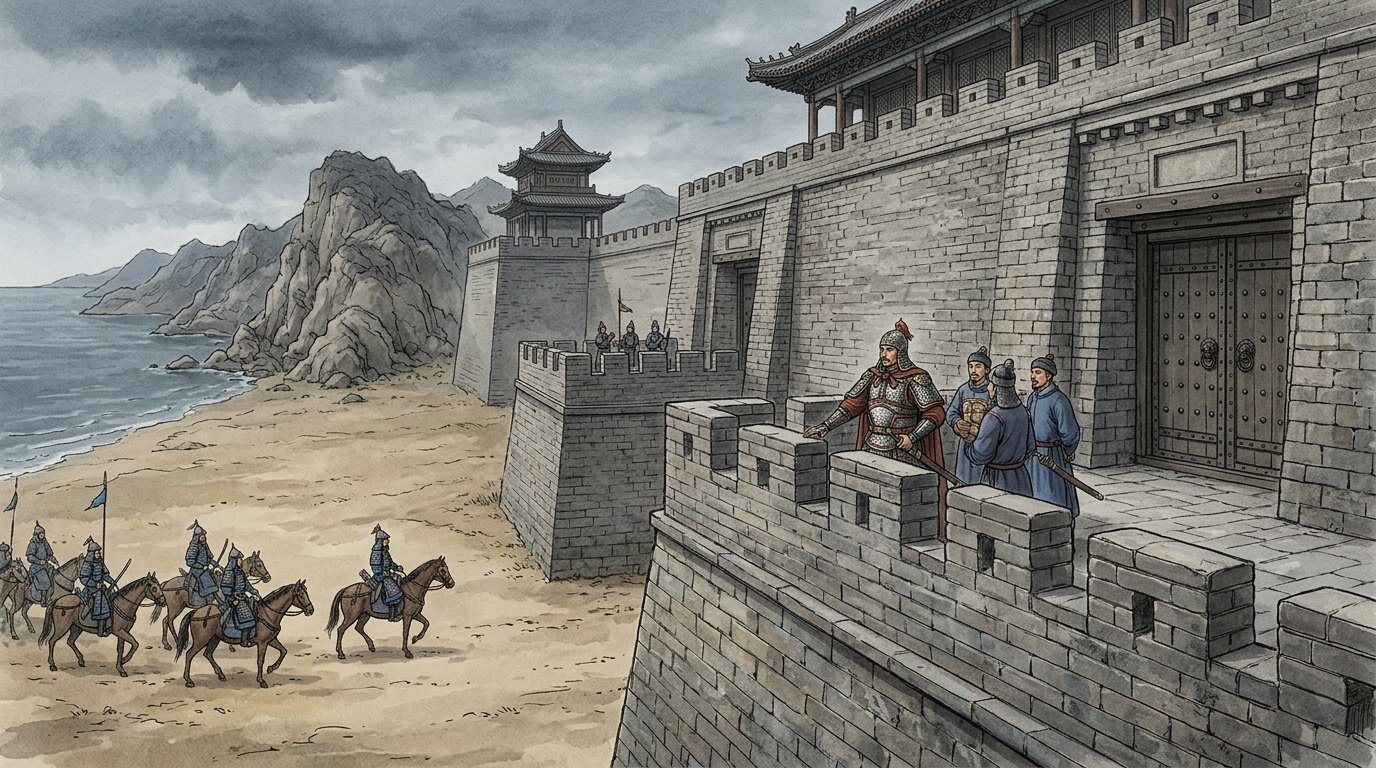
Yet the cataclysm of the Jiashen Year (甲申之变) was only beginning. Li Zicheng’s entry into Beijing was not the birth of an enduring new dynasty, but the prelude to an even greater bloodbath. Within forty days, the inability of the peasant regime to establish civil discipline, combined with the brutal extortion of Beijing’s scholar-official class under the torture racks of General Liu Zongmin, alienated the social and political elites of northern China. Two hundred miles to the northeast, at the formidable choke-point of Shanhai Pass (山海关)—the ‘First Pass Under Heaven’—stood General Wu Sangui (吴三桂), commanding the Ming Empire’s last elite field army, the battle-hardened Guanning Iron Cavalry. Caught in an inescapable vice between Li Zicheng’s advancing rebel hordes and the encroaching Eight Banners army of the Manchu regent Dorgon (多尔衮), Wu Sangui made the fateful decision that altered the destiny of China for the next three centuries: he threw open the Great Wall to the Qing banners, shaved his head, and rode out to crush the Great Shun at the murderous Battle of Yipianhai (一片石之战).
This monograph presents an exhaustive, multidisciplinary investigation into the fall of Beijing and the passage of Shanhai Pass in 1644. We will explore the psychological, factional, and structural causes of Chongzhen’s seventeen-year administrative collapse; examine the socioeconomic dynamics, millenarian propaganda, and military expansion of Li Zicheng’s peasant insurgency; reconstruct hour-by-hour the tragic fall of the Forbidden City and the Coal Hill suicide; analyze the forty days of terror under the Great Shun in Beijing; dissect the military, strategic, and romantic dilemmas of Wu Sangui at Shanhai Pass; trace the masterclass in Machiavellian diplomacy orchestrated by Dorgon and his Han counselors; provide a granular tactical breakdown of the Battle of Yipianhai; and assess the profound historiographical significance of the Ming-Qing transition in early modern global history.
1. The Tragedy of Chongzhen: Paranoid Autocracy and the Factional Abyss
To comprehend why the Ming Dynasty collapsed so swiftly before a peasant army, one must examine the deeply flawed character and administrative style of the Chongzhen Emperor. Zhu Youjian had not been raised to be an emperor. Born in 1611 as the fifth son of the Taichang Emperor, he grew up in the shadowy, terrified corners of the Forbidden City, surrounded by court intrigues, sudden poisonings, and the tyrannical shadow of the notorious eunuch dictator Wei Zhongxian (魏忠贤). When his elder brother, the illiterate carpenter-emperor Tianqi, died without an heir in 1627 at the age of twenty-two, the sixteen-year-old Prince of Xin was suddenly propelled onto the Dragon Throne.
Chongzhen possessed many qualities that Confucian moralists admired. Unlike his grandfather Wanli, who refused to hold imperial audiences for twenty-five years, or his brother Tianqi, who spent his days carving lacquer furniture, Chongzhen was an ascetic workaholic. He rose before dawn every day, slept barely four hours a night, wore patched garments beneath his robes, ate simple vegetarian meals to share the suffering of his famine-stricken subjects, and abolished the lavish entertainments of the inner court. Within months of taking power, he demonstrated extraordinary political cunning by outmaneuvering, purging, and driving Wei Zhongxian to hang himself, while systematically executing or exiling the eunuch’s corrupt factional lackeys.
Yet this personal morality was paired with fatal character flaws: deep-seated insecurity, an explosive temper, pathologically suspicious paranoia, and a total unwillingness to accept personal responsibility for any imperial failure. Having witnessed the murderous factionalism between the Donglin partisans and the eunuch party in his youth, Chongzhen came to believe that every scholar-official was a deceitful, self-serving hypocrite who cared only for factional advantage rather than the salvation of the empire. Whenever a military campaign failed, a tax quota fell short, or a policy miscarried, Chongzhen never blamed his own erratic imperial decrees; he invariably concluded that he had been betrayed by treacherous ministers.
The statistical record of Chongzhen’s seventeen-year reign reads like the administrative pathology of a collapsing state:
- Grand Secretaries: In seventeen years, Chongzhen appointed and dismissed no fewer than fifty Grand Secretaries (首辅/大学士)—an average tenure of barely four months per chancellor—ensuring that long-term strategic planning was impossible;
- Ministers of the Six Boards: He rotated through fourteen Ministers of Revenue (户部尚书), seventeen Ministers of War (兵部尚书), and dozens of regional censors, executing or exiling them whenever military defeats occurred;
- Governors-General and Governors: He executed seven supreme Governors-General (总督) and eleven provincial Governors (巡抚), while driving another dozen to suicide or terminal imprisonment.
The most catastrophic casualty of this imperial paranoia was General Yuan Chonghuan (袁崇焕, 1584–1630 CE). Yuan was the brilliant Cantonese military strategist who had pioneered the ‘Active Defense’ of Liaodong, utilizing Western red-coat cannons (红衣大炮) mounted atop the stone ramparts of Ningyuan to inflict the first decisive defeat upon Nurhaci in 1626, a battle in which the Jurchen founder was mortally wounded. When Chongzhen took the throne, he granted Yuan supreme command over the northeast border with the title of Grand Supervisor of Liaodong. Yuan famously pledged to recover all of Liaodong within five years if granted unfettered administrative discretion, reliable silver funds, and absolute royal trust.
However, in the winter of 1629 CE, Hong Taiji bypassed Yuan’s stone fortresses along the Ningyuan-Shanhai Pass corridor by executing a daring flanking maneuver through the Da’an Pass in eastern Inner Mongolia, marching directly to the walls of Beijing (the Jisi Incident, 己巳之变). Yuan Chonghuan led his elite Guanning cavalry on a grueling forced march of two hundred miles through freezing blizzard conditions, arriving outside the Guangqu Gate of Beijing just hours ahead of the Manchus, where he successfully fought off the invaders in bloody hand-to-hand combat.
Yet instead of receiving imperial gratitude, Yuan was greeted with poisoned suspicion. Hong Taiji deliberately planted intercepted forged letters suggesting that Yuan was in secret correspondence with the Manchus to betray the capital. City dwellers, terrified by the sudden appearance of barbarians at their gates, accused Yuan of allowing the Manchus to pass to demonstrate his indispensability. In a fit of volcanic rage, Chongzhen had Yuan Chonghuan arrested right outside the palace gates. In September 1630 CE, Yuan was subjected to the most gruesome punishment in the imperial legal code: death by slow slicing (凌迟, Lingchi). His flesh was sliced from his bones in thousands of ribbons before a howling mob of Beijing citizens, who bought his roasted flesh to consume with wine. As Yuan wrote in his famous prison testament:
‘一生事业总成空,半世功名在梦中。
— Yuan Chonghuan, Prison Execution Ode (1630 CE)
死后不愁无勇将,忠魂依旧保辽东!’
(‘My lifetime’s labor ends in empty air; half a lifetime of glory dissolved into a dream.
After my death, I fear not a lack of valiant generals; my loyal soul shall still guard Liaodong!’)
The execution of Yuan Chonghuan was a fatal turning point. It irrevocably severed the bond of trust between the Ming throne and its military commanders. Every general stationed on the northern frontiers now understood an unspoken truth: if you lost a battle, the emperor would chop off your head for cowardice; if you won a battle and gained too much prestige, the emperor would slice you to ribbons for suspected treason. Brilliant commanders like Lu Xiangsheng (卢象昇) and Sun Chuanting (孙传庭) were subsequently starved of supplies, micromanaged from the Forbidden City, and driven to their deaths. When Sun Chuanting fell at the Battle of Jiaxian in Henan in late 1643, the official History of Ming recorded the mournful consensus of posterity: ‘Chuanting died, and the Great Ming died with him!’ (传庭死而明亡矣).
2. The Dashing King: Li Zicheng and the Ideology of the Great Shun
While the Ming court was consuming its own generals in Beijing, the arid, canyon-scarred loess plateau of northern Shaanxi was spawning the most formidable peasant insurrection in Chinese history since the Red Turbans. At the center of this hurricane stood Li Zicheng (李自成, 1606–1645 CE), born Li Hongji (李鸿基) in Mizhi County, Shaanxi.
Shaanxi in the late 1620s was an ecological and human slaughterhouse. The coldest decades of the Little Ice Age had gripped northern China in relentless, desiccating droughts. For seven consecutive years, no rain fell across the northern valleys; rivers dried to trickle beds of cracked mud; locust swarms blotted out the sun, devouring every scrap of green foliage. Displaced peasant farmers, burdened by extortionate tax surcharges and postal requisitions, were driven to utter desperation. Local gazetteers record that human beings devoured tree bark, powdered river slate, and dried human excrement, before parents engaged in the horrifying practice of ‘exchanging children to eat’ (易子而食) to avoid consuming their own flesh and blood.
Following his dismissal from the Yinchuan Relay Station in 1629 and his murder of the usurer General Ai, Li Zicheng joined the outlaw bands of his maternal uncle, Gao Yingxiang (高迎祥), the original ‘Dashing King’ (闯王). For nearly a decade, these bands of mobile horse outlaws—calling themselves ‘Wandering Bandits’ (流寇, Liukou)—roamed across Shaanxi, Shanxi, Henan, and Hubei. They were repeatedly crushed by elite imperial cavalry led by Hong Chengchou, Zuo Liangyu, and Cao Wenzhao, only to scatter into the impenetrable mountains and re-emerge whenever drought struck a new prefecture.
When Gao Yingxiang was captured and executed in 1636, Li Zicheng inherited the revered title of ‘Dashing King.’ Yet by 1638, following a disastrous ambush in the Tongguan Gorge by Sun Chuanting and Hong Chengchou, Li Zicheng was reduced to a desperate remnant of barely eighteen riders, hiding in the misty defiles of the Shangluo Mountains (商洛山). Lesser men would have surrendered or perished. But Li Zicheng understood the underlying macro-historical reality: so long as the Ming state continued to demand silver taxes from a starving peasantry in the teeth of climatic disaster, the combustible material for rebellion was infinite.
In 1640, a catastrophic mega-drought struck the central plains of Henan, accompanied by a devastating bubonic plague outbreak that decimated entire county populations. Li Zicheng rode out of the Shangluo defiles with his eighteen riders. Within three months, his force swelled from eighteen men to over three hundred thousand desperate peasants. It was during this dramatic resurgence that Li Zicheng underwent a profound ideological transformation, shifting from a predatory roving bandit into a dynastic contender claiming the Mandate of Heaven.
This ideological metamorphosis was guided by disaffected educated literati who saw that the Ming was beyond redemption. Foremost among them were Niu Jinxing (牛金星), a disgraced provincial licentiate (举人) with a venomous hatred for the corrupt imperial bureaucracy, and Song Xiance (宋献策), a hunchbacked dwarf astrologer and geomancer. Niu Jinxing formulated a revolutionary political program designed to capture the hearts of the peasant masses:
‘杀牛羊,备酒浆,开了城门迎闯王,闯王来时不纳粮!’
— Folk ballad popularized by Song Xiance across Henan and Shaanxi (c. 1641 CE)
(‘Slaughter the cattle and sheep, prepare the wine and broth;
Fling wide the city gates to welcome King Chuang, for when King Chuang arrives, you will pay no taxes!’)
The promise of ‘Equalizing the Land and Abolishing All Taxes’ (均田免赋) struck the northern peasantry with the force of a religious revelation. Wherever Li Zicheng’s armies advanced, they did not pillage ordinary peasant homes. Instead, they enforced strict military discipline: any soldier who raped a woman or stole a copper from a peasant was immediately beheaded and his body displayed on a pike. They stormed the fortified castles of the imperial Ming princely estates, captured the colossal granaries of the Ming princes, and threw open the gates, distributing millions of bushels of grain to starving crowds. When Li Zicheng captured the historic capital of Luoyang in 1641, he executed the despised, morbidly obese Prince of Fu (Zhu Changxun 朱常洵)—the favorite son of the Wanli Emperor—slaughtered the prince’s prized royal deer, stewed the prince’s flesh in a giant cauldron with the venison, and served the banquet to his starving troops under the satirical title of the ‘Blessing and Luck Banquet’ (福禄酒).
In the first lunar month of 1644 CE, having annihilated the last imperial army under Sun Chuanting at Jiaxian and captured the provincial metropolis of Xi’an, Li Zicheng formally proclaimed the founding of the Great Shun Dynasty (大顺). He established the reign title Yongchang (永昌, ‘Eternal Prosperity’), instituted a six-board administrative bureaucracy, minted new bronze coinage inscribed Yongchang Tongbao (永昌通宝), and appointed Liu Zongmin (刘宗敏) as supreme field marshal. He then mobilized a mammoth army of over four hundred thousand cavalry and infantry, launching a two-pronged strategic offensive aimed squarely at the imperial throat: Beijing.
3. The March on Beijing: Collapse of the Northern Garrisons
The speed with which Li Zicheng’s forces advanced upon Beijing in the second and third lunar months of 1644 exposed the utter moral and military hollowed-out rot of the late Ming state. The defense of Beijing depended upon the legendary ‘Three Northern Passes’ (居庸关 Juyongguan, 紫荆关 Zijingguan, 倒马关 Daomaguan) and the formidable garrison hubs of Datong (大同) and Xuanfu (宣府), which had guarded the capital against Mongol invasions for two and a half centuries.
Yet these garrison armies, unpaid for over a year and dying of hunger, possessed zero loyalty to the Chongzhen Emperor. When Li Zicheng crossed the Yellow River into Shanxi, city after city surrendered without firing an arrow:
- Taiyuan: The provincial capital of Shanxi fell after token resistance; the garrison commander surrendered, and the Ming Prince of Jin was captured;
- Datong: Commander-in-chief Jiang Xiang (姜瓖), commanding thirty thousand border troops, flung open the city gates and knelt in the dust to welcome Li Zicheng, presenting his troops and armories to the Shun army;
- Xuanfu: Governor-General Wang Chengzhi was hanged by his own mutinous soldiers when he attempted to resist; garrison commander Du Xun welcomed Li Zicheng with a lavish banquet;
- Juyong Pass: The impregnable mountain gate north of Beijing, where a handful of cannons could hold off an army of millions, was surrendered without a struggle by Supervising Censor Du Xun and the presiding eunuch commanders on the sixteenth day of the third month.
Inside Beijing, panic paralyzed the court. Chongzhen possessed several strategic options that might have saved the dynasty. In late 1643 and early 1644, several perceptive ministers—most notably Grand Secretary Li Jiantai and Censor Wu Lu—repeatedly implored the emperor to execute an immediate Southward Evacuation (南迁) to the secondary capital of Nanjing. Nanjing was an impregnable walled metropolis protected by the vast barrier of the Yangtze River, backed by the immense agricultural wealth of Jiangnan, which had been untouched by drought or peasant rebellion. In Nanjing, an entire secondary central government—complete with Six Boards, a Censorate, an imperial treasury, and naval fleets—was fully staffed and operational.
Yet Chongzhen was paralyzed by vanity, fear of historical censure, and the dogmatic obstinacy of conservative scholar-officials. When the topic of flight to Nanjing was raised in imperial audiences, conservative censors shouted in moral outrage, invoking the sacred ancestral injunction that ‘The Son of Heaven guards the nation’s gate, and the monarch dies for the altars of grain’ (天子守国门,君王死社稷). Censors claimed that abandoning Beijing was an act of filial impiety against the imperial ancestral tombs at Changping. Chongzhen desperately wanted his ministers to unite in a unanimous memorial begging him to relocate to Nanjing, so that history would blame the ministers rather than the emperor for abandoning the capital; but the ministers, terrified that Chongzhen would execute them as scapegoats the moment they reached the south, refused to take the initiative. While ministers argued over Confucian etiquette, Li Zicheng’s cavalry vanguard reached the Marco Polo Bridge (Lugouqiao) on April 23.
Even at this late hour, Chongzhen had a final military card to play: summoning General Wu Sangui from Ningyuan. On the third day of the first month of 1644, Chongzhen issued an imperial decree ordering Wu Sangui to abandon Ningyuan, escort the civilian population inside the Great Wall to Shanhai Pass, and march with his entire fifty-thousand-man Guanning field army to relieve Beijing. But the evacuation of over four hundred thousand refugees and supply wagons from Ningyuan was an excruciatingly slow process; by the time Wu Sangui’s vanguard arrived at Fengrun (丰润), barely eighty miles east of Beijing, the capital was already surrounded by a sea of rebel banners.
4. The Twenty-Four Hours of Jiashen: Blood in the Forbidden City
On the morning of April 23, 1644 (the seventeenth day of the third month), Li Zicheng’s armies deployed before the nine gates of Beijing. Inside the city walls, the defensive situation was hopeless. The regular garrison of Beijing—the Three Grand Camps (三大营)—existed only on paper. Corrupt eunuch supervisors and aristocratic commanders had pocketed the soldiers’ rations for decades, retaining barely twenty thousand sickly, elderly men on the active muster rolls, while Beijing had been ravaged by a virulent epidemic of bubonic plague that killed over two hundred thousand residents in the summer of 1643.
Chongzhen placed the defense of the city gates in the hands of eunuchs. At dusk on the eighteenth day, under the cover of a violent spring thunderstorm, eunuchs guarding the Guangning Gate (广宁门, modern Guang’anmen) quietly swung open the iron-studded wooden portals. Rebel cavalry flooded into the outer city with torches, shouting: ‘The Dashing King has arrived!’
Inside the inner palace, Chongzhen’s world collapsed. He summoned his three young sons: the fifteen-year-old Crown Prince Zhu Cilang (朱慈烺), the Prince of Ding, and the Prince of Yong. Weeping uncontrollably, the emperor said: ‘Why were you born to an unlucky father such as me? Today our country is lost, and our ancestral temples are destroyed. You are imperial princes; do not weep like women. Disguise yourselves in common cloth and seek shelter with your maternal grandfather, Count Zhou Kui. If you survive, avenge your father and mother!’ The three weeping boys were escorted into the stormy night by trusted eunuchs.
What followed was an orgy of dynastic slaughter. Chongzhen ordered Empress Zhou to commit suicide. The empress knelt before him, bowed her head three times, and wept: ‘For eighteen years I have tended to Your Majesty’s bedchamber. I warned you that this day would come if you continued to execute your ministers, yet you would not listen. Today I die for the altars of the Great Ming with no regret!’ She withdrew to her chamber in the Kunning Palace and hanged herself with a white silk cord. Chongzhen then ordered his favorite concubine, Consort Yuan, to hang herself; when the silk cord snapped, the emperor personally drew his sword and hacked her to death.
The emperor then stormed into the Shouning Palace, where his eldest surviving daughter, the sixteen-year-old Princess Changping, knelt weeping on the floor. In a state of temporary insanity, Chongzhen screamed: ‘Why were you born into this house of mine?’ and swung his heavy two-handed sword at her neck. The terrified girl raised her left arm instinctively to deflect the blow; the blade cleaved through her left arm at the shoulder, severing it completely. The princess collapsed in a pool of blood, unconscious from shock, and Chongzhen, believing her dead, fled the chamber. He then entered the palace of the six-year-old Princess Zhaoren, stabbing the screaming child through the chest.
At midnight, Chongzhen, dressed in military leather armor and carrying a three-pronged spear, led a desperate sortie of several dozen personal eunuch guards toward the Zhengyang and Chaoyang Gates, hoping to hack a path through the encirclement. But at every gate, the guards refused to open the doors or fired warning arrows down from the parapets, shouting that rebels controlled the streets. Drenched in freezing rain and coated in soot, the broken monarch trudged back into the Forbidden City.
At dawn on April 25 (the nineteenth day), the emperor climbed Jingshan Hill behind the palace. He stood beneath the crooked scholar tree, looking out over the Forbidden City as rebel banners fluttered atop the Meridian Gate and the sound of triumphal horns filled the morning air. Removing his crown, loosening his hair to cover his face, and biting his finger to pen his final blood testament, Chongzhen stepped onto a stone stool, slipped his head into the silk noose, and kicked the stool away. The Great Ming Dynasty, which had spanned sixteen emperors over two hundred and seventy-six years, died with him at the age of thirty-three.
5. Forty Days in Babylon: The Shun Occupation and the Torture Racks
On the afternoon of April 25, 1644, Li Zicheng entered Beijing in triumph through the Chengtian Gate (承天门, modern Tiananmen). He rode a prized black charger with a white forehead, wearing an azure felt hat, a yellow archery robe, and a quiver of barbed arrows. Looking up at the inscription plaque of the Chengtian Gate, Li Zicheng boasted to his generals: ‘If my arrow strikes the exact character ‘Heaven’ (天), I shall rule the realm for ten thousand years!’ He drew his composite bow and released an arrow; the shaft struck slightly below the character, lodging into the wooden frame. Though shaken by the bad omen, Li Zicheng laughed it off and rode into the Wuying Palace (武英殿) of the Forbidden City, establishing his imperial headquarters.
For the first three days, the Great Shun forces maintained remarkable discipline. Proclamations were posted across Beijing reassuring the citizenry: ‘The new dynasty brings peace; merchants open your shops, citizens return to your hearths.’ When Chongzhen’s corpse was discovered on Coal Hill on the twenty-first day, Li Zicheng ordered the late emperor and empress placed in plain unlacquered cedar coffins and laid out in the Donghua Gate square, permitting citizens and former Ming officials to kowtow and weep before them, before providing a modest burial in the tomb of Consort Tian (later renamed the Siling Mausoleum, 思陵).
Yet behind this veneer of dynastic transition lurked a fatal, insurmountable structural contradiction: the Great Shun had no financial system. For three years, Li Zicheng had won over millions of followers with the seductive populist pledge of ‘Equalizing the Land and Paying No Taxes’ (均田免赋). Having promised the common people that they would never pay taxes, the Great Shun state possessed zero tax revenues, no treasury reserves, and no institutional apparatus to collect grain. Yet Li Zicheng had to feed, equip, and pay a bloated army of over five hundred thousand soldiers in Beijing and across the northern provinces. Where was the money to come from?
The answer devised by Supreme Commander Liu Zongmin (刘宗敏) was terrifying in its simplicity: extracting silver through the systematic torture of the Ming elite. This policy was institutionalized as the notorious campaign of ‘Chasing Stolen Wealth to Aid the Army’ (追赃助饷, Zhui Zang Zhu Xiang).
Liu Zongmin set up his headquarters in the lavish mansion of Count Tian Hongyu, establishing five specialized torture barracks. He ordered blacksmiths to forge five thousand pairs of heavy wooden torture clamps (夹棍, Jiagun), designed with interlocking oak teeth to crush the fingers, ankles, and skulls of prisoners. A sliding ransom scale was promulgated, categorizing every former official according to his Ming rank:
- Grand Secretaries and Board Ministers: Mandated to surrender one hundred thousand taels of silver each;
- Censors, Hanlin Academicians, and Vice Ministers: Mandated to surrender fifty to seventy thousand taels;
- Bureau Directors and Section Chiefs: Mandated to surrender thirty to fifty thousand taels;
- Junior Clerks and Local Degree Holders: Mandated to surrender ten to twenty thousand taels;
- Common Urban Merchants: Mandated to surrender several hundred to several thousand taels according to estimated capital.
Over eight hundred senior Ming officials—men who had only days earlier arrived at the palace gates begging to swear allegiance to Li Zicheng—were rounded up in iron chains, stripped of their robes, and thrown into Liu Zongmin’s dungeons. The scenes that followed horrified the nation. Grand Secretary Wei Zaode (魏藻德), who had knelt before Li Zicheng claiming that he had always sabotaged Chongzhen’s decisions from within, was shackled to the rack. When Wei wept that he possessed only a few hundred taels of silver, Liu Zongmin ordered the clamps tightened until Wei’s fingers were crushed to pulp; Wei surrendered several thousand taels, but Liu Zongmin demanded more, clamping Wei’s skull until his brain matter burst from his ears, crying out as he died: ‘I failed to die for my country, and this is my righteous retribution!’
Chongzhen’s father-in-law, Zhou Kui (周奎, Marquis of Jiading)—who had previously refused Chongzhen’s desperate begging for ten thousand taels of defense silver, claiming to be impoverished—was tortured until his servants dug up over five hundred and thirty thousand taels of pure silver bullion and chests of gold ingots buried beneath the flagstones of his courtyard! In total, the Shun armies extracted over seventy million taels of silver from the homes of the Beijing elite, loading the bullion into thousands of carts to be melted down into massive silver ‘Melon Melts’ (西瓜锭) in the palace mints.
The campaign of torture quickly spiraled out of control. Peasant soldiers, intoxicated by violence and unchecked by their officers, began storming the private houses of ordinary merchants, raping women, looting shops, and hanging anyone suspected of concealing silver. In the words of contemporary chronicler Ji Liuqi in the Ming Ji Beilue: ‘Day and night, the screams of prisoners under the rack echoed across the avenues of Beijing. Every wealthy family was dragged into the streets; blood flowed down the gutters, and the corpses of scholars hung from every crossroads.’
The political consequences of the ‘Chasing Silver’ terror were fatal for Li Zicheng. Within three weeks, the Great Shun completely destroyed its own legitimacy. The educated gentry and scholar-official class across China—the very men whose administrative skills were indispensable to governing a continental empire—saw that Li Zicheng was not a new dynastic founder like Liu Bang or Zhu Yuanzhang, but a predatory barbarian who butchered the literati. And amidst this frenzy of extortion, Liu Zongmin made the fatal mistake that brought the ceiling crashing down upon their heads: he arrested Wu Xiang (吴襄), the former commander of the Liaodong garrison, ransacked his mansion for silver, and seized Wu Xiang’s celebrated daughter-in-law, the breathtakingly beautiful courtesan Chen Yuanyuan (陈圆圆), taking her into his private bedchamber.
6. The General at the Wall: Wu Sangui’s Fatal Dilemma
Two hundred miles east of the burning capital, perched on the narrow coastal corridor between the rugged Yan Mountains and the rolling surf of the Bohai Sea, stood the gateway of China: Shanhai Pass (山海关). Inside the fortress, pacing the ramparts beneath the famous calligraphy plaque reading ‘First Pass Under Heaven’ (天下第一关), was thirty-two-year-old General Wu Sangui (吴三桂, 1612–1678 CE, courtesy name Changbo 长伯).
Wu Sangui was the golden child of the Ming northern frontier aristocracy. Born in Gaoyou, Jiangsu, but raised in the military camps of Liaodong, he was the son of General Wu Xiang and the nephew of legendary commander Zu Dashou (祖大寿). Handsome, athletic, extraordinarily skilled in mounted archery, and possessing a commanding military charisma, Wu Sangui had passed the military imperial examinations as a youth and risen swiftly through the ranks. At the age of twenty-eight, he had been appointed Commander-in-Chief of Ningyuan, commanding the Guanning Iron Cavalry (关宁铁骑)—a force of fifty thousand veteran Han troops who had spent their entire lives fighting the Manchus, equipped with heavy armor, three-eyed carbines (三眼铳), and European breech-loading cannons.
Now, in late April 1644, Wu Sangui found himself trapped in the most agonizing geopolitical vise in Chinese history. To his west lay Beijing, occupied by Li Zicheng’s massive rebel army of over four hundred thousand men. To his northeast, barely three days’ march away across the Liao River, lay the Eight Banners army of the Great Qing, commanded by the brilliant, ambitious Prince Regent Dorgon (多尔衮, 1612–1650 CE). Wu Sangui possessed barely fifty thousand elite soldiers, accompanied by over four hundred thousand terrified civilian refugees who had evacuated Ningyuan. He had no granary reserves, no financial backing from Beijing, and no clear line of retreat.
Initially, Wu Sangui was inclined to surrender to Li Zicheng. On the twenty-first day of the third month, Li Zicheng had dispatched an imperial envoy carrying forty thousand taels of silver, a gold seal, and a letter written by Wu Sangui’s father, Wu Xiang, urging his son to submit to the Great Shun in exchange for a marquisate. Recognizing that the Chongzhen Emperor was dead and that the Great Ming was defunct, Wu Sangui accepted the silver, left a garrison at Shanhai Pass, and began marching his army toward Beijing to pledge allegiance to the new Shun Dynasty.
However, when Wu Sangui’s vanguard reached Luanzhou (滦州), barely eighty miles from the capital, they encountered weeping refugees fleeing Beijing. Among them were trusted family servants from the Wu household who delivered horrifying intelligence:
- His father, Wu Xiang, had been thrown into Liu Zongmin’s torture racks, his fingers clamped until blood spurted, forced to surrender twenty thousand taels of silver;
- The Wu ancestral mansion had been ransacked and sealed by Shun soldiers;
- Most shattering of all, Wu Sangui’s beloved concubine, the peerless beauty Chen Yuanyuan, had been forcibly abducted by Liu Zongmin as his personal concubine.
Upon hearing that his father was under torture and his beloved woman had been violated, Wu Sangui drew his sword, severed the conference table before him, and roared with fury:
‘大丈夫不能保一女子,何面目见天下人乎!’
— Wu Sangui’s exclamation at Luanzhou (April 1644 CE), recorded in Ming Ji Beilue
(‘If a great man cannot even protect a single woman, with what face can he ever stand before the realm!’)
This dramatic episode immortalized by Qing poet Wu Weiye (吴伟业) in his epic ballad The Song of Yuanyuan (《圆圆曲》):
‘鼎湖当日弃人间,破敌收京下玉关。
— Wu Weiye, The Song of Yuanyuan (《圆圆曲》, 1651 CE)
恸哭六军俱缟素,冲冠一怒为红颜!’
(‘On that day the sovereign departed the mortal realm;
To crush the foe and recover the capital, our host swept through the Jade Pass.
The six armies wailed in bitter mourning, all draped in funeral white—
Yet his bristling anger that touched the crown was all for the sake of the red-cheeked beauty!’)
While later romantic literature emphasized Chen Yuanyuan as the primary catalyst, cold geopolitical calculation played an equally decisive role. Wu Sangui recognized that Liu Zongmin’s reign of terror in Beijing signaled the imminent collapse of the Shun regime into factional anarchy. If he entered Beijing without independent leverage, he and his officers would simply become the next victims strapped to Liu Zongmin’s torture racks. Turning his army around in a fury, Wu Sangui marched back to Shanhai Pass, annihilated the Shun garrison left inside the pass, and fortified the ramparts. He was now in open rebellion against the Great Shun.
7. Dorgon’s Opportunity: The Machiavellian Strategy of Mukden
While Beijing was drowning in blood and Wu Sangui was fortifying Shanhai Pass, the ultimate victor of the crisis was watching with cold, predatory patience from Mukden (Shenyang). The fourteenth son of Nurhaci, thirty-two-year-old Prince Regent Dorgon (多尔衮), was the undisputed master of the Great Qing Empire. Ruling on behalf of his six-year-old nephew, the Shunzhi Emperor (Fulin 福临), Dorgon was an exceptional military genius and a master of political opportunism.
For decades, the Manchus had launched devastating winter raids across the Great Wall, sacking cities in Hebei and Shandong, looting millions of taels of silver, and carrying off hundreds of thousands of Han captives as agricultural slaves. Yet they had never succeeded in establishing a permanent territorial foothold south of the Great Wall, repeatedly repelled by the stone walls of Ningyuan and Shanhai Pass.
In the fourth lunar month of 1644, news of Li Zicheng’s capture of Beijing reached Mukden. Dorgon immediately mobilized the entire military machine of the Qing state: over one hundred thousand elite Eight Banner warriors, comprising the Manchu Banners, the Mongol Banners, and the newly established Han Banners (汉军八旗) equipped with advanced artillery corps. On May 2, 1644, the Qing host crossed the Liao River, marching southwest toward the Great Wall.
The strategic grand design that guided Dorgon was not authored by a Jurchen warrior, but by a captured Ming Confucian statesman: Fan Wencheng (范文程, 1597–1666 CE), a direct descendant of the great Song chancellor Fan Zhongyan. Fan Wencheng recognized that 1644 presented an astronomical, once-in-a-millennium geopolitical opportunity. In a legendary memorial submitted to Dorgon on the banks of the Liao River, Fan formulated the ideological blueprint that would win China for the Qing:
‘The bandits have captured Beijing and driven the Ming monarch to suicide. The hearts of the people under Heaven are weeping in bitter grief and confusion. If our Great Qing enters China today simply as predatory raiders seeking plunder, the people of the Central Plains will unite against us as foreign barbarians. But if your Highness proclaims that we enter China as the righteous avengers of the fallen Ming emperor—if we execute the regicide bandits, bury the Chongzhen Emperor with imperial honors, restore order to the scholar-officials, and forbid our troops from pillaging a single village—the entire empire will welcome our banners as saviors from Heaven!’
— Fan Wencheng, Memorial on Grand Strategy for Crossing the Pass (May 1644 CE)
Dorgon embraced Fan Wencheng’s strategy with total conviction. The mission of the Eight Banners was transformed overnight from a barbarian invasion into a ‘Righteous Crusade to Avenge the Fallen Monarch’ (替天行道,为崇祯复仇). Strict orders were read to all banner banners: no burning of temples, no enslavement of civilians, no destruction of crops.
On May 18, 1644, while encamped at the Huanxi Pavilion (欢喜岭) barely ten miles northeast of Shanhai Pass, Dorgon received a desperate secret courier from General Wu Sangui. Wu’s letter was a masterpiece of diplomatic ambiguity: Wu begged the Qing Prince Regent to provide military assistance to crush the peasant rebels, promising rich territorial cessions and annual tribute once the Ming was restored. But Dorgon was far too shrewd to act as a hired mercenary for a dead dynasty. Dorgon fired back an ultimatum that left Wu Sangui with no middle ground:
‘You were a loyal minister to the Ming, yet your emperor has perished and your family is hostage. If you invite our host merely as allies, how can two sovereign armies share a battlefield without suspicion? If you truly desire to avenge your late master and rescue your father, you must submit unconditionally to our Great Qing. Shave your head, lead your army into our ranks, and our Prince Regent will grant you hereditary princely rank and supreme command over the vanguard of our empire!’
— Dorgon’s Reply to Wu Sangui at Shanhai Pass (May 20, 1644 CE)
Wu Sangui hesitated. Shaving one’s head (剃发) was the supreme cultural and filial humiliation in the Confucian cosmos—an act that branded a man as a barbarian. But time had run out. On May 25, lookouts on the western battlements of Shanhai Pass spotted colossal clouds of dust darkening the horizon. Li Zicheng was arriving in person, leading a vanguard of over one hundred thousand elite Shun troops, accompanied by Liu Zongmin, Niu Jinxing, and the chained, bleeding figure of Wu Sangui’s father, Wu Xiang. Wu Sangui had no choice left: either surrender to Li Zicheng and watch his father be executed, or throw open the gates to Dorgon.
8. The Battle of Yipianhai: The Whirlwind of Dust and Iron (May 27, 1644 CE)
The decisive clash that determined the fate of East Asia for the next three hundred years took place on May 27, 1644 (the twenty-second day of the fourth lunar month) along the pebble-strewn flats of the Shihe River (石河), just outside the eastern ramparts of Shanhai Pass. In historical annals, it is immortalized as the Battle of Yipianhai (一片石之战).
On the evening of May 26, under the cover of darkness, Wu Sangui rode out of Shanhai Pass accompanied by a handful of trusted bodyguards, galloping directly to Dorgon’s camp at the Huanxi Pavilion. Inside the Qing command tent, illuminated by torches, the thirty-two-year-old Han general knelt before the Manchu prince. Ceremonial razors were brought forth: Wu Sangui and his senior officers shaved their foreheads and braided their hair into the Manchu queue, swearing eternal allegiance to the Qing Dynasty. Dorgon embraced Wu Sangui, bestowing upon him the illustrious title of Prince Who Pacifies the West (平西王, Pingxi Wang) and promising him an imperial princess in marriage for his son, Wu Yingxiong.
The tactical plan formulated by Dorgon was brilliantly deceptive. Wu Sangui’s Guanning troops were ordered to return to the pass and deploy on the battlefield in their traditional Ming white headbands and banners, engaging Li Zicheng’s army head-on. The Manchu Eight Banners, meanwhile, would remain completely hidden behind the hills and sea dunes east of the pass, waiting for the peasant army to exhaust itself before striking.
At dawn on May 27, Li Zicheng deployed his Great Shun army in a massive, deep formation stretching for ten miles from the base of the Yan Mountains to the shores of the Bohai Sea. Li Zicheng took up position atop a high hill overlooking the battlefield, surrounded by his yellow parasols and personal horse guards, with Wu Xiang bound in chains beside him. At the sound of thunderous bronze drums, eighty thousand Shun infantry and cavalry surged forward against Wu Sangui’s lines.
The battle was horrific in its intensity. Wu Sangui’s Guanning veterans, fighting with the savage desperation of men whose families were hostage and who had burned their bridges, stood like iron ramparts along the Shihe River. Waves of Shun cavalry crashed against the Han gunners, who fired salvos of red-coat cannons and three-eyed carbines into the packed rebel ranks. Yet Li Zicheng’s numbers were overwhelming. For six agonizing hours, under the scorching morning sun, the Shun army launched charge after charge. By mid-morning, Wu Sangui’s cavalry was outflanked; his left wing collapsed, and rebel forces were on the verge of encircling his command post. Wu Sangui dispatched three couriers in frantic succession to Dorgon, pleading for the Manchus to strike before his army was annihilated.
Then, at approximately midday, a legendary meteorological event altered the course of history: a violent sandstorm erupted from the northeast. Howling winds sweeping down from the Mongolian steppes blew blinding clouds of yellow dust and gravel directly into the eyes of the advancing Shun soldiers. Visibility dropped to barely a dozen paces.
Seeing the swirling dust storm, Dorgon drew his scimitar and gave the fateful command: ‘The winds of Heaven favor the Great Qing! Attack!’
Through the open gates of Shanhai Pass poured twenty thousand elite Manchu heavy cavalry, organized under Prince Ajige and Prince Dodo. Clad in black lacquered iron plate armor, riding massive Liaodong warhorses, and screaming terrifying Manchu battle cries, the Banner cavalry galloped out from behind Wu Sangui’s exhausted lines and charged straight into the exposed, dust-blinded flank of the Great Shun army.
The psychological shock was instantaneous and catastrophic. For years, Li Zicheng’s peasant soldiers had fought only against demoralized Ming garrisons. They had never seen the terrifying, iron-plated behemoths of the Manchu Eight Banners. Through the swirling dust, they caught sight of shaved foreheads, fluttering coiled-dragon banners, and heavy iron maces that crushed skulls through helmets with a single blow. A terrified scream rippled through the Shun ranks:
‘满洲兵!满洲兵来矣!’
— Cry of panic in the Great Shun ranks at Yipianhai (May 27, 1644 CE)
(‘The Manchu troops! The Manchu troops have come!’)
In minutes, the disciplined formations of the Great Shun disintegrated into an uncontrollable rout. Shun soldiers threw down their spears and fled westward along the narrow coastal defiles, trampling their own comrades into bloody mud. Over twenty thousand Shun soldiers were slaughtered along the Shihe River; thousands more drowned in the surf of the Bohai Sea. From his hilltop command post, Li Zicheng watched his invincible peasant revolution shatter into pieces before his eyes. Turning his horse to his advisors, he muttered in stunned disbelief: ‘This is indeed the barbarian host of Mukden!’ He abandoned his command tent, executed Wu Xiang on the hill, and galloped west toward Beijing with a small escort of surviving cavalry.
9. Flight from Beijing and the Shaving Order: The Dawn of the Qing
The aftermath of the Battle of Yipianhai unfolded with dizzying rapidity. Li Zicheng arrived back in Beijing on April 29, exhausted, soot-covered, and politically ruined. The dream of a Great Shun Dynasty lasting ten thousand years was dead. Knowing that Dorgon and Wu Sangui were pursuing him with fifty thousand cavalry, Li Zicheng enacted a hasty, grotesque pantomime of imperial legitimacy.
On April 29, inside the Wuying Palace, Li Zicheng held a hurried imperial coronation, crowning himself Emperor of the Great Shun in the presence of terrified former Ming officials. The ceremony was an absurd farce: rebel soldiers roamed through the throne room carrying looted silver ingots, while smoke from burning palace gates drifted through the windows. The very next morning, having worn the imperial dragon robe for barely twenty-four hours, Li Zicheng ordered his troops to plunder the imperial palaces of every remaining scrap of gold, bronze, and jewelry. As they abandoned the city, the Shun armies set fire to the Qianqing Palace, the Meridian Gate, and several towers of the inner wall, executing the remaining thirty-eight members of Wu Sangui’s family—including his elderly mother and young brothers—and impaling their severed heads upon the eastern city battlements.
On June 5, 1644 (the first day of the fifth lunar month), Dorgon rode through the Chaoyang Gate into Beijing at the head of the Eight Banners army. The citizens of Beijing, terrified that the Manchus would unleash a wholesale massacre, were astonished by the scene that greeted them. Dorgon’s soldiers marched in absolute silence, keeping strictly to the main avenues. Proclamations were immediately posted throughout the city declaring an amnesty for all former Ming civil officials, promising that everyone who surrendered would retain their previous bureaucratic rank, and abolishing all the extortionate Liaoxiang and bandit-suppression surcharges.
Dorgon personally led his princes to kowtow before the coffin of the Chongzhen Emperor at the Siling tomb, declaring three days of national mourning across the empire and proclaiming to the scholar-officials:
‘Our Great Qing has entered China not to conquer the Great Ming, but to extinguish the traitorous bandits who murdered your sovereign. Today we avenge the Son of Heaven; those who submit to our benevolence shall be treated as our own flesh and blood!’
— Dorgon, Proclamation to the Citizens and Literati of Beijing (June 1644 CE)
In October 1644, the six-year-old Shunzhi Emperor arrived from Mukden. Kneeling at the Temple of Heaven, the child monarch proclaimed that the Qing Dynasty had inherited the Mandate of Heaven, establishing Beijing as the eternal capital of the Great Qing Empire. Li Zicheng retreated across Henan into Shaanxi, relentlessly pursued by Prince Dodo and Wu Sangui. In 1645, after losing Xi’an and fleeing through the mountains of Hubei, Li Zicheng was killed at Jiugong Mountain (九宫山), beaten to death by local peasant village militias while foraging for food. The Great Shun had vanished like smoke.
Yet the benevolent mask of the Qing conquerors was quickly discarded. In July 1645, having captured Nanjing and extinguished the first Southern Ming court of Prince Fu (the Hongguang Emperor), Dorgon promulgated the most infamous and traumatic decree in Chinese cultural history: the Tonsure and Queue Order (剃发令, Tifa Ling).
‘留头不留发,留发不留头!’
— Popular distillation of Dorgon’s Queue Decree (July 1645 CE)
(‘Keep your hair and lose your head; keep your head and lose your hair!’)
Every Han male across the empire was given ten days to shave the front and temples of his head, braiding the remaining hair into the Manchu queue, and to abandon traditional Han Ming robes in favor of Manchu riding jackets (Magua). To the Confucian elite, hair was a sacred inheritance from one’s parents that could never be cut without committing supreme filial impiety. The Queue Decree transformed what had been a passive dynastic transition into decades of ferocious, genocidal civil war. Across Jiangnan, cities like Jiading and Yangzhou rose in heroic, suicidal resistance, resulting in horrific massacres where hundreds of thousands of civilians were put to the sword by Qing armies under generals like Dodo and former Ming turncoats.
10. Historiographical Reflections: Why Did the Ming Fall?
The fall of Beijing in 1644 and the triumph of the Qing Empire represent the central enigma of late imperial Chinese historiography. For three centuries, historians have fiercely debated the ultimate cause of the Ming collapse:
- The Climatic and Ecological Thesis: Pioneered by modern environmental historians and paleoclimatologists, this perspective demonstrates that the 1630s and 1640s were the most severe phase of the Little Ice Age (小冰期) in over five centuries. Unprecedented cold, decade-long droughts, locust plagues, and virulent outbreaks of the bubonic plague created systemic agricultural collapse across northern China that no pre-modern agrarian empire could have survived without massive unrest;
- The Macroeconomic Silver Sink Thesis: Advanced by scholars like Dennis Flynn, Arturo Giráldez, and Richard von Glahn, this economic analysis argues that the Ming state’s vulnerability was sealed by Zhang Juzheng’s Single Whip Reform, which tied peasant tax payments strictly to silver bullion. When global silver inflows collapsed in the 1630s due to Spanish and Japanese trade restrictions, the resulting deflationary currency shock tripled real peasant tax burdens, sparking the peasant revolution;
- The Institutional and Factional Thesis: Articulated by traditional Chinese historians from the Qing official History of Ming to Ray Huang (1587, A Year of No Significance), this school focuses on the institutional calcification of the Ming autocracy. The combination of Zhu Yuanzhang’s inflexible fiscal design, the paranoid micromanagement of Chongzhen, and the poisonous factional feuds between the Donglin Academy and court eunuchs paralyzed decision-making and destroyed military leadership;
- The Traitor Thesis vs. Border Dilemma (Wu Sangui): In traditional Han nationalist historiography, Wu Sangui is reviled as the ultimate national traitor (汉奸, Hanjian) who sold his people into barbarian subjugation for personal vengeance and the beauty of Chen Yuanyuan. Modern military historians, however, view Wu Sangui as a tragic border general caught in an impossible structural vice. Abandoned by the court, trapped without supplies between two massive hostile hosts, and facing the torture of his father, Wu Sangui’s decision to open Shanhai Pass was a rational act of factional survival that inadvertently ushered in an alien empire.
In the final analysis, the tragedy of 1644 was not caused by any single failure, but by the catastrophic convergence of all four: climatic disaster, monetary deflation, paranoid autocracy, and military miscalculation. When the gates of Shanhai Pass swung open on May 27, 1644, it closed the chapter on the native Chinese dynasty of the Ming and inaugurated the high imperial era of the Great Qing—a transformation that would define the modern borders, multi-ethnic identity, and historical trajectory of modern China.
11. Chronology of the Jiashen Cataclysm and the Fall of Beijing (1627–1645 CE)
| Date / Year (CE) | Historical Event | Key Historical Figures | Strategic & Dynastic Significance |
|---|---|---|---|
| 1627 (Oct) | Chongzhen Ascends Throne | Chongzhen Emperor, Wei Zhongxian | 16-year-old Zhu Youjian becomes emperor; purges Wei Zhongxian eunuch faction |
| 1629 (Dec) | The Jisi Incident (己巳之变) | Hong Taiji, Yuan Chonghuan | Manchus bypass Shanhai Pass; Yuan marches to rescue capital; Chongzhen suspects treason |
| 1630 (Sep 22) | Execution of Yuan Chonghuan | Chongzhen, Yuan Chonghuan | Supreme Liaodong commander executed by slow slicing; breaks trust of northern military elite |
| 1636 | Founding of the Great Qing | Hong Taiji | Hong Taiji adopts dynastic title Da Qing; establishes Mongol and Han Eight Banners |
| 1638–1640 | Resurgence of Li Zicheng | Li Zicheng, Niu Jinxing | Li recovers from Shangluo hideout; adopts ‘Equalize land, pay no taxes’ across Henan |
| 1641 | Capture of Luoyang; Prince of Fu Stewed | Li Zicheng, Prince of Fu | Peasant army storms Luoyang; Prince of Fu slaughtered and consumed at ‘Blessing Feast’ |
| 1643 (Oct) | Battle of Jiaxian; Death of Sun Chuanting | Sun Chuanting, Li Zicheng | Last effective Ming field army annihilated in Henan; ‘Sun Chuanting died, and Ming died with him’ |
| 1644 (Feb) | Founding of Great Shun Dynasty in Xi’an | Li Zicheng, Liu Zongmin | Li proclaims Shun Dynasty; reign Yongchang; mobilizes 400,000 troops to march on Beijing |
| 1644 (Apr 23) | Encirclement of Beijing | Chongzhen, Li Zicheng | Shun army arrives at Beijing walls; Juyong Pass surrenders; capital besieged |
| 1644 (Apr 24) | Fall of Outer City; Palace Tragedies | Chongzhen, Empress Zhou, Princess Changping | Guangning Gate opened; Empress hangs herself; Chongzhen severs daughter’s arm |
| 1644 (Apr 25) | Chongzhen Hangs on Coal Hill; Fall of Ming | Chongzhen Emperor, Wang Chengen | Emperor writes blood testament on inner robe; hangs on scholar tree; Ming Dynasty ends |
| 1644 (Apr 26–May 20) | Shun Occupation & ‘Chasing Silver’ Terror | Liu Zongmin, Niu Jinxing | 5,000 torture racks deployed; 70M taels silver extracted; Chen Yuanyuan seized; Wu Xiang jailed |
| 1644 (May 20) | Wu Sangui Rebels at Shanhai Pass | Wu Sangui, Chen Yuanyuan | Wu learns of father’s torture and concubine’s capture; ‘Bristling with fury’; turns back to pass |
| 1644 (May 26) | Midnight Submission to Dorgon | Wu Sangui, Dorgon | Wu rides to Huanxi Pavilion; shaves head; sworn as Prince Who Pacifies the West (平西王) |
| 1644 (May 27) | Battle of Yipianhai (Shanhai Pass) | Dorgon, Wu Sangui, Li Zicheng | Dust storm blows; Manchu Banner cavalry attacks Shun flank; Li Zicheng’s army routed |
| 1644 (Apr 29–30) | Li Zicheng Flees Beijing | Li Zicheng | Li hastily crowns himself in Wuying Palace; torches Forbidden City; retreats westward |
| 1644 (Jun 5) | Dorgon Enters Beijing | Dorgon, Fan Wencheng | Qing host enters capital peacefully; buries Chongzhen; proclaims Mandate of Heaven |
| 1644 (Oct 30) | Coronation of Shunzhi Emperor | Shunzhi Emperor, Dorgon | 6-year-old Fulin enthroned at Temple of Heaven; Beijing becomes Qing imperial capital |
| 1645 (Jun) | Promulgation of the Queue Order | Dorgon | ‘Keep hair lose head; keep head lose hair’; ignites fierce Jiangnan resistance and massacres |
| 1645 | Death of Li Zicheng at Jiugong Mountain | Li Zicheng | Rebel founder killed by local peasant militia in Hubei; Great Shun extinguishes |
12. Scholarly Bibliography and Primary Historical Sources
To substantiate the political records, military chronologies, and historical analyses presented in this monograph, the following primary sources and academic studies are recommended for further research:
- Zhang Tingyu (张廷玉) et al. (comp. 1739 CE), History of Ming (明史, Ming Shi): The official twenty-four dynastic history. Essential chapters include the Basic Annals of Zhuanglie Di (Chongzhen, Vols. 23–24), the Biography of Yuan Chonghuan (Vol. 259), the Biographies of Sun Chuanting and Lu Xiangsheng (Vol. 262), and the Biographies of Li Zicheng and Zhang Xianzhong (Vol. 309).
- Ji Liuqi (计六奇, 1622–1699 CE), Detailed Records of the Northern Ming (明季北略, Ming Ji Beilue), 24 vols: The premier contemporary chronicle documenting the final years of Chongzhen, the siege of Beijing, the tortures under Liu Zongmin, and the battle of Shanhai Pass in vivid eyewitness detail.
- Gu Yingtai (谷应泰, 1620–1690 CE), Records of Ming History from Beginning to End (明史纪事本末, Ming Shi Jishi Benmo): Essential narrative monographs covering ‘The Rebellion of Li Zicheng’ (李自成之乱), ‘The Defense and Fall of the Capital’ (京师之变), and ‘Wu Sangui Inviting the Banners’ (吴三桂请兵).
- Wakeman, Frederic Jr. (1985), The Great Enterprise: The Manchu Reconstruction of Imperial Order in Seventeenth-Century China, 2 vols, University of California Press: The definitive Western masterpiece on the Ming-Qing transition, providing an encyclopedic analysis of the fall of Beijing, Dorgon’s statecraft, and the Battle of Shanhai Pass.
- Struve, Lynn A. (1984), The Southern Ming, 1644–1662, Yale University Press: The authoritative political and military chronicle tracing the aftermath of 1644, the flight of Ming loyalists, and the decades of resistance in southern China.
- Huang, Ray (1981), 1587, A Year of No Significance: The Ming Dynasty in Decline, Yale University Press: Foundational institutional and cultural analysis illuminating the structural sclerosis and factional paralysis that doomed the late Ming administration.
- Brook, Timothy (1998), The Confusions of Pleasure: Commerce and Culture in Ming China, University of California Press: Masterful social and economic history exploring the monetization, luxury consumption, and ultimate disintegration of the Ming social fabric.
- Parsons, James Bunyan (1970), The Peasant Rebellions of the Late Ming Dynasty, University of Arizona Press: Detailed sociological and military breakdown of the peasant uprisings of Li Zicheng and Zhang Xianzhong from Shaanxi to the Central Plains.
- von Glahn, Richard (1996), Fountain of Fortune: Money and Monetary Policy in China, 1000–1700, University of California Press: Invaluable economic investigation demonstrating the relationship between global silver flows, currency deflation, and the peasant revolts of the 1630s and 1640s.
- Wu Weiye (吴伟业, 1609–1672 CE), The Song of Yuanyuan (圆圆曲) and Chronicles of the Chongzhen Era (绥寇纪略): Essential contemporary literary and historical documents capturing the tragic pathos, cultural trauma, and psychological atmosphere of the Jiashen Year.