The Eastern Depot, the Eunuch Dictatorship and the Donglin Martyrs
In the freezing midnight gloom of the twenty-fourth day of the seventh lunar month in the fifth year of the Tianqi era (August 26, 1625 CE), a subterranean dungeon beneath the headquarters of the Embroidered Uniform Guard (锦衣卫, Jinyiwei) in Beijing was illuminated by the flickering, greasy glare of whale-oil torches. Lying chained upon the wet stone floor was fifty-three-year-old Yang Lian (杨涟, 1572–1625 CE), formerly the Vice Censor-in-Chief of the Great Ming Empire. Over the preceding four weeks, on the secret instructions of the all-powerful eunuch dictator Wei Zhongxian (魏忠贤, 1568–1627 CE), imperial torturers had subjected the scholar to horrors that rivaled the circles of Dante’s inferno. His chest had been branded with glowing red irons; his kneecaps had been crushed by wooden clamps; his teeth had been knocked out with iron bars; and his ears had been pierced with bronze needles.
Knowing that orders had arrived to murder him before dawn, Yang Lian dragged his battered body toward a patch of moonlight slanting through a sewer grate. Picking up a rusty iron nail that had worked loose from his wooden cangue, Yang Lian dipped the nail into his own pooling, congealed blood and scratched a final testament across a piece of soiled hemp paper torn from his shirt collar:
「涟即死,国家事若何!公仇私恨,调停若何!……涟仁义一生,死于沟壑;报国无门,天日昭昭!涟今真死矣!皇上,皇上!天乎,天乎!」
— Yang Lian (杨涟), final blood-written testament, 1625 CE
‘When I, Yang Lian, am dead, what shall become of the sacred affairs of our state! How can public righteousness and private malice ever be reconciled!…
I have lived a life of humaneness and righteousness, yet today I perish in an open ditch! Having no avenue left to serve my country, the Sun of Heaven is luminous and clear!
I am truly dead today! O Emperor, My Emperor! O Heaven, My Heaven!’
Hours later, executioners entered the cell. To ensure that no visible wounds would betray murder to the outside world, the torturers drove a massive iron nail directly into Yang Lian’s forehead, crushed his ribs beneath heavy bags of earth, and dumped his corpse in an unpaved ditch behind the prison walls. Concurrently, five other towering intellectual luminaries of the Donglin Movement (东林党)—including Zuo Guangdou, Wei Dazhong, and Yuan Huazhong, celebrated as the ‘Six Gentlemen’ (六君子)—were murdered with equal savagery in neighboring cells.
The martyrdom of the Six Gentlemen was the bloody climax of the darkest institutional pathology of late imperial China: the Eunuch Dictatorship (宦官专权) of the Ming Dynasty, directed by the dreaded extra-judicial secret police bureau known as the Eastern Depot (东厂, Dong Chang). In no other civilization in world history did castrated palace servants exercise such absolute, tyrannical mastery over an empire of over one hundred and fifty million people. Operating in the shadows of the Forbidden City, illiterate former street gamblers controlled the appointment of chancellors, directed provincial armies, embezzled imperial tax revenues, and unleashed terror networks of spies that monitored the private dinner conversations of mandarins and commoners alike.
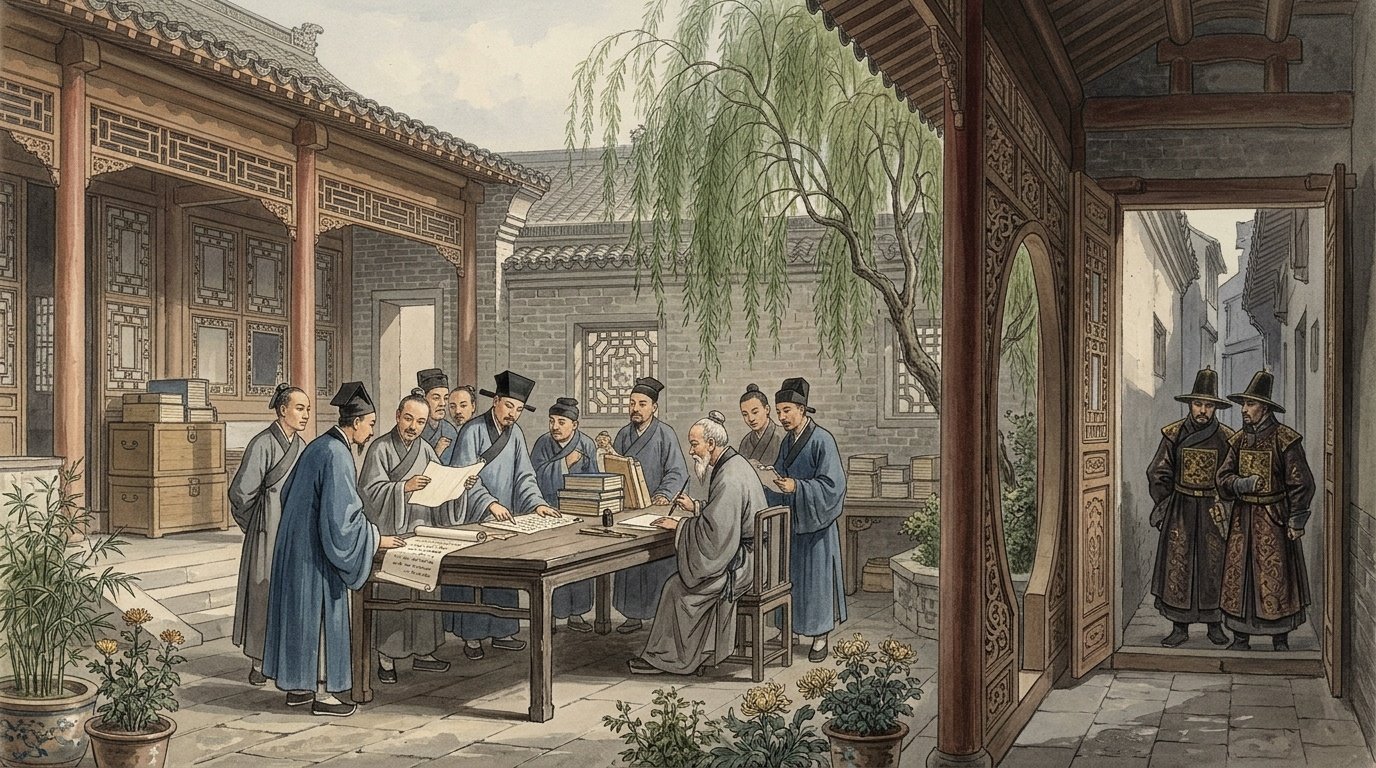
Standing in heroic, tragic opposition to this eunuch terror were the scholar-reformers of the Donglin Academy (东林书院). Armed only with the moral idealism of Neo-Confucian philosophy, their writing brushes, and an unbending willingness to die on the rack, the Donglin martyrs waged an existential war to preserve the moral conscience of Chinese civilization. Yet this titanic clash between castrated despots and puritanical scholars paralyzed the administrative machinery of the Ming state at the exact historical moment when the nomadic Manchu cavalry was rising in Manchuria and famine-stricken peasant rebellions were exploding across Shaanxi, directly sealing the doom of the dynasty.
This comprehensive monograph reconstructs the rise of the Ming eunuch apparatus, the mechanics of the Eastern Depot, and the heroic resistance of the Donglin Academy. We will examine the fatal institutional flaw in Zhu Yuanzhang’s autocratic constitution that made eunuch tyranny inevitable; trace the operational structure of the Directorate of Ceremonial (司礼监) and the ‘Vermilion Rescript’ (批红); follow the monstrous careers of the three great eunuch dictators—Wang Zhen, Liu Jin, and the self-proclaimed ‘Lord of Nine Thousand Years’ Wei Zhongxian; analyze the founding of the Donglin Academy in Wuxi and its moral-political crusade; dissect Yang Lian’s explosive indictment of the Twenty-Four Capital Crimes; chronicle the harrowing reign of terror in the Eastern Depot torture chambers; document the heroic popular uprising of the ‘Five Worthies’ in Suzhou; examine the young Chongzhen Emperor’s daring palace coup that destroyed Wei Zhongxian; and evaluate how the trauma of this conflict destroyed the Ming Dynasty from within.
1. The Castrated Empire: Zhu Yuanzhang’s Iron Tablet and the Autocratic Vacuum
The rise of eunuch power in the Ming Dynasty was an ironic, unintended consequence of the despotic constitutional structure created by the dynastic founder, Zhu Yuanzhang (Ming Taizu, Hongwu Emperor). Having witnessed the historical downfall of previous dynasties—such as the Late Han and Late Tang—where powerful eunuchs had murdered emperors and seized power, Zhu Yuanzhang was determined to eradicate the threat forever.
In 1384 CE, Zhu Yuanzhang cast a massive, three-foot-tall iron tablet and erected it outside the Palace of Heavenly Purity inside the Forbidden City. The tablet was inscribed with eight terrifying Chinese characters:
「内臣不得干预政事,犯者斩!」
— Zhu Yuanzhang (Ming Taizu), iron tablet inscription, 1384 CE
‘Eunuchs are strictly forbidden from meddling in the affairs of state; violators shall be summarily decapitated!’
Zhu Yuanzhang legally prohibited eunuchs from learning to read or write, restricted their official ranks to the fourth grade or lower, forbade them from wearing civil mandarin robes, and decreed that no eunuch could ever correspond with external officials. Yet four years earlier, in 1380 CE, following the execution of Chancellor Hu Weiyong, Zhu Yuanzhang committed a monumental institutional blunder: he permanently abolished the ancient office of the Imperial Chancellor (宰相, Zaixiang) and the Secretariat.
By abolishing the Chancellorship, Zhu Yuanzhang concentrated the entire executive, legislative, and judicial burden of the Chinese empire upon the single person of the Emperor. While an obsessive, hyperactive workaholic like Zhu Yuanzhang could personally review four hundred administrative memorials and sign two hundred decrees every single day, his imperial descendants were ordinary mortals. Raised in the sheltered, suffocating luxury of the inner palace, subsequent Ming emperors were often physically frail, psychologically erratic, or completely indifferent to the grueling drudgery of reading endless mountains of administrative reports written in dense classical prose.
An institutional vacuum opened between the civil bureaucracy in the Outer Court (外廷) and the Emperor in the Inner Court (内廷). Because Confucian mandarins were legally barred from entering the private residential quarters of the Forbidden City, the only human beings who had physical, daily, intimate access to the Son of Heaven were the palace eunuchs. When lazy, superstitious, or hedonistic monarchs sought to escape the suffocating moral lectures of Confucian scholars, they naturally turned to their castrated childhood companions, bed-servants, and drinking buddies to handle their correspondence. The iron tablet of Zhu Yuanzhang was quietly removed and cast into a storage shed.
2. The Factory of Shadows: The Directorate of Ceremonial and the Eastern Depot
The formal institutionalization of eunuch executive supremacy was completed during the reigns of the Yongle Emperor (Zhu Di) and his grandson, the Xuande Emperor (r. 1425–1435 CE). Having seized the throne through the bloody usurpation of the Jingnan campaign, Yongle distrusted the civil bureaucracy, relying upon palace eunuchs as his private secret service. In 1420 CE, Yongle established the Eastern Depot (东厂, Dong Chang)—the world’s first modern state secret police agency.
Headquartered just east of the Forbidden City near Donghuamen, the Eastern Depot was commanded exclusively by a senior eunuch known as the Grand Overseer (提督东厂太监), who answered only to the Emperor. The Eastern Depot maintained a vast, nationwide network of undercover spies, informants, and assassins known as ‘Spies of the Factory’ (番役, Fanyi, or Tingji 听记). Operating outside all statutory imperial law, Depot agents were legally empowered to arrest, interrogate, torture, and execute any imperial minister, military general, or common citizen without a warrant from the Ministry of Justice. Even the Emperor’s elite bodyguards, the Embroidered Uniform Guard (锦衣卫), were formally subordinated to the Eastern Depot.
Simultaneously, the administrative machinery of the palace was reorganized under the Twenty-Four Eunuch Directorates (二十四衙门), the supreme of which was the Directorate of Ceremonial (司礼监, Sili Jian). In 1426 CE, the Xuande Emperor made the fateful decision to establish the Palace School for Eunuchs (内书堂, Neishutang), where Hanlin academicians were ordered to teach young castrated boys classical literacy, administrative law, and calligraphy.
This literate eunuch bureaucracy acquired real, terrifying sovereign authority through the procedural mechanics of Ming imperial governance:
- The Draft Rescript (条旨 / 票拟, Piaoni): When memorials arrived from the provinces, the Grand Secretaries of the Cabinet (内阁) read the documents and drafted proposed imperial decisions on small slips of paper attached to the margins, known as Piaoni.
- The Vermilion Rescript (批红, Pihong): To become statutory imperial law, the draft rescript had to be officially approved and copied onto the original memorial using the Emperor’s sacred vermilion red ink. When emperors refused to attend state affairs, they delegated the authority of the vermilion brush to the Chief Eunuch of the Directorate of Ceremonial, the Bingbi Taijian (秉笔太监, ‘The Eunuch Who Holds the Brush’).
In effect, the eunuch who held the vermilion brush held the imperial crown. If a Grand Secretary opposed a eunuch dictator, the eunuch simply altered the vermilion rescript, ordering the minister to be stripped of rank, flogged on the palace stones, or dragged into the Eastern Depot dungeons. The civil government of the Ming was reduced to a hostage of castrated gatekeepers.
3. The Lineage of Tyranny: From Wang Zhen to the ‘Eunuch Emperor’ Liu Jin
Over two centuries, this toxic institutional design spawned a succession of monstrous eunuch dictators who brought the Ming Dynasty to the brink of annihilation:
A. Wang Zhen and the Catastrophe of Tumu (1449 CE)
The first eunuch to achieve absolute despotic control was Wang Zhen (王振, d. 1449 CE) during the reign of the young Zhengtong Emperor (Emperor Yingzong). Fawning over the boy-monarch, Wang Zhen usurped military command. In 1449 CE, when the Oirat Mongol chieftain Esen Tayisi invaded northern Hebei, Wang Zhen recklessly convinced the inexperienced twenty-two-year-old emperor to personally lead an army of five hundred thousand imperial troops into the northern wilderness.
Wang Zhen treated the campaign as a personal vanity tour, altering military march routes so the imperial host would pass through his native village of Yuzhou to impress his relatives. Trapped without water on the arid plains of Tumu (土木堡), the starving imperial army was surrounded and annihilated by Oirat horsemen. Over two hundred thousand imperial soldiers and fifty senior ministers were slaughtered; the Zhengtong Emperor was captured alive by the Mongols; and Wang Zhen was beaten to death on the battlefield with a bronze mace by an enraged imperial general, Fan Guang. The Tumu Crisis permanently shattered Ming military supremacy in East Asia.
B. Liu Jin: The ‘Standing Emperor’ of the Zhengde Era (1506–1510 CE)
Under the eccentric, adolescent Zhengde Emperor (r. 1505–1521 CE)—who preferred playing soldier in his private menagerie, the Leopard House (豹房)—supreme power fell to his favorite eunuch, Liu Jin (刘瑾, d. 1510 CE). Heading an eight-man cabal known as the ‘Eight Tigers’ (八虎), Liu Jin established a reign of terror. He created a brand-new, private secret police agency, the Western Depot (西厂) and the Inner Depot (内行厂), expanding surveillance to monitor even the Eastern Depot agents!
Liu Jin became so powerful that contemporaries referred to him as the ‘Standing Emperor’ (立皇帝), while the actual Son of Heaven who reclined on the throne was mocked as the ‘Sitting Emperor’ (坐皇帝). Mandarins who refused to kneel before Liu Jin were subjected to the terrifying ordeal of Palace Flogging (廷杖, Tingzhang)—stripped naked on the marble courtyard of the Forbidden City and beaten with heavy, iron-tipped wooden staves across their bare buttocks until their flesh was pulped and their bones were splintered. Dozens of upright scholars died upon the stones. When Liu Jin was finally brought down in 1410 CE in a palace counter-coup, imperial guards searched his private mansion and uncovered an astonishing treasure: twelve million ounces of gold, two hundred and fifty million ounces of silver, and several ceremonial daggers with false blades concealed in his imperial sleeves, intended for assassinating the emperor. Liu Jin was sentenced to the ultimate penalty: execution by Slow Slicing (凌迟) over three days, with 3,357 knife cuts peeling his flesh from his bones.
4. The Conscience of Jiangnan: Gu Xiancheng and the Donglin Academy (1604 CE)
At the turn of the seventeenth century, the Ming Dynasty was sinking into systemic paralysis. The eccentric Wanli Emperor (万历帝, r. 1572–1620 CE) had engaged in a thirty-year imperial strike: furious at his civil ministers for opposing his choice of imperial heir, Wanli refused to hold morning court audiences, refused to meet his Grand Secretaries, and refused to appoint replacements for retiring officials. Half the high offices of the empire were vacant, provincial tax revenues were embezzled by eunuch mining commissioners (矿监税使), and bureaucratic corruption was rampant.
Disgusted by this moral rot, an incorruptible former Vice Minister of Personnel, Gu Xiancheng (顾宪成, 1550–1612 CE), was cashiered from office for courageously remonstrating against the throne. Returning to his native hometown of Wuxi (无锡) in the emerald water-country of Jiangsu, Gu Xiancheng gathered fellow cashiered scholars—including his brother Gu Yuncheng, Gao Panlong (高攀龙), and Qian Yiben. In 1604 CE, on the banks of Lake Tai, they restored the historic Song Dynasty Donglin Academy (东林书院, ‘The Eastern Grove Academy’).
Upon the wooden pillars of the central lecture hall, Gu Xiancheng inscribed a famous, immortal couplet that became the moral manifesto of a generation:
「风声雨声读书声,声声入耳;家事国事天下事,事事关心。」
— Gu Xiancheng (顾宪成), couplet inscribed at the Donglin Academy, 1604 CE
‘The sound of wind, the sound of rain, the sound of reading books—every sound enters the ear;
Affairs of the family, affairs of the state, affairs of all under Heaven—every affair touches the heart.’
The Donglin Academy was far more than a rural school; it transformed into the first modern political party and moral crusade in Chinese history. Rejecting the inward-looking, subjective complacency of late Ming Chan-influenced philosophy, the Donglin scholars championed a rigorous, socially engaged Neo-Confucian orthodoxy based on the teachings of Zhu Xi. They believed that the salvation of the empire required three urgent reforms: absolute moral integrity among scholar-officials, the elimination of eunuch interference in government, and the institutional right of public discussion (清议, Qingyi) to critique imperial statecraft.
Annual summits at the Donglin Academy attracted thousands of scholars, students, and officials from across Jiangnan. When the Wanli Emperor died in 1620 CE and his grandson ascended as the Tianqi Emperor (天启帝, r. 1620–1627 CE), a wave of celebrated Donglin statesmen—led by Yang Lian, Zuo Guangdou (左光斗), and Zhao Nanxing (赵南星)—swept into Beijing, capturing senior cabinet and censorate posts. For a brief, shining moment, it appeared that the moral reformation of the Ming had begun.
4B. The Crucible of Crisis: The Three Great Mysteries of the Late Ming
The bitter polarization that erupted into the eunuch dictatorship was catalyzed by three bizarre, conspiratorial crises that occurred in the Forbidden City between 1615 and 1620 CE, known to Chinese history as the ‘Three Great Cases of the Late Ming’ (晚明三大案). In each case, Donglin scholars clashed violently with palace eunuchs and imperial concubines, turning the inner court into an armed ideological battleground:
- 1. The Case of the Wooden Staff (梃击案, Tingji An, 1615 CE): In the fifth lunar month of 1615, an ordinary peasant ruffian named Zhang Cha breached the heavily guarded gates of the Forbidden City wielding a heavy jujube-wood club. Marching directly into the Ciqing Palace, he attempted to bludgeon to death the Crown Prince Zhu Changluo (later the Taichang Emperor). While court censors suspected that the assassination was orchestrated by the Wanli Emperor’s favorite concubine, Noble Consort Zheng, to install her own son upon the throne, eunuchs attempted to hush up the investigation by claiming the assassin was a madman. Donglin scholars led by Lu Daji and Yang Lian fought fiercely to expose the palace conspiracy, earning the eternal hatred of Consort Zheng and her eunuch allies.
- 2. The Case of the Red Pill (红丸案, Hongwan An, September 1620 CE): When the Wanli Emperor finally died in 1620, Crown Prince Zhu Changluo took the throne as the Taichang Emperor. Yet after barely ten days of rule, the new emperor fell gravely ill with debilitating diarrhea. The eunuch director Cui Wensheng administered a massive dose of purging laxatives that left the monarch dehydrated and dying. In desperation, an obscure minor official named Li Keshao presented two mysterious ‘Red Pills’ (红丸)—an alchemical elixir compounded from red lead, autumn mineral dew, human breast milk, and cinnabar. The Emperor swallowed one pill, declared himself temporarily refreshed, swallowed a second pill at midnight, and was found stone-dead in his bed at dawn. Having reigned for barely twenty-nine days, Taichang’s sudden death threw the empire into chaos. Donglin scholars accused the eunuchs and medicine peddlers of intentional imperial regicide.
- 3. The Case of the Palace Removal (移宫案, Yigong An, October 1620 CE): In the immediate aftermath of Taichang’s death, his favorite concubine, the ambitious Consort Li (known as ‘Western Consort Li’ 西李), seized physical control of the sixteen-year-old heir, Zhu Youxiao. Occupying the Emperor’s private bedchamber in the Palace of Heavenly Purity, Consort Li and her eunuch cabal refused to vacate the premises, attempting to hold the boy-monarch hostage to force the court to name her Empress Dowager and grant her regency over the empire. Hearing of the palace coup, Yang Lian and fellow Donglin scholars stormed past the palace eunuchs, physically dragged the weeping boy out of Consort Li’s grasp into an imperial carriage, proclaimed him the Tianqi Emperor in the outer hall, and forced Consort Li to flee into an auxiliary pavilion.
While the Donglin scholars had saved the young emperor from kidnapping, their righteous assertiveness terrified the inner palace. The young Tianqi Emperor was deeply traumatized by the aggressive mandarins who shouted in his bedchamber, while the humiliated palace eunuchs and wet nurse Madame Ke vowed to exact bloody, merciless vengeance upon Yang Lian and his colleagues at the earliest opportunity.
5. The Lord of Nine Thousand Years: The Rise of Wei Zhongxian (1620–1624 CE)
The Donglin dream of clean government was smashed by the emergence of the most terrifying, grotesque demagogue in four thousand years of Chinese history: Wei Zhongxian (魏忠贤).
Born in Suning (Hebei) as an illiterate peasant ruffian, horse-thief, and compulsive gambler, Wei Zhongxian had accumulated debts so ruinous that loan sharks threatened to murder him. In an act of absolute desperation at the age of twenty-one, Wei took a kitchen knife and castrated himself, bribing his way into the lowest ranks of the palace eunuch service. Possessing animal cunning, ruthless sycophancy, and a genius for court intrigue, Wei wormed his way into the household of the Crown Prince, eventually forming an intimate sexual and emotional partnership with Madame Ke (客氏), the wet nurse of the young prince Zhu Youxiao.
When the sixteen-year-old Zhu Youxiao ascended the throne in 1620 as the Tianqi Emperor, Wei Zhongxian and Madame Ke established total psychological mastery over the boy-monarch. Tianqi was mentally stunted and completely illiterate, possessing an obsessive, autistic passion for only one thing: carpentry. The Emperor spent his days in the palace courtyards wearing coarse linen clothes, wielding saws, chisels, and planes, building elaborate miniature wooden pavilions, carved lacquer folding screens, and water-powered mechanical puppets with breathtaking artisan skill. Whenever urgent state memorials arrived reporting Manchu incursions or domestic famines, Wei Zhongxian deliberately waited until the young emperor was sweating over a dovetail joint or carving a wooden dragon. Annoyed at the interruption, Tianqi would wave his hand dismissively and bark: ‘I am busy! You are capable—handle it for me!’
Armed with this verbal blank check, Wei Zhongxian seized absolute control of the Directorate of Ceremonial and the Eastern Depot. He purged imperial princes, poisoned imperial consorts who threatened his influence, and established a monstrous political machine. Opportunistic civil mandarins who were rejected by the high-minded Donglin party rushed to kowtow before the illiterate eunuch, forming the corrupt Eunuch Faction (阉党, Yan Dang). Wei Zhongxian’s vanity reached psychotic proportions: he forced the court to bestow upon him the blasphemous title of ‘The Lord of Nine Thousand Years’ (九千岁, Jiuqian Sui)—sitting barely one thousand years beneath the Emperor’s sacred ‘Ten Thousand Years’ (万岁). Sycophantic governors across all thirteen provinces spent millions of taels of state silver erecting colossal, golden ‘Living Temples’ (生祠, Shengci) dedicated to Wei Zhongxian, where civil mandarins were required by law to burn incense and prostrate nine times before life-sized wooden and bronze statues of the castrated peasant!
To institutionalize his personal dictatorship, Wei Zhongxian established a grotesque parody of Confucian familial hierarchy within the civil bureaucracy. High-ranking civil and military officials groveled to become his honorary kin, organizing themselves into a corrupt network known as ‘The Five Tigers, Five Cheetahs, Ten Dogs, Ten Children, and Forty Grandsons’ (五虎、五彪、十狗、十孩儿、四十孙):
- The Five Tigers (五虎): Led by the brilliant, cynical Grand Secretary Cui Chengxiu (崔呈秀), who directed the administrative machinery of the cabinet to purge political rivals and draft decrees praising Wei;
- The Five Cheetahs (五彪): Commanded by the sadistic Embroidered Uniform Guard warden Xu Xianchun and military officers who directed the physical tortures, nocturnal assassinations, and prison executions;
- The Ten Dogs (十狗): Imperial censors and prosecutors who specialized in fabricating evidence, drafting scurrilous impeachment memorials, and baying like hunting hounds against any mandarin who failed to bow to the eunuch;
- The Ten Children and Forty Grandsons: Senior provincial viceroys, regional inspectors, and tax collectors who remitted millions in extorted silver to Wei Zhongxian’s private vaults in Beijing.
This parasitic eunuch empire was sustained by a booming, horrifying cottage industry across northern China: voluntary self-castration (自宫). Driven by grinding rural poverty, drought, and the allure of untold wealth inside the palace, tens of thousands of young peasant men and boys in Hebei and Shandong used crude kitchen knives to castrate themselves. By the 1620s, over twenty thousand castrated vagrants congregated in the slums of Beijing, begging outside the palace gates, waiting for rare openings in the imperial household service. The mutilation of human bodies had become the primary avenue for social advancement in late Ming society.
6. The Twenty-Four Crimes: Yang Lian’s Thunderous Indictment (1624 CE)
While the majority of the civil bureaucracy cowered in terrified silence before the Lord of Nine Thousand Years, one man resolved to challenge the monster at the cost of his life. In the sixth lunar month of the fourth year of the Tianqi era (July 1624 CE), the Vice Censor-in-Chief Yang Lian marched into the imperial court carrying an explosive, thirty-page memorial: The Indictment of the Twenty-Four Capital Crimes of the Traitorous Eunuch Wei Zhongxian (参魏忠贤二十四罪大疏).
Reading aloud in a voice trembling with righteous fury, Yang Lian laid bare every atrocity committed by the eunuch dictatorship:
- Usurping Imperial Prerogative: Falsifying imperial decrees, controlling the vermilion brush, and isolating the young sovereign from his ministers;
- Murdering Imperial Blood: Starving the Empress Dowager, murdering the Emperor’s biological concubine Consort Zhao, and causing the Empress Lady Zhang to suffer a miscarriage by beating her attendants;
- Erecting a Terror Police State: Mobilizing the Eastern Depot to arrest innocent citizens in the dead of night, extracting confessions through torture, and executing generals on the frontier;
- Blasphemous Megalomania: Forcing the empire to worship his living statues in state temples and demanding the title of Nine Thousand Years.
Yang Lian concluded with an immortal, defiant demand: ‘I beg Your Majesty to immediately sever the head of this traitor Wei Zhongxian in the marketplace, in order to comfort the ancestral spirits of Taizu and Chengzu, and to cleanse the shame of our dynasty!’
The memorial shook Beijing like an earthquake. Over seventy senior scholar-officials immediately stepped forward to co-sign the petition. Yet Wei Zhongxian was not easily broken. Rushing into the inner bedchamber, Wei fell upon his knees before the young Tianqi Emperor, sobbing uncontrollably, beating his forehead against the floorboards until blood streamed down his face, crying that the Donglin scholars were plotting a palace coup to dethrone the emperor. Bewildered and terrified of losing his favorite playmate, Tianqi issued an angry vermilion rescript condemning Yang Lian for ‘stirring up factional strife’ and dismissing his charges as baseless slander.
7. The Reign of Terror: The Slaughter of the Six Gentlemen
Having survived the supreme political crisis of his life, Wei Zhongxian unleashed a campaign of unsparing, psychotic vengeance designed to physically exterminate the Donglin movement forever.
In early 1625 CE, Wei Zhongxian ordered his sycophantic scribes to compile the infamous Register of Donglin Traitors (东林点将录). Parodying the 108 outlaw heroes of the classic novel Water Margin (水浒传), the register listed one hundred and eight prominent Donglin scholars under mocking outlaw nicknames (naming Yang Lian as ‘The Jade Unicorn’ and Zuo Guangdou as ‘The Leopard-Headed’). By imperial decree, every single scholar on the blacklist was stripped of office and slated for arrest.
In the fifth lunar month of 1625 CE, the Eastern Depot arrested the ‘Six Gentlemen’ (前六君子): Yang Lian, Zuo Guangdou, Wei Dazhong, Yuan Huazhong, Zhou Chaorui, and Gu Dazhang. Dragged into the subterranean cells of the Embroidered Uniform Guard under the sadistic warden Xu Xianchun (许显纯), the scholars were subjected to the infamous ‘Five Venoms’ (五毒) torture every three days. When relatives of the prisoners attempted to raise funds to pay extortionate bail fees, Xu Xianchun ordered the tortures intensified.
The heroic spirit of the martyrs is captured in the legendary prison visitation of the young scholar Shi Kefa (史可法, 1601–1645 CE), the brilliant student of Zuo Guangdou. Disguising himself as a prison sweeper in rags and straw sandals, Shi Kefa bribed a jailer to lead him into Zuo Guangdou’s dungeon. What he found horrified him: Zuo Guangdou was slumped against a damp stone wall, his face scorched black by burning irons, both his legs stripped of flesh down to the white bone, and his left eye swollen shut and leaking pus. Shi Kefa fell to his knees, clutched his master’s bloody ankles, and wept aloud.
Hearing his student’s voice, Zuo Guangdou used his trembling fingers to pry open his remaining swollen eyelid. His gaze was burning with righteous fury. Kicking Shi Kefa away with his shattered foot, the dying master roared:
「奴才!何等时候,而汝犹在此耶!国家事若此,天下事谁可任者?汝不速去,奸人知之,必杀汝!汝死,则天下事真无可为者矣!」
— Zuo Guangdou (左光斗), words to Shi Kefa in prison, recorded in Ming Shi
‘Ignorant slave! What hour is this, that you dare linger here!
The affairs of our empire have reached such a desperate pass—who is left to shoulder the burden under Heaven if not you?
If you do not depart immediately, the traitors will discover you and murder you!
If you die, then the affairs of all under Heaven will truly be lost beyond all hope!’
Weeping in the shadows, Shi Kefa fled the prison. He would survive to become the supreme patriotic general who defended Yangzhou against the Manchus to his dying breath in 1645. Within weeks, all Six Gentlemen were murdered in their cells. The following year, Wei Zhongxian arrested the ‘Seven Later Gentlemen’ (后七君子)—including Gao Panlong, who drowned himself in a lotus pond rather than endure the indignity of eunuch chains. Across China, dozens of classical academies were demolished, and Confucian books were burned on public bonfires.
8. The People Strike Back: The Uprising of the Five Worthies in Suzhou (1626 CE)
While the scholar-officials in Beijing were being butchered, an unexpected explosion of popular resistance erupted from the common working people of the south. In the third lunar month of 1626 CE, Eastern Depot secret police agents arrived in the cultural capital of Suzhou (苏州) to arrest the beloved Donglin leader and former censor Zhou Shuntian (周顺昌).
When the news spread through the city, an enormous crowd of over ten thousand citizens—silk weavers, dyers, blacksmiths, vegetable peddlers, and academy students—flooded into the streets, surrounding the local magistrate’s yamen. When the arrogant Eastern Depot agents strode out into the courtyard, wearing their high black caps and brandishing iron chains, shouting obscenities and kicking civilian elders, public fury detonated like gunpowder.
A courageous civilian named Yan Peipei (颜佩韦) stepped forward, shouting to the crowd: ‘Zhou Shuntian is an incorruptible father to our people! Why should he be chained like a dog by castrated palace slaves?’ Within seconds, the crowd seized cobblestones, tiles, and wooden staves. In a tidal wave of righteous fury, the ten thousand citizens stormed the Eastern Depot agents. The imperial secret police were chased through the streets, dragged from roofs, and beaten to bloody pulps; two Depot officers were killed on the spot, and the remaining agents barely escaped by jumping into city sewage canals.
Terrified of an armed regional rebellion, the Yuan court mobilized provincial garrisons to put down the riot. To prevent an imperial military massacre of their fellow citizens, five ordinary working-class men—Yan Peipei, Ma Jie, Yang Nianru, Shen Liang, and Zhou Rong—courageously stepped forward and voluntarily surrendered themselves to the executioner as the ‘ringleaders’ of the riot. On the scaffold outside the Suzhou city gates, the five commoners met death with laughing, magnificent bravery, shouting curses at Wei Zhongxian until their heads fell into the dust.
The citizens of Suzhou purchased their bodies, buried them together on the scenic slopes of Mount Tiger (虎丘), and erected an immortal stone monument: the Tomb of the Five Worthies (五人墓). The celebrated Ming prose master Zhang Pu (张溥) penned the immortal Record of the Five Men’s Tomb (五人墓碑记), celebrating the eternal truth that when scholar-officials cower before tyranny, the moral soul of a nation resides in the fearless hearts of its common workers.
9. The Coup of Chongzhen: The Fall of the Monster (1627–1628 CE)
The reign of terror collapsed with sudden, breathtaking speed in the eighth lunar month of 1627 CE. The young Tianqi Emperor—having contracted pneumonia after falling into an imperial lake while sailing a toy boat—died at the age of twenty-two, leaving no biological heir. On his deathbed, Tianqi passed the crown to his seventeen-year-old younger brother, Zhu Youjian, who ascended the Dragon Throne as the Chongzhen Emperor (崇祯帝, r. 1627–1644 CE).
Chongzhen was a figure of cold, brilliant cunning and unyielding determination. Knowing that Wei Zhongxian controlled thirty thousand armed eunuchs inside the Forbidden City, Chongzhen feigned complete subservience. For two months, Chongzhen praised Wei Zhongxian, approved his memorials, and ate only food brought from his private mansion, terrified of being poisoned. Chongzhen patiently sowed discord among the eunuch faction, systematically cashiering Wei’s closest military allies.
In November 1627 CE, feeling the imperial net tightening, a brave imperial censor named Qian Jiazheng submitted an impeachment memorial listing Wei Zhongxian’s ten treasonous crimes. Chongzhen seized the moment. Summoning Wei Zhongxian to the palace, Chongzhen ordered the memorial read aloud before the court. Stripped of his titles, Wei Zhongxian was exiled to guard the imperial ancestral tombs in Fengyang (Anhui). A few days later, realizing that Wei was traveling with an armed bodyguard of forty cavalrymen and plotting rebellion, Chongzhen dispatched an elite troop of cavalry with orders to arrest the eunuch and bring him back in iron cages.
On December 11, 1627 CE, trapped at a small roadside inn in Suning, Cangzhou, hearing the hoofbeats of imperial cavalry approaching in the freezing night, the Lord of Nine Thousand Years knew the game was up. Tying a silk belt around a wooden roof beam, Wei Zhongxian hanged himself. Imperial soldiers severed his head, dragged his body to Beijing, and hacked his corpse into a thousand pieces in the public marketplace. Madame Ke was flogged to death in the palace laundry, and hundreds of Eunuch Faction conspirators were executed or banished. The eunuch nightmare was over.
10. The Ghost in the Ruins: Historiographical Epilogue
Yet Chongzhen’s destruction of Wei Zhongxian came too late to save the Great Ming. The thirty-year civil war between the eunuchs and the Donglin party had destroyed the moral and administrative fabric of the empire. When the Donglin scholars returned to power, they proved to be dogmatic, factional moralists who lacked practical administrative, economic, and military competence. They stubbornly blocked vital commercial tax reforms in Jiangnan, bankrupting the imperial treasury while northern soldiers starved in their garrisons.
Consumed by growing paranoia and facing simultaneous disasters—the Manchu invasion of Liaodong and Li Zicheng’s peasant rebellions in Shaanxi—Chongzhen grew impatient with the endless bickering of his civil ministers. In a tragic, fatal irony, Chongzhen eventually resurrected the eunuch system, dispatching palace eunuchs to oversee provincial armies and regional granaries. On April 25, 1644 CE, when Li Zicheng’s rebel army breached the gates of Beijing, it was the palace eunuch Du Xun who opened the city portals to the rebels. Hours later, Chongzhen walked up the slopes of Coal Hill behind the Forbidden City, climbed a twisted pagoda tree, and hanged himself with a silk cord. The Ming Dynasty perished in the shadow of the very eunuchs it could never escape.
11. Chronology of Ming Eunuch Rule and the Donglin Movement (1384–1644 CE)
| Year (CE) | Historical Event | Key Historical Figures | Significance & Dynastic Impact |
|---|---|---|---|
| 1384 | Erection of Zhu Yuanzhang’s Iron Tablet | Ming Taizu (Zhu Yuanzhang) | Decrees death penalty for eunuchs meddling in politics; tablet erected in palace |
| 1420 | Founding of the Eastern Depot (Dong Chang) | Yongle Emperor (Zhu Di) | Extra-judicial secret police bureau created under eunuch command |
| 1426 | Palace School for Eunuchs (Neishutang) | Xuande Emperor | Eunuchs taught classical literacy; begin handling the ‘Vermilion Rescript’ (批红) |
| 1449 | The Tumu Crisis; Wang Zhen Slain | Wang Zhen, Emperor Yingzong | Eunuch dictatorship causes loss of 200,000 troops; Emperor captured by Mongols |
| 1506–1510 | The Reign of Terror of Liu Jin | Liu Jin (‘Standing Emperor’) | Controls state finance; executed by 3,357 knife cuts (Slow Slicing) |
| 1604 | Founding of the Donglin Academy in Wuxi | Gu Xiancheng, Gao Panlong | Scholars launch moral reformation; couplet inscribed; party movement begins |
| 1620 | Tianqi Ascends; Wei Zhongxian Rises | Tianqi Emperor, Wei Zhongxian | Illiterate carpenter emperor delegates all power to Wei Zhongxian and Madame Ke |
| 1624 (Jun) | Yang Lian Submits the 24 Crimes Memorial | Yang Lian, Wei Zhongxian | Censor indicts Wei’s capital crimes; Tianqi rejects petition; purges begin |
| 1625 | Martyrdom of the Six Gentlemen | Yang Lian, Zuo Guangdou | Scholars murdered in Eastern Depot dungeons; iron nails driven into foreheads |
| 1626 (Mar) | The Uprising of the Five Worthies in Suzhou | Yan Peipei, Zhou Shuntian | 10,000 citizens storm Eastern Depot agents; 5 commoners sacrifice lives |
| 1627 (Aug) | Death of Tianqi; Ascension of Chongzhen | Chongzhen Emperor, Tianqi | 17-year-old brother takes throne; begins secret plot to eliminate eunuch faction |
| 1627 (Dec) | Suicide of Wei Zhongxian; Purge of Faction | Wei Zhongxian, Chongzhen | Wei hangs himself at Suning inn; corpse hacked to pieces; temples demolished |
| 1644 (Apr) | Fall of Beijing; Suicide of Chongzhen | Chongzhen Emperor, Eunuch Du Xun | Eunuchs open city gates to Li Zicheng; Chongzhen hangs himself on Coal Hill; Ming falls |
12. Scholarly Bibliography and Primary Historical Sources
To substantiate the political trials, administrative mechanisms, and historical records presented in this study, the following primary sources and academic monographs are recommended for further study:
- Zhang Tingyu (张廷玉) et al. (comp. 1739 CE), History of Ming (明史, Ming Shi): The primary dynastic source, containing the Biographies of Eunuchs (宦官传, Vols. 304–305: Wang Zhen, Liu Jin, Wei Zhongxian), the Biographies of Yang Lian and Zuo Guangdou (Vol. 244), and the Biography of Gu Xiancheng (Vol. 231).
- Gu Yingtai (谷应泰, comp. 1658 CE), Records of Ming History from Beginning to End (明史纪事本末, Ming Shi Jishi Benmo): Essential narrative chapters detailing the ‘Tumu Crisis’ (土木之变), the ‘Donglin Factional Conflict’ (东林党祸), and the ‘Usurpation of Wei Zhongxian’ (魏忠贤乱政).
- Wen Bing (文秉, comp. c. 1640 CE), Pleading for Righteousness at the Gate of Heaven (先拨志始, Xian Bo Zhi Shi): Crucial contemporary eyewitness account written by a late Ming scholar detailing the arrest and torture of the Donglin martyrs.
- Dardess, John W. (2002), Blood and History in China: The Donglin Faction and Its Repression, 1620–1627, University of Hawai’i Press: The definitive English-language monograph on the Donglin movement, analyzing the social backgrounds, philosophical debates, and the Eastern Depot purges.
- Tsai, Shih-shan Henry (1996), The Eunuchs in the Ming Dynasty, State University of New York Press: The foundational, comprehensive academic study of the institutional structure, economic functions, and political dominance of the Ming eunuch bureaucracy.
- Wakeman, Frederic, Jr. (1985), The Great Enterprise: The Manchu Reconstruction of Imperial Order in Seventeenth-Century China, University of California Press: Masterful two-volume epic examining the internal political collapse of late Ming and the factional struggles leading to 1644.
- Huang, Ray (1981), 1587, A Year of No Significance: The Ming Dynasty in Decline, Yale University Press: Classic study illuminating the constitutional paralysis between the Wanli Emperor and the civil bureaucracy that created the vacuum for eunuch despotism.
- Struve, Lynn A. (1993), Voices from the Ming-Qing Cataclysm: China in Tigers’ Jaws, Yale University Press: Rich collection of translated personal diaries, memoirs, and prison letters written by late Ming scholars and eyewitnesses.
- Mote, Frederick W., and Denis Twitchett, eds. (1988), The Cambridge History of China, Volume 7: The Ming Dynasty, 1368–1644, Part 1, Cambridge University Press: Comprehensive chapters detailing the reigns of Zhengtong, Zhengde, Tianqi, and Chongzhen.
- Zhang Pu (张溥, 1602–1641 CE), Record of the Five Men’s Tomb (五人墓碑记, Wu Ren Mu Bei Ji): The immortal primary prose masterpiece commemorating the 1626 popular resistance against the Eastern Depot in Suzhou.