Yue Fei, Qin Hui and the Price of Dynastic Paranoia
On the twenty-seventh day of the twelfth lunar month in the eleventh year of the Shaoxing era (January 27, 1142 CE)—on the eve of the Chinese Lunar New Year, when families across southern China were lighting firecrackers and preparing reunion feasts—the darkest judicial murder in Chinese history was enacted in the subterranean dungeons of the Dali Temple (大理寺, Court of Judicature and Revision) in Lin’an (临安, modern Hangzhou). Stripped of his general’s armor, his flesh torn by savage interrogations on the rack, a thirty-nine-year-old warrior took up a brush for the final time. Upon the official confession parchment, he refused to sign the fabricated charges of treason. Instead, he scrawled eight large, defiant characters that would echo across nine centuries:
「天日昭昭!天日昭昭!」
— Yue Fei (岳飞), final handwritten inscription before execution, 1142 CE
‘The Sun of Heaven is luminous and clear! The Sun of Heaven is luminous and clear!’
Hours later, in the secluded courtyard of the Fengbo Pavilion (风波亭, ‘The Pavilion of Wind and Waves’), the supreme military commander of the Southern Song was executed in cold blood. Some accounts record that he was forced to drink a cup of lethal poison; others document that imperial assassins crushed his ribs with iron maces. Concurrently, outside the city marketplace, his twenty-two-year-old son Yue Yun (岳云), the ferocious hammer-wielding hero of a hundred battles, and his most loyal commanding officer Zhang Xian (张宪), were publicly beheaded. When the veteran general Han Shizhong (韩世忠) stormed into the Prime Minister’s residence and furiously demanded of Grand Councilor Qin Hui (秦桧) what concrete evidence proved that Yue Fei had committed high treason, Qin Hui leaned forward and uttered three immortal, chilling words:
「其事莫须有。」
— Qin Hui (秦桧), response to Han Shizhong, recorded in Song Shi (宋史)
‘Perhaps there is; it is not necessary to have proof.’
The judicial execution of General Yue Fei (岳飞, 1103–1142 CE, courtesy name Pengju 鹏举) is the foundational tragedy of Chinese historical memory. To generations of Chinese, Yue Fei is the supreme embodiment of Jingzhong Baoguo (精忠报国, ‘Serving the Country with Utmost Loyalty’)—the brilliant, incorruptible general who forged an invincible peasant army, halted the terrifying advance of the Jurchen horsemen, and stood on the very precipice of recapturing the ancestral northern capital of Kaifeng, only to be betrayed, recalled, and murdered by a treacherous chancellor and a cowardly sovereign.
Yet beneath the popular romantic mythology popularized by Ming operas and Qing folklore lies a far darker, structural reality of imperial statecraft. Yue Fei was not merely the victim of Qin Hui’s venal cowardice; he was executed because his battlefield genius, military independence, and ideological intransigence directly threatened the political survival of the reigning emperor, Song Gaozong (宋高宗, Zhao Gou). In the cynical calculations of the Zhao imperial clan, the total reconquest of North China was not a glorious dream, but an existential nightmare: it threatened to liberate the deposed elder emperor Qinzong, delegitimize Gaozong’s own throne, and resurrect the specter of military warlordism that the Song dynasty had spent two centuries suppressing. Yue Fei was the sacrificial lamb slaughtered on the altar of dynastic self-preservation.
This monograph provides an exhaustive military, institutional, and psychological autopsy of the life, campaigns, and execution of Yue Fei. We will examine his humble origins in Henan and the legendary tattooing of his back; analyze the operational structure and iron discipline of the Yue Family Army (岳家军); dissect his tactical innovations that shattered the Jurchen Tiefutu heavy cavalry at the battles of Yancheng and Zhuxian Town; reconstruct the agonizing tragedy of the ‘Twelve Gold-Lacquered Plaques’ (十二道金牌); unpack the hidden psychological and dynastic terror driving Emperor Gaozong; investigate Qin Hui’s role as imperial scapegoat and diplomatic appeaser; chronicle the harrowing trials in the Dali Temple; and trace the enduring transformation of Yue Fei into the eternal patron saint of Chinese national identity.
1. The Boy from Tangyin: The Crucible of the North (1103–1127 CE)
Yue Fei was born on the fifteenth day of the second lunar month in 1103 CE into a humble, tenant-farming family in Tangyin County, Xiangzhou (modern Anyang, Henan Province). Legend records that at the hour of his birth, a great flock of swans or mythical roc-birds flew screaming above the thatch roof of the family cottage, prompting his father, Yue He, to name the infant Fei (飞, ‘Flight’) and give him the courtesy name Pengju (鹏举, ‘The Soaring of the Giant Roc’). Shortly after his birth, the Yellow River burst its dykes in a catastrophic flood; his mother, Lady Yao (姚氏), placed the infant in a large wooden washing tub and floated across the swirling torrents to safety.
Growing up amidst rural poverty, Yue Fei exhibited extraordinary physical strength and an unyielding martial temperament. While other village boys studied the Confucian classics to enter the civil examinations, Yue Fei apprenticed himself to the famous Henan archery master Zhou Tong (周同). By the age of sixteen, Yue Fei could draw an iron bow requiring three hundred catties of draw weight (approx. 180 kg) and shoot arrows ambidextrously with unerring precision. Following Zhou Tong’s death, Yue Fei studied the spear techniques of Chen Guang, mastering the heavy iron lance until he was hailed across the county as ‘invincible with the spear.’
When the Jurchen Jin armies invaded northern China in 1125–1126 CE, burning villages and looting ancestral temples, Yue Fei enlisted as a junior soldier in the Song volunteer militias. It was during this dark hour of national collapse that the most famous legend of Yue Fei’s life occurred. As the young soldier prepared to march south to join the forces defending the dynasty, his mother, Lady Yao, took a sewing needle and vinegar ink. To ensure that her son would never succumb to the temptations of banditry, surrender, or treason during the chaos of war, she painstakingly tattooed four Chinese characters deep into the flesh of his back:
「尽忠报国」
— Tattooed on Yue Fei’s back by his mother, Lady Yao, recorded in Song Shi (宋史, later popularized as 精忠报国)
‘Serve the State with Utmost Loyalty.’
Following the fall of Kaifeng and the capture of Emperors Huizong and Qinzong in 1127 CE, Yue Fei joined the garrison defending the southern approaches to the capital under the legendary veteran commander Zong Ze (宗泽, 1060–1128 CE). Zong Ze, an unyielding patriot who died with his teeth clenched shouting ‘Cross the River! Cross the River! Cross the River!’ (过河!过河!过河!), recognized Yue Fei’s extraordinary military genius. Zong Ze promoted the young officer, broke him of his habit of reckless solo charges, and taught him the art of battlefield formation and operational coordination. With Zong Ze’s passing, Yue Fei inherited the mantle of northern resistance.
2. The Yue Family Army: Iron Discipline and Tactical Revolution
During the chaotic early years of the Southern Song (1127–1134 CE), the imperial military apparatus was a disaster. Most Song armies were little more than undisciplined mobs of former bandits, mutineers, and displaced mercenaries who fled before the Jurchen cavalry and pillaged Chinese civilians in the rear. Amidst this moral decay, Yue Fei constructed a military force that stood as an extraordinary anomaly: the Yue Family Army (岳家军, Yuejia Jun).
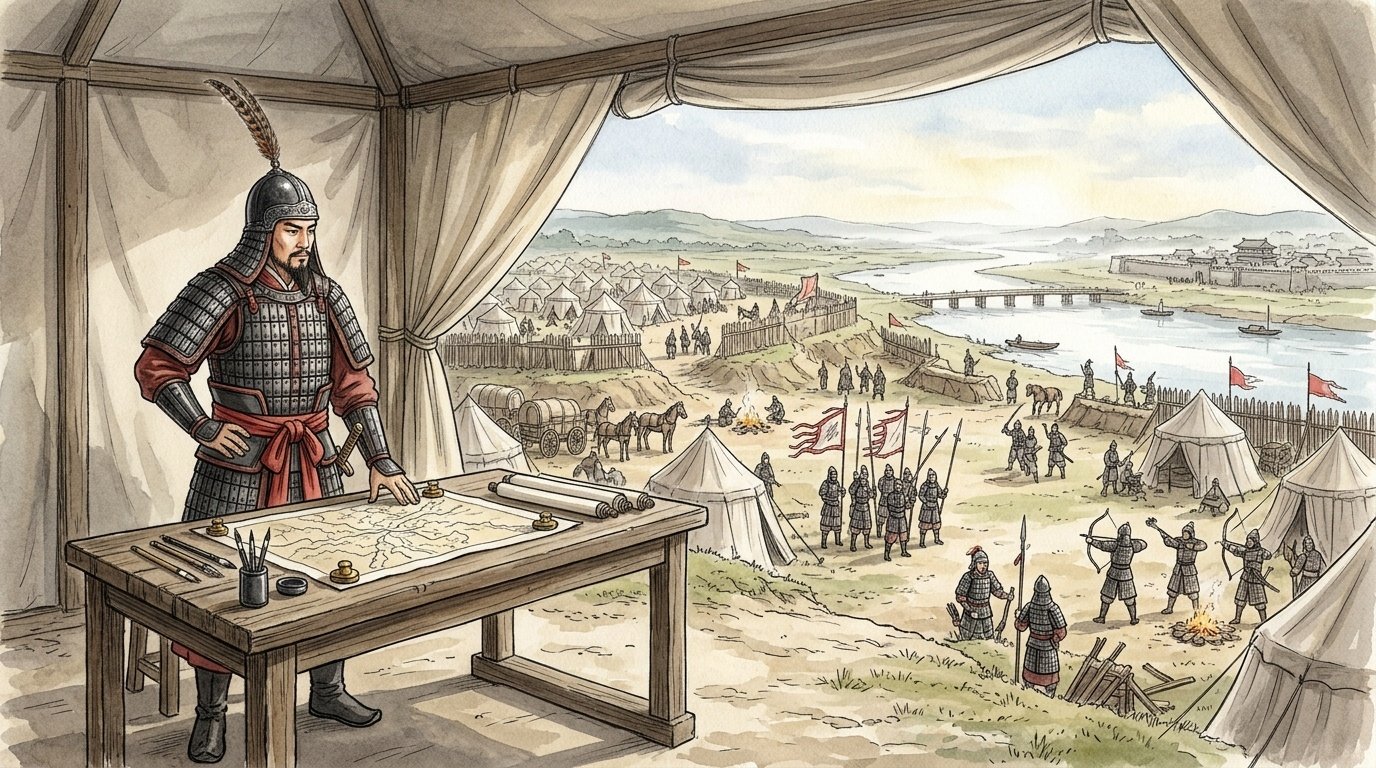
By 1135 CE, the Yue Family Army had swelled to an elite force of approximately 100,000 veteran soldiers, organized into twelve specialized corps (including the elite vanguard Beiwei Jun 背嵬军, the vanguard Qianjun, and the shock cavalry). The army’s legendary battlefield effectiveness rested upon three revolutionary pillars:
- 1. Inflexible, Incorruptible Discipline: Yue Fei instituted a code of conduct unprecedented in medieval Chinese warfare. The army operated under an absolute moral maxim: ‘Freeze to death, do not pull down citizens’ houses; starve to death, do not plunder the people’ (冻死不拆屋,饿死不掳掠). When marching through villages, soldiers slept in open ditches or under trees rather than forcing entry into civilian homes. A soldier who requisitioned a single piece of hemp cord from a peasant was immediately executed by court-martial. For the first time in centuries, the common people of China saw an imperial army that protected them rather than robbing them.
- 2. Rigorous Tactical Training: Yue Fei subjected his infantry to brutal, realistic combat drills. Soldiers practiced charging up steep embankments in full armor, jumping across wide moats, and engaging in continuous hand-to-hand combat exercises. Yue Fei demanded that training simulate the terror of the battlefield: if a horse stumbled during a cavalry drill down a ditch, the rider was flogged. Yue Fei treated his men with deep paternal affection—tending to the wounded, visiting sick soldiers in their tents, and personally distributing all imperial rewards down to the lowest rank-and-file soldier without taking a single ounce of silver for himself.
- 3. Tactical Counter to Jurchen Shock Armor: The supreme terror of the battlefield was the Jurchen heavy shock cavalry: the Tiefutu (铁浮屠, ‘Iron Pagodas’). The Tiefutu were elite Jurchen warriors clad in triple layers of articulated iron armor, mounted on heavy warhorses entirely draped in boiled leather and iron trappings, linked together by heavy chains in squads of three to five horses to smash through enemy infantry like a living iron wall. On the flanks rode the swift Guazi Ma (拐子马) light horse archers, executing deadly pincers.
To neutralize this seemingly invincible cavalry doctrine, Yue Fei developed revolutionary infantry tactics. He equipped his elite Beiwei shock troops with two specialized weapons: the Zhamadao (斩马刀, ‘Horse-Cleaving Saber’)—a heavy, two-handed, razor-sharp curved broadsword—and heavy hooked halberds (麻扎刀, Mazhadao). Yue Fei ordered his men never to look up at the armored Jurchen riders. Instead, the infantry waited until the heavy horses charged within paces, ducked beneath the lances, and hacked violently at the unprotected legs of the warhorses. When one horse in the chained trio collapsed with severed hocks, the other horses tripped and fell into an immobile heap of iron and flesh. Yue Fei’s infantry then swarmed the downed knights, thrusting heavy iron daggers through the eye-slits of their iron helmets. The Jurchen cavalry shock was broken forever.
3. The Northern Expeditions: The Miracles of Yancheng and Zhuxian Town (1140 CE)
Between 1134 and 1140 CE, Yue Fei launched four massive counter-offensives against the Jurchen Jin and their northern puppet regime of Qi (刘豫伪齐). Operating from his central strategic base at Xiangyang (襄阳) on the Han River, Yue Fei systematically liberated the central Yangtze basin, crushing rival warlords, clearing the southern lakes of pirate fleets, and recapturing the Six Prefectures of Jingxiang without losing a single campaign.
The operational climax of Yue Fei’s military career occurred in the summer of 1140 CE. Violating a fragile ceasefire, the supreme Jurchen grand marshal, Wanyan Zongbi (完颜宗弼, Prince Jinwuzhu 金兀术), mobilized the entire northern military apparatus—over 100,000 elite Jurchen horsemen—and launched a blitzkrieg to conquer the Central Plains. Yue Fei seized the initiative. Rather than waiting defensively behind the Huai River, Yue Fei marched the Yue Family Army deep into the Henan heartland, launching a lightning offensive that shattered the Jurchen garrisons at Zhengzhou, Luoyang, and Chenzhou.
On the eighth day of the seventh lunar month in 1140 CE, Jinwuzhu concentrated his supreme elite force—fifteen thousand Tiefutu heavy shock cavalry and thirty thousand Guazi Ma flankers—outside the walls of Yancheng (郾城, modern Henan). Yue Fei had only his personal guard corps and the Beiwei cavalry, numbering barely a few thousand men. In the blazing summer heat, Yue Fei dispatched his son, twenty-year-old Yue Yun, at the head of the heavy cavalry, giving him a terrifying order: ‘Go forth! If you fail to break their lines and return alive, I will sever your head myself!’
Wielding twin eighty-pound iron hammers, Yue Yun plunged directly into the center of the Jurchen host, battling for hours until his body was drenched in blood from dozens of wounds. Yue Fei then unleashed his infantry armed with horse-cleaving sabers. In hours of savage hand-to-hand slaughter, the Yue Family Army shattered the Tiefutu, leaving the battlefield strewn with thousands of dead Jurchen knights. Jinwuzhu fled the field weeping bitter tears, crying aloud to his staff:
「自海上起兵,皆以此胜,今已矣!撼山易,撼岳家军难!」
— Wanyan Zongbi (Prince Jinwuzhu), lament after the Battle of Yancheng, recorded in Song Shi
‘Since our rising by the sea, we have conquered all under Heaven using these tactics; today, it is all over!
It is easier to shake a mountain than to shake the Yue Family Army!’
Jinwuzhu rallied 100,000 troops at Zhuxian Town (朱仙镇), just forty-five li (approx. 22 km) south of the former northern capital of Kaifeng. Yue Fei advanced with his vanguard of five hundred elite Beiwei cavalry. In a masterclass of psychological warfare and tactical assault, Yue Fei broke the massive Jurchen army, routing them back into the gates of Kaifeng. Across the North China Plain, hundreds of thousands of Han Chinese loyalist guerrilla fighters (the Zhongyi Xunjiu 忠义循九) rose in rebellion behind Jurchen lines, cutting supply roads and delivering cattle and wine to Yue Fei’s camp. The recovery of Kaifeng, the liberation of the Yellow River, and the total collapse of Jurchen power were within Yue Fei’s grasp. Euphoric with victory, Yue Fei declared to his cheering officers:
「直抵黄龙府,与诸君痛饮尔!」
— Yue Fei (岳飞), address to his commanders outside Kaifeng, 1140 CE
‘We shall march straight to the Yellow Dragon City, and there drink to our hearts’ content alongside you all!’
4. The Twelve Gold Plaques: The Agony of the Forced Retreat
Just as Yue Fei was preparing his final assault to liberate Kaifeng, an unexpected, catastrophic blow struck not from the front lines of the Jurchen enemy, but from the rear: the imperial court in Lin’an. Terrified that Yue Fei’s total military triumph would shatter his secret diplomatic negotiations with the Jin, Emperor Gaozong and Grand Councilor Qin Hui issued an immediate, unconditional command: Yue Fei must halt all offensive operations, surrender his liberated territory, and retreat southward to Ezhou (modern Wuhan).
Knowing that Yue Fei might refuse a single imperial edict for the sake of the campaign, Qin Hui orchestrated a relentless psychological assault. Within the span of a single afternoon, twelve consecutive gold-lacquered courier plaques (十二道金牌, Shi’er Dao Jin Pai)—the supreme, urgent military summon of the Song emperor, carried by post-riders galloping night and day—arrived at Yue Fei’s frontline headquarters in Zhuxian Town. Each plaque bore the imperial seal commanding Yue Fei to dismantle his camp immediately on pain of high treason.
Yue Fei was caught in an agonizing existential vice. If he advanced forty-five li and took Kaifeng, he would be guilty of open rebellion against his sovereign lord, violating the sacred oath of loyalty tattooed onto his back. If he obeyed, ten years of bloody sacrifice would be discarded overnight, and the millions of Han Chinese northern civilians who had risen to support him would be abandoned to wholesale Jurchen butchery. Yue Fei turned his face toward the southern sky, fell to his knees in the mud, and wept tears of blood:
「十年之功,废于一旦!所得州郡,一朝全休!社稷江山,难以中兴!乾坤世界,无由再复!」
— Yue Fei (岳飞), lament upon receiving the Twelve Gold Plaques, 1140 CE
‘Ten years of dedicated toil, wiped out in a single morning!
The prefectures and commanderies we recaptured, surrendered in a single dawn!
The altars of our soil and grain can never be restored;
Our sacred realm of Heaven and Earth will never be reconstituted!’
As the Yue Family Army began its agonizing southward retreat, tens of thousands of northern peasants blocked the road, weeping and clutching the stirrups of the soldiers’ horses, crying: ‘We supplied the imperial army with grain and marked our foreheads with loyalist tattoos! If the Great General departs, the Jurchens will boil us alive in cauldrons!’ Yue Fei halted his army for six days, sheltering over twenty thousand refugee families and escorting them south across the Huai River. The moment the Song rear guard cleared the battlefield, Jinwuzhu’s cavalry swept back into Kaifeng, butchering every loyalist who had aided the Song. The golden window to recover North China was closed forever.
5. The Sovereign’s Nightmare: Why Gaozong Feared Yue Fei More Than the Barbarians
For centuries, popular Chinese folklore has portrayed Emperor Gaozong as a naive, manipulated dupe who was deceived by the silver-tongued traitor Qin Hui. This moralistic fable obscures the cold, ruthless Machiavellian logic that governed Gaozong’s actions. Emperor Gaozong was not an idiot; he was an exceptionally intelligent, hyper-paranoid autocrat who understood the foundational political genetics of the Song dynasty. To Gaozong, Yue Fei posed a far more lethal threat to his personal throne than the Jurchen cavalry ever could.
This dynastic paranoia was rooted in three irreconcilable structural dilemmas:
- 1. The Phantom of the True Emperor (Emperor Qinzong): The central battle-cry of Yue Fei’s northern expeditions was ‘Welcome Back the Two Sages’ (迎还二圣, Yinghuan Er Sheng)—the liberation of the captured former monarchs Huizong and Qinzong from Manchuria. For Gaozong, this slogan was a dagger aimed directly at his imperial throat. While Huizong was his father, Emperor Qinzong (Zhao Huan) was his elder brother and the legally reigning sovereign when Kaifeng fell. Gaozong had ascended the throne as a wartime emergency ruler. If Yue Fei marched into Manchuria, freed Emperor Qinzong, and brought him back to Lin’an, who would be the legitimate Emperor of China? Gaozong would be instantly reduced to a usurper or forced into abdication. Gaozong desperately needed Huizong to remain dead and Qinzong to rot forever in the frozen wastes of Wuguo City.
- 2. The Biological Crisis of Succession: In 1129 CE, during the terrifying Jurchen raid on Yangzhou, Gaozong was caught in bed by Jurchen horsemen and had to flee on a naked horse in the dead of night. The severe psychological shock induced permanent psychogenic impotence; Gaozong was never able to father another child, and his only biological infant son died shortly thereafter of convulsions. Because Gaozong was childless, he was consumed by terror that a charismatic, beloved military general commanding 100,000 fanatically loyal troops would stage a palace coup. Yue Fei had committed the fatal political blunder of submitting a memorial to Gaozong in 1137 CE advising him to formally designate an imperial heir from the distant branches of the imperial clan—a direct, unforgivable intrusion into the emperor’s most painful, intimate vulnerability.
- 3. The Song Founding Curse: ‘Yellow Robes at Chenqiao’: The Song Dynasty was founded in 960 CE through a military coup d’état, when General Zhao Kuangyin’s troops draped a yellow imperial dragon robe over his shoulders at Chenqiao Station. For 180 years, the Song house had followed the iron rule of Chongwen Qingwu (重文轻武, ‘Elevate the Civil, Subordinate the Martial’) to prevent warlords from emerging. Now, in the crucible of war, four massive autonomous military commands had arisen in the south: the armies of Yue Fei, Han Shizhong, Zhang Jun, and Liu Guangshi. The troops did not pledge loyalty to the Song State; they called themselves the ‘Yue Family Army’ and the ‘Han Family Army.’ In Gaozong’s eyes, Yue Fei was another Zhao Kuangyin in the making.
To secure his own personal safety, Gaozong made a conscious, strategic decision: he preferred to be a humiliated, tributary vassal monarch ruling the emerald rice fields of Jiangnan under the protection of a peace treaty with the Jurchens, rather than risk being dethroned by a victorious Chinese general. Peace had to be purchased at any cost—even if that cost was the head of his greatest field commander.
6. The Architect of Capitulation: Qin Hui and the Shaoxing Treaty (1141 CE)
To execute this treacherous policy of dynastic capitulation, Gaozong found his ideal instrument in Qin Hui (秦桧, 1090–1155 CE). Qin Hui was a brilliant civil bureaucrat from Jiangning who had passed the imperial examinations with distinction. Captured alongside Huizong and Qinzong in 1127 CE, Qin Hui spent three years in northern captivity, serving as a trusted secretary to the Jurchen prince Wanyan Chang (Dalan). In 1130 CE, Qin Hui miraculously returned to the Southern Song court—claiming he had killed his Jurchen guards and escaped on a stolen boat, though contemporaries widely suspected he had been released as an embedded Jurchen agent of influence.
Reappointed Grand Councilor in 1138 CE, Qin Hui formed an unshakeable political partnership with Gaozong. Qin Hui possessed the administrative ruthlessness required to muzzle anti-appeasement scholars, censor court diarists, purge loyalist censors, and dismantle the autonomous military commands. In early 1141 CE, Gaozong and Qin Hui summoned the three supreme generals—Yue Fei, Han Shizhong, and Zhang Jun—to the capital under the guise of rewarding their battlefield victories. In an administrative coup echoing Song Taizu’s ‘Cup of Wine’ maneuver, the generals were stripped of their active military commands and given honorary, powerless sinecures: Yue Fei was made Vice Commissioner of the Bureau of Military Affairs (枢密副使, Shumi Fushi).
With the military neutralized, Qin Hui finalized the humiliating Treaty of Shaoxing (绍兴和议, Shaoxing Heyi) in the tenth lunar month of 1141 CE. The terms were an absolute surrender of Chinese sovereign dignity:
- The Southern Song formally submitted as a vassal kingdom to the Jurchen Jin, with Emperor Gaozong receiving investiture from the Jin emperor.
- The border between the two empires was permanently fixed along the Huai River and the Dabie Mountains to the Dasanguan Pass in Shaanxi, surrendering the entire Central Plains.
- The Southern Song agreed to pay an astronomical annual tribute of 250,000 taels of silver and 250,000 bolts of silk to the Jin court.
There was, however, one final secret condition. In private correspondence intercepted between Jinwuzhu and Qin Hui, the Jurchen grand marshal delivered an absolute, non-negotiable ultimatum:
「尔朝夕以和请,而岳飞方为河北图,必杀飞,始可和也!」
— Wanyan Zongbi (Jinwuzhu), secret letter to Qin Hui, recorded in Song Shi (宋史·岳飞传)
‘Day and night you beg for peace, while Yue Fei plots the reconquest of the north! You must execute Yue Fei before peace can ever be ratified!’
7. The Judicial Murder at Dali Temple: Mo Xu You and the Fatal Cup
To carry out the execution of an imperial military hero whose prestige among the common people was absolute, Qin Hui and his chief judicial inquisitor, Moqi Xi (万俟卨), fabricated an elaborate conspiracy. They bribed two disgruntled subordinate officers of the Yue Family Army—Wang Jun and Wang Gui—to file false accusations claiming that Yue Fei’s chief lieutenant, Zhang Xian (张宪), was plotting an armed mutiny to forcibly restore Yue Fei to military command, and that Yue Fei’s son, Yue Yun, had sent treasonous letters encouraging the coup.
In the tenth lunar month of 1141 CE, Yue Fei was arrested and dragged into the underground interrogation chambers of the Dali Temple. For two months, Moqi Xi subjected the general to brutal physical torture: floggings with bamboo rods, burning irons applied to the flesh, and the stretching of his limbs upon the wooden rack. Yet through every ordeal, Yue Fei refused to admit to treason. At one point, Yue Fei ripped open his blood-soaked robes, exposing his back to the inquisitors. When Moqi Xi and the scribes saw the four characters Jin Zhong Bao Guo (尽忠报国) scarred deep into his flesh, they stepped back in silent terror and shame.
When the original chief judge of the Dali Temple, Zhou Sande (周三畏), found zero evidence of treason and refused to convict, he was stripped of office and fled the capital in moral disgust. Outside the prison, public outrage exploded. Imperial students marched in protest, and ordinary citizens wept in the streets. Han Shizhong, the battle-hardened general who had trapped Jinwuzhu at Huangtiandang, stormed into Qin Hui’s grand mansion and roared: ‘Where is the proof that Yue Fei plotted rebellion?’ Qin Hui, sweating with cynical arrogance, replied with the infamous evasion: ‘The letters sent by Yue Yun to Zhang Xian are unclear, but the matter—perhaps there is / it is not necessary to have proof’ (其事莫须有). Han Shizhong spit on the floor and snarled: ‘How can three words “Mo Xu You” ever convince all under Heaven!’ (莫须有三字,何以服天下!).
Seeing that public unrest was escalating and that the Jurchen envoys were arriving to sign the treaty, Emperor Gaozong issued a secret imperial decree directly from the inner palace on January 27, 1142 CE: Yue Fei was granted ‘death by imperial benevolence’ in prison, while Yue Yun and Zhang Xian were to be executed immediately in the public square. In the biting midnight cold of the Fengbo Pavilion, Yue Fei drank the poisoned cup or was crushed by assassins, departing this life at thirty-nine years of age. Yue Yun was twenty-two; Zhang Xian died alongside him. The Yue Family Army was permanently disbanded, its officers cashiered or transferred to distant border garrisons.
8. The Afterlife of Loyalty: From Secret Grave to West Lake Temple
Following the execution, Qin Hui ordered Yue Fei’s corpse to be dumped in an unmarked ditch outside the prison walls to prevent loyalists from recovering the body. Yet an obscure, low-ranking prison guard named Kui Shun (隗顺), moved by Yue Fei’s supreme innocence, risked execution to preserve the general’s remains. Under cover of darkness, Kui Shun carried Yue Fei’s battered body on his back out through the water gates of Lin’an. He secretly buried the general on the slopes of Mount Jiuqu (九曲山) outside the Qiantang Gate, planting two twin orange trees beside the mound and burying Yue Fei’s jade ring alongside his corpse as an identification token.
For twenty years, as long as Gaozong and Qin Hui lived, the name of Yue Fei was banned from public discourse. Anyone caught possessing his poems or memorials was branded a traitor. Qin Hui died in 1155 CE, paralyzed by terminal terror and hallucinations of Yue Fei’s ghost haunting his bedchamber. In 1162 CE, Emperor Gaozong abdicated the throne, exhausted by decades of subservience. His adopted successor, Emperor Xiaozong (宋孝宗, Zhao Shen, r. 1162–1189 CE), was an energetic, martial-minded monarch who immediately reversed the appease-at-all-costs policy.
Xiaozong’s first imperial decree was the complete, public rehabilitation of General Yue Fei. The Emperor offered a reward of five hundred strings of cash for information regarding the general’s burial site. Kui Shun’s son came forward and revealed the secret tomb beneath the orange trees. When the earth was opened, Yue Fei’s corpse was found miraculously preserved by the dry soil, recognized immediately by the jade ring and the faded ink of the four characters on his back. Xiaozong reburied Yue Fei with the full honors of an imperial first-rank prince on the picturesque shores of West Lake (西湖) at Qixia Ridge (栖霞岭), bestowing upon him the posthumous title Prince of E (鄂王, E Wang) and the posthumous name Wumu (武穆, ‘The Martial and Resolute’), later elevated to Zhongwu (忠武, ‘The Loyal and Martial’).
In 1475 CE, during the Ming Dynasty, the citizens of Hangzhou erected the supreme visual condemnation of treason inside the Yue Fei Temple (岳王庙). Four life-sized cast-iron statues—depicting Qin Hui, his vicious wife Lady Wang (王氏), inquisitor Moqi Xi, and betrayer Zhang Jun—were cast naked, with their hands bound behind their backs, forced to kneel eternally in the stone courtyard before Yue Fei’s tomb. For over five hundred years, millions of Chinese pilgrims have visited the shrine to spit upon, slap, and strike the iron statues of Qin Hui, while reciting the famous rhymed couplet inscribed upon the tomb gate:
「青山有幸埋忠骨,白铁无辜铸佞臣。」
— Couplet inscribed at the Yue Fei Temple, West Lake, Hangzhou
‘The green mountain is blessed to bury the bones of the loyal warrior;
The white iron is innocent to be cast into the forms of treacherous ministers!’
9. The Poetic Soul: Man Jiang Hong and Xiao Chong Shan
Unlike the traditional archetype of the illiterate, brutish military strongman, Yue Fei was an accomplished poet and calligrapher whose literary works stand alongside the greatest masterpieces of the Song Dynasty. His calligraphy was bold, sweeping, and dynamic, reflecting the furious energy of his battlefield maneuvers.
His towering literary monument is his lyric poem to the tune of Man Jiang Hong (满江红, The River All Red), a composition that has stirred the hearts of Chinese patriots across a thousand years:
「怒发冲冠,凭栏处、潇潇雨歇。抬望眼,仰天长啸,壮怀激烈。
— Yue Fei (岳飞), Man Jiang Hong (满江红)
三十功名尘与土,八千里路云和月。莫等闲、白了少年头,空悲切!
靖康耻,犹未雪。臣子恨,何时灭!驾长车,踏破贺兰山缺。
壮志饥餐胡虏肉,笑谈渴饮匈奴血。待从头、收拾旧山河,朝天阙!」
‘My wrath bristles through my cap as I lean upon the balustrade, while the pattering rain subsides.
I lift my gaze and roar toward Heaven—my heroic spirit surging with fierce passion!
At thirty, my achievements are but dust and earth;
Eight thousand li of campaigns under clouds and moon.
Do not wait idly—until the hair of youth turns white in vain regret!
The shame of Jingkang is not yet wiped clean;
When shall the grief and fury of your subjects ever be extinguished!
Let us drive our war chariots to trample through the Helan Mountain pass!
In our heroic resolve, when hungry we feast upon the flesh of the barbarian invaders;
Laughing and jesting, when thirsty we drink the blood of the nomadic hordes!
Let us begin anew, to gather up our ancient rivers and sacred mountains,
And present them before the Gates of Heaven!’
The genius of Man Jiang Hong lies in its volcanic compression of personal humility, generational grief, and cosmic resolve. When Yue Fei wrote ‘At thirty, my achievements are but dust and earth’ (三十功名尘与土), he expressed not the vanity of military glory, but the terrible consciousness that despite eight thousand li of marching through mud and blood, the northern homeland was still enslaved. The poem is not merely a song of war; it is a spiritual vow to restore the physical integrity of Chinese civilization.
Yet Yue Fei possessed another, far more intimate poetic voice—one of profound, melancholic isolation—as captured in his lyric to the tune of Xiao Chong Shan (小重山, Accaying Hills):
「昨夜寒蛩不住鸣。惊回千里梦,已三更。起来独自绕阶行。人悄悄,帘外月胧明。
— Yue Fei (岳飞), Xiao Chong Shan (小重山)
白首为功名。旧山松竹老,阻归程。欲将心事付瑶琴。知音少,弦断有谁听?」
‘Last night the cold crickets chirped without cease.
Startled awake from a dream of a thousand li away, it was already the third watch.
I rose and walked alone circling the courtyard steps.
All was silent; outside the bamboo blinds, the moon shone dim and misty.
My hair turns white in pursuit of worldly deeds.
The pines and bamboos of my ancestral mountain grow old, yet my return journey is blocked.
I wished to entrust my heart’s deepest sorrow to the jasper zither:
Yet those who understand my music are so few—
If the strings snap, who is there left to listen?’
In Xiao Chong Shan, the fierce warrior vanishes, replaced by a solitary, aging philosopher walking under the dim moon, listening to the snapped strings of his zither. Yue Fei already knew that his dream was impossible. He knew that the court was against him, that the sovereign feared him, and that there was no zhiyin (知音, ‘one who understands the music’) inside the corridors of power. He marched toward his martyrdom with eyes wide open.
10. Historiographical Deconstruction: The Dialectic of Loyalty and Nation
The tragedy of Yue Fei exposes the fundamental, unresolved contradiction at the heart of imperial Chinese political philosophy: the tension between Loyalty to the Sovereign (忠君, Zhongjun) and Loyalty to the Nation and Civilization (爱国 / 保天下, Aiguo / Bao Tianxia).
In orthodox Confucian dogma, these two concepts were supposed to be identical: the Emperor was the living embodiment of the state, and obedience to the Son of Heaven was the highest moral duty. Yet Yue Fei’s life shattered this comforting illusion. To obey Emperor Gaozong’s twelve gold plaques was to betray the millions of Chinese people suffering under foreign occupation; to liberate the Chinese people and defeat the Jurchens was to disobey the Emperor and commit high treason. Yue Fei chose the path of tragic synthesis: he obeyed the imperial recall, surrendered his military command without resistance, and allowed himself to be executed, thereby preserving his moral purity at the cost of his life.
Across the centuries, Yue Fei was transformed into a malleable cultural symbol across successive dynasties:
- The Southern Song & Yuan Dynasties: Re-imagined as a divine celestial general (the incarnation of the Golden-Winged Great Peng bird) who protected the realm from barbarian destruction.
- The Ming Dynasty: Elevated to the supreme state pantheon alongside Guan Yu as a warrior-saint, his spirit invoked by Ming emperors to rally resistance against the northern Mongols.
- The Qing Dynasty: The Manchu Qing emperors—direct ethnic descendants of the Jurchens—faced an acute ideological dilemma. The Qianlong Emperor solved it with brilliant political cunning: he condemned Qin Hui as a traitor and praised Yue Fei’s absolute obedience to his sovereign, turning Yue Fei into a tool to teach Han Chinese subjects that they must obey the reigning emperor under all circumstances, even unto unjust death!
- Modern Chinese Nationalism: In the twentieth century, during the Second Sino-Japanese War (1937–1945), Yue Fei was resurrected as the supreme symbol of Chinese national resistance against foreign invasion. His Man Jiang Hong became an unofficial national anthem, inspiring soldiers defending the trenches of Shanghai and Wuhan.
11. Chronology of Yue Fei and the Southern Song Resistance (1103–1162 CE)
| Year (CE) | Historical Event | Key Historical Figures | Significance & Battlefield Impact |
|---|---|---|---|
| 1103 (Feb 15) | Birth of Yue Fei in Tangyin, Henan | Yue Fei, Lady Yao, Zhou Tong | Born into poor peasant family; apprentices under archery master Zhou Tong |
| 1126 | Lady Yao Tattoos Yue Fei’s Back | Yue Fei, Lady Yao | Tattoos 尽忠报国 (Serve State with Utmost Loyalty) before marching south to war |
| 1127–1128 | Mentorship under Zong Ze | Yue Fei, Zong Ze, Gaozong | Fights Jurchens in Hebei; Zong Ze recognizes his strategic genius before dying |
| 1130 | Liberation of Jiankang (Nanjing) | Yue Fei, Jinwuzhu | Recaptures Nanjing from retreating Jurchen cavalry; Yue Family Army gains fame |
| 1134 | First Northern Expedition (Xiangyang) | Yue Fei | Recaptures Six Prefectures of Jingxiang in 3 months; creates central defense hub |
| 1135 | Suppression of Yang Yao Peasant Revolt | Yue Fei, Yang Yao | Pacifies Dongting Lake; integrates 50,000 veteran riverine fighters into Yue Family Army |
| 1137 | The Succession Memorial Blunder | Yue Fei, Emperor Gaozong | Yue Fei urges Gaozong to appoint an heir; triggers deep dynastic paranoia in Gaozong |
| 1138 | Qin Hui Appointed Grand Councilor | Qin Hui, Gaozong | Appeasement faction takes absolute control of court; secret peace talks with Jin open |
| 1140 (Summer) | Battle of Yancheng | Yue Fei, Yue Yun, Jinwuzhu | Yue Family Army shatters Tiefutu heavy cavalry using horse-cleaving sabers |
| 1140 (Autumn) | Zhuxian Town & The Twelve Gold Plaques | Yue Fei, Gaozong, Qin Hui | Yue reaches 45 li from Kaifeng; Gaozong issues 12 gold plaques forcing retreat |
| 1141 (Spring) | Generals Stripped of Commands | Yue Fei, Han Shizhong, Qin Hui | Yue Fei, Han, and Zhang Jun demoted to honorary posts; armies decentralized |
| 1141 (Oct) | The Shaoxing Peace Treaty Concluded | Gaozong, Qin Hui, Jinwuzhu | Song submits as vassal to Jin; borders set at Huai River; Jin demands Yue Fei’s death |
| 1141 (Winter) | Trial at Dali Temple; ‘Mo Xu You’ | Yue Fei, Moqi Xi, Han Shizhong | Tortured on rack; refuses to confess; Qin Hui utters ‘Mo Xu You’ evasion |
| 1142 (Jan 27) | Murder of Yue Fei in Fengbo Pavilion | Yue Fei, Yue Yun, Zhang Xian | Yue Fei executed at age 39; son Yue Yun beheaded; Kui Shun secretly buries corpse |
| 1155 | Death of Qin Hui | Qin Hui | Grand Councilor dies in bed paralyzed by terror; reviled by the populace |
| 1162 | Full Rehabilitation by Emperor Xiaozong | Emperor Xiaozong, Yue Fei | Xiaozong clears Yue Fei’s name; reburied at West Lake; created Prince of E (鄂王) |
12. Scholarly Bibliography and Primary Historical Sources
To substantiate the political records, military operations, and historical accounts presented in this study, the following primary sources and academic monographs are recommended for further study:
- Yue Ke (岳珂, 1183–1243 CE), Eguo Jin Tuo Cuan Bian (鄂国金佗稡编) and Xu Bian (续编): The foundational primary biographical source compiled by Yue Fei’s grandson. Preserves dozens of Yue Fei’s original military dispatches, imperial edicts, family records, and frontline tactical reports.
- Tuo Tuo (脱脱) et al. (comp. 1345 CE), History of Song (宋史, Song Shi): Essential chapters include the Annals of Gaozong (Vols. 24–32), the Biography of Yue Fei (Vol. 365), the Biography of Han Shizhong (Vol. 364), and the Biographies of Treacherous Ministers (Qin Hui, Vol. 473).
- Xu Mengxin (徐梦莘, 1126–1207 CE), Collected Records of the Northern Treaties over Three Reigns (三朝北盟会编, Sanchao Beimeng Huibian): Volumes 190 through 220 provide the definitive contemporary archival documentation of the 1140 campaign, the Shaoxing treaty negotiations, and the arrest of Yue Fei.
- Li Tao (李焘) and Li Xinchuan (李心传, 1167–1244 CE), Chronological Record of Important Events Since the Jianyan Era (建炎以来系年要录, Jianyan Yilai Xinian Yaolu): The definitive, 200-volume chronological source for Southern Song administrative and military history during Gaozong’s reign.
- Wilhelm, Hellmut (1975), “From Myth to Myth: The Case of Yüeh Fei’s Biography,” in Confucian Personalities, ed. Arthur F. Wright and Denis Twitchett, Stanford University Press: Seminal academic analysis deconstructing the historiographical transformation of Yue Fei from a historical commander into a cultural archetype.
- Lorge, Peter (2005), War, Politics and Society in Early Modern China, 900–1795, Routledge: In-depth military analysis of the tactical organization of the Yue Family Army and the mechanics of countering Jurchen heavy cavalry.
- Haeger, John Winthrop (1972), “1126–27: Political Crisis and the Fall of Kaifeng,” Ars Orientalis: Critical investigation into the factional paralysis and imperial command breakdown that established the institutional background of the Southern Song.
- Franke, Herbert (1994), “The Chin Dynasty,” in The Cambridge History of China, Volume 6: Alien Regimes and Border States, Cambridge University Press: Comprehensive study of Jurchen military strategy, the Meng’an-Mouke system, and the campaigns of Wanyan Zongbi.
- Tackett, Nicolas (2017), The Origins of the Chinese Nation: Song China and the Northern Frontier, Cambridge University Press: Illuminating examination of how the loss of the north and the trauma of Jingkang created an enduring sense of proto-nationalist identity centered around figures like Yue Fei.
- Wang, Gungwu (1983), “The Rhetoric of a Lesser Empire: Early Sung Relations with Its Neighbors,” in China Among Equals, ed. Morris Rossabi, University of California Press: Essential diplomatic analysis of how Song emperors balanced dynastic survival against ideological rhetoric of universal rulership.