The Calamity of Jingkang and the Jurchen Sack of Kaifeng
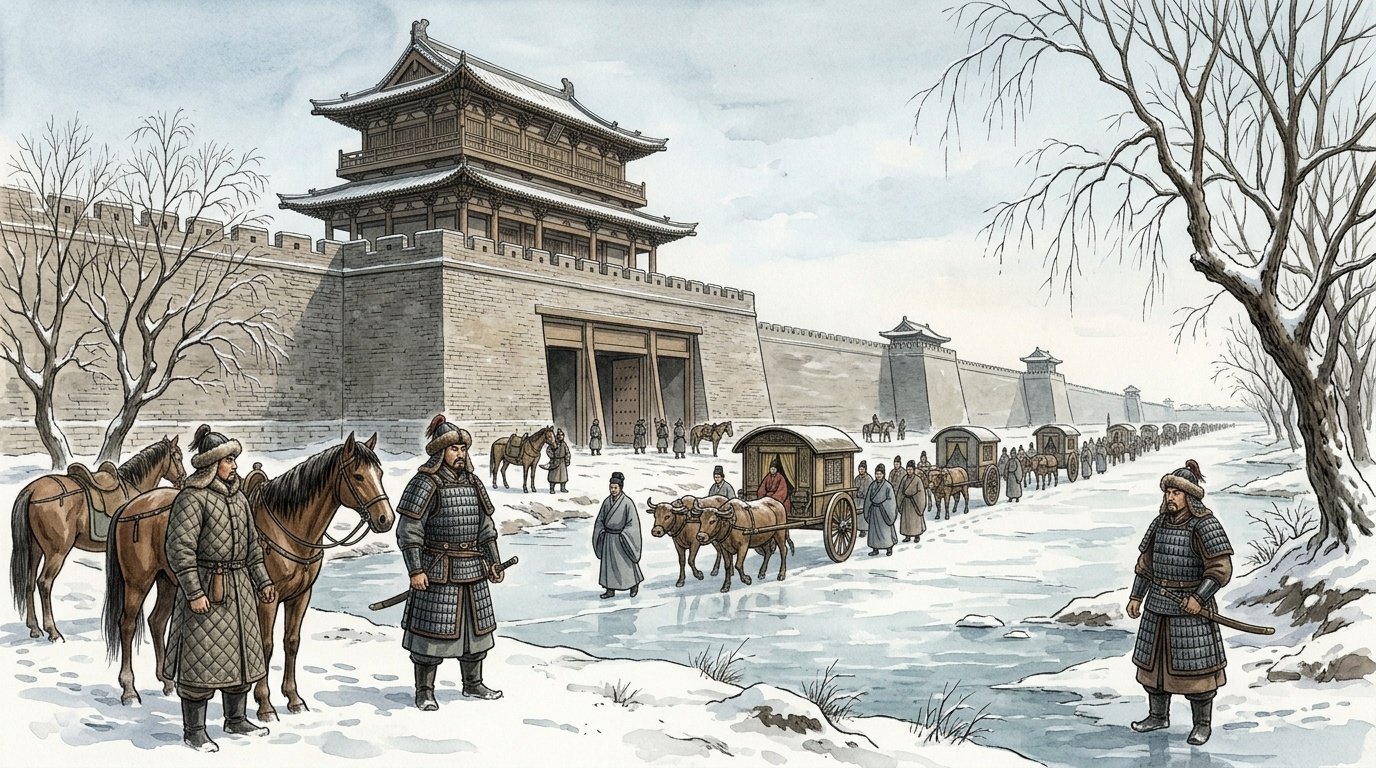
In the biting cold of the eleventh lunar month in the first year of the Jingkang era (January 1127 CE), a thick, suffocating grey fog rolled across the frozen waters of the Bian Canal. Outside the massive brick walls of Kaifeng (开封, then Bianjing 汴京)—the most populous, wealthy, and cultured metropolis on earth—the iron-clad heavy cavalry of the Jurchen Jin Dynasty (金朝) tightened their vice-like siege. Within the city walls, over one million residents, soldiers, and imperial courtiers were starving in the sub-zero chill, burning classical wooden library furniture and slaughtering carriage horses for food. Inside the Forbidden City, the reigning twenty-six-year-old monarch, Emperor Qinzong (宋钦宗, Zhao Huan), and his retired father, the supreme aesthetic patron and connoisseur Emperor Huizong (宋徽宗, Zhao Ji), wept in paralyzed terror as their ministers debated whether to appease the barbarians with gold or entrust the empire’s survival to Daoist street magicians.
What followed over the subsequent four months remains the most traumatic, psychologically devastating catastrophe in four thousand years of Chinese imperial history: the Jingkang Incident (靖康之变, Jingkang zhi Bian, also known as the Calamity of Jingkang 靖康之难). In a matter of weeks, an unbroken 167-year dynasty of peerless cultural achievement and economic supremacy was utterly annihilated in the north. The Jurchen invaders breached the ramparts, stormed the palaces, and systematically stripped Kaifeng of everything it possessed: its gold and silver reserves, its astronomical instruments, its imperial libraries, its ancestral ceremonial vessels, and its human treasure.
In the fourth lunar month of 1127 CE, the Jurchen armies broke camp, marching back toward the frozen wastes of Manchuria. Trudging behind their horses in chains were over three thousand members of the Song imperial court: two living Sons of Heaven (Huizong and Qinzong), the Empress Dowager, imperial empresses, consorts, princesses, princes, aristocratic ministers, scholars, court musicians, and master craftsmen. Marched through snowstorms across thousands of kilometers, the Song imperial house was subjected to unimaginable physical degradation, sexual servitude, and ritual humiliation, culminating in the infamous ‘Rite of the Sheep’ (牵羊礼) in the Jurchen supreme capital. The trauma burned itself into the national consciousness, immortalized forever in the defiant battle-cry of General Yue Fei:
「靖康耻,犹未雪;臣子恨,何时灭!」
— Yue Fei (岳飞), Man Jiang Hong (满江红, The River All Red)
‘The shame of Jingkang is not yet wiped clean;
When shall the grief and fury of your subjects ever be extinguished!’
This comprehensive monograph reconstructs the causes, execution, horrors, and consequences of the Jingkang Incident. We will examine the fatal diplomatic miscalculation of the ‘Alliance Conducted by Sea’ (海上之盟); analyze the aesthetic escapism, megalomania, and bureaucratic rot of Emperor Huizong’s court under the ‘Six Bandits’ (六贼); trace the military clash between the fierce Tungusic Jurchen cavalry and the hollowed-out Song standing army; dissect the heroic defense of Kaifeng under Li Gang and its tragic subversion by royal cowardice; recount the surreal, bizarre episode of Guo Jing’s ‘Divine Soldiers’ (六丁六甲); document the systematic plunder of Kaifeng and the harrowing ‘Northern March of Shame’; examine the degradation of the Song imperial captives in Manchuria; and trace the miraculous resurrection of the dynasty south of the Yangtze as the Southern Song under Emperor Gaozong.
1. The Rise of the Iron Hunters: Wanyan Aguda and the Jurchen Jin (1115 CE)
At the turn of the twelfth century, the geopolitics of East Asia were dominated by a tripartite balance of power: the commercial, sedentary Chinese Song Dynasty in the Central Plains; the semi-sedentary, Khitan-ruled Liao Empire (契丹辽朝) controlling Manchuria, Mongolia, and the Sixteen Prefectures of Yanyun; and the Tangut Western Xia in the northwest. For more than a century, since the Treaty of Chanyuan in 1005 CE, peace had reigned between the Song and Liao. Song borders were stable, financed by annual subsidies of 200,000 taels of silver and 300,000 bolts of silk delivered to the Khitan court.
Deep within the dense virgin forests and freezing river valleys of the Changbai Mountains and the Songhua River basin, however, a terrifying new military power was coalescing. These were the Jurchens (女真, Nüzhen), a Tungusic forest-dwelling people of ferocious hunters, trappers, and horse archers. For generations, the Jurchens had been ruthlessly subjugated, taxed, and humiliated by the Khitan Liao emperors, who demanded annual tributes of precious Gyrfalcons (海东青, Haidongqing), sables, river pearls, and Jurchen virgin women. Khitan tax collectors treated Jurchen chieftains with open contempt, raping their daughters and beating their elders.
In 1113 CE, a charismatic chieftain of the Wanyan clan named Wanyan Aguda (完颜阿骨打, 1068–1123 CE) united the dispersed Jurchen tribes under his iron will. Tall, unyielding, and an extraordinary battlefield commander, Aguda possessed a disciplined military organization known as the Meng’an-Mouke (猛安谋克) system—a socio-military structure that mobilized entire clans into self-sustaining units of 1,000 and 100 cavalrymen. Clad in double suits of iron plate armor and mounted on rugged northern ponies, the Jurchen heavy cavalry (the Tiefutu 铁浮屠, ‘Iron Pagodas’) and swift light flankers (the Guazi Ma 拐子马) were nearly invincible. As contemporary chroniclers noted with dread: ‘The Jurchens cannot be matched: when they number ten thousand, they are invincible under Heaven’ (女真不满万,满万不可敌).
In 1115 CE, Aguda formally declared independence, founding the Jin Dynasty (金朝, ‘The Golden Dynasty’), proclaiming: ‘The Khitans named their state “Liao” after the Iron River, for iron endures; but iron rusts and decays. Gold alone never tarnishes and never rots. Our clan shall take Gold as our dynastic name!’ Over the next decade, Aguda’s iron horsemen smashed Liao armies five times their size, capturing the Liao capitals one by one and hunting the last Khitan emperor, Tianzuodi, across the Gobi Desert.
2. The Fatal Temptation: Tong Guan and the Alliance Conducted by Sea (1118–1123 CE)
In the imperial palace of Kaifeng, the sudden, violent collapse of the Liao Empire was greeted not with strategic caution, but with euphoric, intoxicating hubris. For 180 years, every Song emperor had mourned the loss of the Sixteen Prefectures of Yanyun (燕云十六州)—the vital northern defensive rampart of mountains and Great Wall passes ceded to the Khitans in 936 CE. Without Yanyun, the North China Plain lay completely exposed to northern cavalry raids.
The architect of the catastrophic geopolitical scheme to recover Yanyun was the most powerful eunuch in Chinese history: Tong Guan (童贯, 1054–1126 CE). Tall, physically imposing, and possessing a full beard—an anomaly for a eunuch—Tong Guan held absolute control over the Song military apparatus for two decades. Partnering with the corrupt Grand Councilor Cai Jing (蔡京), Tong Guan convinced the artist-emperor Huizong that the rise of the Jurchens was a once-in-a-millennium blessing bestowed by Heaven. Tong Guan argued that if the Song allied with the Jurchens, attacked the Liao Empire from the south while the Jurchens struck from the north, they could easily recover the Sixteen Prefectures and achieve the supreme ancestral glory that had eluded Song Taizu and Taizong.
Between 1118 and 1120 CE, Song diplomats sailed secretly across the Bohai Gulf to negotiate directly with Wanyan Aguda. The resulting pact was known as the ‘Alliance Conducted by Sea’ (海上之盟, Haishang zhi Meng). The terms were agreed: the Song would attack Liao’s Southern Capital (Yanjing, modern Beijing); the Jurchens would attack the Central Capital; and upon victory, the Song would recover the Sixteen Prefectures, in exchange for transferring to the Jurchen Jin the exact annual subsidies of silver and silk previously paid to the Liao.
A few far-sighted statesmen in Kaifeng recognized the suicidal folly of this alliance. The scholar-official Yuwen Xuzhong submitted a desperate remonstrance, warning: ‘The Liao are our old neighbors of a hundred years; their customs have become civilized, and they are bound by oaths of peace. The Jurchens are wild, ravenous tigers from the deep forests. To destroy a dying sheep in order to invite a ravenous tiger to sleep beside our bed is pure madness!’ His warnings were ignored; Tong Guan and Huizong were blinded by dynastic vanity.
In 1122 CE, Tong Guan led an enormous Song imperial army of 150,000 veteran troops north to capture Yanjing from the crumbling Liao garrison. What followed was a military humiliation of epic proportions. The starving, broken Khitan garrison under Yelü Dashi routed Tong Guan’s massive Song army in two pitched battles outside the gates of Yanjing. Song soldiers threw down their weapons and fled in disgraceful panic, leaving mountains of corpses and abandoned grain. Disgraced and desperate, Tong Guan secretly begged Wanyan Aguda to intervene. The Jurchen cavalry rode south, swept through the Juyong Pass in a single morning, and slaughtered the Khitan defenders. The tragic reality was laid bare for the Jurchen generals to see: the fabulous, wealthy Song Empire was a hollow, military joke. The Jurchens agreed to hand over a devastated, looted Yanjing to the Song, but only after extorting an extra one million strings of cash. The tiger now knew that the sheep had no teeth.
3. The Gilded Twilight: Emperor Huizong and the Garden of Genyue
While the Jurchen armies were conquering northern Asia, the sovereign presiding over the Song Empire was arguably the most artistically gifted monarch in world history: Emperor Huizong (宋徽宗, Zhao Ji, r. 1100–1126 CE). Huizong was an incomparable virtuoso. He invented the dazzling, razor-sharp ‘Slender Gold’ calligraphic script (瘦金体, Shoujin Ti); he painted birds and blossoms with such microscopic, lifelike botanical precision that his silk scrolls remain the supreme treasures of the Palace Museums today; he was an accomplished poet, a master of the guqin, and an obsessed connoisseur of antique bronze vessels.
Yet as a ruler, Huizong was an unmitigated disaster. Utterly detached from the gritty realities of statecraft, Huizong surrendered administrative authority to a cabal of venal, sycophantic courtiers known to posterity as the ‘Six Bandits’ (六贼, Liu Zei): Chancellor Cai Jing, military eunuch Tong Guan, Liang Shicheng, Zhu Mian, Wang Fu, and Li Yan. These men insulated the Emperor from all bad news, telling him that the dynasty was enjoying an era of ‘Peace and Abundance’ (丰亨豫大, Fengheng Yuda), while using the power of the state to loot the empire for their personal enrichment.
Huizong’s crowning megalomania was his obsession with Daoist mysticism and garden architecture. Convinced by Daoist charlatans that the imperial palace lacked geomantic harmony, Huizong ordered the construction of a colossal imperial pleasure park in the northeastern corner of Kaifeng: the legendary Genyue (艮岳, ‘The Auspicious Mountain’). For twenty years, imperial agents under Zhu Mian scoured the hills and lakes of southern China, terrorizing the population to extract massive, bizarrely shaped Taihu limestone rocks, ancient gnarled banyan trees, rare exotic flowers, and sacred birds. This state requisition network was known as the ‘Flower and Rock Network’ (花石纲, Huashi Gang).
Armadas of imperial transport barges clogged the Grand Canal, hauling single limestone boulders weighing tens of tons while the grain transport of the empire was paralyzed. If a rock was too large to pass through a city gate or under a stone bridge, officials demolished the bridges and tore down citizens’ homes. The ruinous extortion provoked the explosive Fang La Rebellion (方腊起义) in Jiangnan in 1120 CE, which consumed the lower Yangtze in blood and required two years of brutal military operations to suppress. While Kaifeng danced beneath artificial waterfalls, jade pavilions, and rare cranes inside Genyue, the social fabric of the dynasty was tearing at the seams.
4. The Wolf Crosses the River: The First Siege of Kaifeng (Spring 1126 CE)
Following the final destruction of the Liao Empire in 1125 CE, the Jurchen Jin court under the second emperor, Taizong (Wanyan Wuqimai), made the inevitable strategic decision: to invade and conquer the rich plains of the Song. Using the pretext that the Song had sheltered a defecting Liao general, the Jurchens mobilized two massive army groups in the tenth lunar month of 1125 CE:
- The Eastern Army: Led by the brilliant young prince Wanyan Zongwang (完颜宗望, Wolibu), striking south from Yanjing across the Hebei plain directly toward Kaifeng.
- The Western Army: Led by the veteran grand marshal Wanyan Zonghan (完颜宗翰, Nianhan), striking south from Datong toward the strategic fortress city of Taiyuan (太原) in Shanxi.
The speed of the Jurchen advance stunned the Song court. In Hebei, Song garrison commanders surrendered without firing an arrow; cities opened their gates; and imperial forces disintegrated upon sight of the Jurchen banners. When news reached Kaifeng in the twelfth lunar month that Wanyan Zongwang had crossed the Yellow River—the last great natural moat protecting the capital—Emperor Huizong was paralyzed with sheer panic. Unable to face the catastrophe his vanity had unleashed, Huizong suffered a stroke, lost the power of speech, and hastily abdicated the throne on January 18, 1126 CE, foisting the doomed crown onto his eldest son, the twenty-five-year-old Crown Prince Zhao Huan, who ascended as Emperor Qinzong (宋钦宗). Huizong then packed his personal treasures, gold, and favorite concubines, and fled south to Zhenjiang under the guise of offering Daoist incense.
On January 31, 1126 CE, Wanyan Zongwang’s iron horsemen arrived before the northern walls of Kaifeng. The capital of one million souls was defended by barely 30,000 disorganized troops. Yet the city found an unexpected savior in the person of Li Gang (李纲, 1083–1140 CE), the newly appointed Vice Minister of War. Resolute, incorruptible, and fearless, Li Gang personally strapped on armor, mounted the city battlements, and organized a ferocious defense. He deployed heavy counter-weight trebuchets (霹雳炮), crossbow batteries, and boiling oil against the Jurchen siege towers, beating back daily assaults across the moat.
Realizing that Kaifeng was too heavily fortified to take by immediate assault, and worried about Song relief armies marching from the provinces, Wanyan Zongwang offered a ceasefire—in exchange for an extortionate ransom that drained the capital: 5 million taels of gold, 50 million taels of silver, 10,000 horses, 10,000 cattle, and 1 million bolts of silk, alongside the cession of three strategic northern fortress circuits: Taiyuan, Zhongshan, and Hejian, and the dispatch of an imperial prince and chancellor as hostages. Terrified of a prolonged siege, the cowardly Emperor Qinzong accepted every humiliating demand over Li Gang’s furious objections. Imperial agents stripped the gold leaf from palace roofs, melted down ancestral statues, and raided private homes to pay the Jurchen ransom. Satisfied with their colossal plunder, the Jurchen Eastern Army withdrew northward in February 1126 CE.
5. The Fatal Vacillation: The Dismissal of Li Gang and the Fall of Taiyuan
The temporary withdrawal of the Jurchen army offered the Song Dynasty a golden, final opportunity to fortify its defenses. Had the court rallied the hundreds of thousands of provincial troops, fortified the Yellow River crossings, and entrenched the mountain passes, Kaifeng could have been made impregnable. Instead, the young Emperor Qinzong and his appeasement-minded councilors descended into childish delusion and treacherous vacillation.
The moment the Jurchen banners disappeared over the northern horizon, the court breathed a sigh of relief and concluded that the crisis had passed. Emperor Huizong returned leisurely from his southern pleasure trip in Zhenjiang, moving back into his luxury pavilions. Courtiers jealous of Li Gang’s immense popularity among the common people whispered in Qinzong’s ear that the general was arrogant, bellicose, and planning a military coup. In the sixth lunar month of 1126 CE, Qinzong cowardly dismissed Li Gang from the central government, exiling him to a provincial post in Jiangxi, and demobilized the provincial relief armies to save money.
Simultaneously, Qinzong engaged in amateurish, double-dealing diplomacy. While officially pledging to surrender the three northern fortress circuits, Qinzong secretly sent messages to the Song commanders at Taiyuan and Zhongshan ordering them to fight to the death. Even worse, Qinzong dispatched secret letters to Khitan and Jurchen tribal chieftains in Manchuria attempting to incite rebellion. The letters were intercepted by Jurchen patrols. Wanyan Zonghan and Wanyan Zongwang were infuriated by what they viewed as Chinese duplicity. In Jurchen eyes, the Song emperor was a dishonorable weakling who understood only the language of total destruction.
In the ninth lunar month of 1126 CE, after an epic, nine-month siege of unimaginable heroism and cannibalism, the great fortress of Taiyuan (太原) finally fell to Wanyan Zonghan’s Western Army. The brave Song commander Wang Bing fought to his dying breath before jumping into the flames. With Taiyuan shattered, the western gate to the Central Plains swung wide open. The two Jurchen army groups—numbering over 100,000 elite veteran troops—converged upon Kaifeng from two directions in an unstoppable pincer movement.
6. The Second Siege and the Comedy of Doom: Guo Jing’s ‘Divine Soldiers’
In the eleventh lunar month of 1126 CE (December), the Jurchen armies encircled Kaifeng for the second time. This time, there was no Li Gang to organize the defenses, and no relief armies on the march. The Yellow River froze solid in an unprecedented arctic cold wave, allowing Jurchen cavalry to gallop across the ice without needing boats. Inside Kaifeng, the winter blizzards piled snow three feet deep; fuel ran out, and residents froze to death in their homes by the thousands.
In this hour of existential desperation, the Song government abandoned rational military strategy and placed the fate of the empire in the hands of a charlatan street magician named Guo Jing (郭京). Guo Jing was a disgraced, illiterate former military private who claimed to possess supernatural Daoist martial sorcery. He boasted that he could master the occult ‘Methods of the Six Ding and Six Jia’ (六丁六甲之法), summon celestial guardian spirits, make himself invisible, and slaughter the entire Jurchen horde with a flick of his wooden sword.
Astonishingly, Grand Councilor He Li (何㮚) and Vice Councilor Sun Fu believed every word. They presented Guo Jing to Emperor Qinzong, who showered the charlatan with official honors, gold bullion, and absolute military authority over the outer ramparts. Guo Jing recruited 7,777 street ruffians, gamblers, beggars, and vagrants from the taverns of Kaifeng, claiming they had matching astronomical birth horoscopes. He refused to allow regular Song soldiers or archers near the battlements, claiming that the presence of common men would ‘pollute the celestial magic’ (恐泄神机).
On the twenty-fifth day of the eleventh lunar month (January 9, 1127 CE), amidst a blinding blizzard, Guo Jing declared that the cosmic stars were aligned. He ordered the massive iron gates of the Xuanhua Gate (宣化门) to be thrown wide open. Guo Jing and his 7,777 ‘Divine Soldiers,’ wearing bizarre painted masks and holding paper talismans, marched out into the snow to confront the iron-clad Jurchen army. The Jurchen generals looked upon the spectacle in utter bewilderment for a moment, then unleashed their armored cavalry. Within minutes, the Jurchen horsemen rode down and butchered the unarmed street beggars. Seeing his ‘celestial army’ turned into mincemeat, Guo Jing muttered that he needed to ‘descend the wall to direct the divine troops,’ rushed down the steps, and fled south with his stolen gold.
Before the panicked Song guards could close the Xuanhua Gate, the Jurchen vanguard poured through the opening. Simultaneously, Jurchen assault brigades mounted scaling ladders, overwhelmed the freezing, demoralized defenders, and captured the battlements of the outer wall. Kaifeng had fallen.
7. The Plunder of Paradise: The Ransacking of Kaifeng (January–March 1127 CE)
Although the outer walls were breached, the inner imperial palace was still defensible, and over 100,000 armed men remained inside the city. Yet Emperor Qinzong was completely broken in spirit. On January 10, 1127 CE, Qinzong personally walked out of the southern gate to the Jurchen military camp at Qingting (青城) to prostrate himself before Wanyan Zonghan and Wanyan Zongwang, begging for mercy. The Jurchens held the Chinese Son of Heaven hostage in a freezing, unheated yurt, forcing him to draft imperial decrees commanding all Kaifeng citizens and soldiers to surrender their weapons and gold.
What followed was three months of systematic, calculated plunder that annihilated Kaifeng’s cultural and economic heritage:
- The Monetary Looting: The Jurchens demanded an astronomical indemnity: 10 million taels of gold, 20 million taels of silver, and 10 million bolts of silk. To meet this impossible figure, imperial squads ransacked every temple, guildhall, monastery, and private mansion in the city. When gold and silver ran out, the Jurchens demanded that the Song court compensate the deficit using human bodies: imperial princesses, palace maidens, and the wives and daughters of aristocrats were appraised at market rates (an imperial princess was valued at 1,000 taels of gold; a noble daughter at 500 taels of silver) and surrendered into Jurchen custody.
- Cultural Annihilation: The Jurchens systematically stripped Kaifeng of its scientific, ritual, and artistic treasures. They dismantled Su Song’s legendary Astronomical Water Clock Tower (水运仪象台)—the most sophisticated mechanical marvel in the medieval world—and loaded its bronze cogs and celestial globes onto carts to be hauled to Manchuria. The imperial library of over 100,000 rare woodblock-printed books and Tang dynasty manuscripts was looted; the ancestral bronze bells of the Xuanhe era were melted down; and thousands of Emperor Huizong’s personal paintings and calligraphic scrolls were confiscated.
- The Enslavement of Human Capital: Over one hundred thousand skilled artisans, astronomers, imperial physicians, silk weavers, jade carvers, musicians, and actors were registered, shackled, and slated for deportation to the north to build the administrative and industrial infrastructure of the fledgling Jurchen state.
In February 1127 CE, the Jurchens summoned the retired Emperor Huizong to their camp. When Huizong arrived in his palanquin, he was stripped of his imperial dragon robes. On March 20, 1127 CE, the Jurchen commanders read an imperial decree formally deposing the Zhao imperial house, abolishing the Song Dynasty in the north, and establishing a puppet regime titled ‘Great Chu’ (大楚) under the renegade Song minister Zhang Bangchang (张邦昌).
8. The Northern March of Shame: The Death March to Manchuria
In the fourth lunar month of 1127 CE (May), as the spring heat began to melt the northern ice, the Jurchen armies broke camp. Divided into two massive convoys led by Zonghan and Zongwang, they began the three-thousand-kilometer forced march northward toward the Jurchen Supreme Capital at Shangjing Huiningfu (上京会宁府, modern Acheng, Harbin, Heilongjiang).
Trudging through the mud in the wake of the cavalry wagons were over three thousand members of the Song royal clan and inner palace: Emperor Huizong, Emperor Qinzong, Empress Dowager Xiang, the imperial consorts, twenty-one sons of Huizong, thirty-four imperial princesses (帝姬, Diji), and thousands of noblewomen. Accompanying them were over ten thousand imperial clerks, eunuchs, and artisans. The march was a living nightmare of physical exposure, starvation, and systematic sexual degradation.
The delicate palace women, accustomed to lives of sheltered luxury inside the courtyards of Kaifeng, were forced to march barefoot through muddy marshes and jagged mountain passes. Jurchen warriors treated the imperial women as collective war spoils. Noble consorts and princesses were repeatedly raped and traded among tribal chieftains along the road. Those who fell behind due to exhaustion or illness were lanced through the throat and kicked into roadside ditches. When pregnant princesses suffered miscarriages in the freezing rain, they were abandoned in the wilderness to be devoured by wolves.
Huizong and Qinzong were forced to wear coarse sheepskin jackets and sleep in muddy pens. Whenever the convoy passed a Jurchen fortress, the two former Sons of Heaven were forced to bow and prostrate themselves before junior Jurchen garrison commanders. Watching his daughters violated and his empire dissolved, Huizong wept until his tears turned to blood, scribbling broken verses on birch bark:
「彻夜西风撼破扉,萧条孤馆一灯微。家山回首三千里,目断天南无雁飞。」
— Emperor Huizong (宋徽宗), poem composed in northern captivity
‘All through the night, the western wind shakes the battered door;
In the desolate, solitary lodge, a single oil lamp flickers dim.
Looking back toward my ancestral hills, three thousand li away:
My gaze is severed by the southern sky, where not even a wild goose flies.’
Upon arrival in the Jurchen territory, the tragedy deepened. More than three hundred Song royal women and imperial princesses—including Huizong’s own daughters—were formally inducted into the Jurchen imperial military brothel, the infamous Huanyi Bureau (浣衣院, Huanyi Yuan, literally ‘The Laundry Bureau’), where they were forced into institutional sexual servitude for Jurchen military officers and princes. Princesses who refused to comply were publicly flogged or executed.
The psychological trauma experienced by the Chinese literati is exemplified by the tragic fate of the celebrated poetess Li Qingzhao (李清照, 1084–c. 1155 CE) and her husband Zhao Mingcheng. Living in Qingzhou (modern Shandong), the couple had spent decades assembling the most magnificent private collection of ancient bronze vessels, stone rubbings, and Song woodblock prints in China. When the Jurchen iron cavalry swept through Shandong, Li Qingzhao was forced to pack fifteen cartloads of precious antiquities and join the chaotic, panic-stricken human stampede fleeing southward across the Yangtze. In the chaos of flight, her husband succumbed to disease, while corrupt officials, looters, and fire destroyed nearly her entire life’s collection. In her heartbreaking autobiographical Postface to Records on Metal and Stone (金石录后序), Li Qingzhao articulated the existential desolation of an entire generation who watched their civilizational heritage dissolve into ashes in the smoke of the northern retreat.
The northern populace left behind in the Central Plains endured unimaginable devastation. Across Hebei, Henan, and Shanxi, centuries-old farmland reverted to wilderness; towns were depopulated; irrigation systems disintegrated; and the Yellow River dykes were intentionally breached by desperate Song military commanders in 1128 CE in a futile attempt to slow the Jurchen pursuit—an environmental catastrophe that altered the river’s course southward into the Huai River, drowning hundreds of thousands of peasants and inducing seven centuries of recurring floods.
9. The Rite of the Sheep: The Ultimate Dynastic Humiliation (1128 CE)
The climax of ritual degradation occurred on the twenty-fourth day of the eighth lunar month in 1128 CE, when the imperial captives finally reached the Jurchen Supreme Capital of Shangjing Huiningfu. The Jin Emperor Taizong (Wanyan Wuqimai) ordered the performance of the supreme Jurchen victory ceremony: the ‘Rite of the Sheep’ (牵羊礼, Qianyang Li) before the ancestral temple of Wanyan Aguda.
The ritual was deliberately designed to extinguish the moral and cosmic majesty of the Chinese Son of Heaven:
- Emperor Huizong, Emperor Qinzong, Empress Dowager Meng, and Empress Zhu (wife of Qinzong) were stripped completely naked to the waist.
- Their shoulders were draped in raw, bloody sheepskins, with their hands bound behind their backs by hemp ropes, and their hair unbraided in the barbarian fashion.
- Holding a sheep tether in their mouths, the two Chinese emperors were forced to crawl on their knees across the gravel courtyard of Aguda’s ancestral shrine, bowing their foreheads into the dust before the spirit tablets of the Jurchen ancestors.
For the proud twenty-six-year-old Empress Zhu (朱皇后), the public humiliation was unbearable. After being forced through the Rite of the Sheep and ordered into the inner palace to serve wine to barbarian generals, Empress Zhu returned to her quarters that evening and drowned herself in a lotus pond, choosing death over dishonor. The Jurchen emperor was so struck by her moral defiance that he posthumously granted her the title ‘Lady of Chaste Elegance’ (靖洁夫人).
Following the ritual, the Jin Emperor formally stripped Huizong and Qinzong of all human dignity, bestowing upon them insulting, derisive noble titles:
Huizong was created ‘The Marquis of Muddled Virtue’ (昏德公, Hunde Gong).
— Imperial edict of Jin Emperor Taizong, 1128 CE
Qinzong was created ‘The Marquis of Heavy Muddle’ (重昏侯, Chonghun Hou).
In 1130 CE, to prevent any rescue attempts by Song loyalists, the Jurchens relocated Huizong and Qinzong even further into the frozen sub-arctic wilderness: to Wuguo City (五国城, modern Yilan County, Heilongjiang), near the Russian border. There, imprisoned in subterranean earth pits and wooden log pens, Huizong spent the final five years of his life in absolute despair, blind in one eye and suffering from frostbite. He died in the fourth lunar month of 1135 CE at the age of fifty-three. According to contemporary chroniclers, when Huizong died, his body was burned by Jurchen guards to extract corpse oil for lighting lamps. Qinzong was forced to survive in captivity for another twenty-six years, finally dying in 1161 CE in the Jurchen northern capital, an old, forgotten ghost of a vanished golden age.
10. The Phoenix from the Ashes: Prince Kang and the Southern Song
By all historical logic, the Song Dynasty should have perished completely in 1127 CE, joining the ranks of short-lived regimes like the Western Jin. That the dynasty survived for another 152 years was due to a single, miraculous accident of dynastic geography. Of Huizong’s thirty sons, twenty-nine were captured in Kaifeng. The sole surviving adult prince was his ninth son: twenty-year-old Zhao Gou (赵构), Prince of Kang (康王).
At the time of the siege, Prince Kang had been serving as an imperial envoy outside Kaifeng, accompanied by loyal military officers like Zong Ze (宗泽). When news reached him that his father, brother, and entire family had been dragged into northern captivity, Prince Kang fled southward across the Huai River. On June 12, 1127 CE, at the Southern Capital of Yingtianfu (modern Shangqiu, Henan), Prince Kang ascended the throne as Emperor Gaozong of Song (宋高宗, r. 1127–1162 CE), formally inaugurating the Southern Song Dynasty (南宋, 1127–1279 CE).
The early years of Gaozong’s reign were an epic saga of desperate military survival. Pursued relentlessly by the elite Jurchen general Wanyan Zongbi (完颜宗弼, Prince Jinwuzhu 金兀术), Gaozong fled across Jiangnan, at one point boarding imperial warships to escape out into the East China Sea for months while Jurchen cavalry burned Hangzhou and Suzhou. Yet as the Jurchens pushed south into the water-logged rice paddies, lakes, and tidal rivers of Jiangnan, their cavalry lost its tactical superiority. Brilliant Song generals—led by Yue Fei (岳飞), Han Shizhong (韩世忠), and Liu Qi (刘锜)—rallied the population, mastered riverine warfare, and dealt the Jurchens crushing defeats at the Battle of Huangtiandang (1130 CE) and the Battle of Yancheng (1140 CE).
By 1138 CE, Gaozong established his permanent imperial capital at Lin’an (临安, modern Hangzhou). Although permanently stripped of the Yellow River heartland and forced to accept the Huai River as the northern border, the Southern Song transformed Hangzhou into the richest, most culturally dazzling urban center on the planet, preserving Chinese civilization, commercial vitality, and maritime trade for another century and a half.
11. Historiographical Reflections: Why Did Kaifeng Fall?
For nine centuries, Chinese historians, military theorists, and philosophers have wrestled with the central riddle of the Jingkang Incident: How could a civilization boasting 100 million people, vast economic wealth, advanced iron production, and early gunpowder technology be conquered in four months by fewer than 100,000 tribal horsemen?
Traditional Confucian historiography laid the blame entirely on personal moral failure: Emperor Huizong’s aesthetic megalomania, the corruption of Cai Jing’s ‘Six Bandits,’ and the hubris of the ‘Alliance Conducted by Sea.’ Yet modern historical analysis reveals deep, structural pathologies within the Northern Song state:
- The Institutional Fear of the Military (重文轻武): Since the founding of the dynasty, Song emperors were terrified of military coups. To prevent generals from rebelling, the state rotated commanders constantly, subordinated military officers to civilian mandarins, and centralized all strategic decision-making in the Kaifeng court. When the Jurchen invasion hit, Song frontier commanders had neither the operational autonomy nor the battlefield authority to react dynamically without waiting weeks for imperial palace edicts.
- The Paralysis of Dangzheng (Factional Purges): Fifty years of vicious factional warfare between the New Policies reformers and the Yuanyou conservatives had obliterated administrative coherence. The court was packed with sycophants who achieved high rank purely through factional loyalty rather than competence. When Kaifeng was besieged, Grand Councilors spent their energy accusing rivals of treason rather than organizing logistics.
- Strategic Geographic Nakedness: The failure of early Song emperors to recover the Sixteen Prefectures of Yanyun left Kaifeng without a northern defensive mountain barrier. Once the Yellow River froze, there was not a single natural obstacle between Manchuria and the walls of Bianjing. Kaifeng was an economic wonder positioned on a indefensible flatland bowling alley.
The memory of Jingkang fundamentally altered Chinese civilization. It shattered the cosmopolitan, confident Han-Tang universalism, replacing it with a defensive, inward-looking cultural nationalism. In literature, it gave birth to the passionate, tragic patriotism of the Song Ci lyrics; in philosophy, it spurred the rise of Neo-Confucian moral introspection under Zhu Xi; and in military memory, it transformed General Yue Fei into the immortal patron saint of Chinese national loyalty.
12. Chronology of the Jingkang Catastrophe (1115–1135 CE)
| Year (CE) / Date | Historical Event | Key Historical Figures | Significance & Dynastic Impact |
|---|---|---|---|
| 1115 (1st Mo.) | Founding of the Jin Dynasty | Wanyan Aguda (Jin Taizu) | Jurchens declare independence from Liao; build Meng’an-Mouke military machine |
| 1118–1120 | The Alliance Conducted by Sea | Tong Guan, Cai Jing, Aguda | Song agrees to joint attack on Liao to recover the Sixteen Prefectures of Yanyun |
| 1120–1122 | Fang La Rebellion & Song Fiasco at Yanjing | Fang La, Tong Guan, Yelü Dashi | Peasant revolt devastates Jiangnan; Song army routed at Yanjing, exposing military impotence |
| 1125 (10th Mo.) | Jurchen Invasion of Northern Song | Wanyan Zongwang, Wanyan Zonghan | Jin armies cross Hebei and Shanxi; Song frontier defenses collapse overnight |
| 1126 (Jan 18) | Huizong Abdicates; Qinzong Ascends | Emperor Huizong, Emperor Qinzong | Huizong flees south to Zhenjiang; 25-year-old Qinzong thrust onto the imperial throne |
| 1126 (Jan 31–Feb) | The First Siege of Kaifeng | Li Gang, Wanyan Zongwang | Li Gang leads heroic defense of ramparts; Song pays colossal ransom; Jurchens withdraw |
| 1126 (Jun–Sep) | Dismissal of Li Gang; Fall of Taiyuan | Emperor Qinzong, Wang Bing, Zonghan | Qinzong exiles Li Gang; Taiyuan falls after 9-month siege; western invasion route opens |
| 1126 (Dec) | The Second Siege of Kaifeng Begins | Zonghan, Zongwang, Qinzong | Jurchens cross frozen Yellow River; Kaifeng encircled; sub-zero blizzards grip the city |
| 1127 (Jan 9) | The ‘Divine Soldiers’ Fiasco; City Falls | Guo Jing, He Li, Jurchen Vanguard | Charlatan Guo Jing opens gates; Jurchens storm outer ramparts; Kaifeng breached |
| 1127 (Jan 10) | Qinzong Surrenders in Jurchen Camp | Emperor Qinzong, Zonghan | Qinzong held hostage at Qingting; orders city to surrender all gold, silver, and weapons |
| 1127 (Jan–Mar) | Systematic Plunder & Human Valuation | Jurchen Commanders, Song Courtiers | Kaifeng stripped of gold, clock tower, and libraries; royal women bartered for indemnity deficit |
| 1127 (Mar 20) | Deposition of Song Dynasty; Puppet ‘Chu’ | Huizong, Qinzong, Zhang Bangchang | Jurchens abolish Song rule in north; establish puppet regime under Zhang Bangchang |
| 1127 (May) | The Northern March of Shame Begins | Huizong, Qinzong, 3,000 Captives | Forced march of 3,000 royals to Manchuria; mass starvation, exposure, and sexual slavery |
| 1127 (Jun 12) | Ascension of Gaozong; Southern Song Born | Emperor Gaozong (Zhao Gou) | Sole surviving prince ascends throne at Shangqiu; inaugurates Southern Song Dynasty |
| 1128 (Aug 24) | The ‘Rite of the Sheep’ in Shangjing | Huizong, Qinzong, Empress Zhu | Song emperors stripped naked in sheepskins; Empress Zhu commits suicide; created ‘Hunde Gong’ |
| 1130 | Exile to Wuguo City (Sub-Arctic) | Huizong, Qinzong | Emperors moved to Heilongjiang wilderness; imprisoned in subterranean dugouts |
| 1135 (Apr) | Death of Huizong in Northern Exile | Emperor Huizong | Artist-emperor dies of grief and frostbite at age 53; corpse burned for lamp oil |
| 1138 | Hangzhou Designated Permanent Capital | Emperor Gaozong, Yue Fei | Lin’an (Hangzhou) made Southern Song capital; southern economic and cultural golden age begins |
13. Scholarly Bibliography and Primary Historical Sources
To substantiate the political records, military operations, and historical accounts presented in this study, the following primary sources and academic monographs are recommended for further study:
- Xu Mengxin (徐梦莘, 1126–1207 CE), Collected Records of the Northern Treaties over Three Reigns (三朝北盟会编, Sanchao Beimeng Huibian): The supreme, monumental primary source for the Jinkang Incident, spanning 250 volumes. Xu Mengxin compiled hundreds of eyewitness diaries, official memorials, diplomatic treaties, and private letters written during the reigns of Huizong, Qinzong, and Gaozong.
- Tuo Tuo (脱脱) et al. (comp. 1345 CE), History of Song (宋史, Song Shi): Essential chapters include the Annals of Huizong (Vols. 19–22), Annals of Qinzong (Vol. 23), Biography of Li Gang (Vol. 358), Biography of Tong Guan (Vol. 468), and the Biographies of Treacherous Ministers (Cai Jing, Vol. 472).
- Tuo Tuo (脱脱) et al. (comp. 1344 CE), History of Jin (金史, Jin Shi): Crucial perspective from the Jurchen side, including the Annals of Taizu (Aguda, Vol. 2), Annals of Taizong (Vol. 3), and the Biographies of Wanyan Zonghan and Wanyan Zongwang.
- Ebrey, Patricia Buckley (2014), Emperor Huizong, Harvard University Press: The definitive English-language biography of Huizong, examining his extraordinary artistic patronage, religious Daoism, and the political miscalculations that led to dynastic annihilation.
- Franke, Herbert, and Denis Twitchett, eds. (1994), The Cambridge History of China, Volume 6: Alien Regimes and Border States, 907–1368, Cambridge University Press: Authoritative chapters on the rise of the Jurchen Jin state, the conquest of Liao, and the siege operations against Kaifeng.
- Lorge, Peter (2005), War, Politics and Society in Early Modern China, 900–1795, Routledge: Rigorous military analysis of Song weapons technology, standing army recruitment, and tactical failures against Jurchen cavalry.
- Tao, Jing-shen (1976), The Jurchen in Twelfth-Century China: A Study of Sinicization, University of Washington Press: Groundbreaking examination of the Meng’an-Mouke military system and Jurchen institutional administration of conquered northern Chinese lands.
- Levine, Ari Daniel (2008), Divided by a Common Language: Factional Conflict in Late Northern Song China, University of Hawai’i Press: Indispensable study of the internal political fragmentation and bureaucratic purges (dangzheng) that paralyzed Kaifeng on the eve of the invasion.
- Kuhn, Dieter (2009), The Age of Confucian Rule: The Song Transformation of China, Harvard University Press: Comprehensive synthesis of Northern Song urbanization, material culture, Su Song’s astronomical clock, and the traumatic retreat to the south.
- Hartwell, Robert M. (1982), “Demographic, Political, and Social Transformations of China, 750–1200,” Harvard Journal of Asiatic Studies: Essential macroeconomic study analyzing the demographic collapse and massive southward migration following the loss of North China.