Li Yu, the Fall of Southern Tang and the Climax of Ci Poetry
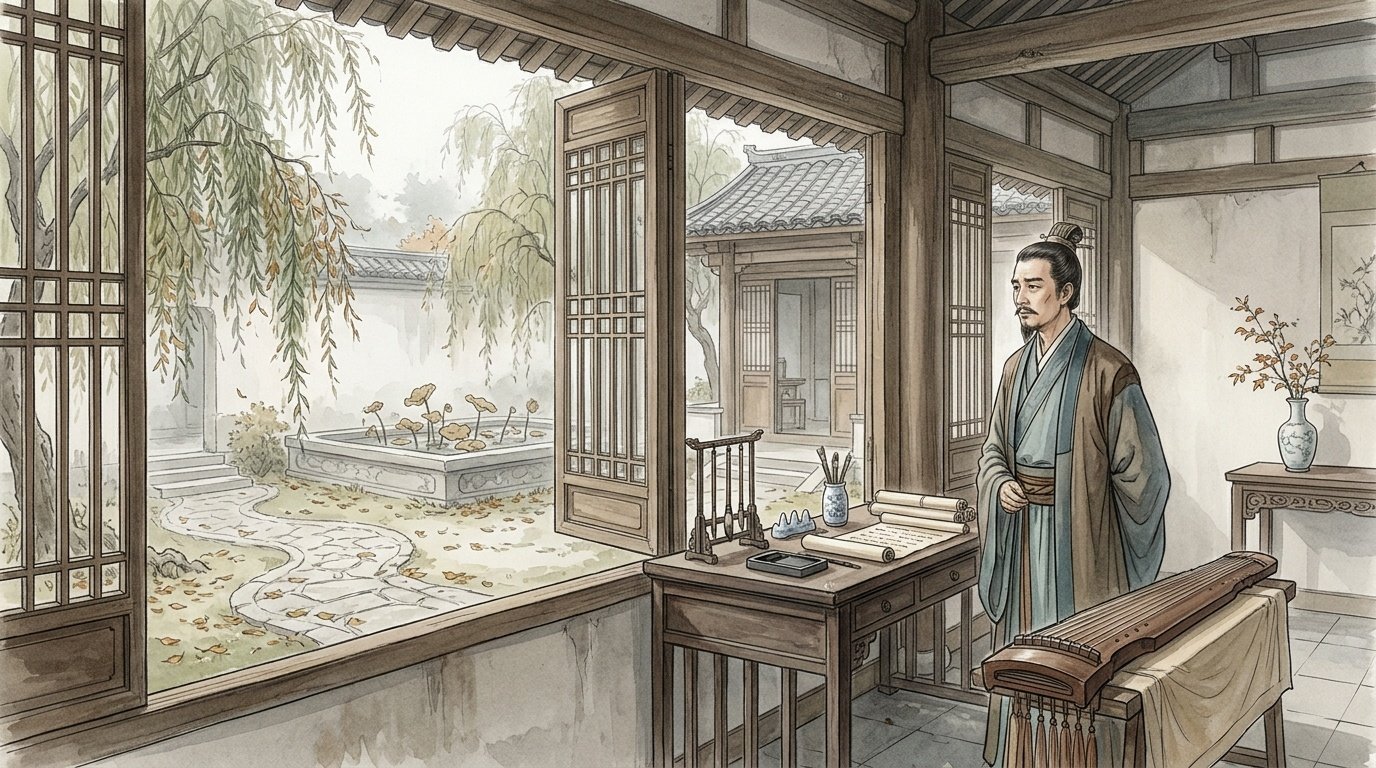
On the seventh day of the seventh lunar month in the third year of the Taiping Xingguo era (August 13, 978 CE)—the traditional night of the Qixi Festival (七夕), when the mythical Cowherd and Weaver Girl meet across the celestial Silver River—a solitary prisoner sat in the dimly lit courtyard of an enclosed mansion in the northern capital of Kaifeng (开封). It was his forty-second birthday. Forty-two years earlier, he had been born into the dazzling opulence of the imperial palace of Jinling (金陵, modern Nanjing), gifted with artistic talents so extraordinary that contemporaries viewed him as an immortal descended to earth: a virtuoso of the seven-stringed zither, an innovator of calligraphic scripts described as ‘gold-inlaid daggers’ (金错刀), a connoisseur of ancient paintings, and the supreme master of the Chinese lyric song (词, Ci). His name was Li Yu (李煜, 937–978 CE, courtesy name Chongguang 重光), the third and Last Lord of the Southern Tang Dynasty (南唐后主).
Three years had passed since the armies of the Song Dynasty (宋朝) had smashed through the ramparts of Jinling, ending thirty-eight years of Southern Tang independence and dragging Li Yu northward in chains. In Kaifeng, the founding Song emperors had stripped him of his royal identity, bestowing upon him the mocking, humiliating title of ‘The Marquis of Disobedience’ (违命侯, Weiming Hou). Living under perpetual house arrest, surveilled day and night by imperial spies, and watching his beloved second wife, Queen Zhou the Younger (小周后), repeatedly summoned to the palace of Song Taizong to endure unmentionable imperial humiliations, Li Yu poured his shattered soul onto paper. That night, gazing up at the autumn moon, Li Yu composed the final, immortal verses of his lyric poem to the tune of Yu Meiren (虞美人, The Beautiful Lady Yu):
「春花秋月何时了?往事知多少!小楼昨夜又东风,故国不堪回首月明中。
— Li Yu (李煜), Yu Meiren (虞美人)
雕栏玉砌应犹在,只是朱颜改。问君能有几多愁?恰似一江春水向东流!」
‘Spring flowers and autumn moon, when shall they ever cease?
How much of the past can one ever truly know!
Upon the small tower last night, the eastern wind blew once again;
My lost homeland—I cannot bear to look back upon it beneath the brilliant moon!
The carved balustrades and jade flagstones should surely still remain,
Only the rosy cheeks of youth have changed.
If you ask me how boundless a sorrow I bear:
It is just like a whole river of spring water flowing endlessly to the east!’
When the verses were reported to Emperor Taizong of Song (宋太宗, Zhao Guangyi), the northern monarch flew into a murderous rage. Recognizing that Li Yu still harbored unyielding nostalgia for his lost southern realm, Taizong dispatched an imperial courier carrying an earthenware jug of poisoned wine: the dreaded Qianji Yao (牵机药, ‘The Loom-Shedding Poison’), a lethal concoction of strychnine. Within hours of drinking the draught, Li Yu was seized by excruciating muscular spasms. His spine arched backward in violent, agonizing convulsions until his crown touched his heels like the shuttle of a weaving loom, dying in unbearable torment upon the floor of his prison pavilion.
The tragedy of Li Yu is one of the most poignant, paradoxical dramas in global cultural history. As a sovereign, Li Yu was a catastrophic failure: politically naive, militarily clueless, superstitious, and paralyzed by indecision, presiding over the collapse of the wealthiest and most refined kingdom in medieval China. Yet as a poet, his political destruction was the divine crucible that forged his immortality. In the famous evaluation of the twentieth-century philosopher and literary critic Wang Guowei (王国维) in Poetic Remarks on the Human World (人间词话), it was through Li Yu that Chinese lyric poetry (Ci) transformed from shallow banquet entertainment for courtesans into a profound, universal vehicle for the collective grief of all mankind. Li Yu had to lose an empire to find his soul.
This comprehensive study examines the life, reign, fall, and literary climax of Li Yu. We will explore the cultural and economic splendor of the Southern Tang kingdom in tenth-century Jiangnan; examine Li Yu’s early life of sensual palace luxury and romantic passion alongside his two queens, the legendary sisters Zhou Ehuang and Queen Zhou the Younger; analyze Zhao Kuangyin’s ruthless geopolitical drive to absorb the south, culminating in his famous maxim: ‘Beside my bed, how can I allow another man to snore!’; reconstruct the harrowing siege of Jinling in 974–975 CE and Li Yu’s surrender in white mourning robes; trace his agonizing captivity in Kaifeng and the creation of his peerless late exile lyrics; dissect the medical and political reality of his murder via Qianji poison; and evaluate his enduring literary revolution that elevated the Ci genre into the supreme aesthetic crown of the Song Dynasty.
1. The Gilded Sanctuary: The Splendor of the Southern Tang (937–975 CE)
While northern China was being reduced to an uncultivated graveyard of smoking ruins during the brutal civil wars of the Five Dynasties, the southern regions along the lower Yangtze River were basking in an extraordinary golden age of peace, agricultural abundance, and high culture. Following the collapse of the Tang, the southern provinces fragmented into the prosperous realms known as the Ten Kingdoms (十国): Southern Tang, Wuyue, Southern Han, Chu, Min, and Former/Later Shu. Among these, the undisputed superpower of wealth, territory, and civilizational refinement was the Southern Tang (南唐, 937–975 CE).
Founded in 937 CE by Li Bian (李昪, Emperor Liezu), who claimed descent from the imperial Li clan of the Great Tang, the Southern Tang encompassed modern Jiangsu, Anhui, Jiangxi, and eastern Hubei, with its capital at Jinling (金陵, Nanjing). Protected by the natural moat of the Yangtze River and blessed with the fertile polder fields around Lake Tai and Lake Poyang, the kingdom was an economic paradise. While northern emperors struggled to feed their mercenary armies, the granaries of Jinling were packed with millions of bushels of polished white rice; its hills produced the finest green teas; its kilns fired exquisite Yue celadon porcelain; and its workshops wove gossamer silks that clothed the courts of East Asia.
Under Li Bian and his son Li Jing (李璟, Emperor Yuanzong, r. 943–961 CE), Jinling transformed into the cultural capital of the Chinese world. Scholars, painters, poets, and calligraphers fled the chaotic north to seek sanctuary in the Southern Tang court. The imperial academy gathered peerless artistic masters:
- The Masters of Landscape Painting: Dong Yuan (董源) and Juran (巨然), who abandoned northern rocky cliffs to invent the soft, mist-veiled, hemp-fiber brushstrokes (披麻皴) and alum-head pebbles that captured the humid, rolling mountains of Jiangnan, establishing the southern school of Chinese monochrome landscape art.
- Figure and Narrative Painting: Gu Hongzhong (顾闳中), whose immortal narrative handscroll The Night Revels of Han Xizai (韩熙载夜宴图) captured the decadent, melancholic banquet culture of the Southern Tang aristocracy with psychological depth never seen before in Asian art.
- Stationery and Cultural Refinement: Jinling artisans produced the legendary ‘Four Treasures of the Study’ of Southern Tang: the exquisite Chengxintang Paper (澄心堂纸)—a paper so smooth, dense, and lustrous that later Song emperors treated single sheets like gold bullion; the fine Hui Inksticks of Li Tinggui (李廷珪墨), described as ‘fragrant as musk and hard as jade’; and the carved Duan inkstones.
Born into this sensual, hyper-refined atmosphere on the Qixi Festival of 937 CE, Li Yu was the sixth son of Emperor Li Jing. Possessing physical peculiarities that were viewed as omens of artistic genius—notably double pupils in one eye (目有一重瞳子)—Li Yu was a sensitive, introverted prince who harbored zero desire for political power. He spent his youth wandering the gardens of Mount Zhong, studying Buddhist sutras, painting bamboo, and mastering the musical rhythms of court lyrics.
2. The Accidental Sovereign: Li Yu Ascends the Throne (961 CE)
Fate, however, refused to grant Li Yu the quiet life of an artistic hermit. In the 950s, the formidable Emperor Shizong of Later Zhou (Chai Rong) launched a devastating military invasion of the Southern Tang, conquering all fourteen prefectures north of the Yangtze River. Humiliated and militarily broken, Li Yu’s father, Li Jing, was forced to surrender the title of Emperor, demote his court titles to that of a King (国主), and submit as a tax-paying vassal to the northern dynasty. Shortly thereafter, Li Yu’s elder brother, Crown Prince Li Hongji, died suddenly of illness. As the eldest surviving son, the twenty-four-year-old poet-prince was thrust onto the throne in the sixth lunar month of 961 CE as the King of Southern Tang.
As a ruler, Li Yu was completely miscast by history. He was profoundly kind-hearted, humane, and incapable of cruelty; he despised physical violence and wept whenever a criminal was sentenced to execution. Yet he possessed neither the cynical cunning nor the administrative discipline required to navigate the ruthless geopolitical vortex of tenth-century China. In Kaifeng, the newly founded Song Dynasty under Zhao Kuangyin was systematically conquering the regional kingdoms one by one: Jingnan fell in 963 CE, Later Shu in 965 CE, and Southern Han in 971 CE. The noose was tightening around Jinling with mathematical certainty.
Li Yu’s sole survival strategy was desperate, humiliating appeasement. Whenever Zhao Kuangyin demanded tribute, Li Yu sent flotillas of barges loaded with pure gold, silver, silk, pearls, and medicinal herbs. To demonstrate his subservience, Li Yu erased the Southern Tang era name, adopted the Song imperial calendar, removed the imperial yellow dragon robes from his court, and demoted his administrative ministries from central imperial titles (尚书省) to provincial bureaus. When his loyal chancellors urged him to train troops, dredge canals, and prepare defensive stockades, Li Yu took refuge in religious escapism. A fervent, superstitious Buddhist, the monarch spent his mornings chanting sutras with hundreds of monks inside the palace, believing that karmic merit and the benevolent protection of the Buddha would shield his realm from northern lances.
3. The Golden Inset Willow: Li Yu’s Calligraphic and Aesthetic Genius
Long before his tragedy in exile, Li Yu had established a reputation as one of the most innovative calligraphers and aesthetic theorists in medieval China. Rejecting the rigid, formalistic regular script of late Tang officialdom, Li Yu invented two revolutionary calligraphic modes that reflected his delicate, nervous sensitivity: the Jincuo Dao (金错刀, ‘Gold-Inlaid Daggers’) script and the Tiegou Suo (铁钩锁, ‘Iron-Hook Locks’).
Contemporary critics in the Xuanhe Shupu (宣和书谱) described his calligraphy with awe: his brushstrokes were slender, taut, and trembling, resembling cold steel blades inlaid with filigree gold, curving with the flex of a drawn bow before snapping with explosive energy. In painting, Li Yu pioneered the monochrome depiction of cold, wind-buffeted bamboo, known as ‘Iron Bamboo’ (铁钩竹), where bamboo stems were rendered with the slashing strokes of a two-handed saber. He established the imperial Baoyi Hall (宝仪堂), assembling thousands of ancient bronze vessels, Shang and Zhou oracle inscriptions, and original calligraphy scrolls of Wang Xizhi and Yan Zhenqing, cataloging them with meticulous scholarly philology.
In music, Li Yu possessed absolute auditory pitch. He could detect a single untuned silk string among twenty instruments in a court orchestra, and spent years reforming the musical scale of the Southern Tang court to match the ancient pitches of the Duke of Zhou. It was this total aesthetic immersion—viewing the universe not as an arena of political conquest, but as a symphony of sounds, colors, brushstrokes, and emotional nuances—that made him an artist of genius, and an imperial sovereign of doom.
4. The Golden Cages of Love: Ehuang, Xiaozhou, and the Early Palace Lyrics
While geopolitical doom crept closer to the palace gates, Li Yu was immersed in one of the most celebrated and tragic love stories in Chinese literature. In 954 CE, Li Yu had married Zhou Ehuang (周娥皇, 936–965 CE, Queen Zhou the Elder 大周后), the daughter of Southern Tang Prime Minister Zhou Zong. Ehuang was a woman of dazzling beauty, supreme intellect, and peerless musical genius. Together, Li Yu and Ehuang formed a celestial artistic partnership. Finding the long-lost musical score of the legendary Tang Dynasty court composition The Rainbow Skirts and Feather Robes (霓裳羽衣曲)—which had been scattered during the An Lushan Rebellion—the royal couple spent months meticulously reconstructing the lost melody, transcribing the intricate pipa and flute arrangements, and choreographing the delicate dances in the Jinling palace.
Li Yu’s early poetry, written during this period of youthful bliss, was the absolute climax of the Hanjian (Flower Interlude 花间) poetic tradition: delicate, sensual, musical, and intoxicated with palace luxury. In his iconic lyric to the tune of Bodhisattva Barbarian (菩萨蛮), Li Yu captured the forbidden thrill of a midnight palace tryst with breathless, intimate vividness:
「花明月暗笼轻雾,今宵好向郎边去。
— Li Yu (李煜), Pusa Man (菩萨蛮)
刬袜步香阶,手提金缕鞋。
画堂南畔见,一向偎人颤。
奴为出来难,教君恣意怜!」
‘Flowers glimmer, the moon is dim, veiled in light mist;
Tonight is the perfect hour to slip away to my beloved’s side!
In stockinged feet I tread the scented steps,
Holding in my hand my gold-embroidered slippers.
By the southern side of the painted hall we meet,
Nestling instantly against his chest, all trembling!
“It was so difficult for your servant to slip out—
Let my lord love me to his heart’s desire!”‘
This immortal verse was written not for Queen Ehuang, but for her fifteen-year-old younger sister, Queen Zhou the Younger (小周后, 950–978 CE), with whom Li Yu had begun a passionate, secretive love affair while Ehuang lay bedridden with terminal illness. In 965 CE, heartbroken by the sudden death of her four-year-old son Prince Zhongjun and discovering her husband’s romance with her younger sister, Queen Ehuang died of grief and illness at the age of twenty-nine. Li Yu was consumed by inconsolable guilt, fasting for days, weeping until he collapsed, and composing an epic 8,000-character funeral eulogy (昭惠周后诔) in archaic classical prose. Three years later, in 968 CE, Li Yu formally married the younger sister, elevating her as Queen Zhou the Younger. Yet the shadow of grief had permanently penetrated the palace walls; the golden dream of Jinling was drawing to a bloody close.
4B. Espionage as Art: Gu Hongzhong and The Night Revels of Han Xizai
No single cultural artifact captures the tragic, decadent paradox of the Southern Tang court more profoundly than the legendary narrative handscroll The Night Revels of Han Xizai (韩熙载夜宴图), executed by the imperial academy master painter Gu Hongzhong (顾闳中). The painting was not a commissioned family portrait; it was an act of high-level state espionage disguised as art, commissioned personally by Li Yu to uncover whether his most brilliant minister was plotting treason or merely surrendering to nihilistic hedonism.
Han Xizai (韩熙载, 902–970 CE) was a northern-born scholar from Beihai (modern Shandong) whose father had been executed during the tumultuous civil wars of the Later Tang. Fleeing southward across the Huai River, Han Xizai offered his formidable talents to the Southern Tang founder, Li Bian. Towering, bearded, and gifted with extraordinary administrative vision, strategic acumen, and poetic eloquence, Han was revered throughout Jiangnan as an intellectual colossus. When Li Yu ascended the throne in 961 CE, Han Xizai was the undisputed candidate to become Chancellor (宰相, Zaixiang) and reform the kingdom’s crumbling administration. Yet Han Xizai recognized the writing on the wall: the Song Dynasty was unstoppable, Li Yu was utterly incapable of resolute leadership, and any minister who assumed executive responsibility for Southern Tang would inevitably be caught between dynastic surrender and catastrophic annihilation.
To disqualify himself from high political office and avoid execution, Han Xizai chose the ancient strategy of tuobi (脱避, feigned madness and moral dissipation). He transformed his lavish Jinling estate into an open salon of continuous, unrestrained nocturnal revelry. He purchased dozens of beautiful courtesans, dancing girls, and flutists, inviting young scholars, monks, and high officials to spend days and nights drinking wine, writing lewd verses, playing drinking games, and consorting openly with courtesans. When friends begged him to preserve his dignity and save the state, Han Xizai wept privately and confessed: ‘I do this merely to escape being made Chancellor. The northern barbarians are growing stronger by the day. Our kingdom will perish within decades. I have no wish to be recorded in history as the minister who lost the realm.’
Disturbed by rumors that his most celebrated statesman was presiding over wild bacchanals—or worse, secretly hosting conspiratorial cabals—Li Yu dispatched court painter Gu Hongzhong and fellow painter Zhou Wenju (周文矩) to infiltrate Han Xizai’s nocturnal banquets. Gu Hongzhong was endowed with photographic memory. Mingling silently in the shadows, Gu observed the festivities for five continuous nights, memorized every posture, expression, costume, musical instrument, and architectural screen, and returned to the imperial palace to paint a long silk handscroll depicting the nocturnal debauch in five sequential scenes:
- Scene 1: Listening to the Pipa (听乐): Han Xizai, wearing a high black scholar’s cap and loose domestic robes, sits beside the brilliant Zhuangyuan scholar Canliao on a daybed, listening intently to the virtuoso courtesan playing the four-stringed pear-shaped lute (琵琶). The guests are spellbound by the melody, yet Han Xizai’s heavy-lidded eyes gaze into empty space with unutterable spiritual fatigue.
- Scene 2: Watching the Dance (观舞): Han Xizai stands beside a massive drum, rolling up his sleeves to beat the wooden rhythm for his favorite concubine, the dancer Wang Wushan (王屋山), who performs the delicate ‘Six Chuo Dance’ (六幺舞). Despite the hypnotic movement of silken ribbons, Han’s face remains austere and somber, a man performing a ritual role rather than enjoying festive delight.
- Scene 3: Resting and Washing Hands (憩息): Han Xizai reclines upon an alcove canopy bed draped in red silk curtains, surrounded by four maidservants bearing copper basins of warm water and silk towels. The sexual dissipation of the household is laid bare, yet Han appears drained and detached, an old philosopher imprisoned within his own sensual theatricality.
- Scene 4: The Flute Ensemble (清吹): A chorus of five young female musicians in matching peach-blossom robes sit side by side on wooden stools, playing the transverse bamboo flute (笛) and pipes (箫). Han Xizai sits sideways in an armchair, unbuttoned, fanning himself with a round fan, gazing down at his lap in profound isolation while the music washes over him.
- Scene 5: Farewell to the Revelers (宴散): As the dawn breaks, guests whisper intimately with courtesans behind folding screens and adjust their robes to depart. Han Xizai stands with a drumstick in hand, gesturing a quiet farewell to his guests. The party is over; the illusion dissolves; the encroaching doom of the northern armies remains.
When Li Yu unrolled the completed handscroll in his private study, he was utterly mesmerized. As a supreme aesthetic connoisseur, Li Yu immediately recognized Gu Hongzhong’s psychological genius: the stark contrast between the bright mineral pigments of the courtesans’ gowns and the crushing, dark sorrow etched upon Han Xizai’s weary face. Li Yu understood Han’s silent message: the debauchery was not treason, but an elegy for a dying kingdom. Li Yu abandoned his intention to appoint Han Xizai as Chancellor, leaving the old scholar to drink himself into oblivion. Han Xizai died in 970 CE, spared by five short years from witnessing the Song assault. Gu Hongzhong’s masterpiece survived the burning of Jinling, passing into the Song imperial collection and enduring through the centuries as the supreme visual monument to the poignant, tragic twilight of Southern Tang civilization.
5. ‘Beside My Bed’: The Inevitable Clash with Zhao Kuangyin
By 974 CE, the Song Dynasty had conquered every other independent kingdom in southern China. Zhao Kuangyin’s gaze was fixed squarely upon Jinling. In the ninth lunar month of 974 CE, Taizu dispatched an imperial summons commanding Li Yu to leave Jinling and travel to Kaifeng to pay personal homage to the Son of Heaven. Li Yu, terrified that entering Kaifeng meant immediate imprisonment, pleaded severe illness and refused to depart.
Taizu immediately ordered an all-out military offensive. He mobilized a hundred-thousand-man expeditionary force under the supreme command of the Song Dynasty’s most disciplined and humane marshal, General Cao Bin (曹彬, 931–999 CE), assisted by General Pan Mei (潘美). Desperate to halt the war, Li Yu dispatched his most brilliant diplomat and scholar, Xu Xuan (徐铉, 916–991 CE), to Kaifeng to plead for the survival of the Southern Tang.
Xu Xuan, celebrated across China for his peerless oratorical eloquence, was granted an imperial audience before Emperor Taizu. Xu Xuan argued eloquently: ‘The King of Southern Tang serves Your Majesty as a dutiful son serves his father; he remits abundant annual tribute, uses your imperial calendar, and has never committed a single violation of ritual law! Why must Your Majesty unleash your armies to destroy a faithful son?’
Emperor Taizu sat motionless upon his dragon throne, listening to Xu Xuan’s elaborate Confucian arguments. Then, the emperor rested his hand upon the pommel of his imperial sword, leaned forward, and delivered one of the most chilling, unvarnished declarations of realpolitik in world history:
「不须多言!江南亦何罪?但天下一家,卧榻之侧,岂容他人鼾睡乎!」
— Emperor Taizu of Song to Xu Xuan, Xu Zizhi Tongjian Changbian, Chapter 15
‘Speak no more! What crime indeed has Jiangnan committed? It is simply that All Under Heaven is one single family! Beside my own bed, how could I ever permit another man to snore peacefully beside me!’
The famous maxim ‘Beside my bed, how can I allow another man to snore’ (卧榻之侧,岂容他人鼾睡) demolished all legalistic, moral, and diplomatic pretenses. The destruction of the Southern Tang was not a question of justice or guilt; it was the inescapable, biological imperative of imperial reunification. Xu Xuan bowed his head in tears and departed in silence. The fate of Jinling was sealed.
6. The Fall of Jinling: Catastrophe upon the Yangtze (974–975 CE)
In the tenth lunar month of 974 CE, General Cao Bin and Pan Mei executed one of the most remarkable engineering feats in ancient military history: the construction of a floating pontoon bridge across the Yangtze River (浮梁跨江) at Caishiji (Dangtu, Anhui). Floating hundreds of massive transport barges linked by iron chains and anchored with heavy stone cables, Song engineers bridged the torrential, mile-wide currents of the Yangtze in a matter of weeks, allowing tens of thousands of Song infantry, cavalry, and siege catapults to march across the river without losing a single warboat.
The Southern Tang court had believed that the torrential Yangtze was an impassable natural barrier. When reports arrived that the Song pontoon bridge was operational, Li Yu laughed aloud in disbelief, declaring: ‘I have heard of bridges over creeks, but who has ever heard of bridging the Great Yangtze? This is childish rumor!’ Only when General Pan Mei smashed the Southern Tang fleet under Zhu Lingyun (朱令赟) at the Battle of Wanzhou—where fifteen thousand southern sailors burned to death in their own fire-ships when a sudden shift in wind blew flames back onto their flotilla—did Li Yu realize that doom had crossed the river.
By the spring of 975 CE, Song armies had completely encircled the stone walls of Jinling. Yet inside the palace, Li Yu remained tragically detached from reality. His corrupt, treasonous chancellors, led by Chen Qiao (陈乔) and Zhang Meng (张汞), withheld military dispatches from the sovereign, assuring Li Yu that the Song armies were starving and would soon retreat. While Song catapults rained incendiary petroleum bombs and boulders into the outer suburbs, Li Yu spent his days secluded inside the Jingju Buddhist Temple, donning monk’s robes, burning incense, and discussing philosophical metaphysics with dozens of bald-headed abbots.
The illusion shattered abruptly in the eleventh lunar month of 975 CE when Li Yu climbed the city battlements to inspect the defenses. Gazing out across the hills, the king was horrified to see the entire horizon covered with hundreds of thousands of Song soldiers, fluttering banners, and siege towers looming over the city walls. Weeping with rage at Chen Qiao’s betrayal, Li Yu prepared to commit mass suicide. He loaded the imperial library—preserving thousands of priceless Tang calligraphy scrolls, rare paintings, and dynastic archives—into a palace hall, surrounded it with straw and pitch, and prepared to incinerate himself and the treasures when the walls fell.
On the twenty-seventh day of the eleventh lunar month (December 975 CE), Song troops breached the southern gate. General Cao Bin, displaying legendary discipline, ordered his troops: ‘Whoever harms a single common citizen or plunders a single home shall be immediately beheaded!’ Cao Bin halted his troops outside the palace gates, sending an envoy to assure Li Yu that his life would be spared if he surrendered peacefully.
Li Yu ordered the fires extinguished, opened the palace gates, and led forty-five high officials out of the city. Clad in coarse white mourning robes, bareheaded, and holding his imperial seals before him, the Last Lord of Southern Tang surrendered unconditionally. As his royal barge sailed down the Qinhuai River, carrying him away from his ancestral home forever, Li Yu composed the heartbreaking lines:
「四十年来家国,三千里地山河。
— Li Yu (李煜), Po Zhen Zi (破阵子)
凤阁龙楼连霄汉,玉树琼枝作烟萝,几曾识干戈?
一旦归为臣虏,沈腰潘鬓消磨。
最是仓皇辞庙日,教坊犹奏别离歌,垂泪对宫娥!」
‘For forty years, our ancestral house and state,
Three thousand li of majestic mountains and rivers!
Phoenix pavilions and dragon towers rose straight into the celestial clouds,
Jade trees and jasper boughs hung like fragrant mists—
When had we ever known the clash of shields and spears?
In a single morning reduced to captive vassals,
Waists withered like Shen Yue, temples graying like Pan Yue!
Most heartbreaking was that hurried day of parting from the Ancestral Temple:
The Imperial Music Academy still played their mournful farewell songs,
While I wept helpless tears before my palace maidens!’
7. The Captive Marquis: Humiliation and Sorrow in Kaifeng
In early 976 CE, Li Yu arrived in Kaifeng. Forced to wear prisoner’s garb, he prostrated himself before Emperor Taizu in the Mingde Hall. Zhao Kuangyin spared Li Yu’s life, granting him a state pension and the mocking noble title ‘Marquis of Disobedience’ (违命侯). Li Yu and Queen Zhou the Younger were assigned an enclosed, walled residence in the southern quarter of Kaifeng. While superficially treated as imperial pensioners, they were prisoners in all but name, watched day and night by armed imperial guards and palace informants.
Nine months after Li Yu’s arrival, Emperor Taizu died mysteriously in the blizzard of 976 CE, succeeded by his ruthless younger brother, Emperor Taizong (Zhao Guangyi). Under Taizong’s reign, the humiliation of the captive royal couple descended into psychological torture. Taizong, who lusted after the legendary beauty of Queen Zhou the Younger, repeatedly summoned the queen to the inner palace under the pretext of paying homage to the Empress. The queen was detained inside the palace for weeks at a time, subjected to sexual violations by the emperor, while palace court painters were reportedly ordered to produce scandalous erotic scrolls depicting the encounters.
Whenever Queen Zhou returned to their residence, weeping hysterically and hurling bitter curses at Li Yu for his physical impotence and cowardice, the broken poet could do nothing but bow his head, clutch his knees, and weep in silent, agonizing despair. Stripped of his crown, his country, his dignity, and his wife, Li Yu found his sole refuge in the brush.
8. The Climax of Grief: The Late Ci Lyrics of Exile
To grasp the astonishing aesthetic rupture that Li Yu achieved during his Kaifeng captivity, one must examine the precise lexical and musical mechanics of his two other towering late masterpieces: Xiang Jian Huan (相见欢, Joy at Meeting, also known as Wu Ye Ti 乌夜啼, The Crowing of Crows at Night) and Po Zhen Zi (破阵子, Dance of the Shattered Battlelines). In these works, Li Yu abandoned the ornamental, polysyllabic diction of the late Tang lyricists—who stuffed verses with gold dust, Kingfisher feathers, and jade hairpins—in favor of bone-chilling, monosyllabic clarity that pierced straight into the universal human condition.
「无言独上西楼,月如钩。寂寞梧桐深院锁清秋。
— Li Yu (李煜), Xiang Jian Huan (相见欢)
剪不断,理还乱,是离愁。别是一般滋味在心头。」
‘Speechless, alone, I climb the western tower;
The moon is like a slender sickle hook.
In lonely desolation, the Chinese parasol trees lock in the cold, deep autumn.
Cut it—it cannot be severed;
Comb it—it falls into tangled chaos once again:
Such is the grief of separation!
It leaves a singular, uncanny flavor lingering in the hollow of the heart.’
The brilliance of Xiang Jian Huan lies in its claustrophobic physical and emotional compression. The opening line—‘Speechless, alone, I climb the western tower’ (无言独上西楼)—establishes total existential abandonment in just six Chinese characters. There is no companion, no consort, no courtly audience; the former king ascends the tower in mute paralysis. The crescent moon is not a glowing pearl of romance, but an icy steel hook (月如钩) suspended in the barren sky. The physical landscape of the courtyard mirrors his psychological cage: the ancient paulownia tree (梧桐) stands in silent solitude, ‘locking in’ (锁) the crisp, chill autumn. The verb suo (锁, to lock) is a masterstroke: it is not merely the season that is imprisoned within the brick walls of the courtyard, but Li Yu’s very existence, sealed away from the flowing rivers and verdant hills of his lost southern home.
In the second stanza, Li Yu introduces one of the most famous metaphors in all of world literature: the tangibility of sorrow (lichou, 离愁). Transforming an abstract emotion into a physical, fibrous thread, he attempts to sever it with shears—‘cut it, it cannot be severed’ (剪不断)—and comb it smooth—‘comb it, it falls into tangled chaos once more’ (理还乱). Sorrow is revealed as an indestructible, living parasite woven into the fabric of consciousness. Finally, the poem closes with an unprecedented sensory synesthesia: grief is neither sound nor image, but a distinct, lingering taste (bie shi yiban ziwei, 别是一般滋味) coating the tongue and throat—the bitter, metallic tang of loss that no imperial vintage can wash away.
If Xiang Jian Huan captures the quiet, suffocating agony of imprisonment, Li Yu’s martial lyric to the tune of Po Zhen Zi (破阵子) unleashes a volcanic explosion of historical guilt, military catastrophe, and shattered sovereign pride:
「四十年来家国,三千里地山河。凤阁龙楼连霄汉,玉树琼枝作烟萝,几曾识干戈?
— Li Yu (李煜), Po Zhen Zi (破阵子)
一旦归为臣虏,沈腰潘鬓消磨。最是仓皇辞庙日,教坊犹奏别离歌,垂泪对宫娥。」
‘For forty years, our imperial ancestral realm;
Three thousand li of sacred rivers and majestic mountains.
Our Phoenix Pavilions and Dragon Towers soared into the milky clouds of heaven;
Jade trees and jasper boughs intertwined like shimmering mists—
When did we ever know the clash of shields and spears?
Then suddenly, in a single dawn, I was reduced to a vassal and a slave!
My waist has shrunk like Shen Yue’s; my temples have turned snow-white like Pan Yue’s.
Most harrowing of all was that chaotic day of bidding farewell to the ancestral temple:
The imperial orchestra still played its parting farewell melodies,
While I streamed endless tears before my palace maidens.’
Here, the scale expands from the solitary courtyard to the vast expanse of Chinese imperial geography. In two thunderous opening lines, Li Yu evokes forty years of peace enjoyed by the Southern Tang dynasty and the three thousand li of emerald territory stretching from the Huai River to the mountains of Fujian. Then comes the self-indicting, devastating confession: ‘When did we ever know the clash of shields and spears?’ (几曾识干戈?). In five characters, the fallen monarch lays bare the fundamental rot of his aristocratic civilization: an ivory tower of poetic refinement, completely blind to the brutal military realities of the northern plains.
The second stanza crashes downward from celestial glory into absolute degradation: ‘In a single dawn, reduced to a vassal and a slave’ (一旦归为臣虏). The physical toll of trauma is rendered through classical literary allusions: Shen Yue (沈约), the fifth-century scholar whose belt shrank month after month from melancholic wasting, and Pan Yue (潘岳), the handsome poet whose hair turned grey at thirty-two. The emotional climax of the poem recalls the final, excruciating morning of November 975 CE: fleeing the imperial palace, standing before the ancestral tablets of Emperor Liezu, while the palace orchestra—trained in the delicate court music of Jiangnan—faithfully strikes up a farewell tune while the sovereign weeps helplessly before his maidservants. The historical honesty of Po Zhen Zi is utterly unprecedented in imperial Chinese literature. Traditional dynastic founders and fallen kings either justified their failures or died in stoic silence; Li Yu alone had the supreme artistic courage to display his own humiliation, vanity, weakness, and tears for all posterity to witness.
It was during these two final, hellish years of captivity in Kaifeng (976–978 CE) that Li Yu created the masterpieces that permanently revolutionized Chinese literature. Stripped of all decorative palace vanity and trivial eroticism, Li Yu’s poetry achieved a terrifying, naked emotional purity. His late lyrics were not written with ink; they were written with tears and blood.
In his peerless lyric to the tune of Xiang Jian Huan (相见欢, Joy at Meeting), Li Yu captured the profound, existential loneliness of the political exile with unprecedented psychological precision:
「无言独上西楼,月如钩。
— Li Yu (李煜), Xiang Jian Huan (相见欢)
寂寞梧桐深院锁清秋。
剪不断,理还乱,是离愁。
别是一般滋味在心头!」
‘In absolute silence, alone I ascend the western tower;
The autumn moon hangs like a sharp hook.
Lonely wutong trees in the deep courtyard lock in the clear chill of autumn.
Cut it, it cannot be severed;
Untangle it, it only tangles more—
Such is the sorrow of parting!
It is an entirely unique, bitter taste that lingers forever in the heart!’
The phrase ‘Cut it, it cannot be severed; untangle it, it only tangles more’ (剪不断,理还乱) became an eternal idiom in the Chinese language, encapsulating the inescapable, suffocating grip of human grief. Similarly, in his lyric to Lang Tao Sha (浪淘沙, Waves Washing the Sands), Li Yu captured the heartbreaking shock of awakening from dreams of former majesty into cold, shivering imprisonment:
「帘外雨潺潺,春意阑珊。罗衾不耐五更寒。
— Li Yu (李煜), Lang Tao Sha (浪淘沙)
梦里不知身是客,一晌贪欢!
独自莫凭栏,无限江山,别时容易见时难。
流水落花春去也,天上人间!」
‘Beyond the blinds, rain murmurs endlessly; the mood of spring fades to ruin.
My silk coverlet cannot endure the chill of the fifth watch.
In my dreams, I knew not that my body was a foreign captive—
For a fleeting moment indulging in stolen joy!
Alone, do not lean against the balcony railing:
Boundless rivers and mountains—parting from them was so easy, seeing them again is so impossible!
Flowing waters and falling petals, spring has departed forever:
One world in Heaven, another on Earth!’
Li Yu’s late poetry accomplished an epochal literary breakthrough: the democratization and universalization of sorrow. When Li Yu wept for his lost kingdom, his ‘homeland’ ceased to be merely the geographic territory of Southern Tang; it became a universal metaphor for every human being’s lost paradise, the fleeting impermanence of beauty, and the tragic fragility of mortal existence. His sorrow was no longer the sorrow of a fallen king; it was the sorrow of the human condition itself.
9. The Loom of Death: The Murder of Li Yu (978 CE)
The creation of these poetic masterpieces proved to be Li Yu’s death sentence. In the summer of 978 CE, Li Yu composed his immortal Yu Meiren (春花秋月何时了). That evening, on his forty-second birthday, Li Yu ordered his former palace singing maidens to sing the newly composed song in his courtyard. The melancholy melody, carrying the lines ‘My lost homeland—I cannot bear to look back upon it beneath the brilliant moon’ (故国不堪回首月明中), drifted over the compound walls and was recorded by imperial spies, who rushed the lyrics directly to Emperor Taizong.
To Song Taizong, this poem was dangerous, intolerable treason. Taizong recognized that as long as Li Yu lived, the millions of subjects throughout Jiangnan would view him as their spiritual sovereign, and his poems would keep the flame of southern resistance alive. Taizong summoned his trusted general, Prince Zhao Tingmei (赵廷美), and handed him an imperial flagon of wine laced with Qianji Yao (牵机药), commanding him to present it to Li Yu as a royal birthday gift.
Li Yu knew what the wine contained. Looking at the cup, the poet smiled with grim, weary resignation, drank it down to the dregs, and bowed to the northern court. The poison, derived from Strychnos nux-vomica (strychnine), acted with terrifying speed. Blocking the inhibitory neurotransmitters in the spinal cord, it induced severe, non-stop tetanic spasms. Every muscle in Li Yu’s body contracted with violent, bone-breaking force. His neck snapped backward, his spine arched into a grotesque circle until his crown touched his heels, his jaw clenched so hard his teeth shattered, gasping for breath until cardiac and respiratory arrest ended his agony on the night of August 13, 978 CE.
Queen Zhou the Younger wept over his contorted corpse for three days, refusing food or water. Months later, broken-hearted and consumed by grief, the twenty-eight-year-old queen took her own life, choosing to join her poet-husband in the yellow springs of the underworld. Li Yu was buried in the Beimang Hills (北邙山) outside Luoyang—the ancient graveyard of emperors—his grave marked only by a modest stone, silent amidst the winter winds.
10. Wang Guowei’s Verdict: The Transfiguration of Chinese Lyric Poetry
In the centuries following his murder, Chinese literary criticism arrived at a profound, unanimous consensus regarding the singular greatness of Li Yu. In his seminal twentieth-century masterwork Poetic Remarks on the Human World (人间词话), the literary philosopher Wang Guowei (王国维, 1877–1927 CE) articulated the definitive evaluation of Li Yu’s place in world literature:
「词至李后主而眼界始大,感慨遂深,遂变伶工之词而为士大夫之词。周介存置诸温、韦之下,可谓颠倒黑白矣……后主则俨有释迦、基督担荷人类罪恶之意,其《破阵子》’归为臣虏’一词,实为词中之绝唱!」
— Wang Guowei (王国维), Poetic Remarks on the Human World (人间词话), Chapter 14
‘With the Last Lord Li [Yu], the horizon of the Ci lyric first expanded into greatness, and its emotional depth became profound! He transformed the Ci from the petty entertainment songs of court entertainers and singing courtesans into the supreme poetry of the scholar-gentleman! For Zhou Jiecun to place him below Wen Tingyun and Wei Zhuang can truly be called turning black into white… The Last Lord seems truly to possess the spirit of Sakyamuni Buddha and Jesus Christ, bearing upon his own shoulders the collective suffering and sins of all mankind! His Po Zhen Zi, describing his reduction to a captive vassal, is in truth the supreme masterpiece of all Chinese lyric poetry!’
Wang Guowei’s comparison of Li Yu to Christ and the Buddha—bearing the collective grief of human existence—captures the miraculous aesthetic transfiguration achieved through his tragedy. Before Li Yu, the Ci genre was restricted to narrow erotic tropes: brocade curtains, painted eyebrows, spring melancholy, and morning wine. Li Yu took that miniature musical form and poured into it the cosmic themes of dynastic fall, the existential agony of exile, the terror of death, and the beauty of enduring memory. Without Li Yu, the monumental lyric poetry of the Song Dynasty—the sweeping heroic lyrics of Su Shi (苏轼), the patriotic thunder of Xin Qiji (辛弃疾), and the melancholic genius of Li Qingzhao (李清照)—could never have been born.
11. Chronology of Li Yu and the Fall of Southern Tang (937–978 CE)
| Year (CE) | Historical Milestone | Key Historical Figures | Literary & Political Significance |
|---|---|---|---|
| 937 (7th Mo., 7th) | Birth of Li Yu in Jinling | Li Yu, Li Bian (Emperor Liezu) | Born on Qixi Festival into the Southern Tang royal house; endowed with double pupils |
| 954 | Marriage to Zhou Ehuang (Queen Zhou the Elder) | Li Yu, Queen Zhou Ehuang | Begins celestial artistic partnership; reconstructs Rainbow Skirts and Feather Robes |
| 958 | Later Zhou Conquers Jiangbei; Southern Tang Submits | Chai Rong, Li Jing (Emperor Yuanzong) | Southern Tang loses 14 northern prefectures; demoted to tributary vassal status |
| 961 (6th Mo.) | Ascension of Li Yu as King of Southern Tang | Li Yu, Li Jing | Li Yu assumes throne in Jinling at age 24; adopts policy of total diplomatic appeasement |
| 965 | Death of Queen Ehuang; Affair with Younger Sister | Queen Ehuang, Queen Zhou the Younger | Ehuang dies of grief; Li Yu pens Pusa Man and 8,000-character funeral eulogy |
| 968 | Marriage to Queen Zhou the Younger | Li Yu, Queen Zhou the Younger | Elevated as primary Queen; peak of sensual, hedonistic palace lyric composition |
| 974 (Autumn) | The ‘Snoring Beside My Bed’ Ultimatum; War Begins | Zhao Kuangyin, Xu Xuan, Cao Bin | Xu Xuan pleads in Kaifeng; Taizu utters ‘snoring’ maxim; Song constructs pontoon bridge |
| 975 (Spring–Nov) | Siege and Fall of Jinling | General Cao Bin, Li Yu, Chen Qiao | Jinling encircled; Li Yu prays in temples; surrenders in white robes; library preserved |
| 976 (Jan) | Arrival in Kaifeng; Created ‘Marquis of Disobedience’ | Emperor Taizu, Li Yu | Subjected to public humiliation in Mingde Hall; placed under house arrest in Kaifeng |
| 976 (Oct) | Death of Taizu; Reign of Terror of Song Taizong | Song Taizong, Queen Zhou the Younger | Taizong repeatedly violates Queen Zhou; Li Yu descends into absolute despair |
| 976–978 | Composition of the Late Exile Ci Masterpieces | Li Yu | Pens Xiang Jian Huan, Wang Jiangnan, Po Zhen Zi; revolutionizes Chinese lyric poetry |
| 978 (Aug 13 / Qixi) | Murder of Li Yu via Qianji Poison on 42nd Birthday | Li Yu, Song Taizong, Zhao Tingmei | Taizong orders poisoning over Yu Meiren; Li Yu dies in spinal convulsions at age 42 |
| 978 (Late) | Suicide of Queen Zhou the Younger; Beimang Burial | Queen Zhou the Younger | Queen commits suicide in grief; Li Yu buried in Beimang Hills outside Luoyang |
12. Scholarly Bibliography and Primary Historical Sources
To substantiate the political records, literary analyses, and historical accounts presented in this study, the following primary sources and academic monographs are recommended for further study:
- Lu You (陆游, 1125–1210 CE), History of the Southern Tang (南唐书, Nan Tang Shu): The foundational historical chronicle of the Southern Tang Dynasty, providing the most detailed contemporary biographies of Li Bian, Li Jing, Li Yu, and Queen Zhou the Elder.
- Ma Ling (马令, comp. 1105 CE), History of the Southern Tang (南唐书, Nan Tang Shu): Essential supplementary source detailing the artistic, musical, and calligraphic culture of the Jinling court and the reconstruction of The Rainbow Skirts and Feather Robes.
- Tuo Tuo (脱脱) et al. (comp. 1345 CE), History of Song (宋史, Song Shi): Indispensable chapters include the Biography of Li Yu (Vol. 478: ‘Hereditary Houses of Southern Tang’), the Biography of General Cao Bin (Vol. 258), and the Biography of Xu Xuan (Vol. 441).
- Li Tao (李焘, comp. 1183 CE), Long Draft of the Comprehensive Mirror in Aid of Governance (续资治通鉴长编, Xu Zizhi Tongjian Changbian): Volumes 14 through 19 provide the definitive chronological reconstruction of the conquest of Jinling, Taizu’s ‘snoring’ dialogue, and Li Yu’s captivity in Kaifeng.
- Wang Guowei (王国维, 1908), Poetic Remarks on the Human World (人间词话, Renjian Cihua): The seminal masterpiece of modern Chinese literary theory, articulating the definitive evaluation of Li Yu’s transfiguration of the Ci genre.
- Bryant, Daniel (1982), Lyric Poets of the Southern T’ang: Feng Yen-chi and Li Yü, University of British Columbia Press: The definitive English-language monograph providing complete poetic translations, metrical analysis, and biographical reconstruction of Li Yu’s literary oeuvre.
- Kurz, Johannes L. (2011), China’s Southern Tang Dynasty, 937–976, Routledge: Masterful political and economic history of the Southern Tang, examining state finance, hydraulic agriculture, diplomacy, and the military campaigns of the Song conquest.
- Egan, Ronald (2006), The Problem of Beauty: Aesthetic Thought and Pursuits in Northern Song Dynasty China, Harvard University Asia Center: Superb examination of the transmission of Southern Tang painting, calligraphy, and stationery culture into the early Northern Song court.
- Lin, Shuen-fu (1977), The Transformation of the Chinese Lyrical Tradition: Chiang K’uei and Southern Sung Tz’u Poetry, Princeton University Press: Foundational study tracing the generic evolution of Ci from early Five Dynasties banquet songs through Li Yu’s emotional revolution.
- Graff, David A., and Robin Higham, eds. (2002), A Military History of China, Westview Press: Contains rigorous analysis of the riverine engineering, pontoon bridges, and siege tactics utilized by Song armies during the conquest of the Southern Tang.