The Battle of Fei River and the Preservation of the South
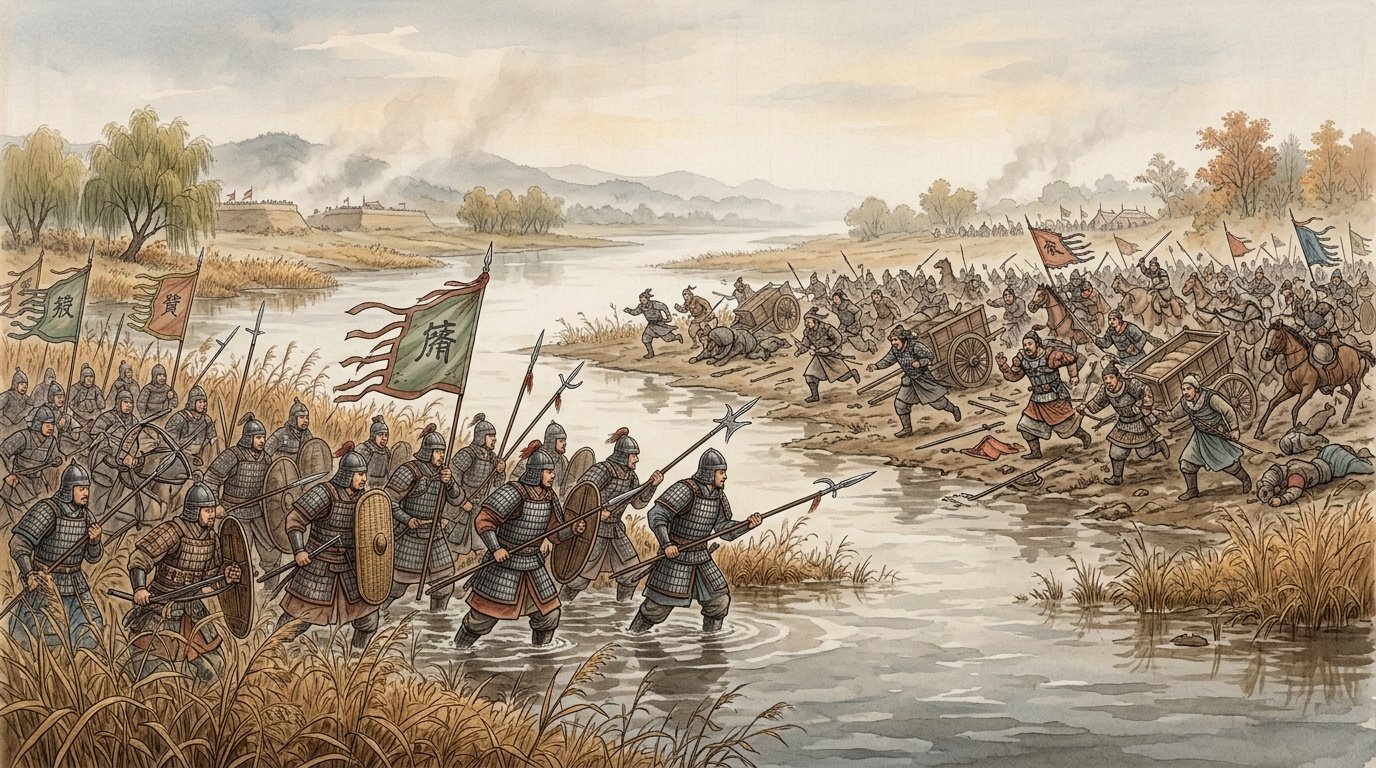
In the late autumn of the eighth year of the Taiyuan era (383 CE), along the muddy, reed-choked banks of the Fei River (淝水, Feishui) in modern Anhui province, the civilizational destiny of China hung precariously in the balance. Bearing down from the north was the most gargantuan military host ever assembled in East Asian antiquity: the grand coalition army of the Former Qin Empire (前秦, 351–394 CE), commanded in person by its charismatic Di (氐) monarch, Fu Jian (苻坚). Marching beneath fluttering silk standards of every color, Fu Jian’s juggernaut comprised, according to contemporary imperial chronicles, over six hundred thousand infantry, two hundred and seventy thousand elite nomadic cavalry, and thirty thousand palace imperial bodyguards—a staggering host nearing nine hundred thousand warriors. So boundless was Fu Jian’s confidence that he famously boasted to his imperial council: ‘If all my soldiers were merely to cast their horsewhips into the Yangtze River, the sheer volume of leather would dam the flow of its torrential currents!’ (以吾之众旅,投鞭于江,足断其流).
Standing between this continental leviathan and the southern imperial capital of Jiankang (建康, modern Nanjing) was a modest southern force of barely eighty thousand men—the newly forged, battle-hardened Beifu Army (北府兵, Army of the Northern Headquarters). Commanded by the aristocratic scions of the Chenjun Xie clan (陈郡谢氏)—General Xie Xuan (谢玄), General Xie Shi (谢石), and overseen from the capital by the unflappable Prime Minister Xie An (谢安)—this small army of northern refugees faced odds of more than ten to one. To contemporary observers throughout East Asia, the outcome appeared preordained. The fractured, luxury-loving Eastern Jin Dynasty (东晋), which had preserved the robes, caps, classical literature, and ancestral rites of the Han civilization in southern exile for seven decades following the Disaster of Yongjia, seemed poised for total physical annihilation.
Yet within forty-eight hours of intense tactical maneuvering, psychological warfare, and catastrophic panic, Fu Jian’s million-man colossus disintegrated into one of the most complete and legendary military debacles in world history. The Battle of Fei River became an indelible civilizational watershed. Had the Former Qin triumphed, China would have been forcibly reunified under a proto-nomadic Di monarchy, cutting short the extraordinary economic, literary, and philosophical evolution of the Southern Dynasties. Instead, the southern victory guaranteed the survival and independent development of the Southern Dynasties for another two centuries, triggered the catastrophic fragmentation of northern China into warring ethnic fiefdoms, and bequeathed to Chinese culture some of its most enduring philosophical idioms: ‘hearing the wind and cranes as enemy soldiers’ (风声鹤唳), ‘seeing grass and trees as warriors’ (草木皆兵), and the supreme aristocratic composure of Xie An breaking his wooden clogs in silent ecstasy.
This comprehensive treatise provides an exhaustive investigation into the Battle of Fei River. We will examine the meteoric rise of the Former Qin under Fu Jian and his brilliant Chinese chancellor Wang Meng (王猛); analyze Wang Meng’s dying deathbed prophecy warning against southern conquest; explore the deep structural, ethnic, and logistical fractures underlying the Former Qin military machine; investigate the revolutionary recruitment, training, and tactical doctrine of the Eastern Jin’s Beifu Army; reconstruct the minute-by-minute tactical phases of the engagement along the Fei River; dissect the catastrophic psychological stampede catalyzed by the defector Zhu Xu (朱序); trace the political and cultural theater of Xie An’s celebrated calm; and evaluate the epochal historical consequences that preserved southern Chinese civilization and dictated the political trajectory of the Northern and Southern Dynasties.
1. The Rise of Former Qin: Fu Jian and the Vision of Universal Empire
To understand the monumental scale of the Fei River confrontation, one must first appreciate the remarkable character and unprecedented achievements of Fu Jian (苻坚, 337–385 CE), Emperor Xuanzhao of Former Qin (秦宣昭帝). Belonging to the Di (氐) ethnicity—a Tibeto-Burman highland people indigenous to the mountainous borderlands of modern Gansu, Shaanxi, and Sichuan—Fu Jian was unlike any of the brutal, predatory warlords who had carved up northern China during the blood-soaked Sixteen Kingdoms period. Ascending the throne of Qin in 357 CE following the assassination of his tyrannical cousin Fu Sheng, Fu Jian was deeply imbued with classical Confucian idealism, Buddhist piety, and a profound personal ambition to establish a universal, multi-ethnic moral imperium.
Fu Jian’s greatest stroke of statesmanship was his discovery and unconditional empowerment of Wang Meng (王猛, 325–375 CE, courtesy name Jinglue 景略), a brilliant Han Chinese scholar and strategist who lived as a hermit in the Huashan mountains. When Fu Jian met Wang Meng, he famously exclaimed that their union was like that of the legendary King Wen meeting Jiang Ziya, or Liu Bei encountering Zhuge Liang. Appointed Prime Minister, Wang Meng instituted sweeping centralized legalist and Confucian reforms across the Qin state. He ruthlessly cracked down on corrupt Di and Qiang tribal aristocrats who terrorized commoners, established state academies to teach the Confucian classics, promoted talented civil administrators regardless of ethnic pedigree, standardized weights and measures, dug extensive irrigation canals across Guanzhong (关中), and cultivated agricultural production.
Backed by this formidable economic and administrative machine, Fu Jian and Wang Meng embarked on an astonishing campaign of military expansion. In rapid succession, the armies of Qin conquered:
- Former Yan (前燕, 370 CE): The powerful Xianbei Murong regime controlling Hebei, Henan, Shandong, and Shanxi was completely crushed by Wang Meng, bringing millions of Xianbei and Han subjects under Qin control.
- Chouzhi (仇池, 371 CE): The independent Di stronghold in southern Gansu was pacified.
- Former Liang (前凉, 376 CE): The ancient Han Chinese buffer state in the Hexi Corridor was absorbed, securing the Silk Road trade routes into Central Asia.
- Dai (代国, 376 CE): The northern Xianbei Tuoba federation (ancestors of the Northern Wei) in modern Inner Mongolia and Shanxi was subjugated.
- Sichuan and the Han River Basin (373 CE): Qin forces pushed southward, conquering Liangzhou (Hanzhong) and Yizhou (Chengdu) from the Eastern Jin, flanking the middle Yangtze.
By 376 CE, Fu Jian had accomplished what no northern ruler had achieved since the fall of the Western Jin: the complete political and territorial unification of all northern China, extending from the Pamir Mountains and Central Asian oasis kingdoms in the west to the Korean peninsula and the Bohai Sea in the east. Flush with these staggering triumphs, Fu Jian came to view himself as the heaven-ordained Son of Heaven, destined to accomplish the ultimate task of universal pacification—the eradication of the illegitimate, exiled Eastern Jin regime at Jiankang and the total political unification of Tianxia (天下, All Under Heaven).
2. The Deathbed Warning of Wang Meng: Prophecy Ignored
Yet the dazzling exterior of the Former Qin Empire concealed deep, lethal structural fault lines. Fu Jian’s sweeping conquests had been achieved with astonishing speed, leaving little time for the genuine organic integration of conquered peoples. Instead of liquidating or dispersing the ruling elites of the defeated states, Fu Jian—guided by an extraordinary, almost naive magnanimity—routinely pardoned their kings and generals, granted them high court ranks, bestowed upon them luxurious palaces in his capital of Chang’an, and entrusted them with massive military commands over their own tribal kin. Murong Chui (慕容垂), the peerless military genius and prince of the defeated Xianbei Former Yan, was made a senior Qin general; Yao Chang (姚苌), a powerful chieftain of the Qiang people, was placed in command of the western armies. Millions of conquered Xianbei, Qiang, and Xiongnu nomads were resettled directly into the fertile valleys surrounding Chang’an, while Fu Jian’s own loyal Di tribesmen were dispersed outward to garrison distant frontier commanderies.
The only man who saw through this perilous facade with absolute, unsparing clarity was Prime Minister Wang Meng. In 375 CE, as Wang Meng lay on his deathbed stricken with terminal illness, Fu Jian visited him in tears, asking his beloved advisor for his final political testament. Wang Meng gathered his remaining strength and delivered a chilling, prophetic warning that is recorded in the Book of Jin (晋书) and the Zizhi Tongjian (资治通鉴):
「晋虽僻陋吴、越,乃正朔相承。亲仁善邻,国之宝也。臣没之后,愿不以晋为图。鲜卑、羌虏,我之仇雠,常思风尘之变,亟宜渐除之,以利社稷。」
— Wang Meng’s dying memorial to Fu Jian, Jin Shu, Chapter 114; Zizhi Tongjian, Chapter 103
‘Although Jin is isolated and relegated to the rugged terrain of Wu and Yue, it represents the unbroken succession of the legitimate imperial calendar. To cherish benevolence and maintain harmony with our neighbors is the supreme treasure of a state. After your servant passes away, I implore Your Majesty never to plot against Jin. The Xianbei and the Qiang barbarians are our mortal enemies; they constantly watch the shifting dust of the wind waiting for a crisis to erupt. It is imperative that you gradually eliminate them to preserve the Altars of Soil and Grain!’
Wang Meng’s geopolitical diagnosis was razor-sharp. The Eastern Jin, whatever its military shortcomings, held the deep ideological legitimacy of the Han civilizational lineage; its southern waterways, dense swamps, and malaria-ridden climate rendered it an extraordinarily hazardous target for northern cavalry. Conversely, the true existential threat to Former Qin lay sleeping within Fu Jian’s own household: the vengeful Xianbei royals like Murong Chui and Qiang chieftains like Yao Chang, who were merely biding their time until an external disaster weakened the Di monarchy enough for them to reclaim their independence.
Tragically for Fu Jian, he could not comprehend Wang Meng’s hard-nosed realism. Fu Jian viewed himself through the universalist lens of the Confucian Sage-King, believing that sincere benevolence (仁) and moral charisma (德) would effortlessly transform conquered foes into devoted subjects. Following Wang Meng’s demise, Fu Jian’s imperial ambitions became utterly unconstrained. When he formally convened his imperial council in the winter of 382 CE to announce his grand campaign against the Eastern Jin, his own younger brother Fu Rong (苻融), his senior civil ministers, and even his favored Buddhist monk Dao’an (道安) vehemently opposed the war. They argued that the celestial omens were unfavorable, the logistical costs were ruinous, and the internal security of Guanzhong would be completely compromised. Fu Jian swept aside all objections with regal arrogance, retorting that his army was so immense that its horsewhips alone would dam the Yangtze. Only two men enthusiastically supported the emperor’s invasion: Murong Chui and Yao Chang—the very men Wang Meng had warned him to execute.
3. The Eastern Jin Crucible: The Chenjun Xie Clan and the Birth of the Beifu Army
While Fu Jian mobilized the manpower of entire continents, the Eastern Jin court in Jiankang was undergoing a profound military and political transformation of its own. In the decades following the death of the formidable general Huan Wen (桓温) in 373 CE, the paramount political leadership of the southern regime had passed into the hands of the aristocratic Chenjun Xie clan (陈郡谢氏), spearheaded by Xie An (谢安, 320–385 CE, courtesy name Anshi 安石).
Xie An was the consummate embodiment of Six Dynasties aristocratic culture: a celebrated master of Pure Conversation (清谈), a patron of the arts who had lived for years in idyllic reclusion at Eastern Mountain (东山, giving rise to the idiom 东山再起, ‘making a comeback from the Eastern Mountain’), and a statesman of icy, unshakable emotional self-control. Unlike previous aristocratic ministers who viewed military command with snobbish distaste, Xie An possessed a brilliant strategic mind. Recognizing that a massive northern invasion was inevitable once Fu Jian conquered Xiangyang and Sichuan, Xie An orchestrated a comprehensive reform of the southern defense posture.
In 377 CE, Xie An secured the appointment of his nephew, Xie Xuan (谢玄, 343–388 CE), as governor of Yanzhou and commander of the northern defense sector stationed at Jingkou (京口, modern Zhenjiang) and Guangling (广陵, modern Yangzhou). Jingkou was uniquely situated: located on the southern bank of the Yangtze where the Grand Canal entered the river, it was the principal reception center for tough, displaced northern refugees who had fled across the Huai River from Hebei, Shandong, and Henan. These refugees were hardened survivors of constant warfare, desperate for land, and possessed a burning ancestral hatred for the northern barbarian regimes that had driven them from their homes.
Xie Xuan systematically recruited the most formidable warriors, brawlers, and refugee clan leaders among this diaspora population, establishing an entirely new, elite standing military formation: the Beifu Army (北府兵, Beifu Bing). Under Xie Xuan’s command, veteran northern refugee warriors—most notably Liu Laozhi (刘牢之), He Qian (何谦), Zhu Lingshi, and later the young Liu Yu (刘裕, future founder of the Liu Song dynasty)—forged an army of unprecedented discipline and ferocity. Unlike the demoralized peasant levies of traditional dynasties, the Beifu troops were heavily incentivized professional soldiers:
- Tactical Specialization: Mastery of combined arms adapted specifically to the wet, marshy terrain of central and southern China. The Beifu soldiers were skilled in long-range crossbow volleys, rapid riverine amphibious deployments using light assault boats, and heavy infantry spear formations designed to withstand and impale charging cavalry.
- Elite Shock Units: Liu Laozhi commanded an elite corps of heavily armored shock troops who wore lacquered leather and iron scale armor, wielding two-handed slashing sabers (斩马剑) and hooked halberds designed to hamstring enemy warhorses.
- Ideological Motivation: Unlike the conscripted multi-ethnic levies of Former Qin, the Beifu Army was bound by a fierce collective consciousness. They were fighting not merely for an imperial dynasty, but for the physical survival of their families, their ancestral culture, and their newly won southern farmlands.
4. Mobilization and Dispositions: The Colossus Marches South
In the eighth lunar month of 383 CE, Fu Jian gave the formal order for the grand offensive to commence. From every corner of northern China, troop columns converged toward the south along three massive strategic axes:
- Western Axis (Sichuan & Han River): Commanded by Yao Chang and Murong Chui’s subordinates, naval squadrons and infantry pushed down the Yangtze gorges toward Jingzhou to pin down the southern armies under Huan Chong (桓冲).
- Central Strategic Vanguard: Commanded by Fu Jian’s younger brother, the Duke of Yangping Fu Rong (苻融), alongside Murong Chui, Zhang Tianxi, and Murong Wei. This force of two hundred and fifty thousand advance cavalry and infantry marched directly through Runan toward the Huai River valley.
- Main Imperial Army: Commanded by Fu Jian in person, bringing up the main host of over six hundred thousand soldiers from Chang’an, stretching along hundreds of miles of highway. The baggage trains, siege towers, and cattle herds choked roads from Xiangyang to the Huai River.
The total mobilized forces of the Former Qin represented an unprecedented logistical undertaking. However, this colossal size was also the army’s greatest tactical liability. The Qin host was not a cohesive national army; it was an unwieldy, multi-lingual confederation composed of dozens of distinct ethnic contingents—Di, Qiang, Xianbei, Xiongnu, Jie, Koguryo, and Han Chinese. Most of the Han infantry conscripts from northern villages had been forcibly dragged from their autumn harvests, given rudimentary spears, and marched thousands of miles south to fight an enemy they did not hate, on behalf of a regime they did not love. Communication across such vast distances was excruciatingly slow, and the logistical challenge of feeding nearly a million men in the humid, waterlogged swamps of the Huai basin quickly began to exhaust supply lines.
In Jiankang, the arrival of news that Fu Jian’s vanguard had crossed the Huai River sparked outright terror among the civil bureaucracy. Aristocrats prepared riverboats to flee further south to Kuaiji (Shaoxing) or Lingnan. Amidst this paralyzing panic, Xie An remained the calm center of the storm. When his brother Xie Shi and nephew Xie Xuan came to the ministerial residence to seek strategic instructions, Xie An gave only a serene smile and said: ‘The court has already made its arrangements’ (朝廷自当有处). He then invited his generals to his countryside estate, spending the entire afternoon drinking wine, composing landscape poetry, and playing high-stakes games of Weiqi (Go) without uttering a single word about military maneuvers. This calculated display of transcendental composure (风度) completely steadied the nerves of the capital, convincing the population that the great minister held secret, miraculous stratagems in reserve.
The southern military deployment was organized under three principal commanders:
| Southern Commander | Official Title | Assigned Force Size | Strategic Mission & Deployment Sector |
|---|---|---|---|
| Xie Shi (谢石) | Conquering Barbarians General (征虏将军), Chief Field Commander | Approx. 30,000 mixed forces | Main coordinating field army; positioned along the East River (八公山 / 淝水 sector) |
| Xie Xuan (谢玄) | Vanguard Commander (前锋都督) & Governor of Yanzhou | Approx. 40,000 elite Beifu Army | Primary tactical shock strike force; mobile frontline offensive maneuvering |
| Xie Yan (谢琰) & Huan Yi (桓伊) | Elite Guard Commanders & Upstream Fleet | Approx. 10,000 cavalry & marine assault | Reserve mobile strike units, river security, and tactical amphibious support |
5. The Fall of Shouyang and the Critical Turning Point at Luojian
In the tenth lunar month of 383 CE, the Former Qin vanguard under Fu Rong achieved a major early operational victory. Striking southward with blistering speed, Fu Rong besieged and captured the strategic fortress of Shouyang (寿阳, modern Shou County, Anhui), the primary southern defensive bulwark on the southern bank of the Huai River. The southern garrison commander, Hu Bin (胡彬), was forced to retreat into the nearby fortress of Jiazishi (硖石), where he was immediately encircled by Qin forces. Starving and out of grain, Hu Bin sent a secret courier to Xie Shi with a desperate message: ‘Our grain supplies are utterly exhausted. Unless the main army arrives immediately, I fear I shall never look upon your face again!’
Disastrously for the southern defense, Hu Bin’s courier was intercepted by Qin scouts and brought before Fu Rong. Seeing Hu Bin’s message, Fu Rong immediately sent an urgent dispatch to Fu Jian, who was still marching hundreds of miles behind with the main host at Xiangcheng (项城). Fu Rong wrote: ‘The southern forces are weak, vulnerable, and completely starving. We can eradicate them with a single stroke! Your Majesty must ride forward in haste with elite light cavalry to take personal command before they can escape across the Yangtze.’
This message triggered Fu Jian’s fatal strategic miscalculation. Leaving his massive main army of six hundred thousand infantry behind under slow baggage escorts, Fu Jian selected only eight thousand elite Di cavalry and rode night and day across muddy roads, arriving secretly at Shouyang in early November. Fu Jian believed that his personal presence at the front would terrorize the southern court into instant surrender. To facilitate this capitulation, Fu Jian summoned Zhu Xu (朱序), a prominent Han Chinese general from Eastern Jin who had been captured four years earlier during the siege of Xiangyang and granted high office in the Qin administration. Fu Jian sent Zhu Xu across the river into the Jin camp to persuade Xie Shi and Xie Xuan that resistance was suicidal.
It was the single greatest intelligence catastrophe of the war. Zhu Xu’s heart had never wavered from his ancestral Jin allegiance. The moment he crossed into the camp of Xie Shi, he discarded his role as Qin envoy and revealed the entire secret disposition of the northern forces:
「若秦兵百万至,中国莫能抗也。及其众军未集,宜速战之!若败其前锋,其后必溃矣!」
— Zhu Xu’s secret counsel to Xie Shi, Jin Shu, Chapter 114; Zizhi Tongjian, Chapter 105
‘If the full host of Qin’s million soldiers were to arrive, our central state could never withstand them! However, their main armies have not yet assembled; only their vanguard is presently here. You must strike their vanguard with utmost speed! If you can crush their advance troops, their rear forces will surely shatter in terror!’
Zhu Xu’s disclosure galvanized Xie Xuan. The southern generals realized that the million-man colossus was an illusion; the vast bulk of the Qin army was strung out over hundreds of miles of highway, bogged down in mud. At the front, only Fu Rong’s advance corps was deployed. If the Beifu Army struck immediately, they could fight on roughly equal numerical terms against an overextended enemy.
The first clash occurred at Luojian (洛涧), a tributary stream of the Huai River located just east of Shouyang. A Qin force of twenty thousand elite troops under the Di commander Liang Cheng (梁成) had fortified the riverbank, erecting timber stockades and deploying warboats to block the advance of Xie Xuan’s fleet. Xie Xuan unleashed the Beifu Army’s fiercest shock general, Liu Laozhi, with five thousand elite armored infantry. Under cover of night, Liu Laozhi’s warriors waded through the icy waters of the marsh, bypassed the Qin naval pickets, and launched a savage dawn assault directly into Liang Cheng’s stockade.
The ferocity of the Beifu assault was terrifying. Liu Laozhi cut his way through the enemy ranks and personally decapitated Liang Cheng on the ramparts. Panic spread like wildfire through the Qin lines. Over fifteen thousand Qin soldiers were slaughtered or driven into the river and drowned; their secondary commander Wang Yong was captured, and the entire northern naval flotilla was seized by Jin forces. The victory at Luojian was a staggering psychological turning point. For the first time, the myth of northern nomadic invincibility was shattered. The Beifu Army had proved that in the waterlogged terrain of the south, their disciplined, heavily armored assault infantry could butcher northern cavalry with complete tactical superiority.
6. The Psychology of Illusion: Mount Bagong and the Grass and Trees
Following the disaster at Luojian, Fu Jian and Fu Rong withdrew their forces westward to the western bank of the Fei River, establishing their headquarters inside the walls of Shouyang. The victorious Beifu Army under Xie Xuan pursued aggressively, marching directly up to the eastern bank of the Fei River and establishing their encampments along the water’s edge.
Shaken by the sudden destruction of his advance division at Luojian, Fu Jian climbed the northern ramparts of Shouyang accompanied by Fu Rong to inspect the disposition of the southern forces across the river. What he saw filled him with profound psychological unease. Across the narrow Fei River, the Beifu Army stood in flawless, glistening formations. Their iron weapons reflected the pale winter sunlight; their banners and pennants fluttered in absolute, disciplined silence; their camp ramparts were fortified with textbook precision.
Then, Fu Jian’s gaze shifted northward toward the rugged ridges of Mount Bagong (八公山), which loomed directly behind the southern encampments. The mountain slopes were covered with dense groves of pine trees, wild shrubs, and swaying reeds, buffeted by freezing gusts of northern wind. In his mounting paranoia and exhaustion, Fu Jian mistook the swaying branches and dark shadows on the mountain slopes for an endless multitude of concealed southern ambushers. Pale and visibly trembling, the Di emperor turned to his brother Fu Rong and uttered one of the most famous remarks in Chinese history:
「坚望八公山上草木,皆类人形,顾谓融曰:’此亦勍敌也,何谓少!’怃然始有惧色。」
— Jin Shu, Chapter 114; giving rise to the idiom Caomu jie bing (草木皆兵)
‘Fu Jian gazed at the grass and trees upon Mount Bagong, which all resembled the shapes of men. Turning to Fu Rong, he said: “These too are formidable enemies; how can you say they are few in number!” Glum and despondent, the look of terror appeared upon his face for the first time.’
This historical moment gave birth to the enduring idiom ‘seeing grass and trees as enemy soldiers’ (草木皆兵, caomu jie bing), symbolizing the total psychological paralysis of a commander who has lost his nerve. Fu Jian, who had begun the campaign believing that the southern regime would surrender at the mere sound of his name, was now trapped in a state of acute cognitive distortion, overestimating the enemy’s numbers and dreading every shadow upon the landscape.
7. The Decisive Climax: The Feigned Retreat and the Cry of Zhu Xu
By mid-November 383 CE, the two armies stood locked in a tense standoff across the Fei River. The river, though not extraordinarily wide, formed a treacherous barrier of deep mud, icy currents, and dense reeds that prevented either side from launching an assault without exposing their troops to devastating slaughter while emerging from the water. Xie Xuan recognized that if the stalemate dragged on, Fu Jian’s massive main army would eventually arrive from the rear, overwhelming the Beifu Army by sheer weight of numbers. Xie Xuan needed a decisive, immediate general engagement.
Playing masterfully upon Fu Jian’s arrogance and impatience, Xie Xuan dispatched an emissary across the river with a daring, provocative message to Fu Rong:
「君悬军深入,置阵逼水,此乃持久之计,非欲速战者也。若移阵小退,使晋兵得渡,以决胜负,不亦善乎!」
— Xie Xuan’s challenge to Fu Rong, Zizhi Tongjian, Chapter 105
‘Your Lordship has led your army deep into our territory, yet you arrange your battle lines hugging the water’s edge. This is a strategy for prolonged delay, not for seeking a swift decision! If you will order your lines to shift back slightly, allowing the Jin troops to cross the river so we may decide victory or defeat in open field combat, would that not be splendid!’
When Fu Rong convened his generals to discuss the proposal, the veteran northern commanders unanimously rejected it. They argued: ‘Our forces are vastly superior in numbers, but inferior in riverine agility. The river is our shield; to abandon the water’s edge and retreat is madness!’ However, Fu Jian overruled them with a clever tactical counter-plan. Fu Jian reasoned: ‘Let us command our army to retreat a short distance. When the Jin soldiers are midway across the river—half on the water and half on land—we will wheel our elite cavalry around and charge down upon them, driving them into the currents and slaughtering them all!’ (迨其半渡,我以铁骑蹂之,无不胜矣).
Fu Jian’s theory was textbook military doctrine. But it fatally ignored the precarious psychological and structural state of his own multi-ethnic army. The hundreds of thousands of conscripts packed into the Qin lines had no tactical communication with the high command; they did not know that this withdrawal was a planned maneuver. When the drums sounded and the front ranks began to step backward, the rear ranks—composed of terrified, unmotivated conscripts—assumed that the front lines had been broken by the Beifu Army.
As the Qin army began its backward movement, Xie Xuan, Xie Yan, and Huan Yi led eight thousand elite Beifu armored shock troops plunging into the freezing waters of the Fei River. They crossed the shallows at blistering speed, their two-handed sabers and halberds flashing as they crashed into the disorganizing Qin front ranks. At that exact, razor’s-edge moment, the fifth-column saboteur Zhu Xu struck from within the Qin rear. Zhu Xu and his confederates galloped wildly through the retreating ranks, shouting at the top of their lungs in Chinese:
「秦军败矣!秦军败矣!」
— The battlefield shout of Zhu Xu, Jin Shu, Chapter 114
‘The Qin army is defeated! The Qin army is defeated!’
In the fog of war, this single cry detonated a nationwide psychological panic. The millions of non-Di conscripts, hearing that the army was defeated, broke formation and fled in wild hysteria. Fu Rong galloped desperately through the chaos, hacking at deserters with his sword in a frantic attempt to reform the battle lines. But in the surging mass of fleeing soldiers, Fu Rong’s warhorse stumbled and threw him into the mud. Before he could rise, Beifu shock troops overtook him and ran him through with spears, severing his head and raising it on a pike.
The sight of Fu Rong’s severed head was the death knell of the Former Qin Empire. The entire northern host collapsed into an uncontrollable, stampeding mob. Hundreds of thousands of soldiers trampled their own comrades to death in their desperation to flee. Xie Xuan unleashed the full fury of the Beifu cavalry in relentless pursuit. For over three hundred li (nearly one hundred miles) from Shouyang northward to Runan, the landscape was carpeted with the corpses of the Qin host. The Book of Jin records that the fleeing soldiers were so terrified that whenever they heard the howling of the winter wind through the trees or the distant screeching of wild cranes in the marshes, they were convinced that Xie Xuan’s cavalry was upon them, fleeing day and night without stopping to eat or sleep until tens of thousands perished of exhaustion and cold:
「秦军大溃,自相蹈藉而死者,蔽野塞川。其走者闻风声鹤唳,皆以为晋兵且至,昼夜不敢息,冻馁而死者,十常七八。」
— Jin Shu, Chapter 114; origin of the idiom Fengsheng heli (风声鹤唳)
‘The Qin army collapsed in total rout; those who died trampling one another covered the wilderness and blocked the rivers. Those fleeing, whenever they heard the sound of the wind or the cry of the cranes, believed that the Jin troops were upon them. Day and night they dared not rest, and those who perished of freezing cold and starvation accounted for seventy to eighty percent of the host.’
Fu Jian himself was struck in the shoulder by a stray arrow during the rout. Stripped of his imperial entourage and weeping uncontrollably, the wounded emperor fled northward with only a handful of Di bodyguards. He found sanctuary only when he reached the camp of Murong Chui—whose army of thirty thousand Xianbei cavalry had deliberately remained intact and refused to engage in the battle, preserving their strength for the coming dynastic partition.
8. Xie An’s Broken Clogs: The Zenith of Aristocratic Composure
While the slaughter unfolded along the Fei River, Prime Minister Xie An sat in his residence in Jiankang, entertaining an aristocratic guest with a game of Weiqi. A courier covered in sweat and road dust dashed into the courtyard, clutching the urgent military dispatch sent by Xie Xuan announcing the total destruction of the Former Qin army and the death of Fu Rong.
The scene that followed, immortalized in the Shishuo Xinyu (世说新语), stands as the ultimate cultural monument to the ideal of Yaliang (雅量)—the supreme aesthetic of aristocratic self-control, emotional detachment, and transcendental composure celebrated by the Six Dynasties elite:
「谢公与人围棋,俄而谢玄淮上信至。公看书竟,默然无言,徐向局。客问淮上利害,公曰:’小儿辈大破贼。’意色举止,不异于常。局罢,还内,过户限,心喜甚,不觉屐齿之折。」
— Shishuo Xinyu (世说新语), Chapter: “Yaliang” (Refined Composure)
‘Lord Xie was playing Weiqi with a guest when suddenly the dispatch from Xie Xuan on the Huai River arrived. His Lordship finished reading the letter, placed it aside in silence without uttering a word, and slowly turned back to resume his move on the board. The guest inquired about the outcome on the Huai; his Lordship remarked casually: “The little youngsters have soundly thrashed the bandits.” His expression, demeanor, and gestures showed not the slightest variation from ordinary times. When the game concluded, he returned to his inner chambers; as he crossed the high door threshold, his heart was so exceedingly overjoyed that the projecting teeth of his wooden clogs snapped off against the wood, without him even noticing.’
This vivid portrait captures the exquisite tension between the cultivated public persona of the Six Dynasties aristocrat—unshakable, serene, utterly above the petty passions of mortal survival—and the overwhelming, visceral human relief of having miraculously saved one’s civilization from extinction. Xie An’s broken clogs (折屐) became an iconic literary symbol of hidden ecstasy triumphing over manufactured restraint.
9. The Aftermath: The Collapse of Former Qin and the Rise of the Ephemeral Empires
The consequences of the Battle of Fei River for northern China were catastrophic and immediate. Wang Meng’s deathbed prophecy was fulfilled with terrifying precision. The moment Fu Jian stumbled back into Chang’an with his shattered prestige and decimated Di army, the ambitious non-Han leaders he had generously sheltered turned upon him with cold-blooded savagery:
- Murong Chui (慕容垂): Abandoned Fu Jian, led his intact Xianbei legions to the northeast, and proclaimed the restoration of his dynasty as the Later Yan (后燕, 384–407 CE), rapidly reconquering Hebei, Henan, and Shandong.
- Murong Hong & Murong Chong: Mobilized the hundreds of thousands of Xianbei tribesmen living in Guanzhong, besieged Fu Jian inside his own capital of Chang’an, establishing the Western Yan (西燕) and devastating the city with cannibalistic starvation.
- Yao Chang (姚苌): The Qiang commander revolted in 384 CE, proclaimed the founding of the Later Qin (后秦, 384–417 CE), captured Fu Jian at Mount Xinping in 385 CE, and after vainly demanding that Fu Jian surrender the sacred Jade Imperial Seal (传国玉玺), strangled the fallen Di emperor to death in a Buddhist temple.
- Lü Guang (吕光): The Di general returning with the expeditionary army from Central Asia proclaimed the independent state of Later Liang (后凉) in the Hexi Corridor.
- Tuoba Gui (拓跋珪): In the northern grasslands, the teenage prince resurrected his ancestral kingdom, which evolved directly into the formidable Northern Wei Dynasty (北魏).
In a single stroke, northern China was hurled backward into another fifty years of chaotic, genocidal civil war among the fractured Sixteen Kingdoms. It would take until 439 CE—over half a century later—before Emperor Taiwu of Northern Wei (北魏太武帝) finally reunified northern China under Xianbei rule. The grand multi-ethnic universal empire envisioned by Fu Jian was utterly destroyed, drowned in the waters of the Fei River.
10. Why Did Eighty Thousand Defeat a Million? Tactical and Institutional Autopsy
Military historians, from Sima Guang in the Song Dynasty to modern strategic theorists, have conducted extensive autopsies on the Battle of Fei River to determine how an eighty-thousand-man force utterly annihilated a host exceeding eight hundred thousand. The victory was neither a supernatural miracle nor mere luck; it was the direct consequence of profound institutional, logistical, and tactical asymmetries:
- Cohesion vs. Fragmentation: The Beifu Army was a culturally homogeneous, highly disciplined, professional force bound by shared identity and survival motivation. The Former Qin army was a dysfunctional mosaic of conquered ethnicities, many of whom—especially the Han infantry conscripts and Xianbei cavalry—actively wished for Fu Jian’s defeat.
- Terrain and Weapons Asymmetry: The marshy, muddy terrain of the Fei River basin neutralized northern heavy cavalry shock tactics. Warhorses bogged down in the reeds, becoming easy targets for Beifu crossbow volleys and specialized anti-cavalry infantry wielding long-handled slashing blades.
- The Critical Role of Fifth-Column Intelligence: Zhu Xu’s role was decisive at two distinct operational moments: first, by providing accurate intelligence that the Qin main army had not yet arrived, emboldening Xie Xuan to strike; second, by shouting the cry of defeat at the precise moment of the feigned retreat, converting an orderly withdrawal into an irreversible stampede.
- The Strategic Flaw of the Feigned Retreat: Feigned retreats are among the most hazardous tactical maneuvers in military history; they can succeed only with extraordinarily disciplined, small, elite units possessing flawless communication. Attempting to execute a feigned retreat with an unwieldy, multi-lingual conscript host of hundreds of thousands along a narrow riverbank was an act of unmitigated operational madness.
- Command Structure Overextension: Fu Jian’s decision to gallop forward to Shouyang with only eight thousand cavalry, leaving his main army hundreds of miles behind, created a fatal command vacuum. When Fu Rong was killed, there was no secondary commander capable of rallying the collapsing lines.
11. Historiographical Debate: The Fei River in Chinese Cultural Memory
The Battle of Fei River occupies a unique and contested position in Chinese historiography, evolving across dynasties from a moral fable into a complex socio-political case study.
Traditional Confucian historiography, represented by Fang Xuanling’s Book of Jin and Chu Suiliang, interpreted the battle through the lens of moral orthodoxy (正统) and karmic retribution. Fu Jian was portrayed as a tragic, flawed tragic hero whose hubris, arrogance, and refusal to heed the sage counsel of Wang Meng brought about divine punishment. In this moral narrative, the Eastern Jin represented the righteous preservation of the civilizational line, saved from barbarian destruction by the heaven-ordained virtue of Xie An.
In modern Chinese historiography, pioneered by scholars such as Tian Yuqing (田余庆) in his seminal The Politics of Aristocratic Lineages in Eastern Jin, the analysis shifted dramatically toward institutional dynamics. Tian Yuqing demonstrated that the Battle of Fei River was the zenith, and paradoxically the beginning of the end, of aristocratic Menfa dominance. The creation of the Beifu Army broke the aristocratic monopoly on violence. Although created by the aristocratic Xie family, the actual officers and soldiers of the Beifu Army were commoner refugees from the lower classes. Within two decades of the Fei River victory, these rough, battle-hardened military men—led by Liu Yu (刘裕)—would overthrow the effete Sima emperors and aristocratic oligarchs, founding the Liu Song Dynasty and inaugurating the era of military strongmen that characterized the Southern Dynasties.
Furthermore, civilizational historians emphasize that the Fei River victory allowed the southern economy, arts, and philosophy to mature in relative peace. During the two centuries that followed, the Yangtze River valley transformed into an agricultural powerhouse, Buddhism became deeply philosophical and thoroughly sinicized, and Chinese aesthetic traditions reached unprecedented heights. When China was finally reunified in 589 CE by the Sui Dynasty, it was not a conquest of the south by an alien steppe regime, but the grand fusion of a sinicized northern martial state with a vibrant, economically dominant southern civilization that had been preserved from destruction along the banks of the Fei River.
12. Chronology of the Battle of Fei River and the Fall of Former Qin
| Date / Year (CE) | Strategic Event | Key Historical Figures | Tactical & Political Significance |
|---|---|---|---|
| 357 | Ascension of Fu Jian to Qin throne; Alliance with Wang Meng | Fu Jian, Wang Meng | Inaugurates centralized Legalist-Confucian reforms and administrative modernization of Qin |
| 370–376 | Former Qin Conquers Northern China (Yan, Liang, Dai) | Wang Meng, Fu Rong, Murong Chui | Complete territorial unification of northern China under Di rule for the first time |
| 375 | Death of Wang Meng; Deathbed Prophecy | Wang Meng, Fu Jian | Wang Meng warns Fu Jian never to attack Jin and to purge Xianbei/Qiang elites; warning ignored |
| 377 | Xie Xuan establishes the Beifu Army at Jingkou | Xie An, Xie Xuan, Liu Laozhi | Creation of elite, disciplined southern refugee strike force to defend the Yangtze |
| 382 (Winter) | Fu Jian Convenes Chang’an Council; Decides on Southern Invasion | Fu Jian, Fu Rong, Dao’an | Fu Jian overrides imperial family warnings; declares plan to ‘cast whips to dam the river’ |
| 383 (8th Mo.) | Qin Invasion Host Begins Mobilization | Fu Jian, Fu Rong, Murong Chui | Nearly 900,000 multi-ethnic infantry and cavalry advance south along three axes |
| 383 (10th Mo.) | Qin Vanguard Captures Shouyang; Hu Bin Encircled | Fu Rong, Hu Bin | Strategic fortress on the Huai falls; Jin defenses severely compromised |
| 383 (Early 11th Mo.) | Battle of Luojian (洛涧之战) | Liu Laozhi, Liang Cheng | Beifu shock troops massacre 15,000 Qin advance troops; northern naval flotilla captured |
| 383 (Mid 11th Mo.) | Mount Bagong Episode; Challenge across Fei River | Fu Jian, Fu Rong, Xie Xuan | Fu Jian mistaking trees for soldiers (草木皆兵); Jin challenges Qin to feigned retreat |
| 383 (Late 11th Mo.) | Battle of Fei River (淝水之战) Climax | Xie Xuan, Fu Rong, Zhu Xu | Zhu Xu cries defeat; Qin army stampedes; Fu Rong killed; Beifu pursues for 300 li; 70-80% perish |
| 383 (Post-Battle) | Xie An Receives Victory Dispatch at Jiankang | Xie An | Zenith of aristocratic Yaliang; Xie An snaps wooden clogs in secret joy |
| 384–385 | Former Qin Implodes; Strangling of Fu Jian | Yao Chang, Murong Chui, Fu Jian | Murong Chui founds Later Yan; Yao Chang founds Later Qin; Fu Jian captured and executed; North shatters |
13. Scholarly Bibliography and Historical Sources
To substantiate the historical narrative, military maneuvers, and institutional consequences detailed in this study, the following primary texts and modern academic analyses are recommended for further study:
- Fang Xuanling (房玄龄) et al. (comp. 648 CE), Book of Jin (晋书, Jin Shu): The foundational official history. Key records include the Chronicles of Emperor Xiaowu (Vol. 9), Biographies of Xie An (Vol. 79), Xie Xuan (Vol. 79), Liu Laozhi (Vol. 84), Zhu Xu (Vol. 81), and the extended Records of Fu Jian (Vols. 113–114) and Wang Meng (Vol. 114).
- Sima Guang (司马光, comp. 1084 CE), Comprehensive Mirror in Aid of Governance (资治通鉴, Zizhi Tongjian): Volumes 103 through 105 provide the definitive chronological, day-by-day military reconstruction of the Fei River campaign, with extensive commentary on generalship and political miscalculations.
- Liu Yiqing (刘义庆, comp. 444 CE), A New Account of the Tales of the World (世说新语, Shishuo Xinyu): Captures the psychological, cultural, and personal dimensions of the southern aristocratic leadership, notably the chapters on Yaliang (Refined Composure) and Zhengshi (Government Affairs).
- Tian Yuqing (田余庆, 1989), The Politics of Aristocratic Lineages in Eastern Jin (东晋门阀政治), Peking University Press: A landmark historiographical study detailing the rise of the Chenjun Xie clan, the factional maneuvering behind Xie An’s appointments, and the critical sociopolitical role of the Beifu Army as an instrument of lower-class northern refugees.
- Graff, David A. (2002), Medieval Chinese Warfare, 300–900, Routledge: Chapter 4 provides an exemplary Western military history analysis of the Fei River campaign, analyzing weapons systems, logistics, river-crossing dynamics, and command-and-control breakdowns.
- Chen Yinke (陈寅恪, 1944), Outline of the Political History of the Tang Dynasty (唐代政治史述论稿): Provides profound theoretical insights into the ethnic composition of northern regimes and the origins of medieval aristocratic institutions.
- Tang Changru (唐长孺, 1955), Essays on the History of the Wei, Jin, and Southern and Northern Dynasties (魏晋南北朝史论丛), Sanlian Shudian: Detailed socio-economic investigations into the agrarian foundations of the Beifu Army and the taxation mechanisms of the Huai River borderlands.
- Dien, Albert E. (2007), Six Dynasties Civilization, Yale University Press: The definitive survey of material culture, military armaments, and everyday aristocratic life in southern China during the fourth and fifth centuries.
- Lewis, Mark Edward (2009), China Between Empires: The Northern and Southern Dynasties, Harvard University Press: Superb geopolitical analysis of the dual regional trajectories of early medieval China catalyzed by the Fei River engagement.
- Pearce, Scott, Audrey Spiro, and Patricia Ebrey, eds. (2001), Culture and Power in the Reconstitution of the Chinese Realm, 200–600, Harvard University Asia Center: A collection of seminal essays analyzing state formation, ethnic adaptation, and ideological legitimacy during the period of division.