The Disaster of Yongjia and the Southward Exodus
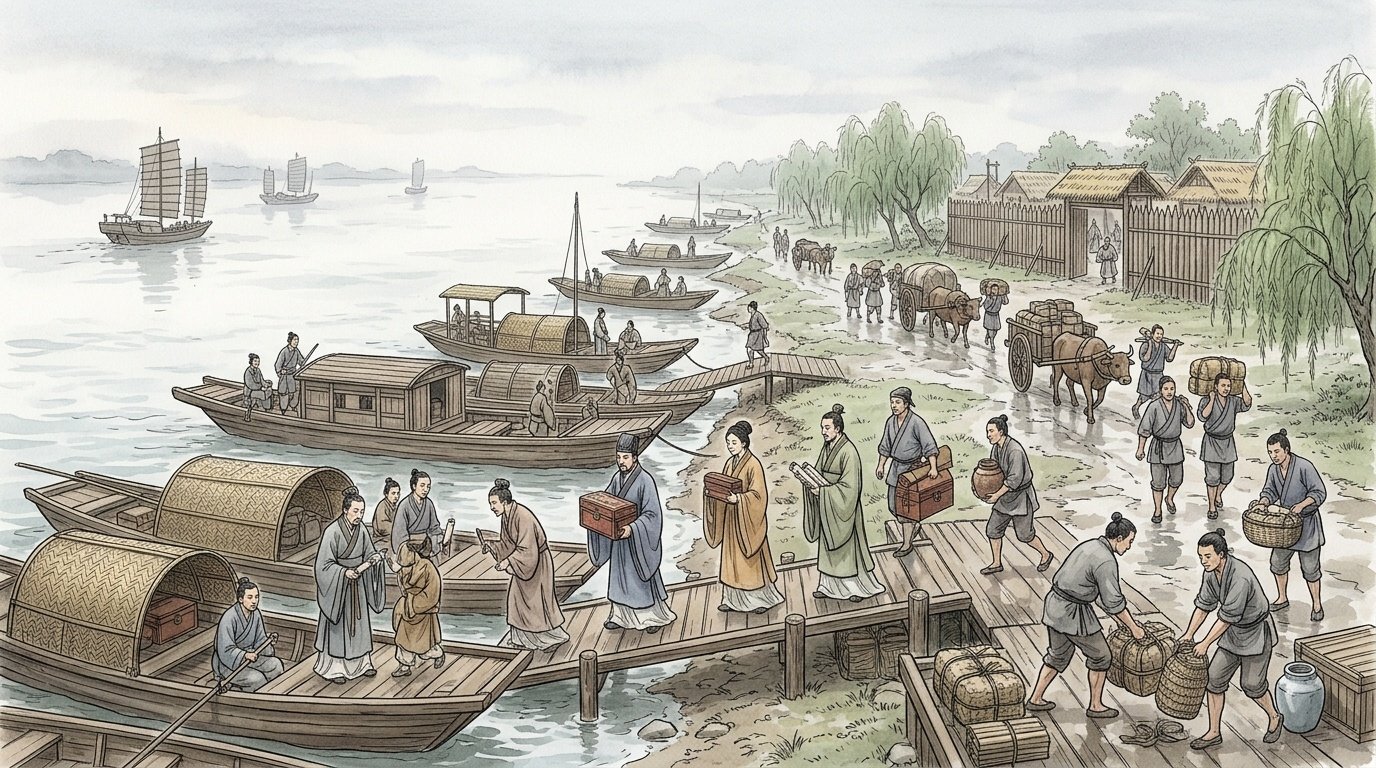
In the fourth lunar month of the fifth year of the Yongjia era (311 CE), the imperial capital of the Western Jin Dynasty (西晋, 265–316 CE), Luoyang (洛阳), fell into darkness, flame, and unspeakable butchery. The cavalry armies of the Han-Zhao state (汉赵), led by the Xiongnu commanders Liu Cong (刘聪), Liu Yao (刘曜), and the rebel general Shi Le (石勒), smashed through the city’s crumbling defenses. Over thirty thousand imperial officials, soldiers, scholars, and citizens were put to the sword. Emperor Huai of Jin (晋怀帝, Sima Chi 司马炽) was captured alive, stripped of his imperial regalia, and forced to pour wine for barbarian chieftains like an enslaved domestic servant before his inevitable execution by poison. The imperial ancestral temples were torched; the mausoleums of the sacred Sima lineage were ripped open and looted; the libraries of the imperial archives, preserving centuries of Han and Wei scholarship, were scattered as burning ash across the Central Plains (中原, Zhongyuan). It was a catastrophe of civilizational proportions, immortalized in the annals of Chinese historiography as the Disaster of Yongjia (永嘉之乱, Yongjia zhi Luan).
For more than four centuries, the fertile basin of the Yellow River had stood as the undisputed geopolitical, cultural, and spiritual core of the Chinese world. To be civilized was to reside within the cradle of the Central Plains, where the rites of the Duke of Zhou were codified and the imperial institutions of Qin and Han had forged a unified imperium. The catastrophic collapse of the Western Jin destroyed that ancient geographic certainty in a single violent decade. The Northern steppe nomadic federations—collectively remembered by later historians as the Five Barbarians (五胡, Wu Hu: Xiongnu, Xianbei, Jie, Di, and Qiang)—swept across northern China, inaugurating the chaotic, fragmented era of the Sixteen Kingdoms (十六国). In response to this existential terror, hundreds of thousands of aristocratic elites, imperial princes, bureaucratic officials, Buddhist monks, and peasant cultivators undertook an unprecedented mass migration across the Huai River and the great barrier of the Yangtze River (长江). This monumental flight of culture, lineage, and statecraft is known in Chinese collective memory as the Southward Flight of the Robes and Caps (衣冠南渡, Yiguan Nandu)—the robes and caps symbolizing the formal ceremonial garments and civilizational identity of the orthodox Han elite.
This exhaustive treatise examines the intricate causes, harrowing execution, and profound socio-economic consequences of the Disaster of Yongjia and the southward exodus. We will dissect the catastrophic internal implosion of the Sima imperial house during the War of the Eight Princes (八王之乱), which completely hollowed out the Western Jin military apparatus; the geopolitical dynamics of the barbarian invasions; the dramatic escape of Prince of Langya Sima Rui (司马睿) and his chief aristocratic architect Wang Dao (王导) to the southern capital of Jiankang (建康, modern Nanjing); the political compromise known as ‘Wang and Sima share the realm’ (王与马共天下); the complex legal and administrative mechanisms of refugee governance through ‘diaspora commanderies’ (侨置郡县) and color-coded residency registers (白籍与黄籍); the brutal social friction between northern refugee clans and indigenous southern gentry; and the enduring economic revolution that permanently shifted China’s demographic and commercial center of gravity southward to the Yangtze delta.
1. The Rot Within: Sima Yan’s Flawed Foundations and the War of the Eight Princes
The calamity of 311 CE did not arrive out of a clear sky; its seeds had been systematically planted fifty years earlier by the founder of the Western Jin Dynasty, Sima Yan (司马炎, Emperor Wu of Jin 晋武帝, r. 265–290 CE). Having seized the throne from the Cao Wei dynasty through dynastic usurpation in 265 CE and conquered the southern kingdom of Eastern Wu in 280 CE to achieve nominal national reunification, Sima Yan became obsessed with preventing the specific vulnerability that had doomed the Cao family. The founders of Cao Wei had ruthlessly disempowered, isolated, and surveilled their own imperial relatives, leaving the throne entirely undefended when the Sima clan orchestrated their palace coup during the Gaoping Tombs Incident (高平陵之变) in 249 CE. Determining that an emperor without powerful imperial kinsmen was uniquely vulnerable to aristocratic oligarchs, Sima Yan instituted a sweeping policy of feudal restoration (分封制). He ennobled dozens of Sima imperial princes, granting them sweeping territorial fiefdoms, independent civilian administrations, and massive regional military commands across the empire’s strategic frontiers.
To compound this structural vulnerability, Sima Yan issued the catastrophic demilitarization decree of 280 CE (州郡悉去兵, Zhoujun xi qu bing). Following the conquest of Wu, the emperor ordered that local prefectures and commanderies throughout the interior of China disband their municipal militias and surrender their weapons, believing this would eliminate the threat of local insurrections and encourage agrarian recovery. However, while civilian commanderies were left virtually defenseless, the imperial princes commanding border garrisons—such as Sima Lun (Prince of Zhao), Sima Jiong (Prince of Qi), Sima Yue (Prince of Donghai), and Sima Ying (Prince of Chengdu)—retained vast, professional armies. The balance of military power shifted irrevocably from the civilian central bureaucracy to ambitious, heavily armed princes of royal blood.
The catalyst that transformed this volatile constitutional structure into a nationwide slaughterhouse was the imperial succession. Sima Yan’s eldest surviving son, Sima Zhong (司马衷, Emperor Hui of Jin 晋惠帝, r. 290–307 CE), suffered from severe intellectual disability—remembered infamously in the Book of Jin (晋书, Jin Shu) for asking, upon hearing that starving peasants had no grain to eat, ‘Why do they not eat minced meat porridge?’ (何不食肉糜?). Into this power vacuum stepped Emperor Hui’s ambitious and ruthless empress, Jia Nanfeng (贾南风). Empress Jia systematically purged the Sima regents, murdered the Crown Prince Sima Yu, and governed through terror and nepotism. In 300 CE, the Prince of Zhao, Sima Lun, marched his garrison into the imperial palace, executed Empress Jia, and shortly thereafter forced Emperor Hui to abdicate, usurping the imperial throne for himself.
Sima Lun’s usurpation shattered the delicate facade of dynastic legitimacy and unleashed the devastating sixteen-year civil war known as the War of the Eight Princes (八王之乱, 291–306 CE). In an unrelenting cycle of betrayal, palace coups, and open battlefield massacres, rival Sima princes mobilized their private and regional armies against one another. The fighting devastated the core agricultural regions of Henan and Hebei. Cities were besieged and starved; irrigation dykes were demolished to flood opposing encampments; grain reserves were seized or incinerated. Crucially, as the fratricidal princes exhausted their domestic troops, they took the fatal step of inviting non-Han nomadic horse archers from the northern frontiers to serve as auxiliary mercenaries. Sima Ying enlisted the southern Xiongnu under Liu Yuan (刘渊); Sima Yue enlisted Xianbei cavalry under Murong Hui and Duan Wuwu; rival commanders unleashed the Jie horsemen under Shi Le. By bringing these hardened, battle-tested nomadic confederations directly into the political and military vortex of the Central Plains, the Sima princes exposed the utter military impotence and moral bankruptcy of the Jin imperium.
2. The Uprising of the Five Barbarians and the Fall of the Northern Capitals
For centuries since the Eastern Han dynasty, non-Han nomadic peoples had been systematically resettled inside the Great Wall within the northwestern frontiers of Shaanxi, Shanxi, and Gansu. These groups served as border buffers, tax-paying agricultural serfs, and imperial auxiliary cavalry. Over generations, millions of Xiongnu, Di, Qiang, and Xianbei lived in close proximity to Han administrative centers, frequently enduring brutal exploitation, debt slavery, and racial contempt at the hands of Jin bureaucratic officials and wealthy aristocratic landlords. A contemporary scholar and statesman, Jiang Tong (江统), had recognized this ticking demographic time-bomb as early as 299 CE, submitting his prophetic memorial Treatise on Expelling the Barbarians (徙戎论, Xi Rong Lun) to the Jin court:
「非我族类,其心必异,戎狄志态,不与华同……今五胡杂居,户口过半,苟遇间隙,必生变乱。宜及平世,遣还本邦,严设关防,以固封疆。」
— Jiang Tong (江统), Treatise on Expelling the Barbarians (徙戎论), Jin Shu, Chapter 56
‘Those who are not of our kind inevitably possess different hearts; the inclinations and sentiments of the Rong and Di are not identical to those of the Hua. Today, the Five Barbarians dwell intermingled among us, accounting for more than half of the households in our frontiers. If an opportunity arises, they will surely stir up insurrection. It is imperative, while the world is yet at peace, to send them back to their native regions, strictly fortifying the frontier passes to safeguard our borders.’
The Jin court, blinded by factional infighting, ignored Jiang Tong’s desperate warnings. When the War of the Eight Princes left northern China shattered, depopulated, and leaderless, the nomadic leaders seized their historical moment. In 304 CE, Liu Yuan (刘渊), a highly sinicized chieftain of the Southern Xiongnu who had studied the Confucian classics in Luoyang, proclaimed himself King of Han (汉王) and later Emperor, establishing the state of Han-Zhao. Liu Yuan claimed the Han imperial mantle by citing the ancient Western Han marital alliances (和亲, heqin) that had bound the Xiongnu Shanyu to the Liu imperial house, explicitly positioning his uprising as the legitimate restoration of the glorious Han dynasty.
Following Liu Yuan’s death, his formidable son Liu Cong (刘聪) unleashed a coordinated offensive targeting the heart of the Western Jin. By 311 CE, Luoyang was completely encircled. The paramount Jin commander, Sima Yue (Prince of Donghai), abandoned the capital with the bulk of the remaining imperial field army—over one hundred thousand soldiers and countless aristocratic families—hoping to establish a defensible base in the east. However, Sima Yue died of illness on the march in early 311 CE. Sensing vulnerability, the brilliant Jie cavalry general Shi Le pursued the leaderless funeral cortege. At Ningping City (宁平城, in modern Henan), Shi Le’s heavy cavalry trapped and annihilated the Jin host in one of the most lopsided massacres in ancient military history. Shi Le ordered his archers to surround the encircled throng and loose clouds of arrows until not a single soul remained standing. Over one hundred thousand soldiers, ministers, and elite clan members perished in a single morning, effectively eradicating the last standing field army of the Western Jin Empire.
With no army left to defend the capital, Luoyang fell without meaningful resistance in June 311 CE. The sacking of the capital was catastrophic. Liu Yao and Shi Le sacked the Grand Granary, set fire to the imperial palaces of Southern and Northern Courts, desecrated the imperial tombs, and massacred thirty thousand officials and scholars. Five years later, in 316 CE, the secondary western capital of Chang’an (长安) was similarly starved into surrender. Emperor Min of Jin (晋愍帝, Sima Ye 司马邺) surrendered to Liu Yao, undergoing the identical public humiliation as his predecessor before being murdered in 318 CE. The Western Jin Dynasty, which had briefly reunited the Chinese world under the Sima family, was completely and irreversibly extinguished across the northern plains.
3. The Great Exodus: The Logistics and Trauma of the Southward Flight
The collapse of imperial authority triggered one of the largest refugee migrations in global antiquity. Over a period extending across several decades from 307 CE to the mid-fourth century, an estimated one to two million people—roughly one-sixth to one-eighth of northern China’s total population—fled their ancestral homelands in the Yellow, Fen, and Huai river valleys to seek sanctuary south of the Yangtze River. This mass movement occurred in overlapping demographic waves, driven by terror, famine, and the breakdown of all civil order.
The exodus was profoundly class-stratified. For wealthy aristocratic lineages—such as the great clans of Langya Wang (琅邪王氏), Chenjun Xie (陈郡谢氏), Taiyuan Wang (太原王氏), Yingchuan Xun (颍川荀氏), and Longxi Li (陇西李氏)—the migration was an organized, militarized undertaking. These elite magnates mobilized their vast domestic retainers, tenant farmers, private house guards (部曲, buqu), and extensive extended kin networks into self-defending armed convoys. They loaded carts with bronze ceremonial vessels, scrolls of family genealogies, classic literary texts, gold bullion, and ancestral tablets, moving slowly along secure southern highways toward modern Anhui, Jiangsu, and Zhejiang. Their economic wealth and private armed forces allowed them to navigate bandit-infested mountain passes and secure prime agricultural territory upon arrival in the south.
For common peasant households, smallholders, and tenant serfs, however, the southward journey was an unmitigated humanitarian nightmare. Families fled on foot through scorched landscapes, carrying infant children and sacks of parched grain on their shoulders. Roads were lined with the corpses of those who had succumbed to starvation, typhus, and exposure. Contemporary accounts in the Zizhi Tongjian (资治通鉴) describe bands of starving refugees resorting to cannibalism, trading children to avoid eating their own offspring, and defending themselves with farm implements against predatory nomadic raiders and marauding bandits who roamed the central plains. Thousands drowned while attempting to cross swollen rivers like the Huai and the Yangtze in makeshift rafts or overloaded wooden skiffs.
Geographically, the refugee flow moved along three primary migration corridors determined by northern river basins and mountain passes:
| Migration Corridor | Point of Origin (North) | Transit Route & Passes | Southern Destination Basin | Primary Demographic Composition |
|---|---|---|---|---|
| Eastern Route (Coastal / Canal) | Shandong, Northern Jiangsu, Hebei | Along the Bian River (汴水) & ancient Grand Canal channels into Huaiyin | Lower Yangtze Delta: Jiankang (Nanjing), Jingkou (Zhenjiang), Wu Commandery (Suzhou) | Prominent aristocratic clans (Langya Wang, Chenjun Xie) & coastal peasant smallholders |
| Central Route (Huai / Ru Basin) | Henan (Luoyang, Xuchang), Southern Shanxi | Through Runan and the Dabie Mountains southward into the middle Yangtze | Jiangzhou (modern Jiangxi) & Ezhou (modern Wuhan, Hubei) | Bureaucratic officials, scholars, craftsmen, and displaced central plains peasantry |
| Western Route (Han River Corridor) | Shaanxi (Guanzhong / Chang’an), Gansu | Over the Qinling Mountains via Hanzhong down the Han River (汉水) | Jingzhou (Hubei) & Xiangyang, with branches continuing into Sichuan | Northern military garrisons, border populations, and Guanzhong farming clans |
This demographic influx fundamentally transformed the ethnic and linguistic landscape of southern China. Prior to the fourth century, the vast territories south of the Yangtze—traditionally referred to as Jiangnan (江南)—were sparsely populated, heavily forested, and inhabited by indigenous Yue (越) peoples, Wu-speaking natives, and lingering administrative networks from the fallen Eastern Wu state. Within a generation, the arrival of hundreds of thousands of Mandarin-speaking northern refugees introduced a dense, highly motivated labor force, advanced metallurgical and hydraulic technologies, and an unshakeable determination to recreate their lost civilization upon southern soil.
4. Sima Rui and Wang Dao: The Genesis of the Eastern Jin at Jiankang
The survival of the Jin imperial house in the south was largely the product of visionary political foresight by one man: Wang Dao (王导, 276–339 CE), the patriarch of the illustrious Langya Wang clan. Long before Luoyang fell to the Xiongnu, Wang Dao had recognized that the fratricidal carnage of the Eight Princes would inevitably destroy the northern imperium. In 307 CE, Wang Dao persuaded his close friend and patron, Sima Rui (司马睿, 276–327 CE)—the modest, unassuming Prince of Langya—to request an appointment as military commander of the Jiangnan region, establishing his headquarters at Jianye (建邺, modern Nanjing; later renamed Jiankang 建康 to avoid a taboo on Emperor Min’s personal name).
When Sima Rui arrived at Jiankang, his prospects appeared bleak. The local indigenous southern aristocracy—led by proud, ancient Jiangnan families such as the Gu (顾), Lu (陆), Zhu (朱), and Zhang (张) clans of Wu—regarded the Sima prince with cold suspicion and outright contempt. The Wu elites had not forgotten the humiliating conquest of their native state by Western Jin in 280 CE, nor were they eager to surrender their lands and local political autonomy to northern interlopers fleeing a disaster of their own making. For months, when Sima Rui held court, not a single prominent southern gentry lord deigned to pay him homage.
Wang Dao devised a brilliant piece of political theater to break the impasse. In the third lunar month of 308 CE, during the ancient spring Purification Festival (上巳节, Shangsi Jie), Wang Dao orchestrated a grand public procession through the streets of Jiankang. Wang Dao and his cousin, the renowned general Wang Dun (王敦), rode in grand ceremonial carriages immediately alongside Sima Rui’s palanquin, visibly displaying profound, submissive deference to the royal prince. Seeing two of northern China’s most illustrious aristocrats humbling themselves before Sima Rui, the watching southern elites were stunned. The great southern magnate Gu Rong (顾荣) and the statesman Ji Han (纪瞻) immediately recognized that this northern prince possessed genuine aristocratic backing and political utility. Persuaded by Wang Dao’s diplomatic charm and promises of power-sharing, Gu Rong and Ji Han led the southern gentry in formally swearing allegiance to Sima Rui.
Following the news of Emperor Min’s murder in Chang’an, Sima Rui formally ascended the throne in Jiankang in 318 CE as Emperor Yuan of Jin (晋元帝), inaugurating the Eastern Jin Dynasty (东晋, 317–420 CE). At the coronation ceremony, a revealing spectacle unfolded that came to define Eastern Jin governance. As Emperor Yuan ascended the elevated dragon throne, he took Wang Dao by the hand and invited him to sit beside him on the imperial dais, declaring:
「夫并理天下者,若天体之有二曜,卿与吾共之矣!」
— Emperor Yuan of Jin to Wang Dao, Jin Shu, Chapter 65
‘Those who govern all under heaven are like the two luminous bodies in the cosmos; you and I shall share this throne together!’
Although Wang Dao modestly declined to sit on the physical dais, the political reality was unmistakable. The contemporary populace coined a famous folk saying that summarized this unique constitutional reality: ‘Wang and Sima share the realm’ (王与马,共天下, Wang yu Ma, gong tianxia). The Eastern Jin was not an absolute monarchy centered upon an imperial autocrat; it was an aristocratic co-regency, an oligarchy where the Sima emperor functioned as a ceremonial figurehead whose legitimacy was preserved, financed, and defended by a coalition of powerful émigré noble houses.
5. ‘Wang and Sima Share the Realm’: The Aristocratic Co-Regency
The power structure forged by Wang Dao established a precedent that would dominate southern Chinese politics for the next two and a half centuries across the Eastern Jin and the subsequent Southern Dynasties (Song, Qi, Liang, and Chen). In this system, imperial authority was severely constrained by institutionalized aristocratic privilege, creating a political order that historians describe as elite consular government or aristocratic factional hegemony (门阀政治, Menfa Zhengzhi).
Under the division of labor orchestrated by the Langya Wang clan, Wang Dao managed the civil administration, court appointments, and diplomatic alliances as Prime Minister in Jiankang, while his cousin Wang Dun commanded the principal field armies and military garrisons stationed upstream along the Yangtze River at Wuchang (武昌, modern Ezhou/Wuhan). This dual civil-military stranglehold ensured that no imperial initiative could proceed without Wang approval. When Emperor Yuan later attempted to assert imperial independence by patronizing rival northern advisors such as Liu Wei (刘隗) and Diao Xie (刁协) and creating private imperial guard units, Wang Dun promptly mobilized his garrison armies in 322 CE and marched on Jiankang, defeating the imperial forces and slaughtering the emperor’s loyalist courtiers. Emperor Yuan was reduced to a weeping captive within his own palace, dying of humiliation and grief shortly thereafter.
Despite Wang Dun’s rebellion and subsequent demise, the fundamental structure of aristocratic dominance did not change; rather, leadership of the aristocratic coalition simply rotated among a small circle of prominent émigré clans. When the Langya Wang clan’s influence waned, the Taiyuan Wang (太原王氏), the Yingchuan Yu (颍川庾氏), the Huan clan of Qiao (谯国桓氏), and most famously the Chenjun Xie clan (陈郡谢氏) stepped into the breach. Political stability depended entirely upon maintaining an intricate balance of power between:
- The Imperial Sima Court: Providing indispensable ritual legitimacy, imperial titles, and the sacred lineage tracing back to the Han and Wei dynasties.
- The Capital Aristocrats (Civil Elite): Ministers such as Wang Dao and later Xie An (谢安) who orchestrated court politics, taxation policies, and cultural patronages in Jiankang.
- The Upstream Military Lords (Jingzhou Command): Warlords like Huan Wen (桓温) who controlled the strategic naval chokeholds and agricultural resources of the middle Yangtze.
- The Indigenous Southern Gentry: Landowners who controlled local estates, water rights, and agrarian labor in the fertile Wu commanderies around Lake Tai.
This decentralized, aristocratic equilibrium prevented the emergence of a tyrannical autocrat, but it also severely crippled the southern dynasty’s offensive military capacity. Whenever an ambitious general—such as Zu Ti (祖逖) or Huan Wen—launched a northern expedition to reclaim the ancestral Central Plains from nomadic rule, the aristocratic factions in Jiankang routinely withheld supplies, reinforcements, and political support, terrified that a victorious general returning with a triumphant northern army would overthrow the fragile balance of power and strip them of their southern privileges.
6. The Mechanics of Refugee Governance: Diaspora Commanderies and Residency Registers
One of the most complex institutional challenges confronting the Eastern Jin court was the administrative integration of hundreds of thousands of displaced northern refugees into a southern landscape that already possessed established local administrative boundaries and proprietary landholders. If the court simply dissolved the refugees into existing southern counties, it would provoke violent local rebellions from native southern magnates who resented the encroachment. Moreover, the proud northern aristocrats adamantly refused to be registered under indigenous southern registries, which would erase their prestigious ancestral pedigrees and subject them to local labor levies.
To resolve this explosive dilemma, the Eastern Jin administration devised one of the most remarkable legal and spatial fictions in administrative history: the establishment of Diaspora Commanderies and Counties (侨置郡县, Qiaozhi Junxian). Instead of forcing refugees to adopt southern geographic identities, the court created phantom administrative units bearing the exact names of northern prefectures, commanderies, and counties, transplanting them onto southern geography. For example, refugees fleeing from Langya Commandery (in modern Shandong) were settled near modern Zhenjiang, and their new settlement was officially designated as ‘South Langya’ (南琅邪). Displaced residents from Pinghe County in Henan were grouped together into a newly carved-out ‘Pinghe Diaspora County’ (侨平河县).
In many instances, these diaspora administrative units possessed no fixed geographic boundaries or territorial borders whatsoever; they existed entirely as legal jurisdictions attached to populations rather than land. A diaspora magistrate exercised administrative and judicial authority exclusively over the specific families registered from his ancestral northern hometown, even if their houses were intermingled among native southern homesteads. This legal fiction preserved the entire hierarchy of northern society: former northern magistrates retained their titles and government stipends, northern aristocratic clans preserved their hereditary authority over their traditional tenant populations, and the memory of northern ancestral geography was codified directly into the southern legal landscape.
To institutionalize this dual administrative universe, the court instituted a bifurcated system of household registration based on color-coded documents:
| Registration Register | Target Population | Taxation Status | Corvée Labor & Military Obligations | Social & Political Implications |
|---|---|---|---|---|
| White Registers (白籍, Baiji) | Northern Émigré Refugees (侨民) | Exempt from standard land taxes (租) and head taxes; paid nominal refugee duties | Strictly exempt from local municipal corvée labor (徭役); eligible for elite military units | Preserved high aristocratic prestige; created deep resentment among indigenous southerners |
| Yellow Registers (黄籍, Huangji) | Native Southern Population (土著) & Fully Naturalized Settlers | Subject to full, crushing imperial grain taxes, household cloth quotas, and property duties | Subject to mandatory annual corvée labor drafts, road building, and local guard duties | Second-class political status; native peasantry frequently sold themselves into white-register serfdom to evade taxes |
The White Registers (written on raw, unbleached white paper) granted northern refugees extraordinary fiscal immunities. Because they were legally classified as temporarily displaced persons residing away from their ancestral homes, they were excused from the grinding corvée labor drafts and heavy grain tributes that burdened the native southern population registered on Yellow Registers (yellow-dyed paper treated with cork tree extract to prevent insect damage). This fiscal disparity provoked immense structural tensions. Native southern peasants frequently abandoned their ancestral lands and sold themselves as private retainers (部曲, buqu) or tenant serfs to powerful northern aristocratic clans holding White Registers, thereby vanishing from the state’s tax rolls and depriving the imperial treasury of vital revenue.
7. North Versus South: Cultural Friction and Social Stratification
The sudden collision of two distinct regional cultures along the Yangtze generated profound social friction, linguistic alienation, and deep-seated mutual prejudice. To the aristocratic émigrés from Luoyang, the southern landscape was a wild, malarial, barbarian frontier. They viewed the native Wu aristocracy as uncouth provincial bumpkins who spoke an incomprehensible tongue sounding like the chattering of birds, consumed strange and unpalatable foodstuffs, and lacked proper mastery of Confucian court etiquette and high classical prose.
The indigenous southern aristocracy returned this contempt with fierce bitterness. Ancient families like the Lu, Gu, and Zhou of Jiangnan prided themselves on their own deep lineages, their proud military heritage from the Three Kingdoms era, and their generous financing of the new regime. They deeply resented being relegated to secondary political offices while arrogant northern refugees monopolized the top cabinet ministries, commanded the military forces, and enjoyed extensive tax exemptions on lands carved out of the southern patrimony. A famous historical anecdote in the Shishuo Xinyu (世说新语, A New Account of the Tales of the World) captures the acute cultural anxiety and culinary competition between northern and southern elites during a dinner hosted by Wang Dao for the southern scholar Lu Ji (陆机):
「王导尝谓陆玩曰:’卿吴人,何以不作吴语?’玩曰:’愿公为主人,幸勿强其所不能。’又陆机诣王武子,武子为设羊酪,指以示机曰:’卿江东何以敌此?’机曰:’千里莼羹,未下盐豉!’」
— Shishuo Xinyu (世说新语), Chapter: “Yanyu” (Words and Speech)
‘Wang Dao once said to Lu Wan: “You are a man of Wu; why do you not speak the Wu tongue?” Lu Wan replied: “I hope your Excellency, as the host, will not force someone to do what they cannot.” Furthermore, when Lu Ji visited Wang Wuzi, Wang laid out rich sheep milk curd (yogurt), pointed to it, and said to Lu: “What in your Jiangdong can rival this?” Lu Ji replied: “The water-shield soup (chungen) of Qianli, requiring not even fermented salted black beans to surpass it!”‘
This culinary duel between northern sheep’s curd (representing the pastoral-agrarian culture of the Yellow River) and southern water-shield soup (celebrating the delicate, aquatic flora of Jiangnan’s lakes) symbolized a much broader civilizational confrontation. Northern elites took extraordinary measures to maintain their distinct linguistic and genealogical purity. They rigidly cultivated the prestigious ‘Luoyang Speech’ (洛阳正音), the standard court dialect of the Western Jin, treating it as the sole auditory hallmark of civilized Han identity. Even generations after migrating south, aristocratic families who spoke the local Wu dialect in private domestic settings were expected to conduct all public discourse, literary composition, and court debate exclusively in the pristine phonetics of ancient Luoyang.
This linguistic segregation was reinforced by extreme marriage endogamy. The top-tier northern clans (such as the Langya Wang, Chenjun Xie, and Yingchuan Xun) established exhaustive genealogical registers known as Clan Genealogies (氏族志, Shizu Zhi). Intermarriage between high-ranking northern émigré families and indigenous southern gentry was strictly shunned, and marriage to commoners was an unforgivable social transgression punishable by permanent expulsion from the aristocracy. Through these rigid social boundaries, the émigré elite maintained an exclusive caste system, preserving their political hegemony across multiple generations.
8. The Tears at Xinting: Nostalgia and the Myth of Northern Recovery
Despite their privileged lifestyle in the comfortable mansions of Jiankang and their scenic villas along the Qinhuai River (秦淮河), the émigré aristocrats were consumed by intense psychological melancholy and homesickness for their lost ancestral heartland. Cut off from the ancient imperial tombs of their ancestors and living on what they regarded as borrowed southern soil, the northern scholars frequently gathered on the southern hills outside Jiankang to gaze across the misty waters of the Yangtze toward the north.
One of the most poignant and famous moments in Chinese cultural memory occurred at a scenic overlook known as Xinting (新亭, the New Pavilion), located just south of Jiankang along the riverbank. During a warm spring gathering of northern scholars and officials, the profound emotional weight of their collective displacement suddenly overwhelmed the assembly. The incident, recorded in the Shishuo Xinyu and later preserved in the Zizhi Tongjian, gave birth to the enduring historical idiom ‘The Tears of Xinting’ (新亭对泣, Xinting duiqi):
「过江诸人,每至美日,辄相携及新亭,藉卉饮宴。周顗中坐而叹曰:’风景不殊,正自有山河之异!’皆相视流涕。唯王丞相愀然变色曰:’当共戮力王室,克复神州,何至作楚囚相对泣邪!’皆收泪谢之。」
— Shishuo Xinyu (世说新语), Chapter: “Yanyu” (Words and Speech)
‘The dignitaries who had crossed the river would, on every fine day, accompany one another to Xinting, sitting upon the grassy turf to drink and banquet. Zhou Yi sat among them and sighed, saying: “The scenery does not differ from that of old, yet what lies before us is an alien landscape of mountains and rivers!” Thereupon, everyone looked at one another and wept openly. Only Prime Minister Wang [Dao] grimly changed his expression and said sternly: “We ought to unite our strength for the Imperial House and reclaim the Divine Land; why must we act like the prisoners of Chu, weeping helplessly facing one another!” At this, they all dried their tears and apologized.’
Wang Dao’s fierce rebuke—invoking the ancient historical trope of the ‘Prisoner of Chu’ (楚囚), who sat helpless in chains weeping for his lost kingdom—rallied the flagging spirits of the court. Reclaiming the ‘Divine Land’ (克复神州, kefu Shenzhou) became the official state ideology and sacred moral justification for the Eastern Jin’s continued existence. Every emperor, upon taking the throne, was ritually bound to swear an oath to lead an expedition north to restore the ancestral tombs at Luoyang and liberate the Chinese populace from barbarian subjugation.
Yet in practice, this grand ideology of Northern Expedition (北伐, Beifa) was riddled with profound political hypocrisy. The Jiankang aristocracy quickly recognized that actual northern campaigns were immensely hazardous to their own domestic power. A successful reconquest of northern China would mean returning to a ruined, desolate landscape where their ancient estates had been destroyed, while empowering military commanders whose victorious field armies could easily dismantle aristocratic hegemony in Jiankang. Consequently, while generals like Zu Ti (祖逖) fought with desperate courage across Henan, striking the oars of his boat in the middle of the river and vowing to die before retreating without victory, the court persistently starved his army of weapons, grain, and reinforcements. Zu Ti died of heartbreak and frustration in 321 CE, his territorial gains rapidly evaporating. For the vast majority of the Jiankang elite, Northern Recovery remained a romantic rhetorical posture and literary metaphor, celebrated in melancholy poetry while they comfortably entrenched themselves in the luxurious estates of the south.
9. Economic Metamorphosis: The Agrarian and Commercial Transformation of Jiangnan
While the southward migration originated in catastrophe and human suffering, its long-term economic consequence was nothing short of revolutionary. Prior to the fourth century, agricultural development in southern China lagged centuries behind the North. The region was characterized by primitive slash-and-burn farming techniques (火耕水耨), low population densities, dense subtropical swamps, and acid-heavy soils. The influx of over a million northern migrants provided precisely the demographic critical mass and technological capital required to unlock the immense agrarian potential of the Yangtze river basin.
The northern migrants brought with them advanced agricultural technologies developed over centuries in the dry farming regions of the Yellow River, adapting them ingeniously to the wet-rice ecosystem of the south. Crucial innovations included:
- Deep-Plowing Cattle Harnesses and Curved Cast-Iron Plowshares: Enabling farmers to break through the heavy, clay-rich wetland soils of the Yangtze delta, aerating the earth and allowing deeper root penetration for high-yield cultivars.
- Sophisticated Water Conservancy and Polder Systems (圩田, Weitian): Migrant engineers constructed vast networks of protective earthen embankments, sluice gates, and drainage canals around marshes and lakes like Lake Tai (太湖) and Lake Poyang (鄱阳湖). These polder dikes transformed hazardous floodplains into extraordinarily fertile, highly regulated paddy fields.
- Double-Cropping and Crop Rotation Cycles: Introducing winter wheat and barley rotations into the traditional single-crop southern rice cycle, doubling annual caloric yields per acre of arable land.
- Hydraulic Machinery: Widespread deployment of dragon-bone foot pumps (翻车) and waterwheels for efficient irrigation, alongside water-powered millstones for processing grain at unprecedented scales.
The economic impact of this agricultural boom is vividly documented in the Book of Song (宋书, Song Shu), compiled by the fifth-century historian Shen Yue (沈约). Describing the spectacular prosperity of Jiangnan during the subsequent Liu Song dynasty (420–479 CE), Shen Yue wrote:
「江南之为国盛矣……地广野丰,民勤本业,一岁或稔,则数郡忘饥。会土带海傍湖,良畴亦数十万顷,膏腴上地,亩值一金……荆城街冲,极槅数百,丝绵布帛之饶,覆衣天下。」
— Shen Yue (沈约), Book of Song (宋书), Chapter 54
‘Jiangnan as a realm has achieved absolute prosperity… Its territories are broad and its fields are bountiful; the populace toils diligently in fundamental agrarian labor. If a single year yields a harvest, then multiple commanderies forget all hunger. The lands of Kuaiji bordered by sea and hugging lakes possess hundreds of thousands of qing of fertile fields; their rich, prime soil is worth a catty of gold per mu… The streets and thoroughfares of the provincial cities are packed with hundreds of warehouses; the abundance of silk, cotton, cloth, and hemp is sufficient to clothe all under heaven.’
In tandem with this agrarian explosion came an unprecedented surge in commercial urbanization. Jiankang transformed from a modest regional garrison town into one of the largest metropolises in the ancient world, boasting a population exceeding one million inhabitants by the early sixth century. The city became a bustling global hub of maritime and riverine trade. Merchant fleets sailed upstream carrying timber, grain, and copper from Jingzhou and Sichuan, while ocean-going junks docked at the ports of modern Ningbo and Guangzhou, transporting silk, paper, celadon porcelain, tea, and spices to Korea, Japan, the kingdoms of Southeast Asia, and India. The Disaster of Yongjia had inadvertently catalyzed the irreversible southward shift of China’s economic center of gravity—a fundamental geopolitical reality that would culminate centuries later during the Tang and Song dynasties.
10. Cultural Renaissance: Xuanxue, Calligraphy, Landscape Poetry, and Southern Buddhism
Transplanted into the lush, mountainous landscapes of the south and freed from the rigid moral orthodoxies of the Han dynasty court, the émigré intelligentsia ignited one of the most brilliant cultural renaissances in Chinese civilization. Stripped of their ancestral homeland and acutely aware of the fragility of human existence, scholars turned away from dry Confucian scholasticism toward introspective philosophy, radical aesthetic innovation, and spiritual exploration.
The intellectual movement known as Neo-Daoist Mystery Learning (玄学, Xuanxue) reached its philosophical apex in southern salons. Aristocrats engaged in elaborate sessions of Pure Conversation (清谈, Qingtan), competing with one another in philosophical debates using flying whisk feather brushes (麈尾), deconstructing metaphysical concepts of Being (有) and Non-Being (无) drawn from the Daodejing, the Zhuangzi, and the I Ching. This intellectual climate fostered an unprecedented celebration of individual genius, emotional authenticity, and eccentric freedom from societal convention.
In the arts, the Eastern Jin produced masterpieces that permanently defined the aesthetics of Chinese high culture:
- The Golden Age of Calligraphy: Led by Wang Xizhi (王羲之, 303–361 CE)—the nephew of Wang Dao—and his son Wang Xianzhi (王献之). In 353 CE, at the Orchid Pavilion Gathering (兰亭雅集) near Kuaiji (Shaoxing), Wang Xizhi composed the legendary Preface to the Poems Collected from the Orchid Pavilion (兰亭集序, Lantingji Xu). His dynamic, floating running script (行书)—described as ‘soaring like a startled dragon and graceful as a swimming swan’—elevated Chinese calligraphy from practical bureaucratic recording into the supreme vehicle of personal emotional expression.
- The Birth of Landscape Poetry (山水诗) and Pastoral Literature: Transfixed by the dramatic topography of southern rivers, gorges, and mist-veiled peaks, poets broke away from formalistic court eulogies. Xie Lingyun (谢灵运, 385–433 CE) pioneered landscape poetry, meticulously recording the spiritual rhythms of nature, while Tao Yuanming (陶渊明, 365–427 CE) renounced bureaucratic office to live as a reclusive farmer, penning immortal verses on pastoral tranquility and authoring the mythical allegory The Peach Blossom Spring (桃花源记).
- Figure and Landscape Painting: Gu Kaizhi (顾恺之, c. 344–406 CE) established the theoretical foundations of Chinese classical painting with his principle of ‘transmitting the spirit through the form’ (以形写神). His masterworks, such as the Admonitions of the Court Instructress (女史箴图) and the Nymph of the Luo River (洛神赋图), combined sweeping, lyrical brushlines with profound narrative emotion.
- The Sinicization of Buddhism: Southern China became the great incubator of a distinctly Chinese Buddhist tradition. Prominent northern refugee monks, such as Dao’an (道安) and Huiyuan (慧远), established monastic centers at Mount Lu (庐山). Huiyuan formed close friendships with Confucian and Daoist intellectuals, founding the Pure Land Buddhist tradition (净土宗) and successfully defending monastic autonomy from imperial control in his groundbreaking treatise A Monk Does Not Bow Down to a King (沙门不敬王者论).
Far from being a pathetic, hollow exile, the civilization built by the émigrés at Jiankang became a sparkling beacon of high culture that preserved, refined, and fundamentally expanded the philosophical and artistic boundaries of the Chinese identity.
11. Institutional Evolution: The Decline of Diaspora Commanderies and the Great Amalgamation
As the fourth century turned into the fifth, the legal and spatial fiction of Diaspora Commanderies (侨置郡县) and White Registers (白籍) became increasingly unsustainable. Decades had passed since the catastrophe of Yongjia. The original generation of refugees who had fled the Central Plains had grown old and died. Their children and grandchildren had been born on southern soil; they spoke with southern accents, owned southern lands, and had never set foot within the ruined gates of Luoyang or Chang’an. Yet legally, they remained classified as transient northern guests, exempt from the crushing taxes and military duties that fell entirely upon native southern households.
This dual administrative structure crippled the financial base of the southern state. With the imperial court desperately needing grain revenues and conscript labor to fend off aggressive northern empires—such as the emerging Xianbei Northern Wei (北魏)—successive southern administrations were forced to dismantle the refugee privileges through a series of radical fiscal reforms known as Tuduan (土断), meaning ‘Territorial Regularization’ or ‘Settlement According to Soil’.
The most decisive and famous of these reforms was the Gengxu Territorial Regularization (庚戌土断) executed in 364 CE by the formidable general and de facto regent Huan Wen (桓温). Huan Wen abolished dozens of redundant, overlapping diaspora commanderies and counties. He declared that with the exception of a few supreme aristocratic lineages, all residents living within southern borders—regardless of their ancestral northern heritage—were legally stripped of their White Registers and reassigned to standard Yellow Registers based upon their actual geographical residence (按土断名, an tu duan ming).
Huan Wen enforced this policy with ruthless military efficiency. Aristocratic magnates who concealed refugee tenant households or resisted registration were arrested and executed, including members of imperial and ducal houses. The result was a dramatic fiscal triumph for the central state: tens of thousands of hidden households and hundreds of thousands of acres of private aristocratic land were restored to the imperial tax registers. More importantly, Tuduan marked the formal, legal end of the refugee era. Northern émigrés and indigenous southerners were legally amalgamated into a single tax-paying populace, solidifying the institutional reality that the southern dynasty was no longer a temporary government-in-exile, but an enduring, sovereign state rooted firmly within the soil of the Yangtze.
12. Historiographical Debate and Legacy: The Preservation and Division of Hua-Xia
The Disaster of Yongjia and the Southward Flight of the Robes and Caps have stood for over sixteen centuries at the center of intense philosophical and historiographical debate regarding the nature of Chinese cultural continuity, dynastic legitimacy, and ethnic identity.
Traditional Song Dynasty neo-Confucian historians, led by Sima Guang (司马光) in the Zizhi Tongjian and Zhu Xi (朱熹), viewed the Eastern Jin as the sole legitimate carrier of the orthodox Mandate of Heaven (正统, Zhengtong) during the period of division. In this orthodox framework, even though the Eastern Jin occupied only a fraction of China’s total territory, it preserved the unbroken ceremonial continuity of the Son of Heaven, the sacred literary tradition of the classics, the formal rituals of the ancestral temples, and the pedigree of the Han bureaucratic elite. To these traditional moralists, the northern Sixteen Kingdoms—regardless of their military prowess or sinicized administrative structures—were illegitimate barbarian usurpations (伪朝, Wei Chao) that lacked moral mandate.
Modern twentieth- and twenty-first-century historians, pioneered by scholars such as Chen Yinke (陈寅恪) in his seminal masterwork Draft Brief Treatise on the Origins of the Sui-Tang System (隋唐制度渊源略论稿) and Outline of the Political History of the Tang Dynasty (唐代政治史述论稿), offer a far more nuanced and dialectical interpretation. Chen Yinke demonstrated that the survival and ultimate reconstitution of Chinese civilization was not an exclusive achievement of the southern refugee court, but rather the result of a profound, dual-engine historical dynamic:
- The Southern Civilizational Arc: The Eastern Jin and Southern Dynasties at Jiankang functioned as a cultural incubator, preserving ancient classical literature, philology, ritual music, fine arts, and calligraphic traditions from steppe destruction, while simultaneously executing the economic colonization and agricultural development of the southern subcontinent.
- The Northern Institutional Arc: Meanwhile, across the war-torn Central Plains, the intense interaction and intermarriage between non-Han steppe elites and entrenched Han local gentry—culminating in the Guanlong Aristocratic Group (关陇集团) and the radical Sinicization reforms of Emperor Xiaowen of Northern Wei—forged a formidable, martial, highly centralized hybrid institutional model. This northern synthesis combined steppe cavalry power with Chinese bureaucratic statecraft, equal-field agrarian distribution, and the Fubing militia system.
When the Sui Dynasty (隋朝) under Yang Jian finally conquered the southern capital of Jiankang in 589 CE, achieving national reunification after nearly three centuries of division, it was these two complementary streams of civilization that reunited. The southern refugee culture bequeathed to the reunited empire its refined legal codes, its exquisite literary and artistic heritage, and the immense agrarian wealth of the newly developed Yangtze delta. The northern martial culture provided the iron bureaucratic discipline, military organization, and expansive geopolitical ambition that propelled the Sui and Tang dynasties into a golden age of cosmopolitan Eurasian empire.
The Disaster of Yongjia began as a nightmare of catastrophic violence, dynastic obliteration, and humiliating exile. Yet through the resilience of its displaced millions and the political compromise of the Eastern Jin, that tragedy was transmuted into an epochal expansion of the Chinese civilizational sphere. By forcing China to rebuild itself upon the shores of the Yangtze, the Southward Flight ensured that Hua-Xia civilization would never again be vulnerable to destruction from a single blow in the North, forever cementing the dual-river reality of the Chinese world.
13. Chronology of the Disaster of Yongjia and the Southward Exodus
| Year (CE) | Historical Event | Key Historical Figures | Significance & Impact |
|---|---|---|---|
| 280 | Conquest of Eastern Wu by Western Jin; Demilitarization Decree | Sima Yan (Emperor Wu of Jin) | Brief national reunification; provincial militias disbanded, sowing future military defenselessness |
| 290–291 | Death of Sima Yan; Ascension of disabled Emperor Hui; Coup of Empress Jia | Emperor Hui, Empress Jia Nanfeng | Imperial authority collapses; triggers violent aristocratic palace feuds |
| 291–306 | War of the Eight Princes (八王之乱) | Sima Lun, Sima Jiong, Sima Yue, Sima Ying | Sixteen years of fratricidal war destroys imperial field armies; nomadic auxiliaries invited into heartland |
| 304 | Proclamation of Han-Zhao State; Rise of Five Barbarians | Liu Yuan, Shi Le | Nomadic confederations establish independent kingdoms across northern China; start of Sixteen Kingdoms |
| 307 | Sima Rui and Wang Dao arrive in Jiankang (Nanjing) | Sima Rui (Prince of Langya), Wang Dao | Strategic relocation of southern command; laying political foundation for the Eastern Jin |
| 311 (4th–6th Mo.) | Massacre of Ningping City and Disaster of Yongjia (永嘉之乱) | Shi Le, Liu Cong, Emperor Huai, Sima Yue | Sima field army eradicated; Luoyang falls; 30,000 massacred; Emperor Huai captured; mass exodus begins |
| 316 | Fall of Chang’an; Extinction of Western Jin Dynasty | Emperor Min, Liu Yao | Chang’an starved into surrender; Western Jin completely extinguished in the North |
| 318 | Ascension of Emperor Yuan; Establishment of Eastern Jin | Emperor Yuan (Sima Rui), Wang Dao | Official founding of Eastern Jin at Jiankang; era of ‘Wang and Sima share the realm’ begins |
| 321–322 | Death of Zu Ti; Rebellion of Wang Dun | Zu Ti, Wang Dun, Emperor Yuan | Northern expedition abandoned; aristocratic hegemony defeats attempt at imperial centralization |
| 353 | Orchid Pavilion Gathering (兰亭雅集) | Wang Xizhi, Xie An | Composition of Lantingji Xu; aesthetic zenith of southern émigré calligraphic culture |
| 364 | Gengxu Territorial Regularization (庚戌土断) | Huan Wen | Abolition of white registers; institutional assimilation of northern émigrés into southern soil |
| 383 | Battle of Fei River (淝水之战) | Xie An, Xie Xuan, Fu Jian | Southern aristocratic armies crush Former Qin invasion, permanently preserving southern independence |
| 589 | Sui Conquest of Chen; Reunified Imperium | Yang Jian (Emperor Wen of Sui) | End of 278 years of North-South division; fusion of northern martial systems with southern culture |
14. Scholarly Bibliography and Primary Historical Sources
To substantiate the institutional, economic, and sociopolitical analyses presented in this study, the following primary sources and scholarly monographs are essential reading for researchers of the Six Dynasties period:
- Fang Xuanling (房玄龄) et al. (comp. 648 CE), Book of Jin (晋书, Jin Shu): The official Twenty-Four Histories chronicle of the Western and Eastern Jin dynasties. Crucial biographical chapters include the Basic Annals of Emperor Wu (Vol. 3), Emperor Hui (Vol. 4), Emperor Huai and Min (Vol. 5), Emperor Yuan (Vol. 6), and the biographies of Wang Dao (Vol. 65), Wang Dun (Vol. 98), Sima Yue (Vol. 59), Jiang Tong (Vol. 56), and Liu Yuan / Liu Cong (Vols. 101–102).
- Liu Yiqing (刘义庆, 403–444 CE), A New Account of the Tales of the World (世说新语, Shishuo Xinyu): The indispensable literary anthology capturing the private conversations, behavioral mannerisms, witty repartees, and psychological anxieties of the Eastern Jin aristocratic elite, annotated extensively by Liu Xiaobiao (刘孝标).
- Shen Yue (沈约, comp. 493 CE), Book of Song (宋书, Song Shu): Provides essential economic, demographic, and institutional documentation of southern colonization, notably the Treatise on Geography (州郡志) and Treatise on Food and Money (食货志) detailing the Gengxu Tuduan and polder reclamation.
- Sima Guang (司马光, comp. 1084 CE), Comprehensive Mirror in Aid of Governance (资治通鉴, Zizhi Tongjian): Volumes 83 through 91 provide the definitive, chronological narrative analysis of the War of the Eight Princes, the fall of Luoyang, and the establishment of Eastern Jin.
- Chen Yinke (陈寅恪, 1944), Draft Brief Treatise on the Origins of the Sui-Tang System (隋唐制度渊源略论稿) & Outline of the Political History of the Tang Dynasty (唐代政治史述论稿): Foundational twentieth-century historiographical works analyzing the dual evolution of northern institutional militarism and southern cultural-economic preservation.
- Tian Yuqing (田余庆, 1989), The Politics of Aristocratic Lineages in Eastern Jin (东晋门阀政治): The seminal modern Chinese historical monograph deconstructing the shifting power balances between the imperial Sima house and the major aristocratic consort clans (Langya Wang, Yingchuan Yu, Qiaoguo Huan, Chenjun Xie).
- Tang Changru (唐长孺, 1955), Essays on the History of the Wei, Jin, and Southern and Northern Dynasties (魏晋南北朝史论丛): Groundbreaking socio-economic studies examining the mechanics of Qiaozhi Junxian, White and Yellow Registers, and the transition of refugees into aristocratic tenant serfs.
- Graff, David A. (2002), Medieval Chinese Warfare, 300–900, Routledge: Masterful military analysis of the tactical developments during the Disaster of Yongjia, the rise of heavily armored nomadic cavalry, and the logistics of riverine warfare along the Yangtze.
- Holcombe, Charles (2001), The Genesis of East Asia: 221 B.C. – A.D. 907, University of Hawaii Press: Illuminating investigation into the southward spread of Sinic civilization and the formation of a broader East Asian cultural sphere during the Six Dynasties migration.
- Ebrey, Patricia Buckley (1978), The Aristocratic Families of Early Imperial China: A Case Study of the Po-ling Ts’ui Family, Cambridge University Press: Pioneering English-language study of Chinese aristocratic lineage dynamics, genealogical purity, and the social mechanisms of elite survival across dynastic collapse.