The Seven Sages of the Bamboo Grove and Neo-Daoist Xuanxue
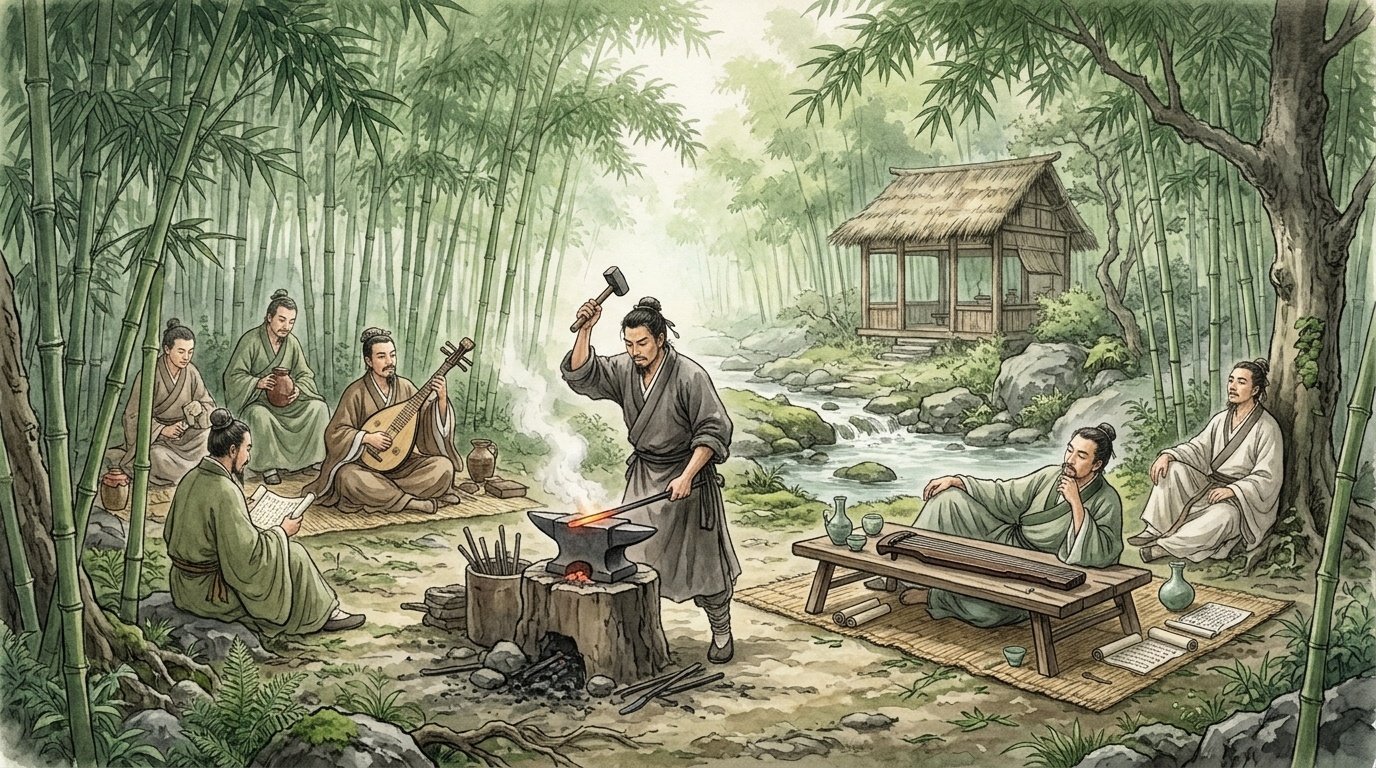
In the middle of the third century CE, in the shadow of the Taihang Mountains near modern Jiaozuo in Henan province, a grove of tall, whispering green bamboo became the spiritual sanctuary for seven of the most brilliant, eccentric, and tormented minds in human history: the Seven Sages of the Bamboo Grove (Zhulin Qixian, 竹林七賢). Surrounding them was an empire gripped by white terror. The blood-drenched transition from the Kingdom of Wei to the Jin Dynasty—orchestrated by the calculating Sima clan through assassinations, palace coups, and the judicial extermination of entire aristocratic families—had transformed Chinese political life into a lethal theatre of paranoia. Hypocritical Confucian moralizing was weaponized by the state to execute dissidents under the pretext of unfilial impiety. Rejecting this corrupt charade, the Seven Sages turned to wine, ecstatic music on the seven-stringed zither (qin), deliberate public madness, and the metaphysical philosophy of Xuanxue (玄學)—Neo-Daoism or “Dark Learning.” Led by the peerless poet-blacksmith Ji Kang (Xi Kang) and the melancholy visionary Ruan Ji, they engaged in the sublime art of “Pure Conversation” (Qingtan), defending the radical supremacy of Naturalness (Ziran) against the artificial hypocrisies of Moral Teaching (Mingjiao). When Ji Kang was condemned to the execution ground in 262 CE, he asked for his zither, plucked the immortal Melody of Guangling before three thousand weeping students, and stepped calmly onto the block. The Seven Sages left to world culture the eternal archetype of the intellectual fighting totalitarian conformity with metaphysical wit, aesthetic purity, and the freedom of the individual soul.
1. The Terror of the Sima Usurpation: Blood at the Gaoping Tombs (249 CE)
To understand the eccentric, desperate behavior of the Seven Sages of the Bamboo Grove, one must first confront the suffocating, lethal political climate of third-century China. Following the death of Cao Cao in 220 CE and the establishment of the Kingdom of Wei, power in northern China was fiercely contested between two elite factions: the ruling Cao imperial clan (allied with the cultural vanguard of poets and free-thinkers) and the ultra-conservative aristocratic gentry led by the formidable patriarch Sima Yi.
On a freezing morning in the first month of 249 CE, the simmering factional struggle erupted in an explosion of judicial slaughter: the Gaoping Tombs Incident (Gaopingling Zhi Bian, 高平陵之變). While the young Wei Emperor Cao Fang and his regent Cao Shuang were visiting the imperial mausoleum outside the capital of Luoyang, the seventy-year-old Sima Yi staged a sudden, meticulously planned military coup. Feigning near-death senility for years—trembling with palsy and spilling medicinal porridge down his chest to fool royal spies—Sima Yi suddenly rose from his bed, mobilized his private retainers, seized the imperial armory, barred the gates of Luoyang, and presented the court with an ultimatum.
Promising Cao Shuang on his ancestral honor and the sacred waters of the Luo River that his life and property would be spared if he surrendered his military command, Sima Yi induced the regent to capitulate. The moment Cao Shuang surrendered his seals, Sima Yi executed the most ruthless purge in early medieval history. Sima Yi violated his sacred oath without a second thought: Cao Shuang, his brothers, his ministers, his advisors, and their entire extended families down to three degrees of kinship—including the brilliant Legalist-Daoist philosopher He Yan—were arrested, dragged into the marketplace of Luoyang, and decapitated. More than five thousand aristocratic elites were exterminated in a single week.
What followed under Sima Yi and his sons, Sima Shi and Sima Zhao, was a permanent reign of terror. In 260 CE, when the young Emperor Cao Mao attempted a desperate palace counter-coup, Sima Zhao’s henchman Jia Chong ordered imperial guards to spear the sitting Son of Heaven to death in the public street. To legitimize their impending usurpation, the Sima family adopted an ideology of aggressive, hypocritical Filial Confucian Moralism (Xiao Dao). The court proclaimed that filial piety was the supreme test of human virtue, using accusations of “unfilial conduct” as a universal, convenient legal pretext to execute any intellectual who refused to collaborate with their usurping regime. Intellectual life was choked with terror; a stray word spoken in a tavern, an ironic sigh at a banquet, or an imperfect bowing gesture at a funeral could bring the executioner’s broadsword down upon a scholar’s neck. As the contemporary chronicle Jinshu recorded with chilling brevity: “In the era of the Sima regency, the great scholars of the realm walked with their heads down, terrified that each day would be their last; none dared to speak of political affairs.”
2. The Intellectual Revolution: The Collapse of Han Orthodoxy and the Rise of Xuanxue
This political horror coincided with a profound, irreversible intellectual revolution. During the four centuries of the Han dynasty, imperial thought had been dominated by an immense, rigid, and dogmatic system of Correlative Confucianism, formulated by scholars like Dong Zhongshu. In this Han cosmological synthesis, human morality, imperial government, and the natural cosmos were linked through rigid correspondences of the Five Elements, Yin and Yang, portents, and solar eclipses. Classics were read through endless, pedantic scholastic commentaries (Zhangju)—scholars spent entire lifetimes analyzing the placement of a single punctuation mark in the Rites of Zhou, while moral virtue was reduced to the performative, hypocritical display of expensive mourning rituals.
When the Han dynasty collapsed into the apocalyptic carnage of the Yellow Turban Rebellion and the Three Kingdoms warlord era, this entire cosmological architecture collapsed with it. How could an educated intellectual believe that Heaven rewarded virtue and punished wickedness when the noble perished in ditches while ruthless warlords like Cao Cao and Sima Yi dominated the earth? Han Confucianism had failed to explain human suffering, failed to preserve the state, and failed to provide spiritual peace to the individual soul.
Out of this existential vacuum was born the philosophical movement known as Xuanxue (玄學)—traditionally translated as “Dark Learning,” “Neo-Daoism,” or “The Mystery Learning.” The term was derived from the opening chapter of Laozi’s Daodejing: “Mysterious and yet more mysterious, the gateway to all wonders” (玄之又玄,眾妙之門). Xuanxue was an audacious attempt to strip away the suffocating, pedantic moralizing of Han scholasticism and return to the primary, fundamental ontological questions of reality: What is the ultimate ground of existence? What is the relationship between the natural cosmos and human social order? How can a human being preserve their moral and physical integrity in a murderous world?
The philosophical fountainhead of this revolution was the tragic intellectual prodigy Wang Bi (王弼, 226–249 CE), who died of illness at the age of twenty-three. Wang Bi revolutionized Chinese philosophy by composing revolutionary commentaries on the Daodejing and the I Ching (Book of Changes). Wang Bi swept away centuries of superstitious omen-reading, formulating the foundational ontological doctrine of Benwu (本無)—”The Primacy of Non-Being.” Wang Bi argued that all differentiated, physical forms in the universe (You, Being)—mountains, trees, empires, laws, and moral codes—emerge from and are sustained by an undifferentiated, metaphysical source: Wu (Non-Being or Nothingness). Non-Being was not an empty vacuum; it was the boundless, silent, unnamable potency of the Dao. For human governance, this meant that the ruler must align with Non-Being: governing through simplicity, tranquility, and naturalness, rather than imposing artificial, coercive moral regulations upon society.
3. The Grove at Shanyang: Seven Minds in a Time of Murder
While Wang Bi conducted his metaphysical meditations within the academic halls of Luoyang, a group of younger intellectuals took the philosophy of Xuanxue out of the lecture halls and into the living, rebellious theatre of daily life. In the early 250s CE, roughly seventy miles north of Luoyang in the county of Shanyang (山陽, modern Henan), seven men began gathering regularly in a secluded, wild grove of bamboo bordering the mountain streams. These were the Seven Sages of the Bamboo Grove (Zhulin Qixian):
1. Ji Kang (Xi Kang, 223–262 CE): The charismatic center; aristocrat, metallurgist, philosopher, and zither master.
2. Ruan Ji (210–263 CE): The melancholy poetic genius and master of ironic silence.
3. Shan Tao (205–283 CE): The elder statesman; pragmatic, perceptive, who later navigated imperial office.
4. Xiang Xiu (c. 227–272 CE): The brilliant philosophical commentator on the Zhuangzi.
5. Liu Ling (c. 221–300 CE): The anarchic apostle of intoxication and total bodily liberation.
6. Wang Rong (234–305 CE): The youngest; child prodigy, financial genius, and later high Jin chancellor.
7. Ruan Xian (234–305 CE): Ruan Ji’s nephew; a musical virtuoso who perfected the lute that bears his name (the Ruan).
The contemporary fifth-century masterpiece A New Account of the Tales of the World (Shishuo Xinyu, 世說新語) by Liu Yiqing captures the magnetic, intoxicating atmosphere of their gatherings:
“Ji Kang of Qiao, Ruan Ji of Chenliu, and Shan Tao of Henei were companions of transcendent spirit. Together with Xiang Xiu, Liu Ling, Ruan Xian, and Wang Rong, they gathered beneath the bamboo grove of Shanyang, letting their hearts wander in carefree ease, drinking wine to their hearts’ content, and abandoning all the artificial constraints of the world. Therefore, the people of the age called them the Seven Sages of the Bamboo Grove.”
— Liu Yiqing, Shishuo Xinyu, Chapter 1: “Virtuous Conduct”
Their meeting place in the bamboo grove was not an escape of idle playboys; it was a carefully calibrated, perilous strategy of Cultural Resistance and Physical Survival. The Seven Sages lived under the daily surveillance of Sima Zhao’s secret police. Sima Zhao desperately desired to force these illustrious intellectual giants into his imperial administration, knowing that their public endorsement would bestow legitimacy upon his usurping regime. By retreating into the bamboo grove, drinking themselves into stupors, composing esoteric poetry that censorious officials could not decipher, and displaying outrageous, shocking eccentricities, the Seven Sages constructed an eccentric armor of madness to protect their moral autonomy.
4. Ji Kang: The Blacksmith of Transcendence
At the undisputed moral and aesthetic center of the Seven Sages stood Ji Kang (嵇康, Xi Kang, 223–262 CE). Standing over seven feet eight inches in ancient measure (roughly six feet two inches), endowed with breathtaking physical beauty, Ji Kang was described by contemporaries as possessing the grace of a soaring crane or a radiant jade pine tree swaying in the mountain wind. He was married to the Princess of Changle, a granddaughter of Cao Cao, giving him intimate, dangerous genealogical ties to the besieged Wei royal house.
Ji Kang was an intellectual polymath of astounding versatility: an essayist, a physician of macrobiotic hygiene, a profound metaphysician, and the supreme master of the seven-stringed zither (Guqin) in Chinese history. Yet his favorite occupation was manual labor. In his villa at Shanyang, beneath a colossal willow tree beside a mountain brook, Ji Kang constructed a blacksmith’s forge. Stripped to the waist, his magnificent, sweat-glistening torso illuminated by glowing coals, Ji Kang spent his afternoons swinging a heavy iron hammer, forging swords and agricultural hoes, while his friend Xiang Xiu pumped the bellows.
When wealthy nobles or high officials traveled in gilded carriages to visit him, Ji Kang ignored them with supreme, cold indifference. When Zhong Hui—the aristocratic darling of the Sima regime, brilliant general, and imperial favorite—arrived at the forge flanked by dozens of mounted retainers, wearing embroidered silk robes to pay court to the philosopher, Ji Kang did not even raise his eyes. For hours, Ji Kang continued hammering iron upon his anvil, allowing Zhong Hui to stand in the choking smoke and flying sparks, ignored like a stray dog. When Zhong Hui finally turned to leave in humiliated fury, Ji Kang paused his hammer and asked with lazy irony: “What did you hear that caused you to come? What did you see that causes you to depart?” Zhong Hui glared with lethal hatred and replied: “I heard that which caused me to come; I saw that which causes me to depart!” With that single exchange, Zhong Hui became Ji Kang’s mortal enemy, vowing to spill the blacksmith’s blood upon the scaffold.
In his philosophical writing, most notably his celebrated essay “On the Absence of Sorrow and Joy in Music” (Sheng Wu Ai Le Lun) and his “Discourse on Nourishing Life” (Yang Sheng Lun), Ji Kang formulated the radical doctrine of Yue Fa Mingjiao, Er Ren Ziran (越名教而任自然)—“Transcend Moral Teaching, and Surrender to Naturalness!” Ji Kang argued that Confucian moral rituals were an artificial, pathological cage that crippled the natural goodness of the human soul. True virtue did not consist of hypocritical bowing, ancestral weeping on cue, or writing sycophantic memorials to tyrants; true virtue was the spontaneous, unforced alignment of the spirit with the effortless rhythms of the Dao.
5. Ruan Ji: The Weeping at the Road’s End and the Pale Eyes
If Ji Kang represented the unbending, crystalline moral fire of the Seven Sages, Ruan Ji (阮籍, 210–263 CE) represented their deep, inconsolable melancholy. The son of Ruan Yu, one of the celebrated “Seven Scholars of the Jian’an Era,” Ruan Ji was a literary genius who spent his entire adult life walking along the razor’s edge of execution.
Ruan Ji’s survival strategy was an extraordinary, high-wire performance of Deliberate, Perpetual Intoxication. Whenever Sima Zhao summoned him to the palace to offer him high government office or proposed a royal marriage between Sima Zhao’s son (the future Emperor Wu of Jin) and Ruan Ji’s daughter, Ruan Ji immediately drank himself into total unconsciousness. For sixty consecutive days, Ruan Ji remained so profoundly drunk that he was physically incapable of speaking, vomiting on his robes whenever imperial couriers arrived, until Sima Zhao threw up his hands in exasperation and canceled the marriage proposal.
Ruan Ji was famous for his terrifying, wordless facial expressions: the celebrated technique of “The Azure and White Eyes” (Qing Bai Yan, 青白眼). In Chinese physiological observation, looking at someone with “azure eyes” (the dark pupil centered) signaled warmth and profound respect; looking with “white eyes” (rolling the eyes upward to expose only the white sclera) signaled total, chilling contempt. When conservative Confucian hypocrites or Sima collaborators—such as the pompous minister Xi Xi—visited his home, Ruan Ji received them sitting cross-legged, staring at them with icy white eyes, refusing to utter a single syllable. But when Xi Xi’s brother, the zither-master Xi Kang, arrived carrying a jar of wine and a zither, Ruan Ji’s eyes instantly turned azure, welcoming his friend with joyous laughter.
His grief over the state of the world was visceral and terrifying. The Jinshu records that Ruan Ji frequently mounted an unpainted, single-horse carriage without a driver. He would whip the horse into a gallop, riding blindly into the mountains without following roads or tracks. When the carriage finally struck an impassable rocky cliff or a deep, flooded marshland where forward movement was impossible, Ruan Ji would step down from the carriage, collapse into the dirt, and weep with howling, apocalyptic despair (Tong Ku Er Fan) for hours before turning back. He was weeping not for a dead road, but for the dead world: a civilization where all roads of moral integrity had been barred by the sword of the usurper.
In his eighty-two immortal poems, the Yong Huai Shi (詠懷詩, Poems Singing of My Cares), Ruan Ji created the most complex, multi-layered poetry of political evasion in the Chinese language. Written in cryptic allegories of birds flying into the void, fading autumn flowers, and lonely stars, the poems burn with silent terror and metaphysical grief:
“I sit through the midnight hour, unable to sleep;
— Ruan Ji, Yong Huai Shi, Poem 1
I rise and pluck my resonant zither beneath the moon.
The thin silk curtain filters the cold gleam;
The clear wind whispers across my unadorned robes.
A solitary goose wails across the wilderness;
A crying bird calls from the northern woods.
Pacing in circles, what can I hope to find?
Bitter sorrow alone lacerates my heart!”
Ruan Ji spoke truth without uttering a word. He lived in the shadow of the executioner’s axe, using drunkenness as his shield, his white eyes as his sword, and his weeping as his sacred protest against the darkness of his age.
6. The Apostles of Anarchy: Liu Ling, Xiang Xiu, and the Naked Sages
Surrounding Ji Kang and Ruan Ji were companions whose outrageous, provocative behavior pushed the boundaries of social rebellion into the realm of modern performance art. None was more legendary than Liu Ling (c. 221–300 CE), the uncompromising apostle of Dionysian intoxication.
Standing barely five feet tall, unwashed, possessing an extraordinarily ugly physical countenance, Liu Ling walked through life in a state of tranquil, continuous drunkenness. He traveled across Henan in a small deer-cart, carrying a colossal jug of wine in his lap. Behind the cart walked a servant carrying a heavy iron spade (chan). Liu Ling instructed the servant with cheerful, serene clarity: “Wherever I drop dead of drinking, bury me on the spot!” (死便埋我). In his immortal prose masterpiece, the “Ode to the Virtue of Wine” (Jiu De Song, 酒德頌), Liu Ling celebrated the drunkard as a cosmic titan who looks upon the rise and fall of empires, the petty laws of kings, and the lectures of Confucian moralists with the amusement of a giant looking down upon mosquitoes dancing on a pond.
Liu Ling was famous for his radical contempt for clothing. He frequently sat inside his home completely naked, drinking wine with friends. When a delegation of scandalized Confucian scholars walked into his house and rebuked him for his shameless indecency, Liu Ling looked up, scratched his ribs, and laughed:
“I take the vast cosmos for my pillars and roof, and this chamber for my trousers and coat! What are you gentlemen doing crawling inside my trousers?!”
— Liu Ling’s Rebuttal, Shishuo Xinyu, Chapter 23: “The Free and Uninhibited”
Then there was Xiang Xiu (向秀), the intellectual architect who composed the revolutionary, foundational commentary on the Zhuangzi, later edited by Guo Xiang. Xiang Xiu argued that human society was an integral part of nature (Ziran); when rulers imposed artificial moral laws that violated human nature, they produced chaos. Ruan Xian was a musical genius who disdained the traditional aristocratic segregation of social classes: when his wealthy cousins washed their expensive embroidered silk robes and hung them out on clotheslines, Ruan Xian took a pair of coarse, patched calico underpants, hung them on a bamboo pole in his courtyard, and told passersby: “I cannot escape worldly custom; I must also hang out my clothes!”
Together, these men turned the classical world upside down. Through nudity, laughter, zithers, and wine, they demonstrated that the emperor’s grand Confucian robes were merely a costume draped over the corpse of a dying civilization.
7. Pure Conversation: The High Art of Qingtan
The primary intellectual medium through which the Seven Sages and the Xuanxue movement operated was the legendary cultural practice known as Qingtan (清談)—”Pure Conversation” or “Pure Talk.” Originating during the late Han as a form of moral character appraisal (Qingyi), Qingtan evolved during the third and fourth centuries into an elite, highly structured art of philosophical debate, metaphysical dialectic, and razor-sharp linguistic wit.
A Qingtan salon was an aesthetic performance of breathtaking refinement. Seated upon raised wooden platforms covered with rush mats, the disputants held in their hands a Zhuwei (麈尾)—a delicate fly-whisk made from the tail-hairs of a large stag, bound with a carved jade handle. The fly-whisk was the sacred baton of dialectical authority: when a speaker held the Zhuwei, he had the floor to formulate an ontological thesis, waving the whisk in sweeping, graceful arcs to punctuate his philosophical cadences.
The rules of Qingtan were strict and intellectually unforgiving. The debate was divided into two roles: the Host (Zhu), who established a philosophical proposition (for example: “Is natural talent identical to moral character?”, or “Does sound possess inherent sorrow and joy?”), and the Guest (Ke), who sought to dismantle the thesis using razor-sharp logical deductions. The participants were forbidden from citing dry scriptural authority or quoting the Confucian classics as infallible dogmas; an argument had to stand purely on internal logical consistency, aesthetic elegance, and philosophical depth. If a disputant’s logic broke down, or if his language became clumsy, the audience murmured in disapproval, and the defeated philosopher was forced to surrender the Zhuwei.
Crucially, Qingtan was “pure” precisely because it was Divorced from Daily Political and Material Affairs. To discuss government offices, money, grain taxes, or military campaigns during a Qingtan session was considered an unforgivable vulgarity that contaminated the spiritual purity of the space. In a totalitarian age where discussing real politics led straight to the execution block, Qingtan provided the intellectual elite of China with a safe, transcendent realm of abstract metaphysics—a linguistic sanctuary where the human mind could soar into the contemplation of Being, Non-Being, and the Infinite, beyond the reach of Sima Zhao’s spies.
8. The Severing of Friendship: The Letter to Shan Tao
As the Sima family prepared to extinguish the Kingdom of Wei and declare the Jin Dynasty, the fragile solidarity of the Seven Sages cracked under unbearable political pressure. The elder member of the circle, Shan Tao (山濤), was a pragmatic realist who recognized that absolute refusal to compromise would lead to the physical extermination of their entire group. In 261 CE, Shan Tao accepted high office under Sima Zhao, serving as Vice-Director of the Ministry of Personnel (Libu Shilang), responsible for recommending worthy candidates for imperial appointments.
When Shan Tao was promoted to a higher post, he submitted a formal recommendation to Sima Zhao, nominating his beloved friend Ji Kang to take his vacant ministerial seat. Shan Tao acted out of deep, protective love: he knew that Sima Zhao was growing increasingly suspicious of Ji Kang’s aloof defiance, and believed that if Ji Kang accepted this prestigious, comfortable office, his life would be saved and his family protected.
When Ji Kang received the invitation, he was seized with burning, majestic fury. To Ji Kang, Shan Tao’s recommendation was not an act of kindness, but the ultimate spiritual betrayal: it was an attempt to drag him into the blood-stained machinery of an illegitimate usurping regime. In 261 CE, Ji Kang composed one of the most famous, devastating open letters in world literature: the Letter Severing Friendship with Shan Tao (Yu Shan Juyuan Jiejiao Shu, 與山巨源絕交書).
“I know myself well: I have seven things I cannot endure, and two things I cannot permit… I love to sleep late, and cannot bear to be summoned by morning court drums; I love to wander with my zither and fishing rod, and cannot bear to sit in state offices surrounded by armed guards; I love to scratch my head in the presence of guests, and cannot bear to bow and scrape before ministers; I hate writing bureaucratic letters, and cannot bear the piles of official ledgers… How could you take a wild deer of the mountain forests, drag it into an imperial court, tie an iron collar around its neck, and expect it not to rear up, kick over the tables, and scream in terror?!”
— Ji Kang, Letter Severing Friendship with Shan Tao, preserved in Wen Xuan, Chapter 43
Ji Kang did not merely declare his personal incompatibility with bureaucracy; he launched an open, lethal assault upon the ideological foundation of the state. He declared with terrifying frankness: “I constantly criticize King Tang of Shang and King Wu of Zhou for rebelling against their sovereigns; I hold Confucius and the Duke of Zhou in low esteem!” (每非湯武而薄周孔). In a single sentence, Ji Kang had crossed the line into capital treason. In an empire where Sima Zhao was preparing to usurp the throne precisely by claiming the precedent of King Wu overthrowing the Shang, Ji Kang had called the founding act of dynastic transition an illegitimate crime.
The letter was a public manifesto. Ji Kang circulated it across the intellectual circles of Luoyang, deliberately severing his friendship with Shan Tao to protect his friend from guilt by association, while knowingly placing his own neck beneath the executioner’s blade. Ji Kang had thrown down his ultimate challenge to the Sima regime: he would rather be iron hammered upon his anvil than silk decorating a tyrant’s court.
9. The Scaffold at Luoyang: The Melody of Guangling (262 CE)
The opportunity to destroy Ji Kang arrived in 262 CE, engineered by his mortal enemy Zhong Hui. Ji Kang’s close friend, the poet Lv An, had been betrayed by his elder brother Lv Song: Lv Song had raped Lv An’s beautiful wife, and when Lv An prepared to sue his brother, Lv Song filed a preemptive court petition accusing Lv An of the ultimate Han-Jin capital crime: Unfilial Impiety (Buxiao) against his mother. When the authorities arrested Lv An, Ji Kang stepped forward with heroic moral integrity, submitting an impassioned deposition defending his friend and exposing Lv Song’s monstrous crime.
Zhong Hui saw his moment. Stepping into Sima Zhao’s private palace chamber, Zhong Hui delivered the fatal, poisonous counsel:
“Ji Kang is a sleeping dragon of the modern age! Today, Your Excellency is stabilizing the world, yet Ji Kang refuses to serve, repeatedly criticizing the ancient sages and holding our court in contempt. In antiquity, Confucius executed Shaozheng Mao; Duke Jing of Qi executed the hermit Huai Rong. Ji Kang’s words corrupt the young and destabilize the state. If you do not eliminate him now, he will become an unstoppable disaster for the Jin enterprise!”
— Zhong Hui’s Counsel to Sima Zhao, Jinshu, Chapter 49: “Biography of Ji Kang”
Sima Zhao signed the death warrant. Ji Kang and Lv An were sentenced to immediate Execution by Beheading in the Public Marketplace (Qishi).
The announcement of Ji Kang’s impending execution triggered an unprecedented earthquake across the intellectual world of China. On the morning of the execution in the Eastern Marketplace of Luoyang, three thousand students from the Imperial Academy (Taixue) marched out of their halls in mass protest. The three thousand scholars knelt in the dust around the scaffold, weeping openly, and submitted an emergency joint petition to Sima Zhao, begging that Ji Kang’s life be spared and offering to surrender their own degrees if Ji Kang were appointed Chancellor of the Imperial University. Sima Zhao, terrified by the sheer magnetic prestige of the philosopher, refused the petition; Ji Kang’s immense popularity only sealed his conviction that the man was too dangerous to live.
What followed on the scaffold at Luoyang was the supreme, incandescent climax of Chinese aesthetic martyrdom. Walking up the steps of the wooden platform in chains, surrounded by heavily armed guards, Ji Kang looked upon the three thousand weeping students with serene, absolute tranquility. His face showed neither terror nor anger. He looked up at the sky, observing the position of the sun. Seeing that the shadows indicated there was still half an hour before the designated execution moment of noon, Ji Kang turned to his elder brother, Ji Xi, and asked with quiet elegance: “Bring my zither.”
His seven-stringed Guqin was placed upon a wooden table on the scaffold. Sitting cross-legged in his execution robes, Ji Kang tuned the silk strings with steady fingers. In the silent, breathless presence of thousands of onlookers, Ji Kang began plucking the legendary, ancient masterwork: the Guangling San (廣陵散, The Melody of Guangling). The melody was an epic of martial fury and tragic vengeance, recounting the ancient assassination of the tyrannical Prime Minister of Han by the heroic assassin Nie Zheng. Beneath Ji Kang’s master touch, the silk strings thundered like galloping warhorses, wept like mountain streams, and roared like autumn gales across the marketplace.
When the final note faded into the silence of the noon sky, Ji Kang laid his hands over the vibrating strings. He looked upon the weeping crowd, smiled gently, and let out a long, magnificent sigh that echoed across two thousand years of history:
“In the past, Yuan Xiaoni begged to study this piece from me, but I was selfish and refused to teach him… Today, the Melody of Guangling is extinguished from the earth forever!” (廣陵散於今絕矣!)
— Ji Kang’s Final Words on the Scaffold, Jinshu, Chapter 49
Ji Kang pushed the zither aside, stretched out his neck, and laid his head upon the wooden block. The executioner’s axe fell. He was thirty-nine years of age. Sima Qian’s successor records that shortly after the execution, when Zhong Hui was crushed in a failed rebellion and Sima Zhao realized the true treachery of his counselor, the dictator wept in bitter regret for having murdered the greatest genius of the age.
10. The Elegy in the Wind: Xiang Xiu’s Rhapsody on Remembering the Past
With Ji Kang’s severed head displayed in the marketplace and Lv An dead, the Seven Sages of the Bamboo Grove ceased to exist as a living fellowship. Ruan Ji, broken in spirit, died of grief and alcohol poisoning one year later in 263 CE. Shan Tao, Wang Rong, and Ruan Xian were absorbed into the high bureaucracy of the newly founded Western Jin Dynasty (265–316 CE).
Years later, around 270 CE, the philosopher Xiang Xiu—who had been forced under intense imperial pressure to travel to Luoyang to accept a minor government office—rode his carriage past the deserted villa of Shanyang. The bamboo grove was silent; the anvil beneath the willow tree was rusted and covered in weeds; the forge was cold. In that moment of desolate memory, Xiang Xiu heard the sound of an anonymous neighbor playing a reed-pipe in a distant mountain cottage. The melancholy melody, floating across the twilight chill, shattered Xiang Xiu’s heart.
Sitting in his carriage, Xiang Xiu composed the shortest, most heartbreaking elegy in Chinese literature: the Rhapsody on Remembering the Past (Si Jiu Fu, 思舊賦). Because Sima Yan (Emperor Wu of Jin) still sat upon the throne and any direct mention of Ji Kang’s execution remained a capital crime, Xiang Xiu was forced to write in veiled, weeping whispers:
“I rode past the ancient dwelling of Shanyang at sunset…
— Xiang Xiu, Si Jiu Fu (Rhapsody on Remembering the Past), preserved in Wen Xuan, Chapter 16
The forge was deserted, the companions scattered to the winds.
Suddenly I heard a woodcutter piping a mournful song in the twilight;
The tune began with sorrow, and ended with a long, trembling wail.
Gazing upon the empty river and the cold mountain,
My heart was torn by grief that had no words.
I remember their faces, their laughter beneath the bamboo;
Now all has dissolved like morning mist upon the grass!”
Xiang Xiu’s brief rhapsody is a literary monument of Grief Under Totalitarian Censorship. It demonstrated that while the state could kill the body of the philosopher and prohibit his name from public records, it could never erase the living memory of his zither from the hearts of those who loved him.
11. The Philosophical Dialectic: Naturalness vs. Moral Teaching
From an analytical perspective, the struggle of the Seven Sages of the Bamboo Grove represents the definitive historical battle between the two great opposing poles of Chinese civilization: Ziran (自然, Naturalness / Spontaneity) and Mingjiao (名教, The Teaching of Names / Moral Ritualism).
The Western Han dynasty had attempted to fuse these two concepts, claiming that the imperial moral hierarchy was a direct reflection of the natural laws of Heaven. The Seven Sages tore that synthesis apart. They demonstrated that in a corrupt autocratic state, Mingjiao had become a monstrous, hypocritical weapon used by tyrants to execute the righteous, while Ziran was the solitary sanctuary where human authenticity, artistic creativity, and moral freedom could survive.
In the subsequent generation, philosophers like Guo Xiang (c. 252–312 CE) completed the philosophical synthesis of Xuanxue in his commentary on the Zhuangzi. Guo Xiang argued that true Ziran does not require fleeing naked into a bamboo grove or drinking oneself into a coma; true Ziran is an internal state of spiritual non-attachment. A sage can wear imperial court robes, manage government administration, and participate in worldly rituals, while remaining inwardly free and detached within his soul—a concept known as “The Recluse at Court” (Chao Yin). This internal compromise allowed the intellectual elite of China to survive through the centuries of barbarian invasions and dynastic chaos that followed.
12. Historiographical and Cultural Legacy: From Shishuo Xinyu to Modern Freedom
The cultural immortality of the Seven Sages was permanently canonized in the fifth century by the prince-scholar Liu Yiqing in his celebrated classic, A New Account of the Tales of the World (Shishuo Xinyu, 世說新語). Through thousands of sparkling anecdotes, witty retorts, and character sketches, the Shishuo Xinyu transformed the Seven Sages into the supreme aesthetic icons of Wei-Jin Demeanor (Wei-Jin Fengdu, 魏晉風度)—a cultural ideal characterized by intellectual independence, razor-sharp wit, deep emotional sensitivity (Qing), and an uncompromising refusal to bow before vulgar power.
Throughout two millennia of imperial history, whenever Chinese intellectuals found themselves trapped beneath despotic, suffocating political regimes—from the late Ming literati during the eunuch terror to the modern dissidents of the twentieth century—the image of the Bamboo Grove was resurrected as an unassailable symbol of intellectual defiance. The great modern essayist Lu Xun, writing in the 1920s under the shadow of warlord censorship, delivered his famous lecture “The Demeanor of the Wei and Jin Eras and the Relationship Between Literature, Medicine, and Wine,” praising Ji Kang and Ruan Ji as the true, authentic moral heroes of China who suffered martyrdom because their love for humanity was too profound to tolerate the hypocritical lies of their age.
Today, when a musician sits before the silk strings of a Guqin to pluck the ancient chords of the Guangling San, the music carries across seventeen centuries the defiant spirit of the blacksmith of Shanyang. Sima Zhao conquered an empire, but his Jin Dynasty collapsed into the bloodbath of civil war and nomadic invasion thirty years after his death, leaving an ancestral name stained with treachery. But Ji Kang, who walked to the scaffold with a smile, holding his zither against the morning sun, lives forever in the soul of human freedom. The bamboo of Shanyang has long since withered, but the music of the unbowed mind never dies.
13. Primary Classical Texts, Commentaries, and Scholarly Bibliography
Primary Classical Sources:
Liu Yiqing (劉義慶). (c. 444 CE). Shishuo Xinyu (世說新語, A New Account of the Tales of the World). With comprehensive critical historical commentary by Liu Xiaobiao (劉孝標, 514 CE). Chapters: 1 “Virtuous Conduct”; 2 “Speech and Conversation”; 4 “Letters and Scholarship”; 23 “The Free and Uninhibited”. Complete scholarly English translation and commentary by Richard B. Mather (1976; 2nd ed. 2002), Shih-shuo Hsin-yü: A New Account of Tales of the World, Ann Arbor: University of Michigan Press. ISBN: 978-0892641550
Fang Xuanling (房玄齡) et al. (648 CE). Jinshu (晉書, Book of Jin). Chapter 49: “Liezhuan 19: Ruan Ji, Ji Kang, Shan Tao, Xiang Xiu, Liu Ling, Ruan Xian, Wang Rong”. Beijing: Zhonghua Book Company, 1974.
Xiao Tong (蕭統) (ed.). (c. 520 CE). Wen Xuan (文選, Selections of Refined Literature). Chapters 16 (Xiang Xiu’s Si Jiu Fu), 23 (Ruan Ji’s Yong Huai Shi), 43 (Ji Kang’s Yu Shan Juyuan Jiejiao Shu). Translated by David R. Knechtges (1982–1996), 3 vols., Princeton: Princeton University Press.
Ji Kang (嵇康). Ji Kang Ji Jiao Zhu (嵇康集校注, Collected Works of Ji Kang with Collations and Commentaries). Critical edition by Dai Mingyang (1962), Beijing: People’s Literature Publishing House.
Modern Scholarly Studies:
Balazs, Etienne. (1964). Chinese Civilization and Bureaucracy: Variations on a Theme. New Haven: Yale University Press. Crucial chapters: “Nihilistic Revolt or Mystical Escapism: Currents of Thought in China During the Third Century A.D.”, pp. 226–254.
Henricks, Robert G. (1983). Philosophy and Argumentation in Third-Century China: The Essays of Hsi K’ang. Princeton: Princeton University Press.
Holzman, Donald. (1976). Poetry and Politics: The Life and Works of Juan Chi (A.D. 210–263). Cambridge: Cambridge University Press. doi:10.1017/CBO9780511735745
Lu, Xun. (1927). “Wei Jin Fengdu Ji Wenzhang Yu Yao Ji Jiu Zhi Guanxi” (The Demeanor of the Wei and Jin Eras and the Relationship Between Literature, Medicine, and Wine), in Complete Works of Lu Xun, Beijing: People’s Literature Publishing House.
Mather, Richard B. (1969). “The Controversy over Conformity and Naturalness During the Six Dynasties,” History of Religions, Vol. 9, No. 2/3, pp. 160–180.
Wagner, Rudolf G. (2000). The Craft of a Chinese Commentator: Wang Bi on the Laozi. Albany: State University of New York Press.
Yu, Yingshi. (1987). Shi Yu Zhongguo Wenhua (士與中國文化, Intellectuals and Chinese Culture). Shanghai: Shanghai People’s Publishing House. Authoritative sociological analysis of the intellectual crisis of the Wei-Jin transition.