Zhuge Liang, the Longzhong Plan, and the Logistics of the Northern Expeditions
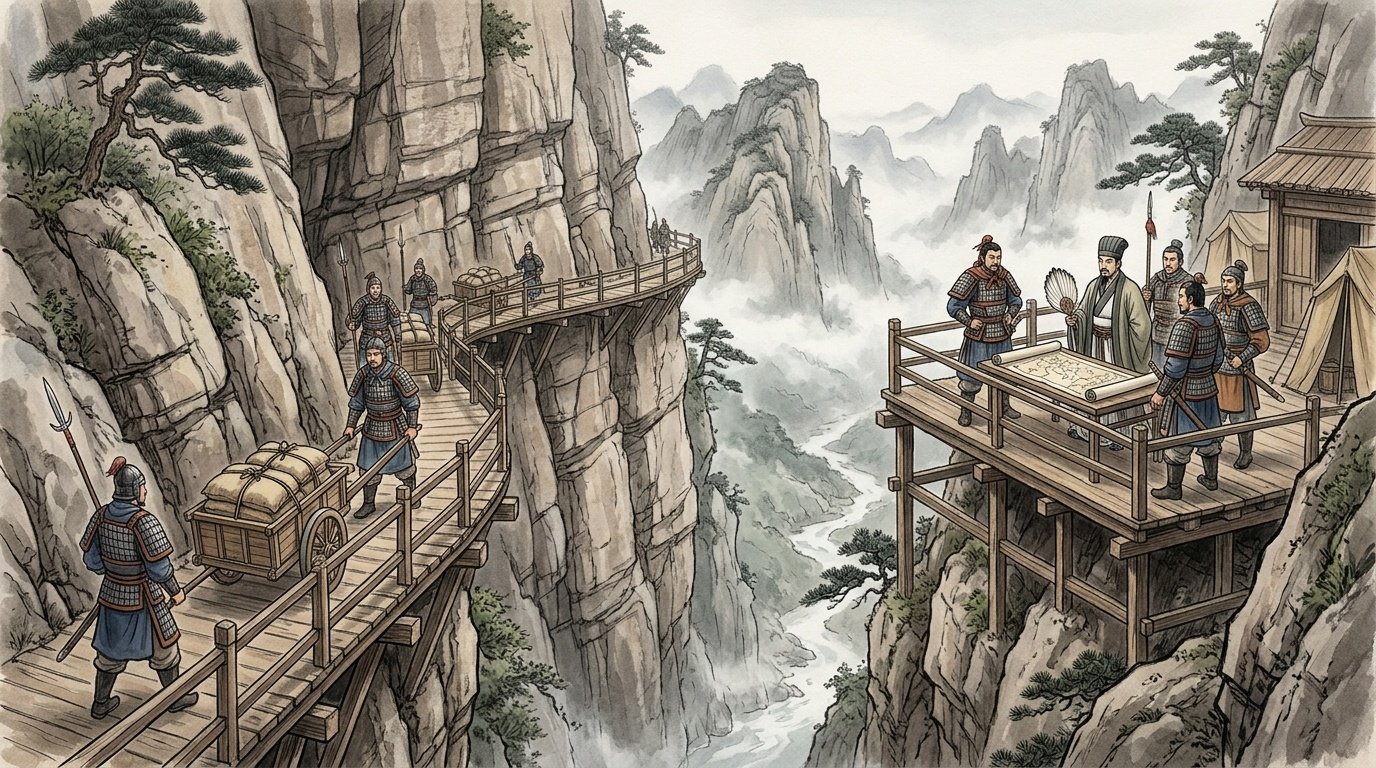
In the spring of 228 CE, from the remote mountain valleys of Hanzhong in southwestern China, an army of fifty thousand soldiers in iron-scaled armor began their slow, agonizing ascent into the jagged, cloud-veiled defiles of the Qinling Mountains. At the head of the column rode a pale, slender statesman in a simple white silk robe, holding a fan of crane feathers and seated in a four-wheeled wooden carriage. That man was Zhuge Liang (諸葛亮)—the Marquis of Wuwei, Prime Minister of the Kingdom of Shu Han (221–263 CE), and the undisputed intellectual titan of the Three Kingdoms era. For seven years, following the catastrophic death of the founding emperor Liu Bei in the burning ruins of the White Emperor City, Zhuge Liang had shouldered the solitary, crushing burden of preserving a tiny, landlocked state of fewer than a million people against the overwhelming economic and demographic colossus of the Kingdom of Wei, which commanded four times Shu’s population and ten times its cavalry reserves. Guided by his celebrated Longzhong Plan (隆中對) and animated by a tragic, heroic sense of dynastic destiny, Zhuge Liang launched the Five Northern Expeditions (Beifa, 北伐, 228–234 CE). Inventing mechanized logistics carts known as the “wooden oxen and flowing horses,” establishing self-sufficient military-agricultural colonies on the high plateaus, and waging an asymmetric war of maneuver against the formidable defensive fortress constructed by Sima Yi, Zhuge Liang fought not for personal ambition or territorial plunder, but to restore the fallen house of Han. When he collapsed of physical exhaustion beneath the cold autumn stars of the Wuzhang Plains in 234 CE, he left to world history the supreme archetype of the tragic hero: the statesman who devoted his life to an impossible ideal, “bowing down to the dust and exhausting his energy until death alone released him.”
1. The Thatched Cottage: The Longzhong Strategic Blueprint (207 CE)
To understand the strategic trajectory of Zhuge Liang’s life, one must return to the winter of 207 CE, in the rolling, forested hills of Mount Longzhong, roughly twenty li outside the city of Xiangyang in modern Hubei province. For ten years, following the death of his uncle, the young Zhuge Liang—styled Kongming (孔明), hailing from the prominent Zhuge lineage of Langya in Shandong—had lived as a hermit-scholar in a modest thatched cottage. While tilling his own vegetable plots by day, Zhuge Liang spent his evenings chanting the ancient ballad “Mount Liangfu” and meditating on grand strategy, comparing his talents with audacious self-confidence to Guan Zhong and Yue Yi, the legendary chancellor-generals of the Spring and Autumn and Warring States periods.
To this humble thatched cottage rode Liu Bei (劉備)—a direct descendant of the Western Han royal house, who had spent twenty years wandering across the chaotic battlefields of China as a landless warrior, repeatedly defeated by Cao Cao, betrayed by Lu Bu, and reduced to serving as a minor garrison commander in the border town of Xinye. Informed by the recluses Sima Hui and Xu Shu that the “Sleeping Dragon” (Wolong) resided in Longzhong and that his genius could not be summoned to a military tent, Liu Bei demonstrated the humble, tireless persistence that defined his character. Three times Liu Bei traveled through the snow and mud to knock upon the wooden gate: the legendary Three Visits to the Thatched Cottage (San Gu Mao Lu, 三顧茅廬).
On the third visit, the forty-seven-year-old warlord sat on a plain straw mat before the twenty-seven-year-old scholar. In an audience that altered the political geometry of Asia, Zhuge Liang unfurled a silk map of China and delivered the celebrated Longzhong Plan (隆中對), preserved with verbatim clarity in Chen Shou’s Records of the Three Kingdoms (Sanguozhi):
“Cao Cao has already wiped out Yuan Shao; his numbers exceed a million, and he controls the Emperor to command the feudal lords. He cannot be contended with on the northern plains. Sun Quan occupies Jiangdong; his house has held the land for three generations, the terrain is treacherous, and the hearts of the people adhere to him. He can be an ally, but he cannot be swallowed… Jingzhou controls the Han and Mian rivers in the north, accesses the wealth of the southern seas, connects to Wu and Kuaiji in the east, and leads into Ba and Shu in the west; this is a land where arms must be exercised! Yizhou (Sichuan) is an unassailable fortress, its fields spanning thousands of li: this is the Land of Abundance where the founding Emperor Gaozu laid his base… If General Liu seizes Jingzhou and secures Yizhou, consolidates the southwestern tribes, signs an unbreakable alliance with Sun Quan, and reforms domestic administration; then, when the great transformation of the world arrives, command one general to march out of Jingzhou toward Wan and Luo, while General Liu leads the legions of Yizhou out through the Qinling passes toward Guanzhong! If this is done, who among the common people will not welcome Your Majesty with baskets of food and flagons of wine?! Thus may the imperial enterprise be accomplished, and the house of Han restored!”
— Zhuge Liang, Sanguozhi (Records of the Three Kingdoms), Chapter 35: “Biography of Zhuge Liang”
The Longzhong Plan was an intellectual masterpiece of geopolitical realism. It recognized that China could no longer be unified through a single swift campaign. It proposed the creation of a stable, triangular balance of power: establishing a southern counter-state based on the dual pillars of Jingzhou (the central strategic transit nexus on the middle Yangtze) and Yizhou (the fertile, self-sufficient mountain fortress of the Sichuan basin). From this dual bastion, supported by a maritime alliance with Sun Quan, Liu Bei could launch a synchronized, two-pronged pincer offensive against Cao Cao whenever political crisis erupted in the north. For twelve years, this blueprint unfolded with miraculous, clockwork precision: Cao Cao was shattered at the Battle of Red Cliffs in 208 CE; Liu Bei secured Jingzhou; and by 219 CE, Liu Bei had conquered Sichuan and captured Hanzhong, proclaiming himself King of Hanzhong. The Longzhong vision stood on the very threshold of absolute fulfillment.
2. The Collapse of the Hinge: The Loss of Jingzhou and the Disaster at Yiling
The fatal, tragic flaw of the Longzhong Plan was its extreme geographical and diplomatic vulnerability: it required the Kingdom of Shu to hold two distant, mountainous territories simultaneously, separated by hundreds of miles of roaring river gorges, while relying upon the permanent, altruistic goodwill of their eastern rival, Sun Quan of Eastern Wu. Sun Quan viewed Jingzhou as his kingdom’s throat; so long as Liu Bei garrisoned the upper Yangtze, Wu was strategically hemmed into the coast, vulnerable to a downstream naval strike.
In the autumn of 219 CE, the grand architecture disintegrated in blood. While Liu Bei’s supreme field marshal, Guan Yu, was launching his spectacular offensive northward against Cao Ren at Fancheng—inundating seven enemy armies by diverting the autumn floodwaters of the Han River—Sun Quan executed the ultimate strategic betrayal. Allied secretly with Cao Cao, Sun Quan dispatched his general Lu Meng to launch a surprise amphibious assault along the Yangtze: the “Crossing in White Civilian Clothes” (Bai Yi Du Jiang). Lu Meng captured the unguarded base at Jiangling, severed Guan Yu’s rear lines, and encircled the veteran general at Maicheng. Guan Yu was captured and decapitated, and the entire province of Jingzhou was permanently annexed by Wu.
The loss of Jingzhou was a fatal, mortal blow to Zhuge Liang’s grand strategy. In a single stroke, Shu was severed from the Yangtze water highway, cut off from the Central Plains, and trapped behind the jagged mountains of Sichuan. The two-pronged pincer envisioned in the Longzhong cottage was permanently broken: henceforth, any northern offensive would have to be launched exclusively along the impossibly steep, narrow mountain tracks of the Qinling range.
Compounding this strategic catastrophe was Liu Bang’s descendant’s emotional rage. Blurring all cold geopolitical judgment, Liu Bei resolved to launch a war of pure vengeance against Sun Quan. Rejecting the desperate, weeping memorials of Zhuge Liang and Zhao Yun—who pleaded that Cao Cao was the usurper of the empire, while Sun Quan was merely a regional rival—the newly crowned Emperor Liu Bei led the entire veteran army of Shu Han down the Yangtze gorges in 221 CE. In the summer of 222 CE, at the Battle of Yiling (Xiaoting), the young Wu general Lu Xun executed a brilliant scorched-earth defense: waiting until Liu Bei’s army had strung out its camps across seven hundred li of dense mountain forests in the sweltering heat, Lu Xun launched a coordinated fire attack with torches. The army of Shu Han was incinerated. Tens of thousands of veteran soldiers were slaughtered; centuries of military equipment and supply boats were destroyed; and Liu Bei barely escaped with his life, fleeing into the frontier fortress of Baidi Cheng (the White Emperor City) at the entrance to the Three Gorges.
3. The White Emperor City: The Deathbed Trust (223 CE)
In the fourth month of 223 CE, inside the Yong’an Palace of Baidi Cheng, Emperor Liu Bei lay dying of grief, dysentery, and humiliation. His veteran generals—Guan Yu, Zhang Fei, Huang Zhong, and Fa Zheng—were all dead; his armies were shattered; his treasury was empty; and the newly established Kingdom of Shu Han stood on the brink of total annihilation. Surrounding the province was the colossal superpower of Cao Wei in the north, a triumphant Eastern Wu in the east, and a massive tribal rebellion erupting across the southern borderlands of Yunnan and Guizhou.
Liu Bei summoned Zhuge Liang from the capital of Chengdu to his bedside. Placing his trembling hands over Zhuge Liang’s wrists, Liu Bei delivered one of the most astonishing deathbed charges (Tuo Gu, 託孤) recorded in global political history:
“Your talent is ten times that of Cao Pi; you are assuredly capable of stabilizing the state and accomplishing the Great Enterprise. If my son (the seventeen-year-old crown prince Liu Shan) can be assisted, assist him; but if he proves talentless and unworthy, you may yourself take the throne of Chengdu and become the sovereign!” (若嗣子可輔,輔之;如其不才,君可自取。)
— Liu Bei’s Deathbed Charge, Sanguozhi, Chapter 35: “Biography of Zhuge Liang”
Hearing these words, Zhuge Liang broke down in uncontrollable weeping. He threw himself to the stone floor, knocking his forehead against the ground until blood ran from his brow, crying aloud:
“Your servant dares not do otherwise than exert the loyalty of a faithful dog and horse, dedicating his life with utmost devotion, bowing down to the dust, and exhausting his energy until death alone shall release him!” (鞠躬盡瘁,死而後已!)
— Zhuge Liang’s Vow to Liu Bei, Sanguozhi, Chapter 35
Liu Bei died a few hours later. Liu Shan (historically remembered as A Dou, a gentle, intellectually dull teenager) was crowned Emperor of Shu Han, but he issued an imperial decree entrusting all executive, military, judicial, and fiscal authority of the state entirely to Zhuge Liang, addressing the Prime Minister with filial reverence as Xiangfu (相父)—”Father Chancellor.” From that midnight hour in 223 CE until his death eleven years later, Zhuge Liang became the solitary brain, spine, and beating heart of the Kingdom of Shu Han.
4. The Southern Expedition: Pacifying Nanzhong and Meng Huo (225 CE)
Before Zhuge Liang could even contemplate marching north against Wei, he had to secure his southern rear. Following Liu Bei’s death, the vast, rugged southern territories known as Nanzhong (南中, spanning modern Sichuan, Yunnan, and Guizhou) had exploded in open insurrection. Indigenous Yi, Bai, and Qiang tribal chieftains, allied with local Han gentry magnates and led by the charismatic tribal king Meng Huo (孟獲), had murdered Han magistrates and seized control of the trade routes leading toward Burma and Southeast Asia.
In the spring of 225 CE, having spent two years restoring diplomatic ties with Sun Quan and re-equipping his infantry, Zhuge Liang personally led an expeditionary force south across the sweltering, malaria-infested waters of the Lu River (modern Jinsha River). His chief military advisor, Ma Su, offered a brilliant piece of psychological advice that Zhuge Liang adopted as his supreme strategic maxim: “In warfare, conquering the heart is superior to conquering cities; psychological warfare is superior to weapon warfare. You must subdue their hearts, so that the south will never rebel again!” (攻心為上,攻城為下;心戰為上,兵戰為下).
What followed was the legendary campaign of the Seven Captures and Seven Releases of Meng Huo (Qi Qin Qi Zong, 七擒七縱). Operating through dense subtropical jungles, navigating toxic volcanic marshes, and overcoming tribal rattan-armor warriors, Zhuge Liang repeatedly outmaneuvered Meng Huo’s tribal levies. Each time Meng Huo was captured, Zhuge Liang invited him to his command tent, feasted him on wine and roast meat, showed him his military camp formations, and asked if he was ready to surrender. Each time, Meng Huo claimed that his defeat was merely bad luck or an unfamiliarity with the terrain. Seven times, Zhuge Liang ordered his chains struck off and released him safely back to his jungle strongholds.
On the seventh capture, having been defeated in every mountain ravine and treated with unvarying, sublime magnanimity, Meng Huo broke down in tears of shame. Kneeling before Zhuge Liang, Meng Huo declared: “The Chancellor possesses the divine majesty of Heaven; the people of the south will never rebel again!” Zhuge Liang’s post-war settlement was an operational masterclass: he refused to station Han garrisons in the south, knowing that foreign occupying troops would provoke resentment; he appointed local tribal chieftains to govern their own people under nominal Han suzerainty; and he opened lucrative trade routes, importing southern cattle, horses, gold, cinnabar, and medicinal herbs to finance his northern military budgets. By the winter of 225 CE, Nanzhong was permanently pacified; the rear was secure, and Zhuge Liang turned his gaze toward the towering peaks of the north.
5. The Chu Shi Biao: The Supreme Manifesto of Imperial Devotion
In the spring of 227 CE, having mobilized fifty thousand hardened troops and concentrated them in the northern forward base of Hanzhong, Zhuge Liang prepared to launch the First Northern Expedition. Before mounting his carriage, he sat down in his study and composed his final administrative testament to the young Emperor Liu Shan: the immortal Former Memorial on Dispatching the Army (Qian Chu Shi Biao, 前出師表). Spanning six hundred and twenty-four characters, it is universally acknowledged as the greatest, most emotionally devastating memorial in classical Chinese literature.
“Your servant Liang states: The Late Emperor had not yet accomplished half his enterprise when he died in the middle of his journey. Today, the realm is partitioned into three, and Yizhou is exhausted: this is truly a critical moment of life and death for our state!… Your servant was originally a commoner, tilling his fields in Nanyang, desiring only to preserve his life in troubled times, not seeking to be known to the feudal lords. The Late Emperor did not disdain my humble origin, but humbled his own person, visiting my thatched cottage three times, consulting me on the affairs of the world. For this reason, my heart was moved, and I resolved to drive myself to his service… Twenty-one years have passed since that hour.”
— Zhuge Liang, Qian Chu Shi Biao, preserved in Sanguozhi, Chapter 35
Zhuge Liang’s memorial was not a boastful military declaration; it was the anxious, loving counsel of a dying father to a vulnerable child. He pleaded with the young emperor to maintain absolute moral discipline: to listen to honest, upright ministers like Guo Youzhi, Fei Yi, and Dong Yun; to avoid the flattering whispers of palace sycophants; and to never forget the sacrifices of the soldiers fighting on the frontier. He explained why Shu Han, despite its demographic inferiority, had an absolute existential duty to attack:
“Now the south is pacified, our weapons are sharp, and our men are ready. We must lead the three armies north to pacify the Central Plains, so that we may exterminate the wicked tyrants, restore the house of Han, and return the imperial capital to Luoyang! This is your servant’s duty to repay the Late Emperor and display his loyalty to Your Majesty!… Today your servant departs on this distant campaign; looking upon this memorial, my tears fall like rain, and I know not what I write!”
— Zhuge Liang, Qian Chu Shi Biao, Closing Lines
The Southern Song philosopher and patriot Wen Tianxiang later remarked that whenever he read the Chu Shi Biao, he wept until his clothes were soaked. The memorial was an act of tragic existential defiance: Zhuge Liang knew that if Shu Han remained passive behind its mountain walls, it would slowly, inevitably wither and die as Wei’s massive population expanded; attack was the only vehicle of survival.
6. The Tyranny of the Mountains: The Logistics of the Qinling Passes
To grasp why Zhuge Liang’s northern expeditions were an engineering and human nightmare, one must understand the formidable, impassable geology of the Qinling Mountains (秦嶺). The Qinling range is the great biogeographical divide of China—a colossal east-west wall of jagged, vertical limestone and granite peaks rising over ten thousand feet above sea level, separating the subtropical, humid Sichuan-Hanzhong basin from the dry, yellow loess plateaus of the north.
Between Hanzhong in the south and the Wei River valley (Guanzhong) in the north lay an impassable labyrinth of razor-sharp ravines, primeval forests, and roaring rivers. Across this mountain barrier ran only five tortuous, precarious mountain tracks, each an engineering nightmare:
| Mountain Pass / Route | Length & Terrain | Strategic Destination | Operational Characteristics |
|---|---|---|---|
| 1. Ziwu Route (子午道) |
Approx. 660 li (200 miles); extremely narrow, rocky gorge. | Exits directly south of the imperial capital of Chang’an. | The most direct route, but extraordinarily treacherous; highly vulnerable to flash floods and mountain ambushes in narrow defiles. |
| 2. Tangluo Route (儻駱道) |
Approx. 500 li; highest average elevation; crosses multiple peaks. | Exits into the Wei River plain near Zhouzhi. | The shortest route across the center, but passes over freezing mountain crests; virtually impassable for supply wagons. |
| 3. Baoxie Route (褒斜道) |
Approx. 500 li; follows the Bao and Xie river valleys. | Exits into the Guanzhong plain near Meixian. | Maintained via wooden gallery roads (zhandao) along vertical cliffs; vulnerable to fire and river washouts. |
| 4. Chencang Route (陳倉道) |
Approx. 600 li; follows the Jialing River northwest before turning east. | Exits at the fortified bottleneck fortress of Chencang. | The historic route taken by Han Xin; relatively gentler gradient, but heavily fortified by Wei at its northern mouth. |
| 5. Qishan Route (祁山道) |
Longest route; loops far to the northwest through southern Gansu (Longyou). | Enters the upper Han and Wei river valleys near Tianshui. | Avoids the steepest Qinling defiles; allows access to the fertile grain fields and nomadic horse reserves of Longyou. |
The fundamental constraint that haunted Zhuge Liang was not the courage of his infantry, but Thermodynamic Transport Logistics. An army of fifty thousand soldiers, plus ten thousand cavalry horses, consumed tens of thousands of bushels of grain every month. Because pack oxen and human porters had to haul the grain over hundreds of miles of cantilevered wooden planks hanging over thousand-foot drops, the transport teams consumed upwards of eighty percent of the grain payload simply to feed themselves during the journey. If the spring rains washed away a single wooden trestle bridge, or if an army was delayed outside a fortress for thirty days, the entire expedition faced catastrophic, instant starvation.
To overcome this crushing logistical ceiling, Zhuge Liang demonstrated his peerless mechanical and civil engineering genius. In his mountain workshops in Hanzhong, he designed and manufactured the legendary Wooden Oxen and Flowing Horses (Muniu Liuma, 木牛流馬). While later popular folklore romanticized these machines as magical perpetual-motion automatons, modern archaeological and mechanical reconstructions have revealed that they were revolutionary, specialized single-wheeled and double-wheeled lever-action mountain wheelbarrows and hand-carts. Featuring low centers of gravity, swiveling axle bearings, brake-stopping pegs, and narrow widths designed specifically to navigate twelve-inch mountain planks, these mechanized carts allowed a single porter to haul four times the payload of an ordinary pack team, significantly lowering the logistical friction of mountain transport.
7. The First Expedition (228 CE): The Miracle and the Tragedy of Jieting
In the spring of 228 CE, Zhuge Liang launched the First Northern Expedition—the closest Shu Han ever came to achieving total strategic victory. Zhuge Liang executed a brilliant operational deception: he dispatched the veteran general Zhao Yun to lead a noisy, ostentatious diversionary force along the central Baoxie route, threatening Chang’an directly. The court of Wei panicked, deploying their main army under Cao Zhen to guard the capital passes.
While Cao Zhen was pinned down in the central defiles, Zhuge Liang swung his main strike force far to the northwest along the Qishan Route into modern Gansu. The maneuver caught Wei completely off guard. Emerging like ghosts onto the fertile plateaus of Longyou, the Shu army triggered an astonishing political collapse: the three strategic commanderies of Nan’an, Tianshui, and Anding revolted against Wei and surrendered to Zhuge Liang in a single week. It was during this campaign that Zhuge Liang discovered and recruited the young Wei officer Jiang Wei (姜維), recognizing his brilliant military intellect and adopting him as his direct strategic protégé.
The entire northern empire was shaken to its foundations. Emperor Cao Rui of Wei rushed in person to the Western Capital of Chang’an to steady the court, dispatching his most formidable veteran generalissimo, Zhang He, at the head of fifty thousand elite cavalry to retake Longyou. To secure his conquests, Zhuge Liang had to hold a single, vital topographical bottleneck: the mountain outpost of Jieting (街亭, near modern Qin’an, Gansu). Jieting was the solitary, narrow corridor through which Zhang He’s cavalry had to pass; if Shu held Jieting, Zhang He was blocked, and the three commanderies would be permanently integrated into Shu Han, providing the state with the cavalry horses and grain needed to crush Guanzhong.
To command this critical chokepoint, Zhuge Liang made the most catastrophic personnel error of his life. Overriding the advice of his veteran commanders, who urged the appointment of battle-hardened generals like Wei Yan or Wu Yi, Zhuge Liang appointed his beloved intellectual protégé, Ma Su (馬謖). Ma Su was a brilliant theoretical strategist, but he possessed zero field combat experience. Arriving at Jieting, Ma Su committed the exact fatal error that Zhao Kuo had committed at Changping: disregarding Zhuge Liang’s explicit operational orders to fortify the crossroads and secure the water springs, Ma Su led his army to the summit of an isolated, waterless mountain, claiming that Sun Tzu taught: “From high ground, a downward charge is irresistible!”
Zhang He arrived, surveyed the scene, and laughed in disbelief. The veteran Wei general did not charge up the slope; he simply encircled the mountain and severed the water supply lines at the foot of the hill. Within two days, the Shu soldiers on the sun-baked mountain were dying of thirst, their lips cracked, their formations breaking into mutiny. Zhang He launched a coordinated fire attack up the mountain and charged. The Shu army at Jieting disintegrated into a catastrophic rout, with only the veteran officer Wang Ping maintaining an orderly retreat with a thousand men beating drums in the dust.
The loss of Jieting was a fatal strategic catastrophe. His northern flank severed and his rear exposed to Zhang He’s cavalry, Zhuge Liang had no choice but to order the immediate, total evacuation of Longyou. Evacuating over a thousand local families back into Hanzhong, the First Expedition collapsed in an instant. Returning to Hanzhong, Zhuge Liang demonstrated his unyielding commitment to legal justice. He submitted a memorial to Emperor Liu Shan demoting himself three ranks from Prime Minister to General of the Right, and with tears streaming down his face, he signed the death warrant for his beloved disciple Ma Su, giving birth to the immortal Chinese idiom “Weeping While Slaying Ma Su” (Holei Zhan Ma Su, 揮淚斬馬謖). Zhuge Liang wept not merely for Ma Su, but for the lost destiny of the Han.
8. The Duel of Giants: Zhuge Liang versus Sima Yi (231–234 CE)
Following the failure of the First Expedition, the strategic balance between Shu and Wei crystallized into an epic, multi-year intellectual duel between two of the greatest minds in military history: Zhuge Liang and Sima Yi (司馬懿), the Grand Commander of Wei.
Sima Yi possessed a cold, ruthless, and profound understanding of operational reality. He recognized that in open field combat, Zhuge Liang’s army was tactically superior: the Shu soldiers were hyper-disciplined, operated with deadly repeating crossbows (Zhuge Nu) that fired ten bolts in rapid succession, and fought with ferocious, desperate cohesion. But Sima Yi also knew that Shu Han was fundamentally crippled by its logistical supply chain. Trapped behind the Qinling mountains, Zhuge Liang could never sustain an offensive for more than a few months. Sima Yi adopted an uncompromising, humiliating, but mathematically unassailable grand strategy: Total Strategic Defense and Attrition (Jianbi Qingye)—building massive earthen walls, digging deep moats, refusing open combat, and allowing the mountain logistics of Shu to starve the enemy out of the field.
In the Fourth Northern Expedition (231 CE), Zhuge Liang besieged Mount Qi and harvested the wheat fields of Shanggui before Sima Yi could intervene. When Sima Yi finally marched to the front, Zhuge Liang repeatedly offered open battle. Goaded by his own fiery subordinate commanders—who mocked Sima Yi for “fearing the Shu army like a tiger, making the world laugh at Wei!”—Sima Yi launched an offensive at the Battle of Lucheng. Zhuge Liang unleashed his shock infantry: over three thousand elite Wei soldiers were decapitated, and Sima Yi was driven back into his fortress with heavy losses. Yet despite this brilliant battlefield victory, Zhuge Liang was forced once again to retreat when his corrupt logistics minister Li Yan failed to deliver grain from Hanzhong due to continuous summer torrential rains.
Recognizing that he could never defeat Wei so long as his supplies were dependent upon the seasonal mountain passes, Zhuge Liang formulated a radical, permanent solution for his final campaign in 234 CE: Military-Agricultural Tuntian on Enemy Soil (Fen Bing Tun Tian). In the spring of 234 CE, Zhuge Liang launched the Fifth Northern Expedition, leading his entire army of one hundred thousand men out through the Baoxie route and deploying upon the expansive, elevated tableland of the Wuzhang Plains (五丈原, in modern Qishan County, Shaanxi), situated directly south of the Wei River.
Zhuge Liang did not intend to retreat. He divided his army: while half the soldiers manned the frontlines and trenches, the other half plowed the soil alongside the local Wei peasantry, planting millet and wheat along the Wei River banks. Sima Qian’s successor Chen Shou records that the discipline of the Shu army was so immaculate that the local civilians went about their daily agricultural work without fear, trading peacefully with the soldiers. Zhuge Liang had successfully exported his logistical base onto northern soil; he was prepared to dig in for years until Wei’s defensive will collapsed.
9. The Wuzhang Plains: Women’s Robes and the Falling Star (234 CE)
Confronting this existential threat, Sima Yi constructed a massive, continuous defensive rampart north of the Wei River, refusing to cross the water or engage in a single skirmish. For more than one hundred days throughout the scorching summer of 234 CE, Zhuge Liang attempted every psychological stratagem to provoke Sima Yi into open combat. He sent emissaries with insults; he challenged the Wei vanguard; and finally, in an act of supreme psychological theater, Zhuge Liang dispatched an envoy to Sima Yi’s command tent bearing a magnificent gift box containing a Woman’s Headdress and Silk Dress (Jin Guo Fu Fu), accompanied by a biting message: “If you are a true man and a general of the Central Plains, march out and fight! If you dare not fight, put on this woman’s dress, stay inside your mud ramparts, and admit that you are merely an old woman!”
The Wei generals and officers were beside themselves with fury, brandishing their swords and demanding permission to sally forth and die rather than endure such intolerable humiliation. Sima Yi remained completely unperturbed. Demonstrating his supreme, terrifying self-mastery, Sima Yi smiled, received the woman’s dress with polite courtesy, and invited Zhuge Liang’s diplomatic envoy to sit down for a meal. Sima Yi did not ask a single question about troop dispositions or tactical formations; instead, he asked with friendly concern about Zhuge Liang’s daily life:
“Sima Yi asked: ‘How is the Prime Minister’s daily routine and diet? How much grain does he consume?’ The envoy replied: ‘The Chancellor rises at dawn and sleeps in the dead of night; every military penalty of twenty caning blows or more he reviews in person. He eats barely a few pints of grain each day.’ Sima Yi sighed and turned to his ministers: ‘Zhuge Kongming eats so little and labors so excessively; how can he long endure in this world?!'”
— Sima Yi’s Assessment, Sanguozhi, Chapter 35: “Biography of Zhuge Liang”
Sima Yi’s medical prognosis was tragically accurate. Zhuge Liang was working himself to death. He carried the entirety of the state administration upon his fragile shoulders: drafting operational dispatches, reviewing logistics ledgers, verifying supply carts, and planning night patrols. In the eighth month of 234 CE, racked with chronic coughing, vomiting blood, and burning with high fever, the fifty-four-year-old Prime Minister collapsed in his command tent beneath the autumn skies of the Wuzhang Plains.
According to the Records of the Three Kingdoms and the contemporary Weishi Chunqiu, as Zhuge Liang lay dying, a colossal red meteor with an incandescent, fiery tail fell from the southwestern sky directly into the Shu camp, shaking the ground. Sensing the end was near, Zhuge Liang summoned his trusted generals—Yang Yi, Fei Yi, and Jiang Wei—and dictated his final, meticulous operational instructions: the army was not to sound mourning cries; they were to construct a lifelike carved wooden effigy of himself seated in his four-wheeled carriage; and they were to retreat slowly through the Baoxie route in disciplined battle formation.
In the late hours of the night on October 8, 234 CE, Zhuge Liang closed his eyes forever in his tent on the Wuzhang Plains. When scouts reported that the Shu camp was deserted, Sima Yi launched an immediate, aggressive pursuit with his elite cavalry. As the Wei horsemen caught up with the retreating column in the narrow defiles of the Baoxie canyon, the Shu commanders suddenly halted, beat their war drums, reversed their battle banners, and pushed the four-wheeled carriage bearing the wooden effigy of Zhuge Liang to the front line. Sima Yi, terrified that his mortal adversary had faked his own death to spring a final lethal ambush, panicked, pulled his reins, and ordered his entire army to retreat in headlong flight for fifty miles. The local peasantry celebrated the event in an immortal folk song: “A Dead Zhuge Scared Away a Living Sima!” (Si Zhuge Zou Sheng Zhongda, 死諸葛走生仲達). When Sima Yi subsequently inspected the abandoned Shu camp at Wuzhang Plains, marveling at the geometric perfection of the trenches, ramparts, and granary pits, he sighed in reverent awe: “He was truly the most peerless talent under Heaven!” (天下奇才也!).
10. The Institutional Legacy: Legalism, Tuntian, and the Shu Economy
While popular romanticism universally venerates Zhuge Liang as a mystical Daoist magician who summoned eastern winds and spoke with spirits, historical reality reveals a far more formidable figure: Zhuge Liang was the premier Legalist-Confucian Administrative Reformer of the early medieval period.
When Zhuge Liang assumed the chancellorship of Shu Han in 221 CE, Sichuan was plagued by chronic lawlessness. Powerful local landed gentry clans (the Yizhou Haowang) monopolized water rights, evaded taxes, maintained private armed retainers, and defied the central court. In drafting the foundational legal code of the realm—the Shu Ke (蜀科, Statutes of Shu)—Zhuge Liang rejected the lenient, toothless policies of the former governor Liu Zhang. He instituted strict, impartial laws that fell equally upon royal relatives and common peasants, summarizing his philosophy in a famous dialogue with his colleague Fa Zheng: “When an empire is established, it must be bound by clear laws; if one bestows unmerited grace, the people become arrogant and ungrateful. To govern through law is true benevolence!”
Under Zhuge Liang’s administration, official corruption was ruthlessly suppressed, while administrative performance was audited with quantitative precision. He revived the ancient Dujiangyan irrigation network in Sichuan, appointing dedicated state water officials (the Yan Guan) to maintain the dykes and ensure that the Chengdu plain yielded continuous agricultural surpluses. He established state monopolies on the lucrative Sichuan iron and salt industries, and revolutionized the production of Shu Brocade (Shujin, 蜀錦)—the magnificent, multi-colored silk textiles produced along the Jinjiang River in Chengdu—exporting them to Wei and Wu to finance his military budgets, famously declaring: “Today our weapons are few and our treasury empty; we must rely entirely upon the brocade of our women to conquer the northern barbarians!”
His personal financial integrity was legendary. Before his death, Zhuge Liang submitted a formal financial disclosure to Emperor Liu Shan, listing every single asset owned by his family: “Your servant possesses eight hundred mulberry trees in Chengdu and fifteen qing of barren land, which is sufficient to feed and clothe his family. When your servant departs on distant campaigns, his clothing and food are provided entirely by the state; he possesses no private savings, no spare garments, and no private wealth. At his death, let there be no surplus property upon his body, so that he may not disgrace Your Majesty!” When imperial inspectors examined his estate after his funeral, they discovered that his declaration was accurate down to the final copper coin. In an age of monstrous warlord rapacity, Zhuge Liang stood as an incorruptible beacon of public virtue.
11. Historiographical and Cultural Apotheosis: The Deity of Loyalty
The historical and cultural apotheosis of Zhuge Liang is without parallel in world history. Following his death, his body was interred in accordance with his final testamentary wishes on the southern slopes of Mount Dingjun (定軍山) in Hanzhong. He demanded that his grave be excavated just large enough to fit his plain wooden coffin, without gold, jade, or earthen mounds, ordering that his corpse be clothed in his daily working garments. The common people of Shu mourned him as their own father, setting up informal ancestral altars along roadways and in mountain villages, until the imperial court formally established the Temple of the Martial Marquis (Wuhou Ci, 武侯祠) in Chengdu—which remains today the most revered ancestral shrine in China.
The contemporary historian Chen Shou (who had lived under the Shu Han administration and whose father had been disciplined by Zhuge Liang) delivered a remarkably balanced, brilliant historical appraisal in Chapter 35 of the Sanguozhi:
“Zhuge Liang as chancellor pacified the people, laid down clear standards, restrained official power, showed sincerity, and distributed justice… Those who were guilty were punished, even if they were beloved relatives; those who were faithful were rewarded, even if they were mortal enemies. Within the realm, all respected and feared him; the laws were severe yet no one complained, because his heart was fair and his rewards impartial. He was truly a statesman capable of ordering an age, fit to be ranked alongside Guan Zhong and Xiao He! Yet he marched on annual expeditions without achieving final victory; it must be said that while his civil governance was peerless, field tactical improvisation was not his supreme strength.”
— Chen Shou, Sanguozhi, Chapter 35
In the fourteenth century, Luo Guanzhong’s colossal historical epic, the Romance of the Three Kingdoms (Sanguo Yanyi), elevated Zhuge Liang from an extraordinary historical statesman into the supreme, immortal embodiment of wisdom and strategic genius in East Asian culture. Through episodes like the “Borrowing of Arrows with Straw Boats” (Cao Chuan Jie Jian) and the “Empty Fort Strategy” (Kong Cheng Ji), Zhuge Liang became a mythic figure whose crane-feather fan and silk carriage symbolize transcendent intellect outwitting brute force.
Yet the true greatness of Zhuge Liang does not reside in folklore or magic; it resides in his tragic, unbreakable moral commitment. In a world governed by cynical opportunism and shifting warlord loyalties, Zhuge Liang stayed true to his thatched cottage vow. He knew that the odds against Shu Han were hopeless; he knew that the mountains of the Qinling were impassable; he knew that his own physical body was failing. Yet he marched anyway, choosing to exhaust his life in the pursuit of justice rather than surrendering to comfortable defeat. As the Tang dynasty poet Du Fu lamented in his celebrated visit to the Temple of the Martial Marquis in Chengdu:
“Where is the temple of the famous Prime Minister to be found?
— Du Fu (杜甫), “The Temple of the Premier” (Shu Xiang), 760 CE
Deep in the cypress shadows outside the city of Brocade!
Two reigns he sustained with undivided devotion;
His dying army retreated, leaving his heart unfulfilled.
Before his march achieved its goal, his life had run its course;
Ever since, heroes of all ages weep their coats with tears!”
Zhuge Liang proved that historical greatness is not measured by the crown on one’s head or the size of the territory one conquers, but by the moral purity of the ideal for which one is willing to die in the cold autumn dust of the Wuzhang Plains.
12. Classical Chapters, Epigraphical Finds, and Scholarly Bibliography
Primary Classical Sources:
Chen Shou (陳壽). (c. 280 CE). Sanguozhi (三國志, Records of the Three Kingdoms). With historical commentary and collations by Pei Songzhi (裴松之, 429 CE). Chapter 32: “Xianzhu Chuan” (Biography of the First Ruler / Liu Bei); Chapter 35: “Zhuge Liang Chuan” (Biography of Zhuge Liang, containing the complete texts of the Longzhong Plan, the Qian Chu Shi Biao, and the Hou Chu Shi Biao); Chapter 26: “Man Tian Qian Guo Zhuan”; Chapter 9: “Xiahou Cao Zhuan”. Critical punctuated edition by Zhonghua Book Company, Beijing, 5 vols., 1959; revised 1982.
Chang Qu (常璩). (c. 350 CE). Huayang Guo Zhi (華陽國志, Records of the States South of Mount Hua). Fascicles 1, 2, and 7: Crucial regional historical chronicle of the Shu Han administration, the southern campaign in Nanzhong, and the Sichuan salt and iron economies. Annotated edition by Ren Naiqiang (1987), Shanghai: Shanghai Classical Books Publishing House.
Fang Xuanling (房玄齡) et al. (648 CE). Jinshu (晉書, Book of Jin). Chapter 1: “Xuan Di Ji” (Annals of Emperor Xuan / Sima Yi). Detailed accounts of the tactical clashes between Sima Yi and Zhuge Liang on the Wuzhang Plains. Beijing: Zhonghua Book Company, 1974.
Archaeological Excavations and Epigraphy:
Shaanxi Provincial Institute of Archaeology. (2014). “Comprehensive Archaeological Survey of the Ancient Qinling Mountain Routes (Ziwu, Baoxie, Tangluo, and Chencang Tracks),” Kaogu Yu Wenwu (Archaeology and Cultural Relics), No. 4, pp. 45–62. Direct physical documentation of the ancient wooden gallery road mortise-holes and masonry river piers utilized during Zhuge Liang’s Northern Expeditions.
Zhuge Liang Memorial Hall and Hanzhong Municipal Museum. (1988). “Investigation Report on the Tomb of Zhuge Liang at Mount Dingjun, Mianxian,” Wenwu, No. 6.
Modern Scholarly Studies:
de Crespigny, Rafe. (2010). Imperial Warlord: A Biography of Cao Cao 155–220 AD. Leiden: E. J. Brill. doi:10.1163/ej.9789004185227.i-554
de Crespigny, Rafe. (2018). Generals of the South: The Foundation and Early History of the Three Kingdoms State of Wu. Canberra: Australian National University.
Huang, Ray. (1997). China: A Macro History. Armonk, NY: M. E. Sharpe. Crucial analysis of the geopolitical and economic limits of the Shu Han state, pp. 88–104.
Mansvelt Beck, B. J. (1990). The Treatises of Later Han: Their Interpretation, Adaptation, and Transmission. Leiden: E. J. Brill.
Tian, Yuqing. (1989). Dong Jin Menfa Zhengzhi (東晉門閥政治, The Politics of the Aristocratic Clans in the Eastern Jin). Beijing: Peking University Press.
Zhu, Dawei. (1998). Sanguo Shi Yanjiu (三國史研究, Studies on Three Kingdoms History). Beijing: People’s Publishing House.