The Haber-Bosch Process
On a July morning in 1909, in a small laboratory at the Technische Hochschule Karlsruhe, a German physical chemist and his assistant opened a valve on a tabletop apparatus and let a stream of liquid ammonia drip into a glass beaker. The stream was thin — about 125 millilitres per hour, four US fluid ounces — but it was the first time anyone had made ammonia in usable quantities from atmospheric nitrogen and hydrogen. Two men watched the demonstration. One was Fritz Haber, the professor who had built the apparatus. The other was Carl Bosch, the chemist whom the chemical company BASF had sent to assess whether the process was worth taking to industrial scale. Bosch watched the drip for some time, asked questions, and returned to Ludwigshafen with the news that the engineering problems, though formidable, were not insurmountable. He was right. Within four years the first industrial ammonia plant was on stream at Oppau, and within ten years the same chemistry was making the explosives that would prolong the First World War and the fertilisers that would feed the twentieth century.
The Haber-Bosch process is the most consequential piece of industrial chemistry ever developed. Vaclav Smil, the Canadian geographer whose 2001 book Enriching the Earth remains the standard scholarly treatment, has calculated that the nitrogen fertiliser produced by the process now sustains roughly forty per cent of the world’s population. The figure is approximate, and the causal chain from chemical process to dinner plate is long, but the broad claim is widely accepted by agronomists, environmental historians, and economists. Smil and others have estimated that, without the Haber-Bosch process, the world’s population would have plateaued at around three or four billion instead of approaching eight. Two human beings in five alive today owe their protein intake, directly or indirectly, to a reactor in Ludwigshafen.
The problem Haber solved
Nitrogen is essential to life. It is the building block of amino acids, proteins, nucleic acids, and chlorophyll, and no plant or animal can grow without it. The atmosphere is four-fifths nitrogen — the largest single reservoir of any element on Earth. The problem is that atmospheric nitrogen is also exceptionally inert. The two nitrogen atoms in N2 are held together by a triple bond that requires more energy to break than almost any other common molecule in the biosphere. Until 1909, the only practical ways to convert atmospheric nitrogen into biologically useful forms were biological: the nitrogen-fixing bacteria in the root nodules of legumes and a few other plants, and the smaller-scale lightning-driven chemistry that produces trace amounts of nitrogen oxides. Over geological timescales, these biological processes slowly accumulated the nitrate deposits in the Atacama Desert and elsewhere that became the basis of the Chilean nitrate industry of the late nineteenth century.
By 1900 the natural supply of fixed nitrogen was coming under pressure. The Chilean nitrate mines, then the largest single source of fixed nitrogen for the world’s farmers and explosives manufacturers, were producing nearly half a million tons a year and were approaching their physical limit. The German chemist Wilhelm Ostwald, in 1900, warned that the world would run out of fixed nitrogen within a generation, with consequences for both agriculture and munitions. The alarm was serious enough that several industrial chemists, in Germany and Scandinavia, took up the problem. The Norwegian Kristian Birkeland and the engineer Samuel Eyde developed the Birkeland-Eyde process, which used an electric arc to fix nitrogen as nitric oxide, taking advantage of the cheap hydroelectric power in Norway. The German Adolf Frank and Nikodem Caro developed the cyanamide process, which fixed nitrogen as calcium cyanamide by reacting it with calcium carbide at high temperatures. Both were real processes, both produced fixed nitrogen in industrial quantities, and both consumed enormous amounts of energy. A better answer was wanted.
The chemistry was already known in outline. In 1789 the French chemist Claude Louis Berthollet had shown that ammonia could be broken down into nitrogen and hydrogen; the reverse reaction, combining the two elements to form ammonia, was suspected to be possible but was thought to be uneconomical at industrial scale because the reaction was so slow. The equilibrium between ammonia and its elements was studied throughout the nineteenth century. The German physical chemist Walther Nernst had, around 1907, shown that the equilibrium strongly favoured ammonia at very high pressures and moderate temperatures, but the engineering required to operate at those pressures was largely beyond what the existing chemical industry could supply. Haber’s contribution was to combine the chemistry with the engineering.
Haber’s career before 1909
Fritz Haber was born in Breslau, Silesia (now Wrocław, Poland) on 9 December 1868, the son of a Jewish merchant. He studied chemistry in Breslau, Berlin, and Heidelberg, and after a brief period in industry took a position at the Technische Hochschule Karlsruhe in 1894, where he worked on physical chemistry and electrochemistry. By 1905 he had published enough papers on the thermodynamics of gas reactions to be considered one of the leading physical chemists of his generation. His 1905 book, Thermodynamik technischer Gasreaktionen, was the first systematic treatment of the industrial applications of gas-phase equilibria, and it became the standard reference for the next two decades.
The book was the springboard for Haber’s later work on ammonia. The reverse reaction — breaking ammonia down into nitrogen and hydrogen — had been the topic of several earlier studies, and the equilibrium constants had been measured. Haber and his assistant Robert Le Rossignol began a systematic study of the conditions under which ammonia could be synthesised. They worked at high pressures, using steel cylinders that had been developed for the liquefaction of gases; they tested catalysts, looking for metals that would accelerate the reaction without being poisoned by the trace impurities in the gas stream; and they measured yields under varying conditions. By 1908 they had shown that an iron-based catalyst could, at pressures of around two hundred atmospheres and temperatures near 500°C, produce ammonia in yields of about six per cent per pass — enough to make the process a candidate for development.
The Austrian chemical firm Österreichische Chemische Werke had approached Haber in 1904 about the possibility of synthesising ammonia, but the work had not been promising until Haber’s breakthrough in 1908. BASF, the German chemical firm, learned of the work and sent representatives to Karlsruhe in March 1909 to see a demonstration. The demonstration, in Bosch’s presence, succeeded. Haber had at last found conditions under which the synthesis was feasible.
Bosch and the engineering of the industrial reactor
Carl Bosch had joined BASF in 1899, after a chemistry doctorate at Leipzig. By 1909 he was the firm’s chief chemist, with responsibilities for the development of new processes. He was not, at first sight, an obvious choice to lead the ammonia programme: his training was in organic chemistry, and his experience was with high-temperature reactions, not the high-pressure gas reactions that Haber was proposing. But he had a talent for industrial scale-up that was rare in his generation, and the BASF board judged him the firm’s best option.
The engineering problems were formidable. Haber’s apparatus operated at pressures of around two hundred atmospheres and temperatures near 500°C, conditions that no industrial chemical reactor had ever been required to maintain. The first reactors that Bosch had built failed within hours. The cause was a phenomenon known at the time as “hydrogen embrittlement”: at high temperatures and pressures, hydrogen penetrated the steel walls of the reactor and combined with the carbon in the steel to form methane, leaving the steel porous and weak. The reactors, in Bosch’s words, “sweated hydrogen.” A reactor that worked for an hour would, after several hours, develop leaks and eventually fail.
Bosch’s solution was to line the inside of the reactor with a thin layer of soft iron that had been specially treated to be impermeable to hydrogen. The outer steel wall provided the mechanical strength; the inner iron lining provided the chemical resistance. This double-walled construction, an entirely new departure for chemical engineering, became the standard for high-pressure gas reactors for the next half-century. Bosch also developed new compressors, valves, and pressure gauges capable of operating at the required pressures; he built a materials testing laboratory at Oppau to characterise the behaviour of metals at high temperatures and pressures; and he supervised the design of the first large-scale ammonia plant.
The plant at Oppau, near Ludwigshafen, was begun in 1911 and brought on stream in September 1913. Its initial capacity was about thirty tons of fixed nitrogen per day, equivalent to roughly twenty tons of ammonia. By the end of 1914 the capacity had been doubled. The Oppau facility was the first industrial ammonia plant in the world, and it was the model for every ammonia plant built in the next fifty years.
The dual-use problem
BASF’s interest in the Haber-Bosch process was not principally agricultural. The German agricultural chemistry firm had been the dominant supplier of nitrogen fertilisers, including the Chilean nitrates and the cyanamide made by the Frank-Caro process. But the German army was the firm’s largest potential customer for fixed nitrogen, in the form of nitric acid and the explosives made from it. Germany had no Chilean mines, no significant guano deposits, and no domestic supply of Chilean nitrate; in the event of a war, its munitions industry would run out of fixed nitrogen in months. The Haber-Bosch process offered Germany the prospect of an unlimited domestic supply of fixed nitrogen, independent of foreign imports.
This dual-use quality of the process — its capacity to produce both fertilisers and explosives — has shaped its history ever since. From 1914 to 1918, BASF’s ammonia plants at Oppau and the new Leuna plant, near Merseburg in central Germany, produced more than half a million tons of fixed nitrogen per year, almost all of it destined for the German war machine. Without the Haber-Bosch process, Germany would have run out of explosives in 1915 or 1916. The process has therefore been credited with prolonging the First World War by at least a year, and possibly more.
The same dual-use quality shaped the post-war period. The Haber-Bosch process made synthetic fertilisers cheap enough that the world’s farmers could afford them. The introduction of high-yielding crop varieties in the 1950s and 1960s, the “Green Revolution” of Norman Borlaug and his colleagues, was made possible in part by the cheap nitrogen fertiliser that Haber-Bosch made available. The world’s grain production tripled between 1950 and 2000, and a substantial fraction of the increase is attributable to the use of synthetic nitrogen fertiliser.
Haber, the Nobel, and the moral question
Fritz Haber received the Nobel Prize in Chemistry in 1918, the year the First World War ended, for his work on the synthesis of ammonia. The award was controversial. Haber had been a vocal advocate of chemical weapons during the war; he had personally overseen the first use of chlorine gas at Ypres in April 1915; and his name had become associated, in the popular press of the Allied countries, with the horror of chemical warfare. The Nobel Committee chose to honour the chemistry and ignore the politics. Haber himself, in his Nobel lecture, did not mention the war.
Haber’s later life was marked by a different kind of failure. After the war, he worked on a process for extracting gold from seawater to help Germany pay its war reparations; the project failed because the concentration of gold in seawater was far lower than his initial estimates had assumed. He also worked on pesticides and on a process for producing synthetic fuel from coal, with mixed results. The rise of National Socialism in Germany put him in an impossible position: as a Jew, he was excluded from the universities and from public life, and his scientific work was dismissed as “Jewish science.” He resigned from his position at the Kaiser Wilhelm Institute in 1933 and went into exile in Switzerland, where he died in Basel in January 1934. Carl Bosch, by contrast, had adapted to the new regime and remained in his position as chairman of IG Farben, the chemical conglomerate that BASF had joined in 1925. He died in 1940, by which time the company was deeply involved in Nazi war production.
The question of how to evaluate Haber’s moral standing has been debated ever since. His defenders note that the chemistry that earned him the Nobel Prize has saved more lives than the chemical weapons programme that earned him condemnation. His critics note that he was aware of the military implications of the Haber-Bosch process from the beginning and accepted the consequences. The two views are not easily reconciled. Haber himself, in a letter to a colleague written shortly before his death, wrote that he had spent his life in a kind of moral confusion, unable to separate the good of his work from the bad.
How the modern ammonia plant works
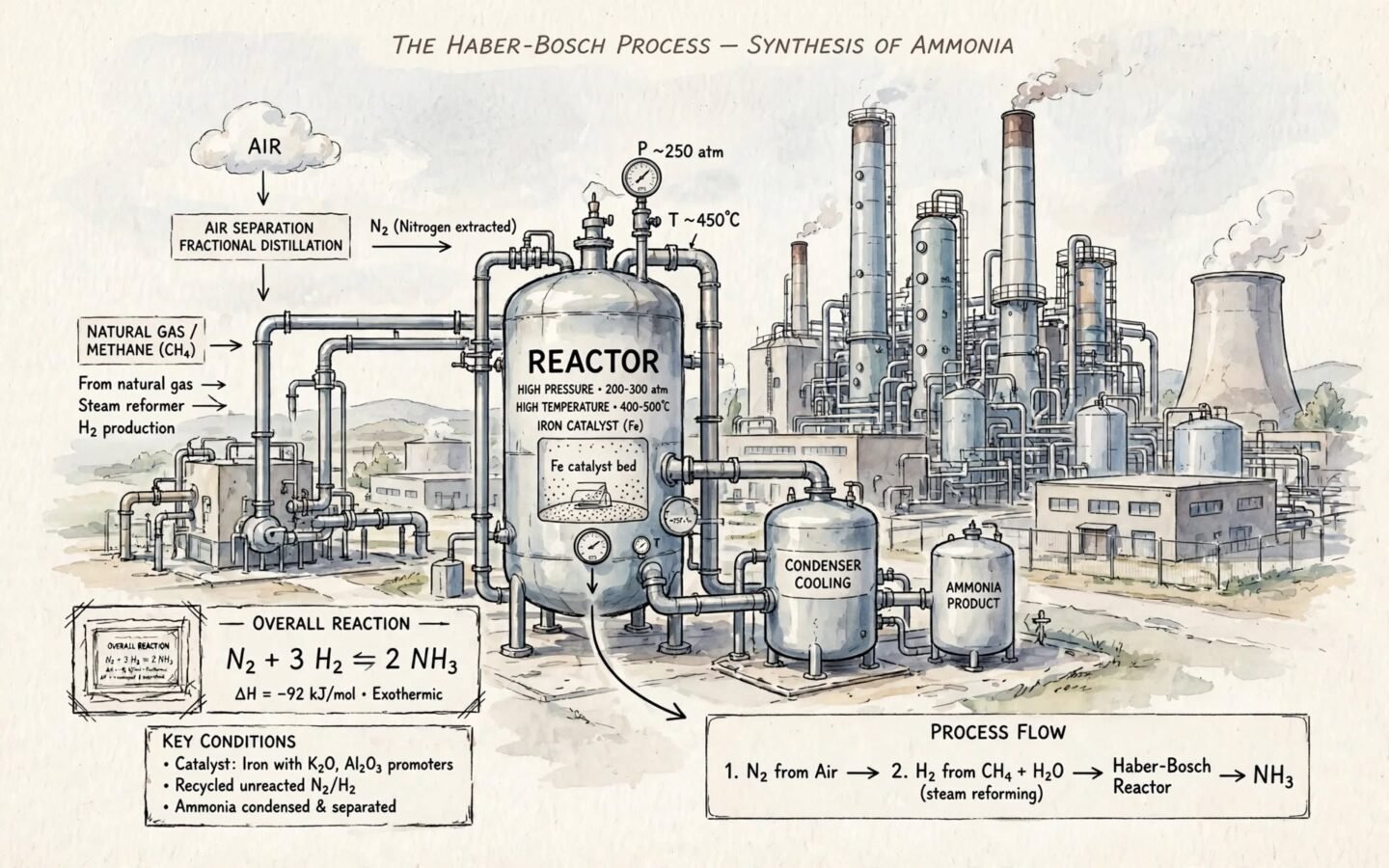
The industrial Haber-Bosch process, in its modern form, differs from Haber and Bosch’s original in detail but not in chemistry. Atmospheric nitrogen is mixed with hydrogen in a ratio of roughly one to three. The hydrogen is produced, in most plants, by steam reforming of natural gas: methane is reacted with steam at high temperature over a nickel catalyst, yielding hydrogen and carbon dioxide; the carbon dioxide is then removed. The nitrogen comes from a cryogenic air separation plant. The mixed gas is compressed to pressures of two hundred to three hundred atmospheres, heated to about 450°C, and passed over a multi-promoted iron catalyst. The catalyst accelerates the reaction but does not change the equilibrium; only a fraction of the gas reacts on each pass, and the unreacted gas is recycled. The ammonia produced is condensed out by cooling, and the unreacted gas is reheated and returned to the reactor.
A modern plant of this kind produces about one thousand tons of ammonia per day, with an energy consumption of around thirty gigajoules per ton. The energy is mostly natural gas, both as feedstock and as fuel. The ammonia is stored as a refrigerated liquid at atmospheric pressure, or at modest pressure at ambient temperature, and shipped by rail, road, or pipeline. The largest ammonia plants are in Trinidad, Russia, the United States, and the Persian Gulf. World production in the early 2020s was about 185 million tons of fixed nitrogen per year, almost all of it from the Haber-Bosch process.
The downstream chemistry
Most of the ammonia produced by the Haber-Bosch process is used as fertiliser, in one of three forms. Anhydrous ammonia, the liquefied gas itself, is injected directly into the soil by specialised equipment. Urea, a synthetic organic compound made by reacting ammonia with carbon dioxide, is the most widely used solid fertiliser; it contains forty-six per cent nitrogen by weight and is easy to transport and apply. Ammonium nitrate, made by neutralising nitric acid (itself produced by oxidising ammonia) with ammonia, is also widely used, particularly in Europe.
The remaining ammonia is the feedstock for other industrial chemicals. Nitric acid, made by the Ostwald process (oxidation of ammonia to nitric oxide and thence to nitrogen dioxide and nitric acid), is the basis of most nitrogen-containing explosives, including TNT, nitroglycerine, and ammonium nitrate fuel oil. The explosives industry, which had been a major customer for Chilean nitrates before 1914, became a major customer for Haber-Bosch ammonia. Other downstream products include caprolactam, the precursor of nylon; acrylonitrile, the precursor of acrylic fibres and resins; and hydrazine, used as a rocket propellant.
The combination of Haber-Bosch ammonia and Ostwald nitric acid has therefore produced, directly or indirectly, most of the nitrogen-containing industrial chemicals in the modern world. The chemistry was developed for fertiliser and explosives; it turned out to be applicable to almost everything else.
How the Haber-Bosch process changed agriculture
The pre-1914 agriculture of Europe, North America, and Asia relied on the nitrogen from three sources: the nitrogen-fixing bacteria in leguminous crops, the manure of animals fed on leguminous crops, and the small deposits of Chilean nitrate and Peruvian guano. The first two could supply, at best, about half of the nitrogen that crops needed in the most intensive systems; the third was expensive and finite. Most agricultural land was therefore under-fertilised, and yields were limited by nitrogen availability. The Haber-Bosch process changed this in three ways.
First, it made synthetic nitrogen fertiliser cheap enough that farmers could afford to apply it in the quantities that crops needed. The price of fixed nitrogen fell by a factor of ten between 1900 and 1950. Second, it made the fertiliser available in forms that could be applied to almost any crop, on almost any soil, at almost any time. The third was the indirect effect of the first two: by raising the productivity of agricultural land, the process removed the constraint that nitrogen had placed on the size of the human population.
The numbers are large. In 1900, world production of grain was about 600 million tons. By 1960 it had tripled, to 1.8 billion tons. By 2010 it had tripled again, to 5.5 billion tons. Most of the increase came from higher yields per hectare rather than from more land, and most of the increase in yields came from the use of synthetic fertiliser, particularly nitrogen. The Haber-Bosch process, combined with the Borlaug-style plant breeding of the 1950s and 1960s, made the Green Revolution possible. Without either, the world’s population would have run out of food long ago.
What the Haber-Bosch process did not do
The Haber-Bosch process has been criticised on three main grounds: its dependence on fossil fuels, its contribution to environmental pollution, and its concentration of power in the hands of a small number of chemical companies.
On the first point, the energy intensity of ammonia synthesis is real. The process consumes about one per cent of world energy production, and most of that energy comes from natural gas. The transition to renewable energy for ammonia synthesis is technically possible, using electrolysis of water to produce hydrogen and renewable electricity to power the compressors, but is not yet economic at scale. The Haber-Bosch process is therefore, for the moment, a significant contributor to world carbon emissions.
On the second point, the environmental costs are substantial. The run-off of nitrogen fertiliser into rivers and lakes has produced “dead zones” in the Gulf of Mexico, the Baltic Sea, the Black Sea, and many other coastal waters. The emission of nitrous oxide, a greenhouse gas, from heavily fertilised soils is a significant contributor to climate change. The production of ammonia itself, particularly in older plants, releases significant quantities of carbon dioxide and other pollutants. The Haber-Bosch process is one of the largest single industrial sources of greenhouse gas emissions after the energy and steel industries.
On the third point, the Haber-Bosch process, like most heavy industries, has produced concentration. The world’s ammonia production is dominated by a small number of firms, most of them based in a handful of countries. The dependence of modern agriculture on cheap synthetic fertiliser is itself a source of vulnerability: a disruption to ammonia production, whether from a war, a pandemic, or a natural gas price spike, can have immediate effects on food prices.
What the Haber-Bosch process taught us
The Haber-Bosch process is not the only industrial process that has reshaped the world. The Haber-Bosch process is the one whose effects are most visible in the basic biological infrastructure of human life. Every additional person on Earth since 1909 has, on average, been made possible by the chemistry that Fritz Haber demonstrated in Karlsruhe and Carl Bosch scaled up at Oppau.
The lesson of the process is twofold. First, that a single chemical process, properly developed and properly diffused, can be the limiting factor on the size of the human population. The Haber-Bosch process did not by itself cause the population to grow, but it removed the constraint that had kept it in check. Second, that the consequences of such a process are not always what its inventors intended. Haber and Bosch both saw the agricultural application; they were less successful in seeing the military one. They did not anticipate the environmental consequences, because the environmental sciences of their time were not yet equipped to do so. They did not anticipate the population consequences, because demography as a discipline had not yet developed the tools to make such projections.
The Haber-Bosch process is therefore a paradigm of the modern condition. A piece of chemistry, developed for what seemed at the time to be a straightforward industrial purpose, became the basis for an entirely new phase of human existence. The world in which four-fifths of all humans who have ever lived are alive today is, to a substantial degree, the world that Fritz Haber made when he opened a valve in Karlsruhe in 1909.