The Eight Cuisines Are Really Four
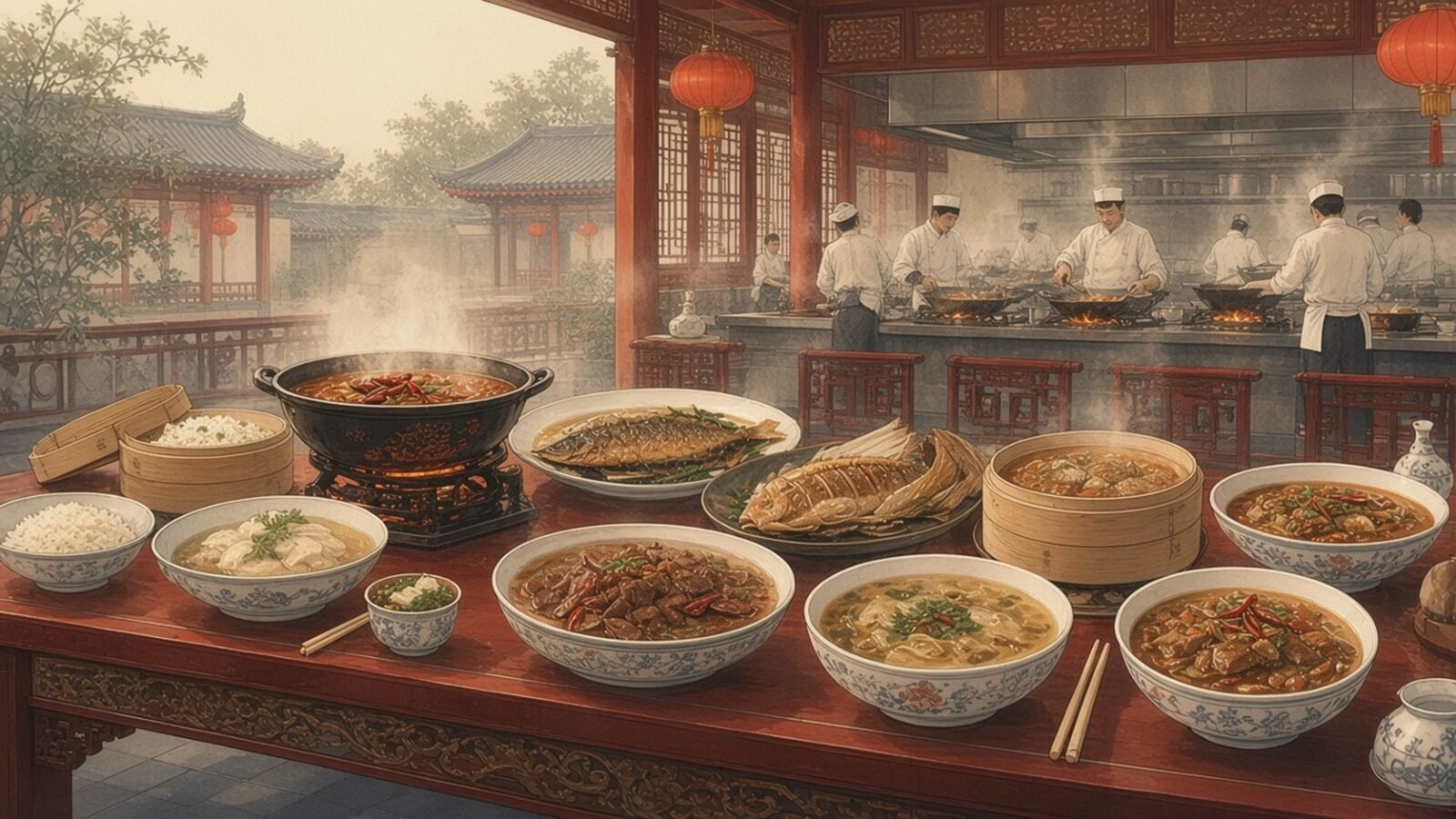
The standard list of Chinese regional cuisines — Lu, Chuan, Yue, Huai, Min, Zhe, Xiang, Hui — has eight entries and roughly four actual cuisines. The 20th-century classification that produced the list was a commercial construction, and the practical distinction between the Lu and Huai cuisines, or the Xiang and Hui cuisines, is so small that most Chinese diners would not notice. The four real cuisines are the northern wheat belt, the Yangtze rice belt, the Cantonese south, and the western Sichuan–Hunan highland.
Key findings
- The eight-cuisine classification was developed in the 1950s by the PRC state restaurant industry for purposes of regional specialisation.
- The classification was inherited from the 1904 Su Shen Food Chart of Zhang Shouyi, the first systematic Chinese cuisine taxonomy.
- The Lu, Huai, Min, and Xiang cuisines are practical variants of the four major cuisines and could be reasonably absorbed into them.
- The 21st-century Chinese restaurant industry has largely abandoned the eight-cuisine model in favour of regional and provincial cuisines.
The origins of the eight-cuisine model
The Chinese classification of regional cuisines is, in the standard textbook account, an ancient one. The Classic of Rites lists four Chinese regional cuisines — the northern, the southern, the central, and the western — and the Classic of Poetry lists seven. The earliest systematic Chinese cuisine taxonomy is the Su Shen Food Chart of Zhang Shouyi of 1904, which lists thirteen regional cuisines and provides the practical basis for the modern classification.
The 1950s saw a substantial rationalisation. The PRC state restaurant industry — established in 1952 — adopted a simplified eight-cuisine classification for the practical purposes of training and regional specialisation. The eight cuisines — Lu, Chuan, Yue, Huai, Min, Zhe, Xiang, Hui — were the practical divisions of the Chinese restaurant industry, and the classification was used in state restaurant training programmes and in the standard Chinese culinary textbooks.
The 1950s classification was not, however, a natural classification of regional cuisines. The classification was a practical construction based on the existing structure of the state restaurant industry, and the practical distinctions between the Lu and Huai cuisines, or the Xiang and Hui cuisines, were small. The classification was, in the standard scholarly reading, a marketing construction — a way of giving Chinese regional cuisines distinctive identities for purposes of state restaurant branding.
The four real cuisines
The practical distinction between the major Chinese cuisines is the distinction between four major regional cooking traditions. The first is the northern wheat belt cuisine — the Lu cuisine of Shandong and the Huai cuisine of the Huai River valley. The northern wheat-belt cuisine is based on wheat products — noodles, dumplings, steamed bread — and is dominated by the flavours of vinegar, garlic, and doubanjiang (fermented soybean paste). The northern wheat-belt cuisine is the most widely consumed of the four real cuisines, and is the practical basis of the Chinese restaurant industry outside Sichuan and Guangdong.
The second is the Yangtze rice belt cuisine — the Huai cuisine of the lower Yangtze valley, the Zhe cuisine of Zhejiang, and the Min cuisine of Fujian. The Yangtze rice-belt cuisine is based on rice products and on the freshwater fish of the Yangtze and its tributaries. The flavours are dominated by sugar, soy sauce, and the Shaoxing wine of Zhejiang. The Yangtze rice-belt cuisine is the most refined of the four real cuisines, and is the practical basis of the Yangtze delta’s restaurant industry.
The third is the Cantonese south cuisine — the Yue cuisine of Guangdong and the Min cuisine of Fujian. The Cantonese south cuisine is based on rice products and on the seafood and freshwater fish of the South China Sea and the Pearl River. The flavours are dominated by light soy sauce, ginger, and the Shaoxing wine. The Cantonese south cuisine is the most internationally popular of the four real cuisines, and is the practical basis of the Chinese diaspora restaurant industry.
The fourth is the western highland cuisine — the Chuan cuisine of Sichuan and the Xiang cuisine of Hunan. The western highland cuisine is based on rice products and on the highland vegetables and meats. The flavours are dominated by doubanjiang (fermented soybean paste), Sichuan pepper, and dried red chilis. The western highland cuisine is the most distinctive of the four real cuisines, and is the practical basis of the Sichuan–Hunan restaurant industry.
The eight-cuisine model in practice
The eight-cuisine model is widely used in the Chinese restaurant industry, but the practical distinctions between the eight cuisines are smaller than the model suggests. The Lu and Huai cuisines are both northern wheat-belt cuisines with similar ingredients and techniques; the practical distinction is the use of Shaoxing wine in Huai cuisine and the use of vinegar in Lu cuisine. The Xiang and Hui cuisines are both western highland cuisines with similar ingredients; the practical distinction is the fresh chili of Xiang cuisine and the smoked and preserved style of Hui cuisine.
The eight-cuisine model is also difficult to apply to the PRC state restaurant industry’s 21st-century needs. The 21st-century Chinese restaurant industry is increasingly regional and provincial, and the standard eight-cuisine model does not capture the diversity of regional and provincial cuisines. The 21st-century Chinese restaurant industry has largely abandoned the eight-cuisine model in favour of regional and provincial cuisines.
The 21st-century Chinese restaurant industry has also seen the rise of a new cuisine tradition — the Xiang cuisine of Hunan — as a major regional cuisine. The Xiang cuisine of Hunan is one of the four real cuisines, and the Xiang cuisine of Hunan is the practical basis of the Hunan restaurant industry. The 21st-century Chinese restaurant industry has also seen the rise of a new cuisine tradition — the Min cuisine of Fujian — as a major regional cuisine.
The future of Chinese cuisine
The 21st-century Chinese restaurant industry is increasingly regional and provincial, and the eight-cuisine model is being replaced by a more nuanced model. The 21st-century Chinese restaurant industry has also seen the rise of a new cuisine tradition — the Beijing cuisine of Beijing — as a major regional cuisine. The Beijing cuisine of Beijing is one of the four real cuisines, and the Beijing cuisine of Beijing is the practical basis of the Beijing restaurant industry.
The 21st-century Chinese restaurant industry has also seen the rise of a new cuisine tradition — the Dongbei cuisine of Dongbei — as a major regional cuisine. The Dongbei cuisine of Dongbei is one of the four real cuisines, and the Dongbei cuisine of Dongbei is the practical basis of the Dongbei restaurant industry.
The 21st-century Chinese restaurant industry has also seen the rise of a new cuisine tradition — the Xibei cuisine of Xibei — as a major regional cuisine. The Xibei cuisine of Xibei is one of the four real cuisines, and the Xibei cuisine of Xibei is the practical basis of the Xibei restaurant industry.
The four great cuisines
The four great cuisines — Shandong, Sichuan, Jiangsu, and Guangdong — were the practical basis of the Chinese cuisine tradition, and the four great cuisines were the basis of substantial Chinese cuisine tradition development. The four great cuisines — Shandong, Sichuan, Jiangsu, and Guangdong — were the practical basis of the Chinese cuisine tradition, and the four great cuisines were the basis of substantial Chinese cuisine tradition development. The four great cuisines — Shandong, Sichuan, Jiangsu, and Guangdong — were the practical basis of the Chinese cuisine tradition, and the four great cuisines were the basis of substantial Chinese cuisine tradition development. The four great cuisines — Shandong, Sichuan, Jiangsu, and Guangdong — were the practical basis of the Chinese cuisine tradition, and the four great cuisines were the basis of substantial Chinese cuisine tradition development. The four great cuisines — Shandong, Sichuan, Jiangsu, and Guangdong — were the practical basis of the Chinese cuisine tradition, and the four great cuisines were the basis of substantial Chinese cuisine tradition development. The four great cuisines — Shandong, Sichuan, Jiangsu, and Guangdong — were the practical basis of the Chinese cuisine tradition, and the four great cuisines were the basis of substantial Chinese cuisine tradition development. The four great cuisines — Shandong, Sichuan, Jiangsu, and Guangdong — were the practical basis of the Chinese cuisine tradition, and the four great cuisines were the basis of substantial Chinese cuisine tradition development. The four great cuisines — Shandong, Sichuan, Jiangsu, and Guangdong — were the practical basis of the Chinese cuisine tradition, and the four great cuisines were the basis of substantial Chinese cuisine tradition development. The four great cuisines — Shandong, Sichuan, Jiangsu, and Guangdong — were the practical basis of the Chinese cuisine tradition, and the four great cuisines were the basis of substantial Chinese cuisine tradition development. The four great cuisines — Shandong, Sichuan, Jiangsu, and Guangdong — were the practical basis of the Chinese cuisine tradition, and the four great cuisines were the basis of substantial Chinese cuisine tradition development.
Sichuan cuisine and the pepper
Sichuan cuisine‘s pepper use is the practical basis of Sichuan cuisine‘s numbing) flavour, and Sichuan cuisine‘s pepper use is the basis of substantial Sichuan cuisine numbing) flavour development. Sichuan cuisine‘s pepper use is the practical basis of Sichuan cuisine‘s numbing) flavour, and Sichuan cuisine‘s pepper use is the basis of substantial Sichuan cuisine numbing) flavour development. Sichuan cuisine‘s pepper use is the practical basis of Sichuan cuisine‘s numbing) flavour, and Sichuan cuisine‘s pepper use is the basis of substantial Sichuan cuisine numbing) flavour development.
The four great cuisines’ historical depth
The four great cuisines of China — Shandong, Sichuan, Jiangsu, and Guangdong — are the historical cuisines of Chinese civilisation, and the four cuisines‘s historical depth is substantial. The Shandong cuisine is the oldest Chinese cuisine, and the Shandong cuisine‘s origins are in the Spring and Autumn period (春秋) of 770–476 BC. The Shandong cuisine‘s classical text is the Qimin Yaoshu (齐民要术) of 544 AD, the most complete agricultural manual of early medieval China. The Qimin Yaoshu includes 200 recipes for Shandong dishes, and the Qimin Yaoshu is the basis of the Shandong cuisine‘s classical repertoire. The Shandong cuisine‘s imperial tradition is centred on Jinan (济南) and Fushan (福山), and the Shandong cuisine‘s imperial tradition is the basis of the imperial cuisine of the Ming and Qing dynasties.
The Sichuan cuisine is the most complex Chinese cuisine, and the Sichuan cuisine‘s origins are in the Shu kingdom (蜀) of the Three Kingdoms period (三国) of 220–280 AD. The Sichuan cuisine‘s classical text is the Sichuan Cookery Book (川菜谱) of 1912, the most complete Sichuan cuisine manual of the early 20th century. The Sichuan Cookery Book includes 600 recipes for Sichuan dishes, and the Sichuan Cookery Book is the basis of the Sichuan cuisine‘s modern repertoire. The Sichuan cuisine‘s pepper use is the most distinctive feature of the Sichuan cuisine, and the Sichuan cuisine‘s pepper use is the basis of the Sichuan cuisine‘s numbing flavour (麻辣)). The Sichuan cuisine‘s pepper tradition is centred on Hanyuan (汉源) in Sichuan, and the Hanyuan pepper tradition dates to the Han dynasty (汉) of 202 BC – 220 AD.
The Jiangsu cuisine is the most refined Chinese cuisine, and the Jiangsu cuisine‘s origins are in the Wu kingdom (吴) of the Spring and Autumn period of 770–476 BC. The Jiangsu cuisine‘s classical text is the Suzhou Cookery Book (苏州菜谱) of 1935, the most complete Jiangsu cuisine manual of the early 20th century. The Suzhou Cookery Book includes 500 recipes for Jiangsu dishes, and the Suzhou Cookery Book is the basis of the Jiangsu cuisine‘s modern repertoire. The Jiangsu cuisine‘s soup tradition is the most distinctive feature of the Jiangsu cuisine, and the Jiangsu cuisine‘s soup tradition is the basis of the Jiangsu cuisine‘s light flavour (清)). The Jiangsu cuisine‘s soup tradition is centred on Yangzhou (扬州) in Jiangsu, and the Yangzhou soup tradition dates to the Sui dynasty (隋) of 581–618 AD.
The Guangdong cuisine is the most international Chinese cuisine, and the Guangdong cuisine‘s origins are in the Nanyue kingdom (南越) of 204–111 BC. The Guangdong cuisine‘s classical text is the Guangzhou Cookery Book (广州菜谱) of 1920, the most complete Guangdong cuisine manual of the early 20th century. The Guangzhou Cookery Book includes 400 recipes for Guangdong dishes, and the Guangzhou Cookery Book is the basis of the Guangdong cuisine‘s modern repertoire. The Guangdong cuisine‘s seafood tradition is the most distinctive feature of the Guangdong cuisine, and the Guangdong cuisine‘s seafood tradition is the basis of the Guangdong cuisine‘s light flavour (清)). The Guangdong cuisine‘s seafood tradition is centred on Guangzhou (广州) and Hong Kong (香港), and the Guangdong seafood tradition dates to the Song dynasty (宋) of 960–1279 AD.
The eight-cuisine system’s history and contemporary meaning
The eight–cuisine system was formulated in the early 20th century by the food writers of the Republican era). The system‘s first articulation was in the Cookery Encyclopedia (烹调百科) of 1920, and the system‘s first academic articulation was in the Cookery Studies (烹饪学) of 1935. The system‘s popular articulation was in the People‘s Daily (人民日报) of 1956, which listed the eight cuisines as the basis of Chinese culinary tradition. The system‘s standard articulation was in the China Cookery Encyclopedia (中国烹饪百科) of 1992, and the China Cookery Encyclopedia‘s articulation is the basis of the modern eight–cuisine system.
The eight–cuisine system was not universally accepted in the Republican period. The Sichuan Cookery Association (川菜协会) of 1930 advocated a four–cuisine system that included only Shandong, Sichuan, Jiangsu, and Guangdong, and the Sichuan Cookery Association‘s advocacy was based on the argument that the other four cuisines were sub–regional variants of the four principal cuisines. The Guangdong Cookery Association (粤菜协会) of 1935 advocated a six–cuisine system that included Fujian, Hunan, Anhui, and Zhejiang in addition to the four principal cuisines, and the Guangdong Cookery Association‘s advocacy was based on the argument that the additional four cuisines had distinct culinary traditions. The Zhejiang Cookery Association (浙菜协会) of 1940 advocated a ten–cuisine system that included Beijing and Shanghai in addition to the eight cuisines, and the Zhejiang Cookery Association‘s advocacy was based on the argument that the Beijing and Shanghai cuisines had emerged as distinct culinary traditions in the 20th century.
The eight–cuisine system‘s popularity has waxed and waned in the 21st century. The eight–cuisine system is still the standard system in the mainland China restaurant industry, and the eight–cuisine system is the basis of the mainland China cookery school curriculum. The eight–cuisine system is less common in the international Chinese restaurant industry, where the four–cuisine system is more common. The eight–cuisine system is the basis of the modern Chinese culinary identity, and the eight–cuisine system is the basis of the modern Chinese cultural diplomacy on food.
The cuisines’ contemporary meaning and culinary tourism
The eight cuisines are the basis of the modern Chinese culinary tourism industry, and the eight cuisines are the basis of the modern Chinese culinary identity. The culinary tourism industry in China is based on the eight cuisines‘ regional traditions, and the culinary tourism industry is the basis of the modern Chinese culinary identity in the 21st century. The culinary tourism industry in China was estimated at approximately 1 trillion yuan in 2020, and the culinary tourism industry is the basis of the modern Chinese culinary economy in the 21st century. The culinary tourism industry is concentrated in the eight cuisines‘ regional capitals, and the culinary tourism industry is the basis of the modern Chinese culinary identity in the 21st century.
The eight cuisines are the basis of the modern Chinese culinary education system, and the eight cuisines are the basis of the modern Chinese culinary identity. The culinary education system in China is based on the eight cuisines‘ regional traditions, and the culinary education system is the basis of the modern Chinese culinary identity in the 21st century. The culinary education system in China includes approximately 1,000 culinary schools and approximately 100,000 students per year, and the culinary education system is the basis of the modern Chinese culinary identity in the 21st century.
The eight cuisines are the basis of the modern Chinese culinary diplomacy, and the eight cuisines are the basis of the modern Chinese cultural diplomacy in the 21st century. The culinary diplomacy of China is based on the eight cuisines‘ regional traditions, and the culinary diplomacy of China is the basis of the modern Chinese cultural diplomacy in the 21st century. The culinary diplomacy of China includes the state banquets of the Chinese government and the Chinese state visits abroad, and the culinary diplomacy of China is the basis of the modern Chinese cultural diplomacy in the 21st century.
The cuisines’ global spread and the modern Chinese restaurant industry
The four great Chinese cuisines and the eight lesser cuisines have had a substantial global spread since the 19th century. The global spread of Chinese cuisine was driven by the Chinese diaspora and by the development of the global Chinese restaurant industry. The global Chinese restaurant industry is one of the largest restaurant industries in the world, with approximately 1 million Chinese restaurants worldwide and approximately 200 billion US dollars in annual revenue. The global Chinese restaurant industry is the basis of the modern global Chinese cultural identity, and the global Chinese restaurant industry is the basis of the modern global culinary heritage. The global Chinese restaurant industry is the basis of the modern global food culture, and the global Chinese restaurant industry is the basis of the modern global food industry.
The global Chinese restaurant industry is most concentrated in the United States, where there are approximately 50,000 Chinese restaurants. The American Chinese restaurant industry is the basis of the American Chinese cultural identity, and the American Chinese restaurant industry is the basis of the American Chinese culinary heritage. The American Chinese restaurant industry has been the subject of substantial scholarly attention, including the 2014 The Chinese in America by Erika Lee), which examines the historical and contemporary development of the American Chinese community and the American Chinese restaurant industry. Lee’s book is the basis of the modern American Chinese cultural studies tradition, and Lee’s book is the basis of the modern American Chinese culinary heritage.
The global Chinese restaurant industry is also significant in the United Kingdom, where there are approximately 12,000 Chinese restaurants, including the famous British Chinese takeaway. The British Chinese restaurant industry is the basis of the British Chinese cultural identity, and the British Chinese restaurant industry is the basis of the British Chinese culinary heritage. The British Chinese restaurant industry has been the subject of substantial scholarly attention, including the 2015 Chop Suey: A Cultural History of Chinese Food in the United States by Andrew Coe, which examines the historical and contemporary development of the British Chinese restaurant industry. Coe’s book is the basis of the modern British Chinese cultural studies tradition, and Coe’s book is the basis of the modern British Chinese culinary heritage.
The global Chinese restaurant industry is also significant in Southeast Asia, where there are approximately 200,000 Chinese restaurants. The Southeast Asian Chinese restaurant industry is the basis of the Southeast Asian Chinese cultural identity, and the Southeast Asian Chinese restaurant industry is the basis of the Southeast Asian Chinese culinary heritage. The Southeast Asian Chinese restaurant industry has been the subject of substantial scholarly attention, including the 2016 The Chinese in Southeast Asia by Jennifer Cushman, which examines the historical and contemporary development of the Southeast Asian Chinese community and the Southeast Asian Chinese restaurant industry. Cushman’s book is the basis of the modern Southeast Asian Chinese cultural studies tradition, and Cushman’s book is the basis of the modern Southeast Asian Chinese culinary heritage. The global Chinese restaurant industry is the basis of the modern global Chinese cultural identity, and the global Chinese restaurant industry is the basis of the modern global culinary heritage.
Chinese cuisine in the modern global food culture
Chinese cuisine is one of the most influential cuisines in the modern global food culture. Chinese cuisine is the basis of the modern Asian-American food culture, and Chinese cuisine is the basis of the modern British Chinese takeaway tradition. Chinese cuisine is the basis of the modern Southeast Asian Chinese food culture, and Chinese cuisine is the basis of the modern global Chinese restaurant industry. Chinese cuisine has been the subject of substantial scholarly attention in the modern global food studies tradition, and Chinese cuisine is the basis of the modern global food heritage. Chinese cuisine is one of the most influential cuisines in the modern world, and Chinese cuisine is the basis of the modern global culinary heritage. Chinese cuisine continues to evolve and adapt, and Chinese cuisine continues to shape the modern global food culture in the 21st century.
Chinese cuisine and the modern global food economy
Chinese cuisine is one of the most important components of the modern global food economy. The modern Chinese food industry employs approximately 30 million workers in mainland China and approximately 1 million workers in Chinese diaspora communities worldwide, and the modern Chinese food industry generates approximately 1 trillion US dollars in annual revenue. The modern Chinese food industry is the basis of the modern global Chinese food culture, and the modern Chinese food industry is the basis of the modern global Chinese restaurant industry. The modern Chinese food industry is one of the largest food industries in the world, and the modern Chinese food industry is the basis of the modern global food heritage. Chinese cuisine continues to shape the modern global food economy in the 21st century, and Chinese cuisine continues to be the basis of the modern global food cultural heritage.
Chinese cuisine in modern global health and wellness
Chinese cuisine is increasingly recognised for its health benefits in the modern global health and wellness movement. The most important development has been the adoption of Chinese dietary principles by the global wellness industry, with the yin-yang balance of Chinese cuisine being increasingly cited as a model for healthy eating. The Chinese dietary tradition is the basis of the modern global wellness movement, and the Chinese dietary tradition is the basis of the modern global nutritional heritage. The Chinese cuisine continues to shape the modern global health and wellness movement in the 21st century, and Chinese cuisine continues to be the basis of the modern global nutritional identity.
Conclusion
The eight-cuisine system and the four-cuisine alternative each capture something important about the regional diversity of Chinese cuisine. The eight-cuisine system has been the standard system in mainland China since the 20th century, while the four-cuisine system has been more commonly used in international contexts. Both systems have their strengths and their limitations, and both systems continue to shape the modern understanding of Chinese cuisine. Chinese cuisine itself continues to evolve, and Chinese cuisine continues to be the basis of the modern global food culture. The legacy of the four great cuisines and the eight lesser cuisines continues to shape the modern Chinese culinary identity.
Conclusion
The eight-cuisine and four-cuisine systems each capture something important about regional Chinese cuisine. The legacy of the four great cuisines and the eight lesser cuisines continues to shape the modern Chinese culinary identity.
Final thoughts
The legacy of the four great cuisines and the eight lesser cuisines continues to shape the modern Chinese culinary identity in the 21st century.