The Pharmacy Behind the Pharmacy
The pill in a Western blister pack is a finished object. It has a brand, a barcode, a country of origin printed on the carton that is usually India, Ireland, Germany, or the United States. That label is not a lie. It is a truncation. Behind the tablet sits a shorter, uglier, more decisive object: a white powder or a wet cake made in a plant that most patients will never hear named. The powder is the active pharmaceutical ingredient. The plant is often Chinese. The hospital that depends on the tablet depends, one or two chemical steps earlier, on a fermentation tank in Hebei or a fluorination line in Zhejiang. That is the pharmacy behind the pharmacy.
Western commentary has learned to say this in the register of alarm. Hearings produce a single number—eighty percent, ninety percent—and then treat the number as a strategy. The number is usually wrong in the aggregate and right in the places that matter. Careful work by Brookings and others puts direct Chinese-made API at something closer to a quarter of United States drug volume by unit, not a near-monopoly of every bottle on the shelf. The same work, and a pile of congressional and industry testimony since, shows something sharper: China is not evenly present across medicine. It is concentrated where chemistry is dirty, capital-intensive, and unglamorous. Fermentation antibiotics. Heparin. Vitamin C. Paracetamol and ibuprofen. The key starting materials that sit even further upstream than the API itself. Forty-one percent of those starting materials used in United States–approved actives are produced only in China. For some classes—certain sartans, some glucose-lowering drugs, some antivirals—the sole-source share is higher still.
That is not a map of “cheap labour won again.” It is a map of who kept the tanks running when everyone else decided the smell was someone else’s problem.
How the map reversed
In 1981, according to Drug Master Files compiled from Food and Drug Administration records, Europe accounted for about sixty-three percent of active API filings and the United States for about twenty-five. China and India were rounding errors. By 2024 the files had inverted. China held about forty-five percent, India about forty-three, Europe six, the United States three. The West did not lose a secret formula. It closed plants that made intermediates nobody wanted next to a suburb, and bought the output from parks that still accepted the effluent, the coal, and the night shift.
Two specialisations hardened. China kept and thickened the bottom of the funnel: bulk fermentation, chlorination and fluorination, solvent-heavy routes, the first two or three steps that turn a petrochemical or a corn sugar into something a chemist will later call an intermediate. India specialised in the later synthesis and in the finished generic tablet that Western pharmacies actually stock. Indian firms and the Indian government have said, in public, that they draw some sixty-five to eighty percent of key starting materials, intermediates, and many APIs from China. A tablet “made in Hyderabad” can be a Chinese molecule in an Indian coating. The carton is not designed to teach that sentence.
The reversal had a method. Provincial chemical parks in Jiangsu, Zhejiang, and Shandong gathered the organic-synthesis houses. Hebei, with Shijiazhuang as its old antibiotic capital, and the corn-and-coal belt of Inner Mongolia gathered the fermentation tanks. Corn starch becomes sugar. Sugar feeds a microorganism. The organism secretes a penicillin nucleus or a statin precursor or a vitamin. The broth is extracted, crystallised, dried, drummed, and sold to someone who will finish the molecule somewhere else. The work needs cheap carbohydrates, cheap power, large plots, and a regulator willing to live with an industrial smell. Those are place advantages. They are also policy advantages. Once the parks existed, volume did what volume does: yields rose, unit costs fell, European and American fermenters shut, and the next tender was awarded to the plant that still had a working seed bank.
Vitamin C and penicillin in the early 2000s were the demonstration projects. Chinese producers flooded the market at prices that hollowed out Western capacity. Lawsuits followed. Capacity did not come home. The lesson, for purchasing departments, was simple. The lesson, for anyone who thinks about wartime antibiotics or a winter of pediatric amoxicillin, was delayed by twenty years.
The tanks
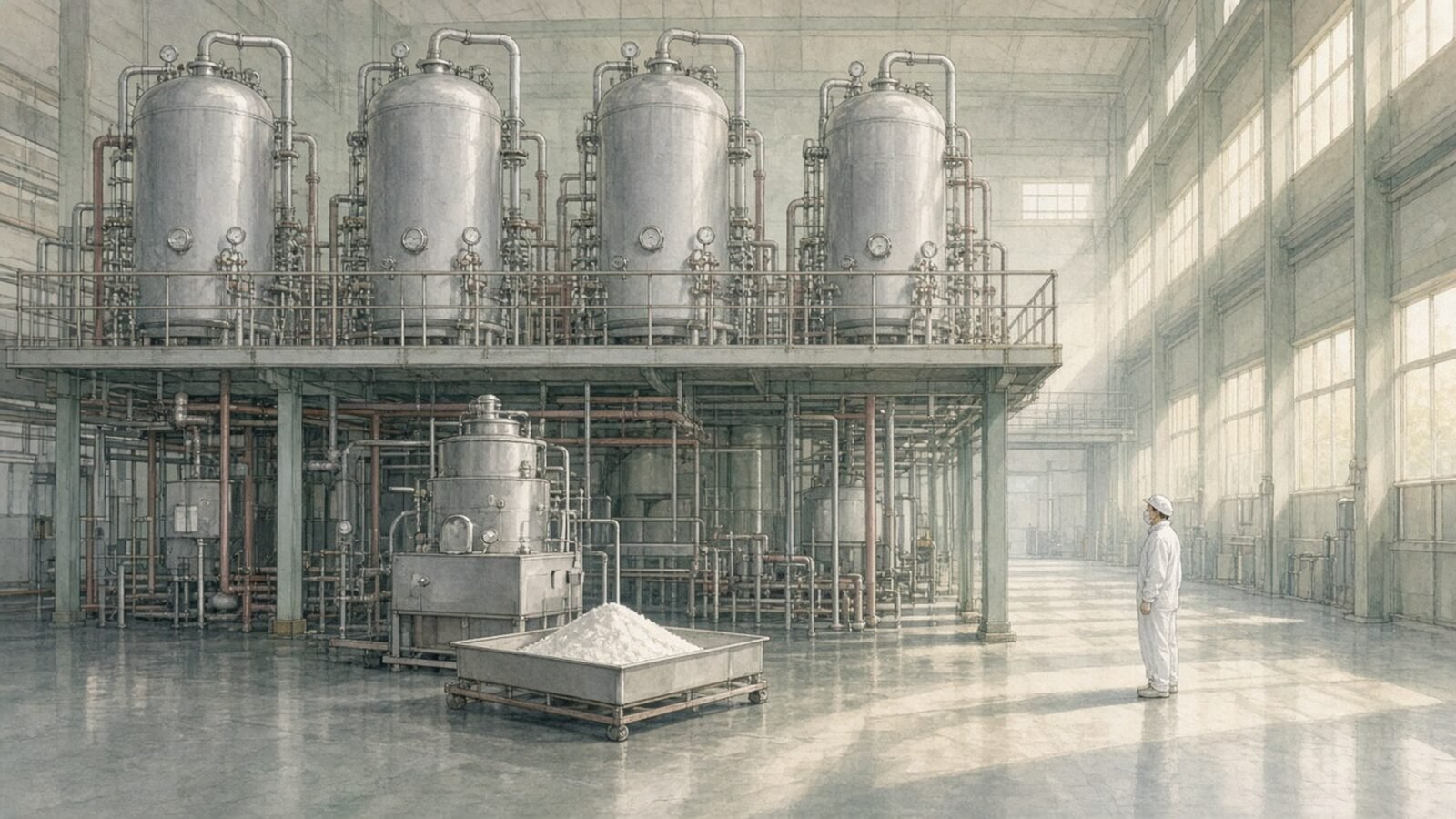
A fermentation hall is not a clean room in the popular sense. It is a room of steel cylinders, some of them storeys high, piped for air, steam, and ammonia, watched by technicians who think in batches and contamination events. North China Pharmaceutical in Shijiazhuang and firms in the same Hebei cluster spent decades as the state’s answer to infection. Inner Mongolia’s bio-industrial parks—Chifeng, Tongliao, and the wider corn belt—added scale where land and feed were cheaper than on the coast. Jiangsu and Zhejiang added the synthetic steps that fermentation cannot do: the fluorine atoms that turn up in statins, sartans, and a surprising share of modern small-molecule drugs.
Heparin is the animal version of the same logic. The world’s crude heparin still begins, in large part, in Chinese slaughterhouses and processing plants. More than twelve million hospitalised Americans receive the drug in a typical year. In 2007 and 2008, over-sulfated chondroitin sulfate in crude heparin of Chinese origin was implicated in a crisis that killed dozens of patients in the United States. The episode is the industry’s permanent reminder that upstream opacity is not a metaphor. It is a contaminant in a vial.
Amoxicillin is the civilian version. Physicians in the United States write tens of millions of prescriptions a year. Finished tablets come from India, Europe, Israel, Jordan, and a thin domestic remainder. The 6-aminopenicillanic acid nucleus that makes the molecule possible is overwhelmingly Chinese. Five firms have been described in recent testimony as holding more than four-fifths of world production of that nucleus. If those plants stop, the shortage does not begin in Beijing. It begins in a pediatric clinic that cannot fill a pink bottle.
Paracetamol, ibuprofen, tetracyclines, and ascorbic acid tell the same story at grocery-store scale. Import shares into the United States for several of those actives have been reported in the seventy-to-ninety percent range from China. Those figures are more honest than a single “China makes all our medicine” headline, and more useful. They name the molecules.
The inspector and the park
The plants that sell into regulated Western markets are not lawless sheds. They file Drug Master Files. They host inspectors. They fail inspections. The Food and Drug Administration still issues warning letters to Chinese API makers for the ordinary sins of the trade: impurity methods taken from the Chinese Pharmacopoeia rather than the United States Pharmacopeia, missing stability data, quality units that exist on a chart and not on the floor. Import alerts follow. European inspectors write their own versions. The paper trail is long. It is also thinner than the trail behind a plant in New Jersey, because a foreign inspection is a scheduled event. Until recently, a firm in Xuancheng or Chengdu generally knew the week the Americans were coming. A 2025 turn toward unannounced foreign inspections, after a China-and-India pilot, is an admission of that gap, not a closure of it.
None of this makes Chinese API uniquely dangerous, and none of it makes it uniquely safe. It makes it a production system that grew faster than the inspection apparatus that was supposed to follow it, in a country where provincial growth targets and environmental crackdowns arrive in waves. When Beijing tightens effluent rules, parks close and supply tightens. When parks reopen, prices fall and Western buyers return. The buyer’s memory is short. The tank is still in Hebei.
There is a second pharmacy behind the first that receives even less attention: the solvent, the catalyst, the fluorine chemistry, the corn. A country can build a finished-dose plant in two years. It cannot will a competitive fermentation organism and a qualified solvent chain into existence on an election cycle. That is why “reshore antibiotics” speeches keep ending in a request for Chinese intermediates.
What the dependence is, and is not
It is not true that every American or European prescription is a Chinese powder. Branded specialty drugs, biologics, and many high-value actives are still made in the old industrial countries, or in Singapore, or in Ireland. It is not true that India is a mere pass-through. Indian process chemistry is real. It is not true that Chinese firms only copy. Process improvement at this scale is a form of knowledge, the same way battery yields are knowledge.
What is true is narrower and harder.
First, the West sold the bottom of its own funnel and kept the label on the bottle. That was a commercial decision dressed, later, as a strategic surprise.
Second, the risk is not evenly spread across “pharma.” It sits in the essential, cheap, high-volume molecules and in the starting materials that have no second address. A conflict, a flood in a Jiangsu park, a contamination event, or an export licence regime copied from rare earths would not empty every cabinet. It would empty particular cabinets first: antibiotics, anticoagulants, basic analgesics, some hospital injectables.
Third, China is not a single factory. Jiangsu is not Inner Mongolia. A coastal synthesis park under a different environmental inspector is not a Hebei fermenter running on coal-fired steam. Treating “China API” as one object is how policy gets the tariff wrong and the stockpile wrong at the same time.
Fourth, inspection is part of the supply chain. A drum that has never seen an unannounced inspector is a different product from a drum that has, even if the certificate of analysis looks the same.
The rhyme
Huaxia’s other industrial essays keep returning to the same instinct: treat capacity as a problem of place. The Grand Canal moved grain. The battery belt moved electrochemical capacity from inland salt to coastal cells. The pharmacy behind the pharmacy moves molecular capacity from corn belts and chemical parks into the sterile rooms that the public is allowed to photograph.
The uncomfortable fact is not that China makes medicine. China has made medicine for a very long time; the archive that produced artemisinin is older than the FDA. The uncomfortable fact is that the modern world arranged itself so that the least visible step became the most concentrated, and then printed the visible step on the box.
A Western hospital can hire more pharmacists. It cannot, on a Tuesday, hire a second global source of 6-APA. Until it can, the pharmacy that matters is the one that never appears on the carton.