The Poison That Opened China
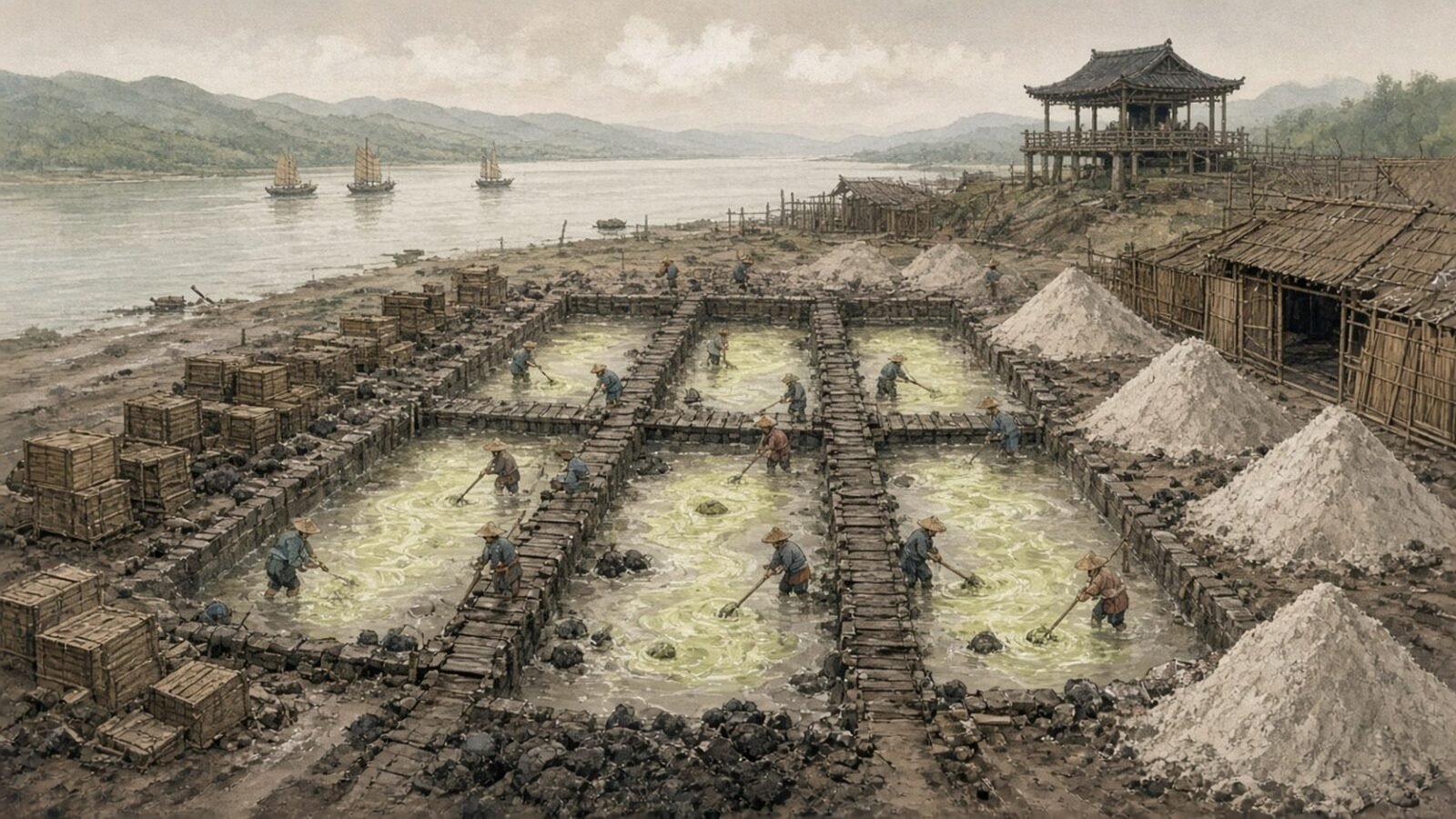
For twenty-three days in June 1839, on a muddy flat by the mouth of the Pearl River, five hundred labourers destroyed the most valuable cargo in the history of the China trade. Into three great trenches, each the length of a cricket pitch, lined with stone and filled with brine, they tipped the contents of 20,283 chests of opium, some two and a half million pounds of it, broke the black balls underfoot, stirred the paste into the water with long poles, and scattered quicklime over the surface until the trenches frothed and steamed. Then they opened the sluices and let the tide carry the residue out to sea. Watching from a raised pavilion, in full ceremonial dress, was the imperial commissioner Lin Zexu, the most feared and most honest official in the Qing empire. Before the work began he had composed a prayer to the god of the Southern Sea, apologizing in advance for poisoning his waters and asking him to warn the fish and turtles to keep away until the poison had dispersed. It was an extraordinary gesture, and an accurate self-portrait of the man: meticulous, moral, operating inside a cosmology his enemies did not share, and utterly serious about what he was doing. Within a year Britain had sent a fleet to make him pay for it.
This essay is the third in a series that began with the two embassies that failed at Beijing over ceremony, and with the prisoner of St Helena who said that war with China would end by teaching China the arts of war. Here is the war’s cause. The destruction at Humen was not the opening of the Opium War; it was the act that made the war inevitable, the moment when sixty years of tolerated smuggling collided with the first Chinese official prepared to treat the law as law. To understand why an imperial commissioner dissolved twenty thousand chests of drugs in tidal trenches, you have to understand what opium had become by 1839: not a contraband sideline but the financial engine of the British position in Asia, and the solvent in which the Qing fiscal system was quietly dissolving.
The silver problem
The background is the trade imbalance that had already launched the Macartney and Amherst embassies. Britain’s appetite for Chinese tea was insatiable and growing: by the 1830s some thirty million pounds of it a year crossed the docks of London, and the duty on tea, together with the East India Company’s profits, supplied roughly a tenth of the British government’s revenue. China, for its part, wanted almost nothing that Britain made. Its own manufactures of silk, porcelain, lacquer and tea supplied the world; its internal market dwarfed anything Europe could offer; and the court, as Qianlong had explained to George III, did not value ingenious articles. The imbalance was settled in silver, which flowed east in a river for most of the eighteenth century. Both empires regarded this as a fact of nature. The problem for London was that facts of nature are expensive, and the Company’s treasury could not bleed bullion forever.
Opium was the answer, and everyone involved understood that it was an answer of a particular kind. The drug had been smoked in China in quantity since the early eighteenth century, and the Qing had banned its sale for smoking as early as 1729, with the prohibition stiffened under the Jiaqing Emperor in 1796 and 1800 into a full ban on import and domestic cultivation. It was, in other words, illegal, and remained illegal throughout the entire period of its greatest expansion. What changed in the late eighteenth century was not the law but the supply. In 1773 the East India Company established a monopoly over opium production in Bengal, and by the 1790s it controlled the finest opium in the world, grown under licence in Bihar and Benares, processed at Patna and Ghazipur, and packed into the standardized chests, each holding about 140 pounds of the drug, that became the unit of the trade.
A monopoly with clean hands
The Company’s arrangement with its own product was a masterpiece of institutional hypocrisy, and it deserves a paragraph of its own because it set the moral tone for everything that followed. The Company would not carry opium to China. Its own ships were forbidden to touch the drug, and its directors could honestly tell Parliament that the honourable Company engaged in no smuggling. What it did instead was auction the chests in Calcutta to private merchants, the so-called country traders, who carried the opium to the China coast and sold it to Chinese smugglers. The Company then required the proceeds to be paid into its treasury at Canton in exchange for bills on London or Calcutta, which financed the purchase of tea. Every link in the chain was legal in the place where it was performed. The illegality was outsourced to the Chinese shore, where it belonged, from the Company’s point of view, to someone else. The system satisfied the demands of commerce, the demands of the Exchequer, and the demands of conscience, in that order, and it ran for decades.
The quantities tell the story. In the 1770s perhaps a thousand chests a year reached China. By the 1820s the figure was around four to five thousand, by 1830 approaching twenty thousand, and by the late 1830s something like forty thousand chests a year, a flood enlarged after 1831 by competition from Malwa opium grown in the princely states of western India and after 1834 by the abolition of the Company’s China monopoly, which threw the trade open to every free merchant who could charter a ship. The physical infrastructure of smuggling grew up alongside: receiving ships, old hulks permanently anchored at Lintin Island in the Pearl River estuary, where the chests were stored offshore; fleets of Chinese fast boats, the notorious fast crabs and scrambling dragons, rowed by scores of oarsmen, that ran the drug upriver past, and frequently with the connivance of, the water police; and a distribution network reaching, by the 1830s, deep into the interior and far up the coast, where clipper schooners cruised as far north as the Yellow Sea. On some of those clippers sailed the missionary Karl Gützlaff, handing out Bibles from a deck stacked with opium, an image that no satirist improved upon. By 1839 the trade was dominated by two great free-trade houses, Jardine Matheson, founded in 1832 by two Scots, and Dent and Company, and it employed thousands, corrupted officials by the hundred, and moved more silver than any other commerce on earth.
The river runs backward
The consequences for China were exactly the mirror image of the silver problem opium had solved for Britain. From the 1820s the flow of bullion reversed: China, which had absorbed the world’s silver for a century, began to hemorrhage it, millions of ounces a year draining out to pay for the drug. Because the Qing monetary system ran on silver for taxes and copper cash for daily life, with the two linked by an exchange rate, the scarcity of silver was a catastrophe delivered to the poorest people in the empire. A peasant paid his taxes in silver but earned his living in copper, and as silver rose from roughly a thousand cash per tael toward two thousand, his tax bill doubled in real terms without any official having raised it. Landholders were ruined, treasuries emptied, and the court watched its fiscal foundations soften. Meanwhile the drug itself was doing what drugs do. Estimates of the addicted population by the late 1830s ran into the millions, concentrated where the state could least afford it: among clerks, soldiers, and the official class itself, including, it was whispered, men at court. An empire that had turned away two embassies on the ground that it needed nothing from the outside world now needed one thing from it desperately, and that thing was destroying it.
The court’s response, through the 1830s, was a debate, and the debate is worth recovering because it shows how close the Qing came to a different choice. In 1836 the senior official Xu Naiji memorialized in favour of legalization: since prohibition had manifestly failed, he argued, the state should license the trade, barter opium for tea and silk rather than silver, tax it, and restrict its use to commoners while punishing officials and soldiers. The proposal had logic and precedent, and for a while it had momentum. Against it rose the moralist faction, whose most effective voice was Huang Juezi, whose memorial of 1838 proposed attacking demand rather than supply: give smokers a year to quit, and execute those who failed. The draconian proposal clarified the question. Opium, the moralists argued, was not a commodity but a poison, and a state that legalized poison to balance its books had admitted that it governed for the books rather than the people. The Daoguang Emperor, a conscientious man ruling a deteriorating inheritance, agreed. He needed an instrument equal to the policy, and in late 1838 he found one.
The commissioner
Lin Zexu was born in 1785 in Fujian, the province facing Taiwan, into a family of modest means and high seriousness. He took the jinshi degree in 1811, rose through the examination bureaucracy on merit, and made his reputation as the kind of official the Qing system was designed to produce and rarely did: personally incorruptible, obsessively hardworking, technically competent in everything from flood control to famine relief. As governor-general of Hunan and Hubei he had already run the empire’s most successful suppression campaign against opium, confiscating pipes by the thousand and treating addicts with a regime of gradually diminishing doses, an approach that combined moral severity with something like medical sense. He was also, unusually among high mandarins, curious about the West: he employed translators, collected foreign newspapers, and would later compile a gazetteer of the maritime nations. On 31 December 1838 the emperor appointed him imperial commissioner with plenipotentiary powers over the Canton trade, and Lin set off south having already told his sovereign the scale of the stakes. If opium continued to be tolerated, he warned in a famous memorial, then within a few decades the empire would have no soldiers capable of fighting and no silver with which to pay them.
He reached Canton on 10 March 1839 and moved with a speed that stunned the trade. His first blows fell on the Chinese side of the network, where he believed the guilt was greatest: hundreds of dealers, brokers and corrupt runners were arrested in the opening weeks. Then, on 18 March, he turned to the foreigners, with an edict demanding two things: the surrender of every chest of opium in their hands, and signed bonds guaranteeing that any future trader who brought opium to China would suffer death under Chinese law. The demand on the merchants was backed by a demand on the hong merchants, the licensed guild through which all trade passed, and Lin made the leverage physical: the two senior hong merchants, including the immensely wealthy Howqua, one of the richest men in the world, were sent to the foreign factories wearing chains around their necks, to demonstrate what awaited them if the foreigners refused. When the foreigners hesitated, Lin sealed the factories. On 24 March the British chief superintendent of trade, Captain Charles Elliot of the Royal Navy, arrived from Macao, entered the besieged factories in full uniform to share the confinement of his countrymen, and found some 350 foreigners, British, American, Parsi and Indian, blockaded in their warehouses, their servants withdrawn, their food supply controlled by their besiegers.
Elliot’s masterstroke
What Elliot did next was either a brilliant salvage operation or the act that made the war, and it was probably both. On 27 March he ordered every British merchant to surrender his opium not to the Chinese but to him, as the representative of the Crown, promising that the British government would be answerable for its value. The merchants, facing ruin either way, complied with relief. Over the following weeks 20,283 chests were collected from the receiving ships at Lintin and delivered to the commissioner, and in early May the blockade was lifted. Elliot’s manoeuvre transformed the character of the destruction that followed. The opium was no longer smuggled property seized from smugglers; it was British property, surrendered under duress to the Crown’s officer and then destroyed. When news reached London, the merchant houses, led by William Jardine, who travelled home in person in the autumn of 1839 to lobby for war, could present the bill to Palmerston’s government not as a loss but as a claim, and the government’s decision, taken in October 1839, to send an expeditionary force, rested on exactly that construction. The war that followed would be publicly justified as a matter of compensation, honour and diplomatic equality. It would never be officially described as a war for opium, and the Treaty of Nanjing that ended it in 1842 would not mention the drug, while extracting, among its indemnities, six million silver dollars for the chests destroyed at Humen.
Lin, meanwhile, destroyed the opium in June, and did it with the thoroughness he brought to everything. The method at Humen, trenches, brine, lime and tide, was chosen after experiment as the one method that left nothing recoverable. He reported the work to the throne, composed his apology to the sea god, and turned to the question that remained: the bond. No British ship would sign the guarantee of submission to Chinese law, and Elliot forbade it. The standoff curdled in July when a party of British and American sailors, ashore at Kowloon, beat a villager, Lin Weixi, who died the next day. Elliot refused to surrender the suspects to Chinese justice, trying them himself and handing out sentences of derisory lightness; Lin cut off supplies to the British community and ordered them out of Macao; the British took to their ships and anchored off the barren island of Hong Kong, where skirmishes over food and water escalated through the autumn. On 3 November 1839 British warships and a fleet of Chinese war junks exchanged fire at Chuanbi near the Bogue forts. It was the first naval action of the war that had not yet been declared. In London the war party still had to survive Parliament, which it did in April 1840 by nine votes, 271 to 262, in a debate in which a young William Gladstone, whose own sister was an opium addict, delivered the dissent that has outlasted the victory: a war more unjust in its origin, a war more calculated in its progress to cover this country with permanent disgrace, I do not know and I have not read of.
The unmentionable war
The expedition arrived in June 1840, and the military part of the story is quickly told, because Napoleon’s prediction about the early encounters proved exactly right. Steam-powered iron gunboats, most famously the Nemesis, destroyed war junks and shore batteries with an ease that shocked the Qing command; the Bogue forts fell, Canton was ransomed, and when the fleet moved north and seized the island of Zhoushan, threatening the approaches to the Grand Canal and the capital itself, the court’s nerve broke. The Qing were not primitive; they had cannon, forts and large forces. What they lacked was everything industrial: naval architecture, gunnery science, logistics, and above all the ability to concentrate power on the sea, and so they lost the sea and with it the war. Lin Zexu, who had been right about everything except the outcome, was made the scapegoat for the strategy his opponents had failed to provide, dismissed, and exiled to Ili in the far northwest, where he spent his banishment surveying land reclamation and writing, before being recalled in 1845. He died in 1850, on the road to a new assignment against the first stirrings of the Taiping rebellion, which would kill more people than any war between China and the West.
The settlement of 1842 gave Britain the island of Hong Kong, five treaty ports, an indemnity of twenty-one million dollars, and the diplomatic equality whose refusal had wrecked two embassies. Opium itself remained technically illegal in China until 1858, when a second war produced the Treaty of Tianjin and legalized the drug at last, taxed and regulated, twenty-two years after Xu Naiji had proposed doing exactly that on Chinese terms. The trade then ran legally for another half century. Between the lines of the treaties, the question that the kowtow crisis had posed was answered for a century: the Qing grammar of tribute and hierarchy gave way to the Western grammar of treaties, ports and extraterritorial courts, enforced by the ships Napoleon had said would win the early encounters. The longer part of his prophecy, that China would in time acquire the arts it lacked and turn them outward, took another hundred years, and is the subject of other essays.
Lin Zexu’s afterlife has been stranger than his life. In China he became the founding hero of resistance to the West and, later, the patron saint of drug prohibition, his statue erected in Fuzhou and, in 1997, in Chatham Square in New York’s Chinatown, inscribed as a pioneer in the war against drugs, a short walk from the courts that process the modern trade. The moral clarity that made him impossible to work with in 1839 has made him infinitely adaptable since. At Humen, where the trenches were, there is a museum. What the site does not preserve is the thing that makes the episode hard to file away: that both sides were telling the truth about the other. The British were right that the Qing were maintaining a fantasy of supremacy over a trade they could not control. Lin was right that the British were poisoning his country for money and calling it commerce. The war settled which truth had the gunboats. It did not settle which was true, and the modern world, which runs its own version of the argument about drugs, trade, sovereignty and double standards, has not settled it either.