The Envoys Who Would Not Kneel
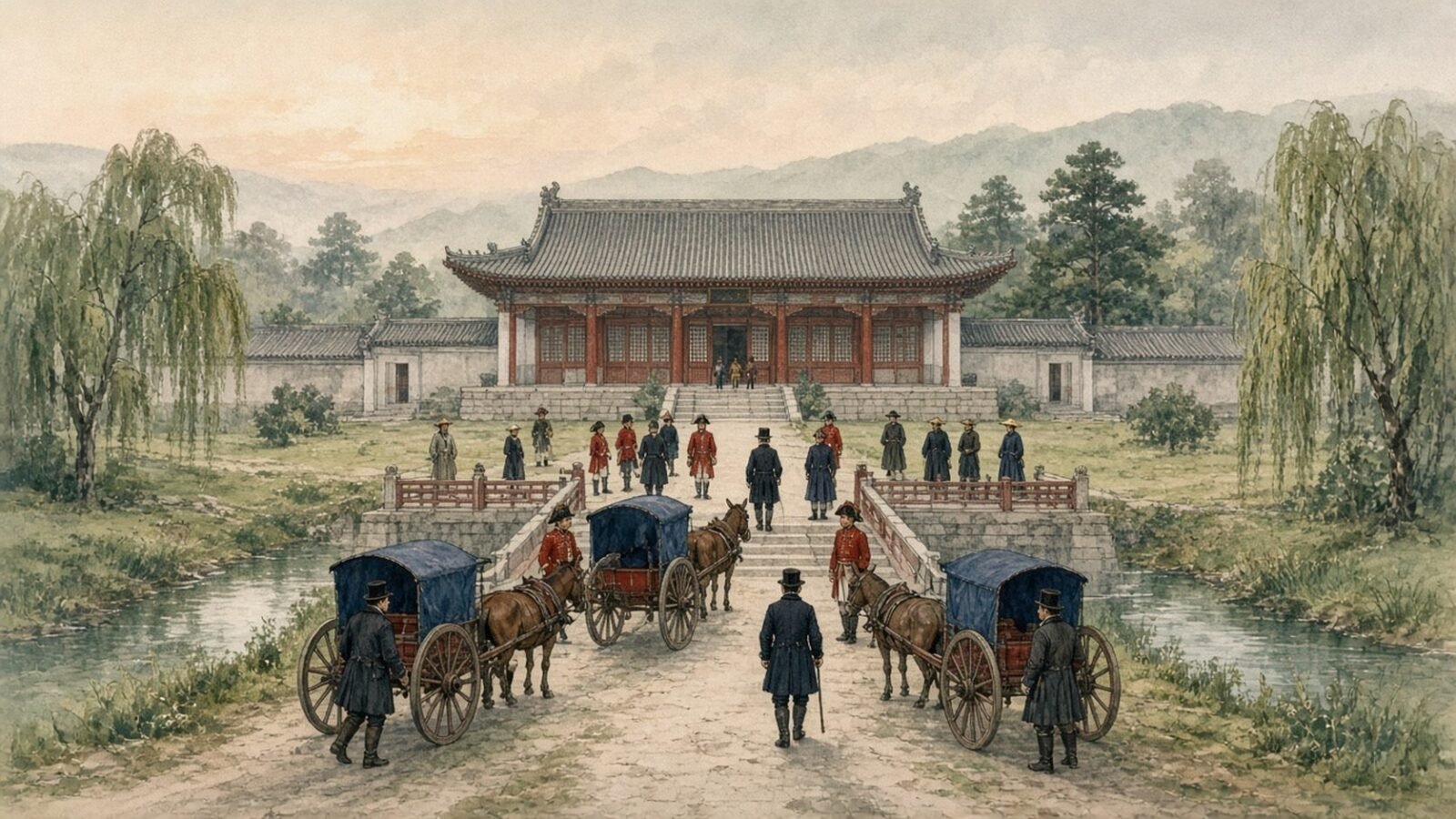
At about five o’clock in the morning of 29 August 1816, a procession of exhausted Englishmen arrived at the gates of the Yuanmingyuan, the imperial summer palace northwest of Beijing. They had travelled all night on bad roads, jolted in springless carts, and their baggage, with the court dress, the credentials and the gifts, was straggling somewhere behind them. They were met not by ushers but by officials in a state of high alarm. The Jiaqing Emperor was waiting, and the embassy of Lord Amherst was summoned to an audience immediately. Amherst refused. He had arrived in disorder, he said, unfit to appear; and in any case he had not agreed to perform the kowtow, the kneelings and knockings of the forehead to the ground without which no one approached the Dragon Throne. The officials, who had already assured their master that the barbarian would comply, begged, argued and physically pressed him toward the audience hall. Amherst held his ground. By evening the emperor had ordered the entire mission out of his dominions, and the last British embassy to Beijing for a generation was marching south under guard, having spent less than a day at the capital it had crossed half the world to reach.
It was the second time in twenty-three years that a British embassy had been broken on the question of how a man should bend his knees. In 1793 Lord Macartney had compromised on ceremony, been received in full splendour, and been refused every single thing he asked for. In 1816 Amherst refused to compromise and was refused everything faster. Together the two missions are the great set-piece of the early encounter between the world’s rising naval power and its largest empire, and they deserve to be told at length, because nearly everything that came after, from the opium clippers to the burning of the Yuanmingyuan itself, runs downhill from them. This essay is a companion to the story of what Napoleon said about the affair from his prison island; here is the affair itself.
The door at Canton
The grievances that launched both embassies were commercial, and they were structural. Since 1759 the Qing had confined all Western maritime trade to the single port of Canton, where foreigners could deal only with a licensed guild of Chinese merchants, the Cohong, under the supervision of a customs superintendent answerable to the court. Foreigners could not reside year-round, could not enter the city, could not learn Chinese legally, could not communicate with officials except through the guild, and could not appeal over the heads of local mandarins to Beijing. The trade itself was enormously profitable and grotesquely unbalanced. Europe, and above all Britain, drank ever more tea and dressed in ever more silk and porcelain, while China wanted almost nothing that Europe manufactured and settled accounts almost exclusively in silver. The bullion flowed east in a river, and by the late eighteenth century the directors of the East India Company, which held the British tea monopoly, had concluded that diplomacy was the cheaper remedy: win a resident minister in Beijing, open more ports, secure a depot island of the kind the Portuguese held at Macao, and fix the whole arrangement by treaty at the top. Twice they paid for the attempt. Both times the attempt came to grief on ritual before it could come to grief on substance.
It is worth being precise about what the ritual was, because it is usually described vaguely. The kowtow required of ambassadors at a formal audience was the san gui jiu kou: three kneelings, each followed by three prostrations in which the forehead touched the ground, nine knockings in all, performed before the throne. Within the Chinese world order this was not an arbitrary humiliation but the basic grammar of hierarchy, the gesture with which every governor, every general, every prince and every tributary envoy acknowledged the Son of Heaven. The court did not regard foreign missions as embassies between equals; it registered them as tribute, and the kowtow was the act that made the registration true. To waive it for the English would have been to falsify the record of the universe. The British, for their part, inhabited a different universe, the Westphalian one of sovereign states treating on a footing of equality, in which an ambassador incarnated the dignity of his king and could not abase him before any earthly prince. Each side’s position was internally coherent. That is what made the collision so total.
Six hundred cases of ingenuity
The first attempt was mounted with every advantage preparation could buy. Lord George Macartney was perhaps the most experienced diplomat in British service: he had negotiated a commercial treaty at the court of Catherine the Great, governed Grenada and Madras, and refused a marquessate and the governor-generalship of India. His mission, approved by Henry Dundas and financed by the East India Company to the tune of some £78,000, was designed to overawe by quality rather than numbers. It sailed from Portsmouth on 26 September 1792 in three vessels: the 64-gun ship of the line Lion, the great East Indiaman Hindostan and the brig Jackall, carrying a suite of about a hundred, from scientists and artists to a military escort, and roughly six hundred cases of gifts selected to demonstrate the full range of British manufacture. There were clocks and watches by the best London makers, a state carriage with plate-glass windows, lenses, scientific instruments, Wedgwood and Derby wares, and the centrepiece, an enormous planetarium that took weeks to assemble and represented the heavens over Beijing with British precision. A hot-air balloon was considered and abandoned. As interpreters the embassy carried two Chinese Catholic converts recruited from the Collegio dei Cinesi in Naples, since the Company had no one of its own who could handle court language, and among the pages was an eleven-year-old boy named George Thomas Staunton, son of the embassy’s secretary Sir George Staunton, who had spent the voyage drilling Chinese characters and would turn out to be the mission’s single most consequential member.
The embassy reached the anchorage off Dagu, at the mouth of the river for Tianjin, in late July 1793, and the misunderstanding began with the first boats the Chinese sent alongside. The barges that carried the embassy’s baggage upriver flew flags inscribed, in large characters, with the words “tribute envoy from the English country”. Macartney noticed, understood perfectly well what the inscription claimed, and decided not to make an issue of it. The choice was characteristic, and it haunts the whole history: the British quietly accepted being inscribed as tribute-bearers on the way in, and then discovered, at the top, that the inscription was the point. The Qing reception was lavish by tributary standards. The emperor’s favourite, the grand minister Heshen, took charge of the arrangements, and because the court was spending the summer at the mountain retreat of Chengde, beyond the Great Wall, for the emperor’s eighty-third birthday celebrations, the embassy was brought the long way round, overland through Beijing and past the wall, with its mountain of presents laboriously carted behind it.
One knee at Chengde
The negotiations over the kowtow consumed the weeks before the audience and were conducted, on the Chinese side, with real anxiety, since the birthday calendar could not be moved and the tribute had to be presented within it. Macartney’s position was carefully prepared. He would not perform the kowtow to any mortal man, but he offered two things: to go down on one knee and bow his head, as he would before his own sovereign, and to perform the full ceremony if a Chinese official of equivalent rank would perform the same ceremony before a portrait of George III. The reciprocity clause was unanswerable within the British frame and impossible within the Chinese one, since no official could treat a barbarian king’s picture as the equal of the emperor. In the end Heshen, a pragmatist facing a deadline, accepted the single genuflection, and the court chronicles solved the problem in the manner of courts: they recorded that the tribute envoy had trembled with awe and performed the ceremony. Both sides’ archives thus report, with perfect confidence, opposite accounts of the same morning.
The audience took place on 14 September 1793 in an enormous circular tent in the park at Chengde, the emperor enthroned at its centre, the court arranged in ranks, tributary envoys from Burma and Mongolia in attendance. Macartney, in embroidered velvet and the star of the Bath, approached alone, went to one knee, presented the king’s letter in its gold casket, and received for George III a jade ruyi sceptre and for himself gracious words. The single memorable breach of choreography came from the page boy. Qianlong, hearing that young Staunton could speak Chinese, called him forward, exchanged a few sentences with him in Mandarin, and in a gesture of genuine imperial favour untied a yellow silk pouch from his own belt and gave it to the boy. It was the only moment in either embassy in which a Briton and a Chinese emperor met without intermediaries, and it belonged to a twelve-year-old. There were further audiences, banquets and a birthday gala of dazzling scale, and then, with exquisite politeness, the embassy was invited to depart, since the weather was turning and the passes would soon close. Macartney, who had not yet been permitted to broach a single item of business, was forced to submit his requests in writing. The court’s answer was already being drafted.
The emptiest of answers
Qianlong’s reply to George III, delivered in two edicts in October 1793, is the most famous diplomatic refusal in history, and it is usually quoted in a way that makes it sound like smug delusion. “We possess all things,” the emperor wrote. “We have never valued ingenious articles, nor do we have the slightest need of your country’s manufactures.” Read whole, the edicts are less absurd than the extract: they are the standard instruments of the tribute system, versions of which had been sent to kings and khans for centuries, and they refuse each British request not on the merits but on the ground that the request is a category error. A resident minister in Beijing was impossible because no barbarian envoy had ever been permitted to reside; if the English were allowed it, every other nation would demand the same. New ports were impossible because trade was confined to Canton by ancestral regulation. An island depot was impossible because every inch of territory belonged to the throne. The embassy’s presents were accepted as tribute, graciously, and equivalent gifts returned, and the king was instructed to strengthen his devotion and obey. Macartney understood at once what had happened. “The Empire of China is an old, crazy, first rate Man of War,” he wrote in his journal, “which a fortunate succession of able and vigilant officers has contrived to keep afloat for these one hundred and fifty years past,” and which, under worse management, would “drift as a hulk”. The embassy returned overland by the Grand Canal, a three-thousand-mile survey of the country that yielded more intelligence than any previous European journey, reached Canton in December, and sailed for home. Its gifts stayed behind at the Yuanmingyuan, where British officers found some of them, including artillery pieces, still stored among the palace treasures when they looted the complex in 1860.
One control experiment survives, and it is unflattering to everyone. In the winter of 1794-95 the Dutch East India Company sent an embassy to Beijing under Isaac Titsingh, a scholar-administrator who knew China well and had decided to swallow the ceremony whole. Titsingh’s party performed the kowtow without qualification, in the snow, repeatedly, and were treated by the court as model barbarians. They gained precisely nothing: no concessions, no trade advantage, not even a serious hearing, and their journey home in winter was an ordeal of cold and squalor. The lesson was plain, and the British drew it. The kowtow was not the obstacle to agreement; it was the price of a ceremonial admission that committed the court to nothing. Compliance and refusal were equally useless. Which meant that nothing remained except power, and that argument was deferred, not settled, for another forty years.
The boy who came back as the hard man
By the time Britain tried again, the context had shifted and so had the people. The Napoleonic Wars were over, the Company’s monopoly of the China trade was under political attack at home, and the Canton arrangements had frayed badly: during the War of 1812 a British frigate had chased an American prize into Chinese waters, the Canton authorities had retaliated against the Company’s trade, and relations with the local mandarins were at their worst in living memory. In 1815 the Prince Regent’s government and the Company agreed on a second embassy to Beijing, with essentially Macartney’s shopping list: a resident minister or at least direct correspondence with the capital, relief from the Canton grievances, and if possible wider access to the coast. To lead it they chose William Pitt Amherst, an amiable peer of distinguished name and thin diplomatic experience. The real weight of the mission lay in its second commissioner: George Thomas Staunton, the page boy of 1793, now thirty-five, chief of the Company’s factory at Canton, the foremost British authority on Chinese law and language, translator of the Qing penal code, and a man who had spent his entire adult life inside the Canton system and come to loathe it. Staunton had knelt, in effect, at Chengde, and had watched it buy nothing. He had concluded that concession on ceremony purchased contempt, and that a British envoy who kowtowed would be registered as a tributary and dealt with accordingly. He was the most formidable Sinologist the country possessed, and on the central question of the embassy he was an absolutist. The kowtow, he believed, must simply not be done.
The embassy sailed from Spithead in February 1816 in the frigate Alceste, Captain Murray Maxwell, with Henry Ellis as third commissioner, Robert Morrison, the pioneering Protestant missionary and lexicographer, as Chinese secretary, and a full scientific staff. It reached the mouth of the Peiho in July, and the kowtow was raised at the first banquet ashore, weeks before Beijing. Amherst’s position was more muddled than Macartney’s had been, and his instructions, reflecting a divided cabinet in London, were genuinely ambiguous: he was to maintain national dignity but was not, on any account, to let the ceremony wreck the mission. He improvised a formula, offering to kneel on one knee and bow his head nine times, the Macartney compromise in effect, but he could not commit himself, he told the mandarins, until he had consulted his own precedents and his council. The reception officials, men whose careers depended on delivering a compliant tribute envoy, reported up the chain that the English would conform; whether from optimism, mistranslation or self-preservation, they let the court believe the kowtow had been agreed. The embassy was moved forward toward the capital in stages while the argument continued at every halt, Staunton urging outright refusal, Ellis inclining to Macartney’s middle way, Morrison interpreting, and Amherst, exhausted and out of his depth, oscillating. It was a mission arriving at the throne without a policy on the only question that mattered.
A night march to a closed gate
The endgame was engineered, probably deliberately, to make refusal impossible. On the evening of 28 August the embassy was collected at Tongzhou, twelve miles from the Yuanmingyuan, and marched through the night, over rutted roads, in jolting carts and on horseback, with no rest and no provision made for the baggage train carrying the court uniforms and the royal letter. The embassy’s gentlemen understood the purpose: to deliver them to the palace gates in a state of physical collapse, at an hour when argument was least possible, with the emperor already waiting, so that sheer exhaustion would do what persuasion had not. They arrived about five in the morning on 29 August, filthy, sleepless and half-dressed, and were at once summoned to the audience. Amherst refused on grounds of condition, and the officials, now visibly desperate, admitted the truth of their situation: they had assured the emperor that the kowtow would be performed, and if the embassy would not go in, they were ruined. The scene at the gate, recorded by several of the party, has a nightmare quality that no amount of diplomatic language can launder: Chinese officers seizing the ambassador by the arm to propel him toward the hall, the ambassador shaking them off, Staunton coldly advising that nothing was to be gained and much lost, and somewhere inside the enclosure the Son of Heaven kept waiting in his audience tent like a groom at the altar while the bride’s party brawled on the porch.
Jiaqing’s reaction, when the truth reached him, combined fury with a certain chilly correctness. He had been deceived by his own officials, and he dismissed and degraded them, but the embassy’s conduct at the gate confirmed everything the court suspected of the English: that they were evasive, unstable and ungoverned by ritual, which in the Qing frame meant ungoverned by principle. The edict of dismissal went out the same day. Amherst was ordered to depart immediately, the imperial gifts to the Prince Regent were at first withheld and then, after a slight cooling of tempers and a realization that the embassy had been handled roughly, sent after it together with a letter. That letter, addressed to the Prince Regent, closed the door with a finality that Macartney’s edicts had not attempted: the Celestial Empire, Jiaqing wrote, had no need of distant envoys, and the British were instructed not to send another. The embassy marched south through the provinces for four months, lodged well but treated as a dismissed mission, reached Canton on 1 January 1817, and sailed for home. It had cost about £100,000, achieved less than nothing, and left the Canton trade exactly where it had been, except that both governments were now confirmed in their worst opinion of each other.
The wreck and the prisoner
The homeward voyage supplied the epilogue that made the whole affair famous. On 18 February 1817 the Alceste struck a reef off Pulo Leat in the Gaspar Strait and was lost; Amherst and the survivors reached Batavia in open boats and by raft, and the ambassador eventually took passage for England in the East Indiaman Caesar, which called, as homeward ships from the China Sea often did, at St Helena. There, on 27 June 1817, Amherst was received by Napoleon Bonaparte, two years into his exile, and gave the fallen emperor a first-hand account of the debacle. Napoleon’s verdict, preserved by his surgeon Barry O’Meara, cut against every assumption the embassy had carried: an ambassador, he said, is sent for the affairs of his country, not for its ceremonies, and should conform to the customs of the court he visits, on the sole condition of reciprocity; a mission mounted on behalf of the tea merchants of England might with perfect honour purchase commercial advantage by compliance; and war with China, though it would open with easy victories, would end by teaching an immense empire with enormous resources exactly the arts it lacked, whereupon it would build fleets and defeat you. The interview made Amherst’s failure the occasion of the most quoted strategic judgement ever passed on China, and it is told at length in the companion piece to this essay.
Twenty-three years of opium
What the two embassies had failed to settle at the level of ceremony was settled, in the end, by chemistry and gunnery. The silver drain that had launched Macartney was reversed after 1816 not by treaty but by opium, smuggled up the coast against Chinese law in quantities that rose from a few thousand chests a year to tens of thousands, until the trade the court had refused to regulate by agreement had become a trade it could not regulate at all. The diplomatic track did not recover from Amherst. In 1834 the Company’s monopoly ended and the Crown sent Lord Napier to Canton as chief superintendent of trade, armed with instructions to communicate directly with the governor, a right the Canton regulations had never conceded; the confrontation that followed, over exactly the old questions of access and status, broke Napier’s health and killed him at Macao within months. In 1839 the imperial commissioner Lin Zexu destroyed twenty thousand chests of British opium at Humen, and the argument that had begun with kneeling was continued by fleets. The Treaty of Nanjing in 1842, which ended the first Opium War, dealt with the question of diplomatic form in its own way: among its provisions, British and Chinese officials were henceforth to conduct their correspondence on a footing of perfect equality. The kowtow question, the specific thing on which two embassies and twenty-three years had been spent, was never conceded by the Qing in its original form at all. The last Western missions to Beijing simply stopped being asked to perform it, and when the Tongzhi Emperor finally received the foreign ministers resident in Beijing in 1873, they bowed three times, standing, and the ceremony that had defined the empire’s dealings with the world passed out of use without ever having been formally abandoned.
It is tempting, and usual, to tell this story as a comedy of mutual arrogance: the court that would not bend, the envoys who would not kneel, and a great deal of ruin got up between them. That is not quite fair to either side. The Qing were defending a working system, the tribute order that had organized East Asian diplomacy for centuries, and the history of the Titsingh embassy shows that they did not trade concessions for prostrations because they did not understand the prostrations as a bargain: they were simply the form in which the world was recorded. The British were defending a different working system, the equality of sovereign states, and the history of the next century shows they were not wrong that the kowtow functioned as an admission of hierarchy, since the whole treaty structure of 1842 and after was built precisely on the denial of it. Between two complete and incompatible grammars there was never a translation, only a decision about whose grammar would be enforced, and in the nineteenth century that decision belonged to whoever had the ships. The men who crossed the world in 1793 and 1816 understood, more clearly than their masters in London or the ministers in Beijing, what was actually at stake in those nine knockings of the forehead on the floor. Macartney knelt on one knee and got nothing; Amherst stayed on his feet and got nothing faster; Staunton, who had stood in the tent at Chengde as a boy and spoken to the emperor in his own language, spent the rest of his life arguing that the gesture was the substance. The century that followed proved all three of them right, at a price none of them would have chosen to pay.