Napoleon Predicted China’s Rise From His Prison Island
On 27 June 1817, the East Indiaman Caesar dropped anchor off St Helena, a volcanic speck in the South Atlantic where the British government kept the most famous prisoner in the world. Aboard the Caesar was Lord Amherst, returning to England in disgrace. He had spent the previous year leading a grand embassy to the court of the Jiaqing Emperor in Beijing, had refused to perform the kowtow, had been turned away without an audience, and had been expelled from China with nothing to show for the journey. Before the ship sailed on, Amherst went ashore and was received at Longwood House by Napoleon Bonaparte. The fallen Emperor of the French, two years into his exile and four years from his death, wanted to hear about the Celestial Empire. What he said about it, preserved by his Irish surgeon Barry O’Meara, amounts to the sharpest analysis of China produced by any European statesman of the age, and it seeded a prophecy that the world is still quoting two centuries later.
Napoleon never saw China. Everything he knew about it came from books, from conversation, and from the strategic imagination that had redrawn the map of Europe. Yet his views on the country are worth recovering in detail, because they combine hard-headed diplomatic pragmatism, genuine respect for Chinese civilization, and a warning about the future that reads today like a prediction. The famous line attributed to him, that China is a sleeping lion which will shake the world when it wakes, is almost certainly something he never said in those words. What he demonstrably did say is more interesting.
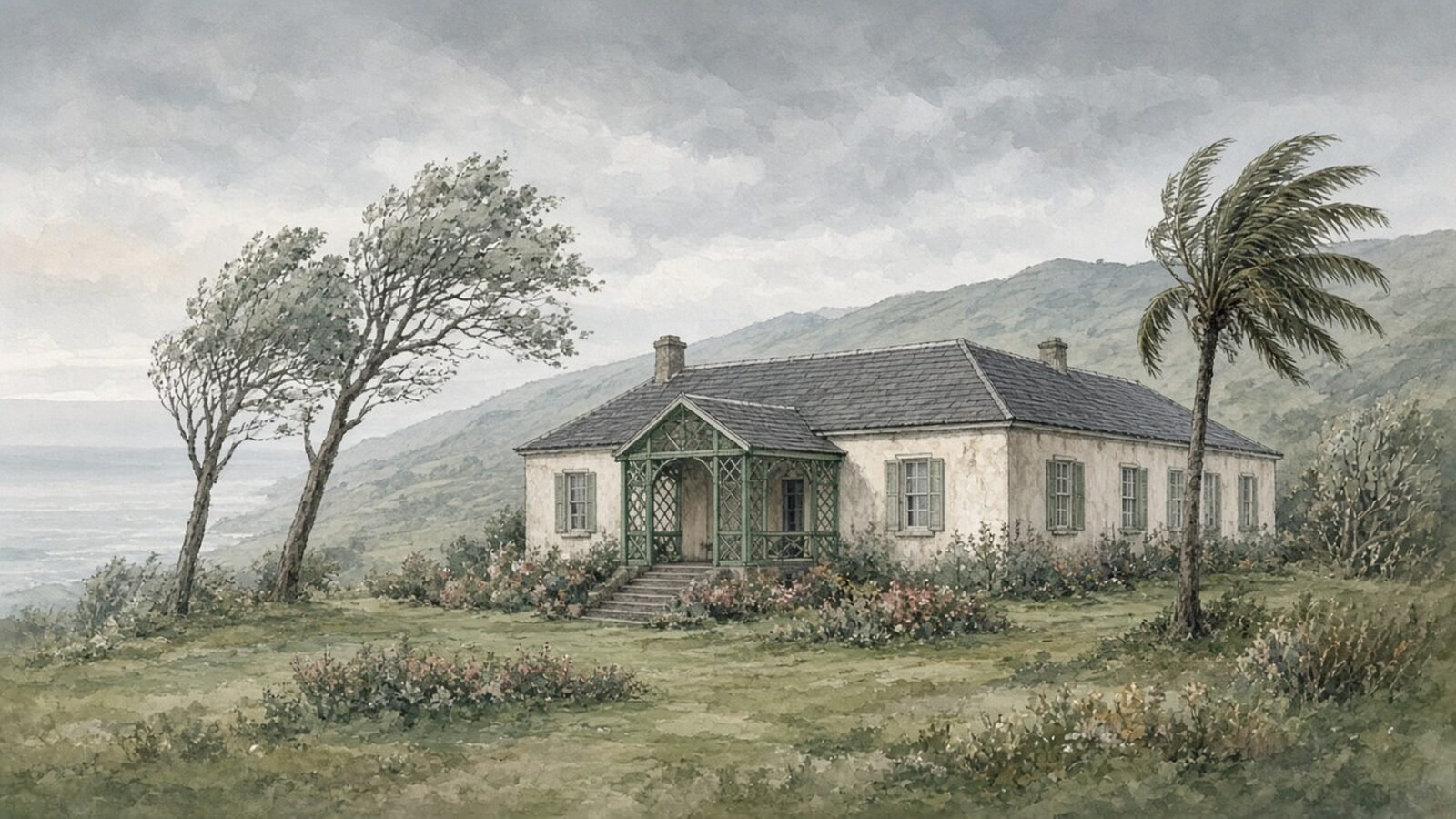
St Helena was about as far from China as it was possible to be and remain on the planet: ten degrees south of the equator, twelve hundred miles from the nearest continent, a fortress of basalt cliffs garrisoned by nearly three thousand soldiers and ringed by patrolling frigates. Longwood House, where Napoleon lived with his small court in exile, was a damp, rat-haunted farmhouse on a wind-scoured plateau. Yet the drawing room of that farmhouse became, for a few years, one of the most curious listening posts in the world. Ships bound home from India and China called at the island, and their passengers, from governors to missionaries to disgraced ambassadors, were brought up the hill to be interrogated by the man who had once held Europe in his hand.
The embassies that failed
To understand the conversation at Longwood, you need the two British embassies that framed it. In 1793 Lord Macartney had led the first British embassy to Beijing, carrying six hundred cases of instruments, clocks, carriages and scientific instruments intended to dazzle the Qianlong Emperor into opening trade. The embassy foundered on ceremony. Macartney refused to perform the kowtow, the sequence of kneelings and knockings of the forehead to the ground required of all who approached the throne, and compromised with a single genuflection of the kind he would give his own king. Qianlong received him politely, accepted the tribute, and sent George III a letter that has echoed ever since: the Celestial Empire possessed all things in abundance, had no need of England’s ingenious manufactures, and could grant none of the requested concessions. The embassy sailed home empty handed.
In 1816 the British tried again. Lord Amherst’s embassy reached the outskirts of Beijing in August, exhausted and travel-stained, and was summoned to an immediate audience. When Amherst learned that the kowtow would be required, he refused; the Chinese court, which had been promised by its own officials that the barbarian would comply, felt itself deceived and ordered the embassy out of the country. The decision was heavily influenced by the mission’s second commissioner, George Thomas Staunton, the one man in the party who actually knew China. Staunton had gone to Beijing as a twelve-year-old page on the Macartney embassy, had learned enough Chinese on the voyage to converse briefly with Qianlong himself, and had spent years at Canton as the East India Company’s chief China hand. He regarded the kowtow as a humiliation no British envoy could accept, and Amherst took his advice. The embassy sailed home empty handed, having cost the British around £100,000, a fortune at the time, and achieved less than nothing: it left ill will on both sides. It was this fiasco, fresh in every newspaper, that Amherst came to explain to Napoleon the following summer.
The stakes that drove both embassies were commercial, and enormous. Britain’s trade with China was confined by the Qing to the single port of Canton, conducted through a licensed guild of Chinese merchants, and grotesquely unbalanced: Britain drank ever more tea and dressed in ever more silk and porcelain, while China wanted almost nothing Britain made and accepted payment almost exclusively in silver. The bullion drain was unsustainable, and the British answer, already visible in the 1810s and central to the coming catastrophe, was Indian opium, smuggled against Chinese law to reverse the flow. Both the Macartney and Amherst missions were attempts to fix the imbalance at the diplomatic level, by winning resident embassies, open ports and direct access to the emperor, before the opium trade forced a reckoning. The court’s refusals guaranteed that the reckoning would come by other means.
The prisoner’s library
Napoleon’s interest in China was not a whim of exile. He had grown up in the high noon of French sinology, when the Paris of the Enlightenment devoured the writings of the Jesuits who had served at the Qing court since the days of Kangxi. The great compilations of that tradition, Jean-Baptiste Du Halde’s Description of China of 1735 and the sixteen volumes of the Mémoires concernant les Chinois published between 1776 and 1814, were the standard reference works of educated Europe, and Napoleon had absorbed them. He inherited, too, the Enlightenment’s running argument about what China meant. Voltaire had held the country up as proof that a rational society could be governed by merit rather than birth, an empire where the road to office ran through examination halls rather than bloodlines. The physiocrat economists admired its agrarian order; Montesquieu, dissenting, had dismissed it as a despotism ruled by the stick. Napoleon, who had built his own empire on careers open to talent, instinctively took the Voltairean side of that argument, and it shows in everything he said at Longwood.
His Eastern ambitions had also been practical as well as literary. The invasion of Egypt in 1798 was in part a blow aimed at Britain’s route to India, undertaken with a train of a hundred and sixty-seven scholars and scientists in tow, and he corresponded with Tipu Sultan of Mysore about a common front against the British. China sat at the far end of the same map. An officer who had contemplated the conquest of the Orient from Cairo could hardly fail to wonder about the greatest empire in it.
At St Helena the interest sharpened into something like a running seminar. The prisoner of Longwood questioned every visitor who had been anywhere near Asia. In June 1817, three weeks before Amherst’s arrival, he received Thomas Manning, the eccentric Cambridge scholar who in 1811 had become the first Englishman to reach Lhasa and meet the Dalai Lama. Napoleon grilled him about the manners and customs of Tibet, asked several questions about the Chinese language, enquired about the fate of the late embassy, whether the Russians had ever penetrated in that direction, and whether Manning intended to publish his travels. The prisoner, Manning’s hosts noted, was delighted to be addressed as Emperor, a title the island’s governor Sir Hudson Lowe had forbidden. On 3 November 1816, when the first news of the Amherst debacle reached the island, Napoleon had already held forth on the Macartney precedent and the cultural chasm of the kowtow. By the time Amherst himself appeared, Napoleon had thought the matter through.
What he actually said
O’Meara, who attended Napoleon as surgeon and published Napoleon in Exile in 1822, recorded the emperor’s views at length, and they are startlingly pragmatic. The whole controversy, Napoleon argued, rested on a ridiculous misunderstanding. An ambassador, he said, is sent for the affairs of his country, not for its ceremonies: once accredited to a foreign court, he becomes the equivalent of one of that country’s first nobles and should conform to the same ceremonies they do. The kowtow was what Chinese grandees performed before their emperor; the emperor therefore had a right to require it of Amherst. If England and Russia wanted ambassadors at Beijing, they should instruct them to submit to the kowtow, on the sole condition that a Chinese ambassador in London or Petersburg would submit to whatever forms were practised by princes and grandees there. Reciprocity of etiquette, not unilateral exemption, was the answer. Amherst, in Napoleon’s judgement, had been badly advised by men who imagined that an ambassador incarnated the personal dignity of his sovereign, a notion Napoleon dismissed as a modern fiction.
He was equally blunt about the embassy’s purpose. It had not been sent, he said, for the honour of the British nation; it was an affair of merchandise, mounted on behalf of the tea merchants of England, and commercial advantages might with perfect honour be purchased by compliance. He added, with the cynicism of a man who had dealt with courts all his life, that if a million francs had been given to the first mandarin, everything would have been settled. The deeper principle he articulated was simple: when you send ambassadors to those peoples, you must humour them and comply with their customs. They do not seek you. They never sent ambassadors in return for yours, nor asked you to send any.
Then came the strategic warning, and it is the passage that matters most. War with China, Napoleon told his listeners, would be the worst thing the British could do. You might succeed at first, he granted: European ships and discipline would win the early encounters. But you would be going to war with an immense empire possessing enormous resources, and you would teach it what it lacked. The Chinese would get artificers and shipbuilders from France, from America, even from London; they would build a fleet, and in the course of time they would defeat you. Here, in the documented words of 1817, is the authentic core of the legend: not a lion, but a cool calculation that military aggression against China would end by creating the very power it sought to suppress.
Underneath the tactics ran a current of respect. Napoleon spoke of China as a vast, ancient, self-sufficient civilization of some three hundred million people, an empire administered not by a hereditary aristocracy of the European kind but by scholar-officials selected through examinations, a system that had impressed European admirers since Voltaire. He did not sentimentalize the Qing; he saw the empire’s military backwardness plainly. But he grasped what many of his contemporaries, drunk on industrial superiority, refused to see: that backwardness was a condition, not a character, and conditions can change. On the economic question he sided, in effect, with Qianlong. The Chinese, he observed, wanted nothing that Europe sold; they had their own manufactures, their own tea, silk and porcelain, their own enormous internal market. Britain’s problem was not that China was closed but that Britain was the demandeur, the supplicant at the door, and a supplicant does not get to dictate the etiquette of the house he is begging to enter.
The lion that was never quoted
So where did the sleeping lion come from? The famous sentence, “China is a sleeping lion; let her sleep, for when she wakes she will shake the world”, appears nowhere in Napoleon’s writings, nowhere in Las Cases’ Memorial of Saint Helena of 1823, nowhere in O’Meara, nowhere in the journals of Henry Ellis or the other members of the Amherst party who described the Longwood meeting. Generations of Chinese and foreign scholars have hunted for the original occasion and found nothing. What can be documented is a slower, stranger process. During the Opium War of 1839 to 1842, as Britain did exactly what Napoleon had warned against, his recorded remarks about war with China began to circulate in embellished form: newspapers such as the New York Herald carried versions of the warning in 1841, and memoirs of the Amherst voyage were reprinted. Somewhere in that retelling the sober prediction acquired claws and a mane. By 1880 the Australian politician Henry Parkes was repeating in the Sydney Morning Herald that the first Napoleon had said the Chinese, once they learned shipbuilding, would conquer the world. Variants multiplied: sleeping giant, sleeping dragon, sleeping lion. Some researchers, tracing the phrase forward rather than backward, find its earliest securely datable attribution to Napoleon in the screenplay of the 1963 Hollywood film 55 Days at Peking, set during the Boxer siege, which is a pleasing origin for so cinematic a line.
The French gave the quote its canonical form. In 1973 the writer and diplomat Alain Peyrefitte published a book about China’s emergence titled Quand la Chine s’éveillera, le monde tremblera: When China wakes, the world will tremble. Peyrefitte, who later wrote the definitive account of the Macartney embassy, The Immobile Empire, understood both the power and the dubiety of the attribution, and used it as a frame rather than a fact. The phrase did what apocryphal quotes do: it attached a true insight to a great name, and travelled farther than the documented words ever could.
Between the Opium War and Peyrefitte, the sleeping China motif had already done a century of political work. Around 1900, in the era of the Boxer uprising and the scramble for concessions, it fed directly into the discourse of the Yellow Peril: the fear, encouraged in Germany by Kaiser Wilhelm II’s lurid speeches and cartoons, that the teeming millions of Asia would one day descend on Europe. The same image could be made to carry hope in China itself, where reformers and revolutionaries from Liang Qichao onward invoked the awakening of the nation as the goal of their politics. A sleeping nation, after all, is one that can wake. The metaphor proved endlessly adaptable precisely because no one could check it against the source.
From Longwood to Paris
The quote’s most consequential outing came on 27 March 2014, when Xi Jinping stood before an audience in Paris at the ceremony marking fifty years of diplomatic relations between China and France. Napoleon, Xi reminded his hosts, had called China a sleeping lion whose waking would shake the world. “The lion of China has awakened,” he declared, “but it is a peaceful, pleasant and civilized lion.” The choice of venue and author was precise: a French emperor, quoted in the French capital, to certify that China’s rise was both inevitable and benign. Chinese commentary has embraced the lion ever since, and the quotation now circulates in Beijing as something close to licensed prophecy, the more useful for being untraceable.
There is an irony here that Napoleon himself would have savoured. His real views on China were about etiquette, trade and the folly of coercion, and they were ignored: the British went to war in 1839, won their early victories exactly as he had foreseen, and pried the empire open. The longer part of his prediction took a century and a half to come due, but it came due, and the mechanism he named turned out to be exactly right. China responded to defeat by doing what he had said it would do. The Self-Strengthening Movement of the 1860s to the 1890s built the arsenals and shipyards, at Jiangnan and Fuzhou, and hired the foreign artificers and shipbuilders, French and British among them, to teach the necessary arts. The first attempt collapsed in the naval defeats of 1895; the lesson was learned again, at greater cost, across the wars and revolutions of the twentieth century; and in our own time the process has completed itself on a scale that would have startled even the prisoner of Longwood. China has become the world’s largest shipbuilder, launched the world’s largest navy by number of hulls, and built the industrial base that makes the rest possible. The world now lives inside the strategic question Napoleon posed in 1817: what happens when the immense empire with enormous resources decides to use them.
The lion, meanwhile, turned out to be more useful asleep than awake. As a documented judgement, Napoleon’s China analysis belongs to the history of statecraft: a case study in how much a first-rate mind could infer about a country it had never seen, armed with Jesuit books, a strategic map and a disgraced ambassador’s account of failure. As an invented quote, the sleeping lion belongs to everyone: to Victorian alarmists, to Hollywood, to French men of letters, and to a Chinese president looking for a two-hundred-year-old permission slip. Napoleon, who understood better than anyone the manufacture of legitimacy and the uses of a good story, would have recognized the technique. He might even have envied it. He died at Longwood on 5 May 1821, still insisting to his dwindling court that history would vindicate him. On the subject of China, in a way he never intended, it did.