South China Morning Post
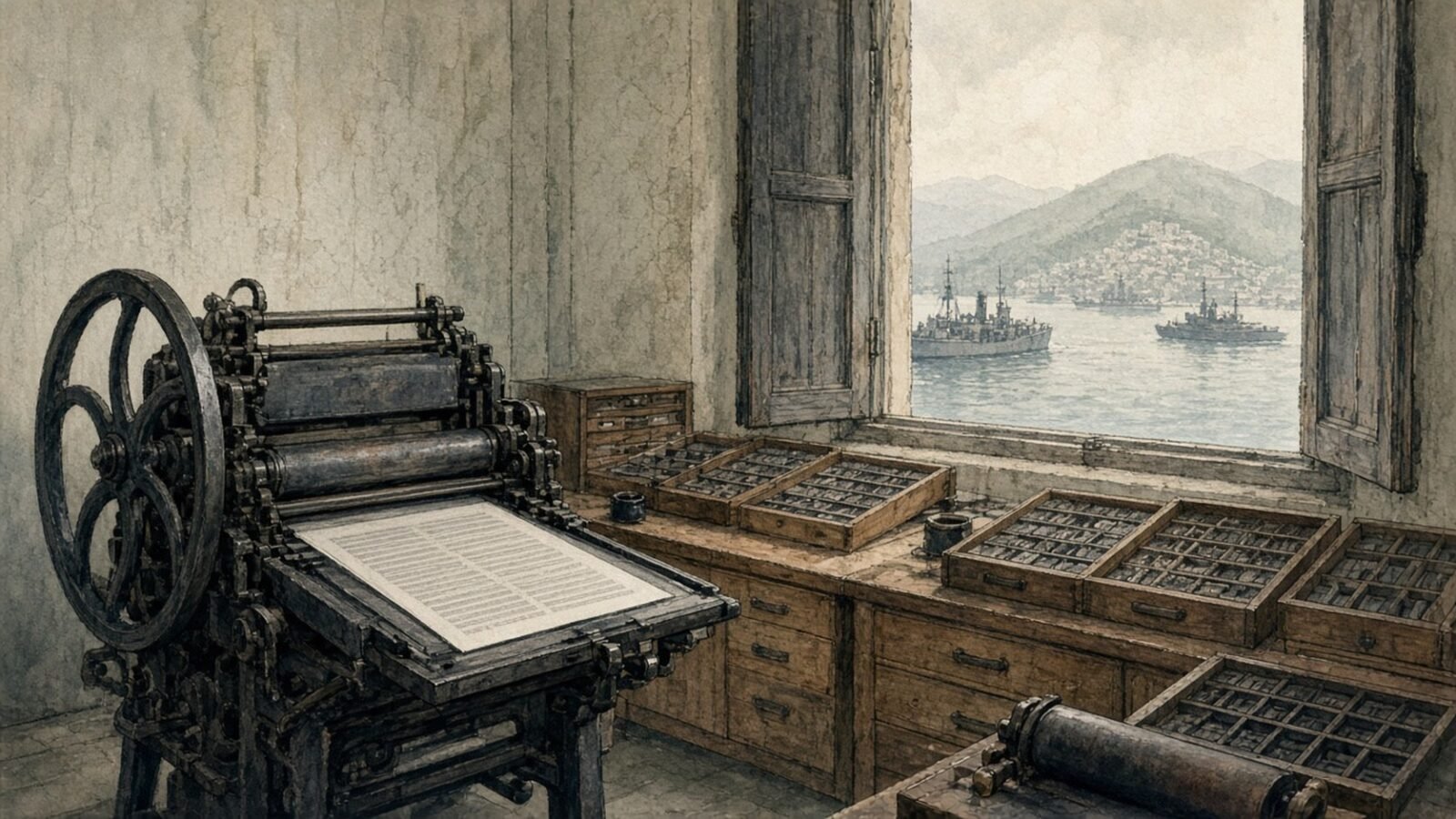
On 30 August 1945, with Japanese personnel still occupying its office, a small group of South China Morning Post staff produced a free leaflet announcing the approaching British fleet. Its headline was economical: “FLEET ENTERING.” Editor Harry Ching recorded the episode in his wartime diary. After occupation and interrupted publication, the newspaper was finding its voice again. The scene captures something larger than an institutional anniversary. Here were printers and journalists turning a change of sovereignty into words that could be carried through the streets, making a distant movement of ships into immediate public knowledge. Ching’s diary preserves that moment.
The newspaper’s history is inseparable from Hong Kong’s position between political systems, commercial networks and languages. Founded in 1903, the South China Morning Post, usually called the SCMP or simply the Post, became an English-language institution in a predominantly Chinese city. It has belonged to different owners, survived war, reported the end of British rule and remade itself for digital readers across the world. Its significance lies in these overlapping identities. It is a local newspaper, an interpreter of China, a commercial enterprise and a workplace whose professional ambitions have repeatedly encountered the demands of powerful people.
Understanding the Post therefore requires more than a list of proprietors. Ownership determines resources and raises questions about influence, but reporters, editors, advertisers, subscribers and political circumstances also shape what appears each day. The paper’s culture has never been entirely uniform. Its history is better understood as a continuing negotiation over audiences, authority and credibility: who the newspaper serves, whose language it speaks, and how far its access to decision makers helps readers understand the decisions being made.
A colonial paper with Chinese beginnings
The first issue appeared on 6 November 1903. Its founders were Alfred Cunningham, a British journalist, and Tse Tsan-tai, an Australian-born Chinese revolutionary, merchant and inventor. That partnership complicates the easy description of the Post as simply a British expatriate newspaper. Chinese political and commercial ambitions were present at its creation. Tse’s revolutionary associations did not make every subsequent editorial revolutionary, but they placed the institution within the traffic of ideas surrounding the late Qing world. The paper’s own account of its beginnings emphasises this mixture of journalism, enterprise and Chinese political engagement.
English was both an opportunity and a boundary. It connected the newspaper to colonial officials and international merchants while limiting its immediate accessibility in a Chinese-speaking society. Historian Yizheng Zou’s study of the early Post describes a readership strategy combining sport and social news for wealthy British readers with political and commercial information attractive to Chinese merchants. He also argues that the English-language paper enjoyed greater latitude under colonial censorship than Chinese newspapers, allowing Chinese subscribers another route into public discussion. English could therefore signify privilege while also carrying Chinese concerns towards the people who exercised colonial power.
This was journalism embedded in the practical rhythms of a port. Information about trade and government had direct economic value, while social coverage helped a small readership recognise itself. Such a newspaper could create a community and reproduce its exclusions at the same time. Its archive should consequently be read critically: what it records matters, but so do the people whose lives rarely became news. A prominent English newspaper offers a valuable perspective on Hong Kong without standing for the whole city. The distinction remains important when later generations use its pages as historical evidence.
The business also depended on mundane innovations. The company’s historical timeline records a steam launch delivering newspapers across the harbour in 1905 and the first profit in 1913. It identifies Helen Duncan as its first woman reporter in 1932. Distribution, financial discipline and recruitment were therefore part of the institution’s development alongside its editorial voice. The harbour was an operating problem as well as a symbol: a story had little commercial value if copies arrived late. These details restore the physical newspaper to a history often dominated by the names of editors and owners.
War, recovery and changing owners
Japanese occupation broke the continuity of publication. The Post’s presses were used for The Hongkong News, the occupation-era English newspaper. The Hong Kong Baptist University Library’s archive description documents that relationship. It is therefore misleading to describe the SCMP as an uninterrupted journalistic operation since 1903. Machinery can survive while editorial authority changes completely. The return of the Post in 1945 involved the recovery of an institutional identity as well as the reuse of equipment. Ching’s leaflet is memorable precisely because it makes that distinction visible: familiar staff and a familiar name were reclaiming the act of publication.
Postwar Hong Kong developed into an industrial and financial centre, giving an English-language business newspaper a changing field of subjects. Its importance increasingly rested on explaining the relationship between local events and developments beyond the territory. The paper’s long life also created an accumulated memory: names, disputes, neighbourhoods and institutions returned to its pages across generations. That continuity helps explain the attraction of the phrase “newspaper of record.” Yet a record is made through choices. The authority of a durable archive does not remove the need to ask how its categories, assumptions and omissions changed over time.
Changes in capital and technology transformed the enterprise. According to the SCMP’s corporate milestones, it listed in 1971; Rupert Murdoch’s News Corporation gained control in 1986, followed by privatisation in 1987 and relisting in 1990. Printing and distribution moved to Tai Po in 1995. The website launched in December 1996, putting the paper online before the handover. Its coverage of the 1997 transition included live video, an early demonstration that a newspaper could distribute moving images as well as printed columns. These developments made international reach possible before smartphones made it routine.
In 1993 Robert Kuok’s Kerry Media purchased a 34.9 per cent controlling stake from News Corporation. Contemporary UPI reporting valued that transaction at US$349 million. It was a purchase of a controlling holding, rather than every share in the company. The distinction matters because histories of newspapers often compress complicated corporate changes into simple transfers between famous men. Kuok’s arrival also placed the Post within another extensive business network as the transfer of Hong Kong to Chinese sovereignty approached. Questions about ownership increasingly became questions about the territory’s political future.
Those concerns predated Alibaba by decades. Writing in 1997, Ian Buruma described anxiety that the newspaper’s editorial voice had softened towards Beijing, while acknowledging that critical reporting still appeared and that interference was denied. His contemporary essay is useful because it preserves uncertainty rather than supplying a clean turning point. A publication can contain vigorous reporting, cautious institutional positions and internal disagreement simultaneously. The handover did not make those tensions disappear; it changed the political setting in which editors and readers interpreted them.
Alibaba and the search for a digital business
Alibaba announced its agreement to acquire the newspaper and associated media assets in December 2015, with completion following in April 2016. The announced consideration was HK$2.06 billion, approximately US$266 million. Reuters’ contemporary report placed the deal within the wider migration of news towards digital distribution. A technology group was acquiring a newspaper whose institutional history reached back more than a century. The strategic attraction was understandable: established reporting expertise and a recognised name could be combined with investment in reaching readers far beyond the limits of a local print market.
In his December 2015 letter to readers, Alibaba executive Joseph Tsai promised investment, wider international distribution and the removal of the online paywall. He also said everyday editorial decisions would remain with newsroom editors. Readers would have to judge those commitments through the journalism itself. The letter identified a valuable position for the Post: reporting China in English from Hong Kong for readers around the world. That ambition enlarged the newspaper’s possible audience while intensifying scrutiny of the relationship between its journalism and its owner.
The paywall came down on 5 April 2016. Free access reduced the barrier to discovering its reporting and reflected a strategy centred on audience expansion. But reach alone does not establish a sustainable business. A reader who arrives through a search engine may never return; an enormous audience may generate disappointing advertising income. For a newspaper maintaining specialist reporters and editors, the important question is not simply how many people encounter an article. It is whether enough value can be recovered from that attention to finance the next investigation, interview or reporting trip.
In July 2020, the Post announced digital subscriptions beginning that August. Then editor-in-chief Tammy Tam explained that advertising alone could no longer support the cost of journalism. The change revealed the difference between building an audience and persuading it to pay. It also suggested a sharper proposition: distinctive reporting about China and Asia should be valuable enough to purchase. The free-access period and the return to subscriptions belong to the same continuing experiment in financing an international publication, rather than to a simple story of technological progress solving newspaper economics.
Further segmentation followed. SCMP Plus, launched in May 2024, offered premium analysis and opinion alongside the general news subscription, as the paper’s account of the product explains. Such products distinguish readers seeking daily awareness from those seeking interpretation for professional decisions. This creates an opportunity, but also a responsibility. Analysis must offer more than confident prediction, and proximity to influential sources must not be confused with certainty. The commercial promise of expertise ultimately depends on readers believing that the publication can recognise uncertainty and correct its mistakes.
How the Post operates
The modern SCMP is a collection of related publishing activities. Its content portfolio includes the main newspaper and digital reporting, alongside lifestyle and educational publications such as Style, PostMag, Young Post and Posties. Newsletters and video offer additional ways to encounter its journalism. This range matters culturally as well as commercially. A publication that covers diplomacy also introduces children to current affairs and records the pleasures of city life. Its relationship with readers can begin in a classroom, develop through daily news and continue through specialist professional interests.
Income comes from several directions. The company’s services portfolio describes subscriptions, advertising, education products and events. Its enterprise subscription offering extends journalism into briefings and information for organisations. These activities convert editorial knowledge and audience relationships into different products. They should not, however, be taken as proof that the newspaper is independently profitable: a catalogue of services is not a financial statement. Diversification spreads opportunities and risks, while requiring clear boundaries between what readers are being told and what commercial clients have paid to promote.
The leadership structure changed in October 2025. Tammy Tam became publisher, with responsibility spanning editorial and business strategy, while Chow Chung-yan became editor-in-chief. The appointment announcement and current leadership directory establish this distinction. Alibaba remains the corporate owner. Leadership titles do not explain every practical decision, but they identify responsibility. A publisher must consider the institution’s future; an editor must organise the journalism through which that future is earned. Their objectives overlap without making the roles identical.
The workplace itself reflects this broader range of skills. The company’s careers material describes employees representing 27 nationalities, and lists developers, designers, videographers and marketers alongside reporters and editors. Its Times Square headquarters contains video, podcast and editing suites, an open newsroom hub and social spaces, including a pub called the Black Kite. These details suggest a deliberate combination of newspaper tradition and technology-company working life. The physical setting brings different occupations together, while the daily product requires them to negotiate different priorities: editorial substance, visual clarity, technical reliability and the practical experience of reading on a screen.
A Monocle visit published in 2021 offers a concrete, dated view of newsroom operations. It describes a morning editorial meeting, specialist desks, collaboration between field reporters and copy editors, continuous digital updates and later print editions. Its account of the 2019 protests shows how breaking events accelerated teamwork while creating arguments and emotional strain. The report also describes a multinational staff. This is evidence about a particular period, not a claim that every working arrangement remains unchanged. Nevertheless, it shows why the digital newspaper is a coordinated production process rather than merely a collection of individual bylines.
The practical challenge is to combine speed with judgement. An update may be correct but incomplete; a compelling headline may promise more than the reporting establishes. Photographs, graphics and explanatory context can clarify a complicated story, while careless presentation can distort it. These are general newsroom problems, made especially demanding when readers have very different knowledge of China. The experienced local reader needs useful new information. The international newcomer may first need an explanation of an institution or historical dispute. Serving both requires editorial translation in the broadest sense: deciding what readers need to understand before they can assess the news.
Professional ideals and political pressure
The Post’s published policies and standards require accuracy, visible corrections, protection of sources and disclosure of conflicts. They distinguish news from opinion and prohibit fabrication and plagiarism. Its commercial labelling also differentiates advertiser material and branded partnerships from financially supported editorial work. These rules describe the organisation’s formal commitments; they cannot establish compliance in every case. Their value is that readers and journalists can use them as an explicit standard against which particular decisions may be judged. A culture of accuracy becomes meaningful through everyday editing, correction and willingness to acknowledge inconvenient evidence.
Some of the most concrete expressions of newsroom values appear when things go wrong. Under its corrections policy, the Post publishes print corrections on page A2 and identifies factual corrections on digital stories. Its rules also require managerial approval for anonymous sources and explanation of why those people are positioned to know what they disclose. These procedures connect independence to accountability. A reporter’s access to confidential information can serve the public, but readers need enough context to assess it. Likewise, correcting an error visibly turns the claim to accuracy into an obligation that can be observed and tested.
Professional culture also depends on the ability to argue internally. A newspaper interpreting China cannot sensibly assume that shared language, nationality or workplace produces a single political outlook. Local knowledge and international experience may illuminate different aspects of the same event. Disagreement can strengthen coverage when editors demand evidence and distinguish observation from assumption. It becomes less useful when questions of loyalty replace questions of accuracy. The most productive version of the SCMP’s mixed inheritance would make its different perspectives a means of testing stories, with no contributor’s identity treated as a substitute for the quality of their reporting.
Access to officials creates another persistent tension. In 2018 Reporters Without Borders criticised the attendance of Chinese foreign-ministry officials at an SCMP editorial meeting during a farewell visit. The organisation argued that their presence could intimidate journalists and damage the appearance of independence. That concern does not prove officials dictated the meeting’s decisions. It does illustrate why institutional boundaries matter even when no explicit instruction is issued. The newspaper’s defence of its independence and external criticism of particular practices should both remain visible in any serious account of its culture.
In the 2021 Monocle interview, Tam said final editorial decisions were hers and denied pressure from the owner. That assurance belongs alongside external criticism when assessing the newspaper’s independence.
The broader environment has also changed. The Reuters Institute’s 2026 Hong Kong report describes pressure on press freedom, legal uncertainty and self-censorship following the 2020 National Security Law, alongside declining advertising income. Its findings concern the media system in which the Post operates, rather than demonstrating the motives behind each SCMP article. That distinction is essential. It would be naïve to discuss newsroom culture without political conditions, but equally misleading to infer every editorial choice from those conditions alone. Evaluating the paper requires examining actual reporting, omissions, corrections and patterns of coverage alongside ownership and the constraints surrounding journalists.
A local institution with a global readership
The modern visual identity makes an argument about belonging. Introduced in 2018, its yellow-and-blue symbol draws on the maritime signal flag Kilo, according to the company’s explanation of the redesign. The harbour thus survives inside a logo intended for screens around the world. The broadsheet redesign accompanied the corporate rebranding, bringing print and digital products into a recognisable family. This is more than decoration: a familiar masthead makes a promise of continuity each time the underlying product changes. Whether that promise is deserved depends on the work beneath it, but the design communicates where the institution believes its identity begins.
The Sunday publication reveals another tempo within the same institution. Alongside daily news, the Post’s portfolio includes racing coverage, restaurant guidance and lifestyle reporting. PostMag, its Sunday supplement, examines contemporary culture in Hong Kong and the region, while Style addresses luxury consumption. Such material belongs to the newspaper’s social history as much as its balance sheet. It records what readers enjoy, aspire to own and regard as sophisticated or desirable. A newspaper’s cultural influence is consequently exercised through reviews, recommendations and depictions of everyday life as well as through front-page arguments about sovereignty, markets and power.
The international ambitions can obscure the Post’s local roots. Operation Santa Claus, organised with RTHK since 1988, connects the newspaper to schools, businesses, voluntary groups and charities. In February 2025, organisers reported that the 2024 campaign raised HK$13.2 million. Fundraising does not settle questions about editorial independence, but it reveals another kind of institutional relationship: readers participating in a shared civic project. The newspaper is more than a stream of information about a distant geopolitical contest. It also inhabits a city where people recognise its name through recurring community activities.
The South China Morning Post’s distinctive culture emerges from the friction between these roles. A Hong Kong institution addresses an international audience; a commercial organisation claims a public responsibility; a newspaper seeking access must retain the capacity to scrutinise those who grant it. None of those tensions began with its current owner, and none can be resolved permanently by a mission statement. From the first issues to Ching’s wartime leaflet and the present digital publication, its enduring task has been to turn proximity into understanding. Its future credibility will depend on how convincingly readers can see that work being done.