The Bells That Waited 2,400 Years
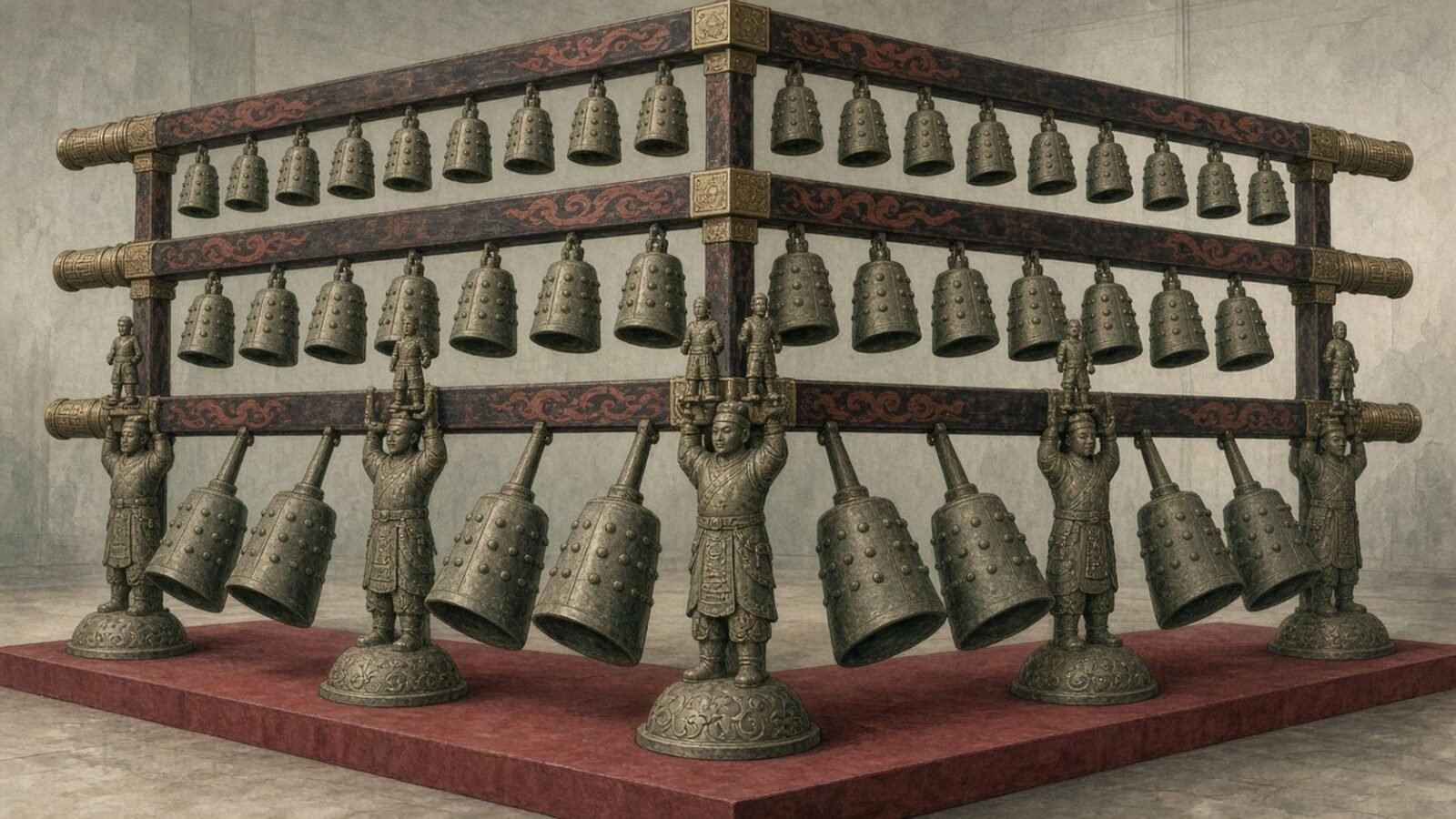
In the spring of 1978, on a low hill called Leigudun outside the city of Suizhou in Hubei, a unit of the People’s Liberation Army was doing what armies do in peacetime: flattening ground. The Air Force needed space for a radar repair workshop, and the hill was in the way. The soldiers blasted through brown earth and red sandstone, and then, metres down, they hit something that was neither. The archaeologists who took over that May found a tomb, and the tomb was flooded, fifteen chambers’ worth of groundwater standing black and still over whatever lay inside. Pumps ran for days. When the water finally fell, the excavators looked into the largest chamber and saw a sight no living person was meant to see: an L-shaped rack of lacquered wood, longer than a city bus, hung with bronze bells in three great tiers, exactly as it had been arranged on the day the tomb was sealed. The tomb had been closed in 433 BC. The bells had hung in the dark, underwater, for two thousand four hundred and thirty-three years. When the conservators struck one, cautiously, it answered in tune.
The dead man was a ruler the history books had essentially lost. The tomb’s own bronzes named him: Yi, Marquis of Zeng, a small state in the Han River valley, and the date came courtesy of a gift. Among the bells hung one outsized specimen, a bo bell cast not in Zeng but sent as a funeral present by King Hui of Chu, and its inscription dates it to the king’s fifty-sixth year: 433 BC, the year the marquis died. Everything else in the tomb was his: more than ten thousand objects, some ten tonnes of bronze in total, the single richest Bronze Age burial ever opened in China. There were lacquered coffins painted with gods, a bronze wine set of such filigreed intricacy that metallurgists still argue about how it was cast, a twenty-one-string se, panpipes, drums, chime stones, and, in a side chamber, the coffins of twenty-one young women. The instruments’ players, most scholars conclude, were buried with their master, so that the orchestra could continue on the other side. One dog went too.
The tomb itself had been built as a palace for the afterlife, four timber-walled chambers laid out like the rooms of a house, each with its function. The great central chamber was the ritual hall, and there the bells and their companion chime stones hung opposite the bronze tripods and wine vessels of the sacrificial set, exactly as they had stood at the marquis’s own ceremonies; the eastern chamber held his nested double coffin and the youngest of the dead women; the others stored the armoury, the chariot gear, the kitchen of the eternal household. And the flood that had so dismayed the excavators turned out to be the tomb’s salvation. Water preserves what air destroys: sealed away from oxygen and from robbers alike, the lacquered rack survived with its paint legible, the wooden instruments kept their shapes, the inscribed bronze stayed bright beneath its patina. A drier tomb would have been an emptier one. The bells owed their second life, in part, to the water that stood guard over their first.
Start with the numbers, because the numbers are absurd. Sixty-five bells. The largest weighs 203.6 kilograms and stands taller than a man; the whole set comes to about two and a half tonnes of tuned bronze, carried on a rack whose beams are shouldered by bronze warriors frozen mid-lift. The span is five octaves, and across the central three of them the set carries every semitone, a complete chromatic palette. To feel what that means, place it in time. This is the fifth century BC. Confucius is old or lately dead. Pericles has just rebuilt Athens. Rome is a muddy republic fighting its neighbours. And in a minor kingdom on the Han River, a foundry has delivered an instrument with the pitch resources of an orchestra, an instrument that would not be matched in Europe until the great church organs of the Baroque, two millennia later.
But the range is not the marvel. The marvel is that every bell plays two notes. Strike the centre of a bell’s face and it sounds one tone; strike the edge of the face and it sounds a second, usually a third apart, and both are deliberate, both are tuned, both are named. The secret is in the cross-section. A Western bell is round, and a round bell is acoustically promiscuous: it rings with a crowd of partials and a slow, wobbling decay. The Zeng bells are almond-shaped, two cusps of bronze meeting like a lens, and that geometry forces the metal into two stable vibration modes with two clean pitches. The founders knew this not as physics but as craft, codified in the Kaogong ji, the Artificers’ Record, which prescribes the alloy for bells at one part tin to six parts copper and describes the shape that makes them speak. After casting, each bell was tuned by filing its inner wall, and the file marks are still there, the fingerprints of technicians who died before Alexander was born, adjusting overtones for a civilisation that had no word for acoustics and plainly did not need one.
The foundry work behind all this was itself a kind of statecraft. Chinese bronze of this era was made not by the lost-wax method the Mediterranean world favoured but by piece-mould casting: the bell was modelled in clay, the model wrapped in clay mould sections fired hard, the sections reassembled around a core with spacers, and molten bronze poured into the gap. It is a demanding way to make anything, since every seam is a chance for failure, and the Zeng founders made sixty-five tuned instruments that way, each in a single pour, then joined the rack by casting and soldering its bronze fittings around the timbers. The showpiece of the technique is the tomb’s famous wine set, a zun vessel nested in a pan basin, rimmed with an openwork of interlaced dragons so dense it looks machine-woven; specialists have argued for decades over whether wax or sectional moulds made it, which is another way of saying the craftsmen achieved by patience what later ages assumed required a trick. The cost was the point. Bronze was power in the Bronze Age, the metal of weapons and ritual, and the marquis took some ten tonnes of it out of circulation and into the ground. His bells were a defence budget you could hear.
Then there is the writing. Inlaid in gold across the bells and their rack are more than 2,800 characters, and they are not prayers, genealogies, or boasts. They are a treatise. Each bell is labelled with the names of its two tones in the marquis’s own terminology, and then, astonishingly, with the equivalent names used in other states: this is what Zhou calls this pitch, this is what Chu calls it, this is Qi, this is Jin. The bells are a conversion table for the music theory of an entire continent, a Rosetta Stone of pitch standards cast in bronze and hung in a tomb. Readers of this series will recognise the reflex. The First Emperor standardised the axle gauge and the script; the examination system standardised the minds; the Zeng founders standardised the notes. Wherever this civilisation finds a practice that varies from state to state, someone, sooner or later, builds the reference object. Usually it is a document. Once, gloriously, it was an orchestra.
To the people who built it, none of this was decoration. Music was government. At the heart of the old theory stand the twelve lü, twelve pitch pipes of cut bamboo, and the deepest of them, the huangzhong, the Yellow Bell, was held to be the foundation of far more than melody. The Han dynasty’s metrologists derived the empire’s units of length, capacity, and weight from the length and volume of that pipe: get the fundamental tone right, and the foot, the pint, and the pound fall into line. It sounds like mysticism until you grasp the claim underneath, which is administrative. A state that cannot agree on a pitch pipe cannot agree on a bushel, and a state that cannot agree on a bushel cannot collect a tax. The classics pair rites and music, li and yue, as the twin instruments of order: rites sort people into their stations, music tunes them to one another. The Book of Songs, the anthology of three hundred and five poems compiled by Confucius’s day, was not read in silence. Every poem was sung, with bells and chime stones marking the phrases, because a poem that could be sung could be remembered, and a poem that could be remembered could govern.
The sage himself left the era’s most famous review. Travelling in the state of Qi, Confucius heard the Shao, a ceremonial suite said to descend from the age of the sage-king Shun, and was undone by it.
For three months he did not know the taste of meat. “I never imagined,” he said, “that music could reach such heights.”
Three months past caring about food: this from a man who took his eating seriously enough to refuse improperly cut meat. The anecdote is usually read as a compliment to one composition. It is better read as a job description. Music, for that world, was the highest technology of the self, the thing that could reorder a human being from the inside, and the educated man was expected to practise it the way a modern executive practises his industry. Among the four arts of the Chinese scholar, the qin came first, before chess, before calligraphy, before painting.
The theory behind the practice was cosmology in staff notation. Chinese melody built on five tones, gong, shang, jue, zhi, yu, and the theorists matched them to everything else that came in fives: the five phases of wood, fire, earth, metal, and water, the five directions, the five viscera, the five flavours. The lowest tone, gong, belonged to the ruler, and the classics warn in dead earnest that when the gong of a state goes slack, disorder follows, because the sovereign note has abandoned its station. Whole ministries of moral philosophy were built on the suspicion of improper music, the so-called decadent sounds of Zheng and Wei that Confucius blamed for corroding the young. Yet here is the lovely contradiction the bells embody: the theory said five tones, and the marquis’s foundry delivered all twelve semitones, ready for music the theorists had not licensed. The practice kept the full palette in reserve, the way the civilisation has always kept more capacity in hand than its own doctrines admitted. Restraint in the text, abundance in the bronze: the two together are the tradition.
The qin, the seven-stringed zither now known as the guqin, deserves its own paragraph because it carries the other half of this story. Its pedigree runs back, by the generous count of tradition, three thousand years, and its repertory was written down in a tablature so old that the oldest surviving copy, a scroll called Solitary Orchid, predates Western staff notation by centuries. But the instrument’s deepest deposit in the language is a story about listening. Bo Ya played the qin; Zhong Ziqi, a woodcutter, heard him. When Bo Ya thought of high mountains, Ziqi said, “lofty as the peaks of Tai”; when he thought of flowing water, “boundless as the rivers.” When Ziqi died, Bo Ya broke his strings and never played again, there being no one left worth playing for. From that tale Chinese drew its word for the friend who truly understands you: zhiyin, the one who knows the sound. No other civilisation on earth defines the soulmate acoustically.
And the tradition runs deeper still, past the Shang, past the bronze, into the bone. At Jiahu in Henan, the same Neolithic village that yielded those controversial traces of early silk, archaeologists in the 1980s lifted flutes made from the wing bones of red-crowned cranes, five to eight finger holes drilled with Neolithic precision, dated to around 7000 BC. Nine thousand years old, and playable: a researcher blew one on camera in 1999 and coaxed out a scale. They are, by a wide margin, the oldest playable musical instruments ever found anywhere. Which means the obsession has been running since before farming was old. China has been arguing about pitch, pipe lengths, and the moral character of melodies for longer than most civilisations have possessed cities. The Marquis of Zeng’s orchestra was not a beginning. It was a very sophisticated middle.
The bells also solved a detective story, and this is the part that reads like the series’ recurring theme of a whole world recovered from a single object. The transmitted histories barely mention a state called Zeng. But since the 1930s, bronzes dug up across Hubei had kept arriving inscribed with that name, and scholars had suspected, without proof, that Zeng was the state the chronicles call Sui. The tomb settled it: here was Zeng’s marquis, in Zeng’s heartland, dated to the year, and the chronicles’ Sui sits exactly where Zeng’s bronze vessels do. Two names, one kingdom, reunited after twenty-four centuries by its own instruments. Later excavations at Yejiashan, in 2011 and 2013, pushed the state’s founding back to the early Western Zhou, centuries before the marquis. A kingdom the written record had half erased turned out to have been casting, ruling, and listening all along. The metal remembered what the texts forgot.
As for the bells themselves, the state that rediscovered them has treated them with an austerity worthy of their first owner. In the forty-eight years since the pumps drained that chamber, the original set has been sounded in public only a handful of times, by most counts three: once at the excavation in August 1978, when a musician struck the first concert anyone had heard from them since antiquity; once in Beijing for the thirtieth National Day in 1979; and once for Hong Kong’s return in 1997, when they were recorded for a symphony of reunion and then, in effect, retired. In 2002 the set was placed on China’s first list of cultural relics forbidden ever to leave the country. What you hear in Wuhan today, at the Hubei Provincial Museum’s daily concerts, is a full-scale replica, cast by measuring the originals down to their file marks. The originals hang behind glass, tuned and silent, an orchestra on permanent standby.
The guqin’s modern history is rougher and more human. The scholar’s instrument was never a folk possession; it lived in studios and gardens, and the twentieth century’s storms hit it where it lived. Guan Pinghu, the greatest qin master of his generation, the man whose touch defined the instrument for the age, spent his last years in poverty and obscurity, mended his own clothes, and died in 1967, in the opening convulsion of the Cultural Revolution, half forgotten. Within a decade and a half, the same nation was teaching his recordings to conservatory students. The revival has since run far past the conservatories: UNESCO proclaimed the art of the guqin a Masterpiece of the Oral and Intangible Heritage of Humanity in 2003 and inscribed it on its representative list in 2008; adult learners queue for lessons in Shanghai office towers; the argument from the Analects about what a gentleman ought to practise has quietly resumed. Instruments, it turns out, are harder to kill than states.
And then there is the strangest afterlife of all, the one that left the planet. In 1977, NASA launched the two Voyager probes, each carrying a gold-plated record of Earth sounds and music, twenty-seven tracks chosen by a committee chaired by Carl Sagan to represent the species to whoever might find the bottle in the cosmic ocean. For China, the committee chose a piece for solo qin: Flowing Water, the very melody Bo Ya was playing in the legend of the listening woodcutter, performed by Guan Pinghu, the master who would die poor ten years later. It is among the longest tracks on the record, and it is now the farthest. Voyager 1 crossed into interstellar space in 2012 and is today some twenty-five billion kilometres from the Sun, still reporting, still carrying the seven strings. The tomb bells wait in Wuhan, tuned, behind glass. The bone flutes wait in Zhengzhou. And a melody about a man and the friend who heard him is falling outward through the dark at seventeen kilometres a second, the oldest music ever to leave the world, playing, as it has for twenty-four centuries, to whoever knows the sound.
That is the arc this series keeps finding under every domain it touches, from the examination halls to the silk looms: the long maintenance, the practice carried across millennia by people who never saw its beginning and cannot imagine its end. The Marquis of Zeng took his orchestra into the dark in 433 BC, and it outlasted his kingdom, his dynasty, the empire that swallowed both, and the map the empire drew. What survives of China is not always stone. Sometimes it is a chord, struck two thousand four hundred years ago, that has not finished decaying.