The Exam That Ruled China for 1,300 Years
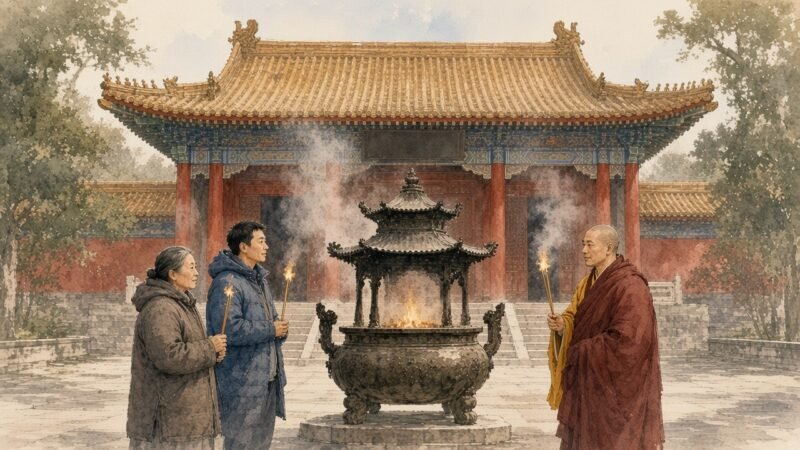
Every year, in the second week of June, China holds its breath. Construction sites near schools fall silent. Traffic police close roads and ban horns. Signal jammers block the airwaves around the halls, candidates pass through security gates and fingerprint scanners, and whole cities arrange themselves around a timetable. Taxi drivers volunteer as free shuttle services, and parents crowd the pavements outside the examination centres, mothers in red qipao for luck, fathers holding umbrellas against the sun, some at temples before dawn burning incense to Wenchang, the god of literature. Inside, more than 13 million eighteen year olds sit down to the gaokao, the national college entrance examination, a test so consequential that Chinese families organise entire childhoods around it. When the scores come out a fortnight later, provincial top scorers become instant celebrities, courted by television crews and elite universities alike, and whole towns celebrate or grieve as one. A single number, summed over a few June days, sorts the children of a continent into the tiers of its universities, and with them, broadly, into the tiers of its future.
Commentators call the gaokao the most pressured exam on earth. What is less often said is that it is also the oldest. The gaokao is the modern descendant of keju, the imperial civil examination, which selected the officials of the Chinese state from its founding under the Sui dynasty in 605 until its abolition in 1905. For exactly 1,300 years, longer than any parliament, any church hierarchy, any royal line on earth has survived, China chose the people who ran it by giving them a test. The examination is arguably the most successful institution China ever built, and it has now been running, with one short interruption, for fourteen centuries.
Blood before merit
To see what the examination replaced, look at what came before. Under the Han dynasty, officials were chosen by recommendation: local worthies were ordered to nominate men judged filial and incorrupt, and the court examined them lightly, if at all. The system assumed that virtue was visible and that local elites would report it honestly. By the third century the state had formalised this into the nine rank system, under which a provincial arbiter assigned every candidate for office to one of nine grades. It worked exactly as you would expect. The arbiters were drawn from the great families, and they graded their own. A bitter saying from the era survives: no poor household in the upper ranks, no powerful clan in the lower ones. Government had become a hereditary club, and the club was strangling the state. The northern dynasties that followed the Han’s collapse were aristocratic in a way China had never quite been before, with lineage registers consulted like stud books and marriage between ranks treated as contamination.
The invention
When the Sui dynasty reunified China in 589 after three centuries of division, its emperors faced the classic problem of every reunifier: how to govern a continent of a realm without handing it back to the great families. Their answer was radical in its simplicity. In 587 Emperor Wen ordered every prefecture to send forward three men a year, chosen not by blood or recommendation but by written examination. Under his son Emperor Yang, in 605, the jinshi degree was created, the "presented scholar", and with it the essential shape of keju was fixed: entry by merit, tested in writing, on subjects set by the throne.
The Tang dynasty made the machine permanent. Examinations were held on a regular cycle, opened in principle to any free male commoner who could register himself, and weighted toward the jinshi, which quickly became the only degree that mattered. Candidates circulated scrolls of their poems among the capital’s tastemakers before the test, hoping reputation would soften the anonymous page, and the poetry section of the examination is one reason the Tang became the golden age of Chinese verse: the state was literally paying for poetry with careers. A Tang saying captured the jinshi’s prestige: a man who passes the mingjing classics degree at thirty is old; a man who passes the jinshi at fifty is young. Empress Wu, ruling in her own name, added the palace examination, conducted by the sovereign in person, and even a military examination. The Tang also discovered the system’s hidden virtue. Watching a new cohort of successful candidates file through the palace gates, Emperor Taizong is said to have exclaimed: the heroes of the empire have entered my trap. Ambition that might otherwise have raised rebel armies was instead bent over books, memorising the classics of the state.
The machine
It was the Song dynasty that turned the examination from a door into a machine. The early Song emperors, building a civilian state after a century of military strongmen, multiplied the intake from a few dozen graduates a year to hundreds, and in doing so they had to solve the problem of trust. Their solutions still impress. From the tenth century onward, scripts bore sealed names, so the examiner could not see who had written them; from 1015, clerks recopied every essay before grading, so that even handwriting could not betray the candidate to a friendly eye. Quotas spread places across the provinces, so the far south and the frontier were not drowned out by the cultured Yangtze delta. The state printed standard editions of the classics and, later, of Zhu Xi’s commentaries, and a whole economy grew up around the exam: academies, tutors, collections of model essays, cheap printed editions for boys from villages. When Wang Anshi reformed the curriculum in 1071, shifting it from poetry toward exegesis of the classics, poets complained he had turned writers into pedants; the state did not care, because the state was not buying poetry. It was buying administrators with identical minds.
The mature ladder had three great rungs. A boy who passed the county licensing examination became a shengyuan, a government student, exempt from corvée labour and answerable to scholars rather than constables. Every three years the provincial examination, days and nights in the cells, admitted perhaps one in a hundred candidates to the rank of juren, a recommended man, eligible for office and rich in local prestige; men turned grey attempting it. The survivors travelled to the capital for the metropolitan examination and finally the palace examination under the emperor’s nominal eye, which conferred the jinshi, the presented scholar, on only two or three hundred men in each cycle for an empire of hundreds of millions. At the summit stood the zhuangyuan, the single name at the head of the golden list, a title so luminous that modern China still uses it, every June, for the top scorer in each province’s gaokao.
The result was something the world had never seen: a great state openly recruiting its ruling class by competitive written test. The historian Ho Ping-ti, examining the rosters of Ming and Qing graduates, found that roughly half of the men who passed the highest examinations came from families that had produced no official for three generations. The ladder was narrow, brutally so, but it reached all the way down. Every village schoolmaster could tell the story of the ploughman’s son who became a minister, and the story was true often enough to keep a million brush pens moving. Popular mythology absorbed the idea whole: the carp that leaps the dragon gate becomes a dragon, and every examination season the temples of the literature god filled with parents bargaining for their sons.
The ordeal
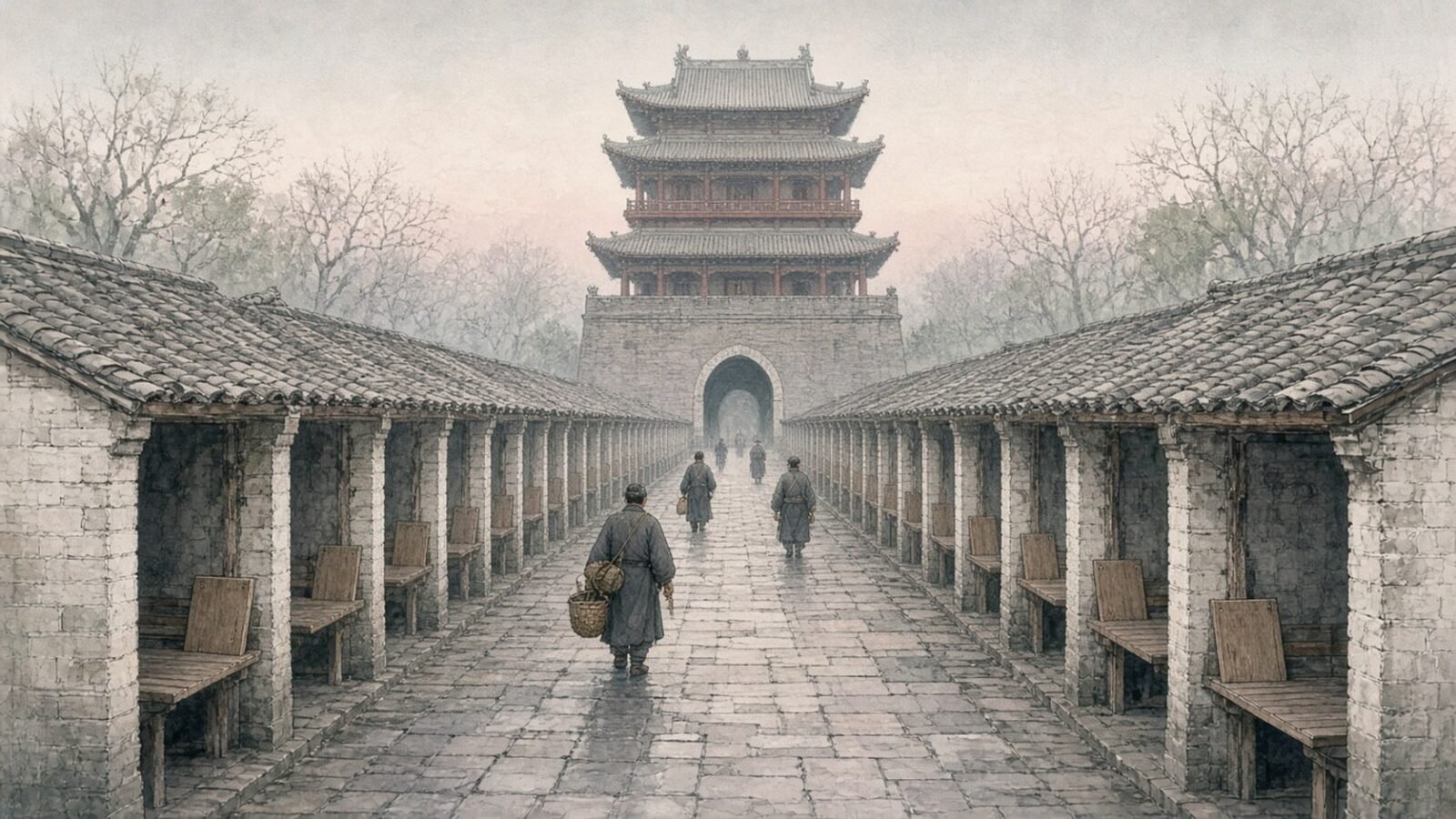
By the Ming and Qing the examination had become an ordeal of almost ceremonial cruelty, and its surviving architecture still startles. At the Jiangnan examination hall in Nanjing, the largest of them all, 20,644 brick cells stood in ranks beside the Qinhuai River. Each cell measured a metre and a half square, fitted with two boards: the upper for writing, the lower for sitting. For three sessions of three days each, candidates lived in the cell, eating, sleeping and composing within its walls, their cooking pots and chamber pots beside their ink stones. Guards watched from the Mingyuan tower. Steamed buns were sliced open at the gate to check for smuggled notes. Candidates were searched to the skin. And still they cheated: miniature books sewn into clothing, essays written on shirt linings in characters the size of a fly’s head, impostors hired to sit in cells. The state answered with exemplary terror. After the great scandal of 1858, the chief examiner, a grand councillor named Baijun, was beheaded, the most senior official put to death in Qing memory.
For those who passed, the theatre was as glorious as the cells had been grim. Results were proclaimed on the golden list, and the idiom "to inscribe one’s name on the golden list" has meant examination triumph in Chinese for a thousand years; you will hear it on television this June. New juren were feasted at provincial expense; stone steles at the Confucian temples recorded their names; families hung plaques above their doors, and whole lineages pooled their land to fund the next boy who might repeat the feat. Failure, by contrast, was a career in itself: the Qing records are full of men who sat the provincial examination ten, fifteen, twenty times across a lifetime, and the literature of the era is haunted by them.
What the candidates wrote was the eight legged essay, a form fixed in the Ming: an argument on a passage from the Four Books, developed in eight strictly regulated limbs, the writer required to ventriloquise the sages in parallel prose of exacting symmetry. Generations of critics despised it. The seventeenth century scholar Gu Yanwu wrote that the harm of the eight legged essay equalled the burning of the books, and the eighteenth century novel The Scholars, Wu Jingzi’s great satire, drew a society so warped by the test that a man goes mad with joy on hearing he has finally passed. China’s failure to answer the West in the nineteenth century was blamed, not unfairly, on a curriculum that had frozen around commentaries written five hundred years before. Yet the critics rarely grasped the form’s real function. The essay was not testing originality. It was testing whether a man could submit his mind completely to a common standard, which is precisely the quality an imperial bureaucracy requires.
What the exam built
Stand back, and the examination’s deepest achievement was not administrative but civilisational. From Sichuan to Shandong, from the ninth century onward, every ambitious boy in China memorised the same Four Books, wrote in the same characters, dreamed the same dream of the capital. An empire of mutually unintelligible dialects was glued together by a single curriculum. The system even taught the empire how to manage its own regions. When the 1397 metropolitan examination produced a pass list composed entirely of southerners, the Hongwu Emperor ordered examiners executed and a new list drawn, and thereafter quotas balanced north against south, a politics of regional fairness conducted entirely through pass rates. Government remained civilian: the soldier, however decorated, stood below the degree holder. Local society organised itself around the gentry, degree holders and aspirants who arbitrated disputes, ran schools and relief works, and stood between the village and the magistrate. And the throne acquired the most loyal governing class any monarchy has ever had, because that class owed everything it was to the palace examination.
There were costs, of course. The same uniformity that unified the empire may have starved it of the institutional variety from which experiments grow, and scholars still argue about how much of China’s missing scientific revolution should be charged to the examination’s account. But when the examiners finally left the cells of Nanjing, the museum that replaced them captured the symbolism perfectly: the Imperial Examination Museum of China descends a ramp 130 metres long, one metre for every ten years of keju.
The exam China gave the world
The system’s strangest afterlife happened abroad. Jesuit missionaries in the sixteenth and seventeenth centuries sent home astonished accounts of a kingdom ruled by philosophers chosen by examination, and Matteo Ricci’s journals dwelt on it admiringly. The reports were devoured by Enlightenment Europe. Voltaire praised China as the one state where office went to merit rather than birth, and European reformers began asking why their own administrations could not work the same way. The East India Company, governing its Indian possessions, moved first: its college at Haileybury began admitting recruits by competitive examination in the early nineteenth century. In 1854 the Northcote and Trevelyan report proposed the same for Whitehall, with the Chinese precedent in plain view, and Britain’s civil service examinations followed. The United States adopted merit examinations with the Pendleton Act of 1883. The scholar Teng Ssu-yu traced the whole line of descent in a famous study. The world’s standard form of bureaucracy, examinations in, patronage out, is a Chinese invention, as much as paper or the compass.
The abolition and the shock
In the end, the system died by the logic that had sustained it. After the shocks of the Opium Wars and the defeat by Japan in 1895, the curriculum itself seemed the enemy: an empire being dismembered by foreign powers could no longer afford ministers trained in parallel prose. Reformers had demanded change for decades; the court had twice abolished and restored the eight legged essay. Then, in September 1905, on the petition of Yuan Shikai and Zhang Zhidong, the Qing abolished the examination outright, effective the following year, after 1,300 years. It was one of the most abrupt institutional suicides in history, and its costs were immediate. Tens of thousands of candidates were stranded mid career with an education in the classics and no ladder to climb. Rural China, which had organised its schooling around the exam, lost its tie to the state. Historians have noted that alienated literati and stranded students became the recruiting pool of revolution. A dynasty that dismantled the ladder that had held it up for over a millennium fell within six years.
The return of the ladder
The People’s Republic understood, consciously or not, what the Qing had thrown away. A unified national entrance examination was established in 1952. Then came the interruption: in 1966, with the Cultural Revolution, the gaokao was suspended and the universities emptied, admissions eventually handed to recommendation by workers, peasants and soldiers, a deliberate return to selection by class origin rather than merit. It was the nine rank system reborn, and it failed the same way. In 1977, within months of consolidating power, Deng Xiaoping restored the examination by personal decision, too late in the year for the usual summer date, so it was held in winter. The state had not even printed enough paper: stock earmarked for a volume of Mao’s Selected Works was diverted to make the examination booklets. Some 5.7 million people sat the test, many of them sent down youth who had spent years in the countryside studying by lamplight with no promise the exam would ever return. Roughly 273,000 were admitted, under five per cent, and that single cohort, among it a future premier, Li Keqiang, went on to supply a disproportionate share of China’s leaders in science, industry and government for the next generation. The winter examination of 1977 is remembered in China the way other nations remember a liberation.
The longest ladder
Today the machine runs at a scale the Sui founders could not have imagined. More than 13 million candidates sit the gaokao each June, prepared for by schools like Hengshui in Hebei, whose timetabled precision is famous and infamous in equal measure. An entire economy orbits the exam: rented flats beside the better schools, relocation schemes to provinces with softer quotas, a national conversation that erupts every year over the essay prompts the moment the first paper ends. The fairness argument is permanent: provincial quotas mean a Beijing household registration needs a lower score for the same university than a candidate from Henan, and rural students know it. Yet even the critics defend the exam itself, because the alternatives, recommendation, money, connections, are all worse. When the imperial system ended, the Chinese examination habit did not die; it migrated. The modern civil service exam, the guokao, drew nearly 4 million registrants for fewer than 40,000 posts in its latest cycle, ratios the Qing examiners would have recognised instantly. Six centuries after Europe borrowed the idea, the original still runs, harder than ever.
Every state must answer one question: who gets to rule, and how would they prove it. Europe answered for centuries with birth, then with wealth, then with the ballot. China, alone among civilisations, answered with a test, and has now been answering with a test for fourteen centuries, through dynasties and republics, emperors and party secretaries, brush pens and bubble sheets. The boy in the brick cell at Nanjing and the girl at her desk in Hengshui are separated by 150 years and a revolution, but they are doing the same thing, on the same ancient terms: one country, one paper, one standard, and may the best memory win. The wall fell, the empire fell, the dynasty fell. The examination remains.
References
- Imperial examination, Grokipedia
- Gaokao, Grokipedia
- Eight-legged essay, Grokipedia
- Nine-rank system, Grokipedia
- Sui dynasty, Grokipedia
- The Ladder of Success in Imperial China: Aspects of Social Mobility, 1368 - 1911, Ping-ti Ho, Columbia University Press, 1962
- Imperial Examination Museum of China, Nanjing, official English site
- The Gaokao Essay: Reflecting China’s Socio-Political Shifts, National High School Journal of Science
- China’s Civil Service Exam Is the New ‘Gaokao’, Caixin Global