The Jews of Odessa
Odessa was a new city. It was founded on the northern shore of the Black Sea at the end of the eighteenth century, on land that the Russian Empire had only recently taken from the Ottoman Empire, and within a hundred years it had become the fourth largest city in the empire and one of the busiest ports in Europe. From the start its population was mixed: Russians and Ukrainians lived alongside Greeks, Italians, Germans, Bulgarians, Armenians, Poles and Moldavians. Among these communities the Jews grew fastest. By the end of the nineteenth century they made up about a third of the city’s population, and Odessa had become one of the largest Jewish cities in the world and one of the main centres of modern Jewish literature, scholarship and music.[1][2]
This special feature follows that history from the founding of the city in 1794 to the end of the twentieth century. It describes the arrival of the first Jewish settlers, the commercial boom of the port and the grain trade, the Jewish Enlightenment and the new schools and periodicals it produced, and the writers in Hebrew, Yiddish and Russian who made the city famous. It recounts the outbreaks of anti-Jewish violence that marked the century, the political and social movements that emerged in the city, and the musical tradition associated with the teacher Pyotr Stolyarsky and his pupils. It then turns to the Soviet period, to the destruction of the community during the Second World War and to the emigration of the later twentieth century, and closes with an account of the city’s cultural legacy. An interactive timeline at the end of the essay gathers the principal dates.
1. A new city on the Black Sea
The site of Odessa had been occupied by a small Ottoman fortress and Tatar settlement known as Khadjibey. Russian forces took it in 1789 during the Russo-Turkish war, and the Treaty of Jassy of 1792 confirmed the transfer of the coastline between the Southern Bug and the Dniester to Russia. In 1794 the Empress Catherine II issued a decree establishing a port and town on the site, and the work of construction was entrusted to José de Ribas, a Neapolitan-born admiral in Russian service, and to the Dutch military engineer Franz de Volan, who drew up the city’s regular grid of streets. The name Odessa, a form derived from the ancient Greek colony of Odessos believed to have stood somewhere on that coast, was adopted in 1795.[1]
The new territories of the south, known collectively as New Russia, were sparsely populated, and the imperial government encouraged settlement from many directions. Colonists were offered land, tax exemptions and freedom from military service. Jews were among the earliest residents. A count made in 1795 recorded a small number of Jewish households, and a Jewish burial society and a prayer house existed within the first years of the city’s life. New Russia lay within the Pale of Settlement, the region of western and southern provinces to which the Jewish subjects of the empire were largely confined after the partitions of Poland, and it was one of the areas in which the government actively permitted and at times encouraged Jewish settlement.[4]
The city grew rapidly under its early governors. Armand-Emmanuel du Plessis, Duc de Richelieu, a French émigré who served as governor of Odessa from 1803 and as governor-general of New Russia until 1814, oversaw the construction of the harbour, the first public buildings and the opening of the city to foreign merchants. His statue, erected in 1828 at the head of the great staircase leading down to the port, remains one of the city’s best-known landmarks. Under Count Mikhail Vorontsov, governor-general from 1823 to 1844, Odessa acquired a theatre, a lyceum, boulevards and a stock exchange, and became the administrative and cultural capital of the south.[5]
The most important single measure for the city’s commerce was the grant of the status of a free port, or porto franco, in 1819. Goods could be imported into the city without customs duties, and Odessa became the principal outlet for the grain grown on the fertile steppes of southern Ukraine and the lands beyond. Grain was brought to the port by ox-drawn wagons, and later by rail, and exported across the Black Sea and through the Bosporus to the Mediterranean and western Europe. The free port status lasted until 1859, and by then Odessa had established itself as the empire’s leading exporter of wheat.[1]
2. Merchants, brokers and the grain trade
The grain trade drew merchants from every corner of the Mediterranean and Eastern Europe. In the early decades Greek and Italian houses dominated the export business, and Italian was widely used in commerce and on the street signs. Jewish merchants and brokers took a growing share of the trade from the 1820s and 1830s onwards, buying grain from landowners and peasants in the interior, arranging credit and transport, and selling to the exporting houses in the port. By the second half of the nineteenth century Jewish firms controlled a large proportion of the grain exports passing through the city, and Jews were prominent in banking, insurance, the trade in timber and sugar, and the professions.[2]
The rapid growth of the Jewish population reflected these opportunities. Odessa offered a degree of freedom unusual in the Russian Empire. As a new city it had no medieval guilds, no entrenched municipal corporations and no long-established Jewish community with traditional institutions of control. Merchants of many nationalities met as equals in the exchange, and the city’s tone was set by commerce rather than by an old aristocracy or a church hierarchy. Jewish migrants came from the towns and villages of Podolia, Volhynia, Lithuania and Belarus, and from across the Austrian border in Galicia. From a few hundred at the start of the century, the Jewish population rose to some 17,000 by the 1850s, to more than 50,000 by the 1870s and to about 139,000 at the census of 1897, when Jews made up roughly 35 per cent of the city’s 404,000 inhabitants. Only Warsaw had a larger Jewish population within the empire.[2][33]
Among the most influential of the early migrants were the Jews of Brody, a commercial town in Austrian Galicia close to the Russian frontier. Brody had long been a centre of trade between the Habsburg lands and Russia, and it was also an early centre of the Jewish Enlightenment in Galicia. Merchants from Brody settled in Odessa in the 1810s and 1820s and brought with them commercial connections, a knowledge of German and a familiarity with the ideas of the Haskalah, the movement that sought to reconcile Jewish life with modern European education. In Odessa they formed a distinct and prosperous group, and their congregation would play a central role in the modernisation of Jewish religious life in the city.[3]
The broader population of Jewish Odessa was far from wealthy. Alongside the merchants and bankers lived large numbers of artisans, shopkeepers, carters, dock workers and small traders, many of them crowded into the districts of the Moldavanka and Peresyp on the edges of the city. Tailors, shoemakers, tinsmiths and printers worked in small workshops, and many families depended on irregular work in the port. Contemporary observers noted the contrast between the elegant streets of the city centre, with their cafés, theatres and shops, and the poverty of the outlying districts. Both worlds would leave their mark on the literature that the city later produced.
The prosperity of the Jewish merchants also gave rise to institutions of charity and mutual aid. A Jewish hospital was established in the early nineteenth century and enlarged several times; burial societies, orphanages and loan funds supported the poor; and wealthy merchant families funded schools and synagogues. The city’s Jewish community became known for the number and variety of its charitable institutions, which by the end of the century included vocational schools, soup kitchens and a home for the aged.[2]
3. Colonies of the steppe
The hinterland of Odessa was also the scene of one of the most unusual experiments in the history of Russian Jewry, the establishment of Jewish agricultural colonies on the steppe. The Statute on the Jews issued by Alexander I in 1804 encouraged Jews to take up farming, and from 1807 the government granted land in the province of Kherson to Jewish settlers who agreed to become cultivators. Colonies with names such as Bobrovy Kut, Seidemenukha, Inguletz and Nagartav were founded in the following decades, and further settlements were established under Nicholas I in the 1840s. The early years were hard. Many settlers arrived without experience of farming, without adequate tools or livestock, and on land that was often poorly watered, and disease and crop failures took a heavy toll.[4]
Over time, however, several of the colonies became stable farming communities. Their inhabitants grew wheat and other grains for the market, kept cattle and vineyards and built schools and prayer houses, and their produce passed through the same networks of traders and brokers that served the port of Odessa. The colonies attracted the interest of foreign visitors and of Jewish philanthropists, who saw in them evidence that Jews could become farmers if given the opportunity, and they later provided a reference point for the agricultural settlement programmes of Hibbat Zion and for Jewish agricultural colonisation in Argentina and, in the Soviet period, in southern Ukraine and Crimea. Many young people from the colonies moved to Odessa to study or to work, and the city’s schools and businesses drew on them as they drew on the towns of the Pale.[2]
The relationship between the colonies and the port reflected the broader economic geography of the south. Odessa was the commercial capital of a region of farms, estates and market towns, and much of the wealth of its merchants came from the trade in their produce. The Jewish brokers who travelled from the city to buy grain in the countryside were part of a network that linked the exchange on Odessa’s boulevards with the villages and colonies of the steppe, and the fortunes of Jewish Odessa rose and fell with the harvests and with the price of grain on the markets of Western Europe.
When American and Argentine grain began to compete with Russian wheat in the last decades of the nineteenth century, and the railway network diverted part of the trade to other ports, the city’s commerce came under pressure. Odessa remained a major port, but its growth slowed relative to the boom years, and the competition for work and markets intensified. Economic historians have connected these changes with the social tensions of the 1880s and 1890s, and with the growth of emigration from the city and the surrounding region in the same period.[1]
4. Enlightenment, schools and synagogues
Odessa became one of the first places in the Russian Empire where the ideas of the Haskalah took institutional form.[6] In 1826 a modern Jewish school opened in the city with the support of the authorities and of the Brody merchants. Under its director Bezalel Stern, a native of Galicia, it taught Hebrew and Jewish subjects alongside Russian, German, French, arithmetic, geography and commercial skills, and it was regarded by the imperial government as a model for the education of Jews elsewhere in the empire. A school for girls followed. These institutions educated a generation of young Jews who were at home in Russian and European culture while retaining a connection to Jewish learning, and their graduates included many of the merchants, doctors, lawyers and journalists of the following decades.[3]
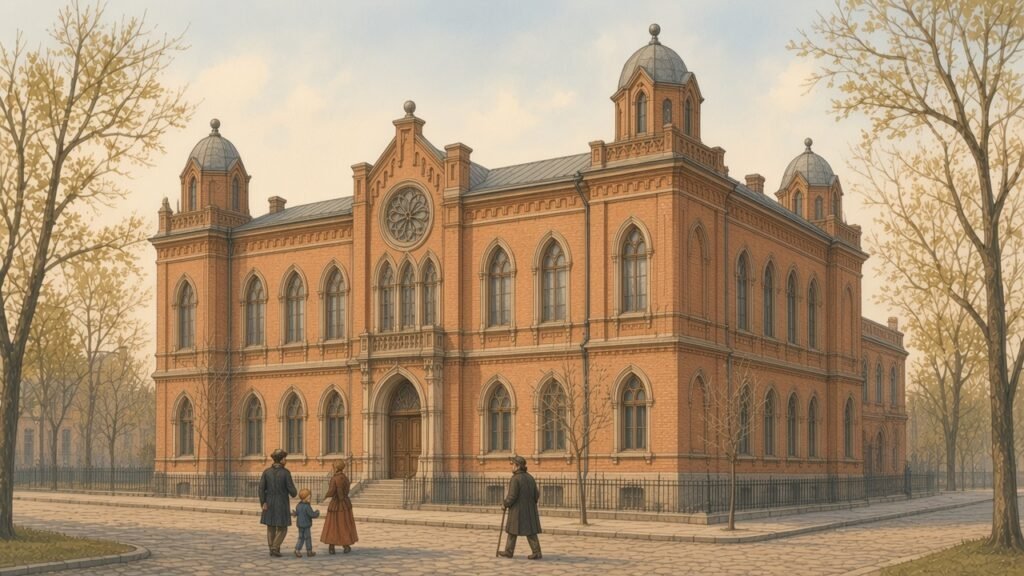
Religious life was transformed in the same spirit. In 1841 the Brody community obtained permission to establish its own synagogue, which introduced a trained choir, a sermon in German and a more formal order of service modelled on the reformed synagogues of Central Europe. The congregation later moved into a large building in a Moorish and Gothic style on Pushkinskaya Street, completed in the 1860s, which became known as the Brody Synagogue. Its cantors and choirmasters, among them Nisan Blumenthal, who led the choir for several decades, and later Pinchas Minkowski, made it one of the most celebrated centres of synagogue music in Eastern Europe. The Main Synagogue on Yevreiskaya Street, built in the 1850s, served the broader community, and dozens of smaller prayer houses, many organised by trade or by town of origin, existed across the city.[2]
The modernising tendencies of Odessa Jewry provoked comment among traditional Jews elsewhere. A saying current in the Yiddish-speaking towns of the Pale held that the fires of hell burned for seven miles around Odessa, an expression of the city’s reputation for religious laxity, worldliness and the pursuit of pleasure. The city was also known in Yiddish and Russian as a place where fortunes could be made quickly, and the phrase “to live like God in Odessa” entered Yiddish speech. These reputations were exaggerated, since the city also had a substantial traditional and Hasidic population, but they reflected a real difference between Odessa and the older communities of the Pale.[3]
The city’s printing presses and periodicals made it a centre of the modern Jewish press. In 1860 Osip Rabinovich and Joachim Tarnopol founded Rassvet, the first Jewish periodical in the Russian language, which argued for the integration of Jews into Russian society and for the reform of Jewish education. In the same year Alexander Zederbaum began to publish Ha-Melits, one of the first Hebrew weeklies in the Russian Empire, and in 1862 he added a Yiddish supplement, Kol Mevaser, which published early works of modern Yiddish fiction. Ha-Melits moved to St Petersburg in 1871, but by then Odessa had established a reputation as a place where Jewish journalism in three languages could flourish.[2]
The use of Russian among Odessa’s Jews distinguished them from the communities of Lithuania and Poland. Many children of merchant families grew up speaking Russian at home, attended Russian gymnasia and the Novorossiysk University, which opened in the city in 1865, and entered the professions. Odessa thus became one of the main centres of a Russian-Jewish intelligentsia that wrote and argued in Russian about Jewish questions. At the same time Yiddish remained the language of the majority of the city’s Jews, and Hebrew retained its place as the language of learning and, increasingly, of a new secular literature. The coexistence of these three languages, often within a single family, was one of the defining features of Jewish Odessa.
5. Violence and its aftermath, 1821 to 1881
The history of Jewish Odessa in the nineteenth century was also marked by outbreaks of violence, the first of which took place in 1821. In that year the Greek War of Independence began, and in April the Ottoman authorities in Constantinople executed the Ecumenical Patriarch Gregory V. Rumours spread that Jews in Constantinople had been involved in the desecration of his body. When the body was brought to Odessa for burial in June, Greek residents attacked Jewish homes and shops. The violence was limited in scale compared with later events, but historians often cite it as the first pogrom in the Russian Empire.[7][8]
Further disturbances took place in 1859, again with the participation of Greek residents, many of them sailors and dock workers, during the Easter season. The most serious outbreak of the period came in 1871, when, over several days at Easter, crowds attacked Jewish property in many parts of the city. Several people were killed and hundreds of houses and shops were damaged before troops restored order. The violence of 1871 was a shock to the city’s Russian-speaking Jewish intelligentsia, which had placed its hopes in integration and enlightenment, and it prompted a reconsideration of those hopes, particularly among the journalists of the Russian-language Jewish press.[7]
Historians of the period have explained the Odessa riots partly in terms of commercial rivalry. As Jewish merchants displaced Greek houses in the grain trade, tensions between the two communities grew, and the Easter season, with its religious processions and holiday crowds, provided an occasion for violence. The large population of seasonal labourers in the port, many of them recent migrants without settled ties to the city, also contributed. These explanations do not account for every outbreak, but they help to explain why Odessa, otherwise known for its cosmopolitan tolerance, was the scene of repeated disturbances.[8]
The assassination of Tsar Alexander II in March 1881 was followed by a wave of pogroms across the southern provinces of the empire, beginning at Elisavetgrad in April and spreading to Kiev and many smaller towns. In Odessa rioting broke out in May 1881 and lasted for several days. Jewish students and workers organised self-defence groups, an early instance of a practice that would recur in the city. The government’s response included the so-called May Laws of 1882, which imposed new restrictions on Jewish settlement and economic activity, and in the following years quotas were introduced limiting the number of Jews admitted to gymnasia and universities. In Odessa, where the Jewish share of the population was large, the quotas fell heavily on the children of the professional classes.[8][4]
The events of 1881 and 1882 had lasting consequences for Jewish political thought, and Odessa was at the centre of the debate. In 1882 Leon Pinsker, a physician who had been born in Tomaszów and had lived and worked in Odessa for most of his life, published in Berlin a German pamphlet entitled Auto-Emancipation.[9][10] Pinsker had once been a supporter of integration and had been associated with the Russian-language Jewish press of the 1860s. In Auto-Emancipation he argued that the Jews would not achieve security through emancipation granted by others, and that they needed a national territory of their own. The pamphlet became one of the founding texts of modern Jewish nationalism, and Pinsker became the leader of the Hibbat Zion, or Love of Zion, movement, which established its central committee in Odessa.
6. The Odessa sages and the Hebrew revival
In the last two decades of the nineteenth century Odessa became the capital of modern Hebrew literature. A group of writers, scholars and activists settled in the city and formed a circle that their contemporaries called the sages of Odessa. Their meeting places were the editorial offices of journals, the homes of patrons and the cafés of the city centre, and their debates shaped the development of Hebrew prose and poetry, Jewish historiography and the cultural programme of the Jewish national movement.[2]
The senior figure of the circle was Sholem Yankev Abramovitsh, known by the name of his best-known literary persona, Mendele Moykher Sforim, or Mendele the Book Peddler.[11][12] Born near Minsk in 1835 or 1836, Abramovitsh had begun his career as a Hebrew writer of the Haskalah, then turned to Yiddish in the 1860s with satirical novels about life in the small towns of the Pale. In 1881 he moved to Odessa to become director of the city’s Talmud Torah, a school for poor Jewish children, a post he held until his death in 1917. In Odessa he rewrote many of his Yiddish works in Hebrew, and in doing so created a supple, flexible Hebrew prose style that drew on all the layers of the language, from the Bible to rabbinic literature. Later writers regarded him as the grandfather of modern literature in both languages.
Asher Ginzberg, who wrote under the name Ahad Ha’am, meaning One of the People, came to Odessa from the Ukrainian countryside in 1884.[13] His essay “This Is Not the Way”, published in 1889, criticised the practical colonisation work of Hibbat Zion for neglecting the cultural and spiritual renewal of the Jewish people. Ahad Ha’am argued for what became known as cultural Zionism: the creation in the Land of Israel of a spiritual centre that would revive Hebrew culture and strengthen Jewish life in the diaspora. He founded a small society called Bnei Moshe to promote these ideas, and from 1896 he edited the Hebrew monthly Ha-Shiloah, which was later edited by the historian Joseph Klausner and became the leading Hebrew literary journal of its time.[16]
Hayim Nahman Bialik, the most celebrated Hebrew poet of the modern era, first came to Odessa as a young man in 1891 and returned to settle there in 1900.[14] He worked as a teacher, editor and publisher, and in 1901, with Yehoshua Hana Ravnitzky and others, he founded the Moriah publishing house, which issued Hebrew textbooks, anthologies and literary works for schools and general readers. In Odessa Bialik wrote much of his major poetry, and with Ravnitzky he compiled the Sefer ha-Aggadah, an anthology of the legends and homilies of rabbinic literature arranged by subject, which became a standard work. Bialik remained in Odessa until 1921, when he left Soviet Russia with a group of Hebrew writers, settling first in Berlin and then in Tel Aviv.
The historian Simon Dubnow lived in Odessa from 1890 to 1903.[15] There he wrote many of the works that made him the leading Jewish historian of Eastern Europe, including studies of Hasidism and the first parts of his history of the Jews of Russia and Poland, and he developed the theory of diaspora nationalism, which held that the Jews constituted a cultural and historical nation whose autonomy could be secured within the states in which they lived. He was a frequent participant in the debates of the Odessa circle, and his correspondence with Ahad Ha’am records their long disagreement over the place of the diaspora in Jewish life.
Other members of the circle included Moshe Leib Lilienblum, a former Talmud student who became one of the leaders of Hibbat Zion, the folklorist and editor Ravnitzky, the writer Mordecai Ben-Ami, and younger writers such as Shaul Tchernichovsky, who studied in Odessa before pursuing a career in medicine and poetry. Joseph Klausner, later a professor at the Hebrew University of Jerusalem, spent his formative years in the city. The Zionist organiser Menachem Sheinkin and the future first mayor of Tel Aviv, Meir Dizengoff, were associated with Zionist activity in Odessa before their emigration to Palestine.[16][17]
The Society for the Support of Jewish Farmers and Artisans in Syria and Palestine, commonly known as the Odessa Committee, was registered with the imperial authorities in 1890 and became the legal framework for Hibbat Zion activity in Russia. It raised funds for agricultural settlements, schools and cultural institutions, and its members included most of the leading figures of the Odessa circle. The committee continued to operate into the Soviet period and was formally dissolved in the 1920s.[2]
7. Yiddish Odessa
Although the city was celebrated as a centre of Hebrew literature, Yiddish was the everyday language of most of its Jews, and Odessa played an important part in the history of Yiddish writing and theatre. Abramovitsh’s Yiddish novels were revised and published in Odessa, and the city provided a setting and a market for popular Yiddish fiction and newspapers. Sholem Rabinovich, who wrote as Sholem Aleichem, lived in Odessa in the early 1890s after losing his fortune on the Kiev stock exchange, and his comic epistolary novel about the luckless speculator Menakhem-Mendl begins with its hero trading on the Odessa exchange.[19] The Odessa of Menakhem-Mendl, with its brokers, cafés and sudden reversals of fortune, became one of the most familiar literary images of the city.
The Yiddish theatre also had early connections with Odessa. Abraham Goldfaden, often called the father of modern Yiddish theatre, toured the south of the empire with his troupe in the late 1870s, and Odessa was among the cities where his plays were performed to large audiences before a government ban on Yiddish theatrical performances in 1883 drove many actors to emigrate. Yiddish companies continued to perform in Odessa under various guises, and in the Soviet period the city had a state Yiddish theatre.
Odessa also produced a distinctive spoken Russian, enriched by Yiddish, Ukrainian, Greek and Italian borrowings, with characteristic intonations and turns of phrase. This Odessa Russian, associated especially with the Jewish population of the Moldavanka and the port, later entered literature through the work of Isaac Babel and other writers, and it remains one of the most recognisable elements of the city’s popular culture. Its humour and its rhythms became part of the image of Odessa throughout the Russian-speaking world.
8. Movements and parties at the turn of the century
By the end of the nineteenth century Odessa’s Jewish population supported a wide range of political and social movements. Zionism in its various forms drew support from merchants, teachers and students. The Jewish socialist movement found adherents among the artisans and workers of the city, and the General Jewish Labour Bund, founded in Vilna in 1897, established branches in Odessa. Many young Jews joined the Russian revolutionary parties, both Social Democratic and Socialist Revolutionary, while others supported the liberal constitutional movement. Leon Trotsky, born Lev Bronstein on a farm in the province of Kherson, attended school in Odessa in the 1890s, an example of the many young people from the region who passed through the city’s schools on their way to political careers.[2]
The youngest and most combative of the Zionist leaders to emerge from the city was Vladimir, later Ze’ev, Jabotinsky, born in Odessa in 1880.[18] Raised in a Russian-speaking family, he became known first as a journalist and feuilletonist writing for the Russian-language press of Odessa under the pen name Altalena, and as a translator of poetry, including Bialik’s verse, into Russian. After 1903 he devoted himself to the Zionist movement. His novel The Five, published in Russian in 1936, is a portrait of an assimilated Jewish family in Odessa at the turn of the century and is regarded as one of the most vivid literary evocations of the city in that period.
Jewish self-defence groups, first organised in 1881, were revived in the early twentieth century. After a pogrom in Kishinev, in neighbouring Bessarabia, in April 1903, which killed dozens of Jews and attracted international attention, Jewish students, workers and members of the political parties in Odessa formed armed self-defence units. Bialik visited Kishinev on behalf of a historical commission organised in Odessa to document the events, and his long poem “In the City of Slaughter”, written after the visit, became one of the most widely read Hebrew poems of the century.[14]
9. 1905 and the end of the old empire
The revolution of 1905 brought the most severe violence in the city’s history before the Second World War. In June of that year the crew of the battleship Potemkin mutinied and brought the ship into Odessa harbour, and in the disorder that followed troops fired on crowds on and around the steps leading down to the port. The episode was later dramatised in Sergei Eisenstein’s film Battleship Potemkin of 1925, whose sequence on the steps made them famous throughout the world.[32]
In October 1905 the tsar issued a manifesto promising civil liberties and an elected legislature. Celebrations by supporters of the manifesto in Odessa were followed by counter-demonstrations, and from 18 October rioting directed against the Jewish population spread across the city. Over four days several hundred Jews were killed, estimates ranging from about 400 to more than 800, and thousands of homes and businesses were damaged or destroyed. Jewish self-defence units fought the rioters in several districts. Contemporary investigations and later historical studies documented the passivity and in some cases the participation of police and troops. The October pogrom was the deadliest of the many that took place across the empire in that month.[7][8]
The violence of 1905 accelerated emigration from Odessa, as from other parts of the empire, to the United States, to Western Europe, to South America and to Palestine. It also deepened the divisions among the city’s Jewish political movements over the proper response. In the following decade, however, the community continued to grow and its cultural life remained vigorous. A Jewish historical-ethnographic society, new schools, a Hebrew gymnasium and new periodicals were founded, and on the eve of the First World War the Jewish population was estimated at more than 150,000.[2]
The First World War, the revolutions of 1917 and the civil war that followed brought years of upheaval. Between 1917 and 1920 Odessa changed hands repeatedly. It was held in turn by the Ukrainian People’s Republic, by Austro-Hungarian and German forces, by French and other Allied troops, by the White Volunteer Army and by the Bolsheviks, who established permanent control in February 1920. During this period the city’s Jewish community saw an extraordinary flowering of political and cultural activity, with Hebrew, Yiddish and Zionist organisations, publishing houses and schools operating with a freedom that would not last. In December 1919 the steamship Ruslan sailed from Odessa to Jaffa carrying several hundred Jewish emigrants, among them writers, artists and scholars, an event later regarded as a symbol of the transfer of Hebrew culture from Odessa to Palestine.[2]
10. Isaac Babel and the Odessa Stories
The writer whose work did most to fix the image of Jewish Odessa in literature was Isaac Babel, born in 1894 in the Moldavanka and raised partly in Nikolayev and partly in Odessa.[20] Educated at the Odessa Commercial School, he studied Hebrew, the Bible and the Talmud with private tutors, and read French literature with enthusiasm. He moved to St Petersburg in 1916, where Maxim Gorky published his first stories, and served as a war correspondent with the Red Cavalry in the Polish-Soviet war of 1920, the experience that produced the story cycle Red Cavalry.[22]
Babel’s Odessa Stories, written in the early 1920s and published in journals between 1921 and 1924 before appearing as a book, describe the gangsters of the Moldavanka and their leader, Benya Krik, known as the King.[21] The figure of Benya Krik is often said to have been inspired by the real gangster Mishka Yaponchik, who led a large criminal organisation in Odessa before and during the civil war. Babel’s stories present weddings, funerals, robberies and family quarrels in a style of extraordinary compression and colour, combining Odessa Russian speech with elaborate imagery and an ironic narrative voice. Stories such as “The King”, “How It Was Done in Odessa” and “The Father” created a mythology of the city that has endured ever since.
Babel also wrote autobiographical stories about his childhood, including “The Story of My Dovecote”, which describes the pogrom of 1905 through the eyes of a child, and “Awakening”, in which the young narrator is sent to study the violin with a teacher who is easily recognised as Pyotr Stolyarsky. In the same story he describes the ambitions of Odessa’s Jewish families for their sons to become musical prodigies, an observation that pointed to one of the most remarkable features of the city’s cultural life. Babel was arrested by the Soviet security services in 1939 and executed in January 1940. He was posthumously rehabilitated in 1954, and his works were republished in the Soviet Union in part from the late 1950s.[20][22]
Babel was one of a group of writers from Odessa who achieved prominence in Soviet literature in the 1920s and 1930s, a group sometimes referred to as the South-Western school. Its members included the poet Eduard Bagritsky, the writers Ilya Ilf and Yevgeny Petrov, authors of the satirical novels The Twelve Chairs and The Little Golden Calf, Valentin Kataev and Yuri Olesha. Several of them, including Babel, Bagritsky and Ilf, were Jewish, and their work carried the humour and speech of Odessa to readers across the Soviet Union.[28]
11. Schools, women and the professions
The educational ambitions of Odessa’s Jews were among the most visible features of the community at the turn of the twentieth century. The city had a large number of Jewish schools of different kinds, from traditional heders and the Talmud Torah directed by Abramovitsh to modern private schools, vocational schools and gymnasia. The vocational school known as Trud, meaning Labour, founded in the 1860s, trained boys in metalwork, carpentry and other trades, and similar institutions were later established for girls. Private gymnasia, some of them founded by Jewish educators, prepared students for the university entrance examinations, and a Hebrew gymnasium was opened in the years before the First World War.[2]
The quotas introduced in the 1880s restricted Jewish admission to state gymnasia and universities in the Pale of Settlement to ten per cent of the student body, a figure that in a city where Jews formed a third of the population excluded a large proportion of Jewish applicants. Many young Jews from Odessa therefore studied abroad, in Germany, Switzerland and France, returning as doctors, engineers, chemists and lawyers. Others studied privately and took examinations as external candidates. The pressure of the quotas helped to explain the remarkable concentration of Jewish students in the universities of Western Europe in the years before 1914.[4]
Women played a growing part in the educational and professional life of the community. Jewish girls attended private gymnasia and the girls’ schools founded by the community, and from the early twentieth century women could attend the Higher Courses for Women opened in Odessa. Many Jewish women from the city trained as doctors, dentists, midwives and teachers, and some studied abroad in Zurich, Bern and Paris. Women were active in the charitable institutions of the community, in the cultural organisations of the Hebrew and Yiddish movements and in the political parties of the period, and the memoirs of the time record their place in the literary salons and cafés of the city.[2]
The professions offered Jews of Odessa a degree of social mobility unusual in the empire. Jewish doctors, lawyers, engineers and journalists formed a large and influential part of the city’s educated class, and Jewish publishers and editors were prominent in the Russian-language press of the south. The newspaper Odesskie Novosti, which had many Jewish contributors, was one of the most widely read papers in the region, and its feuilletons, including those of the young Jabotinsky, were a characteristic genre of Odessa journalism. This Russian-language Jewish professional class would shape the city’s culture into the Soviet period and beyond.[18]
12. Violins of Odessa and the Stolyarsky school
Odessa’s musical tradition was among the richest in the Russian Empire. The city had an opera house from the early nineteenth century, rebuilt after a fire in a lavish baroque revival style and reopened in 1887, and touring musicians from across Europe performed there. A branch of the Imperial Russian Musical Society opened a music school in Odessa, which was later transformed into the Odessa Conservatory. The synagogue choirs of the Brody and other congregations trained singers and musicians, and the klezmer bands that played at Jewish weddings and celebrations provided a living tradition of instrumental music in the city’s homes and courtyards.[2]
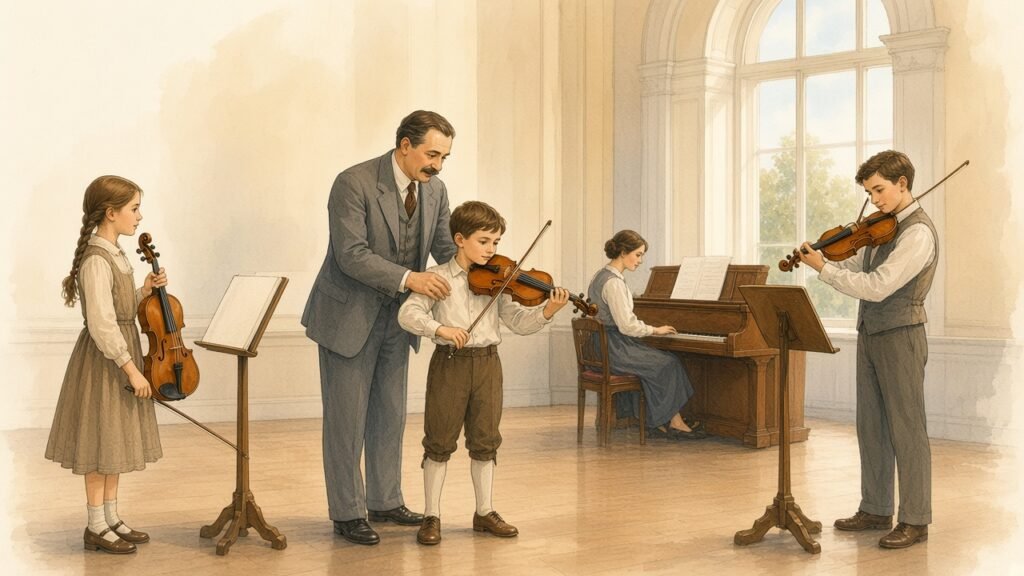
The figure most closely associated with Odessa’s musical reputation was Pyotr Stolyarsky.[23] Born in 1871 in a town near Kiev into a family of Jewish musicians, he studied the violin with his father and later at the music school in Odessa, played in the orchestra of the Odessa Opera for many years and began teaching privately. His studio, located in his flat in the city centre, attracted dozens of young pupils, many of them the children of Jewish families of modest means. Stolyarsky’s methods emphasised early training, careful attention to tone and an atmosphere that encouraged even very young children to perform in public. In 1933 he founded in Odessa a special music school for gifted children, the first of its kind in the Soviet Union, which later bore his name.
Among Stolyarsky’s pupils was David Oistrakh, born in Odessa in 1908, who began lessons with him at the age of five and became one of the greatest violinists of the twentieth century.[24] Oistrakh won the Ysaÿe Competition in Brussels in 1937, a result that brought him international recognition, and he later taught at the Moscow Conservatory, where his own pupils included his son Igor. Nathan Milstein, born in Odessa in 1903, also studied with Stolyarsky before continuing his training with Leopold Auer in St Petersburg. He left the Soviet Union in 1925 and became one of the most admired violinists in Europe and the United States.[26] Other pupils included Elizaveta Gilels and Boris Goldstein, who won prizes at international competitions in the 1930s.
Odessa also produced pianists of great distinction. Emil Gilels, born in the city in 1916, studied with Yakov Tkach and Berta Reingbald and won the All-Union competition in 1933 at the age of sixteen.[25] He went on to win the Ysaÿe Competition for piano in 1938 and was one of the first Soviet musicians to tour extensively in the West after the Second World War. Benno Moiseiwitsch, born in Odessa in 1890, emigrated to Britain and became a celebrated concert pianist there, and Sviatoslav Richter, though born in Zhitomir to a family of German origin, grew up in Odessa and worked as an accompanist at the Odessa Opera before beginning his career.
The phenomenon of the Odessa violin prodigy became a familiar subject in Soviet and émigré memoirs. Babel’s story “Awakening” describes the experience from the inside, and observers in the 1920s and 1930s noted the extraordinary number of young Odessa musicians who reached the finals of Soviet and international competitions. Historians have linked the phenomenon to the importance attached to music in Jewish families, to the existence of a tradition of professional musicianship among Jewish klezmorim and synagogue musicians, and to the opportunities that a career in music offered to children who faced restrictions in other fields.[23]
Popular music had its own Odessa tradition. The singer and bandleader Leonid Utyosov, born Lazar Weisbein in Odessa in 1895, led one of the first Soviet jazz orchestras, the Tea-Jazz, formed in 1929, and his songs about the city and its port made him one of the most popular performers in the Soviet Union for several decades.[27] The repertoire of Odessa songs, often humorous and drawing on the language of the port and the Moldavanka, became a recognised genre of Soviet popular culture.
13. The Soviet decades
Under Soviet rule the institutions of Jewish communal life in Odessa were transformed. In the early 1920s the authorities closed the Zionist and Hebrew organisations, the Hebrew schools and publishing houses, and most religious institutions. In their place the state supported a network of Yiddish-language institutions conceived as part of a secular Soviet Jewish culture: Yiddish schools, a Yiddish pedagogical college, newspapers, a state Yiddish theatre and sections of the Communist Party devoted to work among Jews. Several synagogues were closed and converted to other uses; the Brody Synagogue, for example, was turned into an archive in the 1920s.[2][29]
The social structure of the community changed with the end of private commerce. The merchants, brokers and shopkeepers who had dominated the city’s economy before the revolution lost their businesses, and many emigrated or were displaced. At the same time large numbers of Jews entered higher education, the professions, the civil service, the arts and industry, which the abolition of the imperial restrictions now made possible. The Soviet census of 1926 recorded more than 150,000 Jews in Odessa, about 36 per cent of the population, and the census of 1939 about 200,000, roughly a third of a population of some 600,000.[29]
The political repression of the 1930s affected the Jewish population of Odessa as it affected all other groups. Rabbis, former Zionists, former members of other parties and members of the intelligentsia were among those arrested during the Great Terror of 1937 and 1938. The Yiddish institutions themselves were reduced in the late 1930s, as Soviet nationality policy changed, and many Yiddish schools in the city were closed before the war. By 1939, as the Holocaust Encyclopedia of the United States Holocaust Memorial Museum notes, Jewish communal life in Odessa had virtually ceased to exist in its organised form, despite the very large Jewish presence in the city.[29]
14. War and destruction, 1941 to 1944
On 22 June 1941 Germany and its allies, including Romania, invaded the Soviet Union. Odessa was besieged by Romanian forces, supported by German units, from early August 1941. The defence of the city lasted for more than two months, during which the Soviet authorities evacuated part of the population, industrial equipment and military forces by sea. Estimates of the number of Jews who left the city before its fall vary widely, but a large proportion of the Jewish population, perhaps more than half, remained when the last Soviet troops withdrew in the middle of October. Among those who stayed were many elderly people, women and children, and refugees who had arrived from Bessarabia and other areas earlier in the summer.[29]
Romanian and German troops entered Odessa on 16 October 1941. The city became the administrative centre of Transnistria, the territory between the Dniester and the Southern Bug that Germany had assigned to Romanian administration, under the regime of Marshal Ion Antonescu.[31] Within days the occupying authorities began registering, detaining and killing Jews. On 22 October a large explosion, caused by mines left by the retreating Soviet forces, destroyed the building that served as the headquarters of the Romanian military command, killing dozens of officers and officials, among them the Romanian military commander of the city.[30]
The occupation authorities responded with reprisals of extreme severity directed principally against the Jewish population. On Antonescu’s orders, large numbers of Jews and other civilians were hanged or shot in the city on 23 October. In the following days thousands of Jews were marched to the village of Dalnik on the outskirts of Odessa, where they were shot or locked in warehouses that were then set on fire. According to the Holocaust Encyclopedia of the United States Holocaust Memorial Museum, at least 25,000 to 30,000 Jews were murdered in Odessa and its suburbs in these days.[29][30]
The killings did not end with the October massacres. Approximately 25,000 to 30,000 Jews from Odessa were sent on foot to camps in the region, the largest of them at Bogdanovka on the Southern Bug, where in December 1941 and January 1942 tens of thousands of Jews from Odessa and elsewhere in Transnistria were shot by Romanian gendarmes, local police and ethnic German militia. In December 1941 the Romanian authorities ordered that the city be cleared of its remaining Jews. In January 1942 those still in the city were concentrated in the suburb of Slobodka, in conditions of extreme cold, and in the first months of 1942 they were deported by rail and on foot to sites in the districts of Berezovka and elsewhere, where most of them were killed in mass shootings or died of hunger, cold and disease.[29]
Within a year of the beginning of the occupation the pre-war Jewish community of Odessa had been almost completely destroyed. A small number of Jews survived in hiding, sheltered by neighbours, or in labour units, and some were saved by non-Jewish residents of the city who were later recognised as Righteous Among the Nations by Yad Vashem. Soviet forces recaptured Odessa on 10 April 1944. The investigations that followed the war, and the later work of historians using Romanian, German and Soviet archives, have established the main lines of what took place, though the exact number of victims remains a matter of scholarly estimation. The killings in Odessa and Transnistria are now recognised as among the largest massacres of Jews carried out by an ally of Germany during the Second World War.[29][30]
Postwar Romania brought several of those responsible to trial. Antonescu himself was tried before a people’s tribunal in Bucharest in 1946 and executed, and his conviction included charges relating to the killings in Odessa and Transnistria. In the decades that followed, memorials were erected in Odessa at the sites of the massacres, among them a monument at the place of the former warehouses on the road to Dalnik and a Holocaust museum founded by survivors and their families.[31]
15. After the war
Jews returned to Odessa after its liberation, among them survivors, soldiers demobilised from the Red Army and those who had been evacuated to the Soviet interior. Others came from the surrounding region. The census of 1959 recorded about 106,000 Jews in the city, making Odessa once again one of the largest Jewish population centres in the Soviet Union, although the community no longer had the institutions of its pre-war life. A single synagogue was permitted to function for most of the post-war period, and there were no Jewish schools, newspapers or theatres. Jewish identity in Soviet Odessa was expressed largely in family life, in private memory, in humour and language, and in the strong presence of Jews in the city’s professions, universities, musical institutions and cultural life.[2][33]
The late Stalin years brought new pressures. The campaign against so-called rootless cosmopolitans in the late 1940s and the affair of the Jewish doctors accused of a conspiracy against the Soviet leadership in 1953 affected Jewish professionals across the Soviet Union, including in Odessa. After Stalin’s death the situation eased, and the Odessa writers of the 1920s, including Babel, were gradually republished. The city’s musical schools continued to produce leading performers, and the Stolyarsky school maintained its reputation as one of the best specialist schools in the country.
From the late 1960s growing numbers of Soviet Jews applied to emigrate to Israel, and in the 1970s the Soviet government permitted a significant though fluctuating emigration. Many emigrants from Odessa went to Israel, and many others to the United States. In New York the Brighton Beach neighbourhood of Brooklyn became so closely associated with immigrants from Odessa that it acquired the nickname Little Odessa. Emigration was restricted again in the early 1980s, and then resumed on a much larger scale at the end of the decade. In the 1990s the great majority of the city’s remaining Jews emigrated to Israel, the United States, Germany and other countries, and the Jewish population of Odessa fell to a fraction of its former size.[33]
The end of the Soviet Union also made possible a revival of Jewish communal institutions in the city. Synagogues were returned or reopened, Jewish schools, welfare organisations and cultural centres were established, and a museum of the history of the Jews of Odessa, founded in 2002, began to gather documents, photographs and objects from the city’s Jewish past. Scholars from Odessa, Israel, the United States and Europe began to work on the archives of the city, publishing histories, memoirs and documentary collections that have greatly expanded knowledge of the community’s past.[33]
16. Streets, courtyards and markets
The physical city in which this history took place still bears the marks of its Jewish past. The centre of Odessa, laid out on de Volan’s grid, was built in the nineteenth century in a sequence of classical, Renaissance revival and eclectic styles by architects of Italian, Russian, German and Jewish origin. Its principal thoroughfare, Deribasovskaya Street, named after José de Ribas, was lined with shops, cafés, hotels and offices. The Café Fanconi and the Café Robina, near the exchange, were known as places where grain brokers made deals and where writers and journalists met. In the writing of Sholem Aleichem and others, the café became a symbol of the speculative world of Odessa commerce, where fortunes were made and lost over a glass of tea.[19]
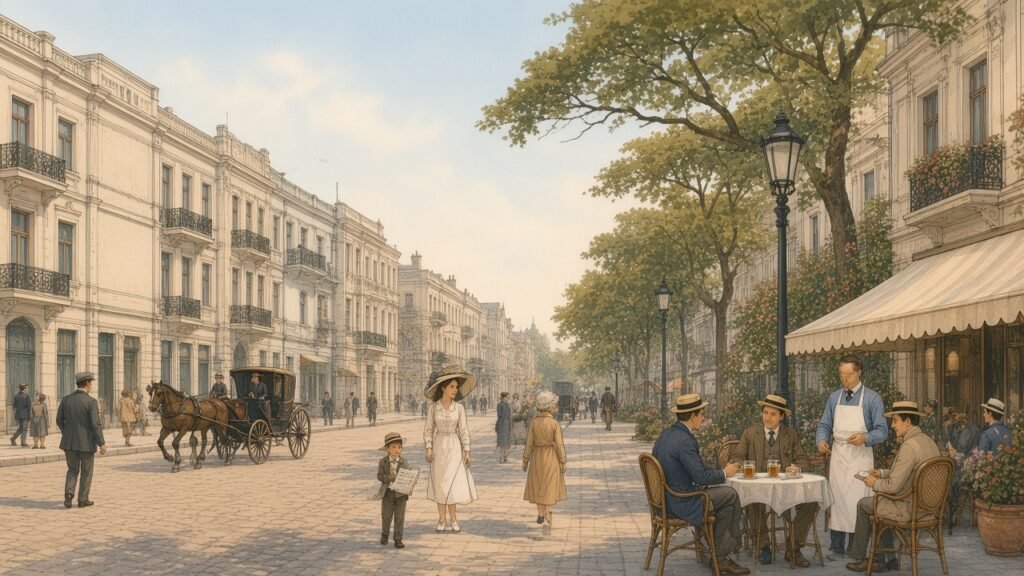
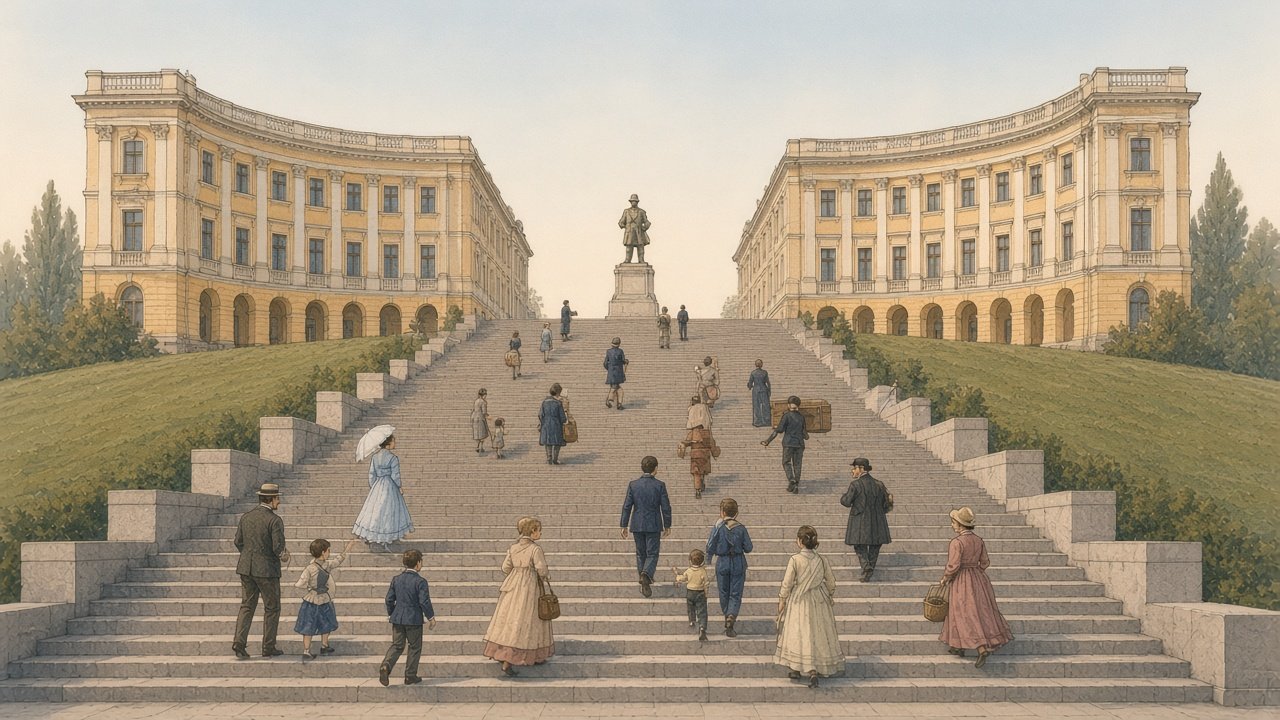
Below the plateau on which the city stands, the harbour stretched along the shore, connected to the boulevard above by the great staircase built between 1837 and 1841 to designs by the architects Francesco Boffo and Avraam Melnikov. The staircase, which descends in ten flights from the statue of Richelieu to the port, was designed with an optical effect that makes the steps visible from below while concealing them from above. It became known as the Potemkin Stairs after the film of 1925, and it remains the city’s most famous landmark.[32]
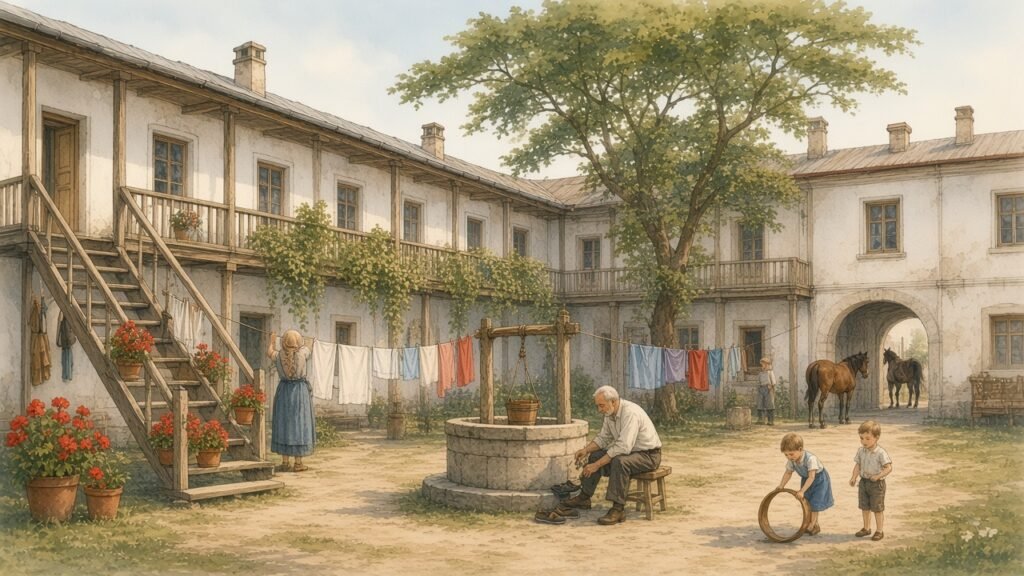
To the south-west of the centre lay the Moldavanka, a district that had grown from a settlement of Moldavian and other migrants into one of the poorest and most densely populated quarters of the city. Its low houses were built around courtyards shared by many families, with galleries, outdoor staircases, wells and lines of washing. Artisans, carters, small traders and labourers lived there in great numbers, and by the late nineteenth century it had a large Jewish population. The Moldavanka had a reputation for crime, which Babel’s stories transformed into legend, but for most of its residents it was a working neighbourhood of workshops, prayer houses and markets.[21]
Near the boundary between the centre and the Moldavanka stood the Privoz market, the largest in the city, where farmers from the surrounding countryside sold produce and where traders of every nationality did business. The market, the port and the courtyards of the Moldavanka provided much of the material for the humour and the language of popular Odessa culture. Jewish shops, workshops and institutions were also concentrated along streets such as Yevreiskaya, whose name means Jewish Street, and in the districts around the Main Synagogue and the Jewish hospital.
The Jewish cemeteries of Odessa preserved the record of the community’s leaders. The old Jewish cemetery, where Pinsker, Mendele and many of the city’s rabbis, merchants and writers were buried, was closed and largely destroyed in the Soviet period, when the land was turned into a park. Some graves, including Pinsker’s, were moved to the second Jewish cemetery, and Pinsker’s remains were later reburied in Jerusalem. The loss of the old cemetery is often cited as an example of the disappearance of the physical traces of Jewish Odessa in the twentieth century.[2]
17. Legacy
The influence of Jewish Odessa extended far beyond the city itself. In Hebrew literature, the work of Mendele, Ahad Ha’am, Bialik and their contemporaries laid the foundations of the modern language and its literature, and the institutions they created, from publishing houses to journals, were carried to Palestine by emigrants such as those on the Ruslan. Several of the founders of Tel Aviv, including Meir Dizengoff, had lived in Odessa, and the culture of the new Hebrew city has often been compared with that of the port from which so many of its early residents came. Bialik’s house in Tel Aviv, where he lived from 1925 until his death in 1934, became a museum.[14][17]
In Jewish thought, the debates of the Odessa circle shaped the main currents of the twentieth century. Pinsker’s Auto-Emancipation, Ahad Ha’am’s cultural Zionism and Dubnow’s diaspora nationalism represented three different answers to the question of the Jewish future, and each had a long afterlife in the intellectual history of the Jewish people.[10][13][15] Jabotinsky’s activity, which began in the Russian-language press of Odessa, left its own lasting mark on Jewish political history. Joseph Klausner’s scholarship at the Hebrew University and the editorial tradition of Ha-Shiloah carried the habits of the Odessa circle into the academic and literary life of Jerusalem.
In Russian literature, Babel and the South-Western school gave the city a literary identity that has proved remarkably durable. The Odessa Stories, the novels of Ilf and Petrov and the memoirs of Konstantin Paustovsky and Valentin Kataev created an image of Odessa as a place of humour, energy, ingenuity and southern warmth, and Jewish characters and speech are central to that image.[20][28] The so-called Odessa myth, as scholars have called it, owes much to these works, and its relationship to the historical reality of the city has become a subject of study in its own right.
In music, the Stolyarsky school and the careers of Oistrakh, Gilels, Milstein and their contemporaries made the city’s name synonymous with the training of virtuosi.[23][24][25] The special music schools established in the Soviet Union on the model of Stolyarsky’s Odessa school produced generations of leading performers, and the teaching traditions of Oistrakh at the Moscow Conservatory and of Milstein in the West passed the methods of the Odessa studio to musicians around the world.
In scholarship, the history of the Jews of Odessa has become one of the most closely studied chapters in the history of Eastern European Jewry. The work of historians such as Steven Zipperstein, whose study The Jews of Odessa: A Cultural History, 1794-1881 appeared in 1985, and of later scholars of the Soviet period and of the Holocaust in Transnistria, has drawn on archives in Odessa, Moscow, Bucharest, Jerusalem and New York.[3] The YIVO Encyclopedia of Jews in Eastern Europe, the Holocaust Encyclopedia of the United States Holocaust Memorial Museum and other reference works provide accessible summaries of this research, and they are among the sources listed at the end of this essay.[2][29]
Finally, the emigrations of the twentieth century carried the memory of Odessa to many countries. In Israel, the United States, Germany, Canada and Australia, families whose origins lay in the city preserved its songs, its humour, its cuisine and its distinctive Russian, and communities such as Brighton Beach in New York gave the city’s name to new neighbourhoods. The history of the Jews of Odessa, from the first households of 1795 to the great community of the early twentieth century and its destruction and dispersal, remains one of the most remarkable episodes in the history of the modern city and of the Jewish people.
18. Timeline
Catherine II orders the construction of a port on the site of the Ottoman fortress of Khadjibey. Jews are among the first settlers recorded in the new town.
The Duc de Richelieu governs the city and the region, laying out streets, the harbour and the institutions of a growing commercial port.
Jewish agricultural colonies begin to be founded on state land in the province of Kherson.
Odessa enjoys free port status, attracting merchants from Galicia, Greece and Italy and accelerating the grain trade.
Riots against Jews break out during the Greek uprising against the Ottoman Empire, in the context of Greek–Jewish commercial rivalry.
A modern Jewish school opens under Bezalel Stern, with secular subjects alongside religious studies.
Immigrants from Brody in Galicia open a reformed synagogue with a choir, later the city's most famous house of prayer.
The first Jewish periodical in Russian appears in Odessa, followed by Sion and Den in the 1860s.
Violence during the Easter season again follows commercial tension in the city and is recorded as a pogrom by contemporaries.
After the assassination of Alexander II, a wave of pogroms reaches Odessa; emigration and the Hibbat Zion movement grow.
Leon Pinsker publishes his pamphlet, arguing that Jews need a territorial home; he later leads the Odessa Committee.
Ahad Ha'am publishes Lo zeh ha-derekh and founds the Bene Moshe circle, centred on Odessa.
Mendele, Ahad Ha'am, Bialik, Dubnow and Klausner make the city the centre of the Hebrew revival in the 1890s and 1900s.
After the October Manifesto, a pogrom kills several hundred Jews in Odessa; self-defence units resist in parts of the city.
Jabotinsky's Russian feuilletons and Zionist writing make him one of the best-known journalists in the south.
Bialik and other Hebrew writers leave Soviet Russia, ending the Odessa Hebrew circle.
Isaac Babel publishes the stories of Benya Krik and the Moldavanka underworld.
Pyotr Stolyarsky's school for gifted children is established, the first of its kind in the Soviet Union.
David Oistrakh wins the Ysaÿe Competition in Brussels, a year before Emil Gilels wins in the same city.
Romanian and German forces occupy the city on 16 October; mass killings of Jews follow within days.
Jews remaining in Odessa are deported to camps and ghettos in Transnistria.
The Red Army retakes Odessa on 10 April; only a small fraction of the prewar Jewish community has survived.
Large numbers of Odessa Jews emigrate to Israel, the United States and Germany; Brighton Beach becomes known as Little Odessa.
References
- Grokipedia, “Odessa” ↩
- YIVO Encyclopedia of Jews in Eastern Europe, “Odessa” ↩
- Steven J. Zipperstein, The Jews of Odessa: A Cultural History, 1794 - 1881 (Stanford University Press, 1985) ↩
- Grokipedia, “Pale of Settlement” ↩
- Grokipedia, “Mikhail Vorontsov” ↩
- Grokipedia, “Haskalah” ↩
- Grokipedia, “Odessa pogroms” ↩
- YIVO Encyclopedia, “Pogroms” ↩
- Grokipedia, “Leon Pinsker” ↩
- Grokipedia, “Auto-Emancipation” ↩
- Grokipedia, “Mendele Mocher Sforim” ↩
- YIVO Encyclopedia, “Mendele Moykher-Sforim” ↩
- Grokipedia, “Ahad Ha’am” ↩
- Grokipedia, “Hayim Nahman Bialik” ↩
- Grokipedia, “Simon Dubnow” ↩
- Grokipedia, “Joseph Klausner” ↩
- Grokipedia, “Meir Dizengoff” ↩
- Grokipedia, “Ze’ev Jabotinsky” ↩
- Grokipedia, “Sholem Aleichem” ↩
- Grokipedia, “Isaac Babel” ↩
- Grokipedia, “Odessa Stories” ↩
- YIVO Encyclopedia, “Babel, Isaac Emmanuilovich” ↩
- YIVO Encyclopedia, “Stoliarskii, Petr Solomonovich” ↩
- Grokipedia, “David Oistrakh” ↩
- Grokipedia, “Emil Gilels” ↩
- Grokipedia, “Nathan Milstein” ↩
- Grokipedia, “Leonid Utyosov” ↩
- Grokipedia, “Ilf and Petrov” ↩
- United States Holocaust Memorial Museum, Holocaust Encyclopedia, “Odessa” ↩
- Grokipedia, “1941 Odessa massacre” ↩
- Grokipedia, “Ion Antonescu” ↩
- Grokipedia, “Potemkin Stairs” ↩
- Jewish Virtual Library, “Odessa” ↩