Deflecting the Heavens – NASA DART
Sixty-six million years ago, a ten-kilometer mountain of primordial carbonaceous rock plummeted through the Earth’s atmosphere at twenty kilometers per second, striking the shallow waters of the Yucatan Peninsula with the explosive force of one hundred million megatons of TNT. The Chicxulub impact excavated a hundred-mile crater, ignited continent-spanning wildfires, lofted billions of tons of vaporized sulfate rock into the stratosphere to blot out the Sun, collapsed global food webs, and extinguished seventy-five percent of all species on Earth—bringing the hundred-and-fifty-million-year reign of the dinosaurs to an abrupt, violent termination. The dinosaurs vanished because they lacked an astronomy department, an aerospace industry, and the technological means to deflect a celestial object. On September 26, 2022, seven million miles from Earth, humanity officially declared that it would not share the dinosaurs’ fate. In an act of unprecedented technological audacity, NASA’s Double Asteroid Redirection Test (DART) spacecraft—a half-ton probe navigating autonomously at fourteen thousand miles per hour—slammed head-on into Dimorphos, a football-stadium-sized asteroid orbiting a larger companion in the dark vacuum of deep space. Transmitting real-time images down to the final fractions of a second until the camera was vaporized on impact, DART did not merely hit a celestial target; it blasted thousands of tons of pulverized rock into a glowing ten-thousand-kilometer comet-like tail, dramatically altering the asteroid’s orbital period by thirty-three minutes—over twenty-five times greater than NASA’s minimum threshold for success. DART stands as a watershed milestone in human civilization: the historic moment our species graduated from helpless, passive spectators of cosmic catastrophe into active stewards of planetary defense, possessing the power to rewrite the celestial mechanics of the heavens.
1. The Cosmic Shooting Gallery – From Chicxulub to Chelyabinsk
To grasp why planetary defense is an existential imperative for human civilization, one must understand the dynamic, violent architecture of the Solar System. The celestial sphere is not an immutable, tranquil clockwork mechanism; it is an active cosmic shooting gallery populated by hundreds of millions of rocky and metallic fragments left over from the accretion disk of the protoplanetary nebula 4.6 billion years ago.
The solar system’s impact history is written in the heavily cratered face of the Moon and the catastrophic mass extinctions of Earth’s geological record:
- The Chicxulub Impact (66 Million BCE): A 10-kilometer asteroid delivered the K-Pg extinction event, releasing an estimated $4 × 10²³ Joules of kinetic energy and terminating the Mesozoic Era.
- The Tunguska Event (June 30, 1908): A stony asteroid or comet fragment measuring approximately 50 to 60 meters in diameter exploded at an altitude of 5 to 10 kilometers over the Podkamennaya Tunguska river basin in Siberia. The atmospheric airburst released 10 to 15 megatons of energy—a thousand times more powerful than the Hiroshima atomic bomb—flattening over 80 million trees across 2,150 square kilometers of virgin forest. Had Tunguska struck five hours later, the Earth’s rotation would have placed the impact directly over St. Petersburg, instantly obliterating the imperial Russian capital.
- The Chelyabinsk Meteor (February 15, 2013): A modest, 19-meter asteroid entered the atmosphere over the southern Ural Mountains of Russia at 19 kilometers per second (68,000 km/h). The object exploded at an altitude of 29 kilometers, releasing approximately 500 kilotons of energy. The supersonic shockwave shattered windows in over 7,200 buildings across six cities, collapsed a factory roof, and injured nearly 1,500 people, primarily from flying shards of glass. Crucially, Chelyabinsk arrived entirely from the direction of the daytime Sun, blinding all ground-based astronomical surveys and striking with zero advance warning.
Astronomers categorize objects whose perihelion (closest solar approach) brings them within 1.3 Astronomical Units of the Sun as Near-Earth Objects (NEOs). Those measuring larger than 140 meters in diameter whose orbits approach within 0.05 AU (7.5 million kilometers) of Earth’s orbit are classified as Potentially Hazardous Asteroids (PHAs). An impact by a 140-meter asteroid would unleash over 100 megatons of energy, obliterating an entire metropolitan region or triggering catastrophic ocean tsunamis. While international surveys have identified over 95% of the civilization-ending 1-kilometer giants, only approximately 40% of the estimated 25,000 hazardous 140-meter asteroids have been discovered.
2. Deflection Paradigms – Nuclear, Gravity, and Kinetic Impact
Faced with an asteroid on a confirmed collision course with Earth, humanity cannot simply blow it up into radioactive fragments with Hollywood-style nuclear warheads. Fragmenting an asteroid without altering its center-of-mass momentum simply transforms a single catastrophic cannonball into an unpredictable cluster bomb of millions of radioactive fragments, potentially multiplying global atmospheric destruction.
Planetary defense scientists at NASA, ESA, and national defense laboratories have formulated three primary scientifically viable deflection paradigms:
| Deflection Technique | Operating Mechanism | Required Warning Time | Primary Advantage / Drawback |
|---|---|---|---|
| Kinetic Impactor | High-speed mechanical collision transfer of linear momentum | 5 to 20 years | Technologically mature; requires high impact velocity precision |
| Gravity Tractor | Massive spacecraft hovering near asteroid, gently pulling via mutual gravity | 20 to 50 years | Ultra-precise orbit control; requires decades of continuous ion thrust |
| Nuclear Standoff Detonation | Detonating a nuclear device hundreds of meters away; X-rays vaporize asteroid surface, creating rocket-like blowoff | 1 to 10 years | Massive impulse for kilometer-scale targets; severe geopolitical and treaty barriers |
| Laser Ablation / Solar Collector | Focusing concentrated sunlight or lasers to vaporize rock surface and generate thrust | 15 to 30 years | Continuous controllable thrust; complex optical deployment in space |
Among these techniques, the Kinetic Impactor stood out as the only technology immediately accessible with modern launch vehicles and guidance systems. If an asteroid is intercepted years before its projected Earth encounter, changing its orbital velocity by a mere fraction of a millimeter per second (delta v about 1 mm/s) will cause it to miss the Earth by thousands of kilometers a decade later. But until 2022, kinetic deflection existed entirely in computer simulations. No human spacecraft had ever attempted to deflect an asteroid.
3. The Ideal Target – The Binary System Didymos and Dimorphos
Selecting an asteroid to test planetary deflection required solving a delicate ethical and physical safety problem: If one slams a spacecraft into an asteroid to alter its trajectory, what if the experiment inadvertently knocks the asteroid onto an orbit that threatens Earth?
To eliminate this existential risk, NASA and the Johns Hopkins Applied Physics Laboratory (JPL/APL) selected an ingenious target: the Binary Asteroid System (65803) Didymos. Didymos consists of two gravitationally bound asteroids orbiting their common center of mass:
- Didymos (The Primary): A spinning, top-shaped S-type asteroid measuring approximately 780 meters in diameter, rotating once every 2.26 hours.
- Dimorphos (The Moonlet): A smaller companion measuring approximately 160 meters across—the exact size of the most hazardous class of city-killer asteroids—orbiting Didymos at a distance of 1.18 kilometers with an unperturbed orbital period of 11 hours, 55 minutes, and 17 seconds (11.92 hours).
The beauty of this binary architecture was twofold: 1. Absolute Planetary Safety: Striking the tiny moonlet Dimorphos would alter its orbital period around Didymos, but would exert virtually zero measurable perturbation on the heliocentric orbit of the combined Didymos system around the Sun. There was zero possibility of knocking the asteroid toward Earth. 2. High-Precision Ground Measurement: From Earth, the Didymos system appears as a single point of light in ground-based telescopes. However, as Dimorphos orbits Didymos, it regularly eclipses and transits in front of the primary body, causing periodic dips in brightness (light curves). By timing these mutual eclipses with millisecond precision from terrestrial observatories, astronomers could measure a change in Dimorphos’s orbital period down to a few seconds, providing an immediate, high-fidelity measurement of the kinetic impact.
4. The DART Spacecraft – An Autonomous Kamikaze Probe
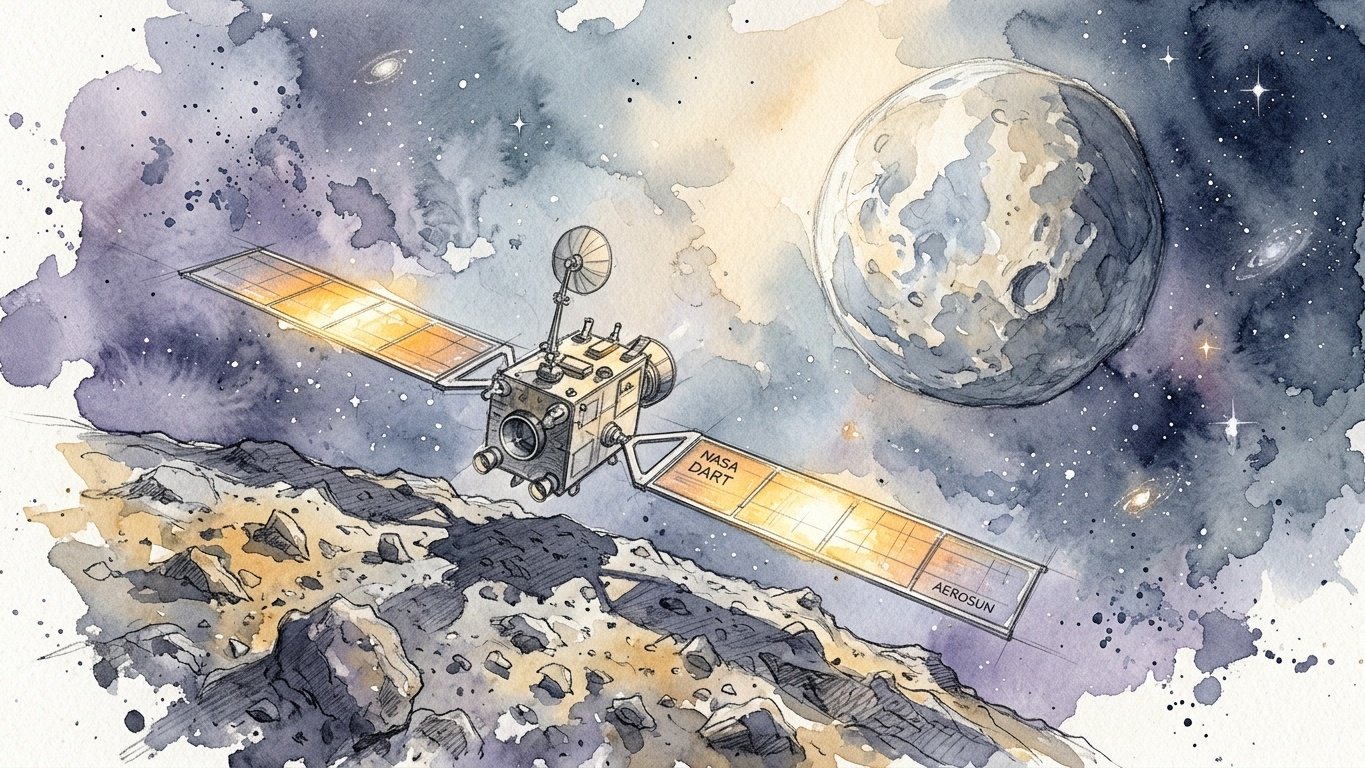
Managed by the Johns Hopkins Applied Physics Laboratory in Laurel, Maryland, the DART spacecraft was launched on November 24, 2021, aboard a SpaceX Falcon 9 from Vandenberg Space Force Base in California. The spacecraft was a compact, highly optimized kinetic missile weighing approximately 570 kilograms at impact.
DART incorporated cutting-edge aerospace and propulsion subsystems:
1. NEXT-C Gridded Ion Propulsion
DART served as the operational flight demonstration of the NASA Evolutionary Xenon Thruster-Commercial (NEXT-C). NEXT-C is a 3.5-kilowatt electrostatic gridded ion engine that ionizes xenon gas and accelerates positive ions through high-voltage molybdenum grids at exhaust velocities exceeding 40 kilometers per second (I_sp approximately 4,100 seconds)—more than ten times the fuel efficiency of chemical rocket engines, providing continuous orbital adjustments during the ten-month interplanetary cruise.
2. The DRACO Imaging Payload
DART carried only a single scientific instrument: DRACO (Didymos Reconnaissance and Asteroid Camera for Optical navigation). DRACO was a high-resolution, narrow-angle optical telescope with a 20.8-centimeter aperture and a 2.5-megapixel CMOS sensor. DRACO had two vital roles: providing real-time optical tracking images to the autonomous navigation software, and capturing humanity’s first ultra-close-up structural views of an asteroid during terminal descent.
3. SMART Nav – Autonomous Real-Time Terminal Guidance
The defining technical triumph of DART was SMART Nav (Small-body Maneuvering Autonomous Real-Time Navigation). At the moment of impact, DART was 11 million kilometers from Earth. Radio signals traveling at the speed of light took 38 seconds to travel one way (a round-trip latency of 76 seconds). Human operators at mission control could not steer the spacecraft via joystick.
Four hours before impact, Dimorphos was completely invisible to DRACO, hidden as a sub-pixel blur next to the five-times-brighter Didymos. SMART Nav had to acquire the binary system, computationally isolate the faint moonlet from the glare of the primary, lock onto Dimorphos at T-60 minutes when it was only a single pixel wide, and fire hydrazine thrusters to guide the half-ton spacecraft dead-center into a 160-meter rock at an astronomical closing velocity of 6.14 kilometers per second (22,100 km/h) without a single human command!
5. LICIACube – The Italian Space Witness
Because DART would be completely obliterated upon impact, it could not survive to photograph the resulting crater or debris cloud. To document the event from deep space, DART carried an autonomous companion: LICIACube (Light Italian CubeSat for Imaging of Asteroids), built by the Italian Space Agency (ASI) and prime contractor Argotec.
LICIACube was a compact 6U CubeSat weighing just 14 kilograms, equipped with two specialized cameras: – LUKE (LICIACube Unit Key Explorer): A wide-angle color RGB camera. – LEIA (LICIACube Explorer Imaging for Asteroid): A high-resolution panchromatic reconnaissance camera.
Fifteen days prior to impact, on September 11, 2022, DART deployed LICIACube into deep space via a spring-loaded mechanical separation canister. Flying on an independent, non-impacting flyby trajectory, LICIACube trailed DART by approximately three minutes. As DART struck the asteroid, LICIACube soared past Dimorphos at a closest approach distance of 55 kilometers, capturing hundreds of high-resolution images of the initial kinetic blast, the high-velocity ejecta plumes, and the dramatic optical evolution of the collision.
6. The Strike – September 26, 2022
On the evening of September 26, 2022, millions of people worldwide watched the live NASA webcast as DRACO images streamed back from deep space at one frame per second. At T-5 minutes, Dimorphos was a tiny speck of light. Within minutes, it expanded into a terrifying, crystalline landscape.
Instead of a smooth, monolithic rock, DRACO revealed that Dimorphos was a Rubble-Pile Asteroid: a loose, chaotic aggregation of thousands of jagged boulders, impact breccia, and gravel held together merely by its own minuscule micro-gravity. DRACO captured boulders measuring tens of meters across, resting on fine gravel beds. At T-1 second, DRACO beamed back a final, breathtaking image from an altitude of only 12 kilometers: individual rocks, surface fractures, and pebbles resolved with millimeter clarity. The following frame was half-transmitted: static lines filling the lower half of the screen as the spacecraft collided with the surface at 6.14 km/s. The telemetry went black. Mission control in Maryland erupted into deafening cheers. Direct impact had been achieved.
7. The Physics of Momentum Transfer – The β Factor
The central scientific objective of DART was to measure the Momentum Enhancement Factor (β) of kinetic asteroid deflection. In classical mechanics, momentum transfer is described by Newton’s third law. In an idealized, perfectly plastic inelastic collision where the spacecraft simply embeds itself into the asteroid without ejecting material, momentum conservation dictates.
However, when a hypervelocity projectile strikes a porous, rocky surface at Mach 18, it does not merely stick. The kinetic energy (the theoretical relationship, equivalent to 2.5 tons of TNT) vaporizes and crushes subsurface rock, generating an explosive high-pressure shockwave that blasts millions of kilograms of rock, sand, and dust backward into space at high speed!
This explosive ejecta plume acts as a Rocket Thruster pushing back against the asteroid! The total momentum imparted to the asteroid is the sum of the spacecraft’s physical momentum plus the reaction recoil momentum of the blasted ejecta.
If the ejecta momentum is large, the parameter β is significantly greater than 1 (β > 1), meaning the kinetic impact is far more effective at deflecting asteroids than simple classical physics would predict.
8. The Astronomical Verdict – 33 Minutes That Changed Celestial Mechanics
Prior to launch, NASA had established the minimum requirement for full mission success: DART had to alter the orbital period of Dimorphos by at least 73 seconds. Numerical simulation models predicted that if Dimorphos was a hard, monolithic rock, the period change would be on the order of 7 to 10 minutes; if it was a porous rubble pile with heavy ejecta, the shift might reach 15 to 20 minutes.
Over the ensuing weeks, dozens of ground-based observatories—including the Goldstone Planetary Radar in California, the Green Bank Telescope, the Very Large Telescope (VLT) in Chile, and the Las Cumbres Observatory network—monitored Didymos light curves. Space telescopes including Hubble and the James Webb Space Telescope (JWST) photographed a sprawling, multi-thousand-kilometer debris tail stretching behind Dimorphos, resembling a new comet in the Solar System.
On October 11, 2022, NASA Administrator Bill Nelson stepped up to the podium at NASA Headquarters to announce the final verified astronomical measurements:
- The pre-impact orbital period of Dimorphos was: 11 hours, 55 minutes, and 17 seconds.
- The post-impact orbital period was measured at: 11 hours, 22 minutes, and 37 seconds.
- The orbital period had shrunk by an astonishing: 33 minutes and 0 seconds (± 15 seconds)!
The measured deflection was over twenty-five times larger than NASA’s minimum benchmark! Detailed momentum analysis published in a suite of papers in Nature confirmed that the momentum enhancement factor was.
The recoil from the blasted ejecta had imparted more than twice as much momentum to the asteroid as the incoming spacecraft itself! DART had excavated between 1,000 to 10,000 tons of rock, completely reshaping the moonlet into a restructured rubble pile and shrinking its semi-major axis orbital radius by tens of meters.
9. The European Follow-Up – The Hera Mission
To complete the scientific investigation of the DART collision, the European Space Agency launched the Hera Mission in October 2024 aboard a SpaceX Falcon 9.
Named after the Greek goddess of protection, Hera will rendezvous with Didymos and Dimorphos in late 2026. Equipped with high-resolution multispectral cameras, thermal infrared imagers, and two deployable CubeSats (Juventas and Milani): – Juventas: Will deploy the first low-frequency radar to sound the deep internal interior structure of an asteroid, measuring Dimorphos’s mechanical cohesion and porosity. – Milani: Will map mineralogical composition and dust distribution around the system.
Hera will directly measure Dimorphos’s exact mass with sub-percent accuracy via close-proximity gravitational Doppler tracking, photograph the exact geometry and depth of DART’s impact crater, and provide the definitive ground-truth calibration required to turn kinetic impactor physics into an off-the-shelf planetary defense engineering playbook.
10. The Planetary Defense Architecture of the Future
The historic success of DART proved that humanity possesses the ability to deflect asteroids; however, deflection is impossible without sufficient Early Warning Time. If an incoming asteroid is detected only six months before impact, no kinetic impactor can prevent disaster.
To ensure humanity has the decades of warning time required to build and dispatch interceptor missions, NASA is constructing the Near-Earth Object Surveyor (NEO Surveyor)—a dedicated mid-infrared space telescope scheduled for launch in 2027. Operating at the Earth-Sun L1 Lagrange point, NEO Surveyor will utilize twin 4.6- and 8.0-micrometer infrared channels to detect asteroids by their thermal heat signatures, discovering over 90% of all hazardous 140-meter asteroids regardless of whether they approach from dark space or the blinding glare of the Sun.
Combined with rapid-response interceptor fleets maintained in orbital or ground readiness, the global planetary defense infrastructure will ensure that no city-killer asteroid can strike our planet unannounced.
12. Rubble-Pile Geophysics – The Internal Structure of Small Asteroids
Prior to the exploration of small asteroids by spacecraft like Hayabusa2, OSIRIS-REx, and DART, planetary scientists frequently conceptualized asteroids as solid, monolithic slabs of bedrock iron or basalt. The close-up reconnaissance of Dimorphos, Bennu, and Ryugu obliterated this classical monolithic model, establishing that virtually all near-Earth asteroids under one kilometer in diameter are Rubble-Pile Aggregations.
A rubble pile is not a single coherent rock; it is a chaotic conglomeration of thousands of fractured boulders, pebbles, and fine dust grains held together exclusively by minuscule gravitational attraction and weak microscopic van der Waals surface cohesion forces (< 1 – 10 Pascals). The geophysical properties of rubble piles profoundly affect kinetic impact dynamics:
- Colossal Macroporosity: Rubble piles exhibit bulk macroporosities ranging from 30% to over 50%. Vast internal voids and caverns honeycomb the asteroid’s interior. When a kinetic impactor strikes, the shockwave crushes these internal voids, dissipating immense kinetic energy through mechanical compaction rather than transferring pure linear impulse.
- Granular Fluidization: Under high-energy impact shockwaves, the granular material undergoes acoustic fluidization, behaving temporarily like a viscous, flowing liquid before re-settling under micro-gravity.
- Global Reshaping Versus Crater Excavation: Hydrocode simulations indicate that DART did not merely punch a localized, deep bowl-shaped crater into Dimorphos; the collision triggered global structural deformation! The entire 160-meter moonlet was physically reshaped, with boulders shifting across the entire body, turning an oblate spheroid into an elongated triaxial ellipsoid.
13. Hydrocode Simulations – Modeling Hypervelocity Impacts with CTH and SPH
To predict the outcome of hypervelocity kinetic impacts and interpret the measured momentum enhancement factor β, computational physicists at Lawrence Livermore National Laboratory (LLNL), Sandia National Laboratories, and the University of Bern deployed cutting-edge Shock Physics Hydrocodes, including CTH, ALE3D, and Smoothed Particle Hydrodynamics (SPH).
Simulating the DART impact required modeling physical regimes spanning twelve orders of magnitude in pressure and time: – In the initial microseconds following impact, pressures at the contact point exceed several megabars (hundreds of gigapascals), vaporizing the aluminum spacecraft and melting silicate rock. The physics is governed by non-linear Equations of State (EOS), such as the Tillotson EOS or ANEOS. – As the shockwave expands over milliseconds, pressures drop to the kilobar and megapascal regime, where material strength models—such as the Drucker-Prager or Lundborg Yield Criteria with Weibull tensile damage models—dictate rock fracturing, spallation, and grain crushing. – Over seconds and minutes, ejecta particles leave the crater at velocities ranging from meters per second to kilometers per second, governed by self-gravitational dynamics and micro-gravity ballistic trajectories.
The post-impact hydrocode analyses demonstrated that achieving a momentum enhancement factor of approximately 2.2 – 3.6 requires Dimorphos to possess low internal shear strength (Y < 100 kPa) and high porosity (φ approximately 40%). The simulations showed that the high-velocity ejecta blasted into space carried over $10^7 kg of kinetic momentum in the reverse direction, confirming that explosive debris blowoff is the primary engine of planetary deflection.
14. The Ground Observation Campaign – Radar and Photometric Astrometry
While DART executed the physical strike in space, the scientific validation of planetary deflection was accomplished by a monumental global astronomical campaign coordinated across hundreds of terrestrial telescopes on seven continents.
To measure the 33-minute period shift, astronomers utilized two complementary observation techniques:
- Photometric Light-Curve Astronomy: Because Dimorphos and Didymos cannot be spatially resolved into separate dots of light by ground telescopes, astronomers continuously measured the total optical brightness of the unresolved system. As Dimorphos orbits Didymos, it produces two distinct photometric events every 11.9 hours: – Primary Eclipse/Transit: Dimorphos passes in front of Didymos, blocking reflected starlight. – Secondary Occultation: Dimorphos passes behind Didymos into its shadow. By tracking the precise timing of these periodic brightness dips across hundreds of light curves collected by telescopes worldwide, astronomers timed the orbital period with an accuracy of ± 15 seconds, capturing the immediate 33-minute shortening of the orbit.
- Planetary Radar Astronomy: Utilizing the 70-meter Deep Space Network (DSN) Goldstone antenna in California and the Green Bank Telescope in West Virginia, radar astronomers bounced high-power X-band radio signals (8.56 GHz) off Didymos and Dimorphos. Doppler-delay radar imaging measured line-of-sight velocities with sub-millimeter-per-second precision, mapping the post-impact debris cloud and confirming the orbital contraction.
15. The Debris Cloud – Solar Radiation Pressure and the Synthetic Comet
One of the most visually stunning and scientifically fruitful aftermaths of the DART collision was the physical evolution of the Impact Ejecta Cloud, photographed across weeks by the Hubble Space Telescope, the James Webb Space Telescope (JWST), and the Lucy spacecraft.
Immediately following impact, DART excavated an estimated 1,000 to 10,000 metric tons of pulverized rock and dust. Because Dimorphos has a microscopic escape velocity of mere centimeters per second (v_esc approximately 8 – 10 cm/s), virtually all of the excavated material escaped the moonlet’s gravitational field into interplanetary space.
Over the ensuing days, two fundamental astrophysical forces sculpted the expanding dust cloud into a breathtaking celestial structure: – Solar Radiation Pressure: Photons from the Sun exerted continuous electromagnetic radiation pressure on the fine, micron-sized dust grains, pushing them away from the Sun. – Poynting-Robertson Drag and Orbital Dispersion: Differential velocity kicks caused larger gravel-sized fragments to travel on independent heliocentric orbits, while fine dust was pushed into a magnificent, dual-filament debris tail stretching over 10,000 kilometers into space.
For months, Didymos appeared in the night sky as an artificial active comet. By analyzing the optical brightness and color spectra of the tail over time, planetary astronomers determined the dust grain size distribution—revealing that the ejecta was dominated by millimeter-to-centimeter pebbles rather than sub-micron dust, providing essential data for calculating spacecraft hazard corridors during future planetary intercept missions.
16. Nuclear Standoff Deflection – The Short-Warning Emergency Shield
While the kinetic impactor proven by DART is the ideal choice when a hazardous asteroid is detected 10 to 30 years in advance, aerospace and defense strategists must confront the terrifying possibility of a Short-Warning Threat: discovering a 500-meter or 1-kilometer asteroid on an un-divertable collision course with less than five years of warning time.
For a massive asteroid detected with short warning, chemical or kinetic impactors lack sufficient energy to deflect the body in time. The only physical technology capable of delivering the gigatons of required impulse is Nuclear Standoff Deflection.
In nuclear standoff deflection, a high-yield thermonuclear device is not detonated inside the rock (which would fragment the asteroid). Instead, the warhead is detonated in the vacuum of space at a distance of approximately 100 to 300 meters from the asteroid’s surface:
- In the vacuum of space, there is no air to form a conventional acoustic shockwave. Instead, 80% of the nuclear device’s energy is emitted in an instantaneous, ultra-intense flash of thermal X-rays and neutrons.
- The intense X-ray pulse penetrates the top few micrometers to millimeters of the asteroid’s facing hemisphere within nanoseconds, heating the surface rock to over tens of thousands of degrees Celsius.
- The superheated surface rock instantaneously vaporizes, exploding outward into space as an ultra-high-velocity plasma plume!
- By Newton’s third law, the violent X-ray Blowoff Plume imparts a colossal mechanical impulse to the remaining asteroid bulk, delivering an instantaneous velocity change (delta v) of meters per second—orders of magnitude more powerful than any mechanical kinetic impactor—safely steering the entire intact mountain around the Earth.
17. Civil Defense and Impact Consequences of 100-Meter Asteroids
To appreciate why planetary defense agencies focus so intensely on 140-meter asteroids like Dimorphos, one must examine the devastating atmospheric and terrestrial consequences if such an object were to impact the modern Earth.
A stony chondrite asteroid measuring 140 meters in diameter strikes the top of the atmosphere with an entry kinetic energy of approximately 100 to 200 Megatons of TNT equivalent—several times larger than the largest thermonuclear weapon ever detonated by human civilization (the 50-megaton Tsar Bomba):
- Atmospheric Hydrodynamic Airburst: If the asteroid enters at an oblique angle or possesses low internal strength, it undergoes catastrophic aerodynamic fragmentation at an altitude of 10 to 15 kilometers. The resulting airburst generates a supersonic overpressure shockwave exceeding 5 psi across hundreds of square kilometers, flattening reinforced buildings, shattering residential structures, and igniting massive urban firestorms.
- Ground Crater Excavation: If the object is a dense iron-nickel asteroid, it penetrates all the way to the Earth’s surface, excavating a crater over 1.5 to 2 kilometers in diameter and 300 meters deep, pulverizing everything within a 20-kilometer radius into white-hot ash.
- Ocean Impact Tsunamis: Because oceans cover 71% of the Earth’s surface, an asteroid impact is most likely to occur in deep water. A 140-meter kinetic impact into the open ocean excavates a transient water cavity kilometers wide, generating localized deep-water waves that propagate toward coastlines, threatening catastrophic inundation across low-lying coastal cities and ports.
The economic devastation of a single 140-meter impact would easily exceed trillions of dollars, accompanied by the potential loss of millions of human lives. Against this catastrophic baseline, the entire multi-hundred-million-dollar budget of NASA’s planetary defense program represents the cheapest, most cost-effective insurance policy ever purchased by humanity.
18. The Apophis Laboratory – The Historic 2029 Close Encounter
The lessons learned from DART are currently being synthesized for the most anticipated celestial event of the twenty-first century: the close flyby of Asteroid (99942) Apophis on April 13, 2029.
Apophis is a 340-meter stony asteroid that will pass within 31,600 kilometers (19,600 miles) of the Earth’s surface—closer than our own geostationary weather and telecommunications satellites! The asteroid will be clearly visible to the naked eye as a moving star across Europe, Africa, and Asia.
While rigorous orbital calculations have definitively confirmed that Apophis will safely miss Earth in 2029, the encounter provides a once-in-a-millennium natural planetary defense laboratory. The Earth’s immense tidal gravitational forces will physically squeeze and stretch Apophis, potentially triggering surface landslides, boulder rolls, and seismic tremors across the asteroid’s surface.
NASA has re-targeted the OSIRIS-REx spacecraft (now renamed OSIRIS-APEX) to rendezvous with Apophis immediately following its Earth flyby, while international agencies are planning dedicated flotillas of reconnaissance probes to monitor the asteroid before, during, and after its encounter. The data gathered from Apophis and DART will refine asteroid geophysics and cohesion models, ensuring that should a real celestial threat emerge in the decades ahead, humanity’s planetary defense forces will be armed with tested, infallible engineering tools to protect the living Earth.
20. International Governance – UN COPUOS, IAWN, and SMPAG
While planetary defense is grounded in physics and aerospace engineering, executing an asteroid deflection mission in the real world is an intensely complex geopolitical and legal undertaking. Under international space law, specifically the 1967 United Nations Outer Space Treaty, celestial bodies are declared the common heritage of all humanity, and placing nuclear weapons in outer space is strictly prohibited under Article IV.
To establish an international protocol for asteroid threat warnings and mitigation decisions, the United Nations Committee on the Peaceful Uses of Outer Space (UN COPUOS) established two permanent global bodies in 2014:
- International Asteroid Warning Network (IAWN): A worldwide coalition of astronomical observatories, radar facilities, and space agencies that coordinates asteroid tracking, orbit determination, and impact probability calculations. If an asteroid with an impact probability exceeding 1% and diameter larger than 50 meters is detected within a 20-year window, IAWN is mandated to issue a formal notification to the United Nations and member states.
- Space Mission Planning Advisory Group (SMPAG – pronounced ‘Same Page’): A forum of space agency executives (NASA, ESA, JAXA, CNSA, Roscosmos, ISRO) tasked with formulating coordinated mission architectures for asteroid reconnaissance, kinetic deflection, or civil defense evacuations. SMPAG establishes deflection criteria: for objects larger than 50 meters detected with more than 10 years of warning, kinetic impactors or civil defense measures are evaluated in real time.
The geopolitical sensitivity of deflection is immense: in an imperfect kinetic deflection attempt, nudging an asteroid slightly off course might inadvertently shift its projected impact corridor across sovereign borders—moving an impact footprint from the Pacific Ocean onto North America or East Asia. Demonstrating the absolute precision of kinetic deflection through DART was therefore vital not merely for physics, but for building international diplomatic confidence that planetary defense can be executed with infallible geopolitical safety.
21. Material Diversity – Chondrites, Carbonaceous Piles, and Metallic Giants
One of the profound lessons of planetary defense is that no two asteroids are physically identical. The efficiency of kinetic deflection (β) depends fundamentally on the target asteroid’s taxonomic spectral class and mineralogical composition:
| Asteroid Taxonomy | Primary Composition | Typical Bulk Density | Kinetic Deflection Response |
|---|---|---|---|
| S-Type (Siliceous) | Pyroxene, olivine, stony silicates (e.g. Didymos, Dimorphos) | 2.0 – 2.8 g/cm³ | Moderate cohesion, high ejecta blowoff (β approximately 2.2 – 3.6) |
| C-Type (Carbonaceous) | Hydrated clays, carbon compounds, volatile organics (e.g. Bennu, Ryugu) | 1.1 – 1.5 g/cm³ | Extremely porous, ultra-low cohesion; shockwaves crush internal voids |
| M-Type (Metallic) | Solid iron-nickel alloy (e.g. (16) Psyche) | 4.5 – 7.5 g/cm³ | Immense tensile strength, minimal ejecta (β to 1); requires massive impulse |
When DART struck Dimorphos, it validated deflection for an S-type silicate rubble pile. However, if a hazardous object is discovered to be a dense, metallic M-type asteroid, a half-ton kinetic impactor would merely dent the metallic iron surface with minimal ejecta recoil, resulting in a low β approximately 1. For metallic objects, nuclear standoff detonation or multi-impactor flotillas would be required to impart sufficient momentum to avert impact.
22. The Slow-Push Alternatives – Gravity Tractors and Ion-Beam Deflectors
While kinetic impactors provide immediate, impulsive velocity changes, they carry an inherent risk: if the asteroid is an extremely fragile, weakly bound rubble pile, an overly energetic kinetic impact could fragment the asteroid into multiple hazardous pieces on diverging trajectories.
For scenarios where warning time exceeds two or three decades, planetary defense engineers prefer non-destructive Slow-Push Deflection Techniques: – The Enhanced Gravity Tractor: A spacecraft weighing several tons flies alongside the asteroid at a distance of 50 to 100 meters, using high-efficiency xenon ion thrusters to continuously counteract the mutual gravitational attraction. The gravitational pull between the spacecraft and the asteroid acts as an invisible, non-physical towline. Over a period of five to ten years, this continuous nano-gravity pull shifts the asteroid’s velocity by fractions of a millimeter per second—completely altering its orbital arrival time years later without ever touching the fragile rubble pile! – Ion-Beam Shepherd (IBS): In this advanced concept, a spacecraft directs one of its high-velocity ion thruster plumes directly at the asteroid’s surface, while a second opposing thruster keeps the spacecraft at a constant stand-off distance. The momentum of the high-speed xenon ions physically impinges on the asteroid surface, gently pushing the asteroid without requiring physical anchors or touchdown mechanisms.
23. The Autonomous Vision Algorithms of SMART Nav
The guidance software that steered DART to its target—SMART Nav—represents one of the finest achievements in aerospace computer vision. During the final four hours of flight, the spacecraft was closing the distance to Dimorphos at over 6 kilometers per second, executing autonomous optical tracking and navigation loops every second.
The SMART Nav software architecture operated through three primary mathematical stages:
- Blob Extraction and Photometric Deconvolution: At T-4 hours, the DRACO camera saw only Didymos. SMART Nav applied dynamic point-spread function (PSF) sub-pixel centroids to track the combined photocenter of the binary system.
- Dimorphos Isolation and Target Identification: At T-60 minutes, as Dimorphos emerged from the glare of Didymos as a separate, faint pixel of light, SMART Nav used ephemeris-based relative motion filters to identify the moonlet, instantly shifting its optical lock from the primary body to Dimorphos.
- Line-of-Sight Proportional Navigation: In the final 20 minutes, SMART Nav calculated the instantaneous line-of-sight angular rate vector Ω_LOS. Using continuous Kalman filter state estimation, the software commanded pulsed hydrazine reaction control thrusters (RCS) to nullify the line-of-sight rate (Ω_LOS to 0), keeping the spacecraft on an exact, unswerving collision course directly into the center of the asteroid’s illuminated terrain until the moment of structural impact.
24. The Invisible Accelerators – The Yarkovsky and YORP Effects
In classical celestial mechanics, asteroids are treated as point masses subject to the gravitational attraction of the Sun and the planets. In physical reality, however, long-term asteroid trajectories over centuries and millennia are powerfully shaped by subtle, non-gravitational thermal radiation forces: the Yarkovsky Effect and the YORP (Yarkovsky-O’Keefe-Radzievskii-Paddack) Effect.
The Yarkovsky effect occurs because an asteroid does not re-radiate absorbed sunlight instantaneously: – The sunlit afternoon side of a rotating asteroid heats up under solar illumination. – As the asteroid rotates into evening, the warm surface radiates thermal infrared photons back into space. – Because photons carry physical momentum, the thermal photon emission acts like a tiny, continuous rocket thruster! For a prograde rotating asteroid, the thermal thrust pushes the asteroid forward along its orbital vector, slowly expanding its semi-major axis over centuries. For a retrograde rotating asteroid, the force drags the orbit inward toward the inner Solar System.
The related YORP effect arises from asymmetric topography: thermal recoil from irregular surface boulders and jagged ridges exerts a net rotational torque, causing asteroids to spin faster or slower over millions of years. If the YORP torque spins an asteroid beyond its rotational breakup limit (approximately once every 2.2 hours for rubble piles), centrifugal forces exceed gravity, flinging boulders off the equator and creating binary asteroid systems—the exact evolutionary mechanism that originally birthed Dimorphos from Didymos!
Understanding the Yarkovsky effect is essential for planetary defense because it introduces an ongoing drift of hundreds of meters per year in an asteroid’s position. Ground-based radar observations of Dimorphos following the DART impact will measure how the newly created impact crater and reshaped surface alter its long-term thermal radiation properties, providing key data for predicting asteroid orbital evolution centuries into the future.
Through this extraordinary convergence of autonomous terminal guidance, hypervelocity shock physics, global radar astronomy, and planetary geophysics, NASA’s DART mission demonstrated that human technology can triumph over celestial hazards—transforming the story of life on Earth from a fragile, passive survival lottery into an enduring, protected cosmic journey.
Aviation and Satellite Sensor Synergy – The Airborne Observation Campaign
To capture the immediate flash and spectroscopic signature of the DART collision uninhibited by cloud cover or low-altitude atmospheric aerosols, NASA and international astronomical partners deployed high-altitude airborne observatories. Specially instrumented Gulfstream V aircraft and high-altitude research planes flew along the shadow footprint in the southern hemisphere, equipped with mid-infrared spectrometers and high-frame-rate infrared cameras. Within seconds of impact, airborne sensors detected the high-temperature thermal thermal emission from the vaporized aluminum spacecraft body and the ionized shock front expanding through the vacuum, recording the rapid radiative cooling of the plume and providing the first direct experimental ground-truth calibration for the thermodynamic partition of energy between mechanical excavation, thermal shock, and optical radiation in hypervelocity celestial collisions.
By transforming ancient planetary vulnerability into an era of proactive celestial stewardship, DART proved that human ingenuity can safeguard our biosphere from the cosmic hazards that once dictated planetary history. The stars above are no longer omens of unavoidable doom, but frontiers of exploration safeguarded by the vigilant technology of our living civilization.
25. Conclusion – Guardians of the Living World
The triumph of NASA’s DART mission represents a watershed moment in the four-billion-year history of terrestrial life. For eons, every living creature on Earth existed at the absolute mercy of celestial mechanics—frozen in terror beneath falling stars, wiped out by random cosmic collisions that reshaped the biosphere without malice or remorse.
On September 26, 2022, humanity proved that consciousness, science, and engineering can alter the architecture of the heavens. When DART’s thrusters guided its camera into the rocky face of Dimorphos, it carried the collective will of eight billion human beings refusing to be passive casualties of the cosmos. By shifting the orbit of an asteroid seven million miles from Earth, humanity did what the trilobites, the ammonites, and the dinosaurs never could: we took the first glorious, definitive step toward ensuring that the light of life on Earth will shine unbroken across cosmic time.