The Kilogram That Was a Cylinder
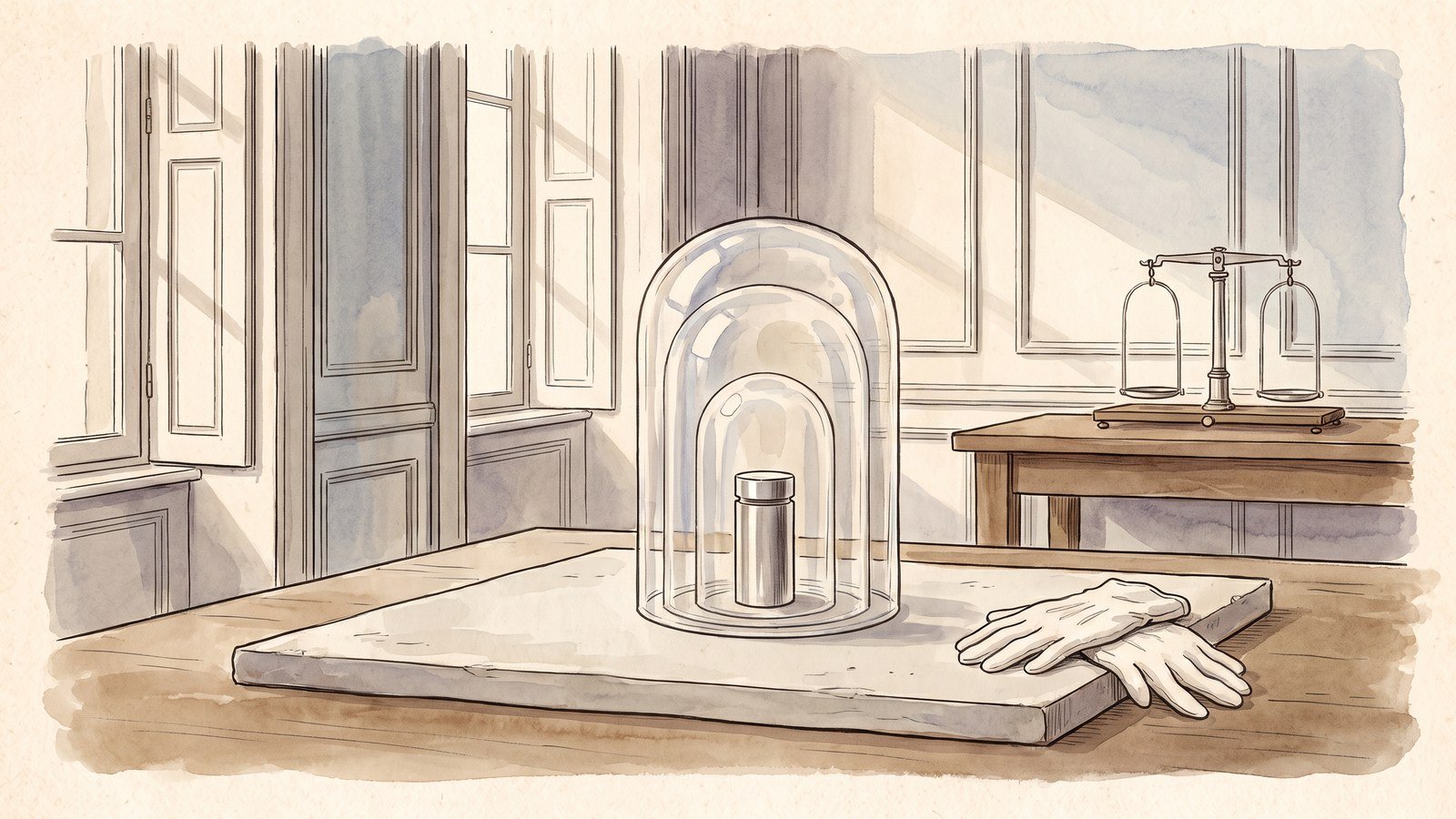
Three keys, each held by a different custodian, must be turned before the steel door of the vault at the BIPM’s Pavillon de Breteuil will open. Inside, in a basement store kept at a steady mild temperature, a small metal cylinder stands under three bell jars on a shelf in its own glass case. It is roughly the size of a golf ball, it weighs almost exactly one kilogram, and for a hundred and thirty years it was the reason anyone anywhere could say what a kilogram was. On 20 May 2019 that arrangement ended, and the cylinder went back to being an object.
The Object in the Vault
It is worth starting with how strange this is, because the strangeness was designed in. Every unit in the metric system had, for most of its working life, a definition that pointed somewhere other than a government building. The metre, from 1889 to 1960, was a platinum-iridium bar scribed with two lines, kept at the same institution under similar conditions. The second was a pendulum clock in a Paris observatory. The ampere was a column of mercury. Mass alone, however, did not begin with a physical object at all: the French Revolution set out to build units on the human body, the metre as a ten-millionth of a quadrant of the meridian, and the kilogramme as the weight of a litre of water at the melting point of ice. That litre, cast in platinum and preserved as the Kilogramme des Archives, was a reasonable eighteenth-century answer and a very fragile one, since it is a unit defined in terms of a substance, a volume and a temperature, all of which were themselves uncertain.
The Convention of 1875 replaced that arrangement with an institution. Seventeen states signed a treaty creating the Bureau International des Poids et Mesures and committing themselves to keep prototypes and to publish the results of comparisons. The metre convention is one of the oldest unbroken multilateral scientific agreements still in force, and its durability is precisely the point: the treaty did not define mass by a formula so much as by promising that a certain object would be looked after and compared on a schedule.
The object in question was designated Kilogram KIII, and metrologists call it the IPK, or Le Grand K, which is simply French for the Big K. German-language authors writing in English have sometimes called it the urkilogram, after the archaic German prefix denoting the original or primordial one. It is a right-circular cylinder of an alloy known as Pt-10Ir: ninety per cent platinum, ten per cent iridium by mass. The iridium is there for a reason. Platinum alone was too soft; adding iridium raises the hardness substantially while keeping the properties that made platinum acceptable in the first place, above all its resistance to oxidation and its stability in air. The cylinder is machined so that its height equals its diameter, at about thirty-nine millimetres. That proportion is not decorative. A cylinder of given mass has minimum surface area when height equals diameter, and surface area is exactly what you want to minimise, because surface is where the trouble comes from.
The prototype is one of three cylinders made in London in 1879 by the precious-metals firm Johnson Matthey. The records of which three were made, and in what state, are patchy, and it is generally dated to that 1879 order that the cylinder eventually chosen came into being. The first General Conference on Weights and Measures, meeting in 1889, sanctioned a set of forty prototype kilograms distributed among the signatory states and formally adopted KIII as the international prototype of the kilogram, the mass of which defined the unit for all member countries. It also superseded the Kilogramme des Archives. Six sister copies of the prototype were retained at the Bureau and are usually designated K1, K7, K8, K32, K43 and K47. It is worth being candid about how thin the paper trail is here: the Bureau’s own archive contains records of who held what and when, but the everyday custody history of the prototype, every hand that touched it and every surface it was exposed to, is not the kind of thing a metrology institute was ever structured to write down. The nickname Le Grand K is affectionate; it is not documentary.
The physical arrangement inside the vault is the other half of the definition. The cylinder rests under three bell jars, nested one inside the next, which slow the exchange of air and damp and keep skin and dust off the surface. Beyond that, the requirement is simply that nothing should disturb it: stable temperature, no direct sunlight, minimal handling. The three-key system is not mainly about secrecy. It is about making sure that any single accident, theft or clerical error cannot quietly become a change in the kilogram. This is the concept that runs through the whole system, traceability, which means being able to show by what unbroken chain of comparisons a local measurement connects back to the standard. A country wanting a trustworthy kilogram did not buy a good balance. It sent its own prototype kilogram to Sèvres, had it weighed against KIII under glass, and brought home a number. Every factory balance in that country was then calibrated against that number. The chain was long, expensive and slightly absurd, and it was also the most successful measurement traceability system ever constructed.
Two later sets of copies are worth knowing about because they say something about how thoroughly the Bureau feared for its own object. A set of stainless steel replicas was made, generally dated to 1989, for the purpose of checking whether the platinum-iridium prototype was stable without ever touching it: a replica handled and moved in ordinary conditions could be compared against a sister copy under glass, and the difference between two identical-looking cylinders handled differently would show whether handling itself shifted a mass. A further pair is usually attributed to the French Alternative Energies and Atomic Energy Commission. Neither set replaced the originals; both were insurance.
Fifty Micrograms
Then the copies started to disagree with the original.
A microgram is a millionth of a gram, so a hundredth of a kilogram is nothing: on a one-kilogram cylinder, fifty micrograms is a relative change of five parts in ten million, and it is smaller than the fingerprint left by touching it. The measurement problem was not that it was impossible to see. Comparison balances could resolve differences of a microgram or better, and in 2014 the pooled standard deviation of repeated weighings of the prototypes was reported as four-tenths of a microgram. The problem was that there was no explanation. The copies appeared to be getting heavier relative to the prototype at a rate of roughly fifty micrograms per century, and nobody could say why.
Why it mattered is easier to state than it is to feel. By 2018 the prototype underpinned the definitions of four of the seven SI base units: the kilogram itself, but also the mole, whose historical definition referred to the gram, the ampere, whose definition referred to the gram, the kilogram and the second, and the candela, defined through the watt and therefore through the kilogram. A few tens of micrograms of ambiguity in mass was therefore not confined to mass. It was a small, irrecoverable uncertainty sitting underneath the mole, the ampere and the candela. And beyond the laboratories it was a systematic error in every mass measurement on Earth, from the dose of a drug in a syringe to the trajectory correction of an interplanetary probe. Astronomy, which infers the mass of a galaxy from how fast its stars orbit, was working through that same chain. A standard does not have to be badly wrong to be a problem. It has to be wrong by more than you can tolerate downstream.
The obvious candidate explanation was chemistry on the surface. A platinum-iridium surface is noble, but noble is not inert. At the ordinary temperature and humidity of a basement store, the topmost layer of any solid surface accumulates a film of adsorbed water and hydrocarbons, held on by weak surface forces. Adsorption, to give the word its plain meaning, is the sticking of molecules from the air onto a surface, rather like the way dust settles. That film has mass. A layer only a molecule or two thick, spread over the several thousand square millimetres of surface area available on a thirty-nine millimetre cylinder, is exactly the right order of magnitude to account for tens of micrograms.
But this explanation created a puzzle inside the puzzle. The prototype and its six official copies were, to the precision anyone could measure, the same alloy, of the same density and hardness, cut to the same dimensions and kept under the same three-bell-jar arrangement in the same room. If the mechanism were a film building up from ordinary atmospheric exposure, they should all have grown together, and their difference from the prototype should have stayed constant. Instead the copies were pulling away. Something was distinguishing them. Something had happened to the prototype, or to the copies, or to the handling, and the difference between the two candidate explanations is exactly the argument that ran for decades without being settled.
The candidate explanations ran along fairly predictable lines and can be named. Contamination from the periodic cleaning and washing procedures themselves was one persistent suspicion: repeated solvent treatment may leave residue, or may drive off a film that had been accumulating slowly, and either could leave a prototype permanently lighter or heavier than it would otherwise have been. Losses through wear during handling was another. A growing mass was harder to explain than a shrinking one, because platinum and iridium do not rust and are not volatile, so a straightforward chemical gain had to be argued for rather than assumed. And there remained the possibility that the prototype had simply gained a stable contamination film early in its life, on top of the ordinary adsorbed layer, and that the copies never got it. The honest summary is that no single explanation was ever agreed. The campaign of 2014 was designed to test the theory by cleaning everything, and what it found was more interesting than a verdict.
The Night They Washed It
The Bureau had good reason to expect the best from 2014. It had been roughly twenty years since the third periodic verification of national prototypes, in which copies from member states are gathered and weighed against the international prototype. Nothing on the scale of the 2014 work had been attempted since the middle of the previous century. The kilograms had been renounced as a basis for the unit, and the Bureau was planning an extraordinary calibration campaign, in which every working standard held at the BIPM would be tied to the prototype while it still worked, so that the changeover in 2019 would be seamless for laboratories that had calibrated against the old scale and would have to calibrate against the new one.
The procedure for realising the kilogram of the day was explicit, and it began with soap and water. The IPK and its six official copies were cleaned and washed following the Bureau’s standard method, and then weighed. The results were reported in the first paper of the campaign in Metrologia, and they were strange in two directions at once.
The first strange thing was how much mass came off. Cleaning and washing the IPK removed 16.8 micrograms from it. The six official copies lost a very similar amount, averaging fifteen micrograms with a scatter of two. Seventeen micrograms off a cylinder is a layer of contamination and adsorbed material about as thin as a fingerprint. It is also, crucially, a one-off correction. That surface film had been put on over decades of handling and storage, and washing it away in a single afternoon meant that a population of cylinders which had apparently been drifting for a century had just been reset to something closer to its state on the day it was machined. The Bureau’s own working kilograms, which were never cleaned, came out of the campaign measurably lighter than they had been at the previous verification, as they should have if the old scale had been drifting along with everything else.
The second strange thing was the good news buried inside it. The differences in mass between the prototype and its official copies had changed by only about one microgram on average since the third periodic verification of 1989 to 1992. In other words, after a century in which the copies had appeared to be diverging from the prototype by tens of micrograms, the last measured comparison showed essentially no divergence at all. The paper was careful about what this meant. It did not confirm the trend for the masses of the six official copies to diverge from the mass of the prototype that had been observed during the second and third periodic verifications. Not confirming a trend is not the same as refuting it, and the sample was seven cylinders on one occasion. But the obvious reading was that whatever had been producing the apparent drift was not something that continued indefinitely.
And then the number that settled the argument. Every working standard and every reserved prototype held at the Bureau was calibrated against the IPK during the campaign, and all of them came out with lower masses than at the previous verification. That could be taken to mean the standards themselves had drifted. It was not necessary to conclude that. A follow-up paper, examining every internal comparison the Bureau had made between 1992 and 2014 and modelling how the offset had grown, showed that the offset lay in the institutional scale itself: the BIPM’s as-maintained mass unit in 2014 was found to be offset by thirty-five micrograms with respect to the mass of the prototype. Corrections had to be applied retrospectively to every one-kilogram calibration certificate the Bureau had issued over that period. An institution’s idea of a kilogram had drifted by thirty-five millionths of a gram, and the difference had been sitting quietly inside the paperwork.
That was the last time the IPK did any work. It was, in the end, never the culprit; it did not lose mass, it did not gain it, it simply stood there. But the campaign made it impossible to pretend otherwise, because it showed that the drift was a property of copies and handling and institutional scale rather than of a uniquely unstable object, and because it consumed the prototype’s remaining usefulness. After 2014 the IPK was no longer used to calibrate against, and the practice of comparing national kilograms to it was quietly abandoned in preparation for a system that no longer needed it.
Two Ways to Weigh Nothing
What replaced it was not one idea but two, built by different communities, using different physics, and for many years not agreeing with each other.
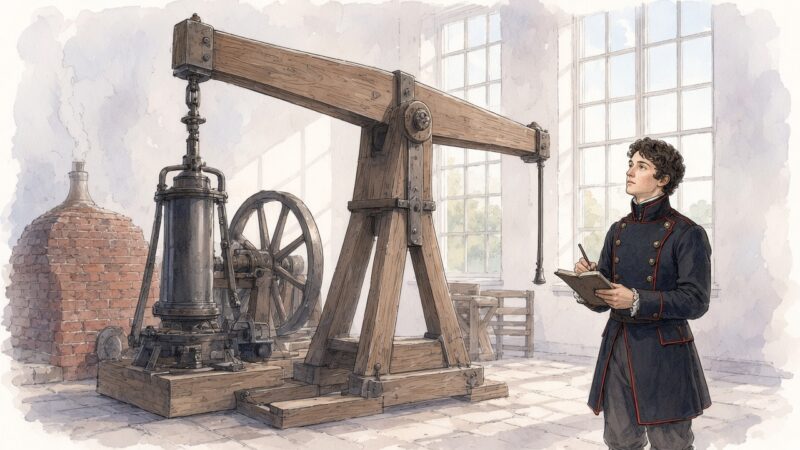
The first is the Kibble balance, called a watt balance for most of its life and renamed in 2016, two months after the death of Bryan Kibble of the UK’s National Physical Laboratory, by the Consultative Committee for Units. Kibble proposed the principle in 1975, and the first moving-coil instrument, the Mark I, was built at NPL in 1978 and ran until 1988. A second, circular-coil design, the Mark II, followed in 1990 and worked in vacuum; that is the machine that made the programme viable. The Kibble balance is an heir to the ampere balance, but it runs backwards. An ampere balance measures the force between current-carrying coils to find out how much current is flowing. A Kibble balance sets the current with great precision and then uses the resulting electromagnetic force to hold a test mass in balance against gravity. The mass falls out of the electrical quantities.
It works because a wire carrying current in a magnetic field experiences a force, and the size of that force depends on the strength of the field and on the length of the wire. The classical difficulty is that nobody can measure the field and the length directly with anything like enough accuracy, because the coil geometry is a nightmare of tolerances. Kibble’s trick was to make the coil measure its own strength. Drive the current through the coil in a stationary magnetic field and let the force balance the weight of the mass. Then stop driving it, and move the coil through the same field at a known speed. A conductor moving through a magnetic field generates a voltage across its ends, and that voltage is the product of the field and the length and the speed, which gives a second measurement of the same product from a completely different physical effect. Subtract the geometry out of the two equations and it disappears, and what is left is the product of a voltage, a current and a speed against a weight and a gravity. Both sides of the resulting expression have the dimensions of power, which is where the name watt balance came from.
The voltage and current are not read off in the obvious way. They are generated from quantum effects that are reproducible anywhere, and this is where the language gets dense enough to be worth slowing down for. A Josephson junction is a weak link between two superconductors with a thin insulator between them; when you apply a voltage across it, a current flows whose frequency is related to that voltage by an exact relation involving two integers and the Planck constant, so putting a frequency on it is like putting a ruler against a voltage and reading off the length in terms of the constant. The quantum Hall effect is the other one: in a very thin layer of electrons at low temperature and under a strong magnetic field, the electrical resistance takes on values that are exact rational multiples of a standard resistance, because the electrons are being forced into discrete states and the counting is integer by nature. Together they supply voltage and resistance standards, so that electrical measurement in a laboratory anywhere on Earth rests on the same constants. The Kibble balance also needs the local pull of gravity, measured separately by a dropping-mass gravimeter that uses a laser interferometer, and it is run in vacuum so that air buoyancy does not contaminate the force.
The programme ran for decades. NPL’s balance was reported at a combined standard uncertainty of some seventy micrograms in 2007 and was then shipped to the National Research Council of Canada in 2009, where the two laboratories continued on it; the NRC published a value for the Planck constant with a relative uncertainty of one-point-eight parts in ten to the eight in 2014 and then one with an uncertainty of nine-point-one parts per billion in 2017, the best of its time. NIST’s own instrument went into full operation in the early months of 2015 and produced a measurement within thirteen parts per billion in 2017. Others were built at METAS in Berne, at the Bureau itself, and at the French laboratory at Trappes. By the end, the Kibble balance family had carried the uncertainty of the Planck constant down to the low tens of parts per billion, from a hundred or more when the campaign began.
The second route was stranger. The International Avogadro Coordination, later the International Avogadro Project, began in the early 1990s with an idea that was almost embarrassingly classical: define a kilogram by counting atoms. If you could make a sphere of perfectly uniform, perfectly pure material, measure its diameter and its mass, and know the spacing of the atoms in its crystal lattice, you could count the atoms in it. Count the atoms in a kilogram and you have defined a kilogram. The Avogadro constant is the number that relates the mass of a sample to the number of particles in it, and under the pre-2019 definition of the mole it could be determined from the mass of a sample, which is why the approach was circular. Fix the Avogadro constant, and you can work backwards from a well-known atom count to a mass.
The material they settled on was silicon-28, the commonest stable isotope of silicon, purified so that it makes up 99.9995 per cent of the sample. The enrichment route, as generally described, took silicon fluoride gas through successive stages of centrifugation and then into a research reactor, where neutron capture on the heavier isotopes turns them into silicon-28 by radioactive decay. From that feedstock they grew single crystals and had them machined by a specialist optical lens maker into spheres about ninety-four millimetres across and one kilogram in mass. They are extremely round. If one were blown up to the size of the Earth, the distance between the highest mountain and the deepest ocean trench would be only three to five metres. The purity and the roundness are both doing essential work: the purity removes the need to guess what fraction of the atoms are the heavy kind, and the roundness means the diameter can be measured and the volume computed to a few nanometres of uncertainty. Interferometry supplied the diameter, X-ray crystallography supplied the lattice spacing, and the mass came from a balance tied back to the Bureau’s working standards. Each sphere cost something in the region of three and a quarter million dollars and took years. The combined value of the Avogadro constant from several laboratories came in with an uncertainty of around ten parts per billion, using teams at PTB in Germany, NMIJ in Japan, NIM in China, METAS in Switzerland, NIST, INRiM in Italy, the Bureau, and IRMM in Belgium. A silicon-28 atom weighs about 27.977 atomic mass units, which puts the number of atoms in a one-kilogram sphere of the order of two followed by twenty-five zeros, and the exact integer count for a specific sphere is a finer thing to look up than I was able to confirm from the sources I checked.
What made the sphere route so valuable was that it was not merely a second number. It was an independent physical argument that the Kibble balance could be wrong about. If the two methods could be brought into agreement, the possibility that they shared a hidden systematic error collapsed, and that mattered more than the accuracy of either.
They disagreed for years. A formal comparison of the Kibble balance against the silicon sphere, and between the Kibble balance, the Avogadro project and the IPK, had been recognised in 2013 as a condition for the whole redefinition proceeding at all, and a dedicated international project was launched in 2012 with the specific aim of reducing a relative disagreement of about seventeen parts in a hundred million down to within two parts in a hundred million. It took until 2017. In October of that year, at the hundred-and-sixth meeting of the International Committee for Weights and Measures, the formal recommendation went up to the General Conference; and the same month the CODATA task group on fundamental constants published the values it had constructed from both methods, in a paper led by David Newell. The Planck constant came out fifteen parts per billion lower than the value the same body had published in 2014, which is a small number and was, in context, the whole thing. When two completely different instruments built on different physics, in different countries, using different laboratory traditions, are made to arrive at the same number to within a few parts in a billion, you have learned something that a more precise instrument alone could not have taught you.
The Vote at Versailles
The 26th General Conference on Weights and Measures met at Versailles in the second half of November 2018. On 16 November the delegates voted, unanimously, to adopt the revised International System of Units. The new definitions were to take effect on 20 May 2019, which was already World Metrology Day, and which was chosen as much for its symbolic value as its convenience.
Four units changed together, which is the detail that tells you the redefinition was structural rather than cosmetic. The kilogram became defined by fixing the value of the Planck constant. The ampere became defined by fixing the elementary charge. The kelvin became defined by fixing the Boltzmann constant. The mole became defined by fixing the Avogadro constant at exactly 6.02214076 times ten to the twenty-three reciprocal moles. And because the candela had always been tied to the watt, it moved too, though it moved by arithmetic rather than by new physics: its defining constant was fixed at 683 lumens per watt, with the watt now following from the new kilogram, metre and second. All four were waiting on the same experiments, and all four were fixed on the same day, so that no unit would depend on a definition that had itself changed.
The Planck constant adopted was fixed at exactly 6.62607015 × 10⁻³⁴ joule seconds. That is the number the redefinition was built on, and it is worth pausing on what it is: a number with no uncertainty attached to it at all, nine digits and every one of them certain, where the best measurements before it had carried uncertainties in the last digit or two.
What happened to the cylinder is written into the resolution in a way that is quietly devastating. The text states that the mass of the international prototype of the kilogram, m(K), is equal to one kilogram within a relative standard uncertainty equal to that of the recommended value of the Planck constant at the time the resolution was adopted, namely 1.0 × 10⁻⁸, and that in future its value will be determined experimentally. It is a formulation that admits the whole history in a single subordinate clause. For a hundred and thirty years, the kilogram was the mass of that object, exactly and by definition. From 20 May 2019, the object is a thing whose mass must be measured, with an uncertainty, against the true kilogram. The prototype was not consulted. The practice of defining units in terms of international prototypes of mass was renounced in the same breath.
Most people would not notice, and that was the point. The new kilogram agreed with the old one to within about ten parts per billion, so a scale in a supermarket did not change, a dose of medicine did not change, and a bridge did not change. But the numbers did shift, very slightly, in the laboratories that needed them to, because a fixed constant and a measured quantity are not interchangeable even when they agree at ten significant figures. The volt moved by about a hundred parts per billion. Mass standards at every national institute had to be recalibrated. The post-redefinition kilogram is a different object, and the difference is invisible precisely because it was designed to be, and because the world had a hundred and thirty years of practice to know how to be small.
What a Standard is For
There is a genuine difficulty in the new definition, and it is not a presentational one. The old definition was, in its way, honest about what it was doing: the kilogram was the mass of this cylinder, and you could point at it. The new definition appears to say something much thinner. The kilogram is defined by taking the fixed numerical value of the Planck constant to be 6.62607015 × 10⁻³⁴ when expressed in the unit joule second. Take this number. That is the instruction. On its own, it does not say what the number is for. A fixed value is not a definition; it is a decision. The definition has to say that the number is to be used to realise mass, through an apparatus, and that apparatus has to be specified, because otherwise the phrase “fixed numerical value” is just a constant with nothing attached to it.
This is why the new SI adopted the strange, careful language it did. The resolution itself states that the SI is realised through a system of units in which the magnitude of all units of measurement is defined in terms of nine fixed constants, and the definitions of each unit specify which constant, in which combination, and to be used to realise which quantity. The definition of mass is parasitic on the metre and the second, which are themselves defined in terms of the speed of light and a caesium frequency; it is a formula written in terms of three other things, on the understanding that those other things will not move. And the old technical machinery for the practical part, the mise en pratique that told laboratories how to go about realising the unit in fact, was retained, then quietly deprecated, because a world can change its mind about how to realise a unit without changing the unit itself. That gap between a definition and its realisation is where the working life of every standard actually happens, and the new arrangement makes the gap visible instead of hiding it behind an object.
Which brings the cylinder back into focus as the thing it always was. It was never really a scientific object. It was a promise made physical: that the kilogram in Paris and the kilogram in a factory in another country were the same kilogram, and that the promise would be checked on a schedule, in public, by people whose only job was to check it. The fifty micrograms were not a scandal. They were the system working, reporting honestly on a drift it could see but not explain, for eighty years, with the discipline to keep reporting it. The cleaning campaign was the system working again, resetting a century of surface chemistry in an afternoon and admitting thirty-five micrograms of its own institutional error in the certificates.
What replaced it is a different kind of promise, and the kind that fits. Nobody has to guard a vault any more, because there is nothing in it that could be lost, damaged or improved. What has to be trusted instead is a number, and an argument that the number is right, and a global apparatus for making that argument continuously. That is more fragile in one obvious way and stronger in every other. The old kilogram could be compared to itself; the new one has to be defended, every day, against the possibility that the experiments all share an error we cannot see. And the discipline of defending it is precisely what the last forty years of Kibble balances and silicon spheres amounted to: two incompatible ways of measuring mass, built to disagree, made to agree.
So the question left over from the whole episode is not whether the cylinder was good enough. It was an extraordinary piece of engineering, cut to a proportion that minimised the one thing that would damage it, made of an alloy chosen for its refusal to react with air. The question is what a standard is for. If it is a thing, then it should be guarded, and it should not be touched, and the fact that touching it was the only way to learn what it was doing is a design flaw. If it is an agreement to measure, then it should be indefensible to the touch and defensible only by argument, and the fact that the new kilogram is a number that any laboratory can attack with its own experiment is a feature. The cylinder went back to being an object in May 2019. The kilogram did not stop being a standard for a single day.
References
- International Prototype of the Kilogram - Wikipedia contributors, Wikipedia, The Free Encyclopedia, retrieved October 2026
- Timeline of International Kilogram Prototypes - Wikipedia contributors, Wikipedia, The Free Encyclopedia, retrieved October 2026
- Kibble balance - Wikipedia contributors, Wikipedia, The Free Encyclopedia, retrieved October 2026
- 2019 revision of the SI - Wikipedia contributors, Wikipedia, The Free Encyclopedia, retrieved October 2026
- 2019 redefinition of the SI base units - Wikipedia contributors, Wikipedia, The Free Encyclopedia, retrieved October 2026
- Avogadro constant - Wikipedia contributors, Wikipedia, The Free Encyclopedia, retrieved October 2026
- Resolution 1 (2018) on the revision of the International System of Units - Bureau International des Poids et Mesures, BIPM, 16 November 2018
- Calibration campaign against the international prototype of the kilogram in anticipation of the redefinition of the kilogram, part I: comparison of the international prototype with its official copies - M. Stock, P. Barat, R. Davis, A. Picard and M. Milton, Metrologia, 2015
- Calibration campaign against the international prototype of the kilogram in anticipation of the redefinition of the kilogram, part II: evolution of the BIPM as-maintained mass unit from the 3rd periodic verification to 2014 - E. de Mirandés, P. Barat, M. Stock and M. Milton, Metrologia, 2016
- The CODATA 2017 values of h, e, k and NA for the revision of the SI - D. B. Newell, F. Cabiati, J. Fischer and others, Metrologia, accepted 20 October 2017
- Kilogram: The Present - National Institute of Standards and Technology, NIST, retrieved October 2026
- Kilogram: Silicon Spheres and the International Avogadro Project - National Institute of Standards and Technology, NIST, 14 May 2018, updated 13 August 2025
- Bringing the World Closer to Revised Measurement System, Scientists Update Four Key Fundamental Constants - National Institute of Standards and Technology, NIST, 23 October 2017, updated 3 February 2025